Generative Engine Optimization (GEO) for Dentists: A Complete Beginner's Guide
Generative Engine Optimization (GEO) is the work of getting your practice named when a patient asks an AI engine to recommend a dentist. ChatGPT, Gemini, Perplexity and Google's AI Overviews no longer hand back ten links; they write an answer and name one or two practices inside it. GEO is everything that makes the named practice yours: pages a machine can read, services and location stated plainly, the same facts everywhere the engine looks, and genuine recent reviews and independent listings that confirm you. Clarity and corroboration decide it, not budget or size.
Generative Engine Optimization (GEO) is the work of making your dental practice the one an AI engine names when a patient asks it for a dentist. When someone types "best dentist near me for nervous patients" into ChatGPT, Google's AI Overviews, Gemini or Perplexity, the engine does not return ten blue links: it writes an answer and names one or two practices inside it.
GEO is everything you do so that the named practice is yours. It matters now because this is already how a large share of patients begin their search: 60% of US adults, and 74% of those under 30, use AI to find information at least some of the time[1]. If your practice is not in the answer, the patient often never reaches the list where your old Google ranking lives.
This is a complete beginner's guide, written for UK practice owners and managers who have heard the term and want a clear map of what to actually do. Every section is a real question a practice owner asks, answered straight away and in full, so you can read the one that applies to you and act on it.
It stays inside the General Dental Council's rules on what a practice may claim at every step, because the moves that win an AI recommendation are the same ones that keep you compliant: accurate facts, genuine reviews, clear pages, transparent pricing. By the end you will know what GEO is, how it differs from the acronyms it gets confused with, how the engines build an answer, the exact beginner steps in priority order, and how to check whether any of it is working.
The short version
- Recommendation, not a ranking. An engine names one or two practices inside its answer; GEO is the work of being that named practice, so a tidy single-site clinic can be picked ahead of a large group.
- Findable and readable first. If an engine cannot retrieve and read your pages, nothing else on the list counts.
- Say plainly what you do and where. Specific service and location pages, in patient language, answer the specific questions patients ask.
- One set of facts everywhere. Matching name, address, phone and hours across your site, Google profile, NHS listing and directories settles most close calls.
- Recent reviews and independent listings. Fresh, genuine reviews and outside sources that corroborate you are what move an engine to name you.
What is GEO (Generative Engine Optimization), in plain English?
GEO is optimising your practice's whole online presence so that AI engines understand what you do, trust that you do it well, and name or cite you when they answer a patient's question. Traditional search hands a patient a list and lets them choose; a generative engine makes a shortlist for them and presents it as the answer. GEO is the practice of getting onto that shortlist.
Picture the moment it happens. A patient asks ChatGPT, "I've cracked a tooth, who can see me today in Reading?" The engine does not show a map. It replies in sentences and names a practice or two, sometimes with a line about why. If that is your practice, the patient is most of the way to booking before they have visited a single website. If it is not, you never learn the question was asked, because as far as your diary is concerned that patient was never looking. GEO is the difference between being the named answer and being invisible to a conversation you cannot see.
The reason GEO is now its own job, rather than a corner of SEO, is that the engines assemble their answer from many sources and then judge which practice they can describe with the most confidence. Your website is one voice. Your Google Business Profile, your reviews across several platforms, healthcare and local directories, the NHS "find a dentist" service and local press are the others. GEO is the work of making all of those agree, and making each one say, in terms a machine cannot misread, exactly what you offer and where.
What is the difference between GEO, AEO, SEO and AI search optimisation?
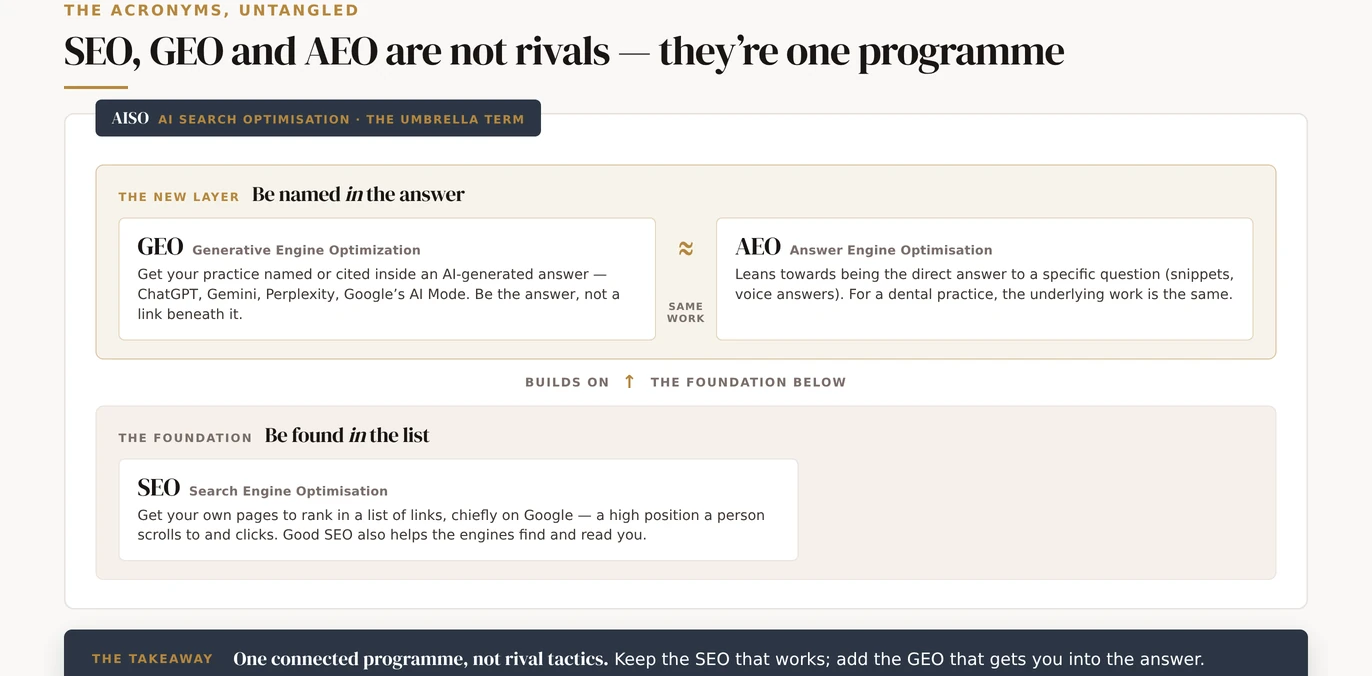
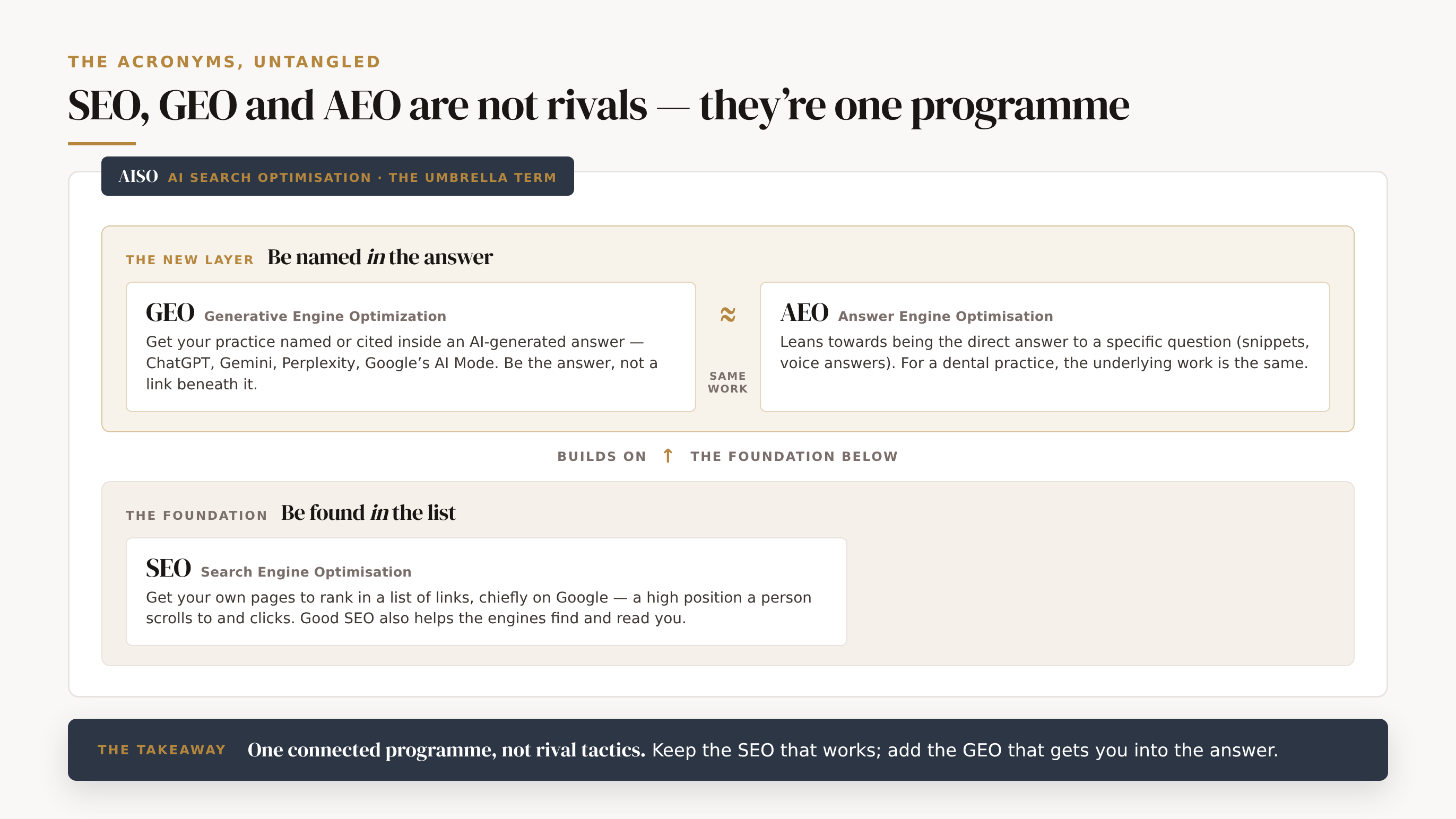
The acronyms are the single biggest source of beginner confusion, so here they are in plain terms. They overlap heavily in practice, and you do not need to agonise over which label a given task wears: the underlying work is closely related.
- SEO (Search Engine Optimisation): getting your own pages to rank in a list of links, chiefly on Google. The goal is a high position a person scrolls to and clicks.
- GEO (Generative Engine Optimization): getting your practice named or cited inside an AI-generated answer from engines like ChatGPT, Gemini, Perplexity and Google's AI Mode. The goal is to be the answer, not a link beneath it.
- AEO (Answer Engine Optimisation): often used interchangeably with GEO. Where people draw a line, AEO leans towards being the direct answer to a specific question (including featured snippets and voice answers), while GEO leans towards being represented well inside longer AI-generated text. For a dental practice the work is the same: clear, factual, well-structured content the engine can lift.
- AI search optimisation (sometimes AISO): a broad umbrella term for all of the above, covering visibility across every AI-mediated way a patient now finds a provider.
The takeaway is that you are not choosing between these. Good SEO still helps a patient who uses Google directly, and it also helps the engines find and read you. GEO and AEO build on that foundation so that you are named when the engine answers for the patient instead of handing them a list. Treat them as one connected programme of being findable, legible and trusted, not as rival tactics competing for your budget.
Why does GEO matter for a dental practice right now?
Because a large and growing share of patients now begin with an AI answer rather than a list of links, and many of them act on that answer without scrolling further. Three findings, each checked at its primary source, set out the stakes plainly.
Why GEO matters now
Patients are already using the engines
60%
of Americans, and 74% of those under 30, use AI to find information at least some of the time.
One-third
of patients trust AI-generated search results as much as traditional search engines like Google.
58%
of respondents ran at least one Google search in March 2025 that produced an AI summary.
10%+
more usage of Google for the query types that show AI Overviews, by Google's own account.
AP, reporting AP-NORC 2025; rater8 Next Evolution of Patient Choice 2025; Pew Research Center, 22 July 2025; Google (The Keyword), 20 May 2025.
First, the behaviour is mainstream, not fringe. An Associated Press-NORC Center for Public Affairs Research poll in 2025 found that 60% of Americans overall, and 74% of those under 30, use AI to find information at least some of the time[1]. Searching for information was the single most common way people used AI in that poll. "Find me a dentist near me taking on patients" is exactly that kind of local, practical question, and the under-30 figure matters for any practice that wants to keep attracting younger families and professionals.
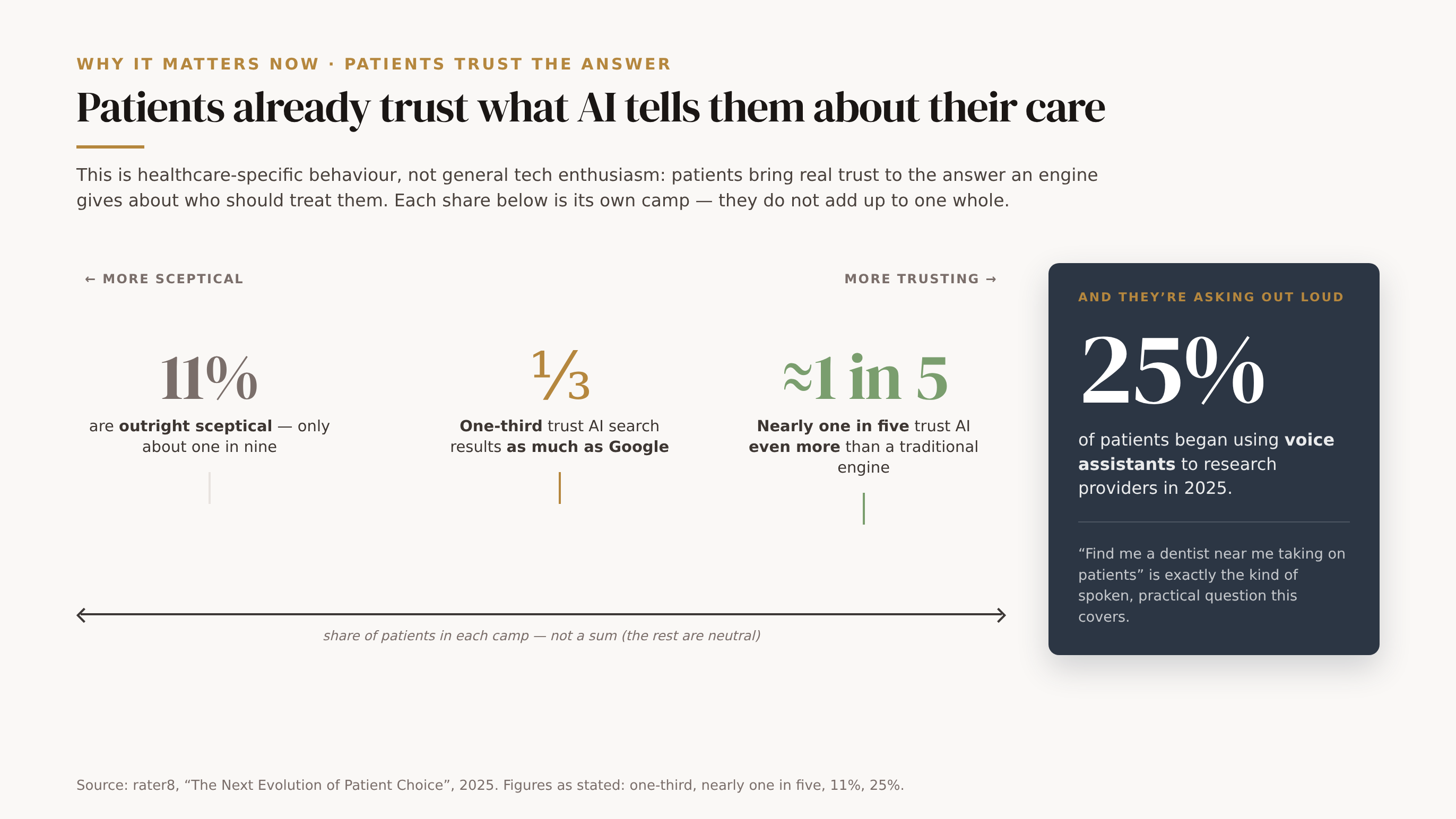
Second, patients increasingly trust what the AI tells them. A 2025 report from the healthcare reputation firm rater8 found that one-third of patients trust AI-generated search results as much as a traditional search engine like Google, nearly one in five trust AI even more, and only 11% are outright sceptical; it also found that 25% of patients began using voice assistants to research providers in 2025[2]. That is healthcare-specific behaviour, not general technology enthusiasm: patients are bringing real trust to the answer an engine gives them about who should treat them.
Third, when the AI answers, the click often disappears. A Pew Research Center analysis of the browsing data of US adults found that 58% ran at least one Google search in March 2025 that produced an AI-generated summary, and that when a summary appeared, users clicked a traditional search result in just 8% of visits, against 15% when no summary was shown[3]. For a "dentist near me" search that AI summary sits above the map pack the patient used to scroll. If you are not inside the summary, far fewer people travel past it to find you.
Put those three together and the case for GEO is measured, not breathless. More patients start with AI, they trust its answer, and they click away from it less. A practice named in the answer collects bookings its competitors never see; a practice that is absent loses them with no missed-call log to explain the quiet. Acting now, while many local practices have not, is the closest thing to an early-mover advantage that local dentistry offers at the moment.
How is GEO different from SEO, and do I still need SEO?
GEO and SEO are different jobs with different goals, and the short answer is that you need both because they stack rather than compete. SEO works to get you found and ranked in a list; GEO works to get you chosen and cited inside an answer. One does not replace the other, and neither one on its own covers how patients now search.
Side by side
Traditional SEO versus GEO
| What it weighs | Traditional SEO | GEO (Generative Engine Optimization) |
|---|---|---|
| What it optimises for | A position in a list of links. | A mention or citation inside an AI-generated answer. |
| Where it mostly happens | Google search results. | ChatGPT, Gemini, Perplexity, Google AI Mode and AI Overviews. |
| What the patient does | Scrolls results and clicks a link. | Reads the answer and acts on the names in it. |
| What it leans on | Your pages, keywords, links, technical health. | Your pages plus reviews, directories, NHS listing and consistent facts across the web. |
| The winning outcome | You rank highly. | You are named as the answer. |
| How success looks | Higher ranking, more clicks. | Your practice cited when patients ask the engines. |
Drawn from the article's side-by-side of traditional SEO and GEO.
The cleanest way to hold the distinction is to compare them side by side.
Read across the table and the relationship is clear: GEO is built on the same foundations SEO cares about (a readable, indexed website with clear pages), then adds the wider trust signals that decide which practice an engine is confident enough to name. A practice with strong SEO and no GEO can rank first on Google and still go unnamed by ChatGPT. A practice with tidy, consistent information across the web can be named by the engines even where its Google ranking is modest. You want to be the practice that does both, because patients are split across both ways of searching and will be for years.
If you want the deeper comparison, our companion pieces on traditional dental SEO versus generative AI optimisation and organic SEO versus AI optimisation for dental practices take this apart in full. For a beginner, the rule to carry away is simple: keep doing the SEO that works, and add the GEO that gets you into the answer.
How do generative engines actually build an answer about a dentist?
They break your question into many smaller ones, search the live web for each, read what they find, check whether the sources agree, and then write an answer that names the practices they are most confident about. Understanding that sequence is what makes the steps later in this guide make sense, because each step is aimed at a specific stage of it.
Inside the answer
How an engine builds an answer about a dentist
Fan out the question
"Best dentist in Bristol for a nervous patient" becomes separate searches for practices, sedation, reviews, NHS or private and hours.
Search and read
It reads what it finds across your website, listings, reviews and NHS entry, preferring sources it can read cleanly and quote.
Check agreement
It leans towards practices several independent sources agree about, which is why one website praising itself is the weakest signal.
Name the practice
It writes an answer naming the practices it is most confident about: the more sub-questions you answer plainly, the more often your name survives.
Start with how the question is handled. A single patient query is not one search. Google describes its own AI Mode as using a "query fan-out technique, breaking down your question into subtopics and issuing a multitude of queries simultaneously on your behalf"[4]. So "best dentist in Bristol for a nervous patient" quietly becomes separate searches for local practices, for anxiety and sedation options, for recent reviews, for NHS versus private availability, for opening hours.
The engine then stitches the answers back together. Google has said these AI features are popular enough to drive over 10% more usage for the kinds of queries that show them[4], so the behaviour is growing. Our explainer on query fan-out walks through the mechanic in more detail.
The practical consequence of fan-out is that no single clever page or phrase wins the answer. You are trying to be the clear, consistent response to the whole cluster of things a patient wants settled about dental care in your area. The more of those sub-questions an engine finds plainly answered across your presence (your services, your location, your fees, your reviews, your availability), the more of the fanned-out searches you turn up in, and the more often your name survives into the final reply.
Two more traits of these engines shape the work. They prefer sources they can read cleanly and quote without ambiguity, which is why machine-readable structure and plain factual writing matter so much: if your words load only when a browser runs the page's JavaScript, a crawler can miss them entirely. And they lean towards practices that several independent sources agree about, which is why one website praising itself is the weakest possible signal and why directory, NHS and review consistency carry real weight. Keep that picture in mind (fan-out, clean reading, corroboration) and every step below reads as a way of giving the engine what it needs at each stage.
What does a dentist actually do to start with GEO? A beginner's step-by-step
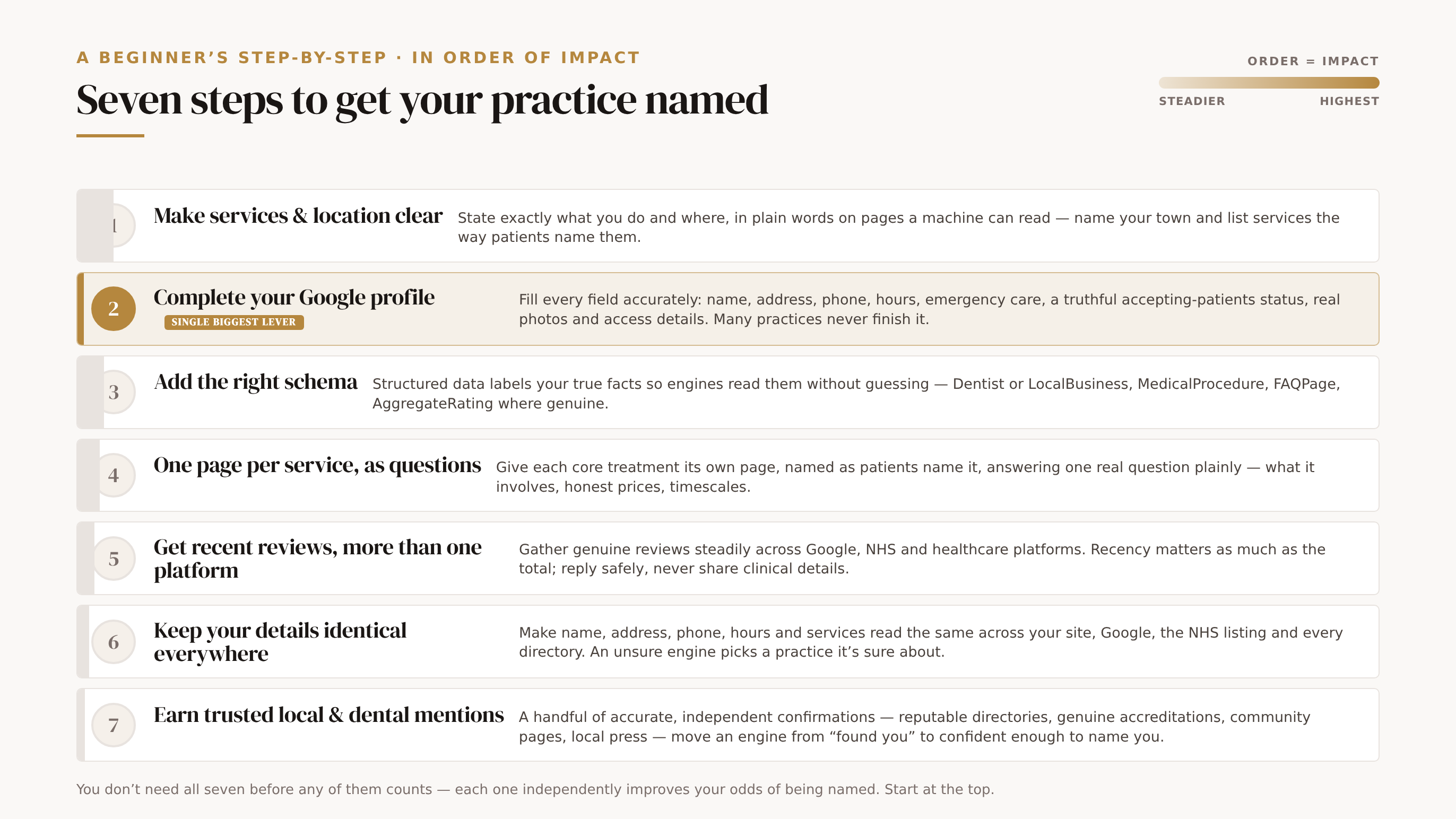
You make your practice unmistakably clear, consistently described, well-reviewed and machine-readable across the handful of sources the engines actually read, in the order that pays off fastest. None of it is glamorous and all of it is verifiable. Here is the sequence a beginner can follow without an agency, with the reasoning for each so you know why it earns its place.
Beginner's step-by-step
What a dentist actually does to start with GEO
Make services and location unmistakably clearName your town and list core services the way patients name them, in plain page text a machine can read.
Complete and tighten your Google Business ProfileThe single biggest lever: exact name, address, phone, hours, services, accepting-patients status, photos and access details.
Keep your facts consistent across the webYour website, NHS listing and directories should tell the same story, because engines lean on sources that agree.
Gather genuine, recent reviewsIndependent corroboration is one of the signals an engine trusts most when deciding who to name.
Add machine-readable structurePlain factual writing and schema so a crawler reads your words without a browser running JavaScript first.
1. Make your services and location unmistakably clear
State exactly what you do and exactly where you do it, in plain words, on pages a machine can read. The engines name practices they can describe with confidence, and confidence starts with clarity. A homepage that says "quality dental care for all the family" tells an engine almost nothing; a page that says "NHS and private dentistry in Reading, including emergency appointments, Invisalign, dental implants and children's check-ups" gives it the specific facts it needs to match you to a specific question.
Name your town and the areas you serve in your page text, not only in an image or a logo. List your core services the way patients name them, each in plain language. This single habit of being specific and literal does more for a beginner than any technical trick, because fan-out searches are specific and only specific content answers them.
2. Complete and tighten your Google Business Profile
Claim your Google Business Profile and fill in every field accurately, because it is one of the most heavily weighted sources an engine reads for a local practice. Exact practice name, address and phone number; full opening hours and how emergency care works; every service you genuinely offer in plain words; a current, truthful "accepting new patients" status; real photographs; and accessibility details such as step-free access, parking and wheelchair access.
This is the single biggest lever for most practices, and many never fully pull it. An incomplete or out-of-date profile is the most common reason a perfectly good practice is passed over: the engine reaches for a competitor it can describe completely instead of one it can only describe in part. Keep the profile current the same day any detail changes.
3. Add the right schema so a machine can read your facts
Add structured data (schema markup) so the engines can read your facts without guessing. Schema is the machine-readable label that states, in terms a system cannot misread, that you are a dental practice, where you are, what you offer, your hours and how patients rate you. It does not make a claim for you; it makes your true facts legible.
For a dental practice the relevant types are Dentist or LocalBusiness for the practice itself, MedicalProcedure for individual treatments, FAQPage for your common patient questions, and AggregateRating where you display genuine review scores. If editing your site's code is beyond you, this is a reasonable thing to ask a web developer to set up once; it is a small job with a lasting benefit. Our dental practice schema markup guide walks through it step by step.
4. Build one focused page per core service, written as patient questions
Give each core treatment its own page, named the way patients name it and written to answer the real questions they ask. Engines quote pages that answer a specific question and ignore a single catch-all "Treatments" page that answers none. A patient does not ask "tell me about your practice": they ask "how much is Invisalign in Leeds?" or "what happens at an emergency dental appointment?"
Write each page to settle one of those questions plainly: what the treatment involves, clear price ranges, typical timescales, and the named clinicians who provide it where appropriate. Phrase a few headings as the exact questions patients type. This is the content that survives fan-out, because each page is a clean answer to one of the sub-questions the engine is running.
5. Get recent, specific reviews across more than one platform
Gather genuine, recent reviews steadily and on more than one platform, because reviews are among the strongest trust signals an engine has and recency matters as much as the total. A wall of five-star reviews that stops eighteen months ago reads, to an engine and a patient alike, as a practice that may have gone quiet.
Ask satisfied patients at the right moment (after a completed course of treatment, not mid-appointment), make leaving a review a single tap, and spread them across the places both patients and engines check: Google first, then NHS profiles and healthcare-specific platforms. Reply to all of them, good and bad, but never put a patient's clinical details in a public reply: thank them, answer the general point, and take specifics offline. The line you must not cross is buying, incentivising or editing reviews to mislead, which is both a fitness-to-practise problem and unlawful in the UK.
6. Keep your name, address and phone identical everywhere
Make your practice name, address, phone number, opening hours and service list read identically across your website, Google profile, NHS "find a dentist" listing and every directory. When these conflict, the engine cannot tell which version is true, and an unsure engine reaches for a practice it is sure about instead. Two slightly different phone numbers or a set of old opening hours lingering on one directory are enough to tip a close decision against you.
This is the most boring task in the guide and one of the most decisive. Make a list of every place your details appear, then bring them all into exact agreement, including the NHS website profile and any professional listings. One version of your facts, everywhere, removes the doubt that quietly costs you mentions.
7. Earn trusted local and dental mentions
Earn mentions from independent, reputable local and dental sources, because corroboration is what moves an engine from "found you" to "confident enough to name you". The more trustworthy places that confirm your practice exists, where it is and what it does, the more readily an engine will put your name in front of a patient.
For a UK practice the sources that carry weight are reputable healthcare and local directories, genuine professional or accreditation listings you hold, community pages, and local press. You do not need dozens; you need a handful of accurate, independent confirmations that agree with everything else you publish. Each one is another direction from which the engine can verify you.
You do not need to finish all seven steps before any of them counts. Each one independently improves your odds of being named, and the order above puts the cheapest, highest-impact work first. Start at the top and you will see the foundations pay off before you reach the longer-term tasks.
Get your free AI visibility check →
How do I check whether GEO is working?
You ask the engines the questions a real patient asks and watch whether your practice is named, then repeat it over time to see the pattern. You do not need a paid tool to find your leak: you need about fifteen minutes and a clear eye on the results.
Work through this self-test. Open ChatGPT, Google's AI Mode, Gemini and Perplexity, and ask each one the questions your patients ask: "best dentist in [your town]", "NHS dentist near me taking on patients", "emergency dentist in [your area] today", "dentist for nervous patients in [town]", and a treatment question such as "how much is a private check-up in [your town]?" For each, note whether your practice is named, where in the answer it appears, how it is described, and which sources the reply leans on. Run each prompt a few times, because the answer shifts between attempts, and it is the recurring pattern rather than any single reply that tells you where you stand.
Read the results as a diagnosis. Absent from every answer points to a foundational problem: your site may not be readable or indexed, your facts may conflict, or your pages may be too thin to quote. Named only alongside a competitor is more encouraging and still useful: study what they hold that you do not (fresher reviews, a live NHS listing, clearer fee and service pages, details that agree across the web), because the gap between their presence and yours is your worklist.
One caveat belongs here. Your website analytics will not show a clean spike labelled "GEO", because a patient who reads your name in an AI answer and then phones you, or searches your practice by name, looks like ordinary traffic. For now the manual self-test is the most reliable read on your AI visibility, which is exactly why repeating it on a schedule (say monthly) and keeping a simple note of where you appear is the most practical way to track progress.
How long does GEO take, and is it worth doing myself?
There is no fixed schedule, and the realistic answer is that it depends on where you start, but the early foundations can move things within weeks while the deeper trust signals take a few months to compound. Completing your Google Business Profile and beginning to gather recent reviews can shift your visibility quite quickly; building consistent directory presence, fixing contradictory facts across the web and earning enough corroboration to be named confidently takes longer.
Some agencies quote a window of around 60 to 90 days for meaningful change, though that is an agency estimate rather than a guaranteed timeline, and AI answers are volatile enough that you should treat the direction of travel as the goal rather than any single good answer on any single day.
On whether to do it yourself, much of the beginner work genuinely is do-it-yourself. Claiming and completing your Google Business Profile, writing clear service pages, asking patients for reviews and replying to them safely, and making your details agree across listings are all within reach of an organised practice without specialist help. The parts that most often warrant a hand are the technical ones (adding schema correctly, confirming your site is indexed and readable) and the diagnostic one: knowing precisely which patient questions name you, which name a competitor, and which single gap is costing you the most.
A sensible beginner's path is to do the foundational work yourself, get a developer to set up schema once, and consider a paid audit when you want a clear, prioritised picture of where you drop out rather than guesswork. The point of help is to spend your effort where it pays, not to hand over work you could do well yourself. If you would like that handled for you, our AI SEO for dentists service page sets out how we approach it for a practice.
Frequently asked questions
What is GEO for dentists?
GEO (Generative Engine Optimization) for dentists is the work of making your practice the one an AI engine names when a patient asks it to recommend a dentist. Instead of competing for a position in a list of links, you are working to be cited inside the answer that engines like ChatGPT, Gemini, Perplexity and Google's AI Overviews write for the patient. In practice it means clear, specific service pages, a complete Google Business Profile, machine-readable schema, genuine recent reviews and consistent facts across the web.
Is GEO different from SEO?
Yes. SEO works to rank your pages in a list of links, mostly on Google, so a person can scroll to them and click. GEO works to get your practice named or cited inside an AI-generated answer. They overlap, and good SEO helps GEO by making your site findable and readable, but a first-place Google ranking does not guarantee that an engine will name you. You need both, because patients are split across both ways of searching.
What is the difference between GEO, AEO and AI search optimisation?
They are closely related and often used interchangeably. GEO (Generative Engine Optimization) is about being represented well inside AI-generated answers. AEO (Answer Engine Optimisation) leans towards being the direct answer to a specific question, including featured snippets and voice answers. AI search optimisation is a broad umbrella term covering all visibility across AI-mediated search. For a dental practice the underlying work is the same: clear, factual, well-structured content that engines can read, trust and quote.
How long does GEO take to work?
There is no set timeline. Completing your Google Business Profile and gathering recent reviews can move things within weeks; building directory presence, fixing inconsistent facts and earning enough corroboration to be named confidently takes a few months. Some agencies cite roughly 60 to 90 days for meaningful change, but that is an estimate rather than a promise, and AI answers fluctuate week to week, so treat steady groundwork as the goal rather than chasing a single good answer.
Can I do GEO myself, or do I need an agency?
Much of the beginner work is do-it-yourself: claiming and completing your Google Business Profile, writing clear service pages, asking patients for reviews and replying safely, and making your details agree across every listing. The parts that most often warrant help are the technical ones (setting up schema, confirming your site is indexed and readable) and a diagnostic audit that tells you exactly which patient questions name you and which name a competitor. A practical path is to do the foundations yourself and bring in help for the technical and diagnostic work.
Which AI platforms should a UK dental practice optimise for?
Focus on the engines patients actually use: ChatGPT, Google's AI Overviews and AI Mode, Gemini and Perplexity. The good news is that you do not optimise for each one separately. They read overlapping sources (your website, Google Business Profile, reviews, directories and the NHS listing), so the same work of being clear, consistent, well-reviewed and machine-readable improves your visibility across all of them at once.
Where to start
If you do only three things from all of this, take them in order: complete your Google Business Profile with an accurate, current accepting-patients status; confirm your site is indexed and readable and add the right schema so the engines can read you; and rewrite your key service and fee pages so each answers a real patient question plainly and provably. Those three carry most of a patient from "I need a dentist" to "I've booked", and every one of them sits comfortably inside GDC rules.
If you would sooner see where you stand before spending anything, a free QBiz Leads AI visibility check scans your website in about thirty seconds and returns a plain pass or fail on the signals that decide whether AI tools can find, read and recommend you, with the fixes ranked in the order to tackle them.
Get your free AI visibility check →
Sources
- [1] Associated Press, reporting an AP-NORC Center for Public Affairs Research poll, 2025: https://www.ap.org/news-highlights/spotlights/2025/how-us-adults-are-using-ai-according-to-ap-norc-polling/ (US; independent. "60% of Americans overall, and 74% of those under 30, use AI to find information at least some of the time"; searching for information is the most common way Americans have interacted with AI.)
- [2] rater8, "The Next Evolution of Patient Choice" 2025 report: https://rater8.com/the-next-evolution-of-patient-choice-2025-report/ (US; industry. One-third of patients trust AI-generated search results as much as traditional search engines like Google, nearly one in five trust AI even more, only 11% express outright scepticism; 25% of patients began using voice assistants to research providers in 2025.)
- [3] Pew Research Center, 22 July 2025: https://www.pewresearch.org/short-reads/2025/07/22/google-users-are-less-likely-to-click-on-links-when-an-ai-summary-appears-in-the-results/ (US; independent. 58% of respondents ran at least one Google search in March 2025 that produced an AI-generated summary; users who encountered a summary clicked a traditional result in 8% of visits, against 15% when no summary was shown.)
- [4] Google (The Keyword), "AI in Search: going beyond information to intelligence", 20 May 2025: https://blog.google/products/search/google-search-ai-mode-update/ (Global; vendor primary. "AI Mode uses our query fan-out technique, breaking down your question into subtopics and issuing a multitude of queries simultaneously on your behalf"; AI Overviews is "driving over 10% increase in usage of Google for the types of queries that show AI Overviews".)
Leave a comment
Thoughts on this post? Leave a comment below. Comments are moderated before they appear, so yours will not show on the page straight away.
Your email is used only to contact you about your comment if needed — it is never published.
Comments
No comments yet. Be the first to leave one above.