How AI Decides Which Dentist to Recommend “Near Me”: The Factors That Get You Named
AI does not rank dentists in a fixed order; it names the two or three practices it can describe with confidence and leaves the rest out. That confidence is built from a short list of signals you can check: whether the engine can find and read your pages at all, whether your services and location are stated in plain patient language, whether your name, address and hours agree across every source, and whether independent listings and recent reviews confirm the same practice. Clarity and corroboration decide it, not budget or size.
"Near me" is how most people go looking for a dentist, and increasingly they type it into ChatGPT, Google's AI Mode or Perplexity rather than a map. The tool does not hand back a chart of every practice in town. It names two or three it feels sure about and leaves the rest out. What follows is a factor-by-factor account of how that certainty gets built, with one difference from the usual guidance: every factor here is tied to Google's own published local ranking framework, so you can open the source and check the claim yourself instead of taking a percentage weight on trust.
This is written for UK practices, and it takes the view that you want to be named for what is true about you, not for a claim you would struggle to stand behind. For the separate question of earning a recommendation when you are starting from nothing, our companion guide covers how dentists get recommended by ChatGPT. The focus here is narrower: with several practices in the running, what tips the engine towards naming one over another.
The short version
- Recommendation, not ranking. There is no position one to climb; the engine names a small confidence-weighted set, so a tidy single-site practice can be picked ahead of a national group.
- Findability comes first. If your pages are not indexed, or your words load only through JavaScript, the engine has nothing to quote and you are out before the other factors matter.
- Say plainly what you do and where. A page per service in patient language ("Invisalign in Leeds", "emergency dentist open now") beats one catch-all "Treatments" page for every specific search.
- Make every source agree. Matching name, address, phone and hours across your site, Google profile, NHS listing and directories settles most close calls; contradictions hand the mention to a rival.
- Corroboration and fresh reviews decide the rest. Independent listings that confirm the same practice, plus recent genuine reviews, are what tip the engine towards naming you.
AI recommends dentists, it does not rank them
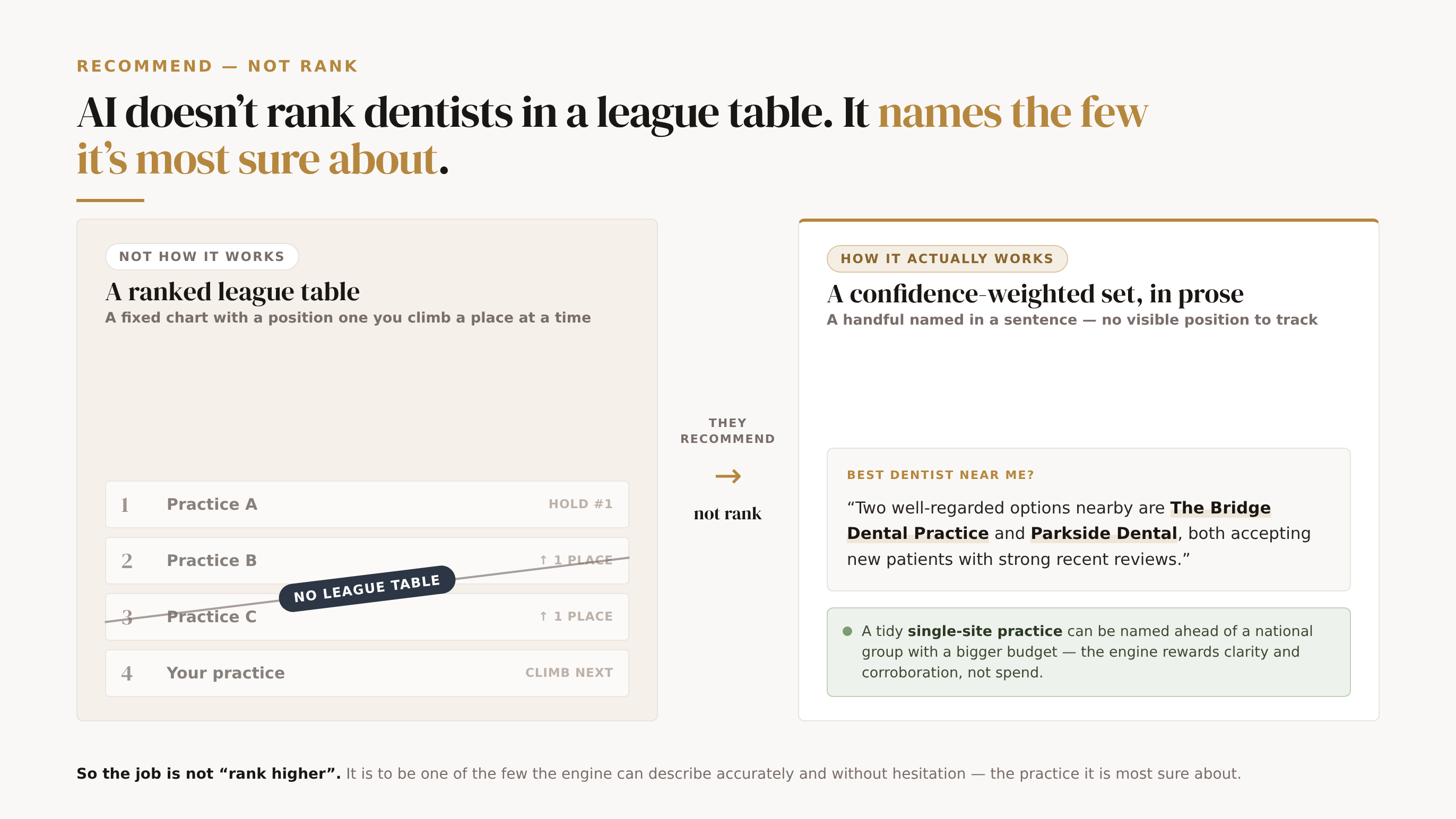
Start with the mechanic, because getting it wrong sends owners chasing the wrong prize. An AI answer is a recommendation, not a league table. Google Maps hands you a literal local pack, a visible top three you can watch yourself climb. An assistant works nothing like that. It reads the live web, forms a view of how confident it is about each practice it turns up, and writes a short confidence-weighted set into a sentence or two. No position one, no ladder, no rung you climb by one place a month.
Patient behaviour
Why dental discovery now runs through AI answers
97%
of consumers read reviews for local businesses
41%
now "always" read reviews when browsing, up from 29% a year earlier
32%
of adults have turned to AI for health information and advice
BrightLocal, Local Consumer Review Survey 2026; KFF, 2025
That reframing works in your favour. The goal stops being "out-rank fifty rivals in a fixed order" and becomes "be one of the handful the engine can describe accurately without pausing to second-guess itself". Clarity and corroboration win here, not budget, which is why a tidy single-site practice can be named ahead of a national group that spends far more. The whole of the rest of this guide is a way to earn that certainty.
Treating this as niche is a mistake. BrightLocal's 2026 Local Consumer Review Survey clocks AI tools such as ChatGPT "surging into third place for local business recommendations"[2], and health questions are among the most common thing people bring to these tools: a US KFF tracking poll put it that "about a third (32%) of adults are turning to AI for health information and advice"[4]. Picking a dentist lands right in the middle of that behaviour.
Why "near me" behaves differently in AI than in the Maps pack
A comfortable spot in the Google Maps three-pack for "dentist in [town]" is no guarantee of a mention in the AI answer to the very same question. The two surfaces do not weigh the same signals, so strength in one does not transfer. The assistant is not reciting the map pack back to the patient; it is drafting a reply from across the web and naming whichever practices it can confirm from more than one direction.
The internals make the divergence obvious. Google has said it is "bringing a custom version of Gemini" into Search for both AI Mode and AI Overviews, and that AI Mode "uses our query fan-out technique, breaking down your question into subtopics and issuing a multitude of queries simultaneously on your behalf"[3]. Type "best dentist near me for a nervous patient" and you set off a spray of separate lookups, not one. Hidden behind it sit several: which practices are local, who offers sedation or anxiety care, whose reviews are fresh, who takes NHS versus private, who is open when. The engine reassembles those threads and names whoever shows up cleanly across the whole cluster.
The stakes rise because the answer itself is more and more the endpoint. AI-generated summaries now sit at the top of a large share of everyday Google searches, and when one is present far fewer people click through to a traditional result at all. Fewer people scroll past the named set, so membership of it does most of the work. Our deeper treatment of that split lives in AI search visibility for dental practices; the short version is to treat the AI answer as a surface of its own, with its own evidence test, and never assume your Maps position carries over.
The factors that decide which dentist gets named
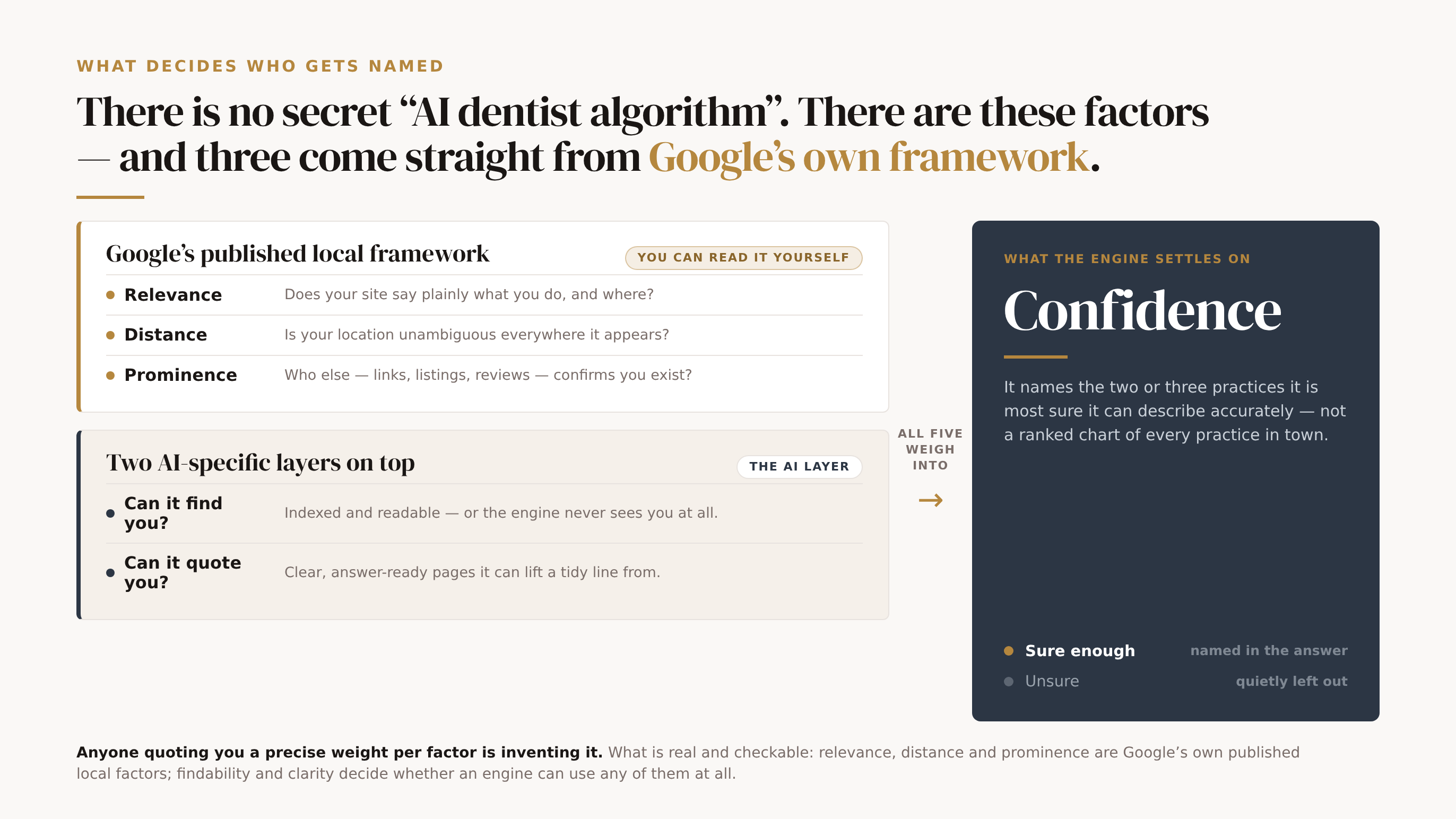
No "AI dentist algorithm" has been published, and any agency quoting you exact per-factor weights is making them up. What is genuinely on the record is Google's framework for local results, and because Gemini is Google's own AI layer feeding from the same local index, it is the nearest verifiable analogue for a "near me" query.
Google puts the three drivers plainly: "Relevance is how well a Business Profile matches what someone is searching for. Distance refers to how far each business is from the customer who's searching. Prominence means how well-known a business is", noting that prominence is "also based on info like how many websites link to your business and how many reviews you have. More reviews and positive ratings can help your business's local ranking"[1].
Selection path
How a practice moves from findable to named
Findability
The site sits in the index the tool reads from, so the practice can be considered at all.
Relevance and distance
The pages say plainly what the practice does and where, so a nearby patient is a clear match.
Consistency and prominence
Details agree everywhere the AI looks, and other sources confirm the practice exists.
Recommendation
The practice the engine can verify from several directions earns the mention.
Take those three, add the two AI-specific layers that sit above them (can the engine find you at all, and can it lift a tidy answer about you), and you have a factor list anchored to something you can read for yourself. Here they are, roughly in the order they bite.
1. Findability: is your site in the index the tool reads from?
Everything else on this list is moot if your pages are not in the index the AI pulls from, since an engine cannot quote a page it has never retrieved. Absence at this stage is both the commonest reason a practice goes unnamed and the one most likely to be overlooked, precisely because the site looks perfectly healthy when you load it yourself.
Two separate faults produce it. One is indexing itself: run site:yourpractice.co.uk in Google and in Bing (ChatGPT's web search has long drawn on Microsoft's Bing index, so Bing is worth a look in its own right). A near-empty result is your first flag. The other fault is rendering. A number of practice sites, the elaborately-designed ones and some page-builder templates especially, deliver their words through JavaScript that only executes once a real browser opens the page; a crawler that skips that step lands on a hollow shell and leaves.
Text a human reads without effort can be invisible to a machine. Because different assistants feed from different indexes, a practice can be well-covered in one and thin in another, which is exactly why the self-test later runs all three side by side. The remedy does not change: exist plainly and readably on the open web.
2. Relevance: does your site say plainly what you do, and where?
Relevance, in Google's phrasing, is "how well a Business Profile matches what someone is searching for". For a dental practice that comes down to stating your services and your location in patient language, on pages a machine can read. Nobody searches "comprehensive oral healthcare provision"; they search "emergency dentist open now", "Invisalign in Leeds", "NHS dentist taking on patients near me". A single catch-all "Treatments" page makes you a weak match for every one of those specific asks.
The remedy is a page per service, each headed the way patients name the thing, spelling out what the treatment involves, rough prices and the usual timescale. Structured data earns its place here by removing ambiguity: Dentist schema carrying your location, services and hours lets the engine read your real facts cleanly, without ever asserting anything for you. More of your control sits in relevance than anywhere else on the list, so it rewards precision.
3. Distance: is your location unambiguous?
Distance, Google says, "refers to how far each business is from the customer who's searching". For a "near me" query it is the single factor effort cannot shift; your address is your address. What effort can do is strip out any uncertainty about where that address is, because a location the engine cannot pin is treated as a distant one.
Keep your address complete and identical across your Google Business Profile, your website and every directory; set an accurate service area if patients travel in from neighbouring towns; name those towns in your copy. Someone searching three towns over is unlikely to be routed past a closer practice to reach you, and no tuning changes that. The aim is to win cleanly wherever you genuinely are the near choice.
4. Consistency: do your details agree everywhere the AI looks?
Wherever a patient might find you (your own site, the Google profile, the NHS listing, the directories), the name, address, phone, opening hours and service list should read identically. It is unglamorous housekeeping, and it settles a surprising number of close calls. A dental answer is not drawn from your website in isolation; the engine gathers from your Google Business Profile, the review platforms, healthcare and local directories, the NHS "find a dentist" service and the local press, then checks whether the accounts line up.
A stale phone number on one listing, last year's hours on another, a former practice name lingering somewhere: each is a reason for the engine to hesitate and hand the mention to a rival it is surer of. Make every source tell one story and the hesitation disappears. Few hours you spend return more.
5. Prominence: who else confirms that you exist?
Prominence, in Google's model, "means how well-known a business is", resting partly on "how many websites link to your business and how many reviews you have". Your own site talking you up is the flimsiest signal there is. Confidence grows with every independent, reputable source that confirms the same practice, at the same address, offering the same services.
The reason a small, familiar set of practices tends to dominate the answers in a town is simply that those are the ones an engine can corroborate from several angles. The UK sources that carry weight are the Google Business Profile, the high-trust NHS "find a dentist" service, solid healthcare and local directories, genuine professional or accreditation listings, and local press or community pages, each accurate and each agreeing with the rest.
6. Reviews: are they recent, genuine and plentiful?
Reviews are the evidence layer, and Google states outright that "more reviews and positive ratings can help your business's local ranking". Patients weigh them at least as heavily. BrightLocal's 2026 survey found "97% of consumers read reviews for local businesses", with 41% now "always" reading them when browsing, up from 29% a year earlier[2]. When two in five people always read reviews and almost everyone reads them sometimes, a sparse or ageing review profile is a weakness in plain sight.
Freshness and spread carry more than the headline count. A stack of five-star reviews that dried up eighteen months back, all on one site, signals a practice that has quietly gone dark. Better to collect real reviews at a steady drip, prompting satisfied patients at the right moment (after a course of treatment finishes, not mid-chair), with a one-tap route to leaving one.
Spread them Google-first, then NHS and healthcare platforms, and answer them all without ever letting a patient's clinical detail into a public reply. The bright line is buying, incentivising or doctoring reviews to mislead: it cuts across the General Dental Council's requirement that anything you publish be accurate and not misleading, it is unlawful under UK consumer law, and an engine that spots a manipulated profile lowers its trust in you rather than raising it.
7. Extractability: can the AI lift a clean answer about you?
The final factor rides on top of the others. A practice can be relevant, well-reviewed and consistently listed and still miss out if the engine cannot draw a neat answer from its pages. What gets quoted is a page that answers a specific question outright; what gets skipped is "welcome to our practice" prose that answers none. Compare two pages. One headed "Emergency dental care in Reading" opens: "We see emergency patients the same day. Call before 10am for a same-day appointment; our out-of-hours line covers evenings and weekends.
Same-day assessment from £75." That is a clean, liftable answer to "emergency dentist near me today". The other, headed "Welcome to our practice", tucks the identical facts three paragraphs down behind warm words about the team, and leaves the engine nothing to quote. Same information, only one version extractable. When you draft or revisit a page, read its first two lines and ask whether an engine could quote them straight back as the answer to a patient's question. If not, lift the answer to the top.
Google Maps pack versus an AI "near me" answer, side by side
A strong Maps presence helps, and they overlap, but the two are not one job. This table lays out what each surface weighs, and why a place in the pack does not buy you a mention in the answer.
Side by side
Google Maps pack versus an AI "near me" answer
| What it weighs | Google Maps local pack | AI "near me" answer |
|---|---|---|
| Primary driver | Proximity plus a complete Google Business Profile | Confidence built from agreement across many sources |
| How results appear | A ranked top three on a map you can see | A short named set written into prose, no visible order |
| Role of distance | Heavy and direct | Real, but one factor among several |
| Role of reviews | Counts, mainly via your Google profile | Counts across Google, NHS and healthcare platforms; recency matters |
| Role of consistency | Helpful | Decisive; contradictions actively cost you |
| Off-site corroboration | Useful | Central; the engine names who it can verify from several directions |
| Can you see your position? | Yes, your pack rank is visible | No, there is no position to track |
The pack pays out for proximity and a polished profile. The answer pays out for a practice the engine can verify and describe without pausing. Do the first and part of the job is done; do both and you are present wherever the patient chooses to look. If you are absent from the AI answers altogether, our guide on why dental practices do not show up in ChatGPT steps through the usual causes.
Test where your own practice stands
You can size up your position today, at no cost, by putting the questions a real patient would ask to the engines and reading what comes back. Take a few minutes over it:
- Ask the patient questions. Line up a handful of searches and run each through ChatGPT, then Google's AI Mode, then Perplexity. Good ones to try: "dentist near me open on Saturday", "private dentist in [your town] with good reviews", "same-day emergency dental appointment [your area]", and "gentle dentist for anxious patients near me".
- See whether you surface, and how. Named every time, named now and then, or named only when the prompt gets very specific? Jot down which practices come up in your place, and which sources each answer draws on.
- Confirm you are indexed. Run
site:yourpractice.co.ukin Google and Bing; a thin or empty result puts indexing and rendering at the front of your queue. - Trace any absence to a factor. Do your name, address, phone and hours match across website, Google profile and NHS listing? Is your review flow recent and spread over more than one platform?
- Repeat each prompt. Answers wander between runs, so trust the pattern that recurs across a handful of attempts rather than any single reply.
Missing from every answer usually traces back to a foundation problem: indexing, inconsistent details, or pages too thin to quote. Turning up only beside a competitor is a prompt to study what they hold that you lack, whether that is fresher reviews, a live NHS listing, or sharper fee and service pages. That gap between their footprint and yours is the to-do list.
Work the factors in order of impact
Tackle the list by impact, mapped to the factors above, not in whatever order the problems surface in your head. A superb service page counts for nothing while the engine cannot read your site, and no volume of reviews rescues a practice whose own details disagree.
Priority order
Work the factors in the order that moves the answer
Get findable first.Make sure the site is in the index the tool reads from before anything else.
Say plainly what you do and where.Relevance and an unambiguous location let a nearby patient match you.
Make every detail agree.Contradictions across your listings actively cost you the mention.
Build outside confirmation.Prominence and recent, genuine reviews tell the engine others vouch for you.
Keep the answer extractable.Clean, quotable pages let the AI lift a correct line about your practice.
- Get indexable and readable (factor 1). Verify the pages are indexed and that the words appear without JavaScript having to run. This is the floor everything else stands on.
- Complete your Google Business Profile (factors 2 and 3). Exact name, address and phone; full hours and how emergency care works; every genuine service in plain words; a current accepting-patients status; real photos; accessibility detail. This is the biggest single lever, and it is the one most practices leave half-pulled.
- Reconcile every fact (factor 4). Line up your details across website, Google profile, NHS listing and directories, and clear the contradictions out.
- Build directory and citation presence (factor 5). Claim and correct the NHS listing and the reputable healthcare and local directories so independent sources confirm you. Our AI SEO for dentists service page sets out how we handle that for a practice.
- Add schema and answer-ready pages (factors 2 and 7).
DentistorLocalBusinessmarkup, plus one clear page per service that answers a real question in its opening line. - Build review velocity (factor 6). Keep a flow of real, recent reviews coming in on Google, the NHS profile and healthcare sites, and respond to each one thoughtfully.
There is no need to finish all six before the effort starts paying off. Each one lifts your odds of being named on its own: the early items clear away the reasons you are invisible, the later ones move you from "found" to "named".
Where to start
If you only manage three moves, run them in this order: confirm the site is indexed and readable, bring your business details into agreement everywhere, and finish your Google Business Profile with an accurate, current accepting-patients status. Between them, those three clear away the faults that most often keep a practice out of an AI answer entirely.
If you would sooner see where you stand before spending anything, a free QBiz Leads AI visibility check scans your website in about thirty seconds and returns a plain pass or fail on the signals that decide whether AI tools can find, read and recommend you, with the fixes ranked in the order to tackle them.
Get your free AI visibility check →
Frequently asked questions
Does AI actually rank dentists, or just recommend them?
It recommends them. There is no ordered chart behind an AI answer the way there is behind the Google Maps three-pack. The engine reads the live web, forms a view of how confident it is about each practice, and names a small set it can describe without second-guessing itself. That is why there is no position one to track and no rung you climb a place at a time.
Can I optimise for "dentist near me"?
Not as a keyphrase, no. "Near me" is resolved by the searcher's own location, so no page can own it. What you can own is the service, the intent and the actual place: name the suburbs, town and county you serve in plain copy, keep your address identical everywhere, and set an accurate service area. Then you are the near choice wherever you genuinely are close.
My practice is top of the Google Maps pack. Why am I not named in the AI answer?
Because the two surfaces weigh different signals, so strength in one does not carry over. The map pack leans heavily on proximity and a complete Google Business Profile; the AI answer leans on whether the engine can confirm your details from several independent sources. A polished profile helps both, but the answer only names practices it can corroborate and describe cleanly.
How many reviews do I need to get named?
There is no threshold number. Freshness and spread matter more than the headline count: a steady drip of recent, genuine reviews across Google, the NHS profile and healthcare sites reads as an active practice, while a stack that dried up eighteen months ago on a single site reads as one that has gone quiet. Collect them at the natural moment after treatment finishes, and never let a patient's clinical detail into a public reply.
Does adding an FAQ section get my practice cited more?
No. Question-style headings do not lift AI citations on their own; the evidence points the other way. FAQs earn their place by answering real patient questions clearly and covering ground your other pages do not. Treat them as reader value, not a citation trick.
Why can a small local practice get named ahead of a big group?
Because the answer rewards certainty, not spend. A tidy single-site practice whose details agree everywhere and whose pages answer questions outright is easier for the engine to describe with confidence than a national group with contradictory listings. Clarity and corroboration are the levers, and neither costs a large budget.
How do I check whether AI can even read my site?
Run site:yourpractice.co.uk in Google and in Bing; a thin or empty result flags an indexing problem. Then check whether your words appear with JavaScript disabled or in the page's view-source, because a site that renders its text only in a real browser can look perfect to you and be a hollow shell to a crawler. If the words are not there for a machine, nothing else on the list matters yet.
Which sources does an AI answer draw on for a dentist?
More than your website alone. For a UK practice the engine gathers from your Google Business Profile, the review platforms, the NHS "find a dentist" service, healthcare and local directories, professional or accreditation listings, and local press, then checks whether the accounts agree. The practices it can confirm from several of these at once are the ones it names.
How long before changes show up in AI answers?
There is no fixed timeline. Fixing indexing or rendering can surface a practice within days once the pages are re-crawled, while building directory presence and review velocity is a slower, steady job measured in weeks and months. Answers also wander between runs, so judge progress by the pattern that recurs across several attempts rather than one reply.
Can I pay ChatGPT or Google to recommend my practice?
No. There is no paid slot inside an AI recommendation and no vendor who can insert your name. The answer is assembled from the public signals the engine can verify, so getting named comes down to making those signals clear and consistent rather than buying a placement that does not exist.
Sources
- [1] Google Business Profile Help, "Tips to improve your local ranking on Google": https://support.google.com/business/answer/7091?hl=en (Global; primary. Local results rest on Relevance, Distance and Prominence; prominence is "also based on info like how many websites link to your business and how many reviews you have. More reviews and positive ratings can help your business's local ranking.")
- [2] BrightLocal, Local Consumer Review Survey 2026: https://www.brightlocal.com/research/local-consumer-review-survey/ (US-weighted; independent. AI tools such as ChatGPT are "surging into third place for local business recommendations"; "97% of consumers read reviews for local businesses"; 41% now "always" read reviews when browsing, up from 29% the previous year.)
- [3] Google (The Keyword), "AI in Search: going beyond information to intelligence", 20 May 2025: https://blog.google/products/search/google-search-ai-mode-update/ (Global; vendor primary. "AI Mode uses our query fan-out technique, breaking down your question into subtopics and issuing a multitude of queries simultaneously on your behalf"; a custom version of Gemini is brought "into Search for both AI Mode and AI Overviews".)
- [4] KFF, Tracking Poll on Health Information and Trust, 2025: https://www.kff.org/public-opinion/kff-tracking-poll-on-health-information-and-trust-use-of-ai-for-health-information-and-advice/ (US; independent. "About a third (32%) of adults are turning to AI for health information and advice", including about three in ten (29%) who have used AI tools in the past year for information or advice about their physical health.)
Leave a comment
Thoughts on this post? Leave a comment below. Comments are moderated before they appear, so yours will not show on the page straight away.
Your email is used only to contact you about your comment if needed — it is never published.
Comments
No comments yet. Be the first to leave one above.