Perplexity or ChatGPT for Finding a Dentist Near You: Which One Recommends Your Practice?
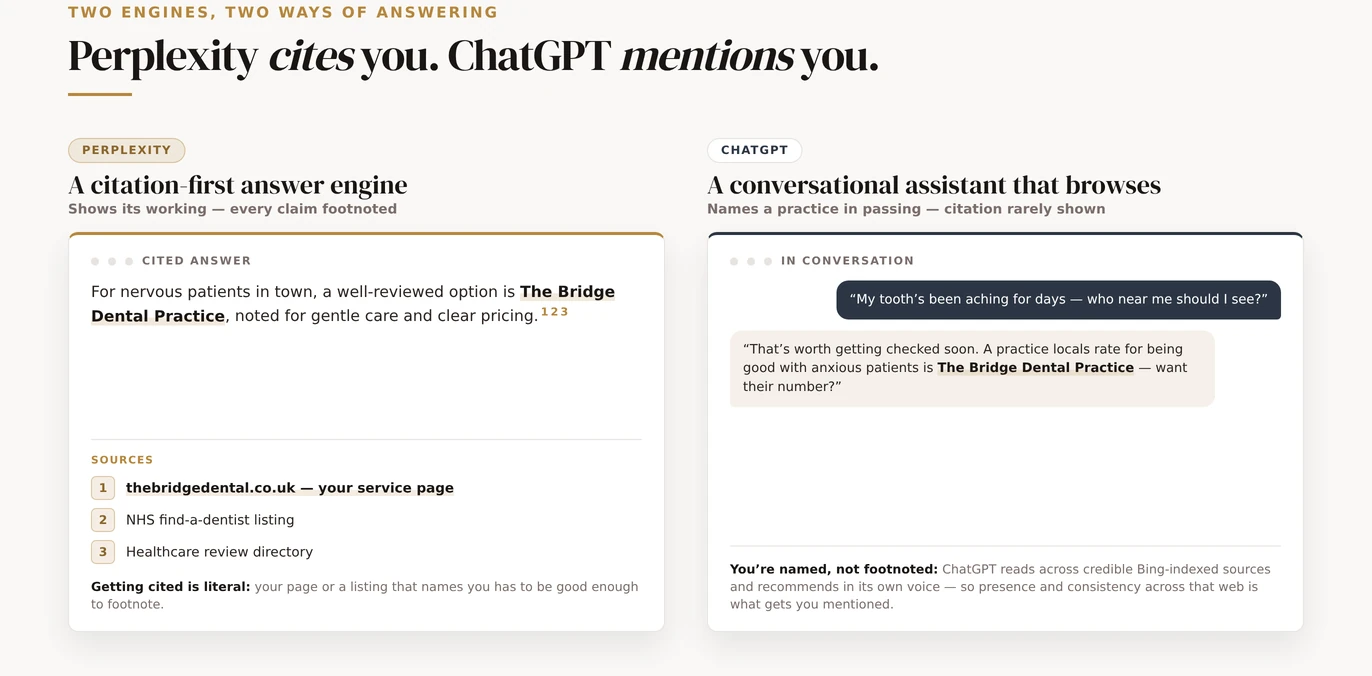
Perplexity is the better lens for citation questions, because it shows the pages it used. ChatGPT is the better lens for conversational recommendation questions, because it may name a dentist while helping a patient think through a problem. Your practice should not choose one to chase. Build one accurate, cited and consistent footprint, then add the Perplexity-specific work of quotable pages and the ChatGPT-specific work of Bing visibility.
A nervous patient is unlikely to say, "which answer engine should I use for local dentistry?" They are more likely to ask one tool for a sourced comparison, then ask another whether a practice nearby is a sensible choice. That is why the Perplexity versus ChatGPT question matters: not because one is the winner, but because each exposes a different weakness in the same dental practice footprint.
Think of it as two doors into the same surgery. Perplexity opens the door marked "show me your sources"; ChatGPT opens the door marked "help me decide". If your practice is missing from the citations, the source trail is thin. If it is missing from the conversational answer, the wider web does not corroborate you clearly enough. A practice that fixes both problems once, with accurate pages, consistent listings and review signals, becomes easier for either assistant to trust. If you are starting from a standing start, our guide on how dentists get recommended by ChatGPT covers the groundwork.
The short version
- Perplexity rewards quotability. It is built around cited answers, so clear pages and accurate third-party listings give it something to footnote.
- ChatGPT rewards corroboration. When it browses, it needs several sources to agree before it is comfortable naming a local practice.
- Bing cannot be ignored. A completed Bing Places listing and a site that appears in Bing's index matter more for ChatGPT-style browsing than many practices realise.
- The shared base is larger than the split. Consistent contact details, answer-first service pages, recent reviews and clean markup help both systems.
- Do not buy a promise of placement. There is no paid slot inside either recommendation. You earn the mention by being easier to verify and quote.
Are patients really using AI tools to choose a dentist?
Yes, but the useful way to read the data is not "everyone now uses one tool". The shift is that AI answers have become normal enough to sit inside ordinary decision-making. BrightLocal's 2026 Local Consumer Review Survey found that use of ChatGPT and other generative AI tools for local recommendations rose from 6% to 45% in a year, making them the third most popular source of business recommendations.[1] That is the local-business backdrop a dental practice now lives in.
The ChatGPT side has scale behind it. TechCrunch reported OpenAI's February 2026 announcement that ChatGPT had reached 900 million weekly active users, up from 800 million the previous October.[2] Those users are not all looking for a dentist, of course, but the habit of asking an assistant for help is no longer fringe.
Health questions are part of that habit. KFF's 2025 tracking poll found that about a third (32%) of US adults are turning to AI for health information and advice.[3] Dental decisions sit in that awkward middle ground between health, money and trust: a patient wants reassurance, wants a practical next step, and often wants to compare options before calling.
Pew adds the zero-click context. Its July 2025 analysis found that 58% of US users conducted at least one Google search in March 2025 that produced an AI-generated summary, and that users very rarely clicked the cited sources when summaries appeared.[4] The lesson for a practice is simple: if the assistant gives the answer and the patient acts on it, being named or cited is no longer a route to the visit. It may be the visit.
Patient behaviour
AI answers now sit inside ordinary dental decisions
45%
use ChatGPT and other generative AI for local recommendations, up from 6% a year earlier and now the third most popular source.
900 million
weekly active users reached by ChatGPT in February 2026, up from 800 million the previous October.
32%
of US adults turn to AI for health information and advice.
58%
of US users ran at least one Google search in March 2025 that produced an AI summary, and rarely clicked the cited sources.
BrightLocal Local Consumer Review Survey 2026; TechCrunch, reporting OpenAI, February 2026; KFF Tracking Poll 2025; Pew Research Center 2025.
The commercial stakes are large enough to deserve plain language. A single implant can sit around £2,000 to £2,800, clear aligners around £1,500 to £4,500, and a veneer case can run into several thousand pounds (all illustrative, typical ranges rather than researched figures, and every practice prices differently). Behind any one treatment is a patient who may stay for routine care for years. When an assistant consistently names a competitor instead of you, the loss is not a click in a report. It is a patient who never knew you were a possible choice.
What is the real difference between Perplexity and ChatGPT?
The clean distinction is this: Perplexity is a citation-first answer engine, while ChatGPT is a general assistant that can browse. That is not a perfect technical definition of either product, and both are changing quickly, but it is the useful working model for a dental practice owner.
Perplexity is designed to show its working. It searches, summarises and attaches numbered sources to the answer, so a practice either appears in the source trail or it does not. For a dental query, that means your treatment page, location page, NHS profile, directory entry or review page needs to be clear enough to support a sentence in the answer.
ChatGPT behaves differently. When it needs fresh or local information, it browses the web and draws on what it can reach, often through Bing-indexed material and the open web around it. The resulting recommendation may not give a neat list of citations. It may simply name a practice as part of a helpful paragraph. That makes the underlying evidence harder to see, but not less important.
Here is the practical split for a dental practice:
Side by side
Two doors into the same surgery
| Question | Perplexity | ChatGPT |
|---|---|---|
| What it feels like to a patient | A researched answer with visible sources | A conversation that may turn into a recommendation |
| What a win looks like | Your page or listing appears as a cited source | Your practice is named in the answer |
| What it needs from your site | Short, factual, answer-first sections it can quote | Clear service pages it can understand and repeat safely |
| What it needs off your site | Trusted pages that mention the practice and support the answer | Consistent corroboration across Bing, directories, reviews and listings |
| Common blind spot | Thin pages that make claims but provide little usable detail | Ignoring Bing Places and Bing indexing because Google looks healthy |
| Shared requirement | Accurate facts, recent reviews, clean schema and matching contact details | Accurate facts, recent reviews, clean schema and matching contact details |
Drawn from the article's working model of a citation-first engine against a browsing assistant.
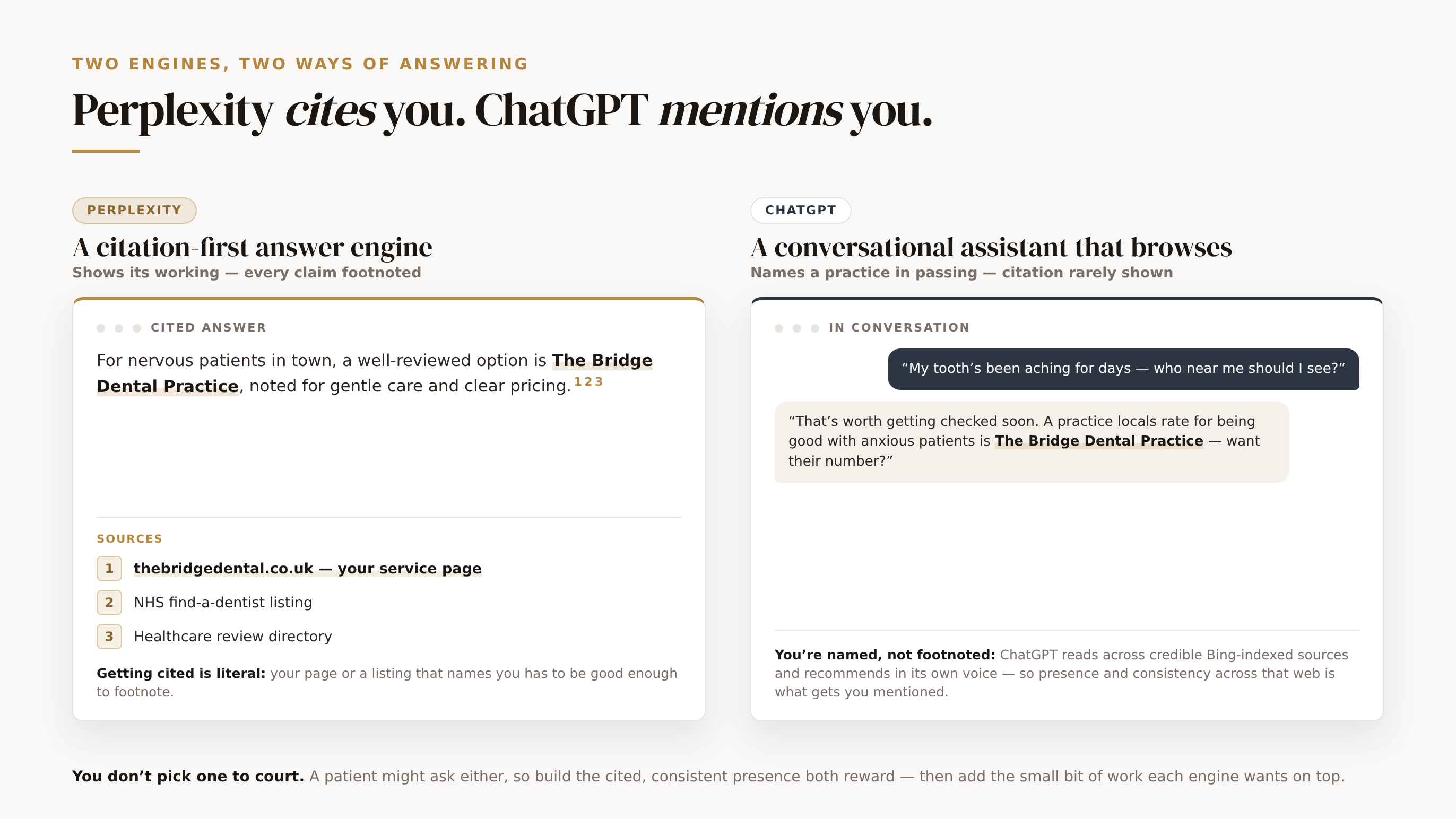
How does Perplexity decide which dentist to cite?
Perplexity's visible source list makes its demand unusually direct: can it find a page that says the answer clearly enough to cite? Three pieces of work matter most.
Citation path
How Perplexity reaches a cited dentist
Read the question
It works out what the patient wants: a treatment, a comparison, prices or reassurance.
Search for quotable pages
It looks for a page or listing that states the answer clearly enough to support a sentence.
Check the sources agree
Your site, NHS profile, directories and review pages need to tell the same story.
Cite the practice
The clearest, most consistent source is attached to the answer as a numbered citation.
Make the answer easy to lift
A page that opens with a vague welcome gives an answer engine very little to use. A page that states the treatment, who it suits, what the appointment involves, likely timescale, typical fee range and next step gives it several clean sentences to cite. If a patient asks, "which dentist near me offers implants and explains costs clearly?", a page that answers that exact concern is easier to footnote than one built around practice slogans.
Put useful facts before persuasion
Perplexity needs facts it can stand behind. For a dental practice, that means treatment pages that answer practical worries: suitability, pain, alternatives, recovery, finance, aftercare and whether NHS or private options apply. The tone can still be warm, but the first job is to make the facts accessible. The most quotable page is not the loudest page. It is the one that answers the question with the least ambiguity.
Make third-party pages agree with you
Perplexity does not have to cite your own website. It may cite an NHS page, a healthcare directory, a local listing or a review platform that confirms the same practice details. That is why consistency matters. If your address, opening hours, services or practice name vary between sources, the assistant has to decide which version is current. Many will sidestep that uncertainty and cite a cleaner competitor instead. Our companion piece on AI citations for dentists goes deeper into building that cited presence.
How does ChatGPT decide which dentist to recommend?
ChatGPT's local answer is less transparent because the citation trail is not always displayed. The practical test is still evidence: when it browses, does the web give it enough agreement to name you with confidence?
Claim the Bing route most practices forget
A practice can look strong in Google and still be weak in the web map ChatGPT reaches during browsing. Claiming and completing Bing Places for Business is basic housekeeping, but it is often missing. Submit the sitemap through Bing Webmaster Tools as well, then run site:yourpracticedomain.co.uk in Bing. If only a handful of pages appear, ChatGPT-style browsing may have little to work from even when Google is full of your pages.
Widen the corroboration
ChatGPT is more likely to name a practice when several credible sources tell the same story. Your website, Bing listing, Google profile, NHS listing, healthcare directories, local directories and review pages should repeat the same name, address, phone, hours and services. This is not glamorous work, but it is exactly the sort of agreement a browsing assistant can use to avoid a risky recommendation.
Write pages a careful assistant can paraphrase
ChatGPT often answers in its own voice, so your page does not need to be copied word for word to matter. It does need to be clear enough to paraphrase accurately. Replace soft claims such as "high quality dental care" with concrete information: who the service is for, what happens first, how urgent cases are handled, what a typical private fee range means, and which limits apply. A careful assistant can repeat that without making unsafe claims.
Which patient questions does each one tend to win?
The classic "dentist near me" query still belongs heavily to maps, especially when the patient mainly wants distance, opening hours and directions. Perplexity and ChatGPT become more influential when the question turns into a decision.
Perplexity is a good fit for comparison questions: "private dentist or NHS dentist for implants near me", "best dentist for nervous patients in [town] with sources", or "compare Invisalign providers in [area]". The patient wants reasons and evidence. If your pages and listings supply those, you are more likely to appear in the citation set.
ChatGPT is a good fit for conversational uncertainty: "my tooth has hurt for three days, what should I do?", "how do I choose between these dentists?", or "is there a gentle private dentist near me?" The recommendation may arrive as part of advice rather than as a formal search result. To be included, your practice has to be easy to verify and describe.
The overlap is where the real value sits. Both systems respond to clear service pages, accurate listings, review evidence and machine-readable facts. The engines differ in presentation, but the patient need is the same: enough trust to choose. For a closer look at another pairing, see ChatGPT versus Gemini for dentist recommendations.
What should a dental practice do first?
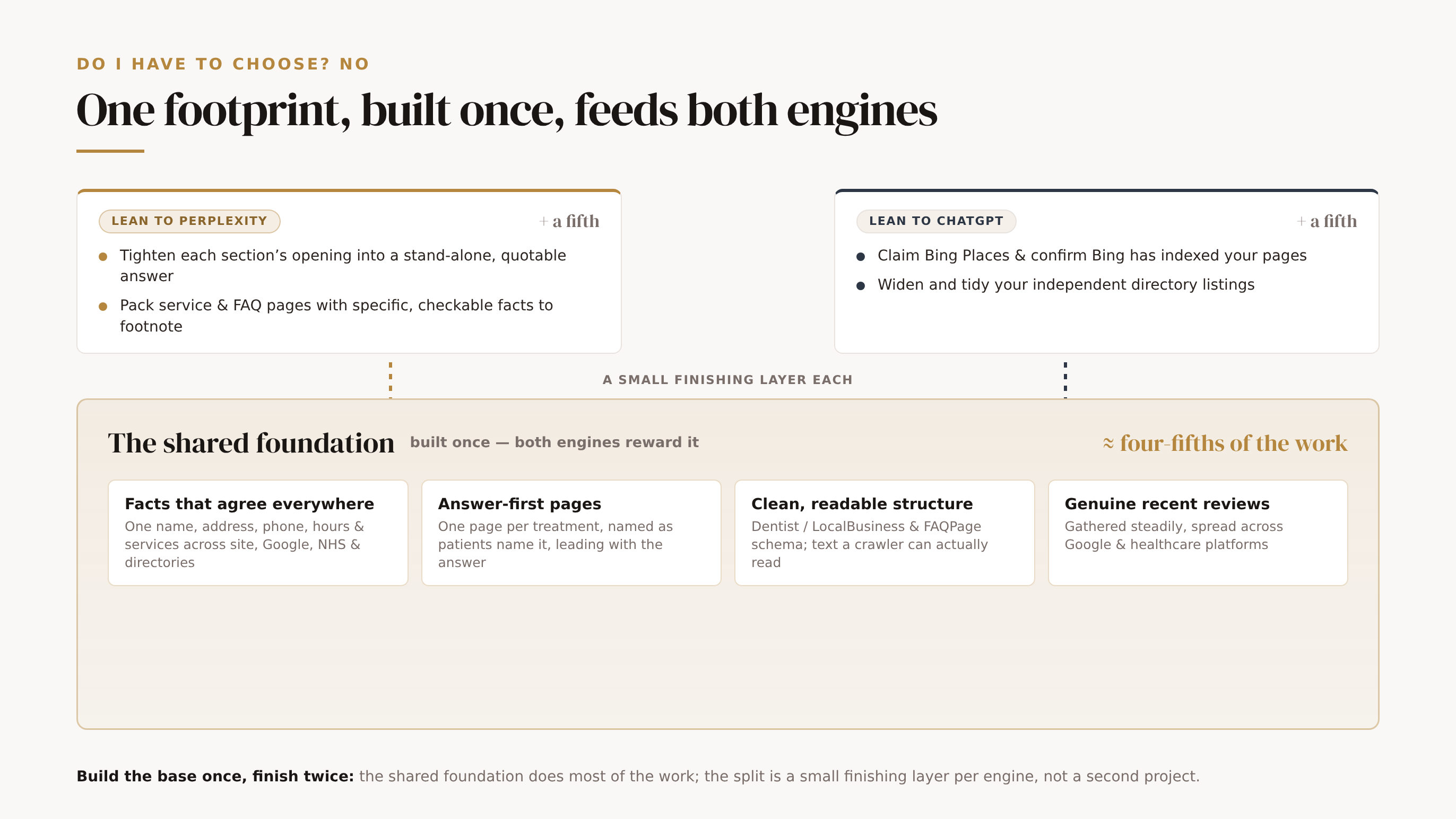
Do the shared work before the engine-specific touches. The shared foundation carries most of the result:
Worklist
The shared foundation, before the split-layer work
Write answer-first service pagesLead with the practical answer, then cover suitability, process, timescale, illustrative fees and aftercare.
Make every contact detail matchSame name, address, phone, hours and service wording across website, Google, Bing Places, NHS listing and directories.
Add clear machine-readable labelsDentist or LocalBusiness schema, plus FAQPage markup where the visible FAQ genuinely answers patient questions.
Keep reviews real and currentAsk at natural points after treatment, spread across visible platforms, and reply without publishing clinical details.
Check that crawlers can read the wordsIf the text only appears after browser scripts run, an assistant may not be able to use it.
- Write answer-first service pages. Each treatment page should lead with the practical answer a patient came for, then cover suitability, process, timescale, typical illustrative fees and aftercare.
- Make every contact detail match. Your website, Google profile, Bing Places, NHS listing and directories should use the same name, address, phone number, opening hours and service wording.
- Add clear machine-readable labels. Use Dentist or LocalBusiness schema, and FAQPage markup where the visible FAQ genuinely answers useful patient questions.
- Keep reviews real and current. Ask at natural points after treatment, spread the work across the platforms patients and assistants can see, and reply without publishing clinical details.
- Check that crawlers can read the words. If the text only appears after browser scripts run, an assistant may not be able to use it.
Then add the split-layer work. For Perplexity, tighten the first two sentences of every important section until they stand alone as a quotable answer. For ChatGPT, complete Bing Places, submit your sitemap to Bing, and fix any index gap you find. It is one footprint with two finishing layers, not two separate marketing plans.
How can you test whether either engine already mentions you?
You can run a practical check in half an hour. Do not treat one answer as the truth, because AI answers move between attempts. Look for the recurring pattern.
- Ask Perplexity researched questions. Try "best dentist for nervous patients in [town]", "compare dentists for implants near [area]" and "private dentist with clear prices in [town]". Look at the numbered sources and note whether your site or listings appear.
- Ask ChatGPT the same questions conversationally. Use browsing if available. Note whether your practice is named, which competitors appear, and what explanation is given.
- Check Bing visibility. Search
site:yourpracticedomain.co.ukin Bing and confirm that the important service pages are present. - Compare your public facts. Open your website, Bing Places, Google profile, NHS listing and two directories. Check whether the name, address, phone, hours and services match exactly.
- Repeat the prompts. A single answer is noisy. A repeated absence is a signal.
If Perplexity cites competitors but not you, your pages or third-party mentions are probably not quotable enough. If ChatGPT names competitors but not you, the likely gaps are Bing visibility, corroboration or weak service pages. If neither names you, start with indexing and consistency before rewriting anything else.
How do you stay inside GDC rules while doing this?
The safest answer-engine work is also the best regulatory work: be specific, accurate and careful. The General Dental Council's Standards for the Dental Team requires information you publish to be accurate, not misleading and compliant with ethical advertising guidance.[5] That applies to the website copy, listings, review replies and promotional material an assistant may later read.
Avoid guarantees, unverifiable superlatives and claims that rank you above named peers. Do not write "best dentist in [town]" unless you can substantiate exactly what that means. Do not imply pain-free outcomes, treatment suitability or guaranteed results. You can still be persuasive by being concrete: explain what you offer, who it suits, how assessment works, what the usual options are and where the limits sit.
The engines do not need you to overclaim. They need enough accurate information to describe you without risk.
Where QBiz fits
When a practice asks QBiz to help with ChatGPT or Perplexity visibility, we treat it as two linked jobs. First we make the website easier for machines and patients to read: answer-first service pages, clean facts, schema, index checks and GDC-safe copy. Then we build the off-site proof the engines need: accurate directory entries, consistent listings and distribution of the useful content so corroboration exists beyond your own site.
That second half matters. A clean page with no supporting footprint is easier to ignore; a useful page backed by matching listings, reviews and citations is easier to trust. Our work is not to promise a paid slot inside an answer engine. It is to make your practice the safer, clearer recommendation.
If you want to see the starting point, the free QBiz visibility check scans your website for AI-readiness: structure, schema, clarity, indexability and whether the words a machine needs are actually present. It does not query ChatGPT, Perplexity or Google AI Overviews to claim that you are named. It tells you whether your site gives those systems a clean enough base to read and trust. If you would rather have both halves run for you, our AI SEO for dentists service page sets out how we approach it for a practice.
Get your free AI visibility check →
Frequently asked questions
Is Perplexity or ChatGPT better for getting dental patients?
Neither is universally better, because they serve different patient behaviours. Perplexity suits research-led questions where the patient wants visible sources; ChatGPT suits conversational questions where a recommendation comes up while the patient is describing a problem. A dental practice should aim to be quotable in Perplexity and nameable in ChatGPT, because most of the foundation work is shared.
Does Perplexity show its sources?
Yes. Perplexity is built around cited answers, so a local dental answer usually includes numbered source links. For a practice, that makes the visibility test concrete: your own page, or a trusted listing that names you, needs to be clear and useful enough to appear in the source set.
Does ChatGPT use my Google Business Profile?
Not in the same direct way a Google local result does. When ChatGPT browses for current local information, the important route is usually Bing-indexed web content plus the wider set of listings and review pages it can reach. A strong Google Business Profile still matters for patients and corroboration, but Bing Places and Bing indexing need attention too.
If ChatGPT recommends me, will Perplexity automatically do the same?
No. The two systems read and present the web differently, so a mention in one does not guarantee a citation in the other. The useful part is that consistent details, answer-first service pages, recent reviews and clean markup lift your chances in both, so you do not need two separate campaigns from scratch.
Can I pay to appear in Perplexity or ChatGPT?
No. There is no paid slot that buys a practice into a Perplexity citation or a ChatGPT recommendation. Anyone selling that as a direct placement is overselling. The work is to make your practice easier to verify, quote and describe than the alternatives.
How long until my practice shows up in AI answers?
There is no fixed timetable, and the answers can shift between runs. Indexing and listing fixes can start to matter within weeks once pages are crawled, while stronger corroboration through content, directories and reviews compounds over several months. Track recurring patterns across repeated prompts rather than treating one answer as final.
Sources
- [1] BrightLocal, Local Consumer Review Survey 2026: https://www.brightlocal.com/research/local-consumer-review-survey/ (Independent local-business research. "Use of ChatGPT and other generative AI tools for local recommendations has grown rapidly, rising from 6% last year to 45% and becoming the third most popular source of business recommendations.")
- [2] TechCrunch, "ChatGPT reaches 900M weekly active users", 27 February 2026: https://techcrunch.com/2026/02/27/chatgpt-reaches-900m-weekly-active-users/ (Reporting OpenAI's announcement. "ChatGPT has reached 900 million weekly active users" and the figure was "a jump of 100 million users from the 800 million that OpenAI reported in October 2025.")
- [3] KFF, Tracking Poll on Health Information and Trust: Use of AI For Health Information and Advice, 2025: https://www.kff.org/public-opinion/kff-tracking-poll-on-health-information-and-trust-use-of-ai-for-health-information-and-advice/ (Independent health research. "KFF's latest Tracking Poll on Health Information and Trust finds about a third (32%) of adults are turning to AI for health information and advice.")
- [4] Pew Research Center, "Google users are less likely to click on links when an AI summary appears in the results", 22 July 2025: https://www.pewresearch.org/short-reads/2025/07/22/google-users-are-less-likely-to-click-on-links-when-an-ai-summary-appears-in-the-results/ (Corroborative behaviour context. "About six-in-ten respondents (58%) conducted at least one Google search in March 2025 that produced an AI-generated summary" and users "very rarely clicked on the sources cited.")
- [5] General Dental Council, Standards for the Dental Team, Principle 1: https://standards.gdc-uk.org/pages/principle1/principle1 (UK dental regulator. Standard 1.3.3 requires advertising, promotional material and other information to be accurate, not misleading and compliant with ethical advertising guidance.)
Leave a comment
Thoughts on this post? Leave a comment below. Comments are moderated before they appear, so yours will not show on the page straight away.
Your email is used only to contact you about your comment if needed — it is never published.
Comments
No comments yet. Be the first to leave one above.