AI Agents Will Soon Visit Your Website Instead of Customers. Are You Ready?
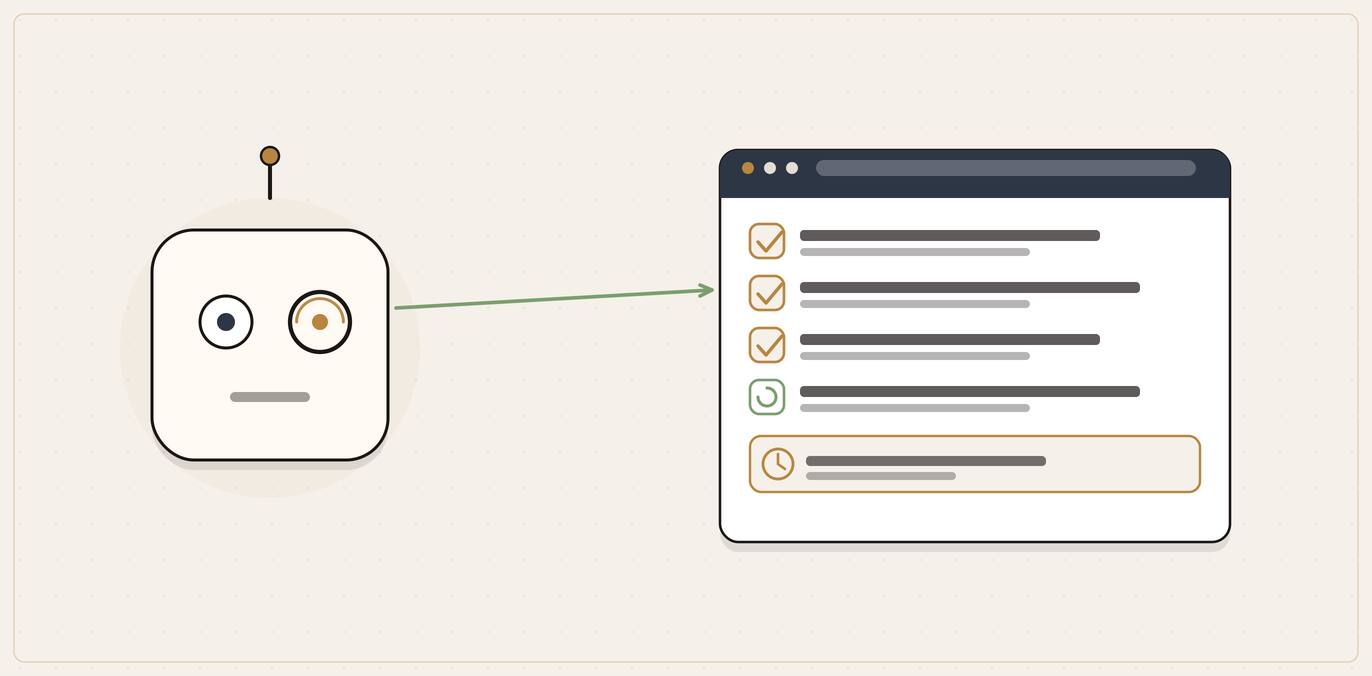
Agent Experience (AX) means designing your website so that AI agents, software acting on a customer's behalf, can use it, not just human visitors. An agent reads sites, compares options, and completes tasks such as booking a slot. For a typical local business this is early rather than urgent, and the way to get ready is the same work that helps AI search and human visitors: clear, machine-readable facts, a site a crawler can actually read, a simple enquiry flow, and consistent business details. You do not need to rebuild anything or buy "AX optimisation".
Here is a scene that did not exist two years ago. A customer opens an AI assistant and types, "find me a local electrician who can fit an EV charger next week, and book the first available one." The assistant does not hand back a list of links for the customer to phone round. It goes off and does the job. It reads several electricians' websites, works out who covers the area, checks who lists EV charger installation, tries to find a booking option, and comes back with a slot already held.
A booking, done by software
How an agent gets from request to booked job
The customer's request
"Find a local electrician who can fit an EV charger next week, and book the first available one."
Read the sites
The agent looks at candidate sites the way its own browser can, without a human ever seeing them.
Compare options
It weighs services, areas and availability, and gives up faster than a careful human would.
Complete the task
It fills the booking form and confirms the slot, if the flow does not hit a wall.
Notice who never saw your website in that story. Not the customer. A piece of software did, on the customer's behalf, and it made a decision about you in seconds without a human ever looking at your home page.
That is the shift behind a term you may start hearing: Agent Experience, or AX. It is the idea that your website increasingly has a second kind of visitor, an AI agent acting for a person, and that the site needs to work for that visitor too.
Quick answer
- An agent is not a chatbot. A chatbot answers a question and stops. An agent acts on it: comparing options, filling in forms, starting a sign-up, booking a slot.
- AX has a credited origin. The phrase Agent Experience was coined in early 2025 by Netlify's chief executive, Mathias Biilmann, to describe designing software so that agents, not only people, can use it.
- It is early, not urgent. Agent tools exist and are improving fast, but the world where most of your enquiries arrive through an agent is not here yet, so treat AX as planning ahead.
- AX work is mostly AEO work. Almost everything that makes a site easy for an agent, clear content, simple navigation, structured information and a sign-up flow that is not a maze, is the same work that helps AI search and human visitors.
- No rebuild required. Make your business readable, your key facts plain, and your enquiry process something that does not collapse the moment a non-human tries to use it.
What an "agent" actually is
The word agent gets thrown around loosely, and the distinction is the whole point. Most people have now used a chatbot. You ask ChatGPT or Google's AI a question and it writes you an answer. Useful, but passive. It tells you which invoicing tool looks best; it does not go and set one up.
Side by side
A chatbot answers; an agent acts
| A chatbot | An agent | |
|---|---|---|
| What it does | Answers a question and stops | Acts on the answer: compares options, fills forms, starts a sign-up, books a slot |
| How it meets your site | Tells the customer which tool looks best | Actually uses your enquiry or booking flow on the customer's behalf |
| What it needs from you | Readable content to describe you | A process that does not collapse the moment a non-human tries to use it |
An agent is the next step. It does not stop at the answer, it acts on it. As Mathias Biilmann put it when he introduced the idea, computers are "becoming agents in the world, acting and operating and initiating the execution of transactions themselves" (source: Mathias Biilmann, "Introducing AX: Why Agent Experience Matters", 2025)[1]. In plain terms, the software does not just advise the customer, it tries to get the job done for them.
You can already see early, real versions of this. When OpenAI launched its agent tool Operator in January 2025, it described it as "an agent that can go to the web to perform tasks for you," using its own browser to look at a web page and "interact with it by typing, clicking, and scrolling" to handle things like filling out forms and placing orders (source: OpenAI, "Introducing Operator", 2025)[2]. That tool has since been folded into ChatGPT as its "agent mode." It is a research preview with real limits, and OpenAI was open about that, but the direction is clear enough: the assistant is being taught to use websites the way a person does.
So when we talk about AX, we are talking about what happens when that kind of software, not a human, is the one trying to use your site.
What agent experience (AX) is, and why it is not just marketing
It would be fair to be sceptical, since every year brings an acronym invented to sell something. AX is worth a closer look for two reasons.
First, it has a clear and credited origin rather than being a vendor's coinage. Biilmann, who runs the web platform Netlify, set it out deliberately by analogy with two ideas that turned out to matter. In 1993 the designer Don Norman coined "user experience" (UX) to cover a person's whole experience of a product. In 2011 Jeremiah Lee coined "developer experience" (DX) for how it feels to build on top of a platform. Biilmann's argument is that agents are the next user worth designing for, and so we now need "AX or 'agent experience', the holistic experience AI agents will have as the user of a product or platform" (source: Mathias Biilmann, 2025)[1].
Second, he backs it with a concrete number from his own platform rather than a forecast. After Netlify built its product so that ChatGPT could deploy websites to it directly, Biilmann reports that "more than 1,000 sites are being created on Netlify directly from ChatGPT every single day" (source: Mathias Biilmann, 2025)[1]. That is agents doing real work through software that was deliberately made easy for them to use. It is a software-company example, not a plumber's, and we will come back to that gap openly. But it shows the effect is measurable, not hypothetical.
His warning is the line worth keeping: "Platforms, tools or frameworks that are hard for large language models (LLMs) and agents to use will start feeling less powerful." Turned around for a small business, the point is simple. If an agent cannot make sense of your site, it will quietly pick one it can.
Why a small business should care, but not panic
Two facts need to sit next to each other here, because most coverage of AX gives you only one of them.
Care, but do not panic
Should a local business act on AX now?
Ask
Are most of your enquiries already arriving through an autonomous agent?
Plan ahead, do not scramble
For a typical local business the share of real enquiries through an agent is still small, so treat AX as a direction, not a fire.
Do not buy urgent "AX optimisation"
Custom agent APIs are a software-company concern today, not a plumber's or a solicitor's; the durable groundwork already gets you most of the way there.
The first fact is that automated software is already a huge share of web traffic. Imperva's 2024 Bad Bot Report found that "almost 50% of internet traffic comes from non-human sources," with automated "bad bots" alone making up nearly a third of all traffic (source: Imperva, 2024 Bad Bot Report)[3]. Now, an important caveat the AX hype often skips: most of that non-human traffic is not helpful shopping agents. A lot of it is scrapers, spam and malicious bots, which is the whole subject of Imperva's report. So the headline "half the internet is not human" is true, but it is not evidence that helpful buying agents are already swarming your site.
It tells you the web has long since stopped being a human-only place, which makes the arrival of useful agents a difference of degree, not a brand new idea.
The second fact is the plain one the vendors tend to underplay: for a typical local business today, the share of real enquiries coming through an autonomous agent is still small. People asking AI for "the best plumber near me" and then ringing the number themselves is happening now, and we cover that in our guide to Answer Engine Optimisation for local businesses. An agent that books the plumber end to end, with no human in the loop, is further off for most trades and services.
Put those together and you get the right posture. This is not a fire to put out. It is a direction to plan for. The good news, which the next section gets to, is that preparing for agents barely differs from work you should be doing anyway.
AX work is mostly AEO work
If the prospect of "designing for AI agents" sounds like an expensive new project, here is the part that should take the pressure off. Almost every recommendation for becoming agent-ready is something you would do to be found by AI search and to serve human visitors well. You are not opening a third front. You are reinforcing one wall.
An agent trying to use your site needs the same things a careful human needs, only it gives up faster. It needs to find your key facts quickly, understand what you do and where, and get through your enquiry process without hitting a wall. That is it. AI-visibility vendors frame AX readiness around machine-friendly information, a simple sign-up flow, and testing with a real agent to see where it gets stuck. Read past the manifesto language and those are ordinary good-website principles, not a new discipline.
Here is what that means in practice for a local business website.
Make your core facts plain and machine-readable. What you do, the areas you cover, your opening hours, how to contact you, your prices or price ranges if you publish them. These should be written as clear text, not buried in an image, a PDF, or a fancy graphic an automated reader cannot read. A human can squint at a logo that contains your phone number. An agent often cannot.
Make sure a machine can actually read the page at all. Some website builders render their content with JavaScript in a way that simpler automated readers never see, which can leave your site effectively blank to them. This is the single most common technical reason a business is invisible to AI, and it is worth checking. We explain the problem and a quick self-test in can AI even read your website?.
Keep navigation and enquiry simple. Picture a busy finance director whose agent abandons a tool because it has a four-step sign-up with hidden fields or unclear docs. The lesson scales down: a contact or booking flow with fewer steps, clearly labelled fields and no surprise hurdles is easier for an agent and, not coincidentally, for a stressed human on a phone at 8pm.
Keep your details consistent across the web. Your name, address and phone number on your site, your Google Business Profile, and the directories you appear on should match exactly. A human forgives a slight mismatch. An automated system reading several sources may not, and inconsistency makes it less confident about recommending you.
Consider, but do not agonise over, an llms.txt file. This is a simple text file some sites add to point AI tools at their most important pages. The evidence that it helps is still thin, so it is firmly a "nice to have", not a priority. We give the plain verdict in what is llms.txt and does your business need one?.
Every one of those improves your standing with AI search and your experience for human visitors at the same time. None of them is a gamble on AX specifically. That is exactly why they are worth doing before agents become mainstream: the work pays off whether the agent future arrives next year or in five.
What to do this year, and what to leave alone
To keep this concrete, here is the sensible split.
Worth doing now
Agent-ready groundwork that helps on every front
Check a machine can read your site at all.Fix it if a JavaScript-heavy builder is hiding your content; this is the most common technical failure.
Put your essential facts in plain text.Services, areas, contact and hours where any reader can find them, not buried in an image or PDF.
Tidy your enquiry or booking flow.Short, clearly labelled fields and no surprise hurdles, so a non-human can get through it.
Keep your details consistent across the web.Name, address and phone identical on your site, Google profile and the main directories.
Keep earning genuine reviews and mentions.The off-site signals AI search leans on, which serve human visitors just as well.
Worth doing now, because it helps on every front:
- Check your site is actually readable by machines, and fix it if a JavaScript-heavy builder is hiding your content.
- Put your essential facts (services, areas, contact, hours) in plain text where any reader can find them.
- Tidy your enquiry or booking flow so it is short and clearly labelled.
- Get your business details consistent across your site, Google and the main directories.
- Keep earning genuine reviews and mentions, the off-site signals AI leans on.
Not worth chasing yet, for a typical local business:
- Building custom interfaces or APIs purely for agents. That is a software-company concern today, the world Netlify's example comes from, not a plumber's or a solicitor's.
- Anything sold to you as urgent "AX optimisation" with a heavy price tag. The real state of play is early, and a vendor implying your business will vanish next month if you do not buy in is overstating it.
- Treating llms.txt or any single tactic as a magic switch. It is not.
The thread running through both lists is the same. Do the durable, sensible groundwork that serves humans and AI search alike, and you are already most of the way to agent-ready. Skip the speculative, expensive bets while the ground is still moving.
How to see where you stand today
The fastest way to stop guessing is to look at your own business through the eyes of an AI, which is closer to what an agent sees than your own polished view of your home page.
Open ChatGPT, Google's AI Mode and Perplexity, and put in the questions a real customer would ask: "best [your service] in [your town]", "who can do [the job] near me this week". See who the AI names, whether you make the cut, and what it is citing. Then look at your own site the way a hurried machine would: are your services, area and contact details there in plain words within a few seconds, or are they hidden in images and menus? Could a tool fill in your enquiry form without getting confused? It is a rough test, but it surfaces the obvious gaps quickly.
To watch this over time, our guide to tracking AI mentions starts with the free methods.
That check is enough to show whether there is anything to fix. It will not tell you precisely why, or which fix matters most. Pinpointing that is the job of our deeper AI visibility work: we go through the readability, schema and structure issues that decide whether a machine can use your site at all, and rank them by what to put right first. If you would rather have the answers mapped out than work through them alone, book your AI Visibility Audit here and we will show you exactly where you stand.
The bottom line
Agent Experience is a real shift dressed in a lot of premature hype, and both halves of that sentence matter.
The shift is genuine. Software that does not just advise customers but acts for them is here in early form, it is improving quickly, and the people building the web are starting to design for it on purpose. The hype is the suggestion that a local business must scramble today or be left behind tomorrow. For most trades and services, the agent that books the job end to end is still on the horizon, not at the door.
The right response is neither to panic nor to ignore it. It is to do the unglamorous, durable work that makes your business legible, to humans, to AI search, and to the agents coming after them: plain facts, a readable site, a simple enquiry path, consistent details, real off-site reputation. Get those right and you are ready for whatever shape the agent future takes, without having bet anything on a guess.
The businesses that win the next few years will not be the ones who chased every acronym. They will be the ones who quietly made themselves easy to recommend, and easy to use, before most of their competitors noticed the visitor had changed.
Frequently asked questions
What is agent experience (AX)?
Agent experience, or AX, is the idea of designing your website so that an AI agent acting for a person can use it, not just a human visitor. The term was coined in early 2025 by Netlify's chief executive, Mathias Biilmann, by analogy with user experience (UX) and developer experience (DX). In plain terms, it asks whether software, and not only people, can find what it needs and complete a task on your site.
How is an AI agent different from a chatbot?
A chatbot answers a question and stops. An agent acts on the answer: it compares options, fills in forms, starts a sign-up or books a slot on the customer's behalf. That is why AX matters, because an agent has to actually use your enquiry or booking flow, not just read your page.
Does a small business need to act on AX now?
Not urgently. The world where most enquiries arrive through an agent is not here yet, so treat AX as planning ahead rather than an emergency. The sensible step is to keep your site readable, your key facts plain and your enquiry process simple, which pays off for human visitors and AI search today regardless of how fast agents arrive.
Is AX different from AEO work?
Mostly it overlaps. Almost everything that makes a site easy for an agent, clear content, simple navigation, structured information and a sign-up flow that is not a maze, is the same work that makes it easy for AI search and for people. You do not need to rebuild anything; you need to make sure the basics are not broken for a non-human visitor.
How do I make my site easier for agents to use?
Keep your facts plain and consistent, structure your information clearly, and make your contact or booking flow short, with clearly labelled fields and no surprise hurdles. A maze of steps stops an agent for the same reason it frustrates a stressed human on a phone at 8pm.
Will AI agents replace customers visiting my website?
Not replace, but increasingly stand between you and the customer. In some journeys the person never sees your home page; their assistant reads it for them and reports back or acts on it. That makes how a machine experiences your site matter alongside how a human does. For most local businesses today, though, direct human visits still dominate, so this is a shift to prepare for rather than one that has already taken over.
Is "AX optimisation" something I need to pay for?
For a typical local business, no. Anything sold as urgent, high-priced "AX optimisation" is overstating an early trend. The genuine preparation is ordinary good-website work you can largely do yourself or fold into existing AI-visibility work: readable content, plain facts, a clean enquiry flow and consistent details. Building custom agent interfaces or APIs is a software-company concern, not a plumber's or a solicitor's.
How much web traffic is already non-human?
A lot, though not mostly helpful agents. Imperva's 2024 Bad Bot Report found almost half of internet traffic comes from non-human sources, with automated bad bots alone making up nearly a third. Most of that is scrapers and malicious bots rather than shopping agents, so it does not mean buying agents are swarming your site. It does show the web stopped being human-only long ago, which makes useful agents a change of degree, not a brand new idea.
What is the single most important thing to fix for agent-readiness?
Make sure a machine can read your page at all. Some site builders render content with JavaScript in a way simpler automated readers never see, which can leave your pages effectively blank to them. It is the most common technical reason a business is invisible to AI, so check it first; everything else you do for agents depends on the page being readable in the first place.
Does an llms.txt file help my site work better for agents?
Possibly a little, but it is a nice-to-have rather than a priority. An llms.txt file is a simple text file some sites add to point AI tools at their most important pages, and the evidence it makes a real difference is still thin. Sort out the readable content, plain facts, clean enquiry flow and consistent details first; those matter far more to whether an agent can use your site than any single file.
Sources
- [1] Mathias Biilmann (CEO, Netlify), "Introducing AX: Why Agent Experience Matters" (2025): https://biilmann.blog/articles/introducing-ax/
- [2] OpenAI, "Introducing Operator" (January 2025): https://openai.com/index/introducing-operator/
- [3] Imperva, "2024 Bad Bot Report" (non-human traffic share): https://www.imperva.com/resources/resource-library/reports/2024-bad-bot-report/
Leave a comment
Thoughts on this post? Leave a comment below. Comments are moderated before they appear, so yours will not show on the page straight away.
Your email is used only to contact you about your comment if needed — it is never published.
Comments
No comments yet. Be the first to leave one above.