AI Citations for Dentists: A Step-by-Step Visibility and Citation-Building Guide
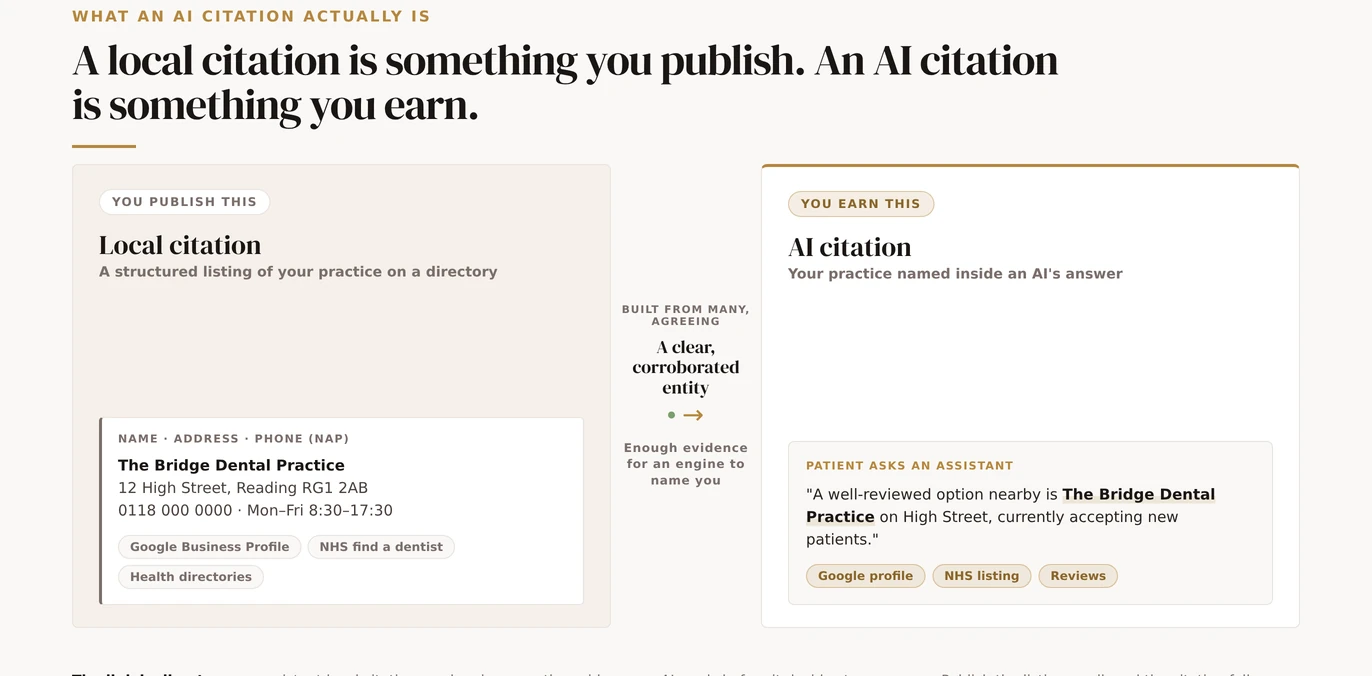
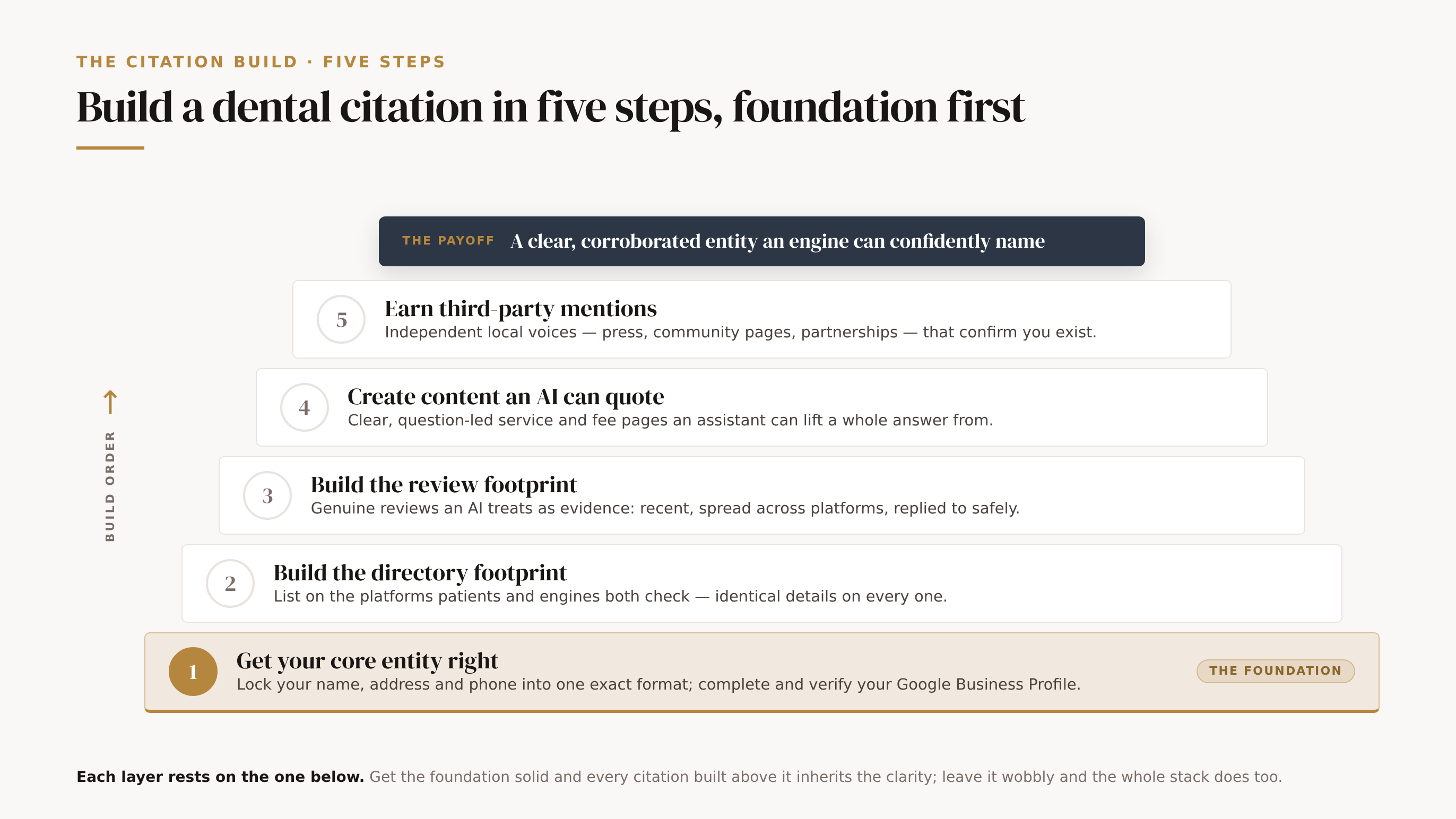
An AI citation is your dental practice being named or linked inside an assistant's answer to a patient, and you earn it rather than buy it. It comes from making one thing true: your website, Google Business Profile, NHS listing, directories and reviews all describe the same practice in the same way, so an engine can verify you and name you with confidence. The five steps below build that corroborated picture in order, foundation first.
An AI citation is the moment an assistant like ChatGPT, Perplexity or Google's AI Overview names or links your practice inside its answer to a patient. You earn one not by paying for it, but by being described in the same consistent way across the sources those tools trust: your website, your Google Business Profile, the NHS listing and the health and local directories patients use, all backed by genuine, recent reviews. Get those to agree and an engine has enough evidence to put your name in front of someone asking for a dentist. Leave them patchy or contradictory and it reaches for a practice it can verify instead.
This guide is the build that most advice only gestures at. It defines what an AI citation actually is, separates it from the local citation it grows out of, and then walks you through a five-step method to construct one: the core entity, the directory footprint, the review footprint, the on-site content an engine can quote, and the third-party mentions that confirm you exist. It is written for UK practices, stays inside General Dental Council rules throughout, and asks you to overclaim nothing. If you want the companion piece on the wider question of being recommended at all, our guide to how dentists get recommended by ChatGPT sits alongside this one.
The short version
- Citation, not payment. An AI citation is your practice named inside an assistant's answer; there is no paid slot, so you earn it by being verifiable.
- Local citations feed AI citations. Your consistent directory listings and reviews are the evidence an engine reads before it decides to name you.
- Get the entity right first. One exact name, address and phone number everywhere, a complete and verified Google Business Profile, and schema on your own site.
- Breadth with consistency. Be present on the platforms patients and engines both check, every listing carrying identical details; consistency beats volume.
- Reviews and mentions decide the rest. Genuine, recent reviews spread across platforms, plus real third-party mentions, tip an engine towards naming you.
What is an AI citation, and how is it different from a local citation?
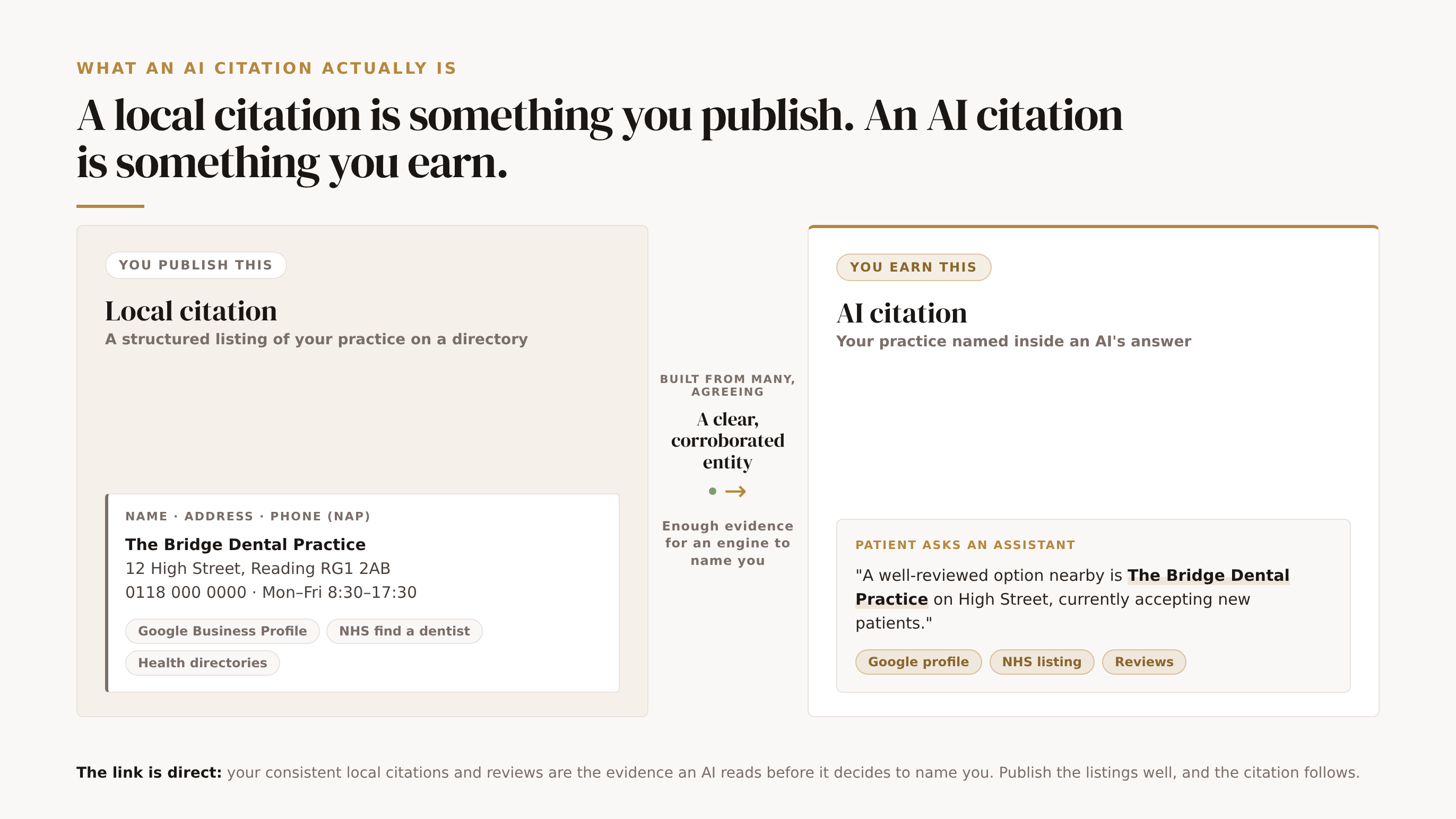
They are related but not the same, and the difference is the thing most articles miss. A local citation is a structured listing of your practice on a directory: your name, address and phone number (the NAP), usually with your hours, website and services, sitting on a platform like your Google Business Profile, the NHS "find a dentist" service, Yell or a healthcare directory. An AI citation is your practice being named or linked inside an AI's answer to a question. The first is something you publish. The second is something you earn.
Side by side
A local citation and an AI citation are related, not the same
| Local citation | AI citation | |
|---|---|---|
| What it is | A structured listing of your NAP, hours and services | Your practice named or linked inside an AI's answer |
| Where it lives | A directory: Google Business Profile, the NHS service, Yell, a healthcare platform | Inside a reply from ChatGPT, Perplexity or Google's AI Overview |
| How you get it | You publish it | You earn it, because consistent citations and reviews build the corroborated entity an engine can name |
The link between them is direct: your local citations are a large part of the evidence an AI reads before it decides whether to give you an AI citation. When an assistant answers "who's a good dentist near me?", it gathers what the trusted sources say about the dentists in that area and names the ones those sources describe clearly and agree on. Your spread of accurate local citations is what lets the engine build that confident picture of you. Thin or conflicting listings give it a blurred one, and a blurred picture rarely makes it into the answer.
So the practical model to hold in your head is a chain. Consistent local citations and reviews across the web create a clear, corroborated entity. A clear entity gives an AI the confidence to name you. Being named is the AI citation, the visibility that now matters. Everything in this guide is about building the first link well enough that the last one follows.
Do patients really find dentists through AI now?
Yes, and the behaviour has moved from novelty to routine faster than most practice owners realise. BrightLocal's Local Consumer Review Survey 2026 found that use of ChatGPT and other generative AI tools for local business recommendations has risen from 6% of consumers the previous year to 45%, making AI the third most popular source of local recommendations, behind only Google and Facebook[1]. A channel that nearly half of consumers now use to find local businesses is not a fringe experiment; it is one of the main routes a patient takes to a dentist.
Patient behaviour
Why AI citations now decide who a patient finds
45%
of consumers now use AI for local recommendations, up from 6% the year before, making it the third most popular source
32%
of US adults use AI for health information or advice
97%
of consumers read reviews for local businesses before trusting them
BrightLocal, Local Consumer Review Survey 2026; KFF, 2025.
Health questions are a large part of what people bring to these tools. A KFF Tracking Poll in 2025 found that about a third (32%) of US adults now use AI for health information or advice[4]. KFF is a respected, non-partisan health research body rather than a marketing firm, which is why the figure carries weight where vendor surveys do not. "Find me a dentist taking on patients" sits squarely inside that behaviour: local, practical and health-adjacent.
The same shift is visible inside ordinary Google searches, where the AI answer increasingly sits above the old list of links. Pew Research Center, analysing real browsing data, found that 58% of US users ran at least one Google search in March 2025 that returned an AI-generated summary, and that when a summary appeared people clicked a traditional result in just 8% of visits, against 15% when no summary was shown[3]. When the AI answers and the click disappears, being the practice named in that answer is the visibility. There is no second prize for ranking tenth in a list nobody scrolls to.
That is the stake for citation work. The practices named in these answers are quietly collecting the patients who ask, and the loss stays hidden, because a patient steered elsewhere by an assistant never becomes a missed call you could count.
How does an AI decide which dentist to cite?
It looks for the dentist it can describe with the most confidence, and confidence comes from corroboration. No assistant wants to name a practice it is unsure about, so it leans towards the one that several independent, trustworthy sources describe in the same way. The closest verifiable model for how this works is the way Google ranks local results, which it explains openly. Google says local results are based on relevance, distance and prominence, and defines prominence like this: "Prominence means how well-known a business is... This factor's also based on info like how many websites link to your business and how many reviews you have. More reviews and positive ratings can help your business's local ranking"[2].
The citation chain
How corroboration turns listings into a recommendation
Consistent citations
Identical NAP across the directories and NHS listings a dentist is found on.
Reviews and mentions
Genuine reviews and third-party coverage describe the practice the same way.
A clear entity
The agreement across sources gives the engine a confident, unblurred picture.
The AI citation
The engine names the practice it can describe with the most confidence.
Read that carefully, because it is the plain mechanism this whole guide teaches. Two of the named inputs to prominence are off-site signals: how many websites link to and mention your business, and how many reviews you have. Those are, in plain terms, your citations and your review footprint. This is Google's documentation of its local ranking, not a set of published rules for AI assistants, and it would be wrong to claim otherwise.
But it is the clearest verifiable evidence we have that the things an AI needs to be confident about a local business (consistent presence across trusted sources, plus reviews) are the same things a search engine already weighs. An AI assembling an answer from those same sources is drawing on the same evidence trail.
BrightLocal makes the connection to AI explicit. Reflecting on the 2026 survey, its CEO described reviews as "an essential piece of evidence that your business is active, reliable. Also that it's worthy of prominent visibility and citation within traditional Google search and LLMs like ChatGPT, and AI search"[1]. The word "citation" there is BrightLocal's own, and it captures the point precisely: your reviews and your consistent listings are the evidence that earns the citation. So a dental citation strategy is not a trick. It is the deliberate construction of a clear, well-corroborated picture of your practice across every source an engine reads, so that naming you is the safe, obvious thing for it to do.
The five steps below build that picture in order, foundation first.
Step 1: Get your core entity right (the citation foundation)
Before you build citations anywhere, the thing they all point at has to be solid and identical. Your "entity" is the single, consistent definition of who your practice is: its exact name, location, contact details and services. If that definition wobbles from one place to the next, every citation you build afterwards inherits the wobble. This first step is unglamorous and decisive, and most practices that feel stuck have skipped it.
Lock your NAP into one exact format
Your name, address and phone number should read identically everywhere they appear: on your website, your Google profile, your NHS listing and every directory. Decide the canonical version once, down to the punctuation, and use only that. "The Bridge Dental Practice, 12 High Street, Reading RG1 2AB" and "Bridge Dental, 12 High St, Reading" look like the same place to you, but to a machine reconciling sources they can read as two practices, or as one practice it cannot pin down. When an engine is unsure which version of you is true, it tends to reach for a competitor it is sure about.
Write your canonical NAP into a single document and treat it as the master copy. Every listing you create or correct from now on is copied from that master, not retyped from memory. This one discipline prevents the slow drift that creeps in when a receptionist updates one platform, a marketing agency updates another, and an old listing nobody remembers carries a phone number you stopped using two years ago.
Complete and verify your Google Business Profile
Your Google Business Profile is the single most important local citation you own, and a foundation the others lean on. Claim it, verify it, and fill in every field: exact NAP, full opening hours including how out-of-hours emergencies are handled, a truthful "accepting new patients" status, every service you genuinely offer in plain words, real photographs, and accessibility details such as step-free access and parking. Google itself states plainly that "businesses with complete and accurate info are more likely to show up in local search results" and that verification makes a profile more likely to show up[2].
A complete, verified profile does double duty. It is the listing patients see directly, and it is one of the most trusted descriptions of your practice that an AI reads when assembling an answer. Half-finished profiles are extremely common in dentistry, which means completing yours properly is often the fastest single improvement you can make to how clearly an engine can describe you.
Add Dentist and LocalBusiness schema so machines read your details
Schema markup is the machine-readable label on your own website that states, in terms a search system cannot misread, that you are a dental practice, where you are, what you offer, your hours and how patients rate you. The relevant types for a dentist are Dentist (or the broader LocalBusiness), FAQPage for your common patient questions, and AggregateRating where you display genuine review scores.
Schema does not invent a claim for you; it removes ambiguity from facts that are already true, so the engine matching your practice to a patient's question has nothing to guess at. Our dental practice schema markup guide walks through the exact markup, but for citation-building the principle is enough: make your own site the clearest, most legible source about your entity, because it anchors every other citation that points back to it.
Step 2: Build citations across the directories dentists are cited from
With a solid entity in place, you can build the listings that corroborate it. The aim is breadth with consistency: a presence on the platforms patients and engines both check, every one carrying the same canonical NAP. BrightLocal found that the average consumer now uses six different review and recommendation sites when choosing a business[1], so a practice present on only one is invisible at the other five touchpoints. Breadth is not vanity; it is how you turn up in more of the places a decision actually gets made.
General local platforms
These are the broad business listings that feed mainstream search and, through it, the assistants. Build and verify your presence on each, with identical details:
- Google Business Profile, completed and verified as in Step 1, the anchor of the set.
- Bing Places for Business. Microsoft's index has long been the retrieval layer behind ChatGPT's web search, so a complete Bing listing matters more for AI visibility than its smaller search share suggests. Claim it and submit your details the same way you did for Google.
- Apple Business Connect. Apple Maps usage is rising sharply, and its listings feed Apple's own discovery surfaces. A claimed, accurate listing here is low effort and increasingly worth holding.
- Foursquare. Less obvious, and worth the attention precisely because most practices ignore it. Foursquare maintains an open location dataset that many apps and AI tools draw location answers from, so a correct Foursquare listing can quietly feed places you never deal with directly.
Health and dental-specific directories
General platforms establish that you exist; health-specific listings establish that you are a dentist, to sources that carry extra trust for a medical query. For a UK practice the ones to prioritise are:
- The NHS "find a dentist" service, where applicable. Both patients and engines treat the NHS listing as high-trust, so an accurate entry (truthful about whether you are accepting patients) is one of the highest-value citations a UK practice holds. A stale "accepting NHS patients" status here does real harm, to patients and to your consistency.
- Your GDC registration, kept current on the public register. It is not a marketing listing, but it is the authoritative confirmation that your clinicians are who you say they are, and it underpins the trust the rest of your presence claims.
- Reputable healthcare and clinic directories such as Doctify, WhatClinic and the listings run by any plan provider or professional body you belong to (for example Denplan or Practice Plan member directories, or a local NHS integrated care board listing). Choose established, relevant directories over volume for its own sake; a handful of trusted, accurate health listings beats fifty thin ones.
A short but necessary caveat: nobody outside the AI companies can publish a definitive list of "the directories ChatGPT reads", and any article claiming to has guessed. The reasoning here is the durable version: be present and consistent on the platforms patients genuinely use and that mainstream search genuinely indexes, because that is the pool the assistants draw from. BrightLocal's own advice to businesses in the 2026 survey lands in the same place: keep your website up to date, monitor your listings for inaccuracies, "build local citations on relevant niche and local sites, and check any sources that AI tools reference. If something is wrong, ask for a correction"[1].
Why consistency beats volume
A hundred listings that disagree with each other are worse than ten that match, because every contradiction gives an engine a reason to doubt the lot. The point of breadth is corroboration, and corroboration only works when the sources actually agree. A second phone number lingering on one old directory, last year's opening hours on another, a previous practice name surviving in a third: each is a small crack in the confident picture you are trying to build. Audit for these deliberately (the self-check later in this guide shows you how), and fix the contradictions before you chase new listings. One version of your facts, everywhere, is the whole game.
Step 3: Build the review footprint an AI treats as evidence
Reviews are among the strongest trust signals an engine has for a local practice, and the 2026 data makes clear that how you gather them matters as much as how many you have. BrightLocal found that 97% of consumers read reviews for local businesses, and that 41% now "always" read them when browsing, a sharp jump from 29% the previous year[1]. Reviews are no longer a nice-to-have; they are the evidence a patient (and an engine reading on the patient's behalf) checks before trusting you.
Three qualities of a review footprint do the heavy lifting:
- Recency. A bank of five-star ratings that stopped a year and a half ago reads, to patients and engines alike, as a practice that has gone quiet. The survey found recency now ranks among the most important factors consumers weigh, with many caring most about reviews written in the last few months. Gather them steadily and continuously, not in one burst before a quiet spell.
- Spread. With the average consumer using six review sites, a strong presence on Google alone leaves you thin everywhere else. Build genuine reviews across the platforms that matter for dentistry: Google first, then NHS profiles and reputable healthcare platforms.
- Responsiveness. BrightLocal flags slow or generic responses as an increasingly visible red flag; consumers expect businesses to acknowledge feedback almost immediately. Replying well is itself a trust signal.
The method that works is simple and repeatable. Ask satisfied patients at the right moment, after a completed course of treatment rather than mid-appointment, and make leaving a review a single tap. Reply to all of them, positive and negative, but never put a patient's clinical details in a public reply: thank them, address the general point, and take any specifics offline. That single discipline protects confidentiality and reads well to everyone, human and machine. The line you must never cross is buying, incentivising or editing reviews to mislead, which is both a fitness-to-practise problem and unlawful in the UK.
Step 4: Create the on-site content an AI can quote
Citations and reviews establish that you exist and are trusted; your own pages give the engine the specific, quotable facts it lifts into an answer. Engines quote pages that answer a precise question and ignore "welcome to our practice" copy that answers none. A patient does not ask "tell me about your practice"; they ask "how much is a private check-up in [town]?" or "can I see an emergency dentist near me today?" Each of those deserves its own clear, factual page, named the way patients name the treatment, describing what it involves, clear price ranges and typical timescales.
Structure these as self-contained answers. A short, direct response near the top of each page, in plain British English, is exactly the kind of passage an assistant can extract whole. A frequently-asked-questions block, marked up with FAQPage schema and written in real patient phrasing, gives the engine ready-made question-and-answer pairs to pull from.
This is where citation-building and content quality meet: the directories make you findable and trusted, and these pages give the engine something accurate and specific to say once it has decided to name you. Our pillar guide on how dentists get recommended by ChatGPT goes deeper on the page structure; for now, treat every service and fee page as a question waiting to be answered cleanly.
Step 5: Earn third-party mentions and links
The last input is the half of Google's prominence definition that has nothing to do with your own listings: "how many websites link to your business"[2]. A citation does not have to be a structured directory entry. A mention of your practice in local press, on a community organisation's page, in a dental association listing, or through a genuine local partnership is a third-party voice confirming you exist and matter in your area. These mentions are harder to manufacture than a directory listing, which is exactly why they carry weight.
Earn them the legitimate way. Sponsor or support a local event and be listed as a sponsor. Offer genuine expert comment to a local paper on an oral-health story. Build real relationships with nearby businesses, schools or community groups that have reason to mention you. Each authentic mention adds an independent strand to the web of evidence an engine reads, and unlike a paid placement (which does not exist for AI answers anyway), it is durable. The aim is not link volume for its own sake; it is a scatter of real, local, relevant mentions that corroborate the picture your listings and reviews already paint.
How do I check what AI already cites about my practice?
You can audit your own AI visibility today, free, in about fifteen minutes, and it is the sensible place to start before any spend. The check has two halves: what the assistants say about you, and whether your listings agree with each other.
Work through it like this:
- Ask the engines the patient's questions. Open ChatGPT, Google's AI Mode and Perplexity, and ask each the questions a real patient asks: "best dentist in [your town]", "NHS dentist near me taking on patients", "emergency dentist in [your area] today", "dentist for nervous patients in [town]". Note whether your practice is named, where in the answer it appears, and which sources the reply leans on. Ask each question more than once, since the reply changes between tries, and read the answer that recurs rather than any single attempt.
- Read what the AI says about you, then check the source. If an assistant names you but gets a detail wrong (old hours, a service you dropped, the wrong phone number), trace it back to the listing feeding that error and correct it. BrightLocal's advice is exactly this: "check any sources that AI tools reference. If something is wrong, ask for a correction"[1].
- Audit your NAP for drift. Search your practice name and check your Google profile, Bing listing, NHS entry and the main directories side by side. Any place where the name, address, phone or hours disagree with your master copy is a crack to fix.
Absent from every answer means the problem is foundational: an incomplete entity, thin citations, or contradictory details. Named only alongside a competitor means it is worth studying what they hold that you do not (fresher reviews, a live NHS listing, clearer service pages), because the gap between their presence and yours is your worklist.
Staying compliant: building citations inside GDC rules
Everything above is designed to sit comfortably inside the General Dental Council's rules, and the fit is not a coincidence: the moves that earn an AI citation are the same ones the GDC already requires. The GDC's Standards for the Dental Team requires at standard 1.3.3 that "you must make sure that any advertising, promotional material or other information that you produce is accurate and not misleading, and complies with the GDC's guidance on ethical advertising"[5]. That rule governs every listing, page and review reply in this guide.
In practice it means three things for citation work. First, keep every citation accurate and current: a stale "accepting NHS patients" status or an out-of-date fee is both a compliance risk and a consistency problem that damages your AI visibility, so accuracy serves you twice.
Second, describe treatments factually and avoid the superlatives and guarantees the rule is built to catch ("the best dentist in town", "painless dentistry", outcome promises); an engine cannot responsibly repeat an unverifiable superlative anyway, so it gains you nothing while it risks your registration. Third, handle reviews properly: solicit them genuinely, never incentivise or edit them to mislead, and never reveal clinical detail in a reply. Build your citations this way and compliance is not a brake on visibility; it is the same work, described from a different angle.
Where to start
If you do only three things from all of this, take them in order. Lock your NAP into one exact format and complete and verify your Google Business Profile, so the foundation every citation points at is solid. Build out the directory and NHS listings that corroborate it, with identical details on each. Then start gathering genuine, recent reviews across Google and the healthcare platforms, replying to all of them safely. Those three build most of the evidence an AI needs to name you, and every one of them sits squarely inside GDC rules. They are the groundwork behind any wider AI SEO for dentists programme.
Where to start
The three things to do first, in order
Lock your NAP and verify your Google Business Profile.One exact format for name, address and phone, so the foundation every citation points at is solid.
Build the directory and NHS listings that corroborate it.Identical details on each, so trusted sources describe the practice the same way.
Gather genuine, recent reviews across Google and healthcare platforms.Reply to all of them safely, and keep them steady rather than gathered in one burst.
Keep every one of them inside GDC rules.Build most of the evidence an AI needs to name you without straying from the standards.
If you would rather see where your practice stands before spending anything, a free QBiz Leads AI visibility check reads your own pages in about thirty seconds and gives a plain pass or fail on whether an engine can verify and describe your practice from what it finds, with the weakest areas flagged for attention first. It is the no-cost first step before any spend.
Get your free AI visibility check →
Frequently asked questions
What is an AI citation for a dental practice?
It is your practice being named or linked inside an AI's answer, when an assistant like ChatGPT, Perplexity or Google's AI Overview responds to a patient's question by recommending you. It grows out of your local citations (your structured listings on directories such as your Google Business Profile and the NHS service) plus your reviews: those are the evidence the AI reads before deciding it is confident enough to name you. You publish the listings; you earn the AI citation.
Can I pay to get cited by ChatGPT or Perplexity?
No. There is no paid placement that buys you into an AI recommendation the way Google Ads buys a slot above the organic results, and anyone promising to pay your way into an AI answer is selling something that does not exist. You earn the citation by being the practice the engine can most confidently verify and describe: complete, consistent listings, genuine recent reviews, and clear service pages. That route is open to a single-site practice as much as to a national group.
How many directory citations does my practice need?
There is no magic number, and chasing volume is the wrong target. What matters is consistency and relevance: a solid presence on the platforms patients actually use (your Google Business Profile, Bing Places, Apple Business Connect, the NHS listing and a handful of reputable health directories), every one carrying identical details. With the average consumer using six different review and recommendation sites, being present and accurate across a relevant spread beats being listed everywhere with details that disagree. Ten matching citations are worth more than a hundred conflicting ones.
Do my reviews affect whether an AI recommends me?
Yes, strongly. Reviews are among the clearest trust signals an engine has for a local practice, and 97% of consumers read them before choosing a business. BrightLocal describes reviews as evidence worthy of prominent visibility and citation within traditional Google search and LLMs like ChatGPT. Recency and spread matter as much as the total: a steady stream of genuine, recent reviews across Google, the NHS and healthcare platforms counts for more than a large but ageing collection on a single site.
How long until my practice starts getting cited by AI?
There is no fixed timeline, and AI answers are volatile by nature, shifting from week to week even for practices doing everything right. Completing your Google profile and starting to gather recent reviews can move things within a few weeks; building a consistent directory footprint, fixing contradictory details across the web and earning enough corroboration to be named confidently takes longer, often a few months of steady work. Treat the durable groundwork as the goal and the day-to-day fluctuation as weather. There is no shortcut that survives contact with how these engines verify a practice.
Sources
- [1] BrightLocal, Local Consumer Review Survey 2026: https://www.brightlocal.com/research/local-consumer-review-survey/ (US-weighted; independent. Use of ChatGPT and other generative AI tools for local recommendations rose from 6% to 45%, third most popular source; "97% of consumers read reviews for local businesses"; 41% now "always" read reviews, up from 29%; the average consumer uses six different review sites; CEO Myles Anderson calls reviews evidence "worthy of prominent visibility and citation within traditional Google search and LLMs like ChatGPT, and AI search"; advises businesses to "build local citations on relevant niche and local sites, and check any sources that AI tools reference".)
- [2] Google Business Profile Help, "Tips to improve your local ranking on Google": https://support.google.com/business/answer/7091?hl=en (Global; primary. Local results rest on relevance, distance and prominence; prominence is "also based on info like how many websites link to your business and how many reviews you have. More reviews and positive ratings can help your business's local ranking"; "businesses with complete and accurate info are more likely to show up in local search results", and verification makes a profile more likely to show up. Used as the closest verifiable analogue for how off-site mentions and reviews build the prominence an AI also reads; not presented as published AI-citation rules.)
- [3] Pew Research Center, 22 July 2025: https://www.pewresearch.org/short-reads/2025/07/22/google-users-are-less-likely-to-click-on-links-when-an-ai-summary-appears-in-the-results/ (US; independent. "About six-in-ten respondents (58%) conducted at least one Google search in March 2025 that produced an AI-generated summary"; users who encountered a summary clicked a traditional result in 8% of visits, against 15% for those who did not.)
- [4] KFF, Tracking Poll on Health Information and Trust, 2025: https://www.kff.org/public-opinion/kff-tracking-poll-on-health-information-and-trust-use-of-ai-for-health-information-and-advice/ (US; independent. "About a third (32%) of adults are turning to AI for health information and advice", including about three in ten (29%) who used AI tools in the past year for information or advice about their physical health.)
- [5] General Dental Council, Standards for the Dental Team, principle 1, standard 1.3.3: https://standards.gdc-uk.org/pages/principle1/principle1 (UK; regulatory, not a statistic. "You must make sure that any advertising, promotional material or other information that you produce is accurate and not misleading, and complies with the GDC's guidance on ethical advertising.")
Leave a comment
Thoughts on this post? Leave a comment below. Comments are moderated before they appear, so yours will not show on the page straight away.
Your email is used only to contact you about your comment if needed — it is never published.
Comments
No comments yet. Be the first to leave one above.