QBiz Leads AI

AI Optimization for HVAC Companies

AI optimization for HVAC companies: be the name AI gives for both seasons

HVAC runs on two demand peaks a year, a summer cooling peak and a winter heating peak, and most contractor websites are only built for whichever one was live when the site went up. That leaves the other half of the year running on stale content, right when an AI system is deciding which company to name for a dead furnace or a failed AC unit.

The company an AI system names for a dead furnace or a failed AC unit is almost never the only one nearby; it is the one whose site already had the season-specific facts the answer needed. A furnace question in January and an AC question in July draw on different pages, different cost ranges and different urgency, and an engine only reaches for a company when it can pull that specific combination straight off the site rather than piecing it together. QBiz Leads structures HVAC company websites so that clarity and proof hold through both peaks: the systems you service, the technicians who hold the credentials, the areas you cover and what a job costs, all year.

Check your HVAC company's AI visibility
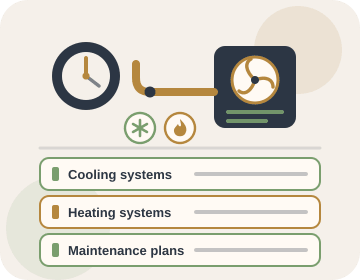
HVAC company page structure shown as crawlable cooling, heating and maintenance service cards.

Summary

Short version: HVAC demand runs on two seasonal peaks a year, not one, and most HVAC company websites are built around a single peak or a single generic services page. QBiz Leads structures HVAC sites so AI platforms can find and recommend a specific company for a specific system, season and service area: system-by-system content, technician and manufacturer-dealer credentials as machine-readable facts, transparent quoting content, and off-site brand distribution, all rebuilt and re-verified before each seasonal peak rather than set up once and left.

Most HVAC websites are built for one season and one query type

01

"We service all makes and models" tells AI nothing useful

A one-line services list gives an answer engine nothing to work with: no system types, no brand relationships, no service radius, no pricing context. AI needs specifics to generate a useful answer: which brands you install, whether you handle ductless mini-splits or only central systems, whether you cover commercial rooftop units, what a maintenance plan includes. Without that detail, an AI system cannot tell your company apart from the next contractor whose site says the same three words, and it defaults to whichever company spelled the details out, or to a directory listing that did.

02

Directory listings answer the questions your site does not

Ask an AI platform for an HVAC recommendation and a directory or marketplace listing often outranks your own site as a source. The reason has nothing to do with brand preference: those listings carry structured facts an AI system can use, system types serviced, verified reviews, service-area boundaries, licensing detail, that your own site never states in a form a crawler can parse. If that information sits in a PDF, a certificate photo or a paragraph of prose, the directory fills the gap your own site left open.

03

Certifications and dealer status are invisible without structure

A NATE-certified technician with EPA 608 certification and manufacturer dealer status carries real credibility, but only if an AI system can read it as a fact rather than infer it from a badge image. A wall-certificate photo or a footer logo is invisible to a crawler that only parses text and structured markup. A younger HVAC company with a properly structured site can be easier for an AI system to evaluate than an established one whose proof sits in images no crawler can parse.

How HVAC Demand Actually Moves

HVAC runs on two demand peaks a year, not one

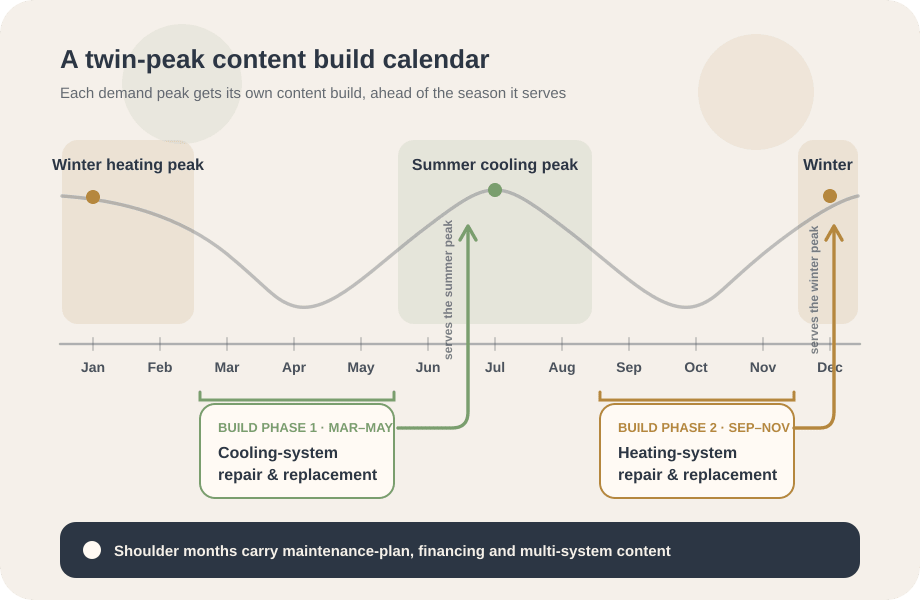
Roofers work around storm urgency. Plumbers split into emergency, installation and commercial buckets. HVAC is different: demand runs on a twin-peak seasonal cycle, a summer peak driven by cooling failures and a winter peak driven by heating failures, with a shoulder-season stretch in between where installation, replacement and maintenance-contract queries dominate instead of repair queries. A site built in June around AC repair costs and cooling-season FAQ content is still carrying that same content in January, when the live query is about a dead furnace, not a warm-air complaint, and the estimate ranges on the page are for the wrong system entirely.

QBiz Leads builds your content calendar around that cycle rather than a single campaign: cooling-system repair and replacement content structured ahead of the summer peak, heating-system repair and replacement content structured ahead of the winter peak, and maintenance-contract, financing and multi-system content built for the shoulder months when homeowners are researching rather than reacting. Each peak gets its own AI-legible service content, refreshed and re-verified before the season it serves, so an answer engine has current, season-appropriate content on your site to draw from whichever month a query arrives.

Twelve-month content calendar showing cooling-system content built ahead of summer and heating-system content built ahead of winter, with maintenance content in the shoulder months.
A twin-peak content build calendar: cooling-system content structured ahead of the summer peak, heating-system content structured ahead of the winter peak, and maintenance/financing content built for the shoulder months between them.

How HVAC Customers Search Now

HVAC customers are asking AI before they call anyone

A homeowner whose system fails does not always start with a phone book search anymore. They ask an AI platform directly: "why is my furnace short cycling," "should I repair or replace a 12-year-old AC unit," "how much does a heat pump installation cost in [region]." What comes back is usually a short, specific reply naming one contractor or a handful of them. A company left out of that reply is out of the running before the customer ever opens a browser tab to search further.

Repair and no-cool/no-heat queries

A dead AC in July or a dead furnace in January is the highest-urgency HVAC query there is. The homeowner wants an immediate, specific answer: is this a simple fix, what will it likely cost, and who can come today. AI answers that name a specific HVAC company, explain what a typical repair visit involves and give a realistic cost range convert faster than a homeowner working through a directory list of ten contractors with no context.

Installation, replacement and financing queries

A system replacement is a considered purchase, not an emergency call. Homeowners research system types, efficiency ratings, brand differences, installation timelines and financing options before choosing a contractor. If your site answers those questions with specific detail, rather than a generic "request a free estimate" form, you are the one an AI system can cite with confidence.

Maintenance-contract and multi-system queries

Property managers, landlords and homeowners with multiple systems (a primary residence plus a rental, a main house plus an addition) ask AI for maintenance-plan comparisons and multi-system service capacity. A specific question like that gets a short list of names back, not a wide field of options. Spell out your maintenance-contract terms and multi-system capability in detail and you are far more likely to be one of those names than a company that lists "maintenance plans available" as a single bullet point.

Pricing Clarity

Quoting and estimate transparency, built for AI as well as the homeowner

A homeowner asking an AI platform what a job costs is not looking for an exact figure; they are looking for a realistic range and an explanation of what changes it. If your page only says "contact us for a quote," it gives an AI system nothing to relay, so the system either skips you or falls back to a national average from a directory site with no connection to your company at all.

QBiz Leads builds AI-legible pricing and estimate content across three query types that the existing HVAC content on most sites does not separate: repair-visit cost ranges and what affects them (parts availability, system age, refrigerant type), installation and replacement cost ranges by system type and size, and maintenance-contract terms with what is included at each tier. Financing signals (available plans, typical terms) are structured alongside cost ranges so a financing question and a cost question can both be answered from the same page.

Every quote-adjacent question an answer engine might field, what a capacitor replacement runs, why a refrigerant type changes the price, what a maintenance tier covers, needs a specific, current answer on your site to draw from. QBiz Leads builds and maintains that content directly on your site rather than leaving it to a generic estimate form.

Method

How we build AI visibility for HVAC companies, across every season

HVAC companies sell systems and service visits, not a single job type. QBiz Leads builds the content structure, schema and credential architecture your HVAC business actually needs: repair, installation, replacement and maintenance-contract pages split by system type, technician and entity credentials made machine-readable, and a service-area and multi-system architecture that scales with what you actually service.

  1. Audit your website for AI readiness: system-type clarity, structured data accuracy, FAQ depth, seasonal content coverage, AI crawler access and credential visibility. You get back a straight list of every system, service and credential that's already legible to a crawler, and a separate list of what still is not.
  2. Build individual pages for each system type and service you handle: central air, ductless mini-splits, heat pumps, furnaces, boilers, commercial rooftop units, indoor air quality, and maintenance plans. Each page answers what a homeowner or facilities buyer actually asks: what the job involves, typical cost range, timeline and what qualifications matter. Commercial rooftop units and indoor air quality get their own build treatment rather than a shared paragraph on a general page, because the buyer and the query are both different from a residential repair search: a facilities manager comparing rooftop-unit service contracts wants uptime guarantees and multi-unit scheduling, and a homeowner asking about indoor air quality wants filtration, humidity control and duct-cleaning specifics, not a repeat of the repair-or-replace framing that answers a failed-system query.
  3. Structure your technician and entity credentials as machine-readable facts, not certificate photos: NATE certification, EPA Section 608 certification, manufacturer dealer or installer status and state HVAC contractor licensing, each mapped to schema properties such as hasCredential rather than left as unstructured text or an image. This is entity-building work QBiz Leads performs on your behalf, distinct from simply mentioning a certification in a paragraph.
  4. Build a service-area and multi-system signal architecture: a structured map of which systems you service in which zip codes, towns or counties, expressed in both readable text and schema (Service, GeoCoordinates, areaServed) so an AI system can match a specific query ("who installs heat pumps in [town]") to a specific, checkable answer rather than a generic "we cover the region" statement.
  5. Mark up every fact an AI system would otherwise have to guess at: which systems you service, your state licensing, your technician credentials and your reviews, expressed through LocalBusiness, Service, FAQPage, Review and GeoCoordinates schema built around your actual offering, not a generic template pulled from a plugin.
  6. Run a review-velocity program across both seasonal peaks: structured review markup plus a review-request cadence timed to summer cooling jobs and winter heating jobs rather than a single annual push. If your most recent reviews are six months old going into a new peak season, that looks stale to both homeowners and AI systems comparing recency; a steady cadence through both peaks keeps that signal current year-round.
  7. Structure manufacturer dealer and installer locator programs as an independent, third-party corroboration source (see the next section) alongside your own site content, so an AI system has more than one machine-readable place to confirm the same facts.
  8. Hand over a ranked to-do list ordered by which fixes win the most HVAC inquiries: which system and season pages to build next, which crawl-access settings to change, which credentials to surface. Plain language, no vanity metrics.

A Trust Signal Most HVAC Sites Never Use

Manufacturer dealer and installer locator programs are a third-party proof source most HVAC sites leave unused

Major HVAC equipment manufacturers maintain public, searchable directories of the dealers and installers authorized to sell and service their equipment. These directories are independent of your own website, structured and machine-readable, and updated by the manufacturer rather than by you, which makes them a genuinely different kind of trust signal than a testimonial or a self-reported certification.

For an AI system deciding whether to trust a credential your company claims about itself, a matching entry in a manufacturer's own dealer or installer directory is corroboration from a source you do not control. QBiz Leads checks whether your dealer or installer status is listed in the relevant manufacturer directories, structures that status as a fact on your own site with schema linking the credential to its issuing organization, and keeps that listing current as part of the ongoing service, not a one-time setup step.

A missing or stale entry is its own signal, and not a good one. If your site claims a manufacturer partnership and the manufacturer's own directory lists a different branch address, an out-of-date service area, or no listing at all, that mismatch is something an AI system can read as a contradiction between two sources that are supposed to agree. QBiz Leads flags that gap and gets the listing corrected or renewed so the two sources back each other up instead of undercutting each other.

Evidence

HVAC demand is real and mostly untouched by AI-visibility work

Homeowners are shifting fast toward AI tools for local recommendations, and most HVAC company websites are still built for someone scanning Google's blue links rather than for an AI system generating a direct recommendation. That gap is the opening: whichever company structures its content first is the one an answer engine has something to work with when the next repair or replacement query comes in.

27% to 67%The share of US homes with central air conditioning rose from 27% in 1980 to 67% in 2020.[1] Central air has gone from a minority feature to the standard in most of the country, which is exactly the base of homeowners now asking AI platforms for a contractor when that equipment needs service or replacement.
6% to 45%Use of generative AI tools such as ChatGPT for local business recommendations rose from 6% in BrightLocal's prior-year survey to 45% in the 2026 edition, making it the third most popular source of business recommendations.[2] That shift applies directly to how homeowners now find an HVAC contractor for a repair or installation.

US EPA, Section 608 program.[3] Cited where the page discusses EPA 608 certification as a structured credential.

  1. ^ US Energy Information Administration, "Electricity use in homes" — https://www.eia.gov/energyexplained/use-of-energy/electricity-use-in-homes.php
  2. ^ BrightLocal, Local Consumer Review Survey 2026 — https://www.brightlocal.com/research/local-consumer-review-survey/
  3. ^ US EPA, Stationary Refrigeration and Air Conditioning / Section 608 — https://www.epa.gov/section608

One page per system and season beats one page for everything

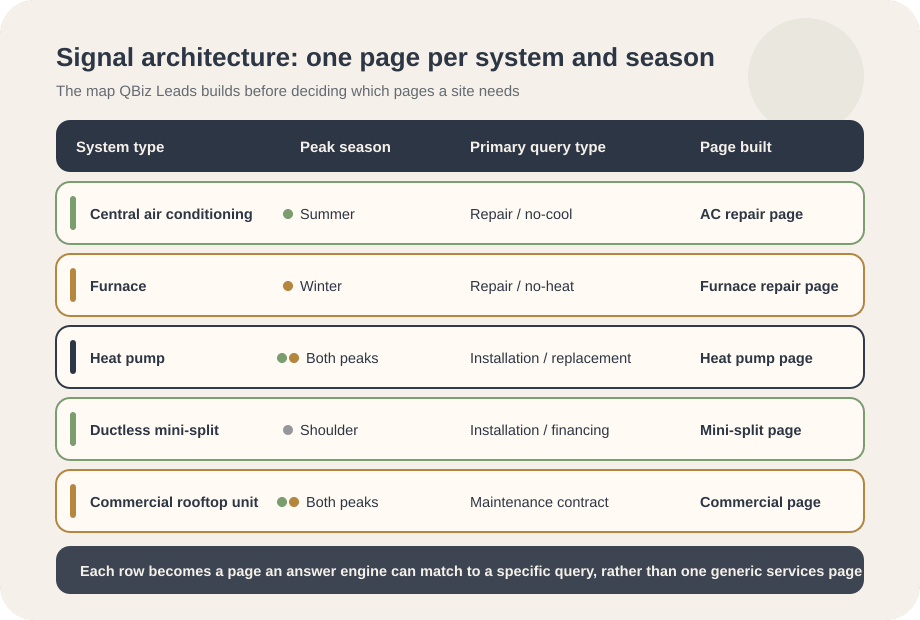
A single "HVAC services" page covering every system and every season in generic terms gives an AI system little to match a specific query against. QBiz Leads maps your real service offering into a structured table of system type by season by query type, then builds the page architecture from that map rather than guessing which combinations matter.

Commercial rooftop units and indoor air quality sit at opposite ends of that map from a residential repair page, and both carry less competition precisely because most HVAC sites never build them out. A rooftop-unit page for a facilities buyer needs multi-unit service contract terms, response-time guarantees and access-scheduling detail that a homeowner-facing repair page has no reason to carry. An indoor air quality page needs filtration ratings, humidity-control options and duct-cleaning specifics that a repair-or-replace page does not answer either. Building both out as their own pages, rather than a shared sentence on a general services page, is what lets an AI system match a facilities query or an air-quality query to your site instead of skipping past it.

Table mapping HVAC system types to their peak season, primary customer query type and the service page built for each.
A structured map of system type, peak season and query type used to plan which pages an HVAC company's site needs, rather than a single generic services page.

Repair, maintain or replace: content that mirrors how homeowners actually decide

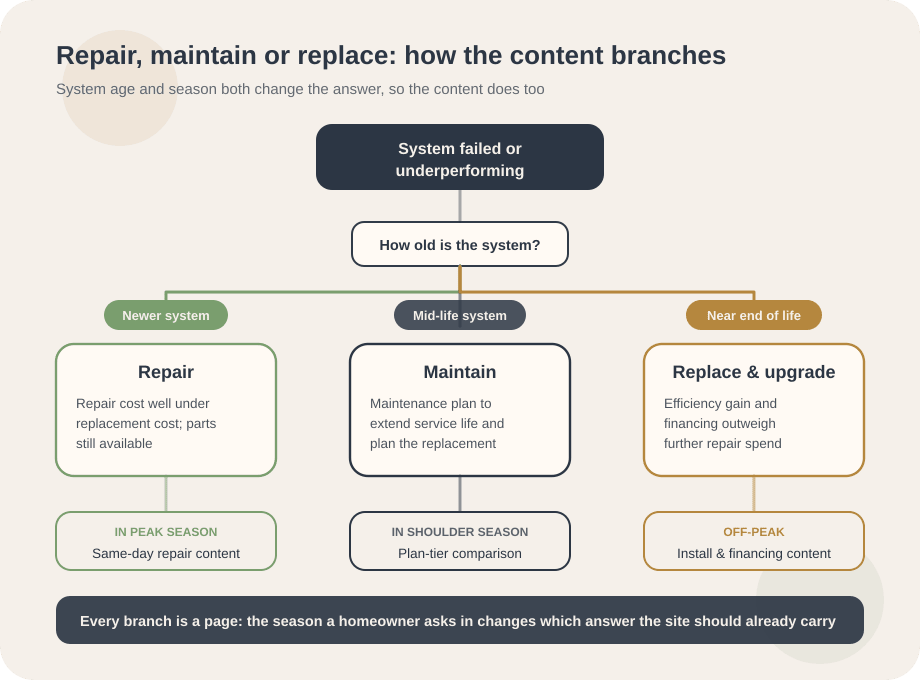
When a system fails or underperforms, a homeowner is weighing one of three paths, and which one applies depends on system age, repair cost relative to replacement cost, and the season. QBiz Leads builds this as structured, branching content on your own site, distinct from the generic two-option "repair or replace" framing homeowner-facing content typically uses, because the maintenance path and the season both change the answer:

  • Repair. The system is young enough or the fault minor enough that a repair resolves it without changing the cost-benefit math for at least another season.
  • Maintenance-plan enrollment. The system is functional but aging, and a scheduled maintenance plan extends its working life and catches the next fault before it becomes an emergency.
  • Replace and upgrade. Repair cost approaches or exceeds a fraction of replacement cost, or the system is old enough that efficiency gains from a new unit offset the upfront cost within a reasonable timeframe.
Decision tree branching from a failed or underperforming HVAC system into repair, maintenance-plan or replace-and-upgrade paths, factoring in system age and season.
A branching decision path for repair, maintenance or replace-and-upgrade content, factoring in system age and season rather than a flat two-option comparison.

FAQs

Frequently asked questions

What is AI optimization for HVAC companies?
AI optimization for HVAC companies means giving a heating and cooling contractor's website the specific, machine-readable details an answer engine checks before naming that company over a directory listing: the system types it services (central air, heat pumps, furnaces, ductless mini-splits), the brands it installs, the certifications its technicians hold, and the zip codes or counties it actually covers across both the cooling season and the heating season. That scope runs from system-specific service pages and licensing schema through FAQ depth to the platform-by-platform tuning each AI system reads differently.
How is this different from normal HVAC SEO?
Traditional HVAC SEO chases Google's organic rankings with keywords and backlinks. AI optimization sits alongside that: season-specific system pages for both the summer and winter peaks, schema that treats a furnace repair and a heat-pump installation as separate, distinctly defined services, and crawler access tuned so ChatGPT and Google AI Overviews can actually parse the page. Ranking well in Google says nothing about whether an AI system can read and cite that same page.
Can you guarantee my HVAC company will be recommended by AI?
No, and that is not a promise a credible agency can make. Which businesses an AI system surfaces is a decision made inside that platform, and the criteria shift with every model update, outside anyone's control. What QBiz Leads does is strengthen the checkable, structured signals, credential schema, system-specific service pages, verifiable service-area data, that give an HVAC company the best odds of being the one an AI system can confidently name. No agency can guarantee a mention, a ranking, or a specific volume of AI-driven calls.
Does this work cover both heating and cooling systems?
Yes. HVAC runs on a twin-peak cycle: cooling failures cluster in summer, heating failures cluster in winter. QBiz Leads builds and maintains AI-legible content for both peaks year-round, rather than optimizing once for whichever season a project starts in and leaving the other half of the year underbuilt.
Which HVAC services benefit most from AI visibility?
No-cool and no-heat repair calls carry the sharpest urgency, so a well-built repair page converts an AI-driven visitor fastest. Installation and replacement queries take longer to close but reward detail, since homeowners are comparing system types, efficiency ratings and financing before they pick a contractor. Maintenance-contract queries respond well to plainly stated plan terms and coverage tiers. Commercial rooftop-unit and multi-property queries carry the biggest upside of all, precisely because almost no HVAC site builds that content out, so the field is close to open.
How do you make technician credentials visible to AI?
QBiz Leads structures NATE certification, EPA Section 608 certification, manufacturer dealer or installer status and state HVAC contractor licensing as explicit, machine-readable facts using schema properties such as hasCredential, rather than leaving them as a certificate photo or a line in an About page. That structure is what lets an AI system state a credential as a fact instead of skipping it.
Do I need a separate page for every system and season?
Not every combination needs its own URL, but a single page covering every system and season in generic terms rarely gives AI systems enough to work with. QBiz Leads maps your service area, system types and seasonal demand into a signal architecture: dedicated content for the systems and seasons your business actually handles, connected by clear internal linking so crawlers can find and trust every part of it.
How does AI optimization handle quotes and estimates?
QBiz Leads builds transparent, AI-legible pricing and estimate signals across repair, installation and maintenance-contract content: typical cost ranges, what affects a quote, financing options and what an estimate visit involves. A page that just says "call for pricing" gives an answer engine nothing checkable to relay, so specific ranges win the citation instead.
Do I need to rebuild my entire HVAC website?
Usually not from zero. QBiz Leads runs an audit first and works from what is already there rather than starting over. A site with one page covering every system and season generally does need dedicated pages built out; a site that already has reasonable service copy might only need structured data, credential schema or deeper FAQ content layered in. How much changes depends on how much of what an AI crawler needs is already on the page in a form it can actually read.
How long before I see results?
AI models have to re-crawl a site before technical fixes show up in what they surface, and that typically starts within a few weeks. Broader gains in how often a company gets named build over several months as the models accumulate confidence in the site as a source. Because HVAC has two separate demand peaks, the fairest read on whether the work is paying off usually waits until a company has been through one summer cooling season and one winter heating season with the rebuilt structure live.
Off Your Own Site

Off your own site is where a tied HVAC race actually gets decided

Two HVAC contractors can each run clean system pages, working schema and every credential structured as fact, and an engine can still read both companies equally well, whether it is Perplexity, Gemini, Copilot, ChatGPT or Google's AI Overviews doing the reading. That parity is the floor, not the deciding factor. Once two sites clear it at the same level, the deciding factor sits outside either site: a matching entry in a manufacturer's dealer directory, jobsite footage that shows the actual crew and equipment rather than a stock photo standing in for it, and a name the wider web already recognizes.

The manufacturer dealer directories covered above are one form of that outside corroboration; earned media and platform presence are the rest of it, and QBiz Leads runs both. HVAC coverage tends to spike in exactly the outlets and searches homeowners are already using, timed to the weather rather than the calendar: a heatwave prompts local cooling-company advice pieces, a cold snap prompts furnace-safety segments, and a contractor whose name is already attached to that story before it breaks has a head start an engine can weigh.

News and authority coverage

A heatwave story about local cooling demand, a cold-snap piece on furnace safety, an efficiency-rebate explainer heading into a purchase season: this is the kind of HVAC coverage USA Today, Business Insider, AP News, MSN, BarChart, TheStreet, StreetInsider and Medium actually run, backed by a syndication tier of 500+ newspaper and TV-affiliate sites. QBiz Leads works to place your company inside that coverage rather than leaving the seasonal story to run without you in it.

Installation and system-changeout footage

Real installs and system changeouts, filmed on the job and published to YouTube, Vimeo, Facebook, Instagram, X, LinkedIn, TikTok and Reddit, give homeowners and answer engines alike something a stock photo cannot: proof of a specific crew handling a specific brand of equipment. QBiz Leads publishes that footage on your behalf as installs happen, building a running record instead of a one-off reel.

Podcasts and published material

A walkthrough of what a heat-pump changeout actually involves, or a one-page guide to reading a furnace efficiency rating, belongs somewhere a homeowner or a facilities buyer might already be looking: Spotify, Castbox, Pocket Casts and Apple Podcasts for audio, Issuu, Scribd, Calaméo and SlideShare for the written version. Publishing that material there gives your name another place to be found, next to real trade knowledge rather than a stock description.

Off-page work only pays off on top of a site an engine can already parse; skip the page-level work and there is nothing for a manufacturer listing or a press mention to reinforce. Do both, and a contractor an engine can read cleanly becomes the one it names when a manufacturer directory, a seasonal news story and real jobsite footage all point back to the same company. From here, the next step is turning that outside coverage into citations an answer engine can cite directly.

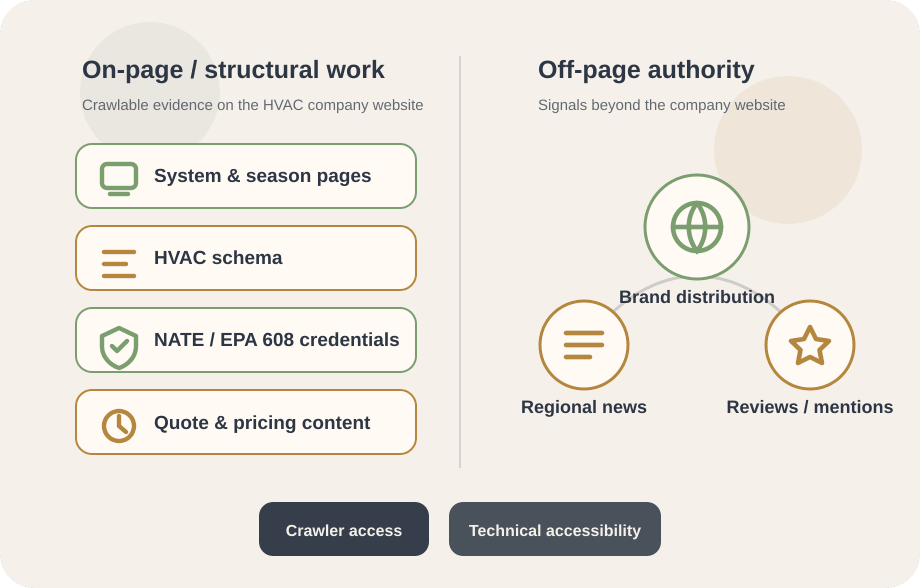
Diagram separating on-page HVAC service-page structure from off-page authority signals such as regional news coverage, brand distribution and reviews.
On-page structure and off-page brand distribution both feed AI recommendations for HVAC companies.
See the off-site half for HVAC

Summary

Short version: The HVAC companies AI platforms name are the ones whose sites hand over specific, checkable facts: which systems and brands they service, what a job costs, who is certified to do the work and where a manufacturer's own directory confirms it. A cooling-season answer and a heating-season answer draw on different facts, so the content behind each one needs its own refresh on its own calendar. A visibility check shows exactly which of those signals your site is missing.

See what an AI system can actually read on your HVAC site, season by season

A typical HVAC site is built for someone scrolling on a phone, not for a model reasoning about which system and credential facts it can trust. An AI-readiness check shows exactly which system, season and credential signals your site is missing before the next peak arrives.

Request your visibility check