AI Search vs Google Search: How Patients Actually Find a Local Dentist Now
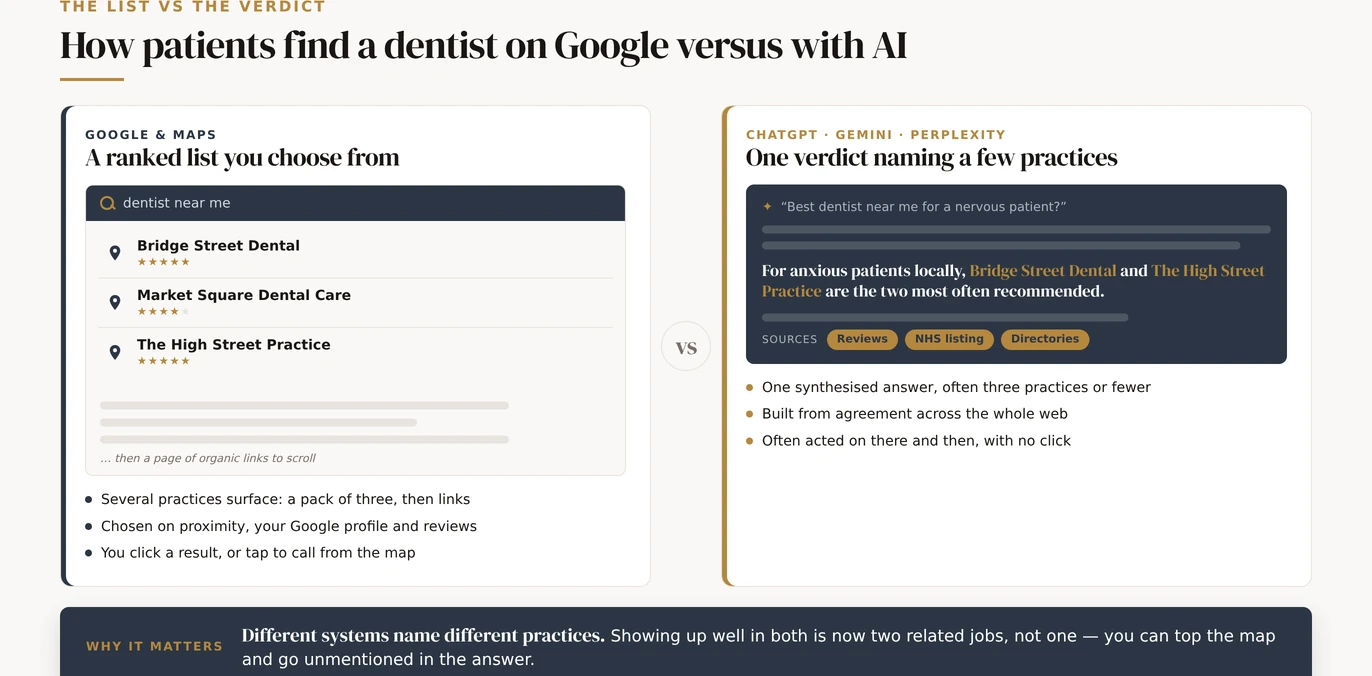
Patients now use Google and AI assistants side by side. Google returns a ranked list you choose from, while an AI assistant hands back one short verdict that names a few practices, and the two draw on different sources. Showing up well in both is now two related jobs rather than one. Google and Maps still carry most of the booking-ready traffic; the AI answer is the fast-growing research layer on top, and being named there is separate work from ranking in the list.
For years the path to a new dentist ran one way: type "dentist near me" into Google, skim the map pack and a few websites, pick one, book. That path still exists, but it is no longer the only one. A growing share of patients now open ChatGPT, Google's AI Mode or Perplexity and ask a question in plain words, then act on the single answer they get back, often without visiting anyone's website at all. The same patient might use both in a week: an AI assistant to research whether an implant is worth it, then Google Maps at the moment they want to phone someone today.
That split matters for your practice, because the two systems do not name the same dentists. You can sit at the top of Google Maps for your town and go completely unmentioned in an AI answer, and the reverse happens too. This guide explains how patients find a dentist on each, why the winners differ, which searches still belong to Google and which are moving to AI, and how to check, for free, whether your practice shows up in both. It is written for UK practices and stays inside General Dental Council rules throughout, because the work that wins an AI mention is the same work that keeps you compliant.
The short version
- Two systems, two winners. Google hands the patient a ranked list to choose from; an AI assistant hands back a short verdict naming a few practices. Being in the list and being in the verdict are separate outcomes.
- Different inputs, different names. Google Maps leans on proximity, your Google Business Profile and Google reviews; an AI answer is built from agreement across the wider web, so a strong Maps position does not carry over.
- Urgent searches stay with Google; research is moving to AI. Emergency and act-now queries still reward the map pack, while considered questions increasingly start with an assistant.
- Consistency and corroboration decide the AI mention. Matching facts everywhere and genuine reviews spread across platforms are what let an assistant name you with confidence.
- You are building one clean presence, not choosing a side. The same groundwork lifts both surfaces at once.
How do patients find a dentist on Google versus with AI?
On Google they get a list and choose from it: a map pack of three practices, then organic links, ranked mostly on proximity, your Google Business Profile and reviews. With an AI assistant they get a verdict: one short answer that names a handful of practices, synthesised from across the web, often read and acted on without a single click.
The shift, in numbers
AI is rising fast, but it has not replaced Google
40%
of consumers are actively using generative AI within search
70%
still default to Google (61% directly, rising to 70% once Safari is counted)
85%
consider contact information and opening hours an important factor when researching a local business
BrightLocal, Consumer Search Behavior (survey of 1,000 US consumers), 2025.
That difference in format changes who wins. A ranked list rewards being one of the better options near the searcher, because the patient still does the choosing. A synthesised answer rewards being the practice the engine is most confident naming, because the engine does the shortlisting before the patient ever sees a name. Being in the list and being in the verdict are different outcomes, and the rest of this guide is about the second one without losing the first.
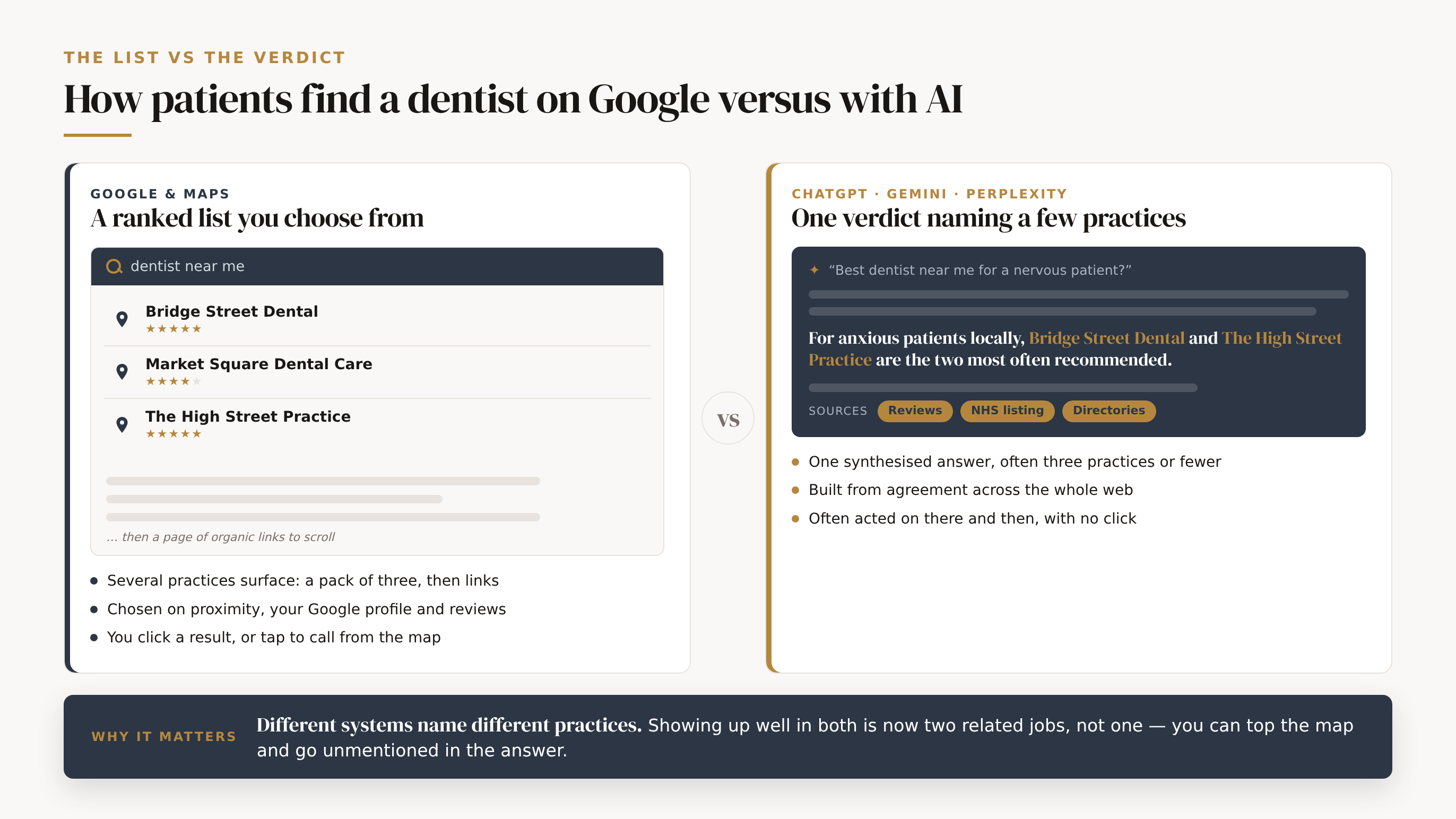
The shift is real but it has not replaced Google. BrightLocal's 2025 survey of 1,000 US consumers found that 40% are actively using generative AI within search, while around 70% still default to Google (61% to Google directly, rising to 70% once Safari is counted)[1]. Both numbers are large. Google's own figures point the same way on direction of travel: it reports that AI Overviews are "driving over 10% increase in usage of Google for the types of queries that show AI Overviews" in its biggest markets[5], a sign the behaviour is deepening rather than fading.
The practical reading is not "AI is taking over" or "AI does not matter yet", it is that a meaningful slice of patients now meets you in an AI answer first while the majority still meet you on Google, so you cannot afford to be invisible on either.
Google search versus AI search: the side by side
Here is the whole comparison in one place. Read down the two columns and the strategic point becomes obvious: the systems reward overlapping but distinct things, so the practice that treats them as one job tends to win only half of it.
Side by side
The same patient, two very different systems
| What the patient meets | Google Search and Maps | AI assistants (ChatGPT, Gemini, Perplexity) |
|---|---|---|
| What the patient sees | A ranked list: a map pack of three, then organic links | One synthesised answer naming a few practices, sometimes with citations |
| How results are chosen | Proximity, Google Business Profile completeness, reviews and signals inside Google's own ecosystem | Agreement across the open web: directories, reviews, the NHS listing, your site, weighed for consistency |
| How many practices surface | Several: a pack plus a page of links to scroll | A handful, often three or fewer |
| Which signals matter most | A complete, accurate Google profile; proximity; recent Google reviews | Consistent facts everywhere; reviews across many platforms; answer-ready, machine-readable pages |
| How fast it updates | Quickly, once your profile or reviews change | Slower and more variable; depends on the wider web catching up |
| What the patient does next | Clicks a result or taps to call from the map | Often acts on the answer itself, with no click |
That consolidated view is the heart of the matter. The left column is the work most practices have already paid someone to do. The right column is the work almost nobody has started, which is exactly why the practices being named in AI answers are quietly collecting patients their better-ranked rivals never see.
Why does AI recommend different dentists than Google?
Because the two systems read different maps of the web. Google's local pack leans on proximity, Google Business Profile completeness and review signals inside Google's own ecosystem. An AI assistant builds its answer from a broader picture: a general web index, third-party directories, review platforms, the NHS "find a dentist" service and your own pages, then weighs whether those sources agree. Different inputs produce different winners. This is the gap that catches owners out, and it has a name worth remembering: the visibility gap.
The gap exists because excelling in one system does not feed the other. A practice can have a flawless Google profile and still be absent from an AI answer if its details contradict each other across directories, its pages are thin or unreadable to a machine, or its reviews live only on Google. Equally, a smaller practice with tidy, consistent information spread across the web can be named ahead of a rival that outranks it on Google. The companion piece on organic SEO versus AI optimisation goes deeper on why these became two jobs; the short version is that ranking a page in a list and being quoted inside an answer are judged on different evidence.
There is a corroboration logic underneath it. A single website praising itself is the weakest possible signal, so an AI assistant looks for several independent sources that agree your practice exists, sits where you say it sits, and offers what you say it offers. The more places confirm you, and the more closely they match, the more confident the engine is in naming you. One stray old phone number on a directory, or opening hours that disagree between your site and your NHS listing, is enough to tip a close decision towards a practice the engine is surer about.
Which dental searches go to AI, and which still go to Google?
Not every dental query is moving at the same speed, and knowing which is which tells you where to spend first. As a rule, urgent and act-now searches still belong to Google and Maps, while considered research is the part shifting fastest to AI.
- Emergency and today searches stay with Google and Maps. "Emergency dentist open now near me", "knocked out a tooth, where do I go in Manchester". These are pure urgency: the patient wants a phone number and a pin, and the map pack delivers it in one tap. Explicit opening hours and a clear out-of-hours route win these.
- High-consideration research is moving to AI. "Is a dental implant worth it?", "best dentist for Invisalign in [town]", "NHS versus private check-up, what is the difference?". These reward a synthesised, balanced answer, which is exactly what an assistant produces, so they increasingly start there before the patient ever reaches a map.
- Treatment and price questions split between the two. "How much is teeth whitening in Cardiff?", "cost of a private check-up near me". Patients ask both Google and an assistant, and reward a clear, factual page either way.
- Insurance, plan and paediatric questions reward specifics on both. "Dentist who takes [plan]", "child-friendly dentist in [town] accepting new patients". Whoever has stated these facts plainly and consistently gets named; whoever buried them in a catch-all page does not.
Read that list as an audit. For each group, ask whether a patient could get a clear, specific answer about your practice from what is currently published about you, on Google and across the wider web. Every group where the answer is no is a group of patients one system or the other cannot route to you.
The two AI surfaces your practice has to win
It helps to split the AI side into two surfaces, because they need different work. The first is the informational answer: a patient asks "does a root canal hurt?" or "how long does Invisalign take?", and the assistant explains. The second is the local recommendation: "best dentist near me for nervous patients", and the assistant names practices.
You win the informational surface with answer-ready content: pages that pose the real patient question as a heading and answer it plainly in the first 40 to 60 words, backed by schema markup that labels you clearly as a dental practice. You win the local recommendation surface with the unglamorous groundwork: a complete Google Business Profile, genuine recent reviews spread across platforms, and business facts that agree everywhere an engine might look. The same practice often does well on one and poorly on the other, which is why "we have great content" and "we have great reviews" each only get you halfway. Our guide on Google AI Overviews and SGE for dentists covers the informational surface in depth.
The AI answer is more and more the endpoint, which raises the stakes for being inside it. Pew Research, analysing the browsing of 900 US adults, found that 58% saw at least one AI-generated summary in a month of Google searches, and that when a summary appeared people clicked a traditional result in just 8% of visits, against 15% of visits without one[4]. Fewer people scroll past the named set, so membership of it does most of the work.
How does an AI assistant decide which dentist to name?
It looks for the practice it can most confidently describe, and confidence comes from agreement across trustworthy sources. Four things carry most of the weight: consistent business facts everywhere, reviews across more than one platform, answer-ready pages a machine can read, and clear signals of a real, qualified, regulated practice.
Selection path
How an assistant decides which dentist to name
Patient question
The prompt names a treatment, a place or a need, such as a nervous-patient dentist nearby.
Facts and reviews
It reads business facts, reviews across platforms and answer-ready pages from across the web.
Do sources agree?
Conflicting details make it reach for a practice it is sure about instead.
The recommendation
It names the practice it can describe with the most confidence.
Consistency does the quiet heavy lifting. Your practice name, address, phone number, opening hours and service list should read identically across your website, Google profile, NHS listing and every directory, because an engine that finds conflicting versions reaches for a practice it is sure about instead. BrightLocal's survey found that 85% of consumers consider the presence of contact information and opening hours an important factor when researching a local business[3], which is exactly the information an assistant most wants to find stated cleanly and in agreement.
Reviews are the other heavy lever, and spread matters as much as the score. A wall of five-star reviews on Google alone reads as thinner evidence than a steady stream across Google, NHS profiles and healthcare-specific platforms. Because dentistry is a health subject, the trust bar is higher than for an ordinary local business: an engine is more cautious about naming a clinic, so genuine reviews, clear qualifications and GDC registration, and accurate service pages matter more, not less. None of this involves overclaiming. You become the easiest practice to verify, not the loudest. The full mechanics of being named sit in our guide to how dentists get recommended by ChatGPT.
Should you prioritise AI or Google?
Both, but in proportion to where your patients actually are. Google and Maps still drive the majority of high-intent booking traffic, so they remain the foundation: if budget is tight, a complete, accurate Google Business Profile and a steady flow of recent reviews come first, because they serve the patients who are ready to book today.
AI is the fast-growing research layer sitting on top of that, and ignoring it cedes the considered, higher-value enquiries to whoever did the work. The reassuring part is how much the two jobs overlap. Consistent facts, genuine reviews, clear service pages and clear pricing improve your standing on Google and your odds of being named by an assistant at the same time. You are rarely choosing between them; you are building one clean, consistent presence that both systems can read. Spend first where the booking-ready patients are, then extend the same groundwork outward so the AI answers start naming you too.
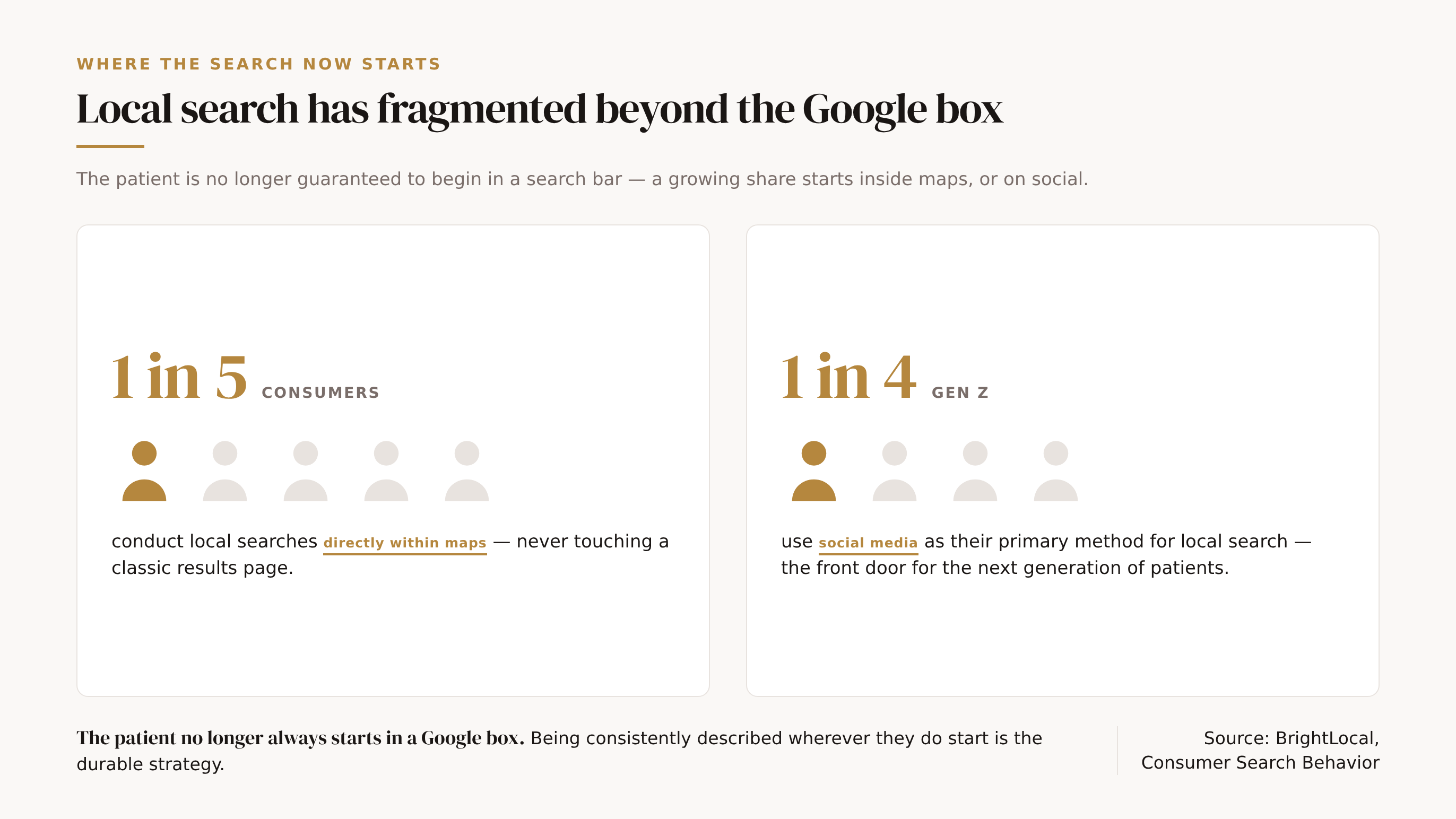
Local discovery has also fragmented well beyond the classic Google list, which is another reason to think in terms of presence rather than a single channel. BrightLocal found that 1 in 5 consumers conduct local searches directly within maps, and 1 in 4 Gen Z consumers use social media as their primary method for local search[2]. The patient is no longer guaranteed to start in a Google search box, so being consistently described wherever they do start is the durable strategy.
How to check if you show up in AI answers: a free 10-minute self-test
You can diagnose this today, for nothing, by becoming your own patient. Open ChatGPT, Google's AI Mode and Perplexity, and ask each the questions a real patient in your town would ask. Watch whether you are named, where in the answer you appear, and which sources the reply leans on.
- Run the real queries. Ask each assistant: "best dentist in [your town]", "NHS dentist near me taking on patients", "emergency dentist in [your area] today", and "dentist for nervous patients in [town]".
- Note where you enter, if you do. Named every time, named only sometimes, or never named? Write down which practices appear instead of you, and which sources the answer cites.
- Compare with Google. Run the same queries in Google and Maps. If you appear strongly there but not in the AI answers, you have found your visibility gap in black and white.
- Run each prompt a few times. The reply shifts between attempts, so it is the recurring pattern, not any single answer, that tells you where you genuinely stand.
Absent from every AI answer while present on Google means the problem is the wider web: inconsistent facts, thin pages, or reviews stuck on a single platform. Named only alongside a competitor means it is worth studying what they hold that you do not. Repeat the test monthly, because AI answers are volatile and the pattern over time tells you more than any one result.
Frequently asked questions
Are patients really using AI instead of Google to find a dentist?
Not instead of, alongside. BrightLocal's 2025 survey found 40% of consumers are actively using generative AI within search, while around 70% still default to Google. The practical reading is that patients now use both: an assistant to research and compare, Google and Maps at the moment they want to book. You need to show up in both, not pick one.
Why does my practice show in Google Maps but not in ChatGPT?
Because the two systems read different sources. Google Maps leans on your Google Business Profile, proximity and Google reviews; an AI assistant builds its answer from the wider web, directories, the NHS listing and reviews across many platforms, weighed for agreement. If those wider sources are missing, thin or contradict each other, the assistant cannot confidently name you even when your Maps listing is strong. That mismatch is the visibility gap.
Can I pay to be recommended by AI?
No. There is no paid placement that buys you into an AI recommendation the way Google Ads buys a slot above the results. Anyone promising to pay your way into an AI answer is selling something that does not exist. You earn the mention by being the practice the engine can most confidently verify: consistent facts, genuine recent reviews, clear pages.
Do reviews affect AI recommendations?
Yes, and spread matters as much as the score. Reviews are among the strongest trust signals an engine has for a local practice, but a large collection on Google alone counts for less than a steady stream across Google, NHS profiles and healthcare platforms. Gather genuine reviews steadily, and reply to all of them without ever revealing a patient's clinical details.
How often do AI answers change?
Often, and more than Google results do. The same query can name different practices from one week to the next, even for a practice doing everything right. Treat the daily fluctuation as weather and the durable groundwork as the goal: consistent facts, genuine reviews and answer-ready pages are what survive across the changes.
Do I still need Google and Maps if I optimise for AI?
Yes, firmly. Google and Maps still drive the majority of booking-ready traffic, and most of the work that wins AI mentions also strengthens your Google presence. Optimising for AI is an addition to your Google foundation, never a replacement for it.
Where to start
If you do only three things, take them in order. First, run the 10-minute self-test above so you can see your own visibility gap rather than guess at it. Second, make your business facts agree everywhere, since your name, address, phone, hours and services reading identically across your website, Google profile, NHS listing and directories is what lets both systems name you with confidence. Third, rewrite your key service and fee pages so each answers a real patient question plainly and provably. Every one of those sits comfortably inside GDC rules, and together they move you towards showing up in both the list and the verdict. They are the foundation of any wider AI SEO for dentists plan.
Where to start
Three moves, in order
Run the 10-minute self-test first.See your own visibility gap rather than guess at it.
Make your business facts agree everywhere.Name, address, phone, hours and services identical across your site, Google profile, NHS listing and directories.
Rewrite your key service and fee pages.Each should answer a real patient question plainly and provably.
Keep it all inside GDC rules.Together these move you towards showing up in both the list and the verdict.
If you would rather see where you stand before spending anything, a free QBiz Leads AI visibility check reads your website the way an AI crawler would and returns a clear pass or fail across the structure, schema and clarity signals that decide whether an assistant can find and describe your practice, then lists the fixes worth making first. It scans your own site, so it is the no-cost first step before any spend.
Get your free AI visibility check →
Sources
- [1] BrightLocal, Consumer Search Behavior (survey of 1,000 US consumers): https://www.brightlocal.com/research/consumer-search-behavior/ (US; independent. "40% of consumers are 'actively' using generative AI within search"; "70% of all general online searches are conducted using Google"; "61% of consumers said they default to Google for general search queries. However, when we combine this percentage with Safari, it rises to 70%.")
- [2] BrightLocal, Consumer Search Behavior: https://www.brightlocal.com/research/consumer-search-behavior/ (US; independent. "1 in 5 consumers conduct local searches directly within maps"; "1 in 4 of Gen Z consumers use social media as their primary method for local search.")
- [3] BrightLocal, Consumer Search Behavior: https://www.brightlocal.com/research/consumer-search-behavior/ (US; independent. "85% of consumers consider the presence of contact information and opening hours an important factor when researching local businesses.")
- [4] Pew Research Center, 22 July 2025 (browsing data of 900 US adults): https://www.pewresearch.org/short-reads/2025/07/22/google-users-are-less-likely-to-click-on-links-when-an-ai-summary-appears-in-the-results/ (US; independent. "About six-in-ten respondents (58%) conducted at least one Google search in March 2025 that produced an AI-generated summary"; "Users who encountered an AI summary clicked on a traditional search result link in 8% of all visits. Those who did not encounter an AI summary clicked on a search result nearly twice as often (15% of visits).")
- [5] Google (The Keyword), "AI in Search: going beyond information to intelligence", 20 May 2025: https://blog.google/products/search/google-search-ai-mode-update/ (Global; vendor primary. "In our biggest markets like the U.S. and India, AI Overviews is driving over 10% increase in usage of Google for the types of queries that show AI Overviews.")
Leave a comment
Thoughts on this post? Leave a comment below. Comments are moderated before they appear, so yours will not show on the page straight away.
Your email is used only to contact you about your comment if needed — it is never published.
Comments
No comments yet. Be the first to leave one above.