Blog Posts or FAQ Pages: Which One Gets Your Dental Practice Cited in AI Answers?
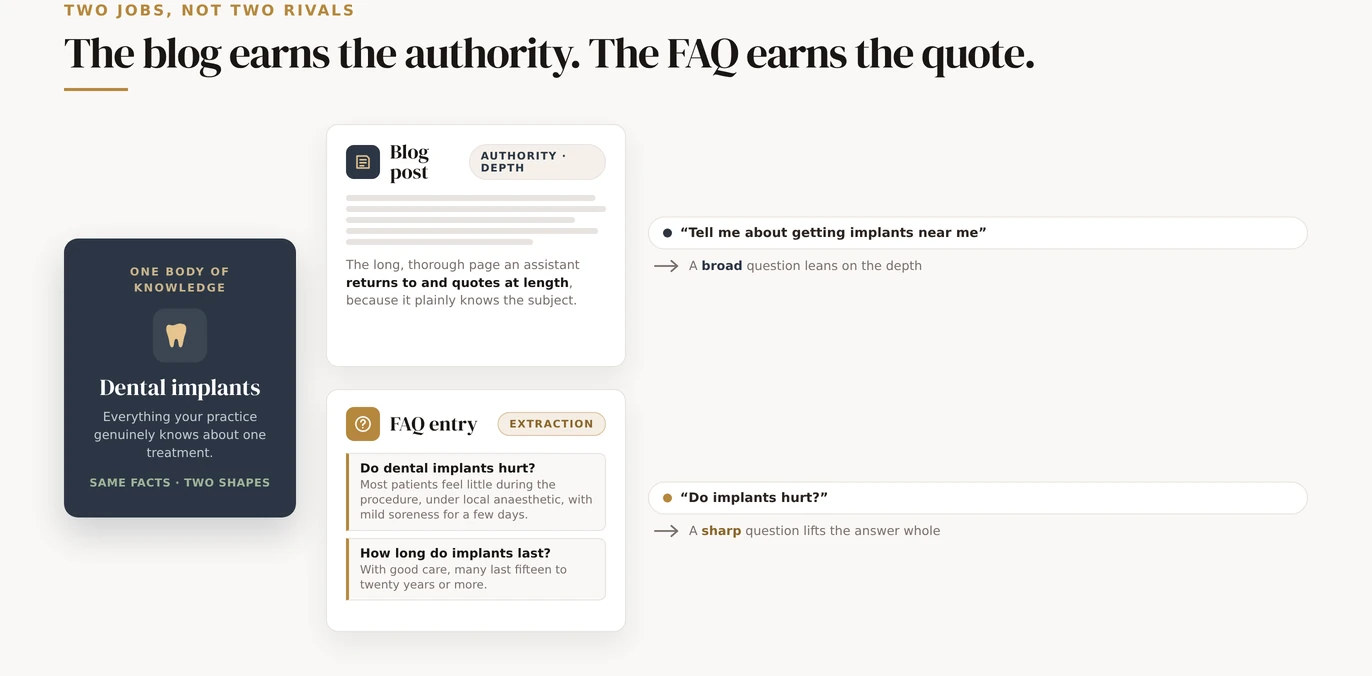
Both, because they do different jobs. A blog post builds the depth and authority an assistant trusts and quotes at length; an FAQ entry is the short, self-contained answer it can lift straight into a summary or read aloud. You need both, drawn from the same knowledge. And the reason to build FAQs in 2026 is not the old one: Google removed the FAQ rich result on 7 May 2026, so the value of the format now sits entirely in AI extraction and a clearer page for patients, not a badge in the search listing.
A prospective patient has been putting off a smile makeover for years. This week they finally decide to look into it, and they do not reach for a directory or a list of links. They open ChatGPT, or Google's AI Mode, or Perplexity, and they ask which practice near them is good for veneers or clear aligners. The assistant names a couple of practices and summarises why.
One of those practices has just been handed an enquiry that, on a veneer case, commonly runs to several thousand pounds, and on a full Invisalign treatment typically sits somewhere in the region of £2,500 to £4,500. If your practice is not the one named, you do not see a missed click in your analytics. You simply never learn the patient existed.
That is the commercial reality sitting underneath a question practice owners ask us constantly: should we be writing blog posts or building FAQ pages to get picked up by AI search? It sounds like a technical content question. It is really a budget question. Your time and your marketing spend are finite, and you want to put them where they bring patients through the door rather than where they tick a box.
A single implant case can sit in the region of £2,000 to £2,500 per tooth, a full-arch restoration runs well into five figures, and a patient who joins your list for routine care is a relationship worth years of check-ups, hygiene visits and the occasional larger treatment (these are illustrative ranges to show the stakes, not researched figures, and any real case varies by clinician and complexity). These are exactly the enquiries patients now research through an assistant before they ever pick up the phone. Choosing the wrong content format, or assuming the two formats compete, quietly hands those cases to the practice down the road.
The real answer is that the question contains a false choice, and there is a specific change in 2026 that flips the advice most existing guides still give. Blog posts and FAQ content do two different jobs, a practice needs both, and the reason to use the FAQ format this year is not the reason almost every dental marketing article still tells you. This guide is written for UK practices, it stays inside General Dental Council rules throughout, and each section answers a real question an owner has put to us, so you can read the one that fits your situation and act on it.
Blog posts or FAQ pages: which one gets my practice into AI answers?
Both, because they are not rivals. They do separate jobs, and an assistant relies on each in a different way, so treating it as either-or is the first mistake to drop.
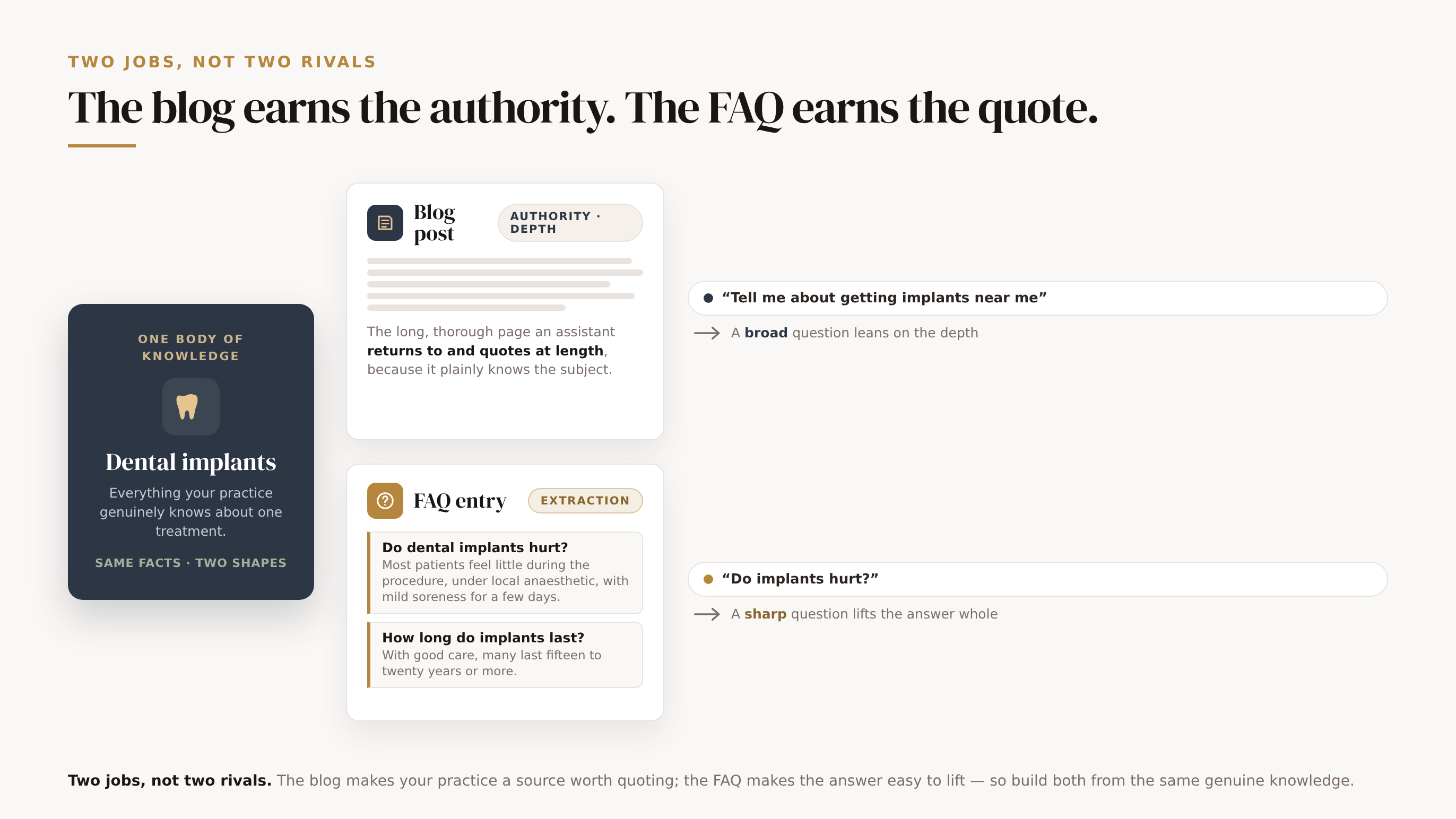
A blog post is the longer, deeper piece of writing that explains a topic properly: what actually happens during a root canal, how Invisalign compares with fixed braces for an adult, what to expect in the weeks after an implant is placed. Its job is to build authority. It is the substance that marks your practice out as a genuine source on a subject, the kind of page an assistant returns to and can quote at length because it clearly knows what it is talking about.
An FAQ entry is the short, self-contained question and answer that matches what a patient typed almost word for word. "Does a root canal hurt?" followed by a direct two-sentence reply. Its job is extraction. It is the most liftable format there is for an AI summary or a spoken answer, because the assistant can take the whole thing cleanly and drop it into its reply without having to summarise a wall of text.
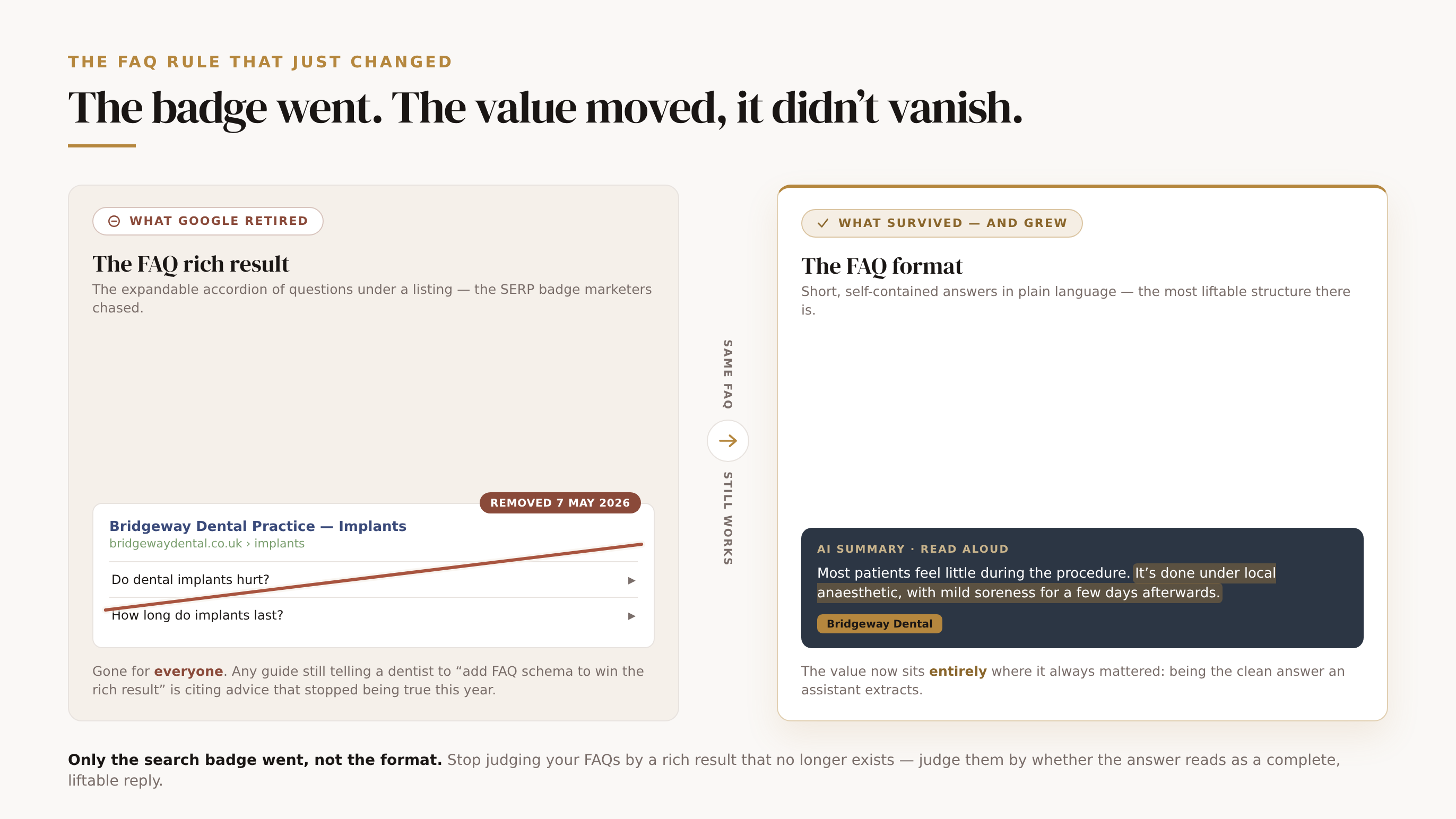
So the practical answer is that the blog earns the authority and the FAQ earns the extraction, and you want both working together. There is one important caveat that reshapes how you should think about FAQs this year, and because it overturns advice that is still everywhere, it is worth stating up front: in May 2026 Google removed the FAQ rich result from its search results entirely. That does not make FAQs pointless. It changes why you build them.
The stakes for getting this right keep rising. Pew Research Center, studying the actual browsing habits of US adults, found that in March 2025 some 58% of them ran at least one Google search that returned an AI-generated summary, and that with a summary present, click-throughs to a traditional result fell to 8% of visits, from 15% when none appeared[1]. More and more often, the patient reads the answer and stops there. Being the practice named inside that answer is the whole game.
What does a dental blog post actually do for AI search?
A blog post builds the topical authority an assistant draws on, and depth is the point of it. It is how you become a source the models trust enough to quote rather than one they skim past.
When an assistant answers a question about, say, dental implants, it is not pulling from a single sentence in isolation. It favours sources that show real command of the subject, that answer the follow-up questions a curious patient would ask next, and that read as written by someone who does this work rather than someone optimising a page. A thorough blog post (what an implant involves step by step, the healing timeline, who is and is not a good candidate, what the costs and alternatives really are) gives the assistant exactly that signal of competence. It is the page the model can return to repeatedly and quote at length, because the answers are genuinely there.
Take a worked example. A post titled "What actually happens during a dental implant, from consultation to final crown" can walk through the assessment, the placement, the healing months, and the fitting of the crown, in plain language a nervous patient understands. That single piece can feed an assistant's answer to a dozen different patient questions, because the depth means almost any reasonable follow-up is covered somewhere in it.
That is the work a blog post does that a short answer cannot: it establishes that your practice knows the subject thoroughly. The credibility behind that, the named clinician, the real experience, the trustworthy detail, is its own piece of work, covered in our guide to E-E-A-T for dentists, and it is what turns a long page into an authoritative one.
What does an FAQ page or FAQ section actually do for AI search?
An FAQ provides the extractable answer, the bit an assistant can lift whole. Where the blog post builds trust through depth, the FAQ wins the quote through format.
The reason is mechanical. AI summaries and voice assistants are built to give a short, direct response to a specific question, and a well-written FAQ entry already is one. The question matches what the patient asked, and the answer is two or three clean sentences that stand on their own without any surrounding context. There is nothing for the assistant to trim or rephrase. It can take the answer as written and read it straight out, which is precisely what a voice assistant does when someone asks their phone a question hands-free.
A dental example shows the difference in shape. An FAQ entry reads: "Is a dental implant painful? Most patients feel little or nothing during the procedure itself, as it is carried out under local anaesthetic. Some mild soreness for a few days afterwards is normal and settles with ordinary pain relief." That is the whole thing, self-contained, phrased the way a patient would actually ask it.
An assistant summarising "does getting an implant hurt" can lift that answer cleanly. The same fact buried three paragraphs into a long blog post is harder to extract, because the model has to find it, separate it from its surroundings and compress it. The FAQ has done that work in advance. That is its value, and as the next section explains, that value has actually grown this year even as the old reason for building FAQs disappeared.
The big 2026 change: Google removed the FAQ rich result
This is the part most dental marketing advice has not caught up with, and it is the single thing this guide most wants you to get right. The old SEO reason for building FAQ pages has gone, and a lot of guidance still tells you to chase it.
The 2026 change
Why the reason to build FAQs moved
7 May 2026
the date the FAQ rich result stopped appearing in Google Search, per Google's own changelog.
June 2026
Google removed the documentation because the feature is no longer shown in results.
58%
of US Google users saw at least one AI summary in March 2025.
8% vs 15%
click-through to a traditional result with an AI summary present, against without one.
Google Search Central changelog, May and June 2026; Pew Research Center, 22 July 2025.
For years, the standard advice was to add FAQ structured data so that Google would show an expandable list of questions directly in the search results, the little accordion of questions and answers under a listing. That was the "FAQ rich result", and it was the headline reason marketers told dentists to build FAQ schema. As of 7 May 2026, it no longer exists.
Google's own changelog records it plainly: the May 2026 entry states the change is "Deprecating the FAQ rich result feature", with the note that "this feature will no longer appear in Google Search starting May 7, 2026", and a follow-up entry in June 2026 confirms Google removed the documentation for the FAQ rich result feature because it "is no longer shown in Google Search results"[2].
Read carefully, because the temptation is to draw the wrong conclusion in either direction. What Google retired is the search-results badge, the visible accordion in the results page. It did not retire the FAQ format, and it has nothing to do with how ChatGPT, Perplexity or an AI summary handle your content. So the change does not weaken the case for writing answer-first question-and-answer content.
If anything it sharpens it, because the value of an FAQ now sits entirely where it always mattered most: being the clean, liftable answer an assistant extracts. Any guide still telling a dentist to "add FAQ schema to win the rich result in Google" is citing advice that stopped being true this year. The format still earns you AI extraction and a better experience for patients reading your page. It just no longer earns a decorative badge in the search listing, because that badge is gone for everyone.
So are FAQ pages dead for dentists? No, their value just moved
Not remotely, and it is worth being precise about what changed so you do not overcorrect and rip out content that is still doing real work.
What died is the rich result, the results-page feature. What is very much alive, and arguably more valuable than before, is the FAQ as a content format: short, self-contained, answer-first question-and-answer blocks written in the plain language patients use. That format is still the most extractable structure there is for an AI summary, and it is the format a voice assistant handles best, because a spoken answer has to be short and complete in itself. If you read one of your own FAQ answers aloud and it sounds like a natural, finished reply to the question, an assistant can use it. If it trails off or depends on the paragraph above it, it cannot.
So the instruction is not "delete your FAQs". It is "stop measuring them by a yardstick that no longer exists". Do not judge your FAQ content by whether it triggers a rich result, because nothing does any more. Judge it by whether the answers are genuinely useful, genuinely self-contained, and phrased the way a patient would ask, because that is what gets them lifted into the answer a prospective patient actually reads.
The practices that keep their well-written FAQs and simply re-point their purpose at AI extraction lose nothing and gain clarity. The ones that hear "the FAQ rich result is gone" and tear out their question pages are throwing away the most extractable content on their site. For more on how AI summaries decide which short answers to read aloud and quote, our piece on how dental practices earn AI citations goes deeper on the extraction side.
Blog posts versus FAQ pages: the full side-by-side
No dental page sets the two formats next to each other cleanly, so here is the contrast in full. Read down the columns and the relationship, two jobs rather than two rivals, becomes obvious.
The full side-by-side
Two jobs, not two rivals
| Dimension | Dental blog post | FAQ page or FAQ section |
|---|---|---|
| The job it does | Builds topical authority and depth | Provides the extractable answer |
| The query it suits | "How", "why" and "what" questions that want explanation | Direct, specific questions asked almost word for word |
| What an assistant does with it | Trusts it, returns to it, quotes from it at length | Lifts the self-contained answer into a summary or reads it aloud |
| Length and shape | Long, narrative, thorough | Short, self-contained question and answer |
| 2026 status | Unchanged: depth and authority still win | Format still wins AI extraction; the rich result was removed in May 2026 |
| The schema it uses | Article or BlogPosting | FAQPage, still valid markup but no longer a Google rich result |
| How it fails | No real depth, so nothing worth trusting or quoting | Thin or vague answers, so nothing clean to extract |
Drawn from the article's comparison of blog posts and FAQ pages.
The bottom two rows are the ones to sit with. The formats fail in different ways because they do different jobs: a blog post fails when it has no genuine depth, and an FAQ fails when its answers are too thin to lift. That is exactly why you cannot trade one against the other. Neither covers the other's weakness.
Which should a dental practice build first? A publishing order that pays off
Build them in a deliberate sequence rather than all at once, because each step makes the next one worth more. The order below is the efficient one, and it maps neatly onto how a practice grows its content over time.
A publishing order that pays
Which to build first
Start with the service page
Each high-value treatment gets a page that answers the real question, with a labelled price range and timescale. It earns the enquiry.
Add a focused FAQ section
Answer the exact questions patients ask about that treatment, self-contained and phrased as spoken. This wins extraction.
Publish deep blog posts
The step-by-step explainers and straight comparisons that establish your practice as a source worth quoting at length.
Interlink the three
The blog links to the service page and its FAQs, and back, so authority flows and each layer reinforces the others.
Start with the service page, because that is where the commercial substance lives. Each high-value treatment (implants, Invisalign, veneers, emergency care) deserves its own page that opens by answering the real question a patient has: what the treatment involves, a clear price range labelled as typical, how long it takes, and who carries it out. This is the page that earns the enquiry, so it comes first. Nothing else you publish matters as much as getting these right.
Next, add a focused FAQ section that answers the exact questions patients ask about that treatment, in the words they use and phrased as if spoken. "How long does Invisalign take?" "Does it hurt to get veneers?" "Can I get an emergency appointment on a Saturday?" Keep each answer self-contained, two or three sentences, complete on its own. This is the layer that wins extraction and voice answers, and it is quick to build once the service page exists, because you are answering the questions that page raises.
Then publish blog posts that go deep around those services and build authority: the step-by-step explainers, the straight comparisons, the "what to expect" pieces. These are the slower, weightier content that establishes your practice as a source worth quoting. They take more effort, which is exactly why they come after the pages that earn enquiries directly.
Finally, interlink the three so the authority flows: the blog post links to the relevant service page and its FAQs, the service page links out to the deeper blog explainer for the patient who wants more. Done in this order, each layer reinforces the others, and a smaller practice can work through it one treatment at a time rather than trying to build everything at once.
It also maps neatly onto where a practice already is. If your site is thin, with little more than a treatments list, start at the beginning: get one or two of your most valuable service pages genuinely answering the patient's question, and you have done the highest-value work first. If you already have solid service pages but no question-and-answer content, the quickest win is the FAQ layer, because the substance is there and you are simply reshaping part of it into the liftable format an assistant prefers.
And if you have decent pages and FAQs but no real depth anywhere, the blog posts are your gap, because you have the answers but nothing yet that marks you out as an authority worth quoting at length. The sequence is the same for everyone; the entry point depends on what you have already built, which is one reason the audit at the end of this guide starts by working out which layer is your weak one.
Here is the part everyone gets wrong: format is not a substitute for substance
The most expensive misunderstanding in this space is the belief that the right format, or the right markup, can stand in for genuinely useful content. It cannot, and Google states the rule that proves it.
Google's structured-data guidance is explicit: "Don't create blank or empty pages just to hold structured data, and don't add structured data about information that is not visible to the user, even if the information is accurate"[3]. That settles a common shortcut. You cannot mark up an FAQ answer that does not actually appear on the page, and you cannot label a service you do not genuinely describe. The markup is only ever allowed to describe content a visitor can really see.
The same principle holds for the content itself, schema or no schema. An FAQ entry with a thin, evasive answer gives an assistant nothing worth lifting, however neatly it is formatted. A blog post with no real depth gives the model no reason to trust or quote it, however long it runs. The format is the container; the substance is what gets extracted and what earns authority.
Get the substance wrong and the format carries nothing. This is the same dependency we cover from the markup side in our guide to structured data versus good content, and it is worth reading alongside this one, because the two articles describe the same trap from different angles: you cannot label, or format, your way past the work of writing genuinely useful answers.
A worked dental example: the same topic as a blog post and as an FAQ
Take one treatment, dental implants, and watch how each format carries it differently. The same underlying knowledge does two distinct jobs depending on how you shape it.
As a blog post, the topic becomes a thorough explainer: "Dental implants, explained from start to finish." It walks through the initial assessment, what placement day actually involves, the months of healing while the implant integrates, the fitting of the final crown, who makes a good candidate, the real cost range and the alternatives worth considering. A patient reading it comes away genuinely informed, and an assistant treats the page as an authoritative source it can quote from on any number of implant questions, because the depth is real and the practice clearly knows the subject. This is the authority layer.
As FAQ content, the same knowledge is broken into short, liftable answers, each phrased as a patient would ask. "Do dental implants hurt? Most patients feel little during the procedure, which is done under local anaesthetic, with mild soreness for a few days afterwards." "How long do dental implants last? With good care, many implants last fifteen to twenty years or more."
"How much does a single implant cost? In the UK a single implant typically sits in the region of £2,000 to £2,500, though the exact figure depends on your individual case." Each answer stands alone, and an assistant can lift any one of them straight into a summary or read it aloud. This is the extraction layer.
Now see how an assistant uses each. Asked a broad question ("tell me about getting dental implants near me"), it leans on the depth of the blog post and the authority behind it. Asked a sharp, specific question ("do implants hurt"), it lifts the matching FAQ answer almost verbatim. The blog earns the trust; the FAQ earns the quote. Build only the blog and your clean answers are buried where they are hard to extract. Build only the FAQs and you have liftable answers with no authority underneath them. Build both, derived from the same genuine knowledge, and you cover the whole range of how a patient might ask.
Do I still need FAQ schema if there is no rich result?
Yes, but for sound reasons rather than the old one, and it helps to be clear about what the markup now does and does not buy you.
FAQPage is still a valid type in the structured-data vocabulary; it did not stop existing when the rich result was removed[4]. Adding it still does a few useful things: it labels your question-and-answer content clearly for any system that reads markup, it helps you validate that your FAQ blocks are well-formed, and other engines beyond Google may still parse it. What it no longer does, as of 7 May 2026, is produce that expandable FAQ panel in Google's search results, because that feature is gone for everyone[2].
So the sensible position is to add FAQPage markup for correctness, not for badges. Mark up the FAQ content that genuinely appears on your page, keep it accurate and matched to the visible words, and then spend the bulk of your effort on the thing that actually wins you the citation: the quality and clarity of the answers themselves. Do not let anyone sell you FAQ schema on the promise of a rich result, because there is no longer one to deliver. If you want the implementation detail, the copy-paste JSON-LD and the review-markup rule most guides get wrong, our dental schema markup guide is the companion to this piece and covers the how-to in full.
The mistakes that waste both formats
A short list of avoidable errors accounts for most of the wasted effort we see. Work through them before you commit budget to either format.
Before you commit budget
The mistakes that waste both formats
Make every FAQ answer self-contained.A vague, hedged non-answer gives an assistant nothing clean to lift; a complete two or three sentences does the work.
Give blog posts real depth.Length alone is not depth; the page has to genuinely know its subject and answer the questions a curious patient asks next.
Build FAQs for extraction, not a badge.There is no FAQ rich result to win since May 2026, so judge FAQs by AI extraction and patient clarity.
Give each answer one clear home.Let the FAQ hold the short answer and the blog hold the depth, then link between them rather than copying wholesale.
Wire up the internal links.The blog post should point to the service page and its FAQs, and back, so a model and a patient can move between depth and quick answer.
- Thin FAQ answers with nothing to extract. A question followed by a vague, hedged non-answer gives an assistant nothing clean to lift. The whole value of the format is a complete, self-contained reply, so if the answer does not stand on its own, the FAQ is doing no work.
- Blog posts with no real depth or authority. A short, generic post that skims the surface gives a model no reason to trust or quote it. Length alone is not depth; the page has to genuinely know its subject and answer the questions a curious patient asks next.
- Building FAQs expecting a rich result. As of May 2026 there is no FAQ rich result to win, so any effort spent chasing the badge is wasted. Build FAQs for extraction and patient clarity, and judge them by that.
- Duplicating the same answer across blog and FAQ with no clear home. Repeating an identical question and answer in several places, with no canonical version, muddies which page should be quoted. Let the FAQ hold the short answer and the blog hold the depth, and link between them rather than copying wholesale.
- Ignoring the internal links. Disconnected pages waste the authority you have built. The blog post should point to the service page and its FAQs, and back again, so a model and a patient can move between the depth and the quick answer.
How can I check which of my pages AI is actually drawing from?
You can run a useful self-audit today, free, in about fifteen minutes, and it tells you whether your blog content or your FAQ content is pulling its weight.
Start by asking the assistants the questions your patients ask. Open ChatGPT, Perplexity and Google's AI Mode and put in the real queries: "best dentist for implants in [your town]", "does getting veneers hurt", "emergency dentist near me open Saturday". Note whether your practice is named, and when your content is quoted, notice whether the assistant is leaning on one of your in-depth pages or lifting a short answer. Run each prompt a few times, because the responses shift, and it is the recurring pattern that tells you where you stand.
Then read your own FAQ answers aloud. This is the quickest test of extraction. If an answer sounds like a complete, natural reply when spoken, a voice assistant can lift it. If it depends on the sentence before it, or trails off, or hedges without resolving, it will not extract cleanly, and that is a fixable problem. Finally, look at your most valuable treatment pages and ask plainly whether the depth is really there: would an assistant treat this as an authoritative source, or as a thin page that happens to mention the topic? Where the assistants are quoting competitors and not you, the gap is usually one of two things, and this audit shows you which.
How QBiz gets both formats working, on your site and across the web
Most providers in this space sell you half the job. One firm writes you some blog posts; another tidies your markup; nobody owns whether your content is actually being drawn into the answers patients read. QBiz is built around the two-jobs principle this whole article describes, and the work runs across two connected fronts.
On your own site, we get both formats right and in the right order. We write the answer-first service pages that carry the commercial substance, build focused FAQ sections whose answers are genuinely self-contained and phrased the way patients ask, so an assistant can lift them straight into a summary or read them aloud, and produce the in-depth blog content that builds the topical authority a model returns to and quotes. Then we mark the lot up cleanly, including FAQPage for correctness rather than for a rich result that no longer exists, so the engines read your genuine content without guessing and credit it to your practice.
The second front is the one on-site work alone cannot reach: getting that content out into the wider web. A clean, authoritative site is necessary but not sufficient, because an assistant's confidence in naming you comes partly from seeing your practice referenced consistently across the platforms, directories and sources the models actually read. So we also do the distribution work, getting your content and your practice details out and agreeing with each other across the web, which is what turns solid groundwork on your own pages into the off-site corroboration that earns a citation. Optimising your site is the foundation; distributing your content and presence is what converts that foundation into answers that name you.
It begins with a QBiz AI Visibility audit. It reads your own website, not the engines, and checks the things that decide whether an assistant can find, read and quote you: whether your blog pages carry real depth, whether your FAQ answers are self-contained and liftable, whether your markup matches the words a visitor actually sees, and whether your practice details line up across the web. You get back a prioritised, GDC-safe plan covering both the on-site content work and the distribution, highest-value cases first. It is the no-cost first step, and it tells you exactly where the patients you should be winning are slipping away.
Frequently asked questions
Should a dentist write blog posts or FAQ pages for AI search?
Both, because they do different jobs. Blog posts build the topical authority an assistant trusts and quotes from at length, while FAQ content provides the short, self-contained answers a model lifts straight into a summary or reads aloud. A practice needs the depth of the blog and the extractability of the FAQ, derived from the same genuine knowledge. Treating them as rivals, and building only one, leaves half the work undone.
Do FAQ pages still help now that Google removed the FAQ rich result?
Yes, for AI extraction and for patient experience, just not for the search-results badge. Google removed the FAQ rich result on 7 May 2026, so FAQ markup no longer produces the expandable panel in Google's results. The FAQ format itself, short self-contained answers in plain language, remains the most extractable structure there is for AI summaries and voice answers. Keep your FAQs and judge them by whether the answers are clean and liftable, not by a rich result that no longer exists.
Is FAQ schema still worth adding in 2026?
It is worth adding for correctness rather than for a rich result. FAQPage is still valid markup: it labels your question-and-answer content clearly, helps you validate that it is well-formed, and may be parsed by engines other than Google. What it no longer does is trigger a Google rich result, because that feature was removed in May 2026. Add it to describe content genuinely on the page, then spend most of your effort on the quality of the answers themselves.
What kind of blog posts get a dental practice cited by AI?
Specific, in-depth, genuinely authoritative ones. An assistant favours content that shows real command of a subject, answers the follow-up questions a curious patient would ask, and reads as written by someone who does the work. A thorough what-to-expect explainer on a treatment, with real detail on the process, the timeline and the costs, gives a model a source it can return to and quote. Thin, generic posts that skim the topic give it no reason to trust them.
Where should my practice start: service page, FAQ or blog?
Start with the service page, because it carries the commercial substance and earns the enquiry directly. Then add a focused FAQ section answering the exact questions patients ask about that treatment, in self-contained answers a model can lift. Then publish the deeper blog posts that build authority around the service, and interlink all three so the authority flows between them. Working in that order means each step makes the next one count for more, and you can do it one treatment at a time.
Where to start
If you take only three things from all of this, take them in order. First, get your key treatment pages answering, in plain sentences a patient would recognise, the real questions they are asking, with a clear price range and timescale, because that is the commercial substance everything else supports.
Second, build focused FAQ content around each one, with short self-contained answers phrased the way patients speak, so an assistant can lift them cleanly, and judge those answers by extraction rather than by a rich result that no longer exists. Third, publish the deeper blog posts that build your authority on those treatments, and link the three layers together so the trust and the quotability reinforce each other. Every one of these steps stays well within GDC rules, and each layer you add makes the ones before it work harder.
If you would rather see where your practice is likely dropping out of the AI answer, whether the gap is blog content with no real depth or FAQ answers too thin to lift, that is the job of a QBiz AI Visibility audit. It scans your own site in about thirty seconds and returns a plain pass or fail on the signals that decide whether AI tools can find, read and describe you: the depth of your pages, the clarity and self-containment of your answers, the markup, and the consistency of your listed details.
It reads your site rather than querying the engines, and it comes with a prioritised, GDC-safe list of what to fix, on your own pages and across the wider web. It is the no-cost first step before any spend. If you would rather have the layers built for you, our AI SEO for dentists service page sets out how we handle it for a practice.
Get your free AI visibility check →
Sources
- [1] Pew Research Center, 22 July 2025: https://www.pewresearch.org/short-reads/2025/07/22/google-users-are-less-likely-to-click-on-links-when-an-ai-summary-appears-in-the-results/ (US; independent. "About six-in-ten respondents (58%) conducted at least one Google search in March 2025 that produced an AI-generated summary." Users who saw an AI summary clicked a traditional result in 8% of visits, against 15% when no summary appeared.)
- [2] Google Search Central, Latest documentation updates (changelog): https://developers.google.com/search/updates (Global; vendor primary. May 2026 entry: "Deprecating the FAQ rich result feature... This feature will no longer appear in Google Search starting May 7, 2026." June 2026 entry: "Removing documentation for the FAQ rich result feature... The FAQ rich result feature is no longer shown in Google Search results.")
- [3] Google Search Central, Intro to How Structured Data Markup Works: https://developers.google.com/search/docs/appearance/structured-data/intro-structured-data (Global; vendor primary. "Don't create blank or empty pages just to hold structured data, and don't add structured data about information that is not visible to the user, even if the information is accurate.")
- [4] Schema.org, FAQPage: https://schema.org/FAQPage (Independent vocabulary. FAQPage remains a valid, active Schema.org type, a subtype of WebPage; only the Google rich result was removed, per source [2].)
Leave a comment
Thoughts on this post? Leave a comment below. Comments are moderated before they appear, so yours will not show on the page straight away.
Your email is used only to contact you about your comment if needed — it is never published.
Comments
No comments yet. Be the first to leave one above.