ChatGPT vs. Google Gemini for Dentist Recommendations: Which One Names Your Practice?
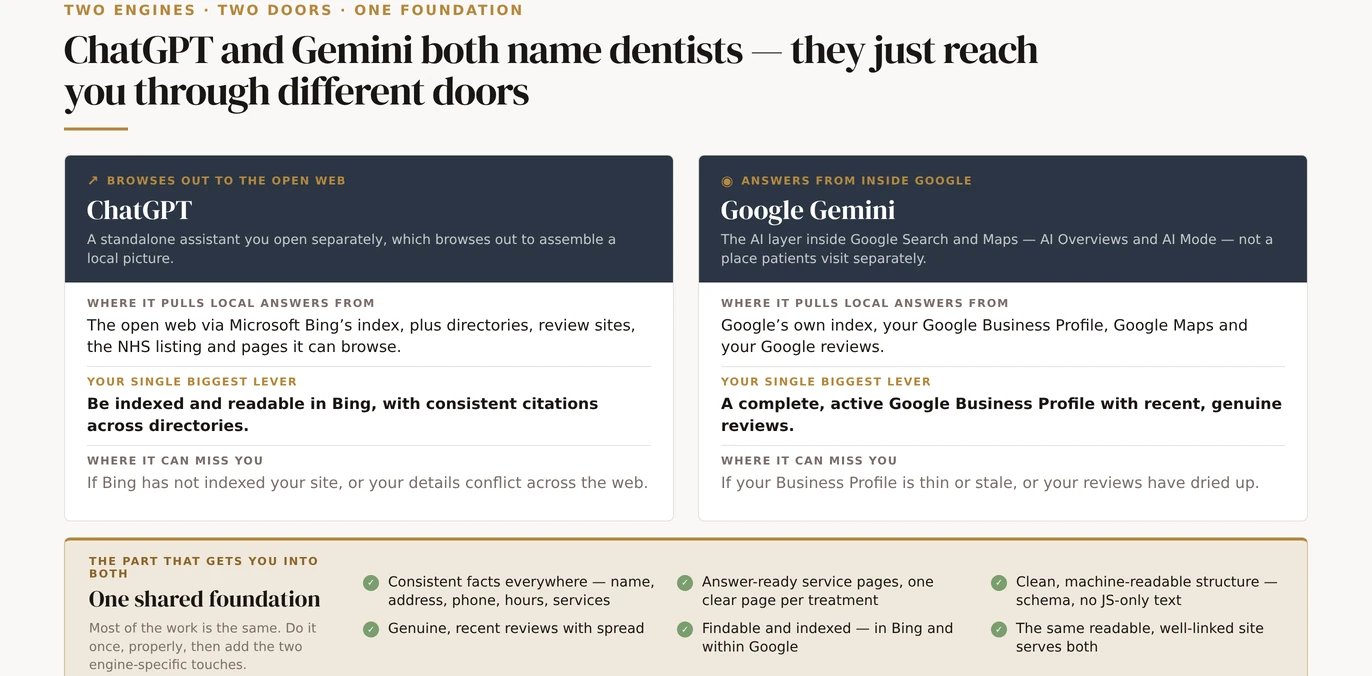
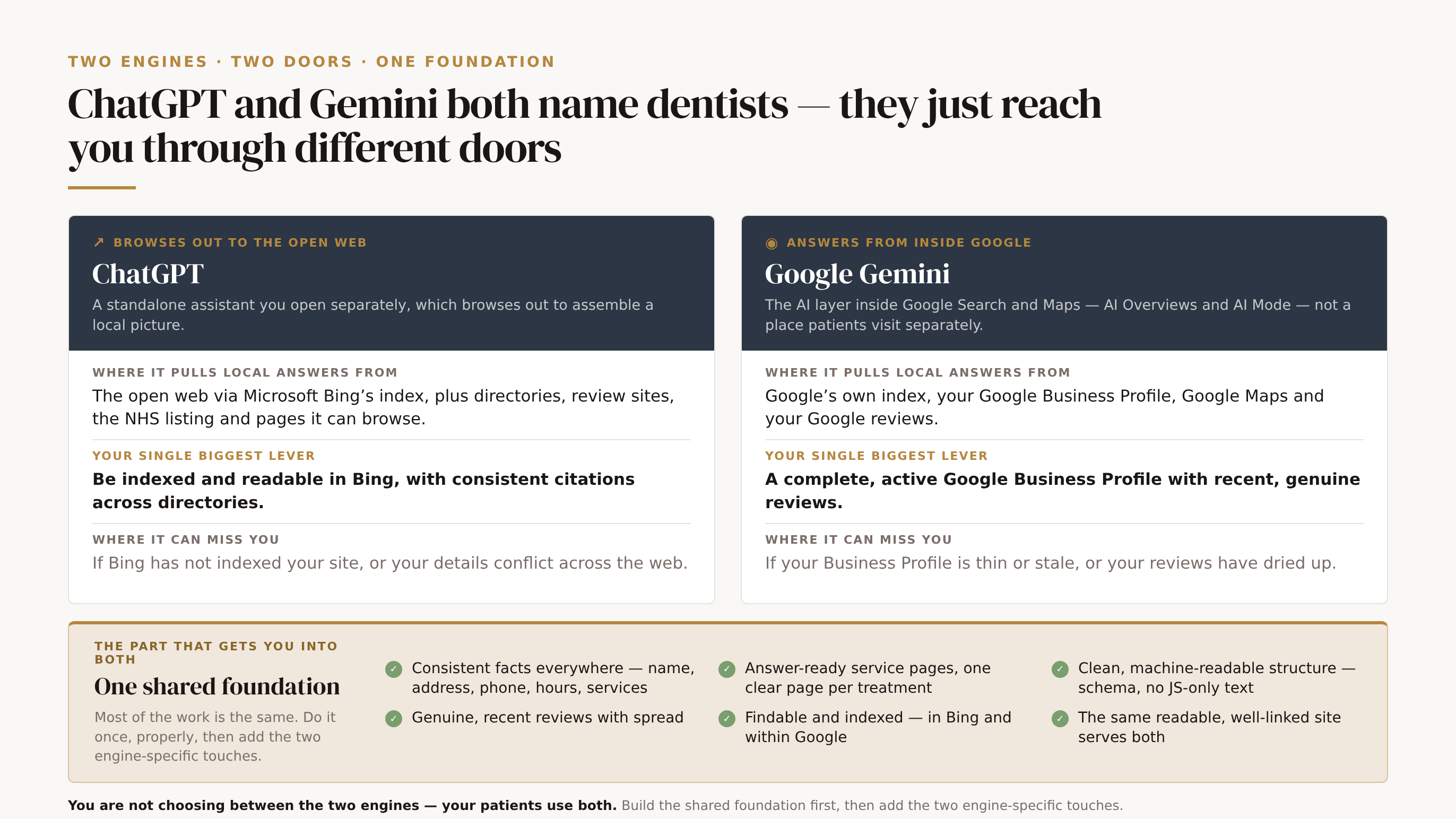
ChatGPT and Google Gemini both recommend dental practices, but they reach you through different doors. ChatGPT browses the open web and leans on Microsoft Bing's index, plus the directories, reviews and listings it can read; Gemini answers from inside Google Search and Maps, drawing chiefly on your Google Business Profile, Google Maps and your Google reviews. Roughly four-fifths of the work that gets you named is shared: consistent facts everywhere, clear service pages, clean machine-readable structure and genuine, recent reviews. The rest is a small, engine-specific split on top of that base.
Both ChatGPT and Google Gemini can recommend a dental practice, but they find you in different ways. ChatGPT browses the open web, leaning on Microsoft Bing's index plus the directories, reviews and listings it can reach. Gemini is the AI layer inside Google Search and Maps, so it draws heavily on your Google Business Profile and Google's own local index. Showing up in both comes from one shared foundation, and the rest of this guide is about what that foundation is.
This is written for UK practices, it stays inside General Dental Council rules at every step, and it is built as a comparison rather than a generic "optimise for AI" checklist. Most articles on this topic treat ChatGPT and Gemini as one undifferentiated "AI" and never explain how the two actually differ. That difference is the whole point here, because the work that gets you named by ChatGPT is not identical to the work that gets you named by Gemini, even though the two overlap more than you might expect. For the separate task of earning a first recommendation when you are starting from nothing, our companion guide covers how dentists get recommended by ChatGPT.
The short version
- Different maps of the web. ChatGPT reads the open web through Bing's index; Gemini reads Google's own record of your practice.
- Your ChatGPT lever is reach. Being indexed in Bing and confirmed by consistent citations across the open web does most of the work.
- Your Gemini lever is Google depth. A complete, active Google Business Profile with recent, genuine reviews is the single biggest signal.
- Advice quality is a separate question. A peer-reviewed study scored ChatGPT highest on dental advice, but that measures clinical answers, not which engine names a local practice.
- Patients use both. The goal is to be visible in both engines, not to back one over the other.
Do patients actually ask ChatGPT and Gemini to recommend a dentist?
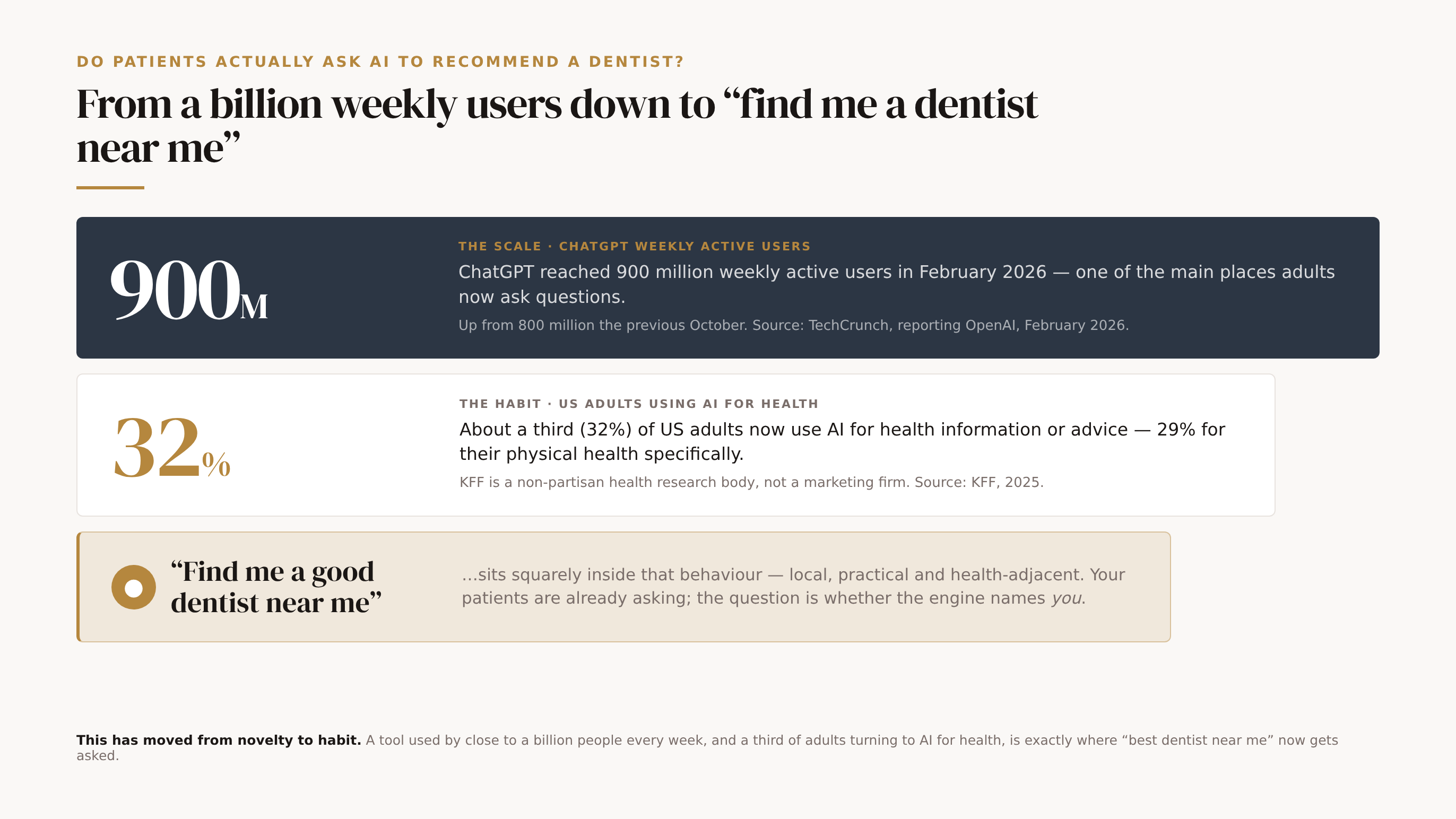
Yes, and on a scale that has moved this from novelty to habit. ChatGPT reached 900 million weekly active users in February 2026, up from 800 million the previous October[3]. A tool used by close to a billion people every week is one of the main places adults now ask questions, and a great many of those questions are about health.
Why this is now habit
Patients are asking both engines at scale
900m
weekly active ChatGPT users by February 2026, up from 800 million the previous October
32%
of US adults use AI for health information or advice, 29% for their physical health specifically
40%
of consumers are actively using generative AI within search, while 70% still default to Google
ChatGPT usage, 2026; KFF, 2025; BrightLocal, 2026.
Health is one of the things people bring to these tools most readily. A KFF Tracking Poll in 2025 found that about a third (32%) of US adults now use AI for health information or advice, with 29% using it for their physical health specifically[4]. KFF is a non-partisan health research body rather than a marketing firm, which is precisely why the figure carries weight where vendor surveys do not. "Find me a good dentist near me" sits squarely inside that behaviour: local, practical and health-adjacent.
Gemini matters here for a different reason: it is woven into the search habit people already have. BrightLocal's consumer research found that 40% of consumers are actively using generative AI within search, while 70% of all general online searches are still conducted using Google[5]. Read those two figures together and the picture is clear: a large and growing group is asking AI directly, and the single biggest place they still search is Google, where Gemini now shapes the answer. You are not choosing between the two engines as a practice. Your patients use both, often without thinking about which is which.
How is Gemini different from ChatGPT when it comes to finding a dentist?
They draw their local answers from different maps of the web, and that single fact explains most of what follows. ChatGPT is a standalone assistant that browses out to the open web to answer a local question. Gemini is not a separate destination most patients visit; it is the AI that now sits inside Google Search and Maps, so it answers from Google's own view of your area.
This is not a guess about Gemini. Google has confirmed it is "bringing a custom version of Gemini 2.5, our most intelligent model, into Search for both AI Mode and AI Overviews", and that AI Overviews are "driving over 10% increase in usage of Google for the types of queries that show AI Overviews"[2].
For a "best dentist in [town]" search, the Gemini-powered answer and the Google AI Overview a patient sees are effectively the same surface; our guide to Google AI Overviews and SGE for dentists goes deeper on that surface. That is the cleanest way to hold it in your head: Gemini is Google's answer layer, and it leans on the parts of Google you already know, chiefly your Business Profile, Maps and your Google reviews.
Here is the practical contrast, side by side.
Side by side
The practical contrast between the two engines
| Factor | ChatGPT | Google Gemini |
|---|---|---|
| What it is | A standalone AI assistant you open separately to ask a question | The AI layer inside Google Search and Maps (AI Overviews and AI Mode) |
| Where it pulls local answers from | The open web via Microsoft Bing's index, plus directories, review sites, the NHS listing and pages it can browse | Google's own index, your Google Business Profile, Google Maps and Google reviews |
| How "local" it is by default | Has to browse out to assemble a local picture | Local-native; Maps and Business Profiles are built in |
| How it points to you | Tends to name and link the sources it browsed | Surfaces your practice as a known Google entity inside the AI answer |
| Your single biggest lever | Be indexed and readable in Bing, with consistent citations across directories | A complete, active Google Business Profile with recent, genuine reviews |
| Where it can miss you | If Bing has not indexed your site, or your details conflict across the web | If your Business Profile is thin or stale, or your reviews have dried up |
The table also shows why so much of the work is shared. Both engines reward a practice whose facts agree everywhere, whose pages answer real questions plainly, and whose reviews are genuine and recent. The difference is in emphasis: ChatGPT puts more weight on being findable across the open web and Bing, while Gemini puts more weight on the strength of your presence inside Google's own ecosystem of Profile, Maps and reviews.
Which AI gives better dental answers, and why does that matter for you?
On the quality of dental advice itself, the published evidence currently favours ChatGPT, but it is important to be precise about what that does and does not mean for your practice. A peer-reviewed study in Frontiers in Oral Health compared ChatGPT, Gemini and Copilot on the quality of paediatric dental advice and found "statistically significant differences across all five domains (p < .001), with ChatGPT consistently achieving the highest scores", and a "strong overall effect of the AI model on response quality" supporting "ChatGPT's superior performance in providing accurate, relevant, and comprehensive pediatric dental advice"[1].
That is a genuine, citable head-to-head, and it is rare. Read it carefully, though. The study measured the quality of clinical advice the engines give to patients, not which engine is better at naming a local practice. The two are different jobs. What it tells you is that these engines do not behave identically; they have different strengths, sourcing and reliability, which is exactly why you cannot treat "AI visibility" as one undifferentiated target.
It is also a useful caution for your own content: patients are getting dental advice of varying quality from these tools, so clear, accurate, well-structured information on your own pages does double duty. It helps an engine name you, and it gives patients a trustworthy source when the engine reaches for one.
So the fair takeaway is not "optimise for ChatGPT because it scored higher". It is that each engine sources and reasons differently, and your job is to be the clear, consistent answer that both can find and trust.
How does ChatGPT decide which dentist to name?
It searches the live web, reads what it finds, checks whether independent sources agree, and names the practice it is most confident about. Two questions decide whether that practice is yours.
Selection path
How ChatGPT decides which dentist to name
The live web
It leans on Microsoft Bing's index, so a first-place Google ranking does not carry over.
What it finds
It reads pages it can crawl, plus directories, review sites and the NHS listing.
Do sources agree?
It tests whether independent sources describe the same practice the same way.
The recommendation
It names the practice it is most confident about, and links the sources it browsed.
Can it find your site? The Bing-index and crawlability question
If your pages are not in Bing's index, ChatGPT cannot cite them, and nothing else you do for ChatGPT matters. When ChatGPT searches the live web for a local question, it leans on Microsoft Bing's index rather than Google's, so a first-place Google ranking does not carry over. A practice can top Google for "dentist in Reading" and go completely unnamed by ChatGPT, because the two systems read different maps.
Two things commonly keep a practice out. The first is never having told Bing you exist: claim Bing Places for Business and submit your sitemap through Bing Webmaster Tools, the same way you once did for Google. The second is more technical. Some practice websites, especially heavily-designed ones and certain page builders, render their text with JavaScript that only runs once a browser opens the page. Several AI crawlers do not run that code, so they arrive and find a near-empty shell. The check takes two minutes: search site:yourpracticedomain.co.uk in Bing. If few or none of your pages appear, the engine that feeds ChatGPT cannot see you, and that is the first thing to fix.
Do enough independent sources confirm you exist?
A single website praising itself is the weakest possible signal. ChatGPT builds confidence from corroboration: the more independent, reputable places that confirm your practice, its location and its services, the more willing the engine is to name you. This is why the same well-listed practices monopolise the answers in many towns. They are simply the ones the engine can verify from several directions.
For a UK dental practice the sources that carry weight are your Google Business Profile, the NHS "find a dentist" service (which engines and patients both treat as high-trust), reputable healthcare and local directories, any genuine professional or accreditation listings, and local press. Each needs to exist, be accurate, and agree with the others. The least glamorous detail on this page is also the most decisive: your practice name, address, phone number, opening hours and services should read identically everywhere. When they conflict, the engine has to guess which version is true, and a hesitant engine settles on a rival whose facts line up cleanly.
How does Gemini (Google's AI) decide which dentist to name?
It answers from inside Google, so it leans on the Google assets you already manage. Where ChatGPT has to browse out to the open web, Gemini starts with Google's local index, your Business Profile, Maps and your Google reviews, then assembles the answer. Three questions decide whether your practice is in it.
Is your Google Business Profile complete and active?
This is the single biggest lever for Gemini, because the Business Profile is the structured record Google holds about your practice. An exact name, address, phone and website; full opening hours and how emergency care works; every service you genuinely offer in plain words; a current, truthful "accepting new patients" status; real photos; and accessibility details such as step-free access, parking and wheelchair access. A thin or out-of-date profile gives Gemini little to recommend, while a complete, regularly updated one gives it a practice it can name with confidence. Many practices claim the profile once and never return to it; treating it as a live record rather than a one-off task is most of the work.
Are your reviews recent, specific and plentiful?
Reviews are among the strongest local trust signals Google has, and recency does more of the work than owners expect. A row of five-star ratings that dries up a year and a half back signals, to patients and the engine alike, a practice that may have gone quiet. Gather genuine reviews steadily rather than in one burst, ask satisfied patients at the right moment (after a completed course of treatment, not mid-appointment), and make leaving one a single tap.
Specificity matters too. A review that mentions an actual treatment, an actual clinician and an actual town gives Gemini far more to work with than "great service, highly recommend". Reply to all of them, good and bad, but never put a patient's clinical details in a public reply: thank them, answer the general point, and take specifics offline. That single discipline protects confidentiality and reads well to everyone, human and machine. Buying, incentivising or editing reviews to mislead is both a fitness-to-practise problem and unlawful in the UK, so it is never a shortcut worth taking.
Does your site carry Dentist/LocalBusiness and FAQPage schema?
Structured data (schema markup) is the machine-readable label that tells a search system, in terms it cannot misread, that you are a dental practice, where you are, what you offer, your opening hours and how patients rate you. The relevant types are Dentist (or LocalBusiness), FAQPage for your common patient questions, and AggregateRating where you display genuine review scores. Schema does not make a claim for you; it makes your true facts legible. Because Gemini answers from Google's understanding of entities, clean schema helps Google connect your website to your Business Profile and read you as one confident, well-described practice rather than a set of loose, ambiguous pages.
What is the one foundation that gets you into both?
Roughly four-fifths of the work is shared, and it is worth doing once, properly, rather than chasing each engine separately. Both ChatGPT and Gemini reward the same underlying things, even though they read them through different doors.
- Consistent facts everywhere. One version of your name, address, phone, hours and services across your website, Google profile, NHS listing and every directory. ChatGPT checks the open web for agreement; Gemini checks Google's record. Consistency satisfies both.
- Answer-ready service pages. One clear page per treatment, named the way patients name it, with what it involves, clear price ranges and typical timescales. Each page answers a real question plainly, which is what both engines quote.
- Clean, machine-readable structure.
Dentist/LocalBusinessandFAQPageschema so your facts are easy to lift, plus a site that renders its text without relying on JavaScript a crawler may not run. - Genuine, recent reviews with spread. Google first, then NHS and healthcare platforms. Gemini weighs your Google reviews heavily; ChatGPT reads the wider review picture across the web.
- Findable and indexed. Indexed in Bing for ChatGPT, and well-connected within Google for Gemini. The same readable, well-linked site serves both.
That shared base is the heart of answer engine optimisation for dental clinics, and it is where any sensible programme starts. The only meaningful split sits on top of it. For ChatGPT, spend a little extra effort on being indexed in Bing and on your spread of independent citations. For Gemini, spend it on the depth and freshness of your Google Business Profile and Google reviews. Do the shared foundation first, then add the two engine-specific touches, and you are working with the grain of both.
How do I check whether ChatGPT or Gemini already recommends me?
You can test this today, free, in about fifteen minutes, by asking each engine the questions a real patient asks. You do not need a paid tool to find the leak; you need a clear-eyed read of the results.
- Run the real questions in both. Open ChatGPT, and open Google's AI Mode (the Gemini-powered answer). Ask each: "best dentist in [your town]", "NHS dentist near me taking on patients", "emergency dentist in [your area] today", "dentist for nervous patients in [town]".
- Compare the two answers. You will often find you are named in one engine and not the other. That asymmetry is the useful signal: named in Gemini but not ChatGPT usually points to a Bing-index or open-web citation gap; named in ChatGPT but not Gemini usually points to a thin Google Business Profile or stale reviews.
- Do the index check. Search
site:yourpracticedomain.co.ukin Bing. No results there explains a lot of absence in ChatGPT specifically. - Run each prompt a few times. The answer shifts between attempts, so it is the recurring pattern, not a single reply, that tells you where you genuinely stand.
Absent from both means the problem is foundational: indexing, consistency or thin content. Named by a competitor in both means it is worth studying what they hold that you do not, because the gap between their presence and yours is your worklist.
Staying compliant: what the GDC rules mean for both engines
Everything above stays inside GDC rules, and that is by design. The General Dental Council's Standards for the Dental Team requires at standard 1.3.3 that "you must make sure that any advertising, promotional material or other information that you produce is accurate and not misleading, and complies with the GDC's guidance on ethical advertising"[6]. That rule governs your website, your Google Business Profile, your reviews and any third-party listing you feed, regardless of which engine eventually reads it.
The reassuring part is that the moves that win an AI recommendation are the same ones that keep you compliant. Accurate information, genuine reviews, clear service pages and truthful pricing satisfy both at once. The trouble starts exactly where the rule already forbids: outcome guarantees ("a brighter smile guaranteed", "pain-free dentistry, always"), unverifiable superlatives ("the best dentist in [town]"), and stale claims such as an "accepting NHS patients" line left switched on after the list has closed.
None of those help with either engine anyway. An engine cannot responsibly repeat a guarantee or a superlative, and a stale fact actively damages the consistency both ChatGPT and Gemini reward. You can be specific, factual and convincing without ranking yourself above a named peer, and both engines will happily name you on factual strength alone.
Where to start
If you do only three things from all of this, take them in this order: complete your Google Business Profile with an accurate, current accepting-patients status (the biggest single lever for Gemini); confirm your pages are indexed in Bing and add Dentist/LocalBusiness and FAQPage schema so both engines can read you; and rewrite your key service and fee pages so each answers a real patient question plainly and provably. Those three carry most of a patient from "I need a dentist" to "I've booked", in both engines, and every one of them sits squarely inside GDC rules. They are the groundwork behind any wider AI SEO for dentists programme.
Where to start
Three moves that serve both engines, in order
Complete your Google Business Profile.An accurate, current accepting-patients status is the biggest single lever for Gemini.
Confirm you are indexed in Bing and add schema.Dentist / LocalBusiness and FAQPage schema so both engines can read you.
Rewrite your key service and fee pages.Each should answer a real patient question plainly and provably.
Keep every step inside GDC rules.These three carry most of a patient from "I need a dentist" to "I've booked", in both engines.
If you would rather see where you stand before spending anything, a free QBiz Leads AI visibility check inspects your own website in about thirty seconds and reports a plain pass or fail, GDC-safe, on the structure and schema signals that decide whether either engine can read and describe you, with the fixes listed in priority order. It is a no-cost first step before any spend.
Get your free AI visibility check →
Frequently asked questions
Is ChatGPT or Gemini better for finding a dentist?
Neither is universally better; they work differently. On the quality of dental advice, a peer-reviewed study found ChatGPT scored highest, but that measured clinical advice, not which engine names local practices best. For finding a dentist, the more useful point is that they source differently: ChatGPT browses the open web and Bing's index, while Gemini answers from inside Google using your Business Profile, Maps and Google reviews. Your patients use both, so the goal is to be visible in both rather than to back one.
Does Gemini use my Google Business Profile?
Yes, heavily. Gemini is the AI layer inside Google Search and Maps, so it draws on Google's own local record of your practice, and your Google Business Profile is the centre of that record. A complete, accurate and active profile, with current opening hours, services and a steady stream of recent reviews, is the single biggest thing you can do to be named in Gemini-powered answers.
Can I pay to appear in ChatGPT or Gemini?
No. There is no paid placement that buys you into a ChatGPT or Gemini recommendation the way Google Ads buys a slot above the organic results. Anyone promising to "pay your way" into the AI answer is selling something that does not exist. You earn the recommendation by being the practice each engine can most confidently verify and describe: complete listings, consistent facts, genuine recent reviews and clear service pages.
If I rank well on Google, will Gemini recommend me automatically?
Not automatically, though it helps. Gemini draws on Google's local index, so a strong, consistent Google presence and a complete Business Profile put you in good standing. But the AI answer is assembled from your Profile, reviews and the clarity of your pages, not from your blue-link ranking alone. A practice with a tidy, active profile and recent, specific reviews can be named ahead of one that ranks higher but has let its profile go stale.
How long until my practice shows up in AI answers?
There is no fixed schedule, and AI answers are volatile by nature. Completing your Google Business Profile and gathering recent reviews can move Gemini-powered answers within a few weeks; getting indexed in Bing and building consistent citations across the open web shifts ChatGPT over a similar or slightly longer period. Building enough corroboration to be named confidently in both takes a few months of steady work. It is durable, compounding groundwork rather than a switch you flip.
Sources
- [1] Frontiers in Oral Health, "Brush, byte, and bot: quality comparison of AI-generated pediatric dental advice across ChatGPT, Gemini, and Copilot", 2025: https://www.frontiersin.org/journals/oral-health/articles/10.3389/froh.2025.1652422/full (Peer-reviewed; independent. "Statistically significant differences were found across all five domains (p < .001), with ChatGPT consistently achieving the highest scores." Measures the quality of clinical advice, not which engine names a local practice.)
- [2] Google (The Keyword), "AI in Search: going beyond information to intelligence", 20 May 2025: https://blog.google/products/search/google-search-ai-mode-update/ (Global; vendor primary. "We're bringing a custom version of Gemini 2.5, our most intelligent model, into Search for both AI Mode and AI Overviews"; AI Overviews is "driving over 10% increase in usage of Google for the types of queries that show AI Overviews".)
- [3] TechCrunch, reporting OpenAI, 27 February 2026: https://techcrunch.com/2026/02/27/chatgpt-reaches-900m-weekly-active-users/ (Independent, reporting OpenAI. "ChatGPT has reached 900 million weekly active users... a jump of 100 million users from the 800 million that OpenAI reported in October 2025.")
- [4] KFF, Tracking Poll on Health Information and Trust, 2025: https://www.kff.org/public-opinion/kff-tracking-poll-on-health-information-and-trust-use-of-ai-for-health-information-and-advice/ (US; independent. "About a third (32%) of adults are turning to AI for health information and advice", including about three in ten (29%) who have used AI tools in the past year for information or advice about their physical health.)
- [5] BrightLocal, Consumer Search Behavior: https://www.brightlocal.com/research/consumer-search-behavior/ (US; independent. "40% of consumers are 'actively' using generative AI within search" and "70% of all general online searches are conducted using Google.")
- [6] General Dental Council, Standards for the Dental Team, principle 1: https://standards.gdc-uk.org/pages/principle1/principle1 (UK; regulatory. Standard 1.3.3: "You must make sure that any advertising, promotional material or other information that you produce is accurate and not misleading, and complies with the GDC's guidance on ethical advertising.")
Leave a comment
Thoughts on this post? Leave a comment below. Comments are moderated before they appear, so yours will not show on the page straight away.
Your email is used only to contact you about your comment if needed — it is never published.
Comments
No comments yet. Be the first to leave one above.