ChatGPT vs Perplexity: How Each Engine Finds Your Content
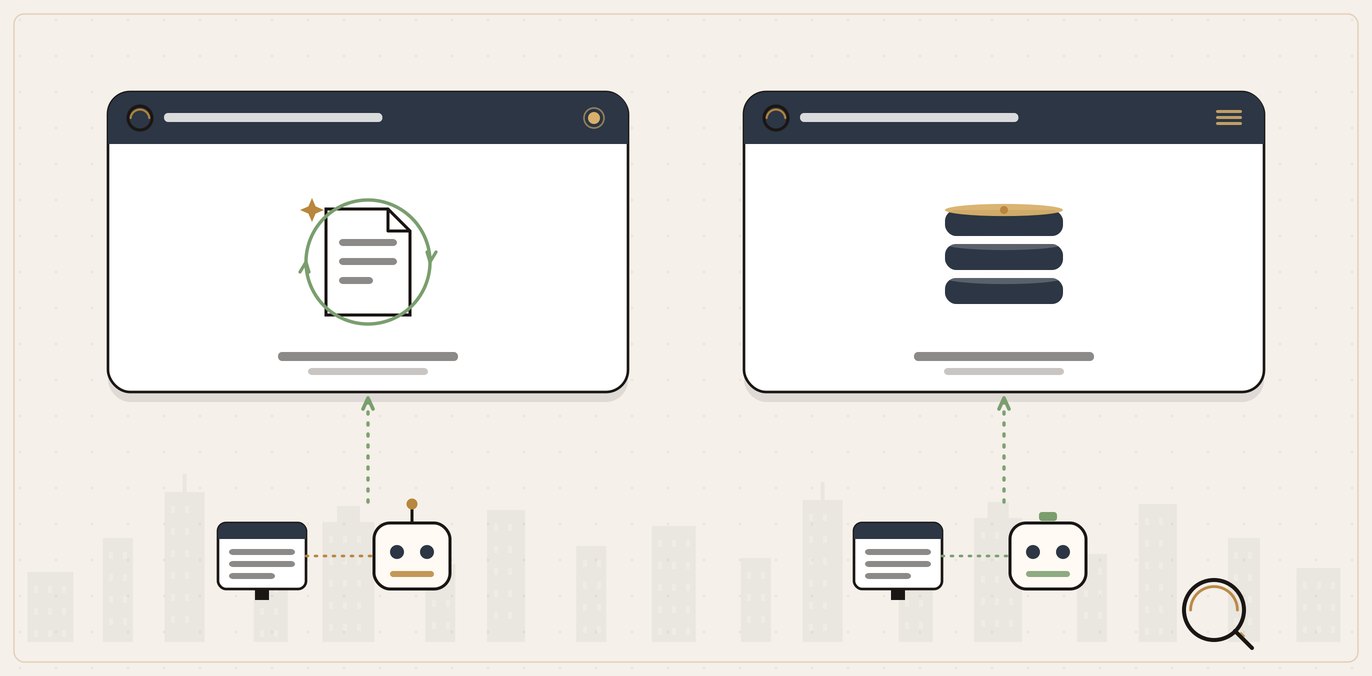
ChatGPT and Perplexity discover your content through two different mechanisms, so being named by one is no guarantee of the other. Perplexity reads the live web at the moment of the question and matches your pages literally, which rewards clear, crawlable, keyword-plain content. ChatGPT answers first from trained memory, a compressed picture of the web fixed when the model was built, and only fetches a live page selectively, which rewards a broad, consistent off-site presence it can recall. To be found in both, allow the right crawlers (OAI-SearchBot for ChatGPT search, PerplexityBot for Perplexity), keep your pages readable and specific, and build genuine third-party coverage so the model that relies on memory has something to remember.
ChatGPT and Perplexity find your business through two different mechanisms, so being named by one tells you nothing about whether the other names you too. Perplexity reads the live web at the moment someone asks, retrieving pages that match the question against a current index. ChatGPT answers first from trained memory, a compressed picture of the web frozen when the model was built, and only fetches a live page when it decides the question calls for one.
This guide takes the publisher's view: how each engine goes looking, what their own crawler docs reveal, and what it takes to be found in both. For a smaller business, neither engine rewards the biggest spender; each rewards specific, checkable steps you can take yourself.
Which engine finds your content, ChatGPT or Perplexity?
Both can, but they reach you through separate machinery. Perplexity is built as a search engine with a language model on top. ChatGPT is built the other way round, as a language model that reaches out to search when a question calls for it. That is why a business that shows up strongly in Perplexity but never in ChatGPT is usually not doing anything wrong; it is being read by one discovery model and missed by the other.
TL;DR
- Two separate discovery models. Perplexity retrieves live at the moment of the question; ChatGPT answers from trained memory first, then fetches selectively. Findable in one does not mean findable in the other.
- Different bots, spelled out in their own docs. OpenAI runs three crawlers that matter for content discovery (GPTBot, OAI-SearchBot, ChatGPT-User); Perplexity runs two (PerplexityBot, Perplexity-User). Block the wrong one and you drop out of that surface.[1][2]
- Perplexity stays close to your words. It runs your question as a live search and matches pages literally, so the plain wording on your service pages is what it looks for; ChatGPT reformulates the question into its own vocabulary before it retrieves.
- Perplexity stays stable enough to check once; ChatGPT keeps moving. Because Perplexity retrieves the same way each time, a single check is a dependable read; because ChatGPT reformulates every question and leans on a shifting memory, its answer can move run to run, so it needs watching over time.
- Two tracks, one for each engine: for Perplexity, be crawlable and keyword-clear so the live retriever matches you; for ChatGPT, build durable, well-cited presence so you are the thing it recalls. Do both and you cover the field.
Two ways of finding you, side by side
Here is what each retrieval strategy means in practice, and exactly where your effort lands with each.
Side by side
Two different ways of being found
| Perplexity | ChatGPT | |
|---|---|---|
| When it finds you | Live, at the moment someone asks the question | From a memory formed earlier, before it decides whether to search |
| What it reads | Your live page, matched against the words in the question | The third-party presence it has already absorbed about you |
| What earns the mention | A crawlable, keyword-clear page it can retrieve on the spot | A wide, consistent description of you across other sources |
Perplexity: it looks when someone asks
When a plumber's customer in Derby asks Perplexity "who fixes a burst pipe on a Sunday near me", it turns that into a search, pulls the pages that match, and answers with a row of numbered sources you can click. The retrieval happens at the moment of the question, against a live index, which has two consequences.
First, freshness counts. A page you published last week can be cited this week, because the index is current and the engine is reading what is there now, not what it memorised months ago. Second, your words count. Because the retrieval stays close to the question, the plain service and area pages you wrote for ordinary search are the same pages Perplexity matches against. If your site says "emergency drain unblocking in Derby" in those words, you are aimed straight at the search Perplexity is likely to run.
Perplexity is the engine you can influence quickly and check reliably. Publish a clear page, and it can enter the pool of sources within days. Ask Perplexity your customer's question once, and because it repeats its searches, the answer you get is a dependable read on where you stand.
ChatGPT: it answers from memory, then checks
ChatGPT reaches for that trained memory first. Ask it for "a reliable accountant for a small limited company" and it can produce names and categories without touching the live web at all, because that knowledge is already inside the model from training. It reaches out to fetch a fresh page only when it judges the question needs current information the memory cannot supply.
That changes what gets you named. To be in ChatGPT's memory, you had to be present, and clearly described, across the web at the time it learned from it: mentioned on the sources it trusts, described consistently, associated with your service and your town in enough places that the pattern stuck. A brand-new page does not have that history yet, which is why freshness helps you far less here than it does on Perplexity. What helps is durable, repeated, third-party presence that the model had time to absorb.
ChatGPT also has a second path. When it fetches live pages through its search feature, a separate index decides what it can surface, and that index is governed by its own bot, which we come to next. So ChatGPT is really two discovery paths in one: the trained memory it recalls from, and the live search it occasionally reaches for. You want to be in both.
If Perplexity misses you, look at your robots.txt and whether your pages name each service and town in plain words. If ChatGPT misses you, look at your reviews, directory listings and mentions across the wider web. The lever is different for each engine, so the fix for one rarely helps the other.
The bots each engine sends to your site
All of this becomes concrete at the level of crawlers, the automated visitors that read your pages on each engine's behalf. Both companies publish exactly which bots they run and what each one does, and reading those docs side by side is the clearest possible view of the two discovery models. It also shows you precisely which access setting decides whether you appear.
OpenAI documents three separate content robots, each with its own job (a fourth, OAI-AdsBot, only checks pages submitted as ads, so it plays no part in discovery). In its words, "OpenAI uses OAI-SearchBot and GPTBot robots.txt tags to enable webmasters to manage how their sites and content work with AI. Each setting is independent of the others"[1]. The three:
- GPTBot feeds the trained memory. OpenAI says it "is used to crawl content that may be used in training our generative AI foundation models"[1]. This is the bot whose past visits shaped what ChatGPT recalls without searching.
- OAI-SearchBot feeds the search index. It "is used to surface websites in search results in ChatGPT's search features", and OpenAI is blunt about the stakes: "Sites that are opted out of OAI-SearchBot will not be shown in ChatGPT search answers"[1]. This is the one that governs whether ChatGPT can cite you when it does go looking.
- ChatGPT-User is the live visit. It fetches "a web page with a ChatGPT-User agent" when a user's specific request sends it there, and "because these actions are initiated by a user, robots.txt rules may not apply"[1].
Perplexity documents two bots. The first, PerplexityBot, is its search crawler, which Perplexity describes as "designed to surface and link websites in search results on Perplexity" and "not used to crawl content for AI foundation models"[2]. What Perplexity asks of you is one line in a file: "To ensure your site appears in search results, we recommend allowing PerplexityBot in your site's robots.txt file"[2]. Its second bot, Perplexity-User, handles the live user-triggered fetch, and like OpenAI's user agent it "generally ignores robots.txt rules" because a person asked for it[2].
Perplexity runs no training crawler. There is no equivalent of GPTBot, because Perplexity does not answer from a trained memory of the web; it only indexes pages and fetches them live. That extra training crawler is exactly why ChatGPT can answer from memory and Perplexity cannot.
What that means for your robots.txt
The map below is what to check. The user-triggered bots (ChatGPT-User, Perplexity-User) mostly bypass robots.txt, so the settings that actually decide your visibility are the two search bots.
| Bot | Engine | Its job | What it decides for you |
|---|---|---|---|
| OAI-SearchBot | ChatGPT | Builds ChatGPT's search index | Block it and you "will not be shown in ChatGPT search answers"[1] |
| GPTBot | ChatGPT | Crawls content that may train the models | Shapes the trained memory ChatGPT recalls from; blocking it opts you out of training |
| ChatGPT-User | ChatGPT | Live fetch on a user's request | robots.txt "may not apply"; a user's question can pull your page directly[1] |
| PerplexityBot | Perplexity | Builds Perplexity's search index | Allow it or you cannot appear in Perplexity's results[2] |
| Perplexity-User | Perplexity | Live fetch on a user's question | "generally ignores robots.txt rules"[2] |
The two search-bot directives in your robots.txt decide most of it. If your robots.txt blocks OAI-SearchBot or PerplexityBot, you have quietly opted out of that engine's search surface, and no amount of good content fixes it. Rebuilds, security plugins and over-cautious web firewalls sometimes add those blocks without anyone deciding to, which is covered bot by bot in our crawler guide. Both companies also note the same lag: a change to your robots.txt can take around 24 hours to register[1][2], so check, then re-check the next day.
How close each engine stays to your actual words
Being allowed in is step one. Step two is whether the words on your pages match the search the engine runs, and here the two models diverge sharply again, in a way that follows directly from the architecture their own docs describe.
Different sources
The two engines rarely reach for the same sites
86%
of the most mentioned sources are not shared across ChatGPT, Perplexity and Google AI Overviews
7
of the 50 most mentioned websites appear in the top 50 of all three engines
76.7M
AI Overviews were compared with ChatGPT and Perplexity prompts in June 2025
Ahrefs, Brand Radar analysis, June 2025
Perplexity barely drifts at all. It runs the customer's question as a live search and, as its documentation puts it, works to "surface and link websites in search results"[2] that match. It behaves like a literal retriever, so traditional keyword coverage stays a strong proxy for what Perplexity is likely to search. In plain terms, if your page uses the words your customer uses, Perplexity is looking for those same words.
ChatGPT does the opposite. It answers first from a trained memory rather than the words on the page, so it tends to reformulate a question into its own vocabulary, adjacent concepts, and alternate framings before it retrieves anything. A customer asking about "a builder for a loft conversion in Bristol" might lead ChatGPT toward planning permission, structural work, or local trades, terms your page may never use. Matching the exact question is not enough; you need to be findable across the wider territory around it.
That difference is visible in whose sites each engine ends up citing. Ahrefs compared the 50 most-mentioned websites on AI Overviews, ChatGPT and Perplexity across roughly 76.7 million AI Overviews, 957,000 ChatGPT prompts and 953,500 Perplexity prompts in June 2025, and found only 7 websites sat in the top 50 for all three.[3] Even for the same questions, the engines reach for largely different sources, so being named by one says little about the others.
It also changes how you monitor each engine. Because Perplexity retrieves the same way each time, a single check gives a reasonably stable read. ChatGPT reformulates almost every question and leans on a memory that shifts, so its answer can vary run to run and monitoring has to be ongoing. You can test Perplexity once and trust it; ChatGPT you keep watching, because it rarely searches the same way twice.
Both engines hold onto one thing more reliably than the rest: location. A geographic qualifier is the hardest part of a query to paraphrase away, so "emergency dentist in Sheffield" tends to survive as "Sheffield" on both engines even when the rest of the phrasing is rewritten. For a business that serves one area, location-clear pages are the surest way to stay matched on either engine.
How to be visible in both
Because the two models reward different things, the smart approach is to cover both: do the crawlable, keyword-clear work that wins Perplexity's live retrieval, and the durable-presence work that earns a place in ChatGPT's memory, knowing that most of it feeds both.
Visible in both
One plan that feeds both discovery models
Allow the search bots
Leave OAI-SearchBot and PerplexityBot allowed in robots.txt, or you opt out of that engine's search surface.
Readable, specific pages
Put services, areas and prices in raw HTML and name each service the way customers say it.
A described presence
Earn steady reviews, accurate listings and genuine local mentions so the memory has something to recall.
Publish and test
Ask the customer's question in both engines and note whether you now appear.
To be found by Perplexity: be readable and specific, now
- Allow PerplexityBot in your robots.txt, and confirm your key content (services, areas, prices, contact details) sits in the raw HTML, not behind JavaScript that only runs in a browser. A crawler that lands on a near-blank page indexes nothing, and this catches more small-business sites than their owners ever realise: our guide to whether AI can read your website walks through it.
- Name each service the way customers say it, on its own page. "Emergency electrician in Nottingham", not "power solutions". Because Perplexity matches your words, plain, specific wording matches better than clever or vague wording.
- Answer "best [service] in [town]" genuinely somewhere, since that phrasing is the most stable search Perplexity runs.
- Publish and check. A new page can enter Perplexity's pool within days, and a single check tells you whether it worked.
To be recalled by ChatGPT: be described, widely and consistently
- Leave both OpenAI bots allowed unless you have a firm reason not to. OAI-SearchBot decides whether ChatGPT's search can cite you; GPTBot shapes the memory it recalls from.
- Build presence on the sources it trusts: genuine reviews, accurate directory and trade-body listings, real mentions in editorial and community threads. ChatGPT's memory is assembled from where the wider web talks about you, not from your own homepage, which is why earning citations across the web moves it more than any single page you publish.
- Keep your details identical everywhere. A name, address and phone number that agree across the web make the model surer of who you are, and a surer model names you more readily. Where they disagree, it hedges.
- Cover the territory, not just the keyword. Because ChatGPT invents its own search phrasings, content that answers the follow-up questions around your service (the "what about", the comparisons, the specifics) gives it more ways to reach you.
Most of this work feeds both models at once. Clear pages, a crawlable site, genuine reviews and consistent listings satisfy the live retriever and the trained memory together. It is one body of work, not two campaigns: the same clear pages and consistent presence reach both at the same time. For the fuller Perplexity-specific playbook, our guide on getting cited by Perplexity goes deeper, and for the ChatGPT side, how to get mentioned in ChatGPT covers the off-site half. To see how the same question resolves across ChatGPT, Perplexity and Google's AI Mode, our piece on who each one cites puts the three side by side.
A worked example
Take a two-room dental practice in Sheffield that has just published a clear new page: "Emergency dentist in Sheffield, same-day appointments". Within a week, someone asks Perplexity "emergency dentist Sheffield today", and the practice appears in the answer, because Perplexity crawled the fresh page, matched the words, and cited it. The owner is delighted, and reasonably assumes ChatGPT will follow.
It does not, and the reason is instructive. Ask ChatGPT the same question and the practice is nowhere, because ChatGPT is answering from a memory formed before that page existed, and the practice has little third-party presence for the model to have absorbed: a thin set of reviews, one out-of-date directory listing, no mentions in local threads. The page that won Perplexity in days cannot win ChatGPT on its own, because ChatGPT is not reading the page at all; it is recalling the practice from memory, and there is little to recall.
The fix is off-site work, not more pages: steady recent reviews, accurate listings that agree with the website, a genuine local presence the model can pick up next time it learns or searches. Do that, and the same practice starts to surface in both, because it has satisfied both discovery models: the live retriever that reads its page, and the memory that has finally been told, in enough places, who it is and where it works.
Two things to check first
Start by finding out whether the search bots are even allowed to read you, then whether each engine already names you today. The first is a robots.txt check, five minutes if you know where to look. The second is a two-minute test: open ChatGPT and Perplexity, ask the question your best customer would ask, and note whether you appear in one, both, or neither. What counts here is being named, since much of the traffic these engines send arrives mislabelled in your analytics anyway.
Check first
Find out which model is already working
Check robots.txt allows both search bots.A blocked OAI-SearchBot or PerplexityBot quietly opts you out, and no content fixes that.
Ask your best customer's question in both engines.Note whether you are named in one, both or neither.
If Perplexity misses you, look at live retrieval.A blocked crawler, or a page too thin and vaguely worded for its literal match to catch.
If ChatGPT misses you, look at trained memory.Too little consistent third-party presence for the model to have absorbed who you are.
That test tells you which of the two discovery models is already working and which is missing you, but it stops short of the diagnosis. If Perplexity ignores you, the fault sits on the live-retrieval side: a blocked PerplexityBot, or a page too thin and vaguely worded for its literal match to catch. If ChatGPT ignores you, the fault sits on the trained-memory side: too little consistent, third-party presence for the model to have absorbed who you are. The symptom looks identical but the cause is opposite, and the fix for one does nothing for the other, so guessing between them wastes weeks.
A free QBiz Leads AI visibility check narrows it down fast. It scans your website in about thirty seconds and returns a clear pass or fail on the signals that decide whether AI tools can find and recommend you, so instead of wondering which engine is ignoring you and why, you get a prioritised list of what to fix first.
Get your AI Visibility audit →
Frequently asked questions
Does Perplexity or ChatGPT find my website faster?
Perplexity, in most cases. It retrieves live from a current index when a question comes in, so a clear new page can be cited within days. ChatGPT answers first from a trained memory that was fixed when the model was built, so a brand-new page influences it far more slowly, unless ChatGPT's search feature fetches the page live for a specific question.
Why does my business show up in Perplexity but not ChatGPT?
Because they discover you differently. Perplexity matched the words on your live page; ChatGPT is recalling businesses from its trained memory, which is built from how widely and consistently the web describes you. If your off-site presence (reviews, listings, mentions) is thin, there is little for ChatGPT to recall, even when your own page is excellent.
Which crawlers do I need to allow for ChatGPT and Perplexity?
For ChatGPT's search results, allow OAI-SearchBot: OpenAI states that opted-out sites "will not be shown in ChatGPT search answers". GPTBot governs whether your content can inform model training. For Perplexity, allow PerplexityBot, which Perplexity recommends enabling so your site can appear in its results. The user-triggered agents (ChatGPT-User, Perplexity-User) generally bypass robots.txt because a person requested the fetch.
Does Perplexity use my content to train an AI model?
No. Perplexity's documentation says PerplexityBot "is not used to crawl content for AI foundation models", and it runs no separate training crawler. It indexes pages to surface them in search and fetches them live for user questions. OpenAI, by contrast, runs GPTBot specifically to crawl content that may train its models, which you can disallow independently of appearing in ChatGPT search.
Is keyword-clear content enough to get into both?
It is most of the job for Perplexity, which runs your question as a live search and matches your words literally, but only part of the job for ChatGPT, which reformulates the question into its own vocabulary before it retrieves. For ChatGPT you also need a broad, consistent off-site presence so the model can reach you through vocabulary your page never used. Clear pages plus genuine third-party presence covers both.
How do I get my business into ChatGPT's trained memory?
You do not upload to it directly; the model absorbs the web when it is trained, and it recalls businesses that are described widely and consistently across it. So the effort goes off-site: genuine reviews, accurate listings, and independent mentions on the kinds of pages ChatGPT reads, all agreeing on your name, location and services. A business that only exists on its own homepage has little for the model to remember, which is why strong Perplexity visibility can sit alongside no ChatGPT presence at all.
If I block GPTBot, do I disappear from ChatGPT search?
Not from search. GPTBot governs whether your content can be used to train the foundation models; OAI-SearchBot is the crawler that lets you appear in ChatGPT's live search answers. You can disallow GPTBot to opt out of training while still allowing OAI-SearchBot so ChatGPT can surface you when it searches the web. Blocking the wrong one is a common way businesses accidentally remove themselves from a surface they wanted to keep.
How do I check where I stand in ChatGPT versus Perplexity?
Ask each engine the questions your customers would ask, in their words. Perplexity repeats its searches the same way, so a single check is a dependable read. ChatGPT reformulates every question and leans on a shifting memory, so its answer can move run to run: check it several times over a few weeks and read the pattern rather than any one reply.
Does structured data (schema) help with both engines?
It helps mainly by making your pages unambiguous. Clear schema for your business, location and services reinforces the plain facts a live retriever like Perplexity matches against, and the same consistency across your site and listings strengthens the entity picture ChatGPT recalls. It is not a shortcut into either engine, but it removes doubt about who you are and what you do, which both value.
Which should a small business prioritise, ChatGPT or Perplexity?
Start with the fundamentals that serve both: a crawlable, clearly worded site with the right bots allowed. Perplexity gives you the faster, more measurable win because a clear page can be cited within days, so it is a sensible first target. ChatGPT rewards the slower work of building durable off-site presence, so run it in parallel rather than waiting. Neither favours the biggest budget; both favour specific, checkable steps.
Sources
- [1] OpenAI, "Overview of OpenAI Crawlers" (primary documentation: GPTBot crawls content that may train the foundation models; OAI-SearchBot surfaces sites in ChatGPT search and opted-out sites "will not be shown in ChatGPT search answers"; ChatGPT-User is the user-initiated fetch and robots.txt "may not apply"; ~24 hours for robots.txt changes to register): https://platform.openai.com/docs/bots
- [2] Perplexity, "Perplexity Crawlers" (primary documentation: PerplexityBot is "designed to surface and link websites in search results on Perplexity" and "is not used to crawl content for AI foundation models"; "we recommend allowing PerplexityBot in your site's robots.txt file"; Perplexity-User "generally ignores robots.txt rules"; up to 24 hours for changes to reflect): https://docs.perplexity.ai/guides/bots
- [3] Ahrefs, "86% of Top Mentioned Sources Are Not Shared Across ChatGPT, Perplexity, and AI Overviews" (Brand Radar, June 2025: of the 50 most-mentioned websites on AI Overviews, ChatGPT and Perplexity, only 7 appear in the top 50 for all three; across ~76.7M AI Overviews, 957k ChatGPT prompts, 953.5k Perplexity prompts): https://ahrefs.com/blog/top-mentioned-sources-are-not-shared-across-ai-assistants/
Leave a comment
Thoughts on this post? Leave a comment below. Comments are moderated before they appear, so yours will not show on the page straight away.
Your email is used only to contact you about your comment if needed — it is never published.
Comments
No comments yet. Be the first to leave one above.