Traditional Dental SEO vs Generative AI Optimisation in the UK: What Changed and What to Do
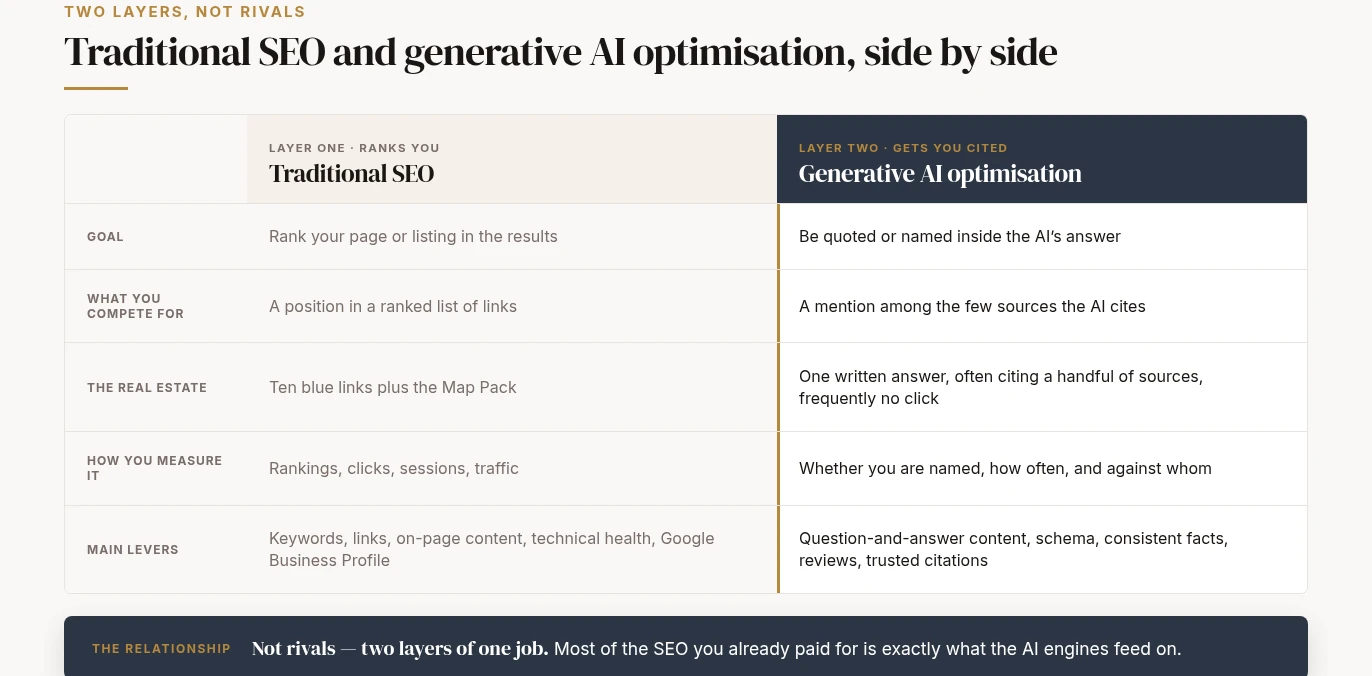
Traditional dental SEO is not dead. It has become the first of two layers: SEO still decides whether you rank in Google's links and map pack, while generative AI optimisation decides whether an AI tool names your practice inside its answer. The two overlap heavily, most of the SEO you already fund is exactly what the AI engines read, and the newer layer is an addition rather than a replacement. You need both.
A patient with a broken tooth on a Saturday morning used to do the same thing every dentist built their marketing around: open Google, scan the map pack, read a few star ratings, pick a name and call it. For twenty years that route was the whole game, and ranking near the top of it was the prize. A growing share of those patients now skip most of those steps. They ask ChatGPT "is there an emergency dentist near me taking patients today?", or they read the AI summary sitting above Google's results and act on it before a single blue link gets a click.
That single change is why dental practice owners keep asking us a version of the same anxious question: has all my SEO just stopped mattering? It has not. Traditional SEO and the newer work people label GEO, AEO or generative AI optimisation are two layers of the same job. Most of the SEO you already paid for is exactly what the AI engines read. This guide sets out what is genuinely different, what still works untouched, and what to actually do about it. It is written for a practice owner, and it stays inside General Dental Council rules at every step.
The short version
- The two layers are judged by different people. Google ranks your pages against other pages; an AI engine weighs whether enough independent sources agree your practice is the right answer.
- Most of it overlaps. A complete Google Business Profile, genuine reviews, a crawlable site and one consistent set of facts serve both layers at once.
- Only a thin slice is new. Extraction-ready answer blocks, thinking in entities and citations, and monitoring whether AI names you at all.
- The click is collapsing on some searches. That is the case for adding the second layer, not for abandoning the first.
- Fund one presence. Your SEO builds the corpus the AI reads; the new spend is modest beside the foundation it sits on.
Is dental SEO dead?
What changed is that a second layer was added on top. Millions of patients still use Google's links and map pack directly, and that route is still won the way it always was. The new layer decides something separate: whether an AI tool names your practice inside its answer. Because the two feed each other, dropping your SEO to chase the AI layer knocks out part of the foundation that layer is built on.
The reason the "is it dead?" fear feels so real is that the click is genuinely collapsing for some searches. Ahrefs studied 300,000 keywords and found that the presence of an AI Overview in the results correlated with a 34.5% lower average click-through rate for the top-ranking page, set against similar informational keywords with no AI Overview[1].
The behaviour is widespread, too: a Pew Research Center analysis of the browsing data of 900 US adults found that about six in ten (58%) ran at least one Google search in March 2025 that returned an AI-generated summary[2]. Fewer people are scrolling to the links. Fewer clicks on links makes the case for adding the second layer.
What is traditional dental SEO?
Traditional SEO ranks your own pages and listings in a search engine's results, chiefly Google, so a patient browsing those results finds and chooses you. It competes for a position in a ranked list of links, and the patient does the rest by clicking through.
For a dental practice it has a familiar shape. You target the words patients search ("dentist in [town]", "Invisalign near me", "emergency dentist"), you publish pages built around them, and you earn links and signals that tell Google your site deserves to rank. Alongside the web pages sits the local layer that matters most for a dentist:
- A complete Google Business Profile.
- The Map Pack that shows three local practices with their stars and hours.
- Genuine reviews.
- A site that loads fast and can be crawled.
The unit you are optimising is the page or the keyword, and the metric you watch is rankings and the traffic they bring.
None of that has stopped working. Patients still open Google, still scan the map pack, still click links. Traditional SEO remains the way you win those patients, and it remains the groundwork the next layer reads from.
What is generative AI optimisation (and why the GEO, AEO and LLMO labels mostly mean the same thing)?
Generative AI optimisation makes your practice the source an AI tool cites and recommends inside its synthesised answer, rather than a link the patient has to find and click. When ChatGPT, Google's AI Overviews, Perplexity or Gemini answer "best dentist in [town] for nervous patients", they do not hand back a list of ten links to scroll. They write a short answer and name a few practices. This layer is about being one of those named practices.
The alphabet soup of labels around this work mostly describes the same thing. GEO (Generative Engine Optimisation), AEO (Answer Engine Optimisation) and LLMO (Large Language Model Optimisation) are three names for one underlying job. That job is making your true, well-structured information easy for an AI to find, trust and repeat. The labels differ only in emphasis: GEO came out of an academic paper, AEO frames it around "answer engines", LLMO points at the models themselves. A dental practice does not need three separate strategies for three acronyms. It needs one: be the clearest, best-supported answer to the dental questions patients ask in your area.
Researchers from Princeton and Georgia Tech introduced the term in a paper accepted to a major data-science conference. They describe GEO as "the first novel paradigm to aid content creators in improving their content visibility in generative engine responses". In a controlled benchmark it could "boost visibility by up to 40%" in those responses, though the effect "varies across domains"[4]. How you structure and present information measurably changes whether an engine repeats it.
Traditional SEO vs generative AI optimisation: the side by side
They share a foundation, but they compete for different things, measure different outcomes and reward slightly different moves.
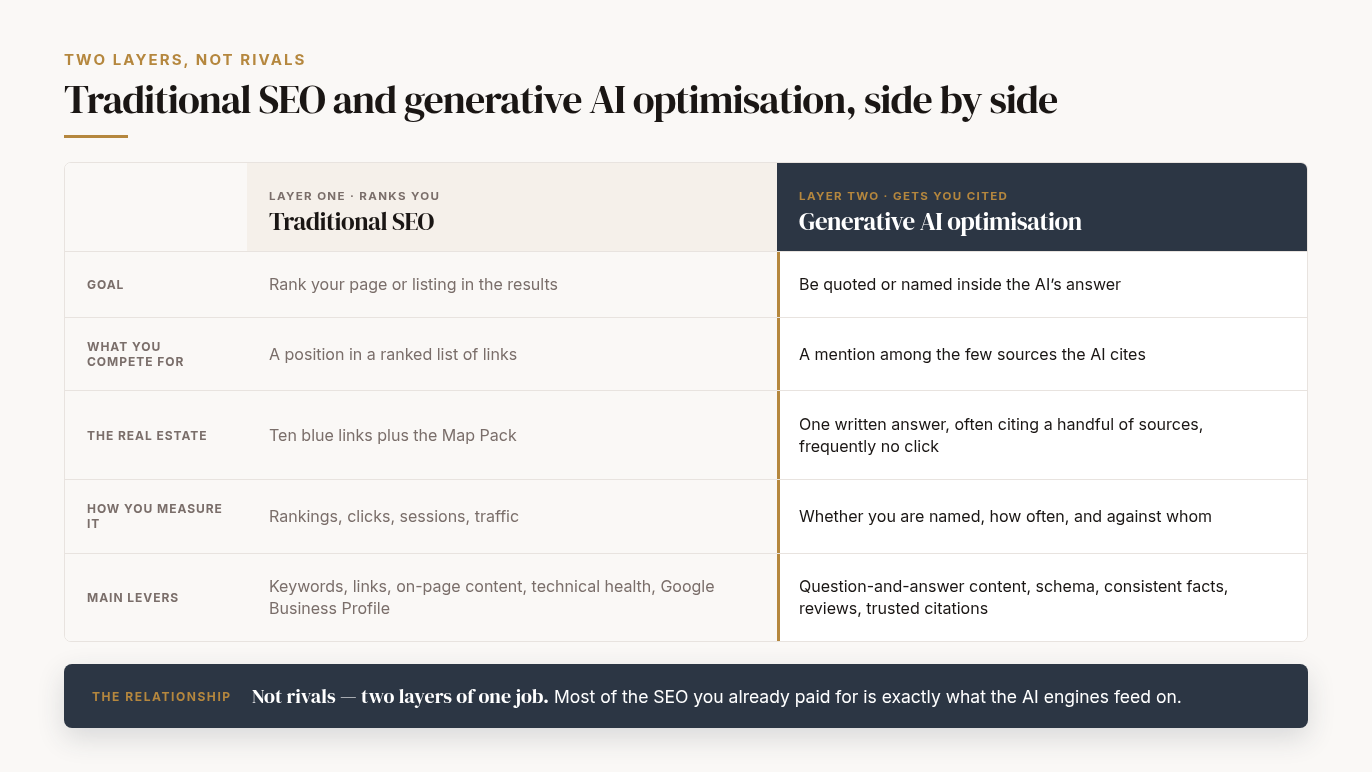
Side by side
The two layers weigh different things
| What it weighs | Traditional SEO | Generative AI optimisation |
|---|---|---|
| Goal | Rank your page or listing in the results | Be quoted or named inside the AI's answer |
| What you compete for | A position in a ranked list of links | A mention among the few sources the AI cites |
| The unit | The page and the keyword | The entity (your practice) and the answer it can supply |
| The real estate | Ten blue links plus the Map Pack | One written answer, often citing only a handful of sources, frequently with no click |
| How you measure it | Rankings, clicks, sessions, traffic | Whether you are named, how often, and against whom |
| Main levers | Keywords, links, on-page content, technical health, Google Business Profile | Structured question-and-answer content, schema, consistent facts across the web, genuine reviews, citations on trusted sources |
Read across the table and the relationship becomes clear. The traditional levers and the generative levers are mostly the same things, weighted differently. A complete Google Business Profile, real reviews and a fast, crawlable site help you rank and help you get named. The genuine differences sit at the edges: SEO chases a clickable position, generative optimisation chases a citation inside a reply where there may be no click to win at all.
What overlaps, and what is genuinely new?
The large majority of good dental SEO already feeds the AI layer. Only a thin slice of it is genuinely new. Once you can see the line between the two, the panic drains out of the decision.
Most of it overlaps. The fundamentals that always mattered for local SEO are the same signals AI engines lean on when they decide whom to name. These all serve both layers at once:
- Genuinely helpful content that answers patient questions.
- A complete, accurate Google Business Profile.
- A fast site a crawler can read.
- Strong, recent reviews.
- One consistent set of facts: name, address, phone, hours and services, across the web.
When you improve them for Google, you are improving them for ChatGPT and Google's AI Overviews in the same motion. None of that work is wasted, and none of it needs redoing for the AI era. It is the corpus the AI reads.
A smaller slice is genuinely new, and it is worth naming precisely so you know where the new effort actually goes:
- Writing extraction-ready answer blocks. AI engines lift clean, self-contained answers far more readily than they parse a page that buries the point. A page that opens a section with a plain question and answers it directly in a sentence or two, in the patient's own words, is easier for an engine to quote than "Welcome to our practice" copy that settles nothing.
- Thinking in entities and citations. Traditional SEO trained you to chase keywords. The AI layer cares whether enough trusted, independent sources agree that your practice exists, where it is and what it does well, because agreement between independent sources is what an engine builds confidence on. That shifts some effort from on-page wording to off-site consistency: the NHS listing, healthcare directories, review platforms and local press all agreeing with your own site.
- Monitoring whether AI mentions you at all. This is a metric SEO never had. You can rank perfectly on Google and still be invisible inside ChatGPT, and rankings dashboards will not tell you. Checking what the AI tools actually say when asked about dentistry in your area is a new, ongoing habit rather than a one-off task.
That is the whole of the new layer for most practices: better-structured answers, attention to off-site agreement, and a way to see whether it is working. Everything else you were already doing, or should have been.
Why is the shift happening now?
The shift is happening because the engines stopped handing back lists and started synthesising answers, and because patients are increasingly content to act on those answers. Two mechanics explain why structure now beats keyword-chasing, and one piece of behaviour explains why ignoring it costs you.
Query fan-out
Why structure now beats keyword-chasing
One patient question
"Who's a good dentist in Leeds for nervous patients?"
A multitude of queries
The engine issues hidden searches for local practices, sedation, recent reviews, NHS versus private and hours.
Answer the cluster
A practice that has answered the whole cluster plainly turns up in more of the fanned-out searches.
One answer
The hidden searches are stitched back into a single reply naming a few practices.
The first mechanic is how the engines read a question. They almost never search for the phrase a patient typed. Google calls its own method query fan-out: it breaks a question into subtopics and issues "a multitude of queries simultaneously on your behalf"[3].
Behind a single "who's a good dentist in Leeds for nervous patients?" sit separate hidden searches for local practices, sedation options, recent reviews, NHS versus private availability and opening hours, all stitched back into one answer. No single keyword-stuffed page wins that. The practice that has answered the whole cluster of patient questions plainly, across its site and listings, turns up in more of the fanned-out searches and lands in the reply more often.
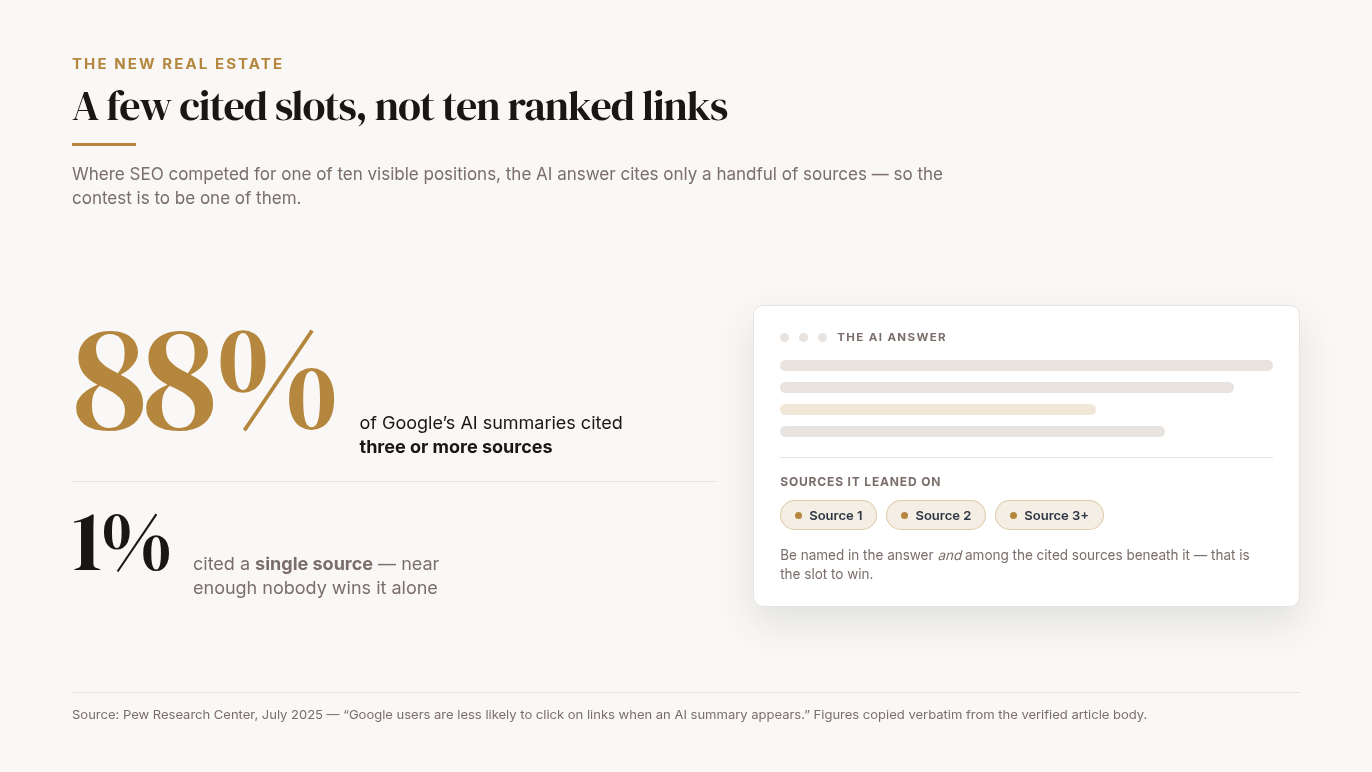
The second mechanic is the shrinking of the result into a single answer. Where SEO competed for one of ten visible positions, generative optimisation competes to be one of the few sources an engine cites, and often there is no click to be had at all. The Pew study found that 88% of Google's AI summaries cited three or more sources, and only 1% cited a single source[2]. A few cited slots are the real estate you are now competing for.
The behaviour that makes it urgent is that search itself is still growing. Google reports that AI Overviews is "driving over 10% increase in usage of Google for the types of queries that show AI Overviews"[3]. People are asking more questions and reading more answers, while clicking fewer links. A practice that is named in those answers is collecting patients its competitors never see coming. There is an added weight for dentistry specifically. Health questions carry higher trust stakes, so the engines lean harder on reputable sources that back each other up before naming anyone. That rewards the practice which has done the dull consistency work.
What does this mean for your practice: keep, add, stop
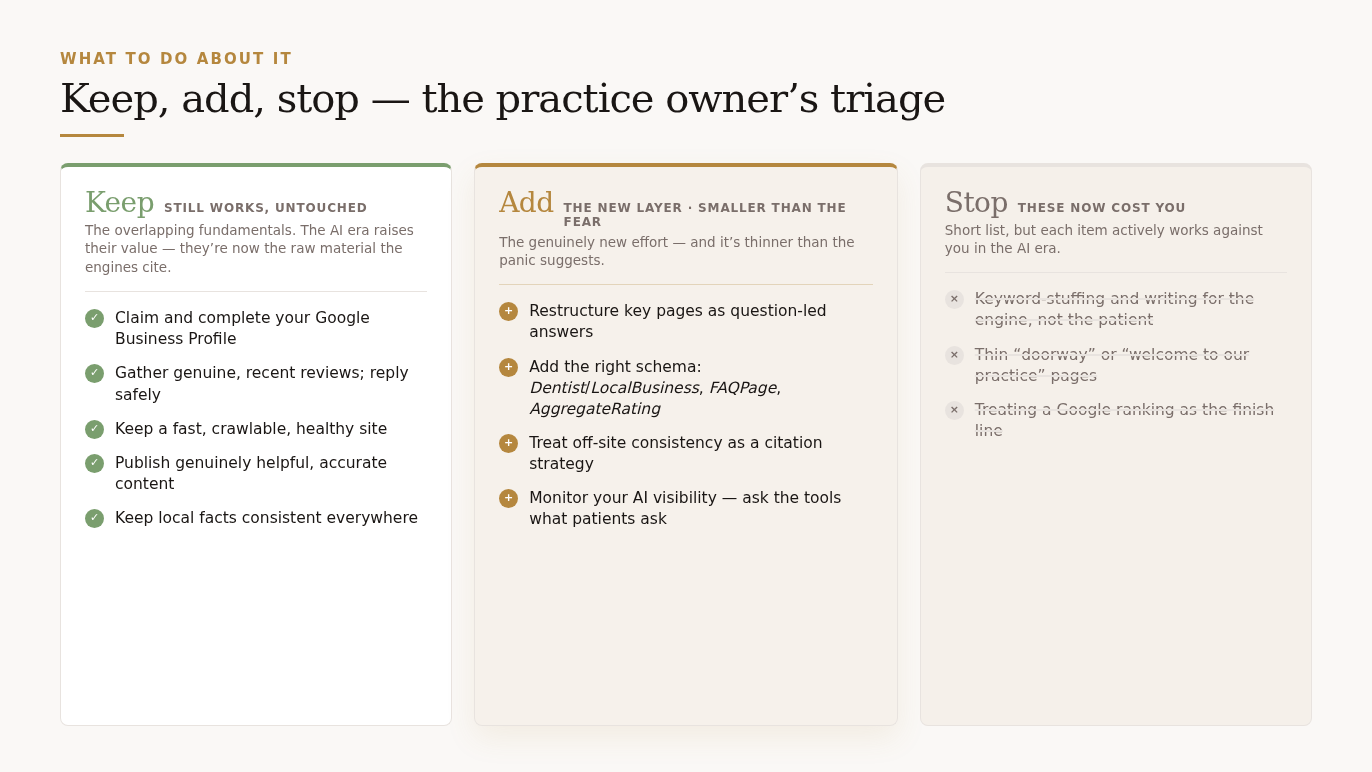
The practical translation of all of this fits into three lists. Keep doing the things that still work, add the thin new layer, and stop the habits that now cost you. Worked in that order, none of it requires throwing anything away.
Why the shift is happening now
Answers are replacing lists, and the click with them
34.5%
lower average click-through for the top-ranking page when an AI Overview appears (Ahrefs, 300,000 keywords)
58%
of Pew's 900 US adults ran a Google search in March 2025 that returned an AI-generated summary
88%
of Google's AI summaries cited three or more sources; only 1% cited a single source
Ahrefs, 2025; Pew Research Center, 2025.
Keep doing (this still works, untouched)
These are the overlapping fundamentals that serve both layers. If anything, the AI era raises their value, because they are now the raw material the engines cite.
- Claim and complete your Google Business Profile, with an accurate, current "accepting new patients" status, full hours, every service in plain words, real photos and accessibility detail. It is the listing that both Google and the AI tools read directly.
- Gather genuine, recent reviews and reply to them safely, never revealing clinical detail in a public reply. Recency matters as much as volume.
- Keep a fast, crawlable, technically healthy site. Speed and crawlability decide whether anything you write is even readable by an engine.
- Publish genuinely helpful, accurate content about the treatments and questions patients care about.
- Keep your local signals consistent: the same name, address, phone, hours and services everywhere they appear.
Add (the genuinely new layer)
The concrete actions, in the order they pay off:
- Rewrite the opening lines of your key service and fee pages as direct answers to the question that page is really about ("how much is a private check-up in [town]?", "can I see an emergency dentist today?").
- Add
DentistorLocalBusiness,FAQPageandAggregateRatingschema where you display genuine review scores. - Reconcile your NHS listing, healthcare directories and review platforms with your own site until every one states the same name, address, phone, hours and services.
- Put a monthly check in the diary: ask the AI tools your patients' questions and record whether you are named.
Stop (these now cost you)
A short list, but each item actively works against you in the AI era.
- Stop keyword-stuffing and writing for the engine instead of the patient. Fanned-out, synthesised search rewards clear answers and ignores keyword density.
- Stop relying on thin "doorway" or "welcome to our practice" pages that name a service but answer no question. They turn up in none of the fanned-out searches.
- Stop treating a Google ranking as the finish line. Topping Google and being named by ChatGPT are now separate jobs, as we set out in why a No.1 Google ranking means nothing in ChatGPT.
One dental query, taken end to end
Take a real question a UK patient types: "NHS dentist near me taking new patients". It is worth walking because the answer turns on facts most practice websites never state plainly.
The engine fans that one question into several. Which local practices hold an NHS contract. Which are open to new NHS patients right now. Whether there is a waiting list. What the patient pays.
The NHS's own guidance tells patients three things directly[6]:
- "some dental practices offer both NHS and private appointments"
- patients "may be asked to join a waiting list"
- patients "may find it difficult to find a local dentist that's offering NHS appointments"
Those are exactly the sub-questions the engine goes looking for an answer to.
So the pages that decide this answer are specific ones:
- A page that states, in words, whether you take NHS patients, private patients, or both.
- A current accepting-new-patients status, dated, on both your site and your Google Business Profile.
- A page that says what happens if there is a waiting list and roughly how it works at your practice.
- A fee page that separates NHS band charges from your private prices.
A practice with those four pages answers most of the fan-out. A practice whose site says only "we are accepting new patients, call us" answers almost none of it, however well that page ranks. This is also where the regulator sets the ceiling on what you may claim: GDC Standard 1.3.3 requires that "any advertising, promotional material or other information that you produce is accurate and not misleading"[5]. The AI layer and that rule pull the same way, since both reward a practice that states verifiable facts and keeps them current.
Do you really need both? The budget logic
Yes, you need both, because they compound. Your SEO work builds the well-documented, consistent, well-reviewed presence that the AI layer then reads and cites. Cut the SEO and you starve the corpus the AI draws on. The practice with the strongest traditional local presence is usually the one best placed to be named in an AI answer, because it has given the engine the most to check against.
For a practice weighing where the next pound goes, that compounding is the whole case. You are not funding two separate marketing programmes. You are funding one well-documented presence and then doing the thin extra work, structured answers, schema, off-site agreement and monitoring, that lets the AI tools repeat it. The fundamentals do double duty; only the top layer is new spend, and it is modest beside the foundation it sits on.
The technical gate underneath all of it
One thing sits beneath both layers and can quietly cancel them: whether an AI crawler can read your site at all. Some practice websites, especially heavily-designed ones and certain page builders, render their text with JavaScript that only runs once a browser opens the page. Several AI crawlers do not run that code, so they reach your site and find a near-empty shell, which leaves even a perfectly written practice invisible to the engines doing the recommending. It is worth a two-minute check before any of the steps above, because no amount of structuring helps a page the engine cannot see. Our guide to whether AI can read your website walks through a quick self-test.
If you want the broader model behind all of this, our complete guide to AEO for local businesses is the pillar this page sits under. Our AEO guide for dentists and clinics walks the patient's journey stage by stage.
Where to start
Week one is a desk job: finish the Google Business Profile and reconcile every listing that disagrees with it, since each later step is checked against those details. Weeks two to four belong to the pages, taken one at a time, starting with your fee page and the treatment you book most. From month two onward the monthly AI check is the only recurring task, and it is the one that tells you whether the earlier weeks landed. All of it sits under any wider AI SEO for dentists programme.
Where to start
Three moves, in order
Keep and complete the fundamentals.Above all a fully accurate Google Business Profile with a current accepting-patients status, since it serves both layers.
Restructure your key service and fee pages.Each should open by answering a real patient question plainly and provably: most of the genuinely new work.
Check what the AI tools actually say.Ask about dentistry in your area so you can see the gap rather than guess at it. These three carry most of the distance from "is my SEO dead?" to a practice that is both ranked and recommended.
If you would rather see where your current site already helps the AI layer and the specific gaps holding you back, that is the job of a free QBiz Leads AI visibility check. It runs over your own site in under a minute and returns a plain pass or fail on how legible your pages are to the engines doing the recommending, with the single biggest fix flagged first. It is the no-cost first step before any spend.
Get your free AI visibility check →
Frequently asked questions
Is SEO dead for dentists?
No. SEO is now one of two layers. Traditional SEO still wins the patients who use Google's links and map pack directly, and it builds the consistent, well-reviewed presence that AI tools read when they decide whom to name. Dropping it would weaken the foundation the AI layer depends on. The right move is to keep your SEO and add the generative layer on top.
GEO vs AEO vs SEO, what is the actual difference?
SEO is ranking your pages and listings in a search engine's results. GEO (Generative Engine Optimisation) and AEO (Answer Engine Optimisation) are two names for the newer work of getting your practice cited inside an AI's answer. They largely describe the same job, so you do not need a separate strategy for each acronym. The practical difference is between competing for a clickable position in a list (SEO) and competing to be one of the few sources an AI quotes in a synthesised reply (GEO or AEO).
Which AI platforms actually matter for a dental practice?
The ones patients use to ask local and health questions: ChatGPT, Google's AI Overviews and AI Mode, Perplexity and Gemini. They draw on overlapping but different sources. One set of consistent work raises your odds across all of them at once: a complete Google Business Profile, an accurate NHS listing, genuine reviews and facts that agree across the web.
How do I know whether AI already recommends my practice?
Test it directly. Open ChatGPT, Google's AI Mode and Perplexity, and ask each the questions a real patient asks: best dentist in your town, NHS dentist near me taking patients, emergency dentist in your area today, dentist for nervous patients in your town. Run each a few times, because the answer shifts between attempts and it is the recurring pattern that matters. Note whether you are named, where, and which sources the answer leans on. Absent from every answer tells you where the gap is.
Do I need to write all-new content, or can I retrofit what I have?
Mostly retrofit. Because the layers overlap so heavily, much of your existing content already serves the AI layer. The new work is restructuring key pages so each answers a real patient question plainly in its first lines, adding schema, and bringing your off-site listings into agreement. You will write some new question-led pages where a service currently has none, but most of the job is reshaping and tightening what already exists.
How long until the AI layer starts working?
There is no fixed schedule, and it varies by practice. Completing your Google profile and gathering recent reviews can move things within a few weeks. The slower part is building out directory presence, fixing facts that disagree across the web and earning enough agreement across sources to be named confidently. That often takes a few months of steady work. It is durable, compounding work, and there is no paid shortcut into an AI recommendation.
What schema should a dental practice actually use?
Use Dentist (or LocalBusiness if you also list non-clinical services) as the base type, FAQPage on pages carrying real patient questions, and AggregateRating only where you genuinely display review scores you have collected. Include your opening hours, address, phone number, the treatments you offer and whether you accept NHS patients as structured fields rather than leaving them in prose alone. Schema does not make a claim on your behalf; it removes ambiguity about facts you can already prove.
Can I pay a directory to get my practice mentioned by AI?
No. There is no advertising slot inside an AI answer to buy, and no directory can place you there. A paid directory listing can still help indirectly, because it is one more independent source stating your name, address and services, which is what the engines check against. But the listing earns nothing by being paid for; it earns something by agreeing with everything else about you on the web. Anyone selling a guaranteed AI mention is selling access that does not exist.
What happens when two of my listings disagree about opening hours?
The engine becomes less certain about you, and uncertainty is what stops a practice being named. If your website says you close at 5pm, your Google Business Profile says 5.30pm and a directory still shows Saturday opening you dropped two years ago, there is no version the engine can state confidently. Fix it by picking your site as the single source of truth, then working through every listing until each one matches it, including the ones you did not create yourself.
Does an NHS-only practice need this if it already has a waiting list?
It still matters, though the goal changes. An NHS-only practice with a full list is not chasing volume. The value sits in being described accurately. A patient who cannot register with you should learn that from the answer itself, before they waste a phone call. A patient you can help should reach you straight away. Stating your NHS status, your list position and what a new patient should expect keeps the engine from guessing, and guessing is what generates the calls you do not want.
Sources
- [1] Ahrefs, "AI Overviews Reduce Clicks by 34.5%": https://ahrefs.com/blog/ai-overviews-reduce-clicks/ (Independent; 300,000-keyword study. "The presence of an AI Overview in the search results correlated with a 34.5% lower average clickthrough rate (CTR) for the top-ranking page, compared to similar informational keywords without an AI Overview.")
- [2] Pew Research Center, "Google users are less likely to click on links when an AI summary appears in the results," 22 July 2025: https://www.pewresearch.org/short-reads/2025/07/22/google-users-are-less-likely-to-click-on-links-when-an-ai-summary-appears-in-the-results/ (US; independent. "About six-in-ten respondents (58%) conducted at least one Google search in March 2025 that produced an AI-generated summary." Of those summaries, "88% cited three or more sources. Only 1% cited a single source.")
- [3] Google (The Keyword), "AI in Search: going beyond information to intelligence," 20 May 2025: https://blog.google/products/search/google-search-ai-mode-update/ (Global; vendor primary. "AI Mode uses our query fan-out technique, breaking down your question into subtopics and issuing a multitude of queries simultaneously on your behalf"; AI Overviews is "driving over 10% increase in usage of Google for the types of queries that show AI Overviews.")
- [4] Aggarwal et al., "GEO: Generative Engine Optimisation," arXiv 2311.09735, accepted to KDD 2024: https://arxiv.org/abs/2311.09735 (Primary research. Introduces GEO as "the first novel paradigm to aid content creators in improving their content visibility in generative engine responses"; can "boost visibility by up to 40%", with efficacy that "varies across domains.")
- [5] General Dental Council, Standards for the Dental Team, Standard 1.3.3: https://standards.gdc-uk.org/pages/principle1/principle1 (UK regulator; primary. "You must make sure that any advertising, promotional material or other information that you produce is accurate and not misleading, and complies with the GDC's guidance on ethical advertising.")
- [6] NHS, "How to find an NHS dentist," page last reviewed 6 February 2025: https://www.nhs.uk/nhs-services/dentists/how-to-find-an-nhs-dentist/ (UK; primary. "Some dental practices offer both NHS and private appointments. Ask for an NHS appointment." "You may be asked to join a waiting list before you can get a dental appointment." "You may find it difficult to find a local dentist that's offering NHS appointments.")
Leave a comment
Thoughts on this post? Leave a comment below. Comments are moderated before they appear, so yours will not show on the page straight away.
Your email is used only to contact you about your comment if needed — it is never published.
Comments
No comments yet. Be the first to leave one above.