E-E-A-T for Dentists: How Expertise and Authority Drive AI Platform Rankings
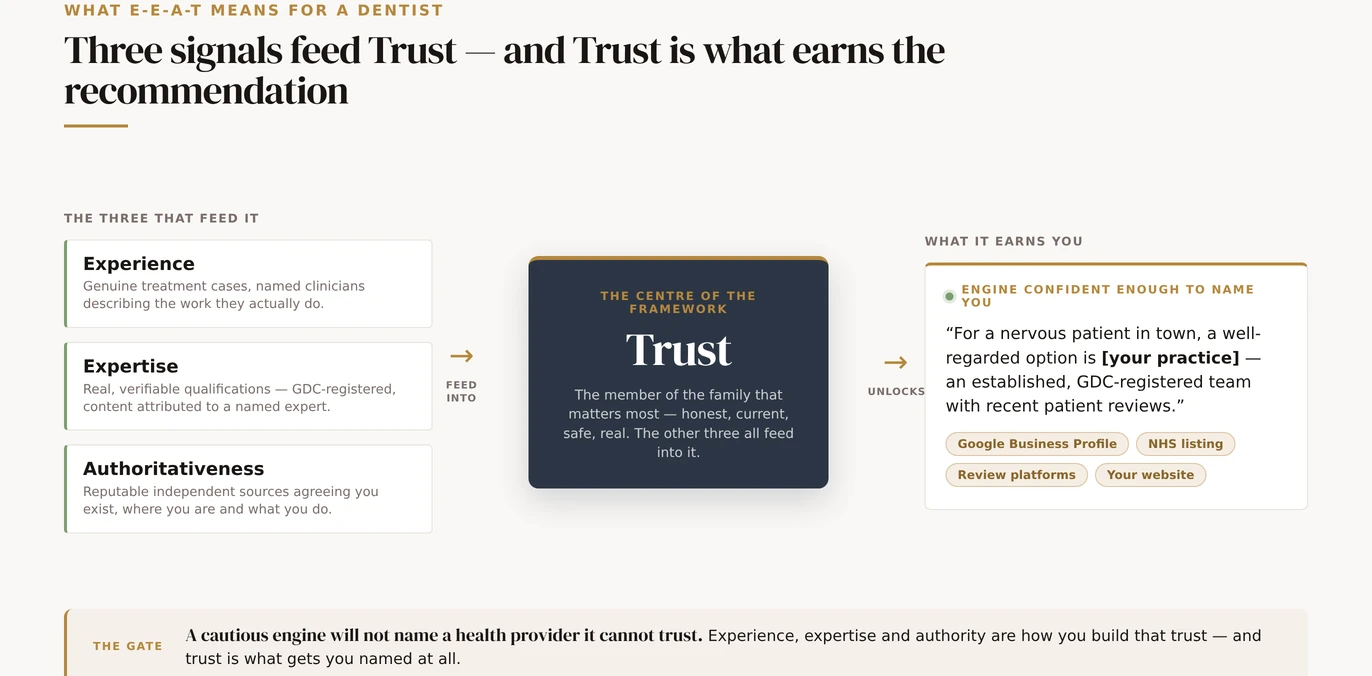
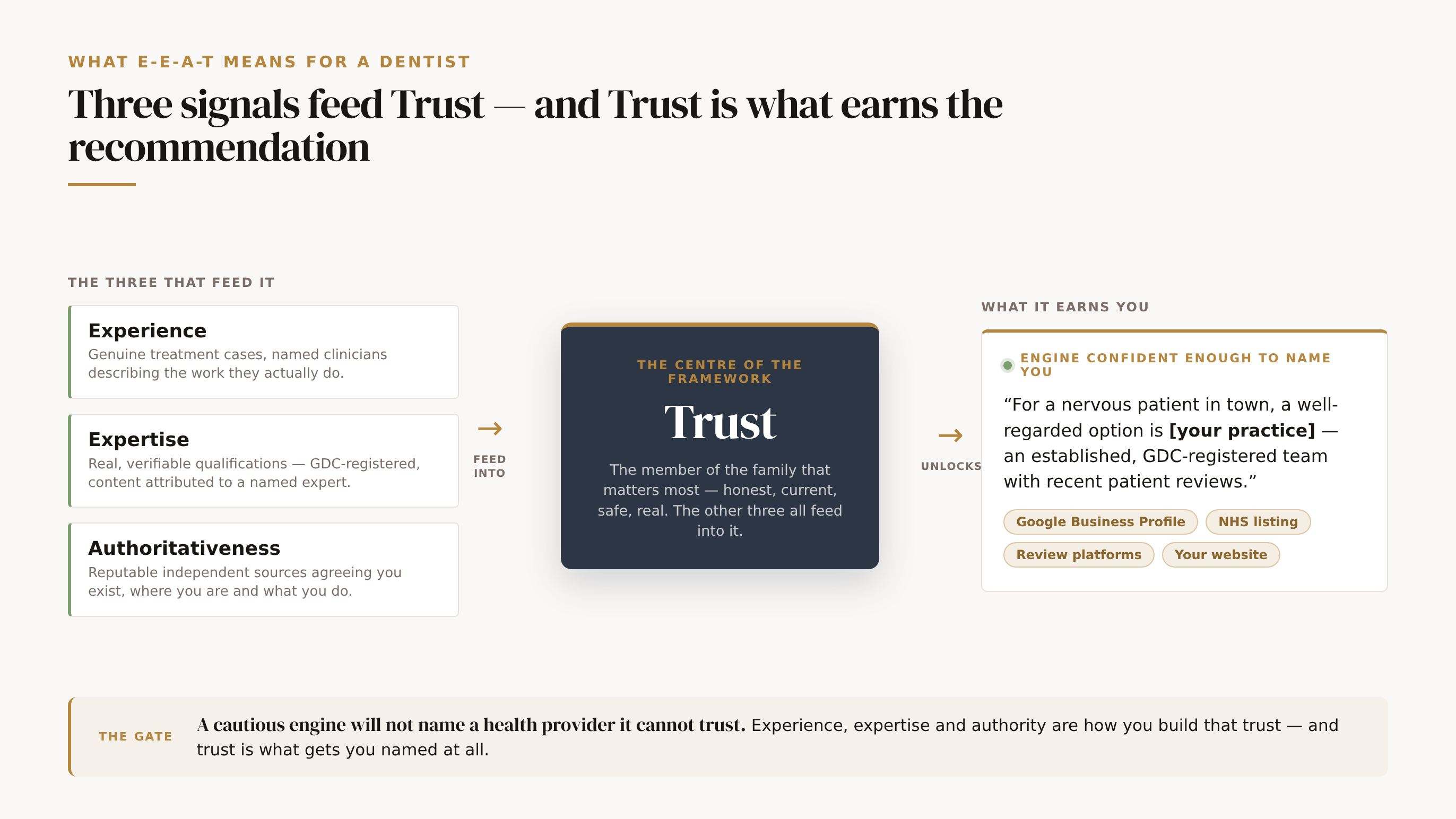
E-E-A-T (Experience, Expertise, Authoritativeness and Trust) is the framework Google's guidance uses to describe content that can be relied on, and AI engines lean on the same quality signals when they decide which health providers to name. For a dentist it is the deciding gate, because engines stay deliberately cautious about recommending a practice they cannot verify as expert, experienced, authoritative and trustworthy. You earn the recommendation by showing genuine first-hand treatment experience, named and qualified clinicians, agreement from reputable third parties, and current, accurate trust signals, then making all of it machine-readable. None of it requires a single boast.
E-E-A-T stands for Experience, Expertise, Authoritativeness and Trust: the four things Google's guidance uses to judge whether content can be relied on, with Trust at the centre and the first "E", Experience, added in December 2022 to turn the older "E-A-T" into "E-E-A-T". For a dentist it matters far more than for most businesses, because dentistry is health, and AI engines will not risk recommending a health provider by name unless the wider web shows them an expert, experienced, authoritative and trustworthy practice. It is not a soft extra: it is the gate that decides whether an AI answer names you at all.
This guide explains what each of the four signals means, why your practice is held to a higher standard than the shop down the road, and how to prove each one in a way both an AI engine and the General Dental Council will accept. Every section answers a question a practice owner actually asks, so you can read the one that applies and act on it. It is written for UK practices, and it asks you to overclaim nothing, because the moves that satisfy an engine are the same ones that keep you compliant. For the wider question of earning a first recommendation from scratch, our guide on how dentists get recommended by ChatGPT covers that ground.
The short version
- Trust sits at the centre. Of the four signals it is the one the others feed into, and for a dentist it rests on genuine recent reviews and transparent, current information.
- Health raises the bar. Dentistry is a "Your Money or Your Life" subject, so engines hold it to the highest trust standard and name only practices they can verify.
- Experience is the most-missed signal. It is the "E" added in 2022, and dentists generate the raw material for it every working day.
- Authority is conferred, not claimed. Reputable third parties agreeing on your facts count; adjectives like "trusted" and "expert" on your own site do not.
- Schema makes it legible. Structured data does not invent authority; it lets an engine read the authority you already have without ambiguity.
What is E-E-A-T, and why did dentists suddenly need to care?
E-E-A-T is the framework Google's own guidance uses to describe trustworthy content: Experience (genuine first-hand involvement with the subject), Expertise (real knowledge and qualifications), Authoritativeness (being recognised by others as a go-to source) and Trust (the accuracy, reliability and safety of the information). Google's guidance on creating helpful, reliable, people-first content asks site owners to check, among other things, whether content is written or reviewed by an expert, and whether it shows clear sourcing, evidence of the expertise involved, and background about the author or the site that publishes it[1]. Those are the questions sitting behind the four letters.
The reason it has crept up on dental owners is that most dental marketing advice is still a step behind. A great deal of the guidance you will find was written for the older "E-A-T" (three letters), Google's framing before late 2022, and was aimed purely at classic Google ranking. The added "Experience" E and the connection to AI answer engines are missing from almost all of it. So a practice can do everything an older article told it to and still be invisible in a ChatGPT or Gemini reply, because the advice never mentioned the part that now decides the outcome.
What changed is where patients ask and how answers are built. An AI engine does not return ten links for you to weigh. It returns a short answer, often naming one or two practices, assembled from sources it judges trustworthy. That puts the question "can this engine verify that you are expert and trustworthy?" at the front of the queue, where it used to sit somewhere in the background of a ranking algorithm. E-E-A-T is the language for answering that question well.
Why does E-E-A-T matter more for dentists than for almost any other business?
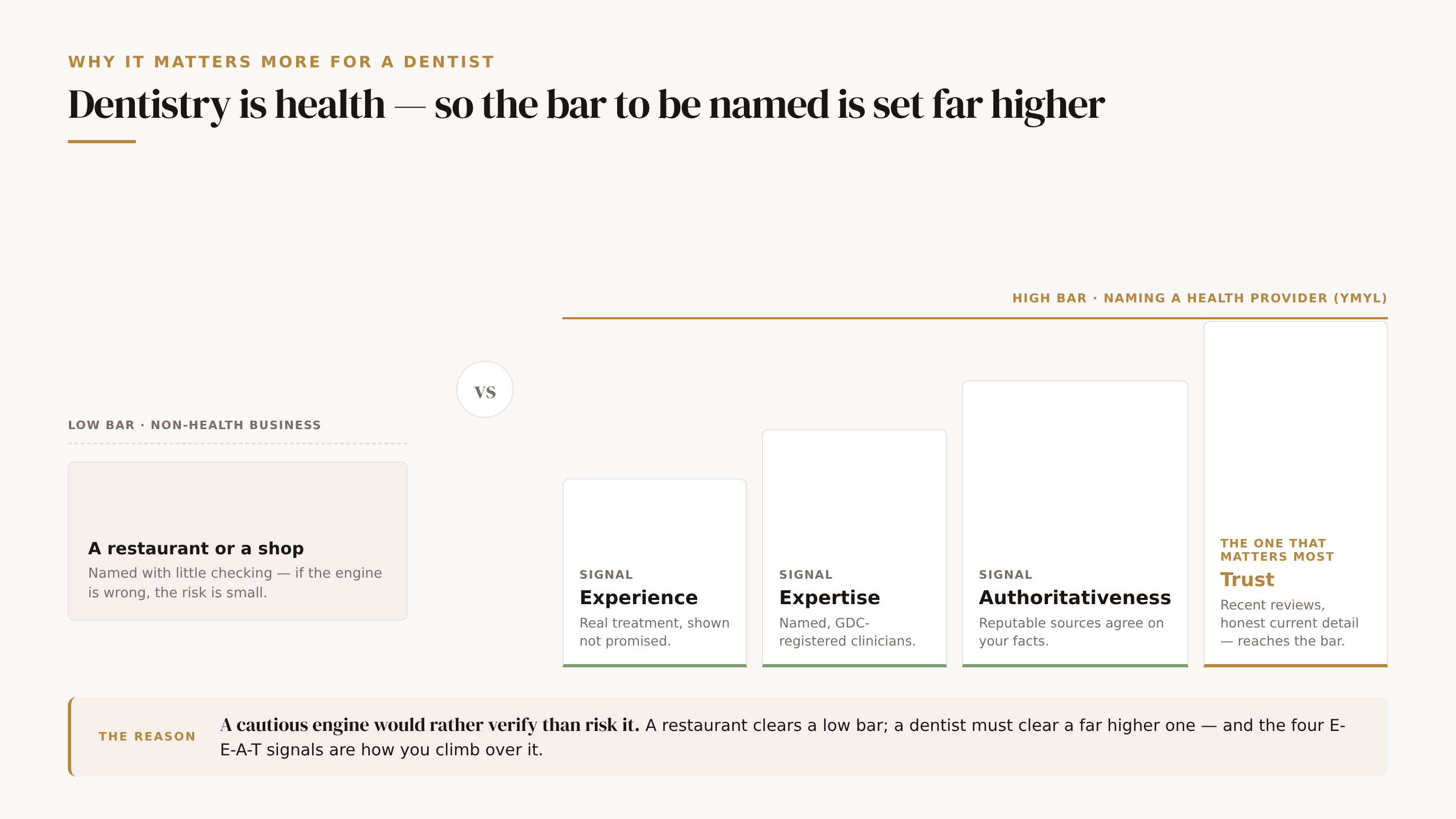
Because dentistry is health, and health sits in the category Google's guidance treats with the most caution: "Your Money or Your Life", or YMYL, topics where weak or wrong information could harm someone's wellbeing or finances. Content on these subjects is held to the highest trust standard, and the bar for who gets cited is correspondingly steep. A florist recommended by an AI carries little risk if the engine is wrong. A dentist recommended for an emergency extraction carries real risk, and the engines behave as though they know it.
Why the trust bar is high
Dental questions are health questions, and engines treat them cautiously
32%
of US adults use AI for health information or advice
29%
use AI for their own physical health specifically
58%
of Pew's users ran a Google search that returned an AI-generated summary
KFF, 2025; Pew Research Center, 2025.
This is the single most useful thing to understand about your situation. The reticence you may have noticed, where an AI will happily list five restaurants but hedges and narrows when asked to name a dentist, is not a glitch. It is the engine being conservative precisely because the subject is health. It would rather name a practice it can verify from several reputable directions than one it cannot, and it would rather give a careful general answer than confidently recommend a provider it is unsure about. Your job is to remove every reason for that hesitation.
Patients, meanwhile, are bringing exactly these questions to AI in growing numbers. A KFF Tracking Poll in 2025 found that about a third (32%) of US adults have turned to AI for health information and advice, including about three in ten (29%) who used it for questions about their physical health[2]. "Is there a good dentist near me taking on patients?" sits squarely inside that behaviour. The combination is what makes E-E-A-T non-negotiable for a dental practice: the audience is asking AI about their health, and the engine is at its most cautious about exactly that kind of question.
Does E-E-A-T actually affect AI rankings, or only Google?
It affects both, but it is worth being precise about how, because a common misunderstanding wastes a lot of effort. E-E-A-T is not a single dial the engine turns, and it is not a numeric ranking factor you can score. It is the quality framework that describes what trustworthy content looks like, and AI engines lean on the same quality signals Google describes, plus your real-world reputation, when they decide which sources to trust and which practices to name. Improve the things E-E-A-T describes and you improve your odds across Google's AI answers and the standalone tools alike.
Two myths cause most of the wasted effort here, and both are worth setting straight plainly.
- Ranking first on Google does not mean an AI will name you first. They are separate systems judged on different evidence. A practice can top Google for "dentist in Reading" and go unnamed in an AI reply, because the AI is weighing reviews, directory agreement, named clinicians and consistent facts, not just your page position.
- Adding trust-sounding language to your site does not buy authority. Writing "trusted", "expert" or "award-winning" across your pages signals nothing an engine can verify. Authority is something other reputable sources confer on you, not an adjective you award yourself. The engine reads the corroboration, not the boast.
Being the source the engine trusts matters more than it used to because users increasingly act on the answer without clicking through to compare. A Pew Research Center analysis of real browsing data found that 58% of US users ran at least one Google search in March 2025 that returned an AI-generated summary, and that when a summary appeared, people clicked a traditional result in just 8% of visits, against 15% when no summary was shown[3]. If the patient reads the answer and stops there, being named inside it, as the practice the engine trusts, is the whole game. The next four sections take the four signals one at a time.
How do I prove Experience, the new and most-missed E?
Experience is first-hand, demonstrable involvement: evidence that real treatment is happening in your practice, performed by real people, on real patients. It is the letter most dental sites neglect, and the one dentists are uniquely placed to win, because you generate the raw material every working day. The fix is to capture and publish it deliberately rather than letting it stay locked in the surgery.
In practice that means a few specific things. Publish genuine treatment cases and before-and-after galleries with plain, factual descriptions of what was done, with patient consent and without identifying anyone who has not agreed to it. Let your named dentists describe, in their own words, the procedures they personally carry out, rather than leaving treatments described in anonymous third-person marketing copy. State how long the practice has operated and how long key clinicians have been practising. Each of these is a signal of lived experience that an engine can read and a patient can believe, and none of it requires a single claim about being the best.
The discipline that keeps this safe is the one the GDC expects everywhere: show, do not promise. A before-and-after case presented as "here is a treatment we carried out" is evidence; the same image captioned "guaranteed results" is a claim the rules forbid and an engine cannot responsibly repeat. Keep the experience concrete and specific (what was done, by whom, over what timescale) and you build the strongest, most defensible signal you have, on material your competitors usually leave on the table.
How do I prove Expertise?
Expertise is the verifiable knowledge and qualification of the people behind the practice, made plain enough for both a patient and a machine to confirm. Google's guidance points straight at this when it asks whether content is written or reviewed by an expert[1]. For a dental practice, the answer to that question should be obvious from your pages, not buried.
The concrete moves are straightforward. Give every clinician a real biography page with their full name, GDC registration number, qualifications, year of registration and any genuine specialisms or special interests. Attribute the content on your site to a named, qualified person rather than to "the team" or to nobody at all, and where a page covers clinical matters, show that a named dentist wrote or reviewed it. Make sure the clinical information you publish about treatments is accurate and current, because expertise that is plainly out of date reads as the opposite.
GDC registration is your strongest single proof point here, and one most practices underuse. It is a verifiable, public credential that says a regulated professional stands behind the work, which is precisely the kind of signal a cautious engine looks for on a health subject. Displaying it clearly, per clinician, costs nothing and turns a vague impression of competence into something an engine and a patient can check.
How do I build Authority?
Authority is reputation that other people confer on you: the degree to which reputable, independent sources recognise your practice as a genuine, established provider. It is the signal you cannot manufacture on your own site, because by definition it lives elsewhere. The practical work is to make sure the wider web agrees, in detail, that your practice exists, where it is, and what it does.
For a UK dental practice the sources that carry weight are your Google Business Profile, the NHS "find a dentist" service (which both engines and patients treat as high-trust), reputable healthcare and local directories, any genuine professional or accreditation listings you hold, and coverage in local press or community pages. Each of these needs to exist, to be accurate, and to agree with the others. Your practice name, address, phone number, opening hours and service list should read identically everywhere they appear, because when the facts conflict, the engine cannot tell which version is true and tends to reach for a practice it is sure about instead.
It helps to retire one outdated idea: authority is not just backlinks. The old SEO instinct was to chase links as a score to accumulate. What an AI engine is really doing is corroboration, checking whether several independent, reputable places confirm the same facts about you. A handful of accurate, consistent listings on sources the engine respects does more for your authority than a pile of low-quality links ever did, and it is squarely within the rules, because it is simply your true information stated the same way in every place it appears. Our answer engine optimisation guide for dentists and clinics goes deeper on building that footprint.
How do I demonstrate Trust, the signal that matters most?
Trust is the centre of E-E-A-T, the member of the family Google's guidance treats as most important, and for a dentist it comes down to whether your practice looks safe, transparent and real to someone (or something) deciding whether to recommend you. Of the four signals it is the one that ties the others together: experience, expertise and authority all feed into whether an engine, and a patient, can trust you. So it deserves the most deliberate attention.
The four signals
What each E means, and how a dentist proves it
| Signal | What it means | How a dentist proves it |
|---|---|---|
| Experience | First-hand, real-world involvement (the new and most-missed E) | Show the practice actually treating patients: cases, before-and-afters shown safely, real photos |
| Expertise | Genuine knowledge and qualifications | Named clinicians with GDC registration and qualifications, content attributed to a real expert |
| Authority | Recognition as a known, referenced practice | Consistent mentions and citations across trusted directories and coverage |
| Trust | The centre of the framework, treated as most important | Genuine recent reviews across platforms, transparent fees, complete details and visible policies |
A few things carry most of the weight. Genuine, recent reviews across more than one platform are among the strongest trust signals an engine has for a local practice, and recency matters as much as the total: a wall of five-star reviews that stops eighteen months ago reads as a practice that may have gone quiet. Transparent information does the rest. Clear, current fees or plainly stated price ranges, plain treatment descriptions, a real and complete set of practice details, visible policies and complaints information, and a secure website all tell the engine and the patient that there is nothing being hidden.
Reply to reviews, good and bad, but never put a patient's clinical details in a public reply: thank them, answer the general point, and take specifics offline.
The line you must not cross is the one the GDC draws and the one the engines cannot reward anyway: buying, incentivising or editing reviews to mislead is both a fitness-to-practise problem and unlawful in the UK, and an engine that detects manipulated reviews trusts you less, not more[4]. Real trust is slower to build and far more durable. The good part is that everything that earns it, current accurate information and genuine recent feedback, is exactly what the rules already require of you.
How do I make my E-E-A-T machine-readable?
You make it machine-readable with structured data (schema markup): the labels that state your facts in terms an engine cannot misread, so the experience, expertise, authority and trust you have built are easy to lift rather than left to be inferred. You can have impeccable credentials and still be passed over if an engine has to work too hard to find and confirm them. Schema removes that friction.
Make it machine-readable
Turning built reputation into structured facts an engine can lift
Person markup
Each named clinician with their name, role and credentials, so an engine can connect content to a qualified author.
Dentist markup
The practice itself with location, services, hours and, where genuine review scores are shown, AggregateRating.
FAQPage markup
On the questions patients actually ask, so your plain answers can be quoted directly.
Verifiable facts
A vague claim of expertise becomes a set of structured facts an engine cannot misread.
The types that matter most for an E-E-A-T case are the ones that make your people and your facts explicit. Use Person markup for each named clinician, carrying their name, role and credentials, so an engine can connect the content to a qualified author. Use Dentist (or LocalBusiness) markup for the practice itself, with location, services, hours and, where you display genuine review scores, AggregateRating. Use FAQPage markup on the questions patients actually ask, so your plain answers can be quoted directly. Together these turn a vague claim of expertise into a set of verifiable, structured facts.
This is where E-E-A-T and structured data meet, and the two are best treated as one job. Our dental schema markup guide covers the implementation in full; the point to hold onto here is that schema does not invent authority, it makes the authority you have legible. The credentials, the named authors, the genuine reviews and the consistent facts have to be real first. Schema is what lets the engine read them without ambiguity.
How can I check how AI currently judges my practice's authority?
You can test it today, free, in about ten minutes, by asking the engines the questions a patient asks and watching how they describe you. You do not need a paid tool to find the gap; you need a clear read of what comes back. Open ChatGPT, Google's AI Mode and Perplexity, and ask each one: "best dentist in [your town]", "is [your practice] any good?", "dentist for nervous patients in [town]", and "who are the dentists at [your practice]?".
Watch three things in the replies. First, whether your practice is named at all, and whether it is named alongside a description that is accurate or one that is vague or wrong. Second, whether your clinicians are named and their qualifications reflected, or whether the engine clearly has no idea who works there. Third, which sources the answer leans on, because that tells you where your authority is coming from and where it is missing. Run each prompt a few times, since the replies shift between attempts, and treat the recurring pattern rather than any single answer as the truth about where you stand.
Read the results as a worklist mapped to the four signals. No mention of treatment cases or what you actually do points to an Experience gap. No named, qualified clinicians points to an Expertise gap. Thin or contradictory information drawn from few sources points to an Authority gap. Old or absent reviews and missing practice detail point to a Trust gap. Each weak answer tells you which of the four to strengthen first.
Where to start
If the list feels long, start with three moves and take them in order. First, make your people visible and verifiable: a real biography for each clinician, with name, GDC registration number and qualifications, and content attributed to a named expert rather than to nobody. Second, reconcile your facts and your reviews across the web, so your name, address, services and hours agree everywhere and you are gathering genuine recent reviews on more than one platform. Third, make it machine-readable with the right schema, so the experience, expertise and trust you have built are easy for an engine to lift. Each of those sits comfortably inside GDC rules, and each independently improves how AI engines judge your practice.
Our AI SEO for dentists service page sets out how we handle the whole sequence for a practice.
Where to start
Three moves, in order
Make your people visible and verifiable.A real biography for each clinician with name, GDC registration number and qualifications, content attributed to a named expert.
Reconcile your facts and reviews across the web.Name, address, services and hours agreeing everywhere, with genuine recent reviews on more than one platform.
Make it machine-readable with the right schema.So the experience, expertise and trust you have built are easy for an engine to lift.
Keep each step inside GDC rules.Each independently improves how AI engines judge your practice.
If you would rather gauge your footing before committing any budget, a free QBiz Leads AI visibility check reads your own pages for AI-readiness (their structure, schema, named authorship and machine-legibility) in about thirty seconds, then hands back a plain pass or fail across the four E-E-A-T signals with the fixes ordered by what to tackle first. It does not query ChatGPT, Gemini or Perplexity on your behalf, so treat the manual test above as the way to see how you are named today.
Get your free AI visibility check →
Frequently asked questions
What does E-E-A-T stand for, and what is the extra E?
E-E-A-T stands for Experience, Expertise, Authoritativeness and Trust. The extra "E", Experience, was added in December 2022, turning the older "E-A-T" (three letters) into "E-E-A-T". It refers to genuine first-hand involvement with the subject, which for a dentist means real treatment cases, before-and-after evidence and named clinicians describing procedures they actually perform. A lot of dental advice still says "E-A-T" and predates this change, which is one reason it no longer matches how engines judge a practice.
Is E-E-A-T a ranking factor?
No, not in the sense of a single score the engine adds up. E-E-A-T is the quality framework Google's guidance uses to describe trustworthy content, not a numeric dial. There is no "E-E-A-T number" to optimise. What you do is improve the real things it describes (genuine experience, named expertise, third-party authority and current trust signals), which in turn improve how engines, including AI answer engines, judge and cite you. Anyone selling you an "E-E-A-T score boost" is selling a thing that does not exist.
Does E-E-A-T affect whether ChatGPT recommends my practice?
Yes, indirectly but meaningfully. AI engines lean on the same quality signals Google's guidance describes, plus your real-world reputation, and they are especially cautious about naming a health provider they cannot verify. A practice that shows genuine experience, named and qualified clinicians, agreement across reputable sources and current, genuine reviews gives the engine the confidence to name it. A practice that shows none of these gives the engine every reason to hedge or to name a competitor instead.
How can a small dental practice build authority against big chains?
By being the most clearly and consistently verified practice in one place rather than a thinly described one in fifty. Authority for a local health query is built on accurate, agreeing information across the sources an engine trusts, plus genuine recent reviews and named clinicians, and a single-site practice can get all of that exactly right. A national group often has scale but inconsistent or generic local detail. You only have to be the best-described, best-evidenced dentist in your town, which is a fight a small practice can win.
What is the single most important E-E-A-T signal for a dentist?
Trust. It is the centre of the framework and the one the other three feed into. For a dental practice, trust is built mostly through genuine, recent reviews across more than one platform, transparent and current information (clear fees, plain treatment descriptions, complete practice details) and a secure, accurate online presence. Get trust right and your experience, expertise and authority all count for more; neglect it and the rest struggles to land.
Sources
- [1] Google Search Central, "Creating Helpful, Reliable, People-First Content": https://developers.google.com/search/docs/fundamentals/creating-helpful-content (Global; primary. The self-assessment asks whether content is "written or reviewed by an expert or enthusiast who demonstrably knows the topic well" and whether it presents information "in a way that makes you want to trust it, such as clear sourcing, evidence of the expertise involved, background about the author or the site that publishes it".)
- [2] KFF, Tracking Poll on Health Information and Trust, 2025: https://www.kff.org/public-opinion/kff-tracking-poll-on-health-information-and-trust-use-of-ai-for-health-information-and-advice/ (US; independent. "about a third (32%) of adults are turning to AI for health information and advice. This includes about three in ten (29%) who say they've used AI tools in the past year for information or advice about their physical health".)
- [3] Pew Research Center, "Google users are less likely to click on links when an AI summary appears in the results", 22 July 2025: https://www.pewresearch.org/short-reads/2025/07/22/google-users-are-less-likely-to-click-on-links-when-an-ai-summary-appears-in-the-results/ (US; independent. "About six-in-ten respondents (58%) conducted at least one Google search in March 2025 that produced an AI-generated summary"; users who encountered an AI summary "clicked on a traditional search result link in 8% of all visits", against "15% of visits" for those who did not.)
- [4] General Dental Council, Standards for the Dental Team, Principle 1: https://standards.gdc-uk.org/pages/principle1/principle1 (UK; regulatory citation, not a statistic. Standard 1.3.3: "You must make sure that any advertising, promotional material or other information that you produce is accurate and not misleading".)
Leave a comment
Thoughts on this post? Leave a comment below. Comments are moderated before they appear, so yours will not show on the page straight away.
Your email is used only to contact you about your comment if needed — it is never published.
Comments
No comments yet. Be the first to leave one above.