Google Business Profile vs. AI Platforms for Dental Lead Generation: Where Do Your Patients Actually Come From Now?
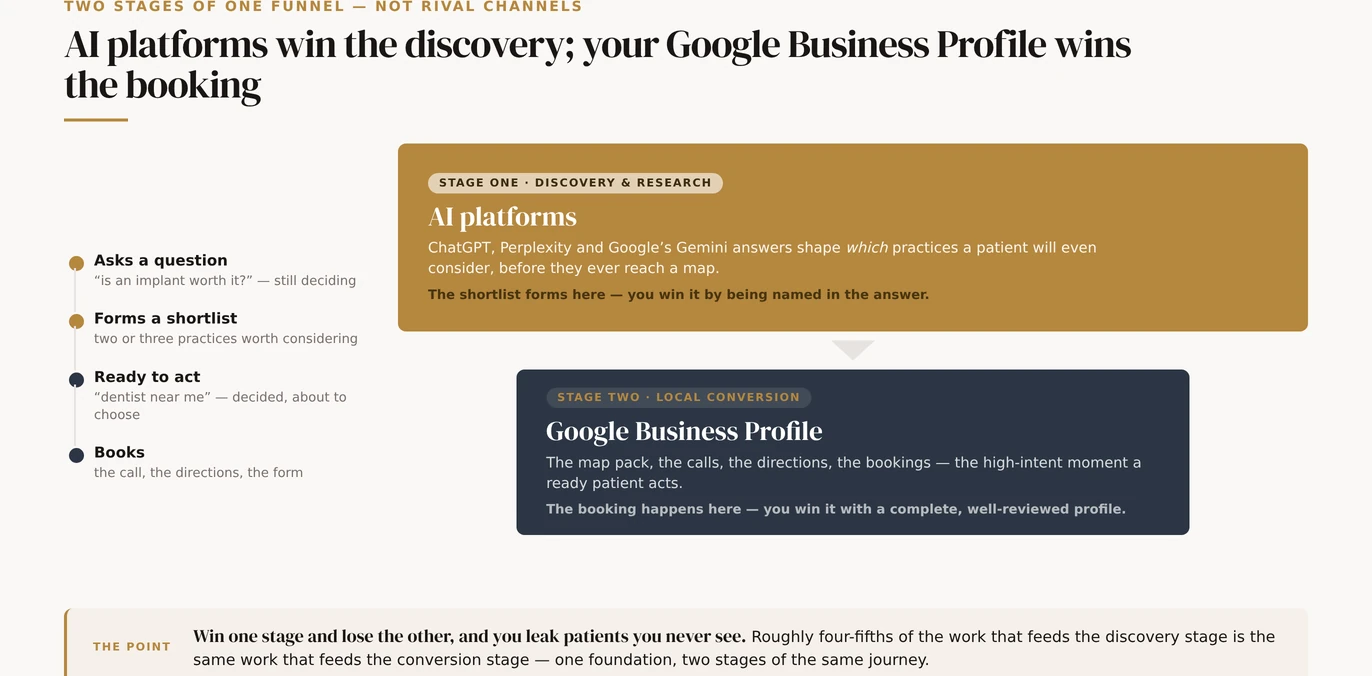
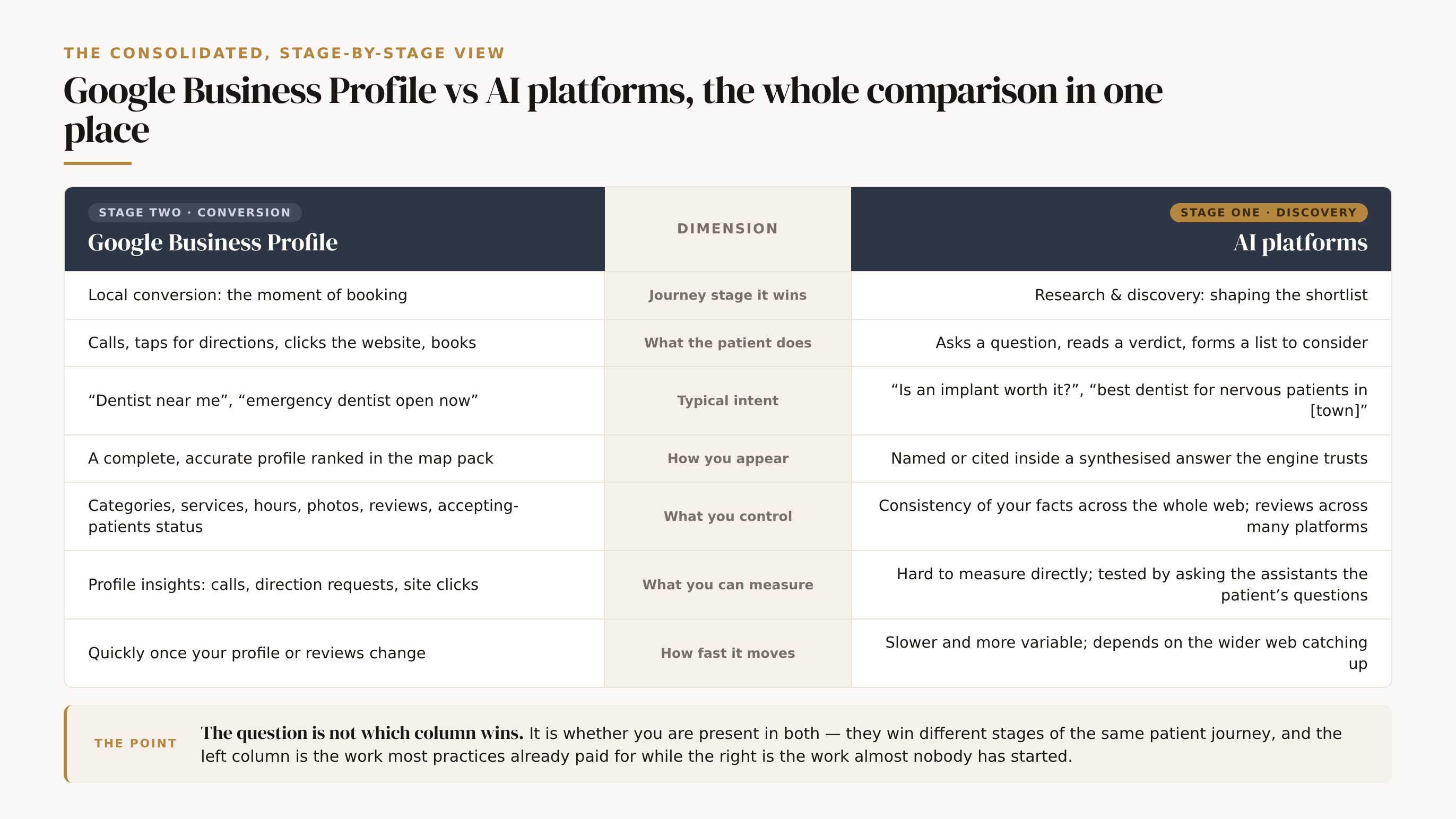
AI platforms increasingly win the research and discovery stage, where a patient is working out what treatment they need and which practices are worth considering, while your Google Business Profile still wins the local conversion stage: the calls, directions and bookings from a "dentist near me" search at the moment someone is ready to act. They are two stages of one funnel, not two rival channels, and roughly eighty per cent of the work that feeds one feeds the other. Bet everything on one and you lose the patients who were decided at the other.
A practice owner sat across from us recently and asked the question this whole article is about: "Should I keep pouring effort into my Google listing, or is that the old game now everyone's asking ChatGPT?" It is a fair question, and the real answer surprises people. It is not either/or. Your Google Business Profile and the AI platforms win different stages of the same patient journey, and a practice that bets everything on one loses the patients who were decided at the other.
This guide answers the comparison dental owners keep putting to us: as channels that bring you new patients, how do your Google Business Profile and the AI platforms actually differ, which one generates more leads, and where should a practice with limited time and budget put its effort?
Every section below is a real question an owner asks, answered straight away and in full, so you can read the one that applies to you and act on it. It is written for UK practices, it stays inside General Dental Council rules throughout, and it asks you to overclaim nothing. For the neighbouring question of how a practice earns a mention in the first place, our companion guide covers how dentists get recommended by ChatGPT.
The short version
- Two stages, not two rivals. AI platforms shape the shortlist during research; your Business Profile turns intent into a booking. A practice needs both, at different moments.
- One shared foundation feeds both. Accurate, consistent facts, genuine recent reviews and answer-ready pages win the AI discovery stage and the Business Profile conversion stage at the same time.
- Google's AI is fed by your profile; the open web is not. AI Mode and AI Overviews read your Business Profile signals; ChatGPT and Perplexity assemble their picture from the wider web instead.
- Falling map impressions are a symptom, not a loss. They usually mean attention moved up to the AI summary, so being named there is what now protects your patient flow.
- Measure them differently. Your profile reports calls and clicks; AI discovery you test by asking the assistants the questions your patients ask.
Where do dental patients actually find a practice in 2026?
In more places than they used to, and the channels have split rather than swapped. The old single path, type "dentist near me" into Google and scroll the map, still carries the majority of patients. What has changed is that a large and growing minority now begins somewhere else: an AI assistant, a maps app opened directly, a social feed. A patient might use three of these in a single week without thinking of them as different.
The channels have split
Where patients actually find a practice now
40%
of consumers are actively using generative AI within search
70%
still default to Google, which remains the centre of gravity
1 in 5
now run local searches directly inside a maps app rather than a general search box
BrightLocal, survey of 1,000 US consumers, 2025.
The numbers behind that fragmentation are worth seeing plainly, because they kill both the hype and the complacency at once. BrightLocal's survey of 1,000 US consumers found that 40% are actively using generative AI within search, while around 70% still default to Google, and that one in five now run local searches directly inside a maps app rather than a general search box[1].
Read those three figures together and the picture is clear: AI has become a real channel, Google is still the centre of gravity, and even within Google the behaviour has split between the search box and the map. No single number tells a practice to abandon anything. Our deeper treatment of that divide lives in AI search versus Google search for a local dentist.
Health is one of the things people now bring to AI most readily. A KFF Tracking Poll in 2025 found that about a third (32%) of US adults have turned to AI for health information or advice[2]. KFF is a respected, non-partisan health research body rather than a marketing firm, which is exactly why the figure is worth trusting where vendor surveys are not. "Is an implant worth it?" or "best dentist for nervous patients near me" sits squarely inside that behaviour. And the scale of the open-web AI channel keeps climbing: ChatGPT reached 900 million weekly active users in February 2026, up from 800 million the previous October[3].
So the patient who used to be a single dot on your map pack is now spread across several first touches. Some of them never reach the map at all until an AI answer has already shaped which two or three practices they are willing to consider. That is the shift this whole comparison turns on, and it is why thinking of your Google Business Profile and the AI platforms as competitors is the wrong frame from the start.
What does a Google Business Profile actually do for lead generation?
It wins the moment of action. Your Google Business Profile is the engine of local conversion: it drives the high-intent things a patient does when they are ready to pick up the phone, get directions, click through to your site or book. When someone searches "dentist near me" or "emergency dentist open now", the map pack of three practices that appears, and the profile a patient taps to call from, is your Business Profile doing its job. It is closest to the booking, which is what makes it so valuable.
Its strengths are concrete and measurable. It captures patients at peak intent, the ones who have stopped researching and want to act today. It feeds Google Maps, which one in five local searchers now open directly[1]. It gives you levers you genuinely control: your categories, services, opening hours, photos, an accurate "accepting new patients" status, and the steady flow of recent reviews that lift you within the pack. And crucially, it reports back. Google's profile insights tell you how many people called, asked for directions or visited your site, which makes it the one channel where you can see the lead arrive.
Its limits matter just as much for a fair comparison. A Business Profile is a local-conversion tool, not a research tool: it is brilliant at turning a patient who already wants a dentist into your patient, and almost silent during the earlier phase when that person is still deciding whether to have the treatment at all or which kind of practice to trust. It works best for "near me, now" intent and least for "is this worth it, and who's good at it" intent. That earlier phase is exactly where the AI platforms have moved in.
What do AI platforms actually do for lead generation?
They win the research before the action. AI assistants like ChatGPT, Perplexity and Google's own Gemini answers increasingly own the discovery stage: the questions a patient asks while they are still forming an opinion. "Is Invisalign better than fixed braces for an adult?", "how much should dental implants cost in Manchester?", "which dentist is best for a nervous patient near me?" These are researched, not acted on immediately, and the answer a patient reads shapes the shortlist of practices they will even consider before they ever reach a map.
It helps to split the AI platforms into two families, because they are fed differently and you influence them differently. The first is Google's own AI answers, AI Mode and AI Overviews, which now run on a custom version of Gemini 2.5[5]. For these, your Google Business Profile and Google's local index are part of the fuel, so the line between "Google" and "AI" is genuinely blurred on Google's own surface; our guide to Google AI Overviews and SGE for dentists walks through that surface in detail.
The second family is the open-web assistants, chiefly ChatGPT and Perplexity, which build their answers from the wider web, third-party directories, review platforms and the NHS "find a dentist" service rather than from your Google profile directly. The same practice can be named confidently by one family and missed entirely by the other, a split we unpack in ChatGPT versus Gemini for dentist recommendations.
What AI platforms do not do, yet, is hand you a measurable booking. When a patient acts on an AI answer, they typically move to a phone call or a map afterwards, and that lead lands in your diary with no label saying "ChatGPT sent me". The discovery is real and growing, but it is harder to see than a Google insight, which is one of the reasons owners underrate it. The patients shaped by an AI answer are still arriving; you just cannot always tell that is where the decision was made.
Google Business Profile vs AI platforms: which actually generates more leads?
Neither, in isolation, and that is the real answer rather than a dodge. They generate leads at different stages of the same journey, so asking which produces more is like asking whether the shop window or the till makes the sale. The practices that lose are the ones invisible at the discovery stage, where AI is shaping the shortlist, or unconvertible at the conversion stage, where the Business Profile turns intent into a booking. Win one and lose the other, and you leak patients you never see.
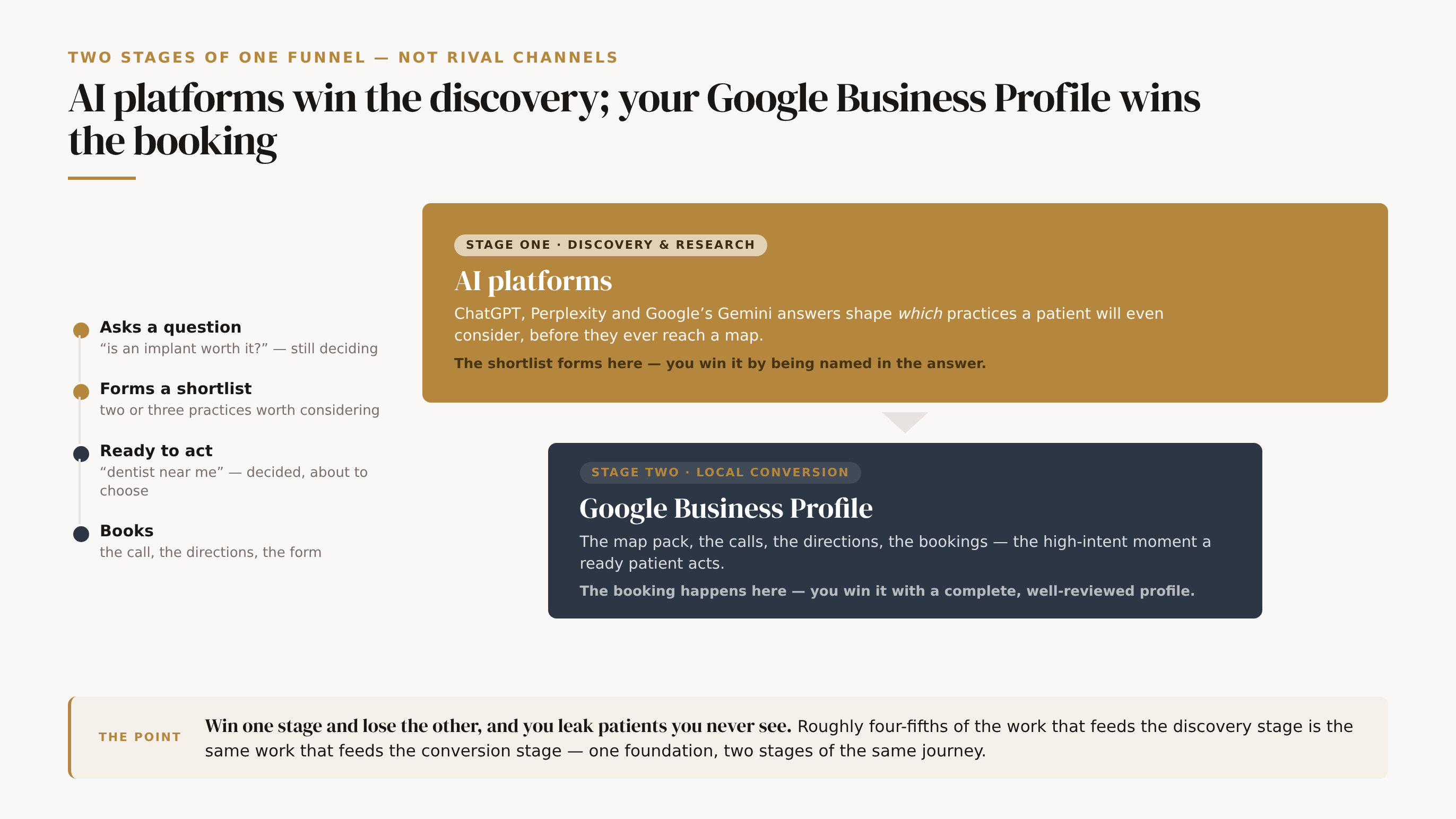
Here is the whole comparison in one place. Read down the two columns and the strategic point becomes obvious: the channels reward overlapping but distinct work, and a practice that treats them as one job tends to win only half of it.
Side by side
The two channels win different stages of the journey
| What it weighs | Google Business Profile | AI platforms (ChatGPT, Perplexity, Gemini answers) |
|---|---|---|
| Journey stage it wins | Local conversion: the moment of booking | Research and discovery: shaping the shortlist |
| What the patient does | Calls, taps for directions, clicks the website, books | Asks a question, reads a verdict, forms a list of practices to consider |
| Typical intent | "Dentist near me", "emergency dentist open now" | "Is an implant worth it?", "best dentist for nervous patients in [town]" |
| How you appear | A complete, accurate profile ranked in the map pack | Named or cited inside a synthesised answer the engine trusts |
| What you control | Categories, services, hours, photos, reviews, accepting-patients status | Consistency and clarity of your facts across the whole web; reviews across many platforms |
| What you can measure | Profile insights: calls, direction requests, site clicks | Hard to measure directly; tested by asking the assistants the patient's questions |
| How fast it moves | Quickly once your profile or reviews change | Slower and more variable; depends on the wider web catching up |
Seen stage by stage like this, the point lands. The Business Profile column is the job most practices have long since paid for; the AI column is the one barely anyone has begun, which is how a well-answered practice ends up shaping shortlists while a better-ranked rival waits at the booking stage for patients who were decided earlier. The question is not which column wins. It is whether you are present in both.
Why are my Google Business Profile impressions dropping, and does it matter?
If your profile impressions have fallen, you are not imagining it, and the cause is usually not a penalty. It is the search results page changing shape above you. When an AI summary now sits at the top of a results page, fewer people scroll down to the map pack the way they once did, so your profile records fewer impressions even though the same number of patients may still be choosing you. Falling impressions are a symptom of where attention has moved, not proof you are losing patients.
The data behind this is worth holding onto. A Pew Research Center analysis of real browsing behaviour found that 58% of US users ran at least one Google search in March 2025 that returned an AI-generated summary, and that when a summary appeared, people clicked a traditional result in just 8% of visits, against 15% when no summary was shown[4]. Fewer clicks down the page means fewer raw impressions for the listings that sit below the summary. At the same time, Google reports that these AI features are not shrinking search but growing it: AI Overviews are driving over 10% more usage of Google for the types of queries that show AI Overviews[5].
Put those two facts together and the real lesson lands. The patients have not gone; the shopfront has moved up the page. If you are named in the AI answer that now sits above the map, the drop in map impressions barely costs you, because you are being chosen earlier. If you are absent from that answer, the falling impressions are an early warning that you are losing the patient before they reach the part of the page where your profile used to win them. So the impression count is not the thing to chase. Being readable to the system that now answers first is.
Is my Google Business Profile also my AI feed?
For Google's own AI answers, largely yes. Google's AI Mode and AI Overviews run on Gemini 2.5 and draw on the same local index and Business Profile signals that power the map pack[5]. So when Google's AI answer recommends a dentist in your town, your Business Profile is part of what it is reading. On Google's surface, a complete, consistent, well-reviewed profile is not just your map listing, it is your feed into Google's AI answer too. The two are one piece of work.
The fields that carry the most weight are the dull, specific ones. Accurate primary and secondary categories, so the engine knows precisely what you are. A full service list named the way patients name treatments. Opening hours and a current accepting-patients status, because an engine will not confidently recommend a practice whose availability it cannot trust. Genuine, recent reviews, which act as the corroboration the AI leans on. And the Q&A and posts that add specific, machine-readable detail. None of this is new advice; what has changed is the stake, because the same completeness now decides whether you appear in Google's AI answer, not only its map.
The important caveat is that this only holds for Google's family of AI answers. ChatGPT and Perplexity do not read your Google Business Profile the way Google does; they assemble their picture from the open web. So "my Business Profile is my AI feed" is true for Gemini answers and only partly true elsewhere. Which is exactly why the next question, the one about the shared foundation, matters so much: you need work that feeds both families, not just Google's.
What's the one foundation that feeds both channels?
Consistency. The single foundation underneath both your Business Profile and the AI platforms is the same: your practice's facts, identical and complete everywhere a machine might read them. Get that right and you feed the map pack, Google's AI answer and the open-web assistants from one effort. Get it wrong and every channel doubts you at once.
One foundation, both channels
How consistency feeds every surface from one effort
Consistent facts
Name, address, phone, hours and services identical across site, Google profile, NHS listing and directories.
The map pack
A complete Business Profile with real photos, accurate categories and a current accepting-patients status.
Google's AI answer
The same facts Google reads to surface your practice as a known entity in an AI Overview.
Open-web assistants
The corroboration ChatGPT and Perplexity check before naming a practice.
That foundation has a short, unglamorous checklist. Your name, address, phone number, opening hours and services should read identically across your website, Google profile, NHS "find a dentist" listing and every directory, because when they conflict, the engine cannot tell which version is true and falls back on a practice whose details it can trust. Your Business Profile should be complete, with real photos, accurate categories and a current accepting-patients status.
Your reviews should be genuine, recent and spread across more than one platform, not a wall of five-star ratings that stopped eighteen months ago on Google alone. Your service pages should answer the specific questions patients ask, named the way they name them. And structured data, schema markup labelling you as a Dentist or LocalBusiness, with FAQPage for your common questions, should make your true facts machine-legible.
The reason this is the heart of the strategy is how much one effort buys you. Roughly eighty per cent of the work that wins you the AI discovery stage is the same work that wins you the Business Profile conversion stage: accurate facts, genuine reviews, clear answer-ready pages. One foundation, two channels. A practice that builds it once stops having to choose between "doing SEO" and "doing AI", because the durable groundwork serves both, and only the last stretch of each channel needs separate attention.
How should a practice split its effort and budget between them?
Split by where your patients decide, not by which channel is fashionable. The useful way to divide effort is by two things: the stage of the journey, and the value of the treatment. Both point you toward a sensible balance rather than an all-in bet on either channel.
Start with the journey stage, because most of the work is shared. Spend the bulk of your effort, perhaps the first eighty per cent, on the common foundation that feeds both channels: a complete, consistent Business Profile, genuine recent reviews, accurate listings everywhere, and clear service pages. That single investment lifts your map-pack conversion and your AI-answer discovery at the same time.
Only then split the remaining effort by where your specific gaps are: if you are well-reviewed and complete on Google but never named by ChatGPT or Perplexity, your gap is open-web discovery, so the directory consistency and answer-ready content matter most. If you are named in research answers but your profile is thin and your phone barely rings, your gap is conversion, so the Business Profile fundamentals come first.
Then weight by treatment value, because the channels skew differently by what a patient is buying. High-ticket, considered treatments, implants, full Invisalign cases, smile makeovers, involve long research, so the discovery stage and the AI platforms carry more of that decision. A patient spends weeks reading before they choose an implant dentist.
Urgent and routine treatments, an emergency appointment, a check-up, a "dentist near me taking NHS patients", skew hard toward the Business Profile and Maps, because the patient is acting now and barely researching. A balanced practice does both: it makes sure its high-value treatment pages are answer-ready for the AI research phase, and its Business Profile is flawless for the "now" conversions. Where you lean within that depends on which treatments you most want to grow.
The practical rule that falls out of this is reassuring for a smaller practice. You do not need a bigger budget than a national group to win; you need to be the best-described, most consistent, most genuinely reviewed dentist in one place. Geography stays the filter on both channels, which is why a well-documented single-site practice can out-answer a fifty-branch group for its own town.
How do I measure leads from each channel?
You measure them differently, and being clear-eyed about that difference is half the job. Your Business Profile is the easy one: Google's profile insights report how many people called you, asked for directions and clicked through to your site, so the conversion channel comes with its own dashboard. Treat those numbers as your conversion-stage scoreboard, and watch the trend rather than any single week.
The AI platforms are harder, because there is no insights panel for "patients ChatGPT sent you". The practical way to measure your discovery-stage presence is to run the test a patient runs. Open ChatGPT, Perplexity and Google's AI Mode, and ask each one the real questions your patients ask: "best dentist in [your town]", "emergency dentist near me today", "dentist for nervous patients in [your area]", and the treatment questions that matter to you, like "how much is Invisalign in [town]?"
Watch whether your practice is named, where in the answer it appears, and which sources the reply leans on. Repeat each question several times: the reply moves from one attempt to the next, so it is the answer that keeps recurring, not any single one, that shows where you actually stand.
Read the two together and you get the full funnel. If your Business Profile insights are healthy but the assistants never name you, patients are converting well once they reach you, but a growing share are being shaped toward competitors before they ever get there. If the assistants name you but your profile is quiet, you are winning the research and losing the booking. Either gap is a leak, and you cannot see it without checking both. That combined picture, your Business Profile insights alongside the engine self-test you run yourself, is what shows you the whole funnel rather than half of it.
Staying compliant: what the GDC expects
All of this work sits comfortably inside the rules, and it is worth saying why, because the moves that win you leads on both channels are the same ones that keep you compliant. The General Dental Council's Standards for the Dental Team requires at standard 1.3.3 that "you must make sure that any advertising, promotional material or other information that you produce is accurate and not misleading, and complies with the GDC's guidance on ethical advertising"[6]. That rule governs your website, your Business Profile, your directory entries and anything an AI platform might quote from them.
The reassuring part is that accurate, specific, current information is precisely what both channels reward. The places practices get into trouble are the places the rule already forbids: outcome guarantees ("a perfect smile guaranteed", "pain-free dentistry, always"), unverifiable superlatives ("the best dentist in [town]"), and stale claims such as an "accepting NHS patients" line left switched on after the list has closed. None of those help you win leads either.
An engine cannot responsibly repeat a guarantee or a superlative, and a stale fact actively damages the consistency that both your Business Profile ranking and your AI discovery depend on. Be specific, factual and current, and you satisfy the regulator and the algorithms in one move. On reviews, the line you must not cross is buying, incentivising or editing them to mislead, which is both a fitness-to-practise problem and unlawful in the UK; gather genuine ones and reply without ever revealing a patient's clinical details.
Where to start
If you do only three things from all of this, take them in order. First, make your facts identical and complete everywhere a machine reads them, your name, address, phone, hours and services across your website, Business Profile, NHS listing and directories, because that single foundation feeds both the map pack and every AI answer at once. Second, complete your Google Business Profile properly, with accurate categories, a current accepting-patients status, real photos and a steady flow of genuine recent reviews, so you win the conversion stage.
Third, make your key treatment pages answer-ready, each one answering a real patient question plainly and provably, so you start appearing in the AI research stage too. Those three carry most of a patient from "should I do this?" all the way to "I've booked", and every one of them sits squarely inside GDC rules. They are the core of any wider AI SEO for dentists programme.
Where to start
Three moves, in order
Make your facts identical and complete everywhere.Name, address, phone, hours and services across site, Business Profile, NHS listing and directories: the single foundation that feeds both.
Complete your Google Business Profile properly.Accurate categories, a current accepting-patients status, real photos and a steady flow of genuine recent reviews, so you win the conversion stage.
Make your key treatment pages answer-ready.Each answering a real patient question plainly and provably, so you start appearing in the AI research stage too.
Keep every step inside GDC rules.These three carry most of a patient from "should I do this?" all the way to "I've booked".
If you would sooner see where your practice stands before committing budget, a free QBiz Leads AI visibility check reads your website the way an engine does, in about thirty seconds, and returns a plain pass or fail on the machine-legibility signals that decide whether AI tools and Google's AI answers can find and recommend you. It checks the site, not the engines, and hands you the gaps in the order worth fixing them. It is the no-cost first step before any spend.
Get your free AI visibility check →
Frequently asked questions
Is Google Business Profile still worth it for dentists in 2026?
Yes, and arguably more than ever. Your Business Profile is the engine of local conversion, the calls, directions and bookings from patients ready to act, and it now doubles as your feed into Google's own AI answers, which run on Gemini and draw on the same profile signals. Falling map impressions do not change that; they reflect attention moving up the page to the AI summary, not patients disappearing. A complete, consistent, well-reviewed profile wins you the booking and helps win the Google AI answer above it.
Can AI platforms generate dental leads without a Google Business Profile?
The open-web assistants like ChatGPT and Perplexity can name you from other sources, your website, directories, the NHS listing and reviews across platforms, so in theory they can surface you without a Business Profile. In practice you would be throwing away your strongest conversion channel and, on Google's own AI surface, your feed into Gemini's answers. The sensible approach is to treat the Business Profile as the foundation that also feeds discovery, not as something AI replaces.
Does my Google Business Profile feed Google's AI answers?
For Google's AI Mode and AI Overviews, largely yes. They run on a custom Gemini 2.5 and draw on the same local index and Business Profile signals that power the map pack, so your profile's categories, services, hours and reviews help decide whether Google's AI names you. It is less directly true for ChatGPT and Perplexity, which read the wider web rather than your Google profile, which is why consistent facts everywhere matter as much as a strong profile.
Should I stop investing in my GBP and focus on AI visibility?
No. That swaps one half of the funnel for the other and loses patients at the stage you abandon. The two channels win different stages, discovery and conversion, and roughly eighty per cent of the work that feeds one feeds the other anyway. Build the shared foundation first, then weight the remaining effort toward whichever stage your practice is currently weakest at, rather than dropping a channel that is doing its job.
How do I track leads from ChatGPT or Gemini?
There is no insights panel for AI-driven discovery the way there is for your Business Profile, so you measure it by testing. Ask ChatGPT, Perplexity and Google's AI Mode the questions your patients ask, note whether and where you are named and which sources the answers lean on, and run each prompt a few times to read the pattern rather than a single reply. Pair that discovery self-test with your Business Profile insights, which do report calls, directions and clicks, and you get the whole funnel in view.
Sources
- [1] BrightLocal, Consumer Search Behavior (survey of 1,000 US consumers): https://www.brightlocal.com/research/consumer-search-behavior/ (US; independent. "40% of consumers are 'actively' using generative AI within search"; "70% of all general online searches are conducted using Google"; "1 in 5 consumers conduct local searches directly within maps.")
- [2] KFF, Tracking Poll on Health Information and Trust, 2025: https://www.kff.org/public-opinion/kff-tracking-poll-on-health-information-and-trust-use-of-ai-for-health-information-and-advice/ (US; independent. "About a third (32%) of adults are turning to AI for health information and advice", including about three in ten (29%) who have used AI tools in the past year for information or advice about their physical health.)
- [3] TechCrunch, reporting OpenAI, 27 February 2026: https://techcrunch.com/2026/02/27/chatgpt-reaches-900m-weekly-active-users/ (Global; press reporting a vendor figure. "ChatGPT has reached 900 million weekly active users"; "a jump of 100 million users from the 800 million that OpenAI reported in October 2025.")
- [4] Pew Research Center, 22 July 2025: https://www.pewresearch.org/short-reads/2025/07/22/google-users-are-less-likely-to-click-on-links-when-an-ai-summary-appears-in-the-results/ (US; independent. "About six-in-ten respondents (58%) conducted at least one Google search in March 2025 that produced an AI-generated summary"; users with an AI summary "clicked on a traditional search result link in 8% of all visits", against "15% of visits" without one.)
- [5] Google (The Keyword), "AI in Search: going beyond information to intelligence", 20 May 2025: https://blog.google/products/search/google-search-ai-mode-update/ (Global; vendor primary. "we're bringing a custom version of Gemini 2.5, our most intelligent model, into Search for both AI Mode and AI Overviews"; "AI Overviews is driving over 10% increase in usage of Google for the types of queries that show AI Overviews.")
- [6] General Dental Council, Standards for the Dental Team, principle 1: https://standards.gdc-uk.org/pages/principle1/principle1 (UK; regulatory citation, not a statistic. "1.3.3 You must make sure that any advertising, promotional material or other information that you produce is accurate and not misleading, and complies with the GDC's guidance on ethical advertising.")
Leave a comment
Thoughts on this post? Leave a comment below. Comments are moderated before they appear, so yours will not show on the page straight away.
Your email is used only to contact you about your comment if needed — it is never published.
Comments
No comments yet. Be the first to leave one above.