Google AI Overviews and SGE for UK Dentists: How to Optimise and Get Featured
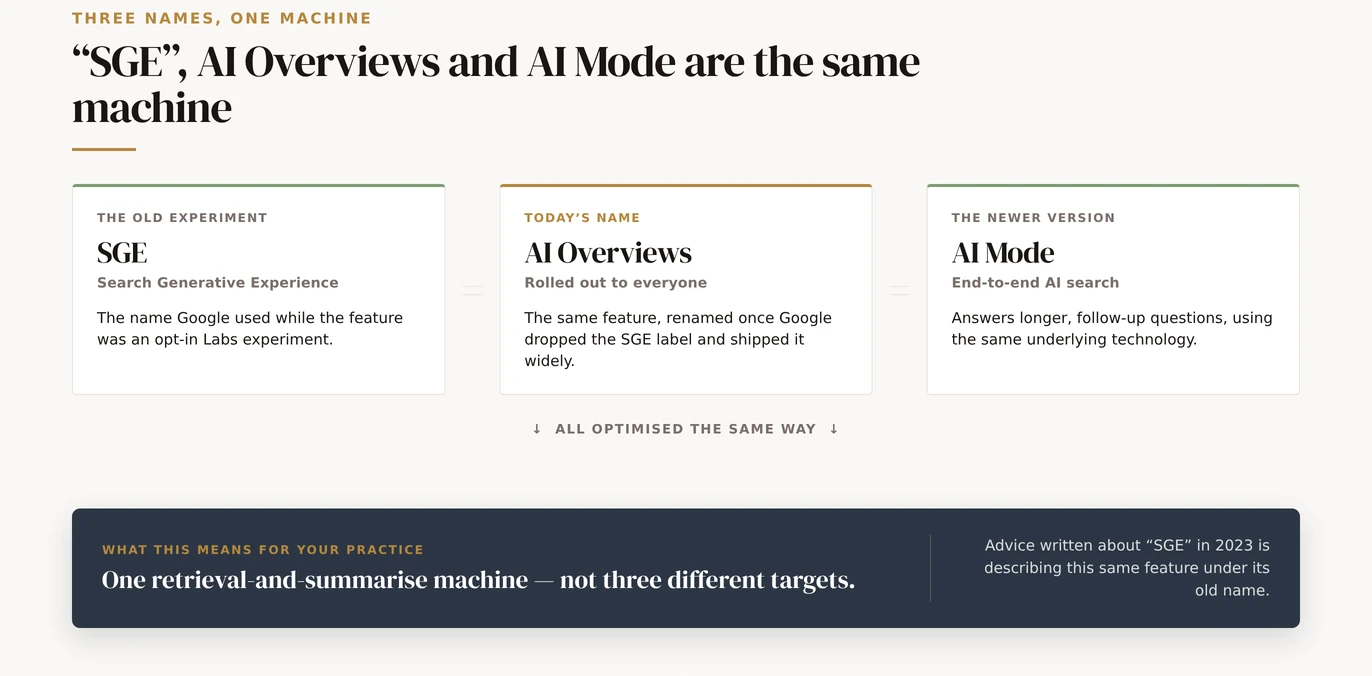
An AI Overview is the AI-written summary Google now places at the top of many dental search results. It names a handful of practices and pushes the rest below a block most patients never scroll past. You cannot buy a place in it: the feature quotes the sources it finds clearest, most consistent and most trustworthy for each question. Getting featured means writing plain, factual answers to the questions patients actually ask, marking them up so a machine can read them, and keeping your practice details identical everywhere the engine looks. SGE, AI Overviews and AI Mode are the same machine, optimised the same way.
A patient in your town searches "is a root canal painful?" or "best dentist near me for nervous patients", and before they reach a single result they read an answer Google has written for them, sitting at the top of the page. That answer is an AI Overview, and it now appears on a large share of dental searches. The practices it names collect the enquiry. The ones it leaves out are pushed below a block that most patients never scroll past.
This is measurable, not anecdotal. Ahrefs analysed 300,000 keywords and found that the presence of an AI Overview correlated with a 34.5% lower average click-through rate for the top-ranking page, compared with similar informational keywords that showed no Overview[1]. The click you used to compete for is collapsing into an answer you were never invited to write.
It is not all loss. Google reports that AI Overviews are "driving over 10% increase in usage of Google for the types of queries that show AI Overviews" in its biggest markets[2]. More people are asking more dental questions, not fewer. The job is no longer only to rank: it is to become the source the AI Overview quotes. This guide explains how AI Overviews actually choose a dentist, and the concrete, GDC claim-safe steps that get your practice featured. For the wider strategy of being named inside any AI answer, our AEO guide for dentists and clinics is the pillar this page sits under.
The short version
- SGE became AI Overviews. Same retrieval-and-summarise feature, renamed once it left Labs; AI Mode is the deeper version. Optimise all three the same way.
- The Overview sits above your ranking. It answers the patient before they scroll, so a top position nobody reaches is worth less than it was.
- It rewards clear answers, not keywords. Lead each page with a short, factual answer under the patient's own question, then mark it up with schema so a machine can read it.
- Two surfaces, two levers. Procedure questions are won on-page; "near me" recommendations are won on your Google profile, consistent details and recent reviews.
- Standard 1.3.3 shapes the copy. The accurate, non-misleading wording the GDC already requires is also the wording an Overview will quote; superlatives get dropped either way.
What are Google AI Overviews, and what happened to "SGE"?
An AI Overview is the AI-written summary Google places at the top of many results pages, answering the search in a few sentences and citing a handful of sources. "SGE" (Search Generative Experience) was the name Google used for the same feature while it was an opt-in Labs experiment; once it rolled out to everyone, Google dropped the SGE label and called it AI Overviews. They are the same idea at two stages of life.
If you read advice from 2023 or early 2024 that talks about "SGE", it is describing this feature under its old experimental name. Google has since gone further and launched AI Mode, a full end-to-end AI search experience that uses the same underlying technology but answers longer, more complex questions and supports follow-ups[2]. For a dental practice that means advice written about "SGE" in 2023 and 2024 still applies unchanged today, and anything you do for AI Mode is already being done for the Overview.
Why do AI Overviews matter for your dental practice?
They matter because they change what winning a dental search means. For twenty years the prize was a high organic position or a spot in the local map pack. An AI Overview now sits above both, answers the patient's question outright, and often satisfies them before they scroll to either. A number-one ranking that nobody scrolls to is worth far less than it was.
Why AI Overviews matter
The answer now sits above the ranking, and takes the click
34.5%
lower average click-through for the top-ranking page once an AI Overview appears (Ahrefs, 300,000 keywords)
53%
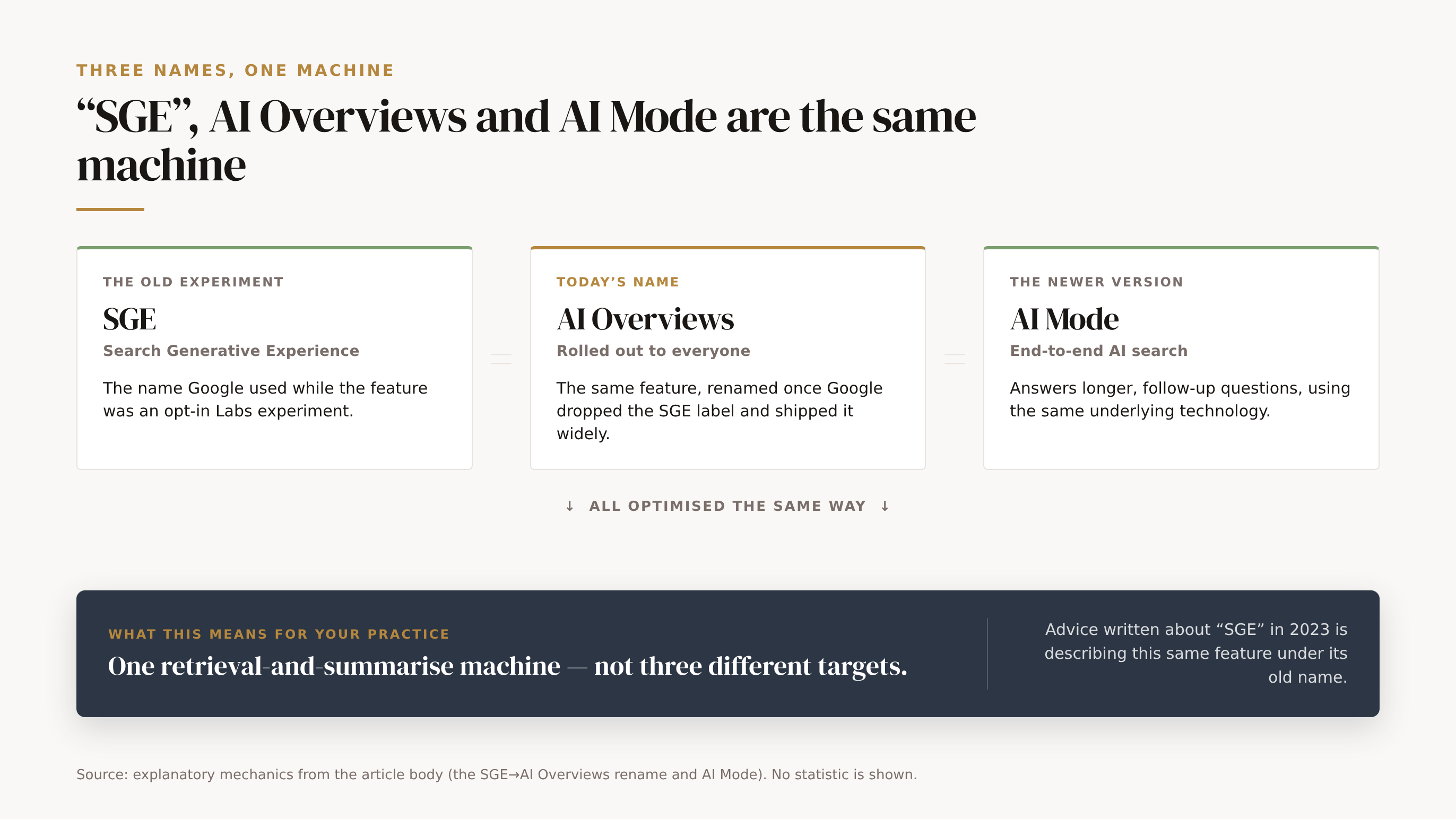
of searches of ten words or more produced an AI summary, against only 8% of one- or two-word searches
60%
of searches beginning with a question word produced an AI summary
The Ahrefs analysis makes the stakes concrete: across 300,000 keywords, a top-ranking page lost roughly a third of its clicks once an AI Overview appeared above it[1]. For "dentist near me" and "does a crown hurt" style queries, that means a patient can read Google's answer, note the practice it names, and act, all without a click landing in your analytics. You never see the miss, because a patient who reads the Overview and rings a competitor leaves no trace in your own booking system. Being named in the Overview is how you stay in a conversation you can no longer see.
Which dental searches trigger an AI Overview?
Question-shaped, informational and comparison searches trigger an AI Overview most often; short, purely navigational searches trigger it least. For dentistry that means "does a root canal hurt?", "Invisalign vs braces cost UK" and "how often should I see a hygienist?" almost always produce an Overview, while typing your exact practice name usually does not. The longer and more question-like the search, the likelier the Overview.
Pew Research Center's analysis of real Google searches backs this precisely: only 8% of one- or two-word searches produced an AI summary. That rose to 53% for searches of ten words or more. And 60% of searches beginning with a question word such as "who", "what", "when" or "why" returned one[3]. It helps to split the dental searches that matter into two distinct surfaces, because the levers that win them differ.
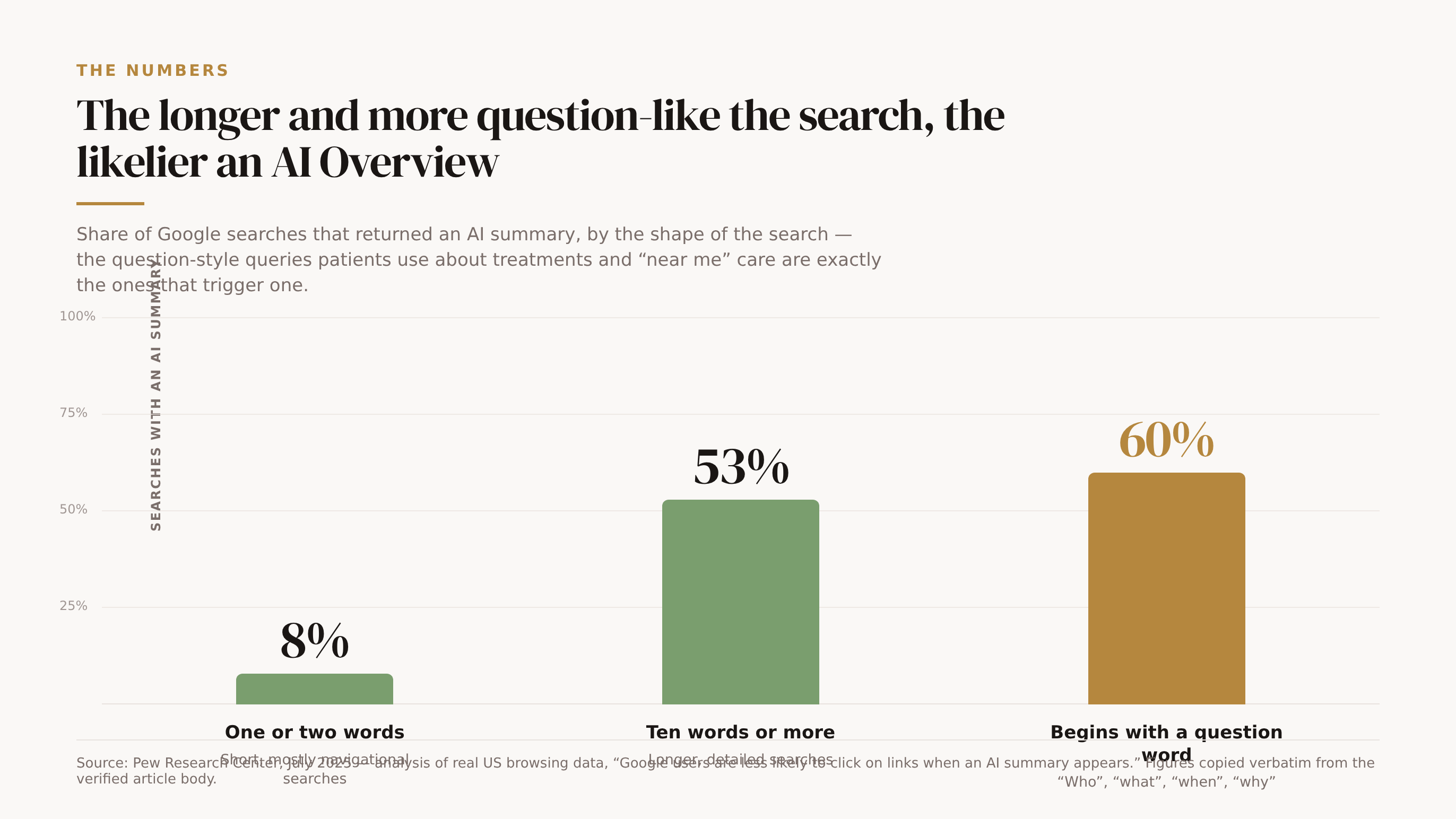
- The informational Overview. Procedure and worry questions: "is a root canal painful?", "how long do dental implants last?", "what is the cost of a private check-up?". These are won mostly on-page, with clear, factual content an engine can lift and schema that labels what each answer is.
- The local recommendation surface. "Best dentist near me", "NHS dentist in [town] taking on patients", "emergency dentist near me today". These lean far more on your Google Business Profile, the consistency of your details across the web, and the depth and recency of your reviews than on your page copy.
Most practices need both. The informational work earns you a place in the answers patients read while they are still deciding; the local work earns you the named recommendation when they choose. Treating them as one undifferentiated "SEO" job is why so much effort produces so little movement.
How does Google decide which dentist to cite?
Google does not match your page to the patient's exact words. It breaks the question into sub-questions, runs many hidden searches at once, and assembles the answer from the sources that most consistently and trustworthily settle each part, then cites a few of them. Being featured means being the clearest, most consistent answer to the cluster of sub-questions behind the search, not to the headline phrase.
Query fan-out
How Google decides which dentist to cite
One patient question
"Best dentist in Leeds for nervous patients" is not matched to your page's exact words.
A multitude of queries
It breaks the question into subtopics and issues many hidden searches simultaneously on the patient's behalf.
Consistent sources
It assembles the answer from the sources that most consistently and trustworthily settle each part.
A few sources
It cites a handful of the sources it drew on, and names them in the answer.
Google calls this mechanism query fan-out, and describes it in its own words: "AI Mode uses our query fan-out technique, breaking down your question into subtopics and issuing a multitude of queries simultaneously on your behalf"[2]. So a single "best dentist in Leeds for nervous patients" is not one search. Behind it sit separate hidden queries for local practices, sedation and anxiety options, recent reviews, NHS versus private availability and opening hours, stitched back into one reply.
Three things then decide whose name survives into that reply:
- Coverage of the sub-questions. The more of the fanned-out questions your presence answers plainly, the more of the hidden searches you appear in, and the more often you are cited. One thin "Treatments" page answers almost none of them.
- Trust and consistency (E-E-A-T, weighted heavily because dentistry is health). Health and medical topics are "Your Money or Your Life" subjects, where Google leans hardest on experience, expertise, authority and trust signals: a named, GDC-registered clinician, accurate listings, real reviews, and facts that agree across the web.
- Freshness and certainty. When your details conflict across directories, the engine cannot tell which version is true and tends to reach for a practice it is sure about instead. Current, consistent information is itself a ranking signal here.
The optimisation that follows is, in academic terms, Generative Engine Optimization (GEO): the framework introduced by researchers at Princeton, Georgia Tech and others as "the first novel paradigm to aid content creators in improving their content visibility in generative engine responses", which their testing found could boost visibility "by up to 40%"[4]. That research measured the gain from restructuring the same content rather than adding to it, which is why the rewrites below matter more than the word count.
How do you get your practice featured? The optimisation playbook
You get featured by making your true, current information the easiest thing in your area for the engine to find, quote and trust. There is no submission form and no paid slot. Six moves do it, in roughly the order they pay off.
What gets lifted, what gets skipped
The page an Overview quotes versus the page it passes over
| A page an Overview can lift | A page it skips | |
|---|---|---|
| The opening | Answers the patient's literal question in the first 40 to 60 words, under a heading phrased as that question | Buries the point under "welcome to our practice" preamble |
| Structure | Short, self-contained answers, then the detail beneath, structured for extraction with clear FAQs | Long, unbroken copy with no extractable answer |
| Schema | FAQPage and Dentist / LocalBusiness markup so Google can read the facts cleanly | No structured data, so the facts must be inferred |
| Locality | Wins the "near me" recommendation with a complete Google Business Profile and consistent facts | Answers the procedure but goes unnamed for the local query |
How should you write an answer so AI Overviews can quote it?
State the direct answer to the patient's literal question in the first 40 to 60 words under a heading phrased as that question, then add the detail beneath. AI Overviews lift short, self-contained answers; they skip pages that bury the point under "welcome to our practice" preamble. Lead with the answer, support it afterwards.
The difference is easiest to see as a before and after. A thin service page reads: "Our practice offers a range of root canal treatments using the latest technology for your comfort. Book today." An engine cannot quote that, because it answers nothing a patient asked. An Overview-ready version, under the heading "Does a root canal hurt?", reads: "A root canal is carried out under local anaesthetic, so the procedure itself is usually no more uncomfortable than having a filling.
Mild tenderness for a day or two afterwards is normal and settles with ordinary painkillers." That is a clean, liftable answer, factual and claim-safe, and it covers one of the fanned-out sub-questions behind "best dentist for nervous patients". Repeat the pattern for every real question a patient asks about a treatment.
How should you structure pages and FAQs for extraction?
Use a heading that is the patient's literal question, follow it immediately with a short answer, group your common questions into an FAQ section, and mark that section up with FAQPage schema so Google can read the question-and-answer structure directly. Structure tells the engine which text is the answer to which question.
A minimal FAQPage starter follows (adapt the questions and answers to your practice, and never publish a question you have not answered truthfully on the page):
{
  "@context": "https://schema.org",
  "@type": "FAQPage",
  "mainEntity": [
    {
      "@type": "Question",
      "name": "Does a root canal hurt?",
      "acceptedAnswer": {
        "@type": "Answer",
        "text": "A root canal is carried out under local anaesthetic, so the procedure is usually no more uncomfortable than a filling. Mild tenderness for a day or two afterwards is normal and settles with ordinary painkillers."
      }
    },
    {
      "@type": "Question",
      "name": "How much is a private check-up in [town]?",
      "acceptedAnswer": {
        "@type": "Answer",
        "text": "A private dental check-up at our [town] practice costs from £[amount]. This includes a full examination and, where needed, advice on any further treatment and its cost before anything goes ahead."
      }
    }
  ]
}
Which schema marks you as a dentist Google can trust?
Add Dentist (a recognised schema type) or MedicalClinic plus LocalBusiness markup that states your name, address, phone, opening hours, area served and services. This labels the facts an engine needs for the local recommendation surface and removes its guesswork about what kind of business you are and where.
A starter, with your real details swapped in:
{
  "@context": "https://schema.org",
  "@type": "Dentist",
  "name": "[Practice name]",
  "address": {
    "@type": "PostalAddress",
    "streetAddress": "[Street]",
    "addressLocality": "[Town]",
    "postalCode": "[Postcode]",
    "addressCountry": "GB"
  },
  "telephone": "[+44 ...]",
  "url": "https://www.[yourpractice].co.uk/",
  "openingHours": "Mo-Fr 09:00-17:30",
  "areaServed": "[Town and surrounding area]",
  "availableService": [
    { "@type": "MedicalProcedure", "name": "Routine check-up and hygiene" },
    { "@type": "MedicalProcedure", "name": "Emergency dental appointment" },
    { "@type": "MedicalProcedure", "name": "Teeth straightening for adults" }
  ]
}
Markup labels the facts; it does not decide the citation. The FAQ below covers what it will and will not do for you.
How do you win the "near me" recommendation, not just the procedure answer?
Win the local surface by completing your Google Business Profile, keeping your details identical everywhere, and gathering genuine, recent reviews. The recommendation Overview leans on these far more than on your page copy, because it is answering "which real practice should this person try", not "what is a root canal".
Fill the profile out fully and keep it current:
- Exact name, address, phone and website.
- Opening hours, and how emergency care works out of hours.
- Every service you genuinely offer, in plain words.
- Whether you are taking new NHS or private patients, updated the day it changes.
- Real photos of the practice.
- Wheelchair access, ground-floor surgeries and where patients can park.
Those same facts must read identically across your website, Google profile, NHS "find a dentist" listing and every directory. Conflicting facts make the engine unsure, and an unsure engine names someone else. Then earn reviews steadily on Google first, then NHS and healthcare platforms, and reply to all of them without ever putting a patient's clinical detail in a public response. The same groundwork carries over to every other local business chasing the same surface, which our answer engine optimisation guide for local businesses works through in general terms.
Why should you build a procedure cluster, not one page?
Because query fan-out rewards breadth, a cluster of clear pages around a treatment gets you into more of the hidden searches than a single page ever can. If "Invisalign" generates sub-questions about cost, duration, comparison with braces, and suitability, a practice with a page answering each is citable for all of them; a practice with one thin page is citable for none.
Build out the questions that orbit each main treatment you offer: the procedure itself, what it costs, how long it takes, how it compares with the alternative, and who it suits. Link them together so the engine, and the patient, can see you cover the whole topic. Most practices skip this because it looks like more effort than tweaking one page. It is, but breadth across the sub-questions is what gets cited.
How do you stay GDC-compliant while writing for AI?
Write only what is true and provable, drop superlatives and outcome guarantees, and keep every fee and availability statement current. The General Dental Council's accuracy rule binds everything you publish, and, helpfully, the content that satisfies it is exactly the content an AI Overview can safely quote.
The binding rule is short: the GDC's Standards for the Dental Team requires, at standard 1.3.3, that "any advertising, promotional material or other information that you produce is accurate and not misleading"[5]. "Painless dentistry, always" and "the best dentist in [town]" are precisely the absolute and unverifiable claims the rule exists to catch, and they are also claims an engine cannot responsibly repeat. You lose nothing by dropping them: an AI Overview recommends on factual strength, accurate services, genuine reviews, transparent fees, not on a superlative it would refuse to quote anyway.
How do you check whether you are showing up in AI Overviews?
Test it yourself today, at no cost, by running the questions a real patient asks and reading what Google's AI Overview says. You do not need a paid tool to find the gap: you need fifteen minutes.
Work through this:
- On Google, search the questions your patients actually ask: "best dentist in [your town]", "NHS dentist near me taking on patients", "emergency dentist in [your area] today", "dentist for nervous patients in [town]", and a procedure question such as "does a root canal hurt?".
- For each, read the AI Overview at the top. Is your practice named or cited? Is a competitor named instead? Which sources is the answer leaning on (a directory, the NHS listing, a review site, someone's blog)?
- Repeat each search a few times, because the Overview shifts between attempts. It is the recurring pattern, not a single result, that tells you where you genuinely stand.
- Note which surface you are losing: the procedure answers (a content and schema gap) or the "near me" recommendation (a profile, consistency or reviews gap).
A paid AI-visibility tool earns its keep once you want to track this across many queries over time, or prove movement to a practice owner; for a first diagnosis, the manual walk-through is enough.
What should you do if your practice is not being featured?
If you are absent, work the diagnosis in order of impact: confirm the engine can read your site, make your facts agree everywhere, then deepen your content and reviews. Most practices that feel stuck have polished one page while a foundational gap kept them out entirely.
Run this checklist:
- Can an engine read your site at all? Some heavily-designed sites and builders render text with JavaScript that several AI crawlers do not run, leaving a rich-looking page near-blank to a machine. If your content only appears once a browser opens the page, fix that first, because nothing else helps until it is true.
- Do your facts agree everywhere? Reconcile name, address, phone, hours and services across your website, Google profile, NHS listing and directories. Conflicts make the engine reach for a practice it is more sure about.
- Is your Google Business Profile complete and current? A complete profile gives the local surface the facts it recommends on, and an accurate accepting-patients status keeps it from sending patients you cannot take.
- Do your pages answer real questions, with schema? Replace catch-all pages with one clear, question-led page per service, marked up so the answers are machine-readable.
- Are your reviews genuine and recent? Thin or ageing reviews read as a practice that may have gone quiet.
The first two items remove the reasons you are invisible; the rest turn "found" into "featured". If you would rather understand how this differs from old-school search optimisation before you start, our companion guide on traditional dental SEO versus generative AI optimisation sets the two side by side.
Frequently asked questions
Can I pay to appear in a Google AI Overview?
No. There is no advertising slot, paid placement or fee for being cited in an AI Overview. The feature draws on the sources Google's systems find most consistent and trustworthy for each question. A paid audit or service can speed up the groundwork and tell you where you are losing the patient, but the citation itself cannot be bought.
Is SGE the same as Google AI Overviews?
Essentially, yes. SGE (Search Generative Experience) was the working name while the feature sat behind an opt-in Labs sign-up; the label was retired at general rollout and the feature became AI Overviews. AI Mode arrived later as the deeper, follow-up-capable version. The naming history matters mainly when you are reading older advice: a 2023 article about "SGE" is describing what you see today.
How long until my practice starts appearing in AI Overviews?
There is no fixed schedule, and Overviews are volatile by nature, shifting week to week even for practices doing everything right. Completing your Google profile and gathering recent reviews can move the local surface within weeks; building out a procedure content cluster and consistent off-site presence compounds over a longer period. Treat the durable groundwork as the goal and the daily fluctuation as weather.
Will reviews help me get into an AI Overview?
For the local "near me" recommendation, a great deal, because reviews are among the strongest trust signals an engine has for a real practice, and recency and spread matter as much as the total. For a purely informational Overview such as "does a crown hurt", reviews matter less than clear, factual, well-structured content. Gather genuine reviews steadily across Google, NHS and healthcare platforms, and never buy or incentivise them.
Can I opt out of AI Overviews?
You can technically limit how your content is used through standard crawler controls, but doing so usually removes you from the answers patients are reading rather than protecting you, which is self-defeating. The practical goal is the opposite: make your true, current information the cleanest thing for the Overview to quote, so that when it answers a dental question in your town, it names you.
Does adding schema guarantee I will be featured?
No. Schema makes your facts machine-readable, which is a precondition for being quoted reliably, but it is not a shortcut past consistent information, genuine reviews and content that actually answers the question. Think of schema as labelling your facts clearly for the engine, not as a switch that turns citations on.
Which dental searches actually trigger an AI Overview?
The ones a patient asks before they have any practice in mind, rather than the ones where they already know who they want. Searches for your practice name still reach you the ordinary way. The searches that decide who a new patient rings are the open ones, and those are the ones to check first.
Does AI Mode need separate work from AI Overviews?
No. AI Mode answers longer questions and supports follow-ups. But it retrieves and summarises from the same sources on the same signals, so a page written to be lifted into an Overview is already written for AI Mode. The one difference worth planning for is depth: AI Mode chains follow-up questions, which rewards a practice that has answered the whole cluster around a treatment rather than one headline question.
Is one page per treatment enough, or do I need a cluster?
One page per treatment is the floor, not the target. A useful test of whether a cluster is deep enough: list the questions a patient asks you in the chair about that treatment. Check each one is answered somewhere on your site, in words a patient would use. Anything you answer out loud but nowhere in writing is a gap. Keep each page short and on one question rather than folding several into a longer page.
How do I tell which of the two surfaces I am losing?
Read what the Overview cites, not just whether you are named. Note the sources it uses, because those are the pages yours are being measured against.
Where to start
If you do only three things, take them in order: confirm an engine can read your site and your facts agree everywhere; complete your Google Business Profile with an accurate accepting-patients status; and rewrite your key service pages to answer real patient questions in the first sentence, marked up with FAQ and Dentist schema. Those three cover most of both surfaces, informational and local. They are the core of any wider AI SEO for dentists programme.
Where to start
Three moves, in order
Confirm an engine can read your site and your facts agree everywhere.Nothing you write helps a page the engine cannot see or a fact it cannot verify.
Complete your Google Business Profile.With an accurate accepting-patients status, so you win the local surface.
Rewrite your key service pages to answer first.Answer real patient questions in the first sentence, marked up with FAQ and Dentist schema.
Keep every step inside GDC rules.Standard 1.3.3 rules out superlatives and outcome guarantees in the copy you publish.
If you would sooner see where you stand before spending anything, a free QBiz Leads AI visibility check assesses your own pages in about half a minute. It tells you, pass or fail, whether an engine can read and quote what each one says, then ranks the gaps in the order worth doing them. It reads your own pages, not the engines, so it is the no-cost first step before any spend.
Get your free AI visibility check →
Sources
- [1] Ahrefs, "AI Overviews Reduce Clicks by 34.5%": https://ahrefs.com/blog/ai-overviews-reduce-clicks/ (Independent; 300,000-keyword study. "We analyzed 300,000 keywords and found that the presence of an AI Overview in the search results correlated with a 34.5% lower average clickthrough rate (CTR) for the top-ranking page, compared to similar informational keywords without an AI Overview.")
- [2] Google (The Keyword), "AI in Search: going beyond information to intelligence", 20 May 2025: https://blog.google/products/search/google-search-ai-mode-update/ (Global; vendor primary. "AI Overviews is driving over 10% increase in usage of Google for the types of queries that show AI Overviews"; "AI Mode uses our query fan-out technique, breaking down your question into subtopics and issuing a multitude of queries simultaneously on your behalf"; a custom version of Gemini 2.5 is brought "into Search for both AI Mode and AI Overviews".)
- [3] Pew Research Center, "Google users are less likely to click on links when an AI summary appears in the results", 22 July 2025: https://www.pewresearch.org/short-reads/2025/07/22/google-users-are-less-likely-to-click-on-links-when-an-ai-summary-appears-in-the-results/ (US; independent. "Just 8% of one- or two-word searches resulted in an AI summary. But that share rose to 53% for searches with 10 words or more"; "60% of search queries that began with question words such as 'who,' 'what,' 'when' or 'why' resulted in an AI summary.")
- [4] Aggarwal et al., "GEO: Generative Engine Optimization", arXiv 2311.09735 (accepted to KDD 2024): https://arxiv.org/abs/2311.09735 (Academic; primary. "we introduce Generative Engine Optimization (GEO), the first novel paradigm to aid content creators in improving their content visibility in generative engine responses"; "we demonstrate that GEO can boost visibility by up to 40% in generative engine responses.")
- [5] General Dental Council, Standards for the Dental Team, standard 1.3.3: https://standards.gdc-uk.org/pages/principle1/principle1 (UK; regulatory basis, not a statistic. "You must make sure that any advertising, promotional material or other information that you produce is accurate and not misleading, and complies with the GDC's guidance on ethical advertising.")
Leave a comment
Thoughts on this post? Leave a comment below. Comments are moderated before they appear, so yours will not show on the page straight away.
Your email is used only to contact you about your comment if needed — it is never published.
Comments
No comments yet. Be the first to leave one above.