How Many Google Reviews Does a Dentist Need to Appear in AI Results?
There is no magic number, and any agency that quotes you one is guessing. No primary source sets a review count a practice must reach, and Google's own documentation says there is no special requirement to appear in its AI answers beyond being indexed normally. What decides whether an AI engine names your practice is not how many reviews you have collected but how recent, specific, consistent and widely spread they are, judged against the other practices competing for the same patient in your town.
You want a target to hit, which is reasonable, so this guide gives you the real one and corrects the premise hiding inside the question. The target is relative, not absolute: enough recent, specific, well-answered reviews to look like the strongest option next to your local rivals, spread across more than just Google. Every section below is a question a practice owner actually asks, answered in order, so you can read the one that applies to you and act on it. It is written for UK practices and stays inside General Dental Council rules at every step[4].
The short version
- No magic number. No primary source sets a review count for AI visibility, and Google says there are no extra requirements beyond normal indexing.
- Content beats count. An engine reads what your reviews say, not just how many; specific, service-level detail is what it can quote back to a patient.
- Recency does more than volume. Fresh reviews read as an active practice; a profile that dried up a year ago reads as one gone quiet.
- Spread beyond Google. Reviews across Google, the NHS profile and healthcare directories corroborate each other and count for more.
- Beat your local rivals, not a number. Your bar is the review profiles of the practices AI already names in your town.
So is there a minimum number of reviews?
No. There is no review-count threshold that switches AI visibility on, and the most authoritative source on the question is Google itself. Its documentation on AI features states that to be eligible to appear as a supporting link in AI Overviews or AI Mode, a page must be indexed and eligible to be shown in Google Search with a snippet, and that there are no additional technical requirements[1]. There is no separate review gate, no quota, no minimum star count that an engine checks before it will name you.
This is the load-bearing fact most advice on the subject quietly skips. Reviews do influence whether you get recommended, but they do it through the underlying local and quality ranking systems that AI answers draw on, not through a dedicated "reviews" switch the AI flips. An engine assembling a reply about local dentists reads your reviews the way it reads everything else about you: as evidence of whether you are a real, well-regarded, currently-active practice. More reviews can help that picture. They do not unlock a level.
The reason the "magic number" idea persists is that it is comforting. A number feels like a finish line you can cross and then stop. The truth is less tidy and more useful: there is no line, only a moving comparison between you and the practices you compete with locally. Once you understand that, you stop chasing a count and start fixing the things that actually move an AI recommendation, which is the rest of this article.
Then why does everyone say reviews matter for AI?
Because they do matter, just not as a tally. Reviews are one of the strongest trust signals an engine has for a local business, and that has become more consequential, not less, as patients move their "find me a dentist" question into AI tools. BrightLocal's 2026 Local Consumer Review Survey found that use of ChatGPT and other generative AI tools for local recommendations has grown rapidly, rising from 6% last year to 45% and becoming the third most popular source of business recommendations[2]. When nearly half of consumers ask AI for a local recommendation, the review content the AI reads becomes the social proof it repeats.
What the survey shows
Reviews matter, but not as a tally
45%
now use AI tools for local recommendations, up from 6% last year: the third most popular source
47%
of consumers won't use a business that has fewer than 20 reviews
74%
of consumers only care about reviews written in the last three months
BrightLocal, Local Consumer Review Survey 2026.
The distinction worth holding onto is that an AI engine reads your reviews as text, not as a score. A human glances at "4.8, 312 reviews" and moves on. An engine can read what the reviews actually say: which patients mention which treatments, whether anyone describes being nervous and looked after, whether the recent ones still sound positive. That is why the content and freshness of your reviews carry more weight in an AI answer than the raw count ever does. A pile of "Great dentist!" five-star ratings tells an engine almost nothing it can use to recommend you for a specific patient need.
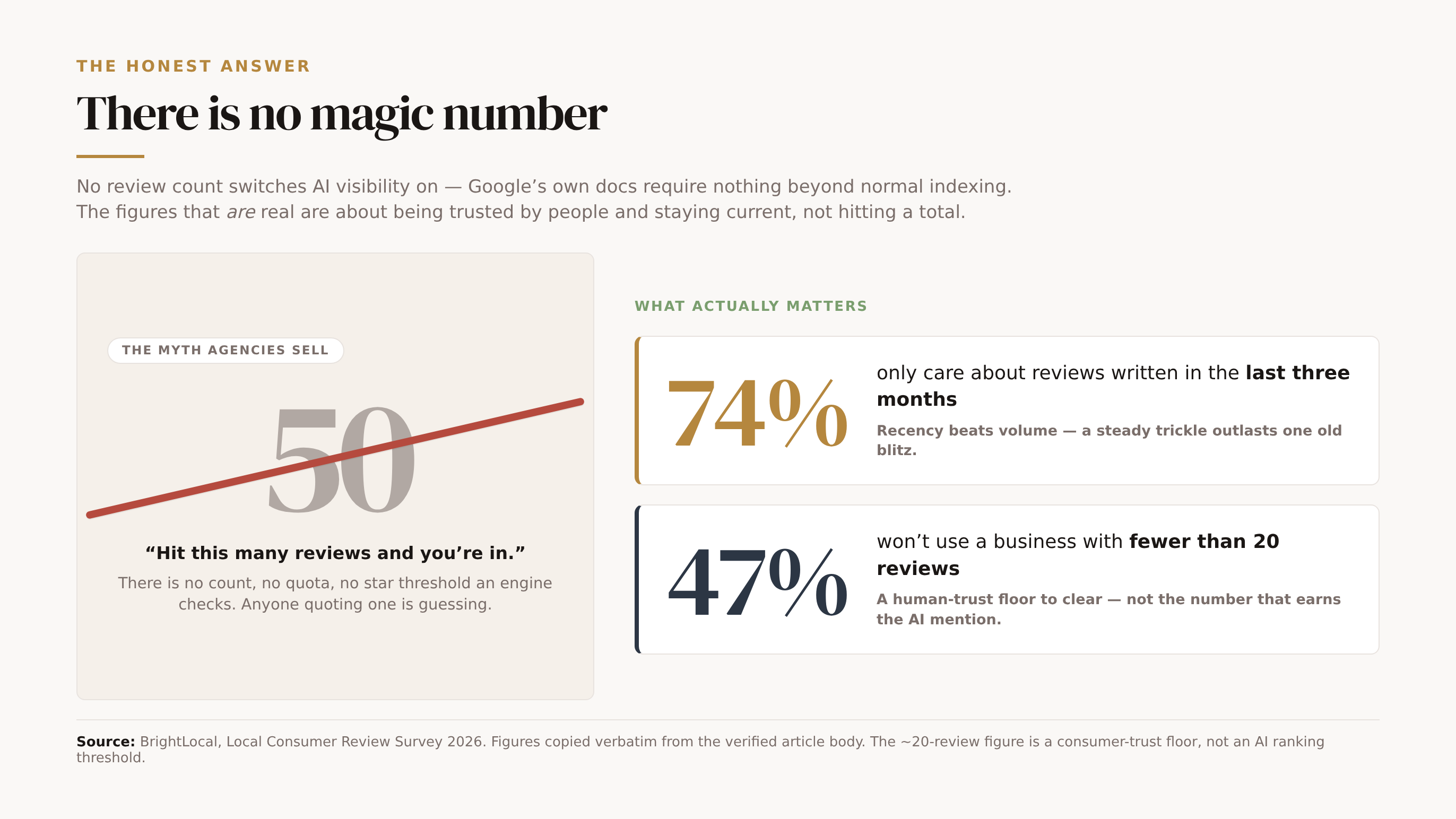
So when a marketer tells you reviews matter for AI, they are right, and you should listen. What you should not do is let them translate that into "get to 50 reviews and you are in". The accurate version is: reviews matter enormously, the number is the least important part of them, and the practices winning AI recommendations are the ones whose reviews are recent, specific and consistent, not merely numerous.
Are all "AI results" the same? The two surfaces reviews affect differently
No, and conflating them is where most of the confusion starts. "Appearing in AI results" means two quite different things depending on what the patient asked, and reviews dominate one of them while barely touching the other. Separating the two gives you a far clearer picture of where your review effort actually pays off.
The first surface is the local recommendation. A patient asks "best dentist near me", "NHS dentist in Bristol taking patients" or "emergency dentist open today". Here the engine is choosing between real practices, and it leans heavily on Google Business Profile detail, directory agreement and reviews. This is the surface where review recency, specificity and spread genuinely help decide whether your name appears. If your goal is to be the practice an AI suggests when someone needs a dentist, this is the fight, and reviews are central to it.
The second surface is the informational answer. A patient asks "does a root canal hurt?", "how long does Invisalign take?" or "is teeth whitening safe?". Here the engine is explaining a topic, not recommending a provider, and it draws on clear on-page content and schema, not on your star rating. Reviews are close to irrelevant to whether your page is the one quoted in that answer. Winning this surface is a content job, covered in our guide to Google AI Overviews and SGE for dentists, not a reviews job. Knowing which surface you are trying to win stops you pouring review effort into a question reviews cannot answer.
If there is no magic number, what should I actually aim for?
Aim to be the most trustworthy-looking practice for your local query, judged by the things an engine and a patient both weigh: recency, specificity, spread, response rate and consistency. None of these is a count, and all of them are within your control. Here is what each one means in practice.
Is there a magic number?
The only target that matters is relative
Ask
Do you look like the strongest option next to the other dentists in your town?
You are in the running
Recency, specificity, spread and response rate all read as the trustworthy-looking practice for the query.
The count alone won't save you
Two hundred reviews is plenty in a town where rivals have thirty, and modest in a city where they have eight hundred.
Beat your local competitors, not an absolute number
The only target that matters is relative. An engine recommending a dentist is comparing the practices available for that query, so the question is never "do I have enough reviews?" but "do I look like the strongest option next to the other dentists in my town?" Two hundred reviews is plenty in a town where rivals have thirty, and modest in a city where they have eight hundred. The absolute figure tells you nothing on its own.
You can see the real benchmark in about ten minutes. Open ChatGPT, Google's AI Mode and Perplexity and ask each "best dentist in [your town]" and "dentist for nervous patients in [your area]". Note the two or three practices the engines actually name, then look at their public review profiles: how many, how recent, how detailed, how well answered. That set, not a number from a blog, is the bar you are aiming to clear. Your worklist is the gap between their review presence and yours.
Clear the consumer-trust floor of around twenty reviews
There is one figure close to a "minimum", but it is about human trust, not an AI gate, and it must be framed carefully. BrightLocal's 2026 survey found that 47% of consumers won't use a business that has fewer than 20 reviews[2]. That is a useful practical floor: below roughly twenty reviews, a meaningful share of patients discount you regardless of what any engine does. Treat twenty as a sensible minimum to clear so that a human reading the AI's answer and then checking you out is not put off, not as the number that earns the AI mention. The two are different, and anyone who quotes that 47% as "the AI threshold" has misread it.
Keep them fresh, because old reviews age out
Recency now does more work than volume. BrightLocal's 2026 survey found that 74% of consumers only care about reviews written in the last three months[2]. A wall of five-star reviews that stops eighteen months ago reads, to both patients and engines, as a practice that may have gone quiet. The implication is the opposite of a one-time push: you want a steady drip of genuine recent reviews rather than a single blitz that ages out of usefulness within a quarter. A practice gathering two genuine reviews a week beats one that collected fifty in a fortnight last year and nothing since.
Spread beyond Google
Reviews on a single platform are a narrower signal than reviews across several. Consumers now check multiple sites before deciding, and engines corroborate across them, so the same effort spread wider counts for more. For a UK dental practice that means Google first, then the NHS "find a dentist" profile, then healthcare-specific and reputable local directories. Presence on more than one trusted source tells an engine your reputation is real and consistent, not concentrated in one place that could be gamed. It also covers more of the surfaces a patient might land on while the engine fans out its searches.
Make your reviews specific
This is the lever almost nobody pulls, and it is the one an engine notices most. A generic review ("Lovely practice, highly recommend") gives an AI nothing it can quote for a particular patient. A specific one ("gentle with my dental anxiety, finished my Invisalign on schedule, explained the costs upfront") gives it citable, service-level detail it can match to the patient's actual question.
You cannot write reviews for patients, and you must never try, but you can prompt genuine specificity simply by how you ask. After a completed course of treatment, a question like "if you have a moment, it really helps others to hear what you came in for and how it went" invites the detail that makes a review useful, without scripting or incentivising anything.
Respond to your reviews
Silence reads as neglect, to patients and engines alike, and a steady response rate is a visible trust signal. Reply to all of them, positive and negative, but never put a patient's clinical details in a public reply: thank them, answer the general point, and take any specifics offline. A practice that answers its reviews thoughtfully looks active, accountable and real, which is exactly the impression that tips a close decision your way. A negative review answered well often reassures a reader more than an unbroken row of fives.
What review content actually gets pulled into an AI recommendation?
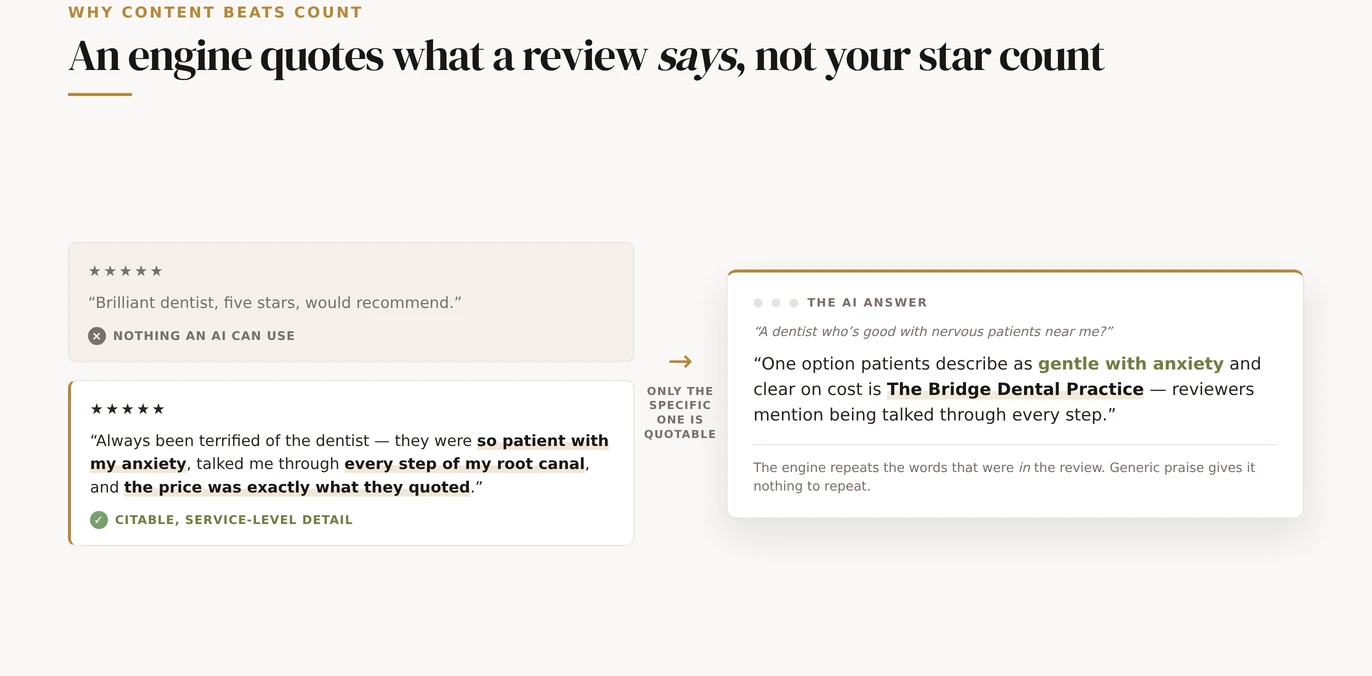
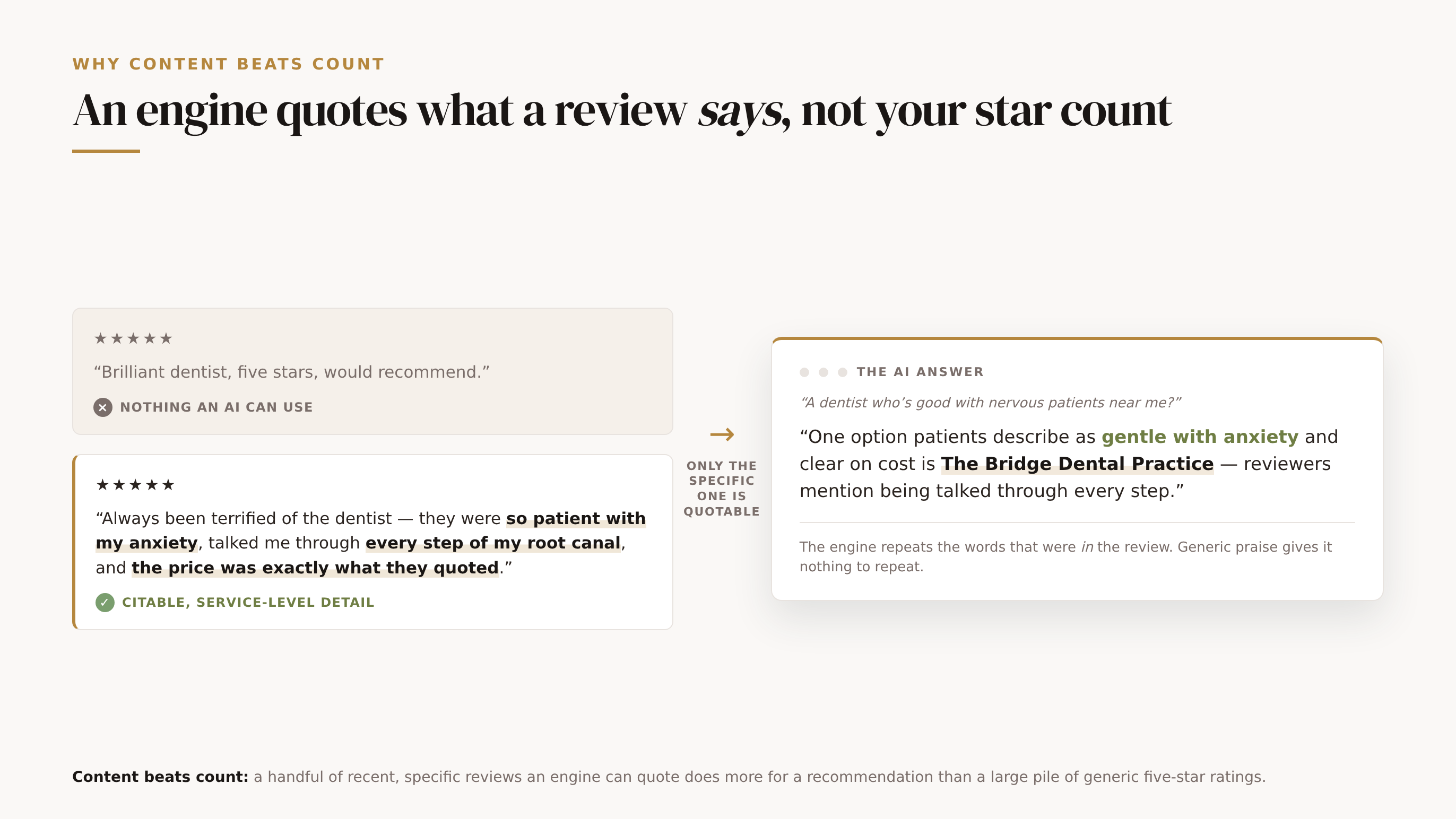
Specific, service-level language gets pulled; generic praise does not. Because an engine reads reviews as text it can quote, the reviews that help you are the ones that say something concrete an AI can match to a patient's question. This is the practical heart of "content beats count", and it is worth seeing the difference plainly.
Content beats count
Two five-star reviews, very different value to an engine
| Generic praise | Specific, service-level review | |
|---|---|---|
| What it says | "Brilliant dentist, five stars, would recommend." | "They were so patient with me, talked me through every step of my root canal, and the price was exactly what they quoted." |
| What an engine can match | Nothing concrete beyond a star rating | Good with anxious patients, handles root canals, communicates clearly, upfront about cost |
| When a patient asks | Rarely surfaced for a specific need | Named for "dentist for nervous patients" or "root canal near me" |
Consider two reviews of the same practice. The first says: "Brilliant dentist, five stars, would recommend." The second says: "I have always been terrified of the dentist and they were so patient with me, talked me through every step of my root canal and never made me feel rushed; the price was exactly what they quoted." Both are five stars.
Only the second tells an engine that this practice is good with anxious patients, handles root canals, communicates clearly and is upfront about cost. When a patient asks an AI for "a dentist who is good with nervous patients in [town]", the practice with the second review is the one the engine can confidently name, because the evidence is right there in the words.
One dental marketing agency, Harris & Ward, makes the same argument from its own client work, writing that "a practice with 200 reviews that say 'Great dentist!' is less visible in AI search than a practice with 80 reviews that specifically mention Invisalign, dental anxiety, same-day appointments," and that "a review mentioning 'gentle with anxious patients' is worth more to an AI recommendation engine than ten generic five-star ratings"[3].
That is their observation from testing rather than a verified statistic, so treat it as an informed opinion rather than proof. It happens to match what Google's documentation and the BrightLocal data imply: the substance of a review matters more than the score attached to it. Your job is to make it easy and natural for genuinely happy patients to describe what you actually did for them.
How do I get more reviews as a dental practice without breaking the rules?
You ask everyone, you make it effortless, and you never gate or incentivise. Gathering reviews as a healthcare provider in the UK comes with real constraints, and getting them wrong is both a fitness-to-practise risk and unlawful, so the method matters as much as the effort. The good news is that the compliant way is also the way that produces the recent, specific, genuine reviews an engine values.
The compliant approach is straightforward. Ask satisfied patients at the right moment, which is after a completed course of treatment rather than mid-appointment, and make leaving a review a single tap with a short link or a QR code at reception. Ask consistently rather than in occasional bursts, so the flow stays recent. Invite genuine detail about what the patient came in for and how it went, which produces the specific language that helps you, without ever scripting what they should say. Spread the ask across Google and your NHS and healthcare profiles so the reviews land on more than one platform.
The lines you must not cross are clear and worth stating. Do not offer anything in exchange for a review, not a discount, a prize draw or a free service: incentivised reviews are misleading and unlawful in the UK, and an engine that detects manipulation trusts you less, not more. Do not "gate" reviews by filtering out unhappy patients before they reach a public platform. Do not write, edit or buy reviews. Do not reveal any patient's clinical details when you reply.
Because dentistry is a health subject, held to the highest trust standard, the engines are deliberately cautious here, and a practice caught manipulating reviews damages exactly the trust it was trying to build. Genuine, recent, specific reviews gathered from everyone are slower and far more durable, and they are the only kind that count. This is also the plain reading of the General Dental Council's standard that anything you publish be accurate and not misleading[4].
How do I check whether AI already recommends my practice?
You can test it today, free, in about ten minutes, by asking the engines the questions your patients ask and watching what comes back. You do not need a paid tool to find the gap; you need a clear read of the results. Open ChatGPT, Google's AI Mode and Perplexity, and ask each one the real questions: "best dentist in [your town]", "NHS dentist near me taking on patients", "emergency dentist in [your area] today", and "dentist for nervous patients in [town]".
Watch three things. First, whether your practice is named at all, named only sometimes, or named only when you ask very specifically. Second, which practices appear instead of or alongside you, because those are your real benchmark, and their review profiles show you the bar. Third, whether the engine, when it does mention you, repeats anything specific from your reviews or only your name and rating, because that tells you whether your review content is doing any work. Run each prompt a few times, since the replies shift between attempts, and treat the recurring pattern rather than any single answer as the truth about where you stand.
Read the results as a worklist. Absent from every answer while rivals with fewer reviews appear usually means your reviews are stale, generic or confined to one platform, not that you need a bigger number. Named only alongside a competitor means it is worth studying what their reviews hold that yours do not: more recent dates, more specific detail, answers from the practice, presence on more sites. The gap between their review presence and yours, not a figure from a blog, is what you act on.
Frequently asked questions
Is there a minimum number of Google reviews to appear in AI results?
No. There is no review-count threshold for AI visibility, and Google's own documentation says there are no additional requirements beyond normal indexing to appear in its AI answers. Reviews influence the underlying ranking systems an AI draws on, but no specific number switches visibility on. The useful target is to have more recent, more specific and more widely-spread reviews than the practices you compete with locally, not to reach a particular count.
Do more reviews guarantee an AI recommendation?
No. Volume alone guarantees nothing, because an engine reads what your reviews say, not just how many you have. A practice with a smaller number of recent, detailed reviews that mention specific treatments and experiences can be named ahead of one with a larger pile of generic, ageing five-star ratings. Recency, specificity, spread across platforms and your response rate all matter more than the total.
How recent do my reviews need to be?
Recent enough to look current, and the bar has risen. BrightLocal's 2026 survey found that 74% of consumers only care about reviews written in the last three months, so a steady, ongoing trickle of genuine reviews beats a one-time burst that ages out within a quarter. Aim to gather reviews continuously rather than in occasional campaigns.
Do reviews on Yelp or Healthgrades count too, or only Google?
They count, and spreading beyond Google helps. Consumers check multiple sources and engines corroborate across them, so reviews on your NHS profile and reputable healthcare and local directories strengthen the picture rather than duplicating it. Google first, then your NHS listing and healthcare-specific platforms, is a sensible order for a UK practice.
Can I pay to appear in AI results?
No. There is no paid placement that buys you into an AI recommendation the way an ad buys a slot above search results, and anyone promising to "pay your way" into an AI answer is selling something that does not exist. You earn the mention by being the practice the engine can most confidently verify and describe: recent, specific reviews, consistent facts, and a complete profile across the sources it reads.
Will responding to reviews help my AI visibility?
Yes, indirectly and meaningfully. A steady response rate signals an active, accountable practice to both patients and engines, and a negative review answered well often reassures a reader more than an unbroken row of fives. Reply to everything, good and bad, but never include a patient's clinical details in a public reply: thank them, address the general point, and take specifics offline.
Where to start
If you do only three things from all of this, take them in order. First, find your real benchmark by asking ChatGPT, Google's AI Mode and Perplexity who they name for "best dentist in [your town]", and look at those practices' review recency and detail, not just their count. Second, set up a steady, compliant way to gather genuine recent reviews from every patient after treatment, inviting them to describe what they came in for, and spread the ask across Google and your NHS and healthcare profiles.
Third, reply to every review you have, safely and without clinical detail, so your practice reads as active and accountable. Each of those sits comfortably inside GDC rules, and each does more for your AI visibility than chasing a number ever could. They are the core of any wider AI SEO for dentists programme.
Where to start
Three moves, in order
Find your real benchmark.Ask ChatGPT, Google's AI Mode and Perplexity who they name for "best dentist in [your town]", and look at those practices' review recency and detail, not just their count.
Set up a steady, compliant way to gather genuine recent reviews.Invite every patient after treatment to describe what they came in for, and spread the ask across Google and your NHS and healthcare profiles.
Reply to every review you have.Safely and without clinical detail, so your practice reads as active and accountable.
Keep every step inside GDC rules.Each does more for your AI visibility than chasing a number ever could.
If you would rather see where you stand before spending anything, a free QBiz Leads AI visibility check checks your own pages in about thirty seconds and returns a plain pass or fail on the readability and markup an engine needs to find and quote you, then shows you which gap to close first. It is the no-cost first step before any spend.
Get your free AI visibility check →
Sources
- [1] Google Search Central, "AI features and your website": https://developers.google.com/search/docs/appearance/ai-features (Global; primary. "To be eligible to be shown as a supporting link in AI Overviews or AI Mode, a page must be indexed and eligible to be shown in Google Search with a snippet... There are no additional technical requirements." No separate review gate is listed.)
- [2] BrightLocal, Local Consumer Review Survey 2026: https://www.brightlocal.com/research/local-consumer-review-survey/ (US-weighted; independent. Use of generative AI tools for local recommendations rose "from 6% last year to 45%", becoming the third most popular source; "47% of consumers won't use a business that has fewer than 20 reviews"; "74% only care about reviews written in the last three months".)
- [3] Harris & Ward (dental marketing agency), "AI Search for Dentists": https://harrisandward.com/ai-search-for-dentists/ (Vendor; attributed opinion. The agency's own assertion from client testing, presented in the article as an informed opinion rather than an independently verified statistic.)
- [4] General Dental Council, Standards for the Dental Team, standard 1.3.3: https://standards.gdc-uk.org/pages/principle1/principle1.aspx (UK; regulatory. Advertising and information must be accurate and not misleading; the compliance basis for the claim-safe framing throughout.)
Leave a comment
Thoughts on this post? Leave a comment below. Comments are moderated before they appear, so yours will not show on the page straight away.
Your email is used only to contact you about your comment if needed — it is never published.
Comments
No comments yet. Be the first to leave one above.