Los Angeles Plumber Local SEO: A Strategy for Google Visibility, Maps and Ads
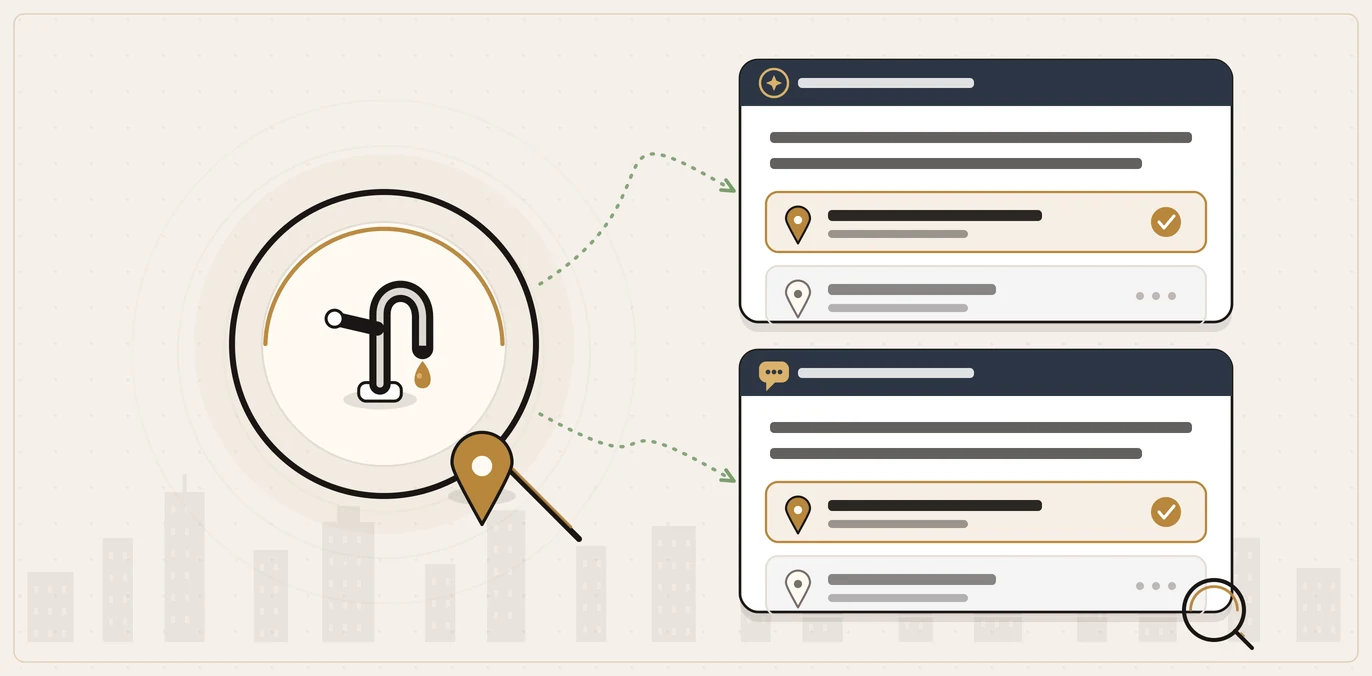
Local SEO for a Los Angeles plumber now has to cover three surfaces at once: Google organic results, Google Maps and the AI answers that appear before a customer clicks. Ads can buy the first look, but the second look decides the booking. A homeowner may click your Local Services Ad, then search your business name, read reviews and ask ChatGPT or Google whether you are credible. The durable strategy is to complete the Business Profile, claim Bing Places, make reviews and listings consistent, build answer-first service pages for real LA places like Sherman Oaks and Pasadena, then use ads only after the owned and earned signals can back the click up.
The short version
- Ads rent attention. They can create leads quickly, but they stop the moment spend stops and they do not build the proof a researching customer needs.
- The second look closes the job. After a click or referral, customers check your reviews, Business Profile and AI summaries before they call.
- AI has changed the prize. Fewer users click past AI summaries, so being named in the answer matters as much as ranking below it.
- Maps work feeds AI work. Services, neighborhoods, credentials, photos and reviews on the Business Profile are also inputs for local AI answers.
- Use place-specific service pages. Write for actual jobs in actual areas, not "near me" keywords. The engine resolves nearness from location signals.
An LA plumbing company can spend four figures a month on Google Ads and still lose the job to a competitor who spent less. The click is not the sale. Someone taps your Local Services Ad at the top of the results, then does what people do before they let a stranger into the house: they look you up. They search your business name, they read your reviews, and more and more they ask ChatGPT or read the AI summary Google now places above the map. What they find in that second look decides whether the ad you paid for turns into a booking or a closed tab.
This is a guide to local SEO for a Los Angeles plumbing business across the three surfaces that actually win work: Google's organic results, Google Maps and your Business Profile, and paid ads. The thread running through all three is AI search, because the AI answer now sits on top of them and quietly decides which plumbers a customer even considers. Get that layer right and the money you already put into ads works harder. Skip it and you are renting attention you never get to keep.
Why does Google's own AI answer steer me toward ads?
Run the search yourself. Ask Google how to get a plumbing business found in Los Angeles and the AI Overview leads with Local Services Ads and Google Ads: the Google Guarantee green check, pay-per-lead, keyword bidding. That is a reasonable answer, and it is also the answer a company with a search-advertising business worth hundreds of billions of dollars is built to give. Google earns when you rent space at the top of its results, so its own AI naturally points there first.
What the data shows
Why AI answers change the plumbing game
34.5%
lower click-through for the top result when an AI Overview appears
97%
of consumers read reviews for local businesses
45.7%
of Google searches are branded, so people seek names they already trust
Ahrefs; BrightLocal, Local Consumer Review Survey 2026
Paid ads have a real place, and there is a section on them below. But leading with them gets the strategy backward for a plumber who wants to spend less over time rather than more. Ads are rented visibility: the day you stop paying, you disappear from the top. The visibility that compounds sits in the assets you own and earn: a complete Business Profile, organic pages that answer the questions customers actually ask, genuine reviews, and a business name that trusted third-party sites mention. Those keep working after the invoice clears, and they are exactly what the AI answer reads when it decides who to name.
Line the levers up by what happens when the spending stops:
The levers, in order
What to build first, and what each lever feeds
| Lever | What it is | Stop investing and… | What it feeds |
|---|---|---|---|
| Google Ads / Local Services Ads | Rented visibility, paid per click or per lead | you vanish from the top the same day | Leads today, while the budget lasts |
| Google Business Profile | Owned and earned: one complete, consistent profile | it keeps ranking in Maps and feeding AI answers | The map pack and local AI Overviews |
| Organic service and area pages | Owned: pages that answer real customer questions | they keep getting found and cited | Organic results and AI answers |
| Reviews | Earned: genuine, recent customer reviews | they stay put and keep building trust | Local ranking and AI trust |
| Brand distribution / earned mentions | Earned: trusted third-party sites naming you | the mentions remain as durable proof | How confidently AI names you |
Nothing here says switch the ads off. It says stop treating rented space as the whole plan when four of the five levers keep paying out long after you stop funding them, and all four feed the AI answer that now frames the customer's decision.
What actually happens after someone clicks my ad?
Very few people call the first plumber they see and book on the spot. A water leak means a stranger coming into the home, often at short notice, so people check before they commit. That checking shows up in the data as branded search. Ahrefs, studying around 150 million US keywords, found that 45.7% of Google searches are branded, meaning people are actively searching for a specific company or product they already know.[2] Close to half of all searching is someone looking up a name they already have in mind.
For a plumber that name usually arrives from somewhere first: an ad they saw, a wrapped truck on the 405, a neighbor's recommendation. The first impression plants the name; the second look decides whether it holds. Ahrefs notes that the branded share is heaviest on longer, multi-word queries, which reads less like people typing a quick brand name and more like people doing deeper research before they act.[2] That second look is where your ad spend is won or lost, and it plays out on surfaces you do not pay per click for: your Business Profile, your reviews, and the AI answer that increasingly summarizes both.
So the ad budget and the AI answer are not two separate line items. The ad buys the first impression. Being named as a credible, recommended plumber when the customer researches afterward, inside Google's AI Overview and inside ChatGPT, is what closes it. A plumbing company that is invisible in AI search pays full price for every ad click and then lets a share of those clicks cool off in the gap between the click and the call. Fill that gap and the same budget converts more of the people it already reached.
If AI answers are taking the clicks, what wins the job now?
The reason being named matters more each month is that the classic organic click is shrinking. Ahrefs analyzed 300,000 keywords and found that the presence of a Google AI Overview correlated with a 34.5% lower click-through rate for the top-ranking page, compared with similar informational keywords that had no AI Overview.[1] That is a correlation from a keyword study rather than a universal law, but independent browsing research points the same direction: when an AI summary sits at the top of the results, people click through to a traditional link far less often, and many never scroll past the summary at all.
Read those two studies together and the change is plain. When the AI answers, fewer people scroll down to the blue links, and almost nobody clicks through the summary to a website. A top organic ranking that earns the click is worth less than it was. The prize that is growing is being one of the names inside the answer, because that is what the customer reads before deciding who to call. For a Los Angeles plumber the goal is no longer only to rank a page; it is to be the plumber the AI names when someone asks for one in their part of the city, whether that question lands in Google's AI Overview or in ChatGPT.
That is why the work splits across engines. The AI Overview Google shows is assembled from Google's own results, so everything you do on Google flows into it. ChatGPT and Microsoft Copilot go somewhere else for their live answers, grounding them in Bing's index, which means a plumber who has only ever cleaned up their Google side can be missing entirely from what those two tools say. Being present and accurate in both indexes is what puts your name in reach of every AI surface an LA customer might use, a split we cover in depth in our guide to plumbing AEO across the AI answer engines.
How does my Business Profile feed the AI answer, not just the map?
Most plumbers treat their Google Business Profile as a Maps listing: a pin, a phone number, done. It is now the single richest feed into local AI answers, because the AI reads the same signals Google uses to build the map pack. Google states that local results are based mainly on relevance, distance, and prominence, and that prominence is built partly on how many websites link to your business and how many reviews you have.[4] The complete, well-reviewed profile that earns the map pack is the same profile the local AI Overview reaches for when it assembles an answer, so profile work is now AI-visibility work.
How it feeds AI
From your profile to a named AI answer
Complete profile
A full, consistent Google Business Profile supplies the local facts an engine can read.
Cross-source read
The engine assembles an answer from the profile, listings, reviews and the wider web.
Confirmation
It settles who to trust when the field looks even, on details that agree everywhere.
Local AI answer
Profile work is now AI-visibility work, not just map-pack work.
For a Los Angeles plumbing company, a profile the AI can use spells out:
- The neighborhoods you actually serve, named the way customers say them: Santa Monica and the Westside, Pasadena, Downtown, the San Fernando Valley, not a vague "greater LA." In a metro this large, "near me" is a neighborhood question, and the plumber tied clearly to one part of the city out-answers the one who claims all of it.
- Emergency versus scheduled work, with real hours and a plain description of how after-hours calls are handled.
- Every service listed individually: water heater repair, slab leak detection, drain and sewer clearing, repiping, fixture installation, not a single "plumbing" category an engine cannot act on.
- Licensed, bonded, and insured stated in plain text. A customer letting a stranger into the house wants to read it, and an engine can quote a fact it can read. This is the natural place for that trust signal, without turning the page into a compliance lecture.
- Real photos of your trucks and crew, and a steady stream of recent reviews rather than a wall of old ones.
Reviews carry unusual weight now, and not only with humans. BrightLocal's Local Consumer Review Survey 2026 found that 97% of consumers read reviews for local businesses, that the average consumer uses six different review sites, and that AI tools like ChatGPT have risen into the top three sources people use for local recommendations, alongside Google and Facebook.[3] The same survey recorded Google's share of reviews slipping from 83% in 2025 to 71% in 2026 as those other sources, AI among them, took a larger role.[3] Reviews on Google, Yelp, Angi and the BBB are no longer just reassurance for a person reading your page; they are evidence an answer engine weighs when it decides whether to put your name forward.
Why do some LA plumbers get named and others don't?
In a market as crowded as Los Angeles, plenty of plumbers already have a tidy Business Profile and decent reviews. When several look equally qualified, the AI still has to choose one or two names, and it makes that call on something your own website cannot supply: what the rest of the web says about you. A site that only quotes itself is a thin signal. A dozen independent, trusted sources naming the same business is a strong one, and that off-site reputation is largely what settles who gets named when the field looks even.
The landing page
What the page a researcher lands on must do
Answer the real question first.Lead with the plain answer a customer actually asked, not a marketing preamble.
Name the LA area plainly.Put the neighbourhood in the words so a local search resolves to you.
State checkable facts.Hours, service area, licensing and pricing shape give the engine something to quote.
Match the profile and listings.Keep the page consistent with your Business Profile and directory records.
Make it easy to act.A clear next step turns a cited answer into a booked job.
This is where QBiz Leads AI brand distribution and earned mentions do their work. The idea is to get your business name onto the trusted third-party sites answer engines already read, consistently described, so that when an engine weighs how credible you are it finds agreement from several directions instead of a single self-made claim. Local press, community pages, industry sites, and the directories customers already check all count.
The more trusted mentions line up behind you, the more readily an engine puts your name forward, and that is usually what settles it between two LA plumbers who otherwise look the same. There is a specific order to building that authority, from a fully built Business Profile out to earned mentions, which we lay out in our guide to how citation authority gets an LA plumber named in AI search. Our citations for AEO page walks through how this part is done.
It is also why NAP consistency, the plain discipline of one exact name, address, and phone number everywhere, matters more than it used to. When your details agree across Google, Yelp, YellowPages, Angi, the BBB and your own site, you present one coherent business an engine can trust. When your suite number or phone differs from one listing to the next, the engine has to work out which version is real, and one that cannot pin down your basic facts will favor a plumber whose details line up cleanly.
What does the page a researcher lands on need to do?
Picture the moment the loop closes. Someone saw your Local Services Ad an hour ago, or a neighbor passed along your name, and now they are checking you out before they pick up the phone. They search "water heater repair Sherman Oaks, same day, cost," or they ask ChatGPT the same thing.
The booking turns on whether the page they reach, and the AI summary drawn from it, settles that question in the first breath. A page that opens with your founding story and a ten-item service menu loses them, because the detail that matters sits too far down for a hurried reader or a retrieval system that only skims the top. Set that against a page that leads with the answer:
Water heater failed in Sherman Oaks and need it looked at today? Most same-day calls begin with a flat diagnostic visit that covers the first hour on site, and the usual culprits (a dead thermostat, a burnt-out heating element, a failing gas valve) are often put right on that first trip. Serving Sherman Oaks and across the San Fernando Valley, licensed, bonded, and insured.
Read that back and note how much a machine can lift straight out of it: the job, the part of the city, roughly what happens on the visit, and the credential that tells a wary homeowner you are safe to let inside. Put your own real dollar figure on the page and say exactly what the fee buys, so that when someone asks an engine what a water heater diagnosis costs in Sherman Oaks, yours is the page carrying a number worth quoting. The heavier detail (when a repair stops being worth it against a replacement, how long a swap takes) belongs further down, waiting for the reader who is nearly ready to book.
Then run the same play for every job you want to be found for. One catch-all "Services" page is where plumbers disappear, because it leaves the engine guessing whether you truly handle the exact thing being asked about. Break it apart: water heater work, slab leak detection, sewer and drain clearing, repiping, emergency call-outs, each on a page that answers a single question well.
Where you can, hand the facts to a machine outright with schema markup, the Plumber or LocalBusiness type for who and where you are, Service for each job, and FAQPage for the questions you answer on the page. The one unbreakable rule is that the markup may never claim more than a visitor can plainly see, or it counts against you.
What is the right order to build all this?
You do not have to do everything at once, and there is a sequence that pays back fastest, front-loading the free, durable work and letting the paid spend come in last, once it has something solid to amplify.
- Build the Business Profile out fully first. It is the one asset that feeds the map pack and the local AI answer together, so it earns the top slot. Exact name, address and phone; real hours and a plain line on after-hours calls; each service on its own; licensed, bonded, and insured spelled out; the neighborhoods you cover named; genuine photos of the crew and trucks.
- Add Bing to the picture, not just Google. The answers ChatGPT and Microsoft Copilot give lean on Bing's index, so a Bing Places listing with the same details is what opens those two engines to you. Google effort alone will not reach them.
- Make every listing agree. Line your name, address and phone up to a single exact version wherever they show, across Yelp, Angi, YellowPages, the BBB and your own site, so nothing is left for an engine to second-guess.
- Rewrite the pages that matter answer-first. Take your top services and neighborhoods and lead each page with what the customer asked, in their words and with a real dollar figure, rather than saving it for the bottom where nothing reads it.
- Keep reviews fresh, then earn the outside mentions. Gather genuine, recent reviews and reply to every one, then go after the trusted third-party coverage that tips a close decision when two plumbers look equally good to the engine.
- Bring the ads in last. Once the owned and earned side is standing, an ad click lands on a business the wider web already backs up, so the person who researches you after the click finds reasons to book rather than reasons to keep looking. The budget you were already spending simply converts more of what it reaches.
Followed in that order, the ad money stops leaking out through the gap after the click and starts compounding on visibility you keep for good. The full version of how we run this for plumbing businesses sits on our AI optimization for plumbers page, and the Google side of it is unpacked in our guide to plumbing AEO for Google's AI Overviews.
Frequently asked questions
Is it smarter to pour budget into Google Ads or into SEO?
Sequence them rather than pick one. Paid ads and Local Services Ads switch on leads this week, which genuinely helps when the calendar is thin. What they do not do is stick around; the moment the invoice stops, so does the visibility. A complete Business Profile, organic pages, and a name that shows up in AI answers are the opposite, they hold their value and quietly make every ad click land better, since the person who looks you up afterward meets a business the web already stands behind. Get that foundation down, and treat ads as the accelerator on top rather than the engine underneath.
My website ranks well on Google, so why is ChatGPT silent about me?
Google and ChatGPT are reading different maps. To answer a live local question, ChatGPT reaches into Microsoft Bing's index, not Google's, which means a page sitting proudly at the top of Google can be completely off ChatGPT's radar if the business barely registers in Bing. The remedy is to treat Bing as its own job, claiming and filling out a Bing Places listing as thoroughly as you did your Google profile, which is what brings ChatGPT and Copilot into range.
What does my Business Profile have to do with AI results?
A great deal, because the local AI answer is built from the same profile Google uses to rank the map pack, and Google says that ranking turns on relevance, distance, and prominence. Fill the profile out (services, hours, the neighborhoods you work, credentials written in plain text, and a steady stream of recent reviews) and you are feeding the exact signals an engine weighs when it picks which plumbers to name. What you once did purely to climb Maps now also helps land you in the AI summary sitting above it.
Where do AI answers get their information about an LA plumber?
They favor the places Angelenos already use to size up a stranger before letting them in: your Google Business Profile first, then Yelp (which pulls unusual weight for local search in California), plus Angi, YellowPages and the BBB, along with any real trade or accreditation listing you hold. Being present across them is only half of it; being consistent is the other half. A suite number left over from your old office, or a cell number on one site and a landline on another, forces the engine to decide which you it believes, and the safe move for it is to feature a plumber whose story lines up everywhere.
How soon will I start showing up in AI answers?
No one can hand you a date. Filling out the Google profile and getting recent reviews flowing can nudge things inside a few weeks. Squaring your details across every listing and earning enough outside mentions to be named with confidence in a contested LA neighborhood is slower, usually a matter of months of steady effort. Think of it as groundwork that compounds instead of a switch you flip, which is also why, once it takes hold, it does not fall over easily.
Should I build pages around "plumber near me"?
No. "Near me" describes how a customer asks, not what a business should target. Google and AI assistants resolve nearness from the searcher's location, your Business Profile, your service area and your local citations. A better page targets the job and the real place: "water heater repair in Sherman Oaks", "slab leak detection in Pasadena" or "emergency plumber in Santa Monica". That gives the engine concrete facts it can match to a nearby buyer.
Why does Bing matter for Los Angeles plumber SEO?
Bing matters because ChatGPT and Microsoft Copilot lean on Bing's index when they search the web. A Los Angeles plumber with a strong Google presence but no Bing Places listing can look credible in Google and still be thin in ChatGPT or Copilot. Claiming Bing Places, matching the same name, address, phone number, services and photos, extends local SEO into the AI tools customers now use for the second look.
What should an LA plumbing service page answer first?
It should answer the job, the place, the likely next step and the trust signal in the first few lines. For example, a Sherman Oaks water heater page should say whether same-day diagnosis is available, what the first visit covers, which parts of the Valley are served and that the company is licensed, bonded and insured. The deeper detail can follow, but the opening needs to settle the customer's immediate question.
Do Local Services Ads still make sense for plumbers?
Yes, but they work best after the owned and earned signals are in place. Local Services Ads can create demand quickly, especially for urgent calls. The risk is paying for a lead that then researches the business and finds thin reviews, inconsistent listings or no AI visibility. Fix the Business Profile, reviews, service pages and citations first, then the paid click lands on a business the wider web already supports.
Which review details help a plumber show up in AI answers?
Specific reviews help most. A review that says "fixed a slab leak in Pasadena" or "same-day drain clearing in Silver Lake" gives an answer engine a service, a place and an outcome to match. A generic five-star review still helps a person feel safer, but it gives AI less to work with. Ask customers naturally to mention what was fixed and where, without scripting the review for them.
Putting the three surfaces to work together
Most LA plumbing companies that stay invisible share one profile: real money flowing into ads, a Google presence that never goes past the map pin, credentials sitting in a logo image no machine can read, and nothing out on the wider web vouching for them. Close those four gaps and the ads stop carrying the whole load on their own. The click still buys the first look, but now the person who takes it finds a plumber the internet plainly recommends, and the two halves start pulling in the same direction instead of one leaking what the other paid for.
To see which of those gaps is yours before the next dollar goes into clicks, run your site through the free QBiz Leads AI visibility check. In about thirty seconds it comes back with a plain pass or fail across the signals that govern whether AI tools can find your business and put it forward.
Get your AI visibility check →
Sources
- [1] Ahrefs, "AI Overviews Reduce Clicks by 34.5%," study of 300,000 keywords: https://ahrefs.com/blog/ai-overviews-reduce-clicks/ (US; independent. "We analyzed 300,000 keywords and found that the presence of an AI Overview in the search results correlated with a 34.5% lower average clickthrough rate (CTR) for the top-ranking page, compared to similar informational keywords without an AI Overview." Stated as a correlation from a keyword study, not a universal law.)
- [2] Ahrefs, "Almost Half of Google Searches Are Branded. Here's Why That Matters," study of ~150 million US keywords: https://ahrefs.com/blog/almost-half-of-google-searches-are-branded-study/ (US; independent. "Nearly half of all Google searches (45.7%) are branded searches," meaning people are actively seeking out specific companies and products they already know. Also: "searches with 3+ words have the biggest slice of the branded search pie... most branded search isn't people typing quick brand names, it's people doing deeper research with longer queries." Cited as a branded-search-share figure, not an after-ad measurement.)
- [3] BrightLocal, "Local Consumer Review Survey 2026": https://www.brightlocal.com/research/local-consumer-review-survey/ (US-relevant consumer survey. "97% of consumers read reviews for local businesses"; "The average consumer uses six different review sites when choosing businesses"; "Google, Facebook, and AI tools like ChatGPT are most commonly used for local recommendations," with AI tools like ChatGPT "surging into third place." Also: "Google has always been the standout source for reviews, but this year its share has dipped from 83% in 2025 to 71%.")
- [4] Google Business Profile Help, "Tips to improve your local ranking on Google": https://support.google.com/business/answer/7091 (Google's own documentation. "Local results are mainly based on relevance, distance, and popularity." The three detail subheadings are Relevance, Distance, and Prominence; on prominence: "This factor's also based on info like how many websites link to your business and how many reviews you have. More reviews and positive ratings can help your business's local ranking.")
Leave a comment
Thoughts on this post? Leave a comment below. Comments are moderated before they appear, so yours will not show on the page straight away.
Your email is used only to contact you about your comment if needed — it is never published.
Comments
No comments yet. Be the first to leave one above.