Organic SEO vs AI Optimisation for Dental Practices: One Foundation, Two Payoffs
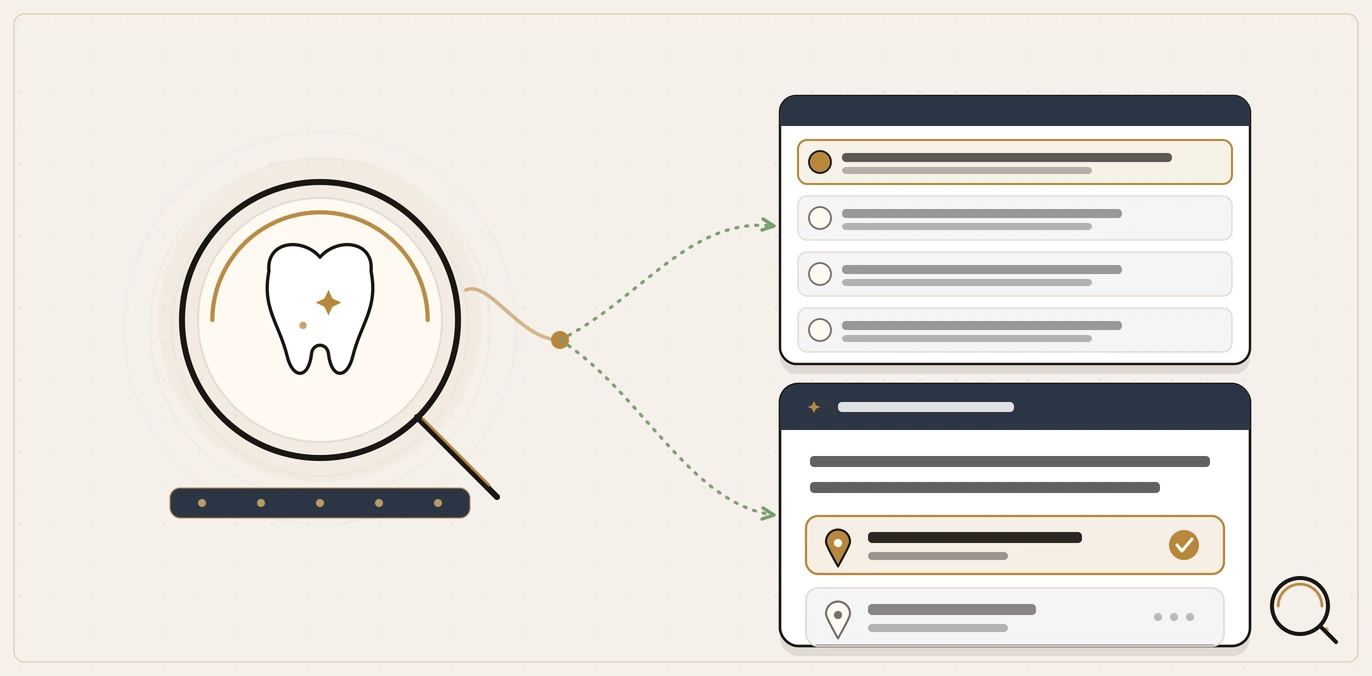
SEO ranks your pages in Google. AI optimisation gets your practice named inside AI answers. They are not competing strategies. Most of it is shared: pages Google can read, clear pages for the treatments patients search (teeth whitening, Invisalign, dental implants, emergency appointments), business details that match everywhere, fresh reviews, and a complete Google Business Profile. The split starts when ChatGPT or Google AI Overviews needs to lift a clean answer off your page and check it against your Google profile and directory listings before it names you. In one line: ranking gets you seen; being recommended gets you chosen.
The short version
- SEO and AI optimisation share one foundation: pages Google can index, clear treatment pages, fresh reviews, and business details that match across the web.
- SEO wins the click. AI optimisation wins the mention inside ChatGPT and Google AI Overviews.
- Ranking first on Google does not win the AI answer. If the engine cannot check your practice against your Google profile and listings, it names a rival it can.
- You do not need two websites or two strategies. You need one stronger site and a clearer answer layer on top.
- Fix in this order: pages Google can read, then treatment pages, then matching business details, then fresh reviews.
SEO vs AI optimisation for dentists at a glance
| What you are trying to win | SEO | AI optimisation |
|---|---|---|
| Primary outcome | Higher visibility in search results | More chances of being named in AI answers |
| Main surface | Google Search and Maps | ChatGPT, Google AI Overviews, Perplexity, Gemini |
| What the engine needs | Relevant, readable, well-structured pages | The same pages, plus answers it can lift and details it can check against your listings |
| Best content type | Treatment pages, location pages, supporting blog posts | Treatment pages, FAQs, clear prices and process, plus reviews and listings that agree |
| Key weakness if ignored | Fewer rankings, fewer visits | Fewer mentions, weaker trust inside AI answers |
| Best way to think about it | Earn the click | Earn the mention |
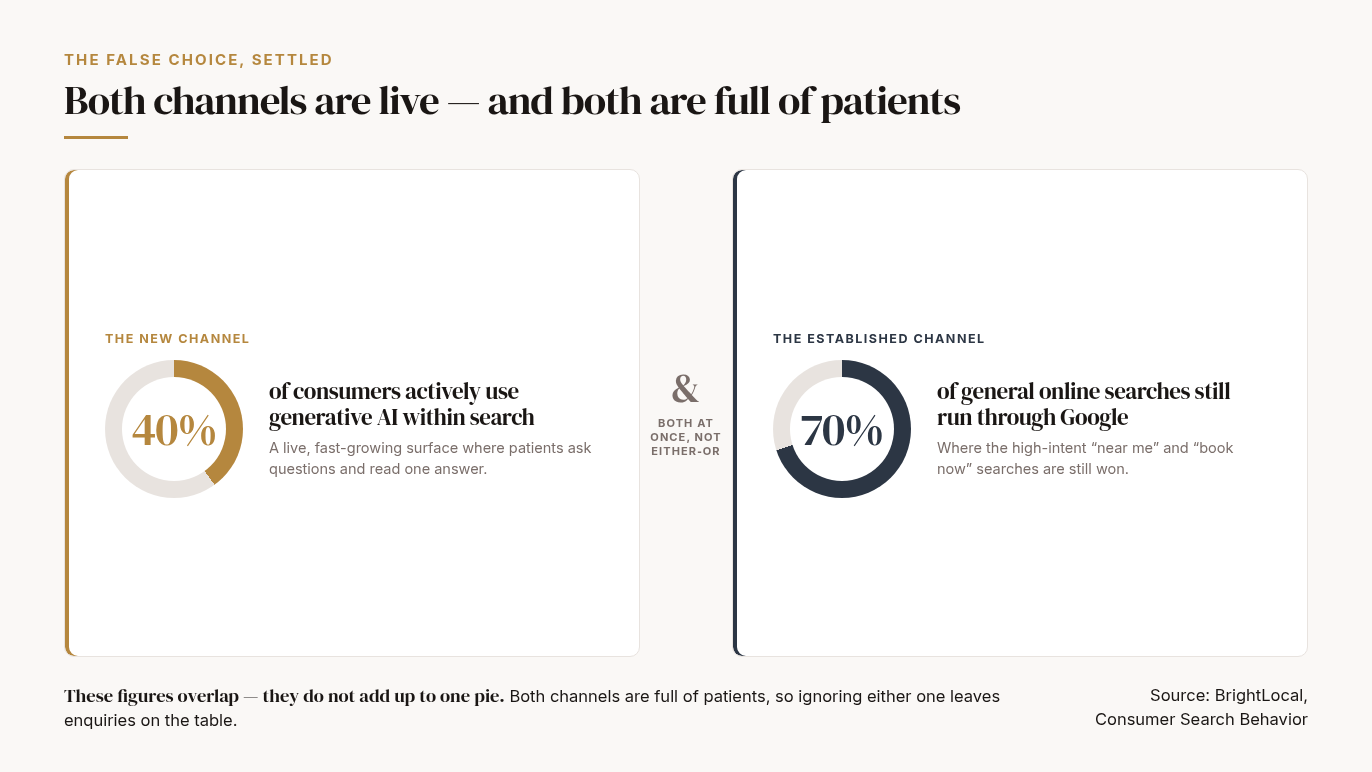
Where the two overlap
Most practices do not need a new strategy. Most of the groundwork already does both jobs at once:
- pages Google can crawl and index
- a page each for the treatments patients search by name: teeth whitening, Invisalign, dental implants, braces for kids, emergency appointments, check-up and hygiene
- a complete, accurate Google Business Profile
- the same name, address, phone and opening hours on every listing
- recent, real reviews on Google, Trustpilot and Facebook
- internal links from your main Treatments page down to each specific treatment page
This is why a practice with weak SEO basics is usually invisible to AI too. If your site is thin, your implant page is one vague paragraph, or your Google profile lists different opening hours than your website, the problem does not stop at Google. ChatGPT and Google AI Overviews hit the same wall.
Shared foundation
The foundation both systems need
Crawlable treatment pagesIf a teeth-whitening or implant page cannot be read, neither search nor AI can trust it.
A page per named treatmentTeeth whitening, Invisalign, implants and emergency care each get their own page.
Consistent business detailsName, address, phone and hours should match across the site and listings.
Complete Google Business ProfileThe profile supports local search and gives answer engines a source to reconcile.
Recent reviewsFresh reviews tell an engine the practice is active before it names you.
Where the split starts
The split begins once your pages are readable and your details line up.
SEO can still rank a page that is broadly relevant and technically sound, even when the writing is hard to quote. ChatGPT and Google AI Overviews are stricter. They want an answer they can lift straight off the page without rewriting it.
So a teeth-whitening page has to answer, in plain words and near the top:
- what is the treatment? (whitening, Invisalign, an implant)
- who is it for?
- what does it cost, or what does it start at?
- how long does it take, and how many appointments?
- which towns do you treat patients from?
- what happens at the first appointment?
If a patient has to dig for those answers, an AI engine skips the page and quotes a practice that put them up front.
The recommendation test
Can the engine name this practice with confidence?
Ask
Does the page answer the patient's question clearly enough to lift?
Make it checkable
Line up the treatment, town, Google profile and listings so the answer does not rest on your website alone.
Rewrite the answer layer
Move the treatment, who it suits, the process, the price and the location to the top of the page.
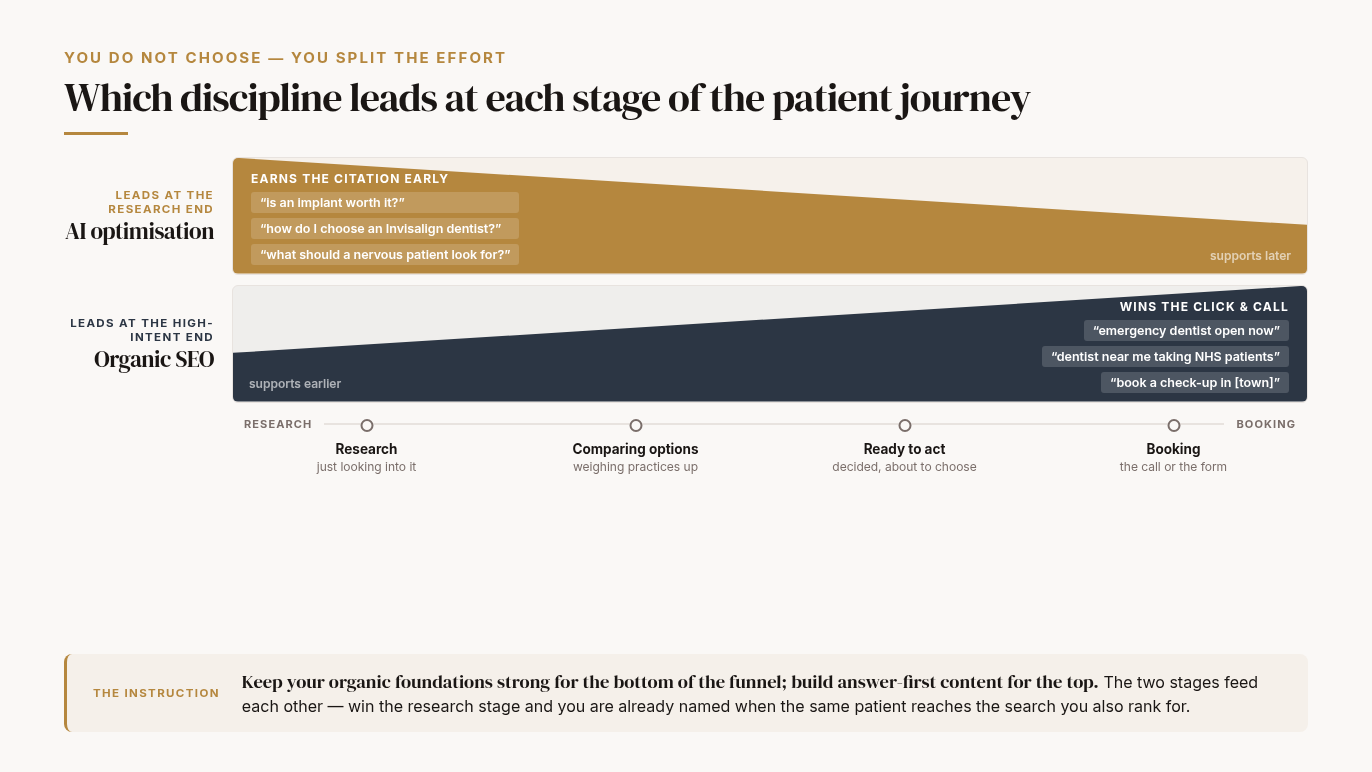
What SEO still does for a dental practice
SEO still builds the visibility and trust that AI answers draw from. Drop it and you weaken both.
Good SEO for a dental practice still means:
- a clear page for each treatment patients search: implants, Invisalign, teeth whitening, emergency appointments
- local relevance for the towns and suburbs you treat patients from
- title tags and meta descriptions that name the treatment and the area
- internal links tying together symptoms, treatments, emergency care, cosmetic work and payment plans
- a fast site that works on a phone
None of that stopped mattering when AI answers arrived. It matters more. A sloppy site is harder for a patient and an engine to trust.
What AI optimisation adds on top
AI optimisation is what makes your practice easy to quote, easy to check and easy to recommend.
For a dental practice, that means:
- putting the direct answer at the top of each treatment page
- adding FAQ sections that answer what patients actually ask: what does Invisalign cost, does whitening hurt, can you see me today
- stating prices, the process and who each treatment suits
- making your name, address and hours match across your site, Google profile, directories and healthcare listings
- building up reviews and listings so the answer does not rest on your website alone
- naming the treatment and the town plainly on the page, so "implants in Leeds" or "emergency dentist in Reading" resolves to you
This is where ranking and being recommended part company. Your page can rank for "emergency dentist in Leeds" and still lose the ChatGPT mention to a practice the engine can check and describe more easily.
![The same Invisalign page optimised two ways, showing AI optimisation adds to the ranking page rather than replacing it. Left, ranking only: a page headed "Invisalign Treatment in [Town]" with keyword copy, a gallery and a contact form. Right, the same page kept unchanged with a gold answer-first layer added beneath, nothing removed: H2 headings phrased as real patient questions (how much does Invisalign cost in town; how long does it take; is it suitable for me), each with a tight self-contained answer using an honest [price range] and [timescale], plus FAQPage and Dentist/LocalBusiness schema chips. Foot line: nothing in the second version weakens the first; it simply makes the same true facts quotable.](/assets/blog/dental-series/07-same-page-two-ways-concept.png)
A dental example: ranking vs recommendation
Two practices in the same city, both wanting the "emergency dentist" searches.
Practice A ranks well. It has an older domain, a reasonable emergency page and enough backlinks to stay near the top.
Practice B ranks a little lower, but it has:
- an emergency page that says "seen same day, from £95, call before 5pm"
- opening hours that match on the site and the Google profile
- the same phone number on every listing
- reviews from the last month, not two years ago
- a short FAQ answering "can you see me today" and "what does an emergency appointment cost"
In normal search, Practice A may still get more clicks. In a ChatGPT answer, Practice B wins the mention, because the engine can describe it without guessing.
That gap is the difference between SEO and AI optimisation for dentists.
Ranking versus recommendation
Why the lower-ranking practice can still get named
| Signal | Practice A: ranks better | Practice B: gets named |
|---|---|---|
| The page | A reasonable emergency page on an older domain | "Seen same day, from £95, call before 5pm" up top |
| Business details | Visible enough to rank | Hours and phone number match on the site and Google profile |
| Reviews | Enough backlinks to stay near the top | Reviews from the last month, not two years ago |
| AI outcome | May still win more clicks in normal search | Wins the mention because it is easy to describe Stronger for AI answers |

What to fix first
You do not need a big project. You need the right order.

Fix order
Build the foundation before the answer layer
Crawlability
Make sure key pages can be read and indexed.
Treatment pages
A page each for whitening, Invisalign, implants and emergencies.
Business details
Reconcile the site, profile, footer and listings.
Fresh reviews
Keep reviews coming on Google, Trustpilot and Facebook.
Answer layer
Put prices, FAQs and the process up top where they can be lifted.
1. Confirm Google can read the pages
Open Google Search Console. Paste your teeth-whitening page URL into the URL Inspection bar at the top. If it says "URL is on Google" it is indexed; if "URL is not on Google", click "Test live URL" to see why. The usual culprits are a noindex tag on the page or a Disallow line in robots.txt (check yoursite.co.uk/robots.txt). Fix either, then click "Request indexing". Repeat for your Invisalign and implant pages. No Search Console yet? Set it up free at search.google.com/search-console first.
2. Tighten the treatment pages
Give whitening, Invisalign, implants and emergency care a page each. Near the top of each one, state six things in plain words: the treatment name, who it suits, the price or a starting price ("from £95"), how many appointments and roughly how long it takes, the towns you treat patients from, and what happens at the first appointment.
To check a page is specific enough, read only its first two paragraphs: if they could describe any practice, or you cannot tell which treatment the page is about, it is too generic. A single "Treatments" list that names implants, Invisalign and whitening in one sentence each will not do it; each treatment needs its own page a patient and an engine can read on its own.
3. Make your business details match
Four fields must read identically everywhere: business name, full address, phone number and opening hours. Open your Google Business Profile dashboard and put it side by side with your website footer, then your contact page, then your main directory and healthcare listings. Correct anything that does not match, right down to "Ltd" versus "Limited", "St" versus "Street", and a landline shown two different ways. As a quick check, search your practice name and look at the top few directory listings (Google, Bing Places, an NHS or private healthcare directory): each should show the same name, address, phone and hours as your site. A single mismatched phone number is enough to make an engine hesitate before it names you.
4. Keep reviews coming
Ask for reviews on the platforms patients and engines check: Google, Trustpilot and Facebook. Aim for a steady trickle, a few every couple of weeks, rather than a burst of twenty and then silence; a steady flow reads as an active practice, a one-off burst does not.
The simplest way is the "Get more reviews" short link in your Google Business Profile dashboard: copy it and text or email it to patients after an appointment, so they land straight on the review box. A wall of five-star reviews that stops eighteen months ago reads as stale to Google and to AI answers, so what matters is that the newest ones are recent, not just that the total is high.
5. Add the answer layer
At the very top of each treatment page, before any history or sales copy, paste a two or three sentence direct answer: what the treatment is, who it suits, the price it starts from, and how long it takes. For a whitening page that might read "Professional teeth whitening lifts stains and brightens your smile, suitable for most healthy adults, from £X, in one or two visits."
Under it, add an FAQ block of the questions patients actually type, with a plain one or two line answer each: what does Invisalign cost, does whitening hurt, can you see me today. Write the questions the way a patient would ask them, not the way a brochure would. This matters more as searches end without a click: Dentistry.co.uk notes that in 2025 around 60% of Google searches ended without anyone clicking through to a website, so for many patients the AI answer or your Google profile is all they see before they call.
Which practices gain the most right now
The quickest wins go to practices that already rank but are not being named in AI answers. Usually that is a practice that:
- offers implants, Invisalign and whitening but has one thin paragraph on each
- has strong Google reviews but nothing on Trustpilot or in the directories
- still leans on a generic "about us" or "treatments" page
- ranks fine but never states what a treatment costs, who it suits, or what the first appointment involves
The foundation is there. The answer layer is what is missing.
The practical conclusion
SEO and AI optimisation are not rivals. AI optimisation turns a practice Google ranks into one ChatGPT will name.
If your site is weak on the basics, the treatment pages, the reviews or matching business details, fix those first. If the fundamentals are solid, the next gains come from making each page easy to quote and easy for an engine to check against your listings.
So do not drop SEO for AI. Build one stronger site that does both jobs. Our hub on AI SEO for dentists shows how to put the answer layer on top of your SEO foundation.
To see where your practice stands first, run an AI visibility check. It shows whether AI tools can find, read and recommend your practice before you change anything.
Frequently asked questions
Is AI optimisation replacing SEO for dentists?
No. AI optimisation depends on the same technical and content foundation that good SEO already requires. It is an added layer, not a replacement.
Can a dental practice rank well in Google and still be absent from ChatGPT?
Yes. Ranking and getting recommended are different jobs. Your page can sit at the top of Google and still lose the ChatGPT mention to a practice that is easier to check and describe.
Do dentists need separate pages for SEO and AI optimisation?
No. One strong set of treatment pages, one each for teeth whitening, Invisalign, dental implants and emergency appointments, can do both jobs if the pages are crawlable, clear, locally relevant, and written so the answer is easy to lift.
What matters more for AI answers: rankings or reviews?
Neither works alone. Before ChatGPT or Google AI Overviews names a practice, it usually needs clear pages, listings that agree with each other, and recent reviews all pointing the same way.
Does schema markup matter for dental AI visibility?
Yes, but it is not magic on its own. Schema helps reduce ambiguity about what the practice does, where it operates, and which entity the page refers to.
Do FAQ sections help dental practices show up in AI answers?
They help when they answer real patient questions clearly. They do not help just because the heading says FAQ.
Should every treatment have its own page?
For treatments like teeth whitening, Invisalign, dental implants or braces for kids, yes. A dedicated page makes it easier for both Google and ChatGPT to match you to that specific search.
Is a Google Business Profile still important if patients use ChatGPT?
Yes. Your Google Business Profile is one of the main places AI tools check your address, hours and reviews against your website. It matters for map searches and for AI answers.
Should dentists block AI crawlers?
Usually no, if they want to be found and recommended in AI answers. Blocking crawlers makes it harder for those systems to understand and cite the practice.
What is the first thing a dental practice should fix?
Start with crawlability, clear pages for treatments like whitening, Invisalign and implants, and business-detail consistency. Those are the foundation for both SEO and AI optimisation.
Sources
- Google Business Profile Help, local ranking framework: support.google.com/business/
- BrightLocal, local search and review behaviour research: brightlocal.com/research/
- Dentistry.co.uk, "AI-SEO explained: what dentists actually need to do in 2026" (zero-click search figure): dentistry.co.uk/2026/04/19/ai-seo-explained-what-dentists-actually-need-to-do-in-2026/
- Supporting paper and dataset: zenodo.org/records/21182318
Leave a comment
Thoughts on this post? Leave a comment below. Comments are moderated before they appear, so yours will not show on the page straight away.
Your email is used only to contact you about your comment if needed — it is never published.
Comments
No comments yet. Be the first to leave one above.