Structured Data or Good Content: Which Gets a Dental Practice Into AI Answers?
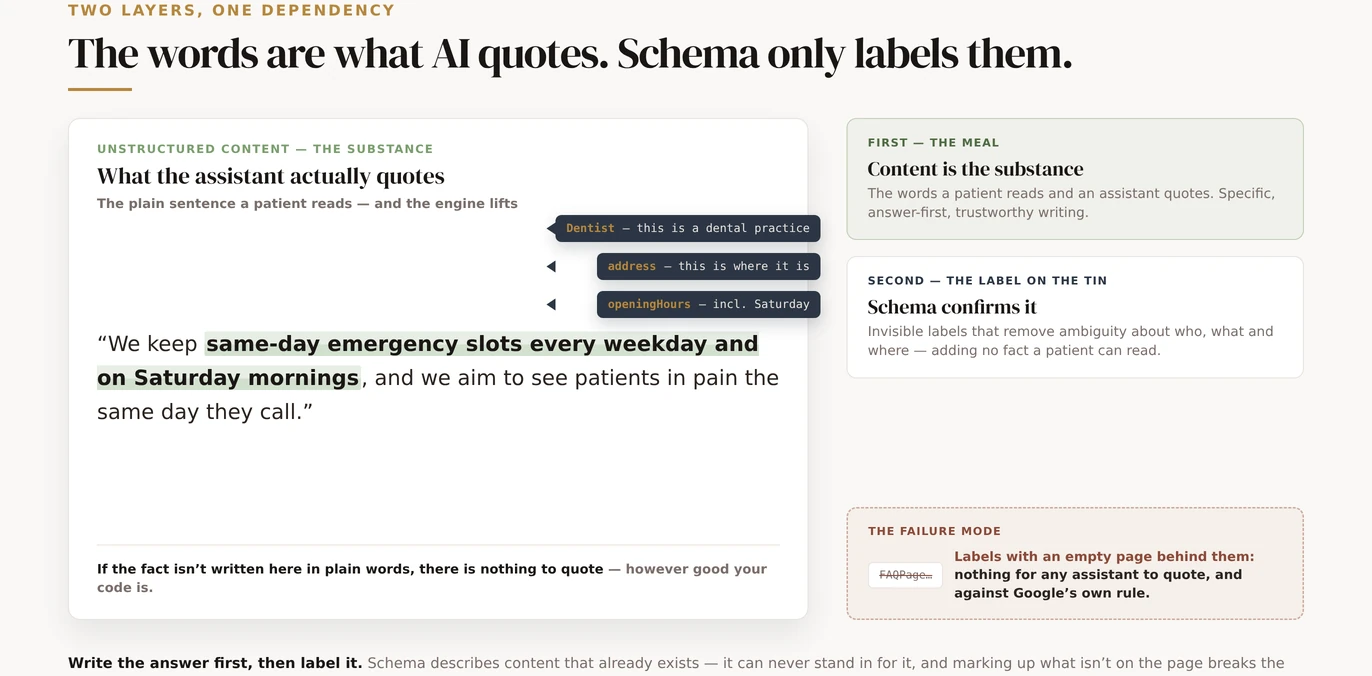
Good content gets a dental practice into the running for AI answers; structured data helps the engine read and attribute that content correctly. They are not rivals. Write the visible answer first, in words a patient would understand, then label the same facts in the code so the practice, service, location and FAQ details are clear to a machine.
A patient deciding whether to book an implant consultation, Invisalign assessment or emergency appointment is no longer only scanning a list of links. They may ask an AI assistant which practice near them can help, read the short answer and phone one of the names inside it. If your page does not state the answer clearly, there is nothing for the assistant to use. If the answer is clear but your practice details are ambiguous, another practice can look safer to name.
That is why the usual argument about structured data versus content is the wrong argument. A dental website needs both, but not in any order you please. Content is the thing a patient and an assistant can read. Structured data is the label that says what that content is. Confusing those jobs wastes budget: some practices buy technical markup for thin pages, while others publish good explanations and leave the machine to guess who, where and what the page describes.
The short version
- Content is the substance. An assistant can quote your explanation of implants, emergency care or fees; it cannot quote a JSON-LD block as patient-facing advice.
- Structured data is the label. Schema helps a machine confirm the practice identity, location, service and FAQ meaning behind the visible words.
- The order matters. Write the page first, then mark up the facts that appear on that page. Hidden claims are not a shortcut.
- The stakes are moving upward. Pew found that 58% of US Google users saw at least one AI summary in March 2025, and clicks fell when summaries appeared.[1]
- The practical answer is two-layer work. Build answer-first pages and then make them machine-readable, rather than paying for one layer while the other is missing.
Structured data or good content: which one gets a dental practice into AI answers?
Good content gets you quoted; structured data helps you be understood and credited. The useful answer is not either-or, but sequence. Write the visible answer first, then add the machine-readable labels around it.
Which layer first
Can structured data carry a thin page?
Ask
Does the visible page answer the patient's question in plain words?
Schema earns its place
Labelling the practice, service and FAQ around a clear answer helps a machine attribute it to the right practice.
Markup cannot help yet
Schema only labels facts that exist. Fix the visible copy first, then add the machine-readable layer.
The visible page carries the meaning. It explains whether you offer same-day emergency appointments, how Invisalign consultations work, what implant treatment involves, what patients can expect at the first visit and what price ranges are typical or illustrative. Those sentences are what an answer engine can summarise. Without them, the page offers no useful material to lift.
The labels in the code do a narrower job. A Dentist entity, an address, opening hours and a visible FAQ block marked as FAQPage reduce uncertainty. They do not create new facts. They attach clear labels to facts you have already published for a patient to read.
The commercial reason to care is simple. Pew Research Center found that 58% of US users had at least one Google search in March 2025 that produced an AI-generated summary, and when a summary appeared users clicked a traditional result in 8% of visits, compared with 15% when no summary appeared.[1] That does not prove every dental journey ends in an AI answer, and it is US browsing data rather than UK dental data. It does show the direction of travel: more decisions happen inside the answer, before a visible click reaches your analytics.
What is unstructured content in dental marketing?
Unstructured content is ordinary language on the page: the words a patient reads. It includes treatment explanations, fee guidance, appointment steps, clinician information, reassurance for nervous patients and direct answers to common questions.
The term can make it sound inferior, but it is not. It only means the text is not wrapped in a formal machine label. A sentence such as 'We keep same-day emergency slots on weekdays and Saturday mornings' is unstructured content. It is also exactly the kind of sentence an assistant can use when a patient asks for an emergency dentist open soon.
The strongest dental content is specific, answer-first and claim-safe. It avoids naming real rival practices, avoids promises a clinician would not stand behind and keeps price ranges clearly labelled as typical or illustrative. If a single implant is described as typically running in the region of £2,000 to £2,500 per tooth, or clear aligner treatment as an illustrative £2,500 to £4,500 relationship, the wording must stay labelled as an example rather than a researched market statistic.
What is structured data, and what does it actually do?
Structured data is machine-readable information added to a page, usually as JSON-LD. It tells search systems what the visible facts mean. In dental terms, it can identify the business as a dental practice, state the address and phone number, list opening hours, mark a visible FAQ section and connect the page to the wider organisation.
Schema.org includes Dentist as a formal vocabulary type for a dental business, with local properties such as address, telephone, opening hours, geographic information and area served.[3] That matters because it gives you a recognised language for facts you already show on the website.
The limit matters just as much. Google’s structured data guidance says not to create blank pages purely for markup and not to add structured data about information that is not visible to the user, even if the information is accurate.[2] In practice, that means schema must describe the page. It cannot be used as a hidden brochure for services, prices or ratings that a patient cannot see.
For implementation detail and copy-paste examples, the companion guide to dental practice schema markup is the more technical page. This article is about the decision order: content creates the fact, and structured data labels it.
Structured data versus unstructured content, side by side
The cleanest way to see the difference is to compare what each layer contributes. The two columns are not competing channels. They are the visible answer and the machine label around that answer.
Side by side
The visible answer and the label around it
| Question | Good content | Structured data |
|---|---|---|
| What is it? | The words a patient reads on the page. | Machine-readable labels in the page code. |
| What does AI use it for? | Quoting, summarising and explaining the answer. | Confirming what the page, practice, service or FAQ block means. |
| What does the patient see? | The full explanation, examples, fees, process and reassurance. | Usually nothing, because it sits in the source code. |
| What makes it good? | Specific, plain, useful answers to real patient questions. | Correct types, complete fields and agreement with the visible copy. |
| Failure mode | Thin or vague pages give an assistant nothing worth using. | Labels without matching visible content create risk and confusion. |
| Best order | Write this first. | Add this second, around the facts already on the page. |
Drawn from the article's comparison of content and schema.
The dependency is the point. A practice can publish useful content without perfect markup and still help patients. It should then add labels so machines read it cleanly. Markup with no useful page behind it is the weaker route, because it labels a hollow answer.
Can schema replace dental content?
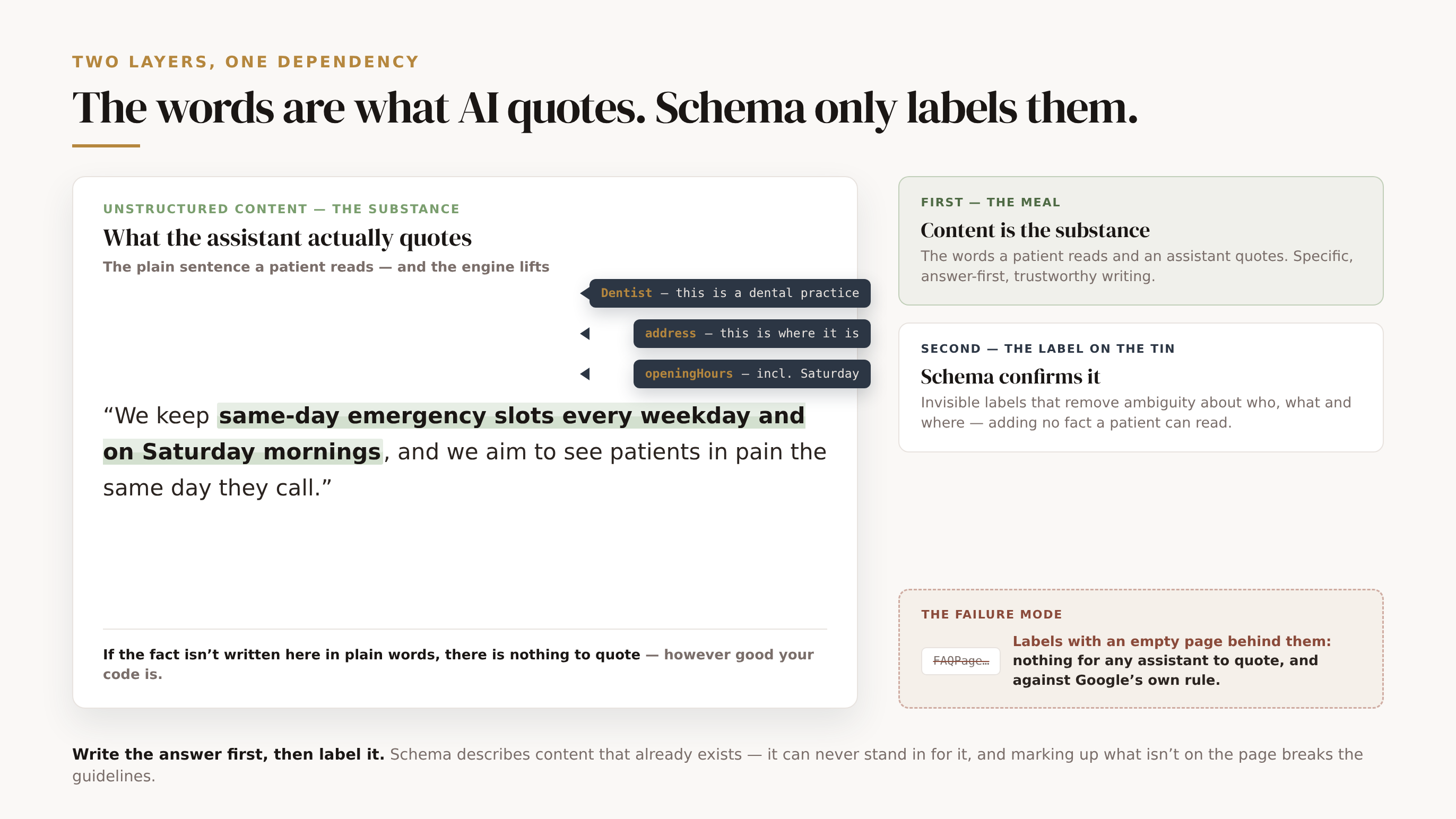
No. Schema can only label facts that exist. It cannot answer whether implants hurt, how emergency triage works, what happens at an Invisalign consultation or whether a nervous patient can ask for a slower appointment. Those answers must be written on the page.
The temptation is understandable. Technical work feels neat: install a block of code, run a validator and see green ticks. But a patient asking an assistant a practical question needs a practical answer. If your page only says 'we offer high-quality dental care' and the markup says you are a dental practice, the machine has still learned very little about why you should be named for implants, emergency care or anxious patients.
There is also a compliance angle. Dental marketing has to stay accurate and not misleading. A hidden data layer that claims more than the visible page supports is not only poor search practice; it is the wrong habit for a healthcare website. Keep the claim visible, clear and supportable, then label it.
Can good content work without schema?
It can work better than schema with no content, but it is still incomplete. A strong page that answers a patient question gives an assistant something useful to read. Markup makes that useful answer easier to attribute to the right practice.
Consider a page for dental implants in Reading. The page might explain suitability, consultation steps, typical healing time, finance options and an illustrative price range. That content carries the patient value. Adding structured data can then clarify that the page belongs to a specific practice at a specific address, that the page covers a service, and that the FAQ block is a question-and-answer set rather than loose prose.
That matters most when several practices have similar claims. If one site says the right things but leaves details scattered, while another says the right things and makes the practice identity, opening hours and FAQ structure clear, the second site gives the engine less work to do. Less uncertainty is often the difference between being named and being passed over.
Where should a dentist start?
Start with the page a patient would read, not the code a validator would read. Pick the valuable treatment or service first: implants, clear aligners, emergency appointments, veneers, nervous-patient care or new-patient check-ups. Then write a page that answers the question directly in the first screen.
A practical content-first sequence looks like this:
- Name the service in patient language. Use the wording people actually ask for, such as 'emergency dentist in Reading' or 'Invisalign consultation in Leeds'.
- Answer the commercial question plainly. Explain what happens, who it is for, typical timescales and any illustrative fee ranges with the label left in place.
- Make the page easy to lift from. Use question-led headings and answer each one in a self-contained paragraph before expanding.
- Add the labels second. Mark up the visible practice details, FAQ block and service information so the machine-readable layer matches the page.
- Check consistency beyond the site. The same name, address, phone number, services and hours should agree with your Google Business Profile, NHS profile and key listings.
Content-first sequence
Where a dentist should start
Name the service in patient language.Use the wording people actually ask for, such as "emergency dentist in Reading" or "Invisalign consultation in Leeds".
Answer the commercial question plainly.Explain what happens, who it is for, typical timescales and any illustrative fee ranges with the label left in place.
Make the page easy to lift from.Use question-led headings and answer each one in a self-contained paragraph before expanding.
Add the labels second.Mark up the visible practice details, FAQ block and service information so the machine-readable layer matches the page.
Check consistency beyond the site.The same name, address, phone, services and hours should agree with your Google Business Profile, NHS profile and key listings.
That order creates something worth labelling. It also avoids the common failure where a practice pays for code around pages that still do not answer the questions patients ask.
A worked example: emergency appointments on Saturdays
Suppose a practice offers same-day emergency appointments, including Saturday mornings. The content layer is the visible sentence: 'We keep same-day emergency slots every weekday and on Saturday mornings, and we aim to see patients in pain the same day they call.' A patient understands it. An assistant answering 'emergency dentist open Saturday near me' has something clear to use.
Worked example
Saturday emergency care, both layers
Say it in plain words
The page states that same-day emergency slots are kept every weekday and on Saturday mornings.
Mark up the same fact
The dental business type, Saturday opening hours and a matching FAQ entry label what the page already says.
Make every source match
Google profile, NHS listing and directories carry the same hours, so nothing contradicts the page.
Get named
An assistant answering "emergency dentist open Saturday near me" has a clear, verified practice to use.
The data layer then labels the same reality. The practice identity can use a dental business type. The opening hours can include Saturday morning. The FAQ section can include a visible question about weekend emergencies, with markup that matches the visible answer. None of that replaces the sentence. It helps a machine connect the sentence to the right practice.
Now reverse the order. If the code says Saturday emergency care but the page never says it to the patient, the markup is doing too much and the visible content is failing. If the page says Saturday care but every listing carries different hours, the assistant has a confidence problem. The winning version is boring and precise: say it clearly, make every source agree, then label it cleanly.
The mistakes that waste budget
Most failures are not subtle. They come from treating one layer as a substitute for the other, or letting the layers contradict each other.
- Buying schema for thin pages. If a treatment page gives no clear answer, markup cannot make it useful.
- Writing strong pages and never labelling them. The content may help, but the practice identity, FAQ structure and service meaning are harder for systems to confirm.
- Adding hidden claims. Markup should not describe services, ratings, fees or FAQs that are absent from the visible page.
- Letting listings disagree. Clean website markup is weakened if your Google profile, NHS listing or other references carry old phone numbers or hours.
- Forgetting trust. Content and code do not rescue claims that read as exaggerated or unsupported on a health subject. The wider credibility work is covered in our guide to E-E-A-T for dentists.
How do you check both layers?
First, read the page as a patient. In the first few paragraphs, can you tell what the treatment is, who it is for, what happens next, what it tends to cost in labelled illustrative terms and how to book? If not, fix the copy before you touch the markup.
Second, test the page as a machine. Use Google’s Rich Results Test and Schema.org’s validator to see whether the labels are valid and whether the visible FAQ block matches the markup. The goal is not to collect every possible schema type. The goal is to make the important facts unambiguous.
Third, test the answer surface. Ask ChatGPT, Perplexity, Gemini and Google’s AI Mode the patient questions your pages should answer. Run each prompt a few times and note whether your practice is named, whether the description is accurate and which source seems to support it. A missing or wrong answer tells you which layer to inspect first.
How QBiz handles the two layers
QBiz treats content and markup as one connected job. The on-site work starts with pages that answer the questions patients ask about high-value treatments, fees, appointments, anxiety, location and availability. The pages are written so the answer appears plainly, not hidden below generic practice copy.
Then the machine-readable layer is added around the same visible facts: practice identity, service detail, FAQ structure and local information. That means the code confirms the content rather than overreaching beyond it.
The work does not stop at your own site. AI answers gain confidence from agreement across the wider web, so QBiz also handles the distribution and consistency work that supports your pages: listings, citations and references that say the same thing about the same practice. On-site clarity is the foundation; off-site agreement is what helps a model trust it.
The free check is deliberately a website scan, not a ranking report across ChatGPT, Gemini, Perplexity and Google’s AI Mode. It checks whether your site gives AI systems the basics they need: readable pages, clear service answers, sensible structure and signals that can be fixed. From there, the next step is a prioritised plan for the content, markup and distribution gaps most likely to cost enquiries.
Get your free AI visibility check →
Frequently asked questions
Is structured data or content more important for AI search?
Content comes first, because it is the substance an AI answer can quote. Structured data comes second, because it labels that content so a machine can read the practice, service, location and FAQ details without guessing. Treat them as two layers: answer-first writing, then clean markup around the visible facts.
Can schema markup get my dental practice into ChatGPT on its own?
No. Schema cannot create a recommendation from an empty or vague page. It can only describe facts that are already visible to the patient, such as your practice identity, address, services, opening hours and FAQs. If the answer to a patient question is not written clearly on the page, schema has nothing useful to label.
If my dental content is clear, do I still need structured data?
Yes. Clear content gives the assistant the words to use, but structured data reduces ambiguity about who the page belongs to and what each part means. A treatment page, FAQ block and practice identity can all be easier to attribute when the visible content and the machine-readable labels agree.
What structured data should a dental practice start with?
Start with the practice identity using the Dentist type where appropriate, then mark up visible FAQ sections and key service details that already appear on the page. Keep name, address, phone, opening hours and service information consistent with your wider listings. Do not add hidden claims or markup for facts a patient cannot see.
How should I check whether my site has the right balance?
Read the page first as a patient: does it answer the real question in plain language? Then test the same URL with Google’s Rich Results Test or Schema.org’s validator to see whether the markup is valid and matches the visible copy. If either layer is missing, fix the content before polishing the labels.
Where to start
If you do three things this week, do them in order. First, rewrite one high-value treatment page so it answers the real patient question in plain, specific language. Second, add or correct the structured data so the practice, service and visible FAQs are labelled accurately. Third, compare the same facts with your wider listings so the site, Google profile, NHS profile and key references all agree.
If you want a quicker view of the gap, run the free QBiz Leads AI website scan. It checks whether your pages are readable, answer-first and technically clear enough for AI systems to work with, then points you towards the fixes in the right order. If you would rather have it done for you, our AI SEO for dentists service page explains how we handle the structured and unstructured layers together.
Get your free AI visibility check →
Sources
- [1] Pew Research Center, 22 July 2025: Google users are less likely to click on links when an AI summary appears in the results (US; independent. "About six-in-ten respondents (58%) conducted at least one Google search in March 2025 that produced an AI-generated summary"; users who encountered an AI summary clicked a traditional result in 8% of visits, against 15% when no summary was shown.)
- [2] Google Search Central, "Intro to How Structured Data Markup Works": https://developers.google.com/search/docs/appearance/structured-data/intro-structured-data (Global; primary. Google's guidance says not to create blank pages just to hold structured data and not to add structured data about information that is not visible to the user, even if accurate.)
- [3] Schema.org, "Dentist": https://schema.org/Dentist (Global; vocabulary reference. Dentist is a recognised schema type for a dental business and carries local business properties such as address, telephone, opening hours, geo and area served.)
Leave a comment
Thoughts on this post? Leave a comment below. Comments are moderated before they appear, so yours will not show on the page straight away.
Your email is used only to contact you about your comment if needed — it is never published.
Comments
No comments yet. Be the first to leave one above.