Answer Engine Optimisation, Explained for Business Owners (No Jargon)
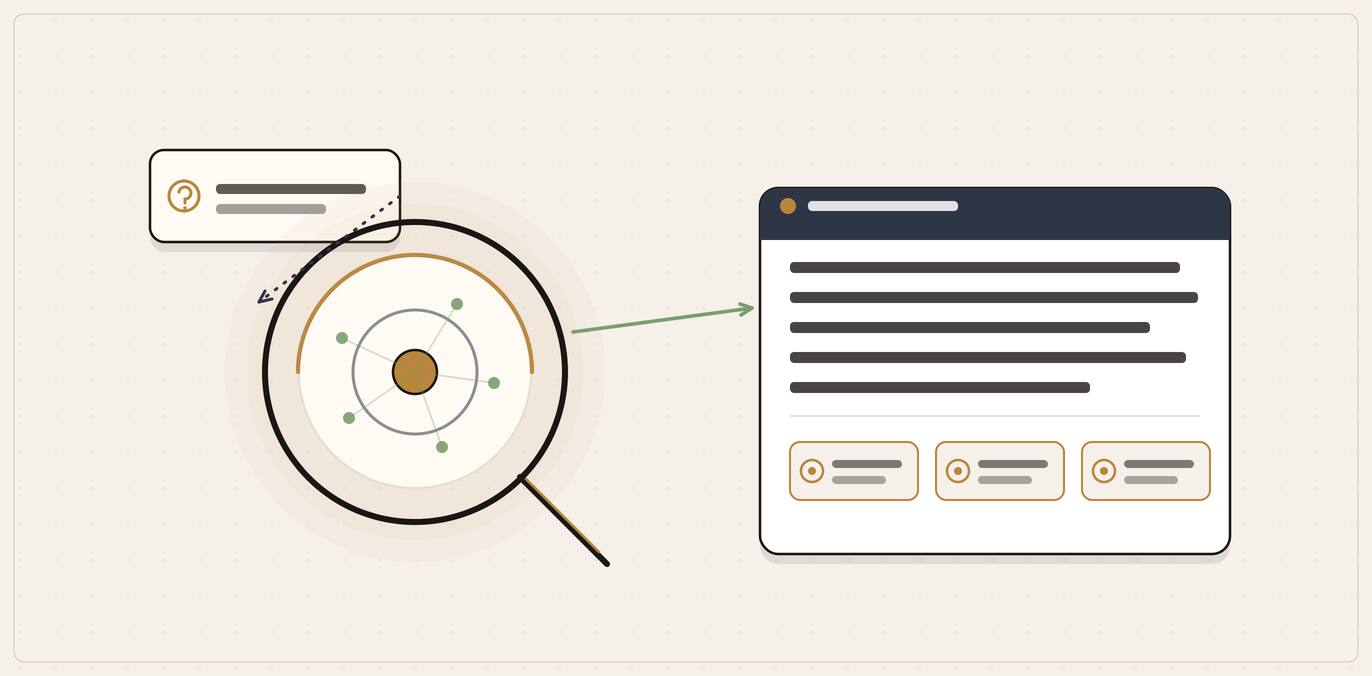
Answer Engine Optimisation (AEO) is the practice of getting your business named, quoted or recommended inside the written answers that AI tools give people, ChatGPT, Google's AI Overviews, Perplexity, Copilot and Gemini. It is the AI-answer counterpart to SEO: where SEO aims to rank your website in a list of links, AEO aims to put your business inside the single reply a customer reads instead of that list. It rests on clear, quotable facts, recent reviews, consistent listings and genuine off-site mentions, not on paid placement, and ranking first on Google no longer guarantees you appear in the AI answer about the same topic.
In brief
- AEO puts you inside the answer, not the list. The goal is to be one of the businesses an AI tool names when a customer asks for a recommendation in your field.
- It is a layer on top of SEO, not a replacement. Good SEO groundwork helps, but a first-place Google ranking does not guarantee an AI mention: they are now two separate jobs.
- AI answers are now common. Google showed an AI Overview on around 16% of queries by late 2025 (Semrush), and clickthrough to the top result fell about 34.5% when one appeared (Ahrefs).
- Clear facts beat brochure copy. "Same-day MOTs in Derby for £45" is quotable; "driven by excellence" is not.
- There is no paid route in, and much of it is DIY. Consistent listings, recent reviews and plain question-and-answer pages carry most businesses a long way.
You have probably noticed it in your own habits. When you want a quick answer, you ask ChatGPT or read the summary at the top of Google instead of clicking through five websites. Your customers are doing exactly the same thing when they look for a business like yours.
That single change is why a new phrase, Answer Engine Optimisation (AEO), has started turning up in your inbox and on agency websites. The acronyms multiply fast, the explanations assume you already run a marketing team, and most articles end with a demo booking for software you have never heard of.
This guide is the plain version: what AEO actually is, how it differs from the SEO you may already pay for, why it has become worth your attention, and a five-step plan you can work through on your own. No jargon, no tooling budget, no marketing degree.
What is Answer Engine Optimisation?
Answer Engine Optimisation means getting your business named, quoted or recommended inside the answers that AI tools give people.
Break the phrase into its two halves and it explains itself. An answer engine is any tool that replies with a written answer instead of a page of links: ChatGPT, Google's AI Overviews and AI Mode, Perplexity, Microsoft Copilot, Gemini. Optimisation is the familiar idea of arranging things so you show up. Put them together and AEO is simply the practice of making sure that when one of these tools answers a question your customer asks, your business is part of the answer.
A quick example outside the usual trades. Imagine someone asks ChatGPT, "what's a good wedding photographer in York for a small registry-office wedding?" The tool writes a short reply naming two or three studios and perhaps a directory. If your studio is named, you have a warm enquiry. If it isn't, you never even knew the question was asked, and no amount of refreshing your Instagram will tell you. AEO is the work that tilts that answer towards you.
The same logic applies whether you are a driving instructor, an independent optician, a recruitment agency, a holiday-cottage owner or a firm of surveyors. If people ask AI tools for a recommendation in your field, AEO decides whether you are in the reply.
AEO and SEO: cousins, not rivals
If you have ever paid for search engine optimisation (SEO), you already understand half of this. The difference is what you are optimising for, and what the customer sees at the end.
SEO aims to rank your website high in a list of blue links. AEO aims to get your business named inside a written answer, where there may be no list to climb at all. Here is the contrast in one table.
Side by side
Traditional SEO and AEO: cousins, not rivals
| Traditional SEO | Answer Engine Optimisation | |
|---|---|---|
| The goal | Rank high in a list of links | Be named or cited inside an AI answer |
| What the customer sees | Ten links to choose from | One short answer naming a few businesses |
| What tends to win | Keywords, backlinks, page authority | Clear facts, trusted mentions, information that agrees across the web |
| Where the work happens | Mostly your own website | Your website and the places AI reads: reviews, directories, forums, press |
| The click | The whole point | Often does not happen: the answer is the destination |
Two things follow from that table.
First, AEO is not a replacement for SEO. Much of the groundwork overlaps: a clear, well-structured website that explains what you do helps you rank on Google and helps an AI tool quote you. Think of AEO as a layer you add on top of decent SEO, not a teardown of it.
Second, and this is the part that catches owners out, ranking first on Google no longer guarantees you appear in an AI answer about the same topic. The two are now separate jobs with separate winners. A business can sit at the top of Google and still be absent from every ChatGPT reply, while a lesser-known competitor gets named because the wider web speaks about it more clearly. That gap is the single biggest reason AEO exists as its own discipline.
For the close cousins of AEO you may also have seen (GEO, "generative engine optimisation", and AI search optimisation), treat them as near-synonyms for now. They all describe the same goal: being part of the AI's answer. We pull the acronyms apart in AEO vs GEO vs SEO if you want the full comparison.
Why this has become worth your attention
AEO would be a curiosity if only a handful of people used AI answers. They don't. Two independent findings show why the shift is real, and neither comes from a company selling AEO software.
Why it matters now
The shift is real, and it is measurable
16%
of Google queries showed an AI Overview by late 2025 (Semrush, 10 million-plus keywords)
34.5%
lower clickthrough to the top result when an AI Overview appears (Ahrefs, 300,000 keywords)
31.8%
of 173 audited UK sites carried FAQ content
32.9%
carried a clear process explanation
Semrush AI Overviews Study 2025; Ahrefs 2025; QBiz Leads AI AI Visibility Gap Report (2026 audit).
AI answers now appear across a large slice of everyday search. A Semrush study of more than 10 million keywords tracked how often Google shows an AI Overview: the share rose from 6.49% of queries in January 2025 to 24.61% in July, then settled at 15.69% in November, hovering around 16% of all queries (Semrush AI Overviews Study, 2025)[1]. The AI answer is no longer a novelty bolted onto search. For a sizeable and growing share of searches it is just how the results look now.
When the AI answers, far fewer people click through. Ahrefs analysed 300,000 keywords and found that the presence of an AI Overview correlated with a 34.5% lower average clickthrough rate for the top-ranking page, compared with similar informational queries that had no AI Overview (Ahrefs, 2025)[2]. The visit you used to earn by ranking well is increasingly spent inside the answer itself. If that answer does not name you, there is often no second chance to be found further down the page.
Put the two together and the conclusion is plain. A growing share of your potential customers are getting their recommendation from an AI reply, and a shrinking share are clicking past it to compare options the old way. The moment of choice has moved into a box you cannot see unless you go looking. We unpack what that means for your enquiries in the zero-click search era.
There is an encouraging side to this too: the methods that get you into AI answers are largely things you can influence directly, and a study from the researchers who coined the sister term GEO found that deliberate optimisation could lift a page's visibility in generative answers by up to 40% (Aggarwal et al., "GEO: Generative Engine Optimisation", KDD 2024)[3]. The methods are learnable, and the rest of this guide is the starter version of them.
How an answer engine decides who to name
You don't need to follow the technology to benefit from it, but a short picture stops you guessing.
An answer engine does not simply search for the exact words of a question and read the top result. It rewrites and expands the question into several smaller searches, gathers sources it trusts, and then writes a summary that stitches the best of them together. Three practical truths fall out of that.
Selection path
How an answer engine decides who to name
The question
A customer asks for a recommendation in your field.
Trusted sources
The engine rewrites the question into several searches and gathers sources it trusts, across the whole web.
Where they agree
It leans on facts it can lift cleanly and that agree across sources.
A few businesses
It writes a summary that names the businesses whose story is clearest and most consistent.
It pulls from the whole web, not just your site. When an AI tool answers a question about a business, it leans on your website, yes, but also on review sites, directories, professional listings, forums and press coverage. Your AI visibility is the sum of what the entire web says about you, and whether all of it agrees. A tidy website with a contradictory mess of old listings elsewhere sends a confused signal.
It rewards clear facts over salesmanship. The summary is assembled from statements the engine can lift cleanly. "We offer same-day MOTs in Derby for £45" is quotable. "Driven by excellence and a passion for motoring" is not. Plain, concrete, checkable facts are the raw material an answer engine can actually use.
The answer changes, and that's normal. Ask the same tool the same question twice and you may get different businesses named. That is expected behaviour, not a fault or a penalty. It is a reason to build steady, durable signals rather than chasing one perfect answer on one particular day.
The five-step AEO plan you can run on your own
You do not need software or an agency to make a real start. Here is the work, ordered from highest impact to lowest, written so a one-person business can do it in spare evenings. Each step links out to a fuller guide where there is more to say.
The plan
The five-step AEO plan, highest impact first
Get your basic facts straight and identical everywhere.Name, address, phone and services should match exactly across your site, Google profile and every listing.
Answer real questions in plain language.Replace brochure copy with pages that answer, directly, the questions a customer actually asks.
Earn reviews, recently and in more than one place.A steady trickle of recent reviews across the platforms that matter, replied to, good and bad.
Exist on the wider web, genuinely.Accurate directories, professional bodies, local press and communities build the off-site reputation AI reads.
Check that AI can read your site, and whether it names you.Rule out JavaScript-only content, then ask ChatGPT, AI Mode and Perplexity the questions a real customer would.
Step 1: Get your basic facts straight and identical everywhere
Before anything clever, fix your foundations. Your business name, address, phone number and core services should be stated plainly on your website and match exactly across every place you appear: your Google Business Profile, directories, professional bodies, social profiles. Inconsistent details (an old phone number on one listing, a slightly different business name on another) make an AI tool less confident about who you are, and a less-confident engine is less likely to name you.
This is unglamorous housekeeping, and it quietly decides a lot. Spend an evening searching for your own business everywhere it appears and correct the mismatches.
Step 2: Answer real questions in plain language on your website
AI tools quote pages that answer specific questions clearly. Most small-business websites do the opposite: a single "Services" page written in brochure language. This is the widest gap in practice.
QBiz Leads AI's AI Visibility Gap Report 2026, a technical readiness audit of 173 UK local service business websites, found FAQ content on only 31.8% of them and a clear process explanation on only 32.9%, even though most of the same sites were already crawlable and carried schema markup.[4] The audit is descriptive and UK-based rather than a verdict on any one business, but the pattern is consistent: the technical basics are usually present, and the answer-ready content is what is missing. Replace vague copy with plain pages that answer the questions a customer actually asks:
- Name each service the way customers say it ("emergency locksmith", not "access solutions").
- State the practical facts people and AI both want: what you do, what it costs or the range, how long it takes, your qualifications, your opening hours, what's included.
- Where it fits, write in question-and-answer form. "How much does a boiler service cost?" as a heading, with a direct answer beneath, is a shape AI handles cleanly.
A page that buries the answer under personality is a page an AI struggles to quote. Write the answer first, the flourish second.
Step 3: Earn reviews, recently and in more than one place
Reviews are among the strongest trust signals an AI tool has about a business, because they are the strongest trust signal humans have too. A steady trickle of recent reviews across the platforms that matter in your field does more for your AI visibility than almost anything else on your own website.
Ask every happy customer, at the moment they are happiest. Spread reviews across more than one site, not just Google. Reply to them, good and bad, because visible responses build the consistent picture an engine reads. Never buy fake reviews: platforms remove them, it is unlawful in several markets, and the upside is fake anyway.
Step 4: Exist on the wider web, genuinely
Because AI reads far beyond your own site, you need a genuine presence elsewhere:
- Directories and listings relevant to your trade and area, accurate and consistent.
- Professional bodies and accreditation schemes ("find a member" pages carry real weight).
- Local or trade press and community sites.
- Forums and communities where your customers actually gather. Be helpful, never spammy. Genuine participation earns mentions; astroturfing is transparent and backfires.
You are building the off-site reputation an answer engine reads when it decides whether to trust you.
Step 5: Check whether AI can read your site, and whether it already names you
Two quick checks close the loop.
First, make sure AI can actually read your website. Some site builders load their content with JavaScript that only runs in a visitor's browser, and several AI crawlers don't run JavaScript, which can leave them seeing a near-blank page. If your site was built on a heavily-designed template, this is worth ruling out. There is a simple self-check in our guide to the JavaScript problem.
Second, test the result. Open ChatGPT, Google's AI Mode and Perplexity, and ask each the questions a real customer would. Note whether you are named, who is, and what the answer cites. Repeat a few times, because answers vary. If you are never named, you have just found your gap, and your to-do list is whatever the named competitor has that you don't.
Common mistakes that keep businesses out of AI answers
- Assuming a Google ranking is enough. Being first on Google and being named in ChatGPT are now two separate jobs.
- Brochure language instead of plain answers. "Bespoke solutions tailored to your needs" tells an AI tool nothing it can quote.
- One page for everything. A single page covering every service answers none of the specific questions an engine runs.
- Thin or ancient reviews. A handful of reviews from three years ago reads as a business that may no longer be active.
- Contradictory details across the web. Mismatched names, addresses and numbers make an engine unsure who you are.
- A site AI can't read because the content loads only in a browser.
- Treating AEO as a one-off. It is upkeep, not a single project. Signals fade if you stop.
Frequently asked questions
Is AEO just SEO with a new name?
No. The groundwork overlaps and good SEO helps, but AEO is specifically about being named or cited inside an AI answer, which depends as much on reviews, listings and off-site mentions as on your website. And a first-place Google ranking does not guarantee an AI mention.
Should I drop SEO for AEO?
No. Keep doing solid SEO and add the AEO work on top. Ordinary search is not disappearing; it is changing shape. The two reinforce each other.
Can I pay to appear in ChatGPT or other AI answers?
You cannot buy your way into an organic AI recommendation. You earn it through the signals above: clear facts, recent reviews, consistent listings, genuine off-site presence. Anyone promising guaranteed AI placement for a flat fee is worth treating with caution.
How long does it take to show up?
There is no fixed timeline, and answers naturally vary day to day. Straightening your listings and gathering recent reviews can shift things within weeks. Building off-site presence is slower. Patient, genuine signals always outlast a shortcut.
Do I need special software to do this?
Not to start. Every step in the plan above can be done by hand. Paid tools and audits save time and show you exactly where you stand, but the manual version is real and free.
I run a tiny business. Is this only for big brands?
The opposite, often. Many of these signals (recent reviews, clear service pages, genuine local mentions) are easier for a focused small business to get right than for a sprawling national brand. You are not outgunned here.
Which businesses does AEO actually matter for?
Any business people ask an AI tool to recommend. If a customer might type "good [your trade] in [your town]" or "who should I use for [what you do]?" into ChatGPT, Google's AI Mode or Perplexity, then AEO decides whether you are in the reply. That covers trades, clinics, professional services, agencies, holiday lets and independent retailers alike. The less relevant cases are businesses nobody searches for by category, but those are rare.
How is AEO different from GEO and AI search optimisation?
They are near-synonyms for the same goal: being part of the AI's answer. GEO ("generative engine optimisation") tends to be used in academic and technical circles, AEO in marketing ones, and "AI search optimisation" as a catch-all. The underlying work is the same, so do not get pulled into buying a separate service for each acronym. Our AEO vs GEO vs SEO guide pulls the terms apart if you want the detail.
Can an AI tool even read my website?
Only if the content is present without JavaScript. Some site builders load text with script that runs in the visitor's browser, and several AI crawlers do not run that script, so they can reach a near-blank page. Check it: open your site, choose "View page source", and look for your services, prices and town names in the text. If the page is bare without JavaScript, that alone can keep you out of the answers, and it is worth fixing before anything else.
How do I know if AEO is working?
Test it the way a customer would. Open ChatGPT, Google's AI Mode and Perplexity and ask each for a recommendation in your field and area, then note whether you are named, who else is, and what the answer cites. Run it every few weeks, because replies vary from one day to the next, and read the trend rather than any single answer. If a competitor is named repeatedly, study what they have that you do not.
Where to start
If you read all of this and do only three things, do these: make your core facts identical everywhere you appear, rewrite your key pages to answer real customer questions plainly, and start gathering recent reviews on the sites that matter in your field. Those three cover most of the distance for most businesses.
If you serve a specific town or area, the local angle deserves its own read: Answer Engine Optimisation for Local Businesses goes deeper on Google Business Profiles, "near me" questions and the local playbook.
And if you would rather see where you stand before you change anything, a free QBiz Leads AI visibility check scans your website in about thirty seconds and returns a clear pass or fail on the key signals that decide whether AI tools can find and recommend your business, turned into a plain, prioritized fix-list. It is the sensible first step before any budget is committed.
Get your AI Visibility audit →
Sources
- [1] Semrush, "Semrush AI Overviews Study" (10M+ keywords, refreshed 2025): https://www.semrush.com/blog/semrush-ai-overviews-study/ (independent search-analytics study; AI Overviews triggered for 6.49% of queries in January, 24.61% in July and 15.69% in November 2025, settling around 16% of all queries)
- [2] Ahrefs, "AI Overviews Reduce Clicks by 34.5%," 2025: https://ahrefs.com/blog/ai-overviews-reduce-clicks/ (independent; 300,000 keywords analysed via Google Search Console data; presence of an AI Overview correlated with a 34.5% lower average clickthrough rate for the top-ranking page)
- [3] Aggarwal, Murahari, Rajpurohit, Kalyan, Deshpande, Narasimhan et al., "GEO: Generative Engine Optimisation," accepted to KDD 2024, arXiv:2311.09735: https://arxiv.org/abs/2311.09735 (independent academic research; deliberate optimisation boosted page visibility in generative-engine responses by up to 40%; effect varied by domain)
- [4] Eddie Eastwood, QBiz Leads AI, "AI Visibility Gap Report 2026," Zenodo, 14 June 2026, DOI 10.5281/zenodo.21182318: https://zenodo.org/records/21182318 (UK; first-party. A technical readiness audit of 173 UK local service business websites scored against 10 binary AI-readiness signals. FAQ content was detected on 55 sites (31.8%) and process explanation on 57 sites (32.9%), while stronger signals such as crawlability (94.2%) and schema markup (79.8%) were present on most sites. A descriptive audit of on-site structure, not a test of whether any site was cited by an AI system; answer-content figures are sample-wide, not split by sector)
Leave a comment
Thoughts on this post? Leave a comment below. Comments are moderated before they appear, so yours will not show on the page straight away.
Your email is used only to contact you about your comment if needed — it is never published.
Comments
No comments yet. Be the first to leave one above.