AI Recommends Businesses in Clusters: How to Get Into Yours
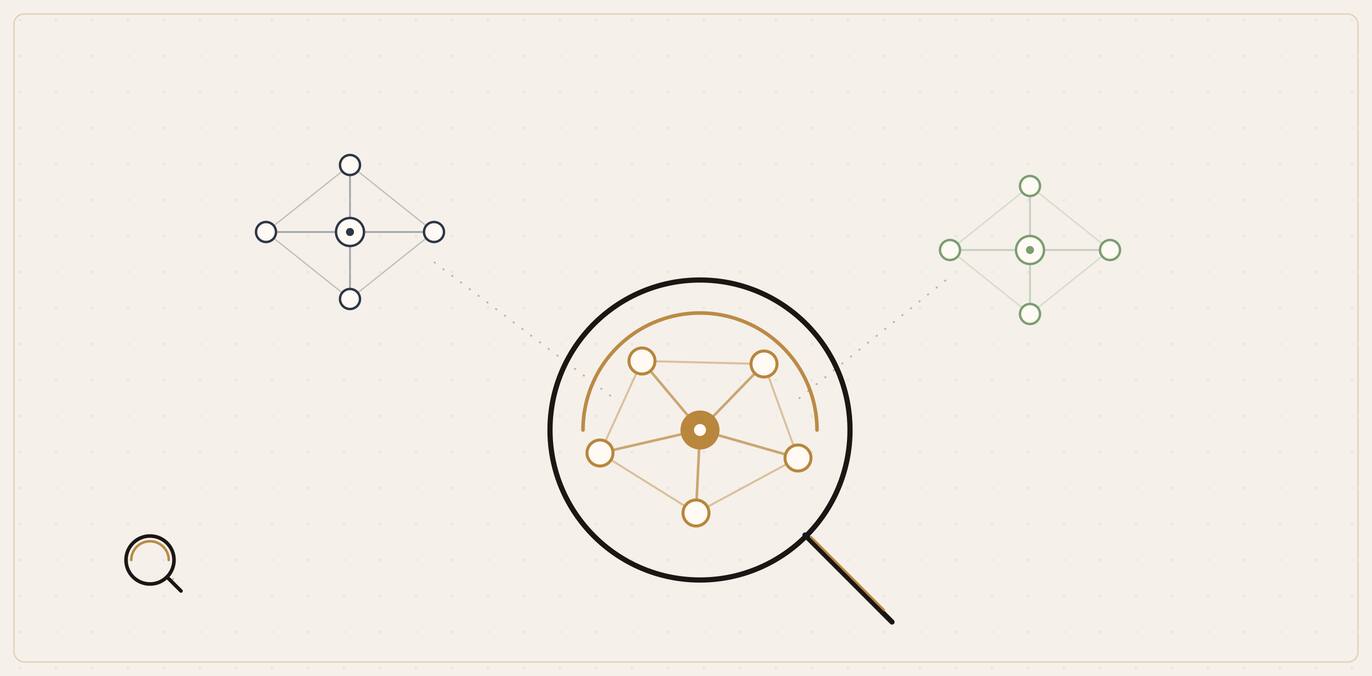
When an AI engine recommends a business like yours, it almost never names one winner: it builds each answer from a handful of trusted sources and hands back a small group of names. The businesses that keep appearing together form a cluster. To get named, map your cluster (put your customers' real questions to ChatGPT, Google's AI answers and Perplexity and record everyone who appears), then get present and accurate on the recurring platforms, directories, review sites and publications that route into it. Each engine builds its own cluster, so map each separately.
TL;DR
- AI answers name a small group, not a single winner, because each answer is assembled from several sources at once.
- The names that recur together are your cluster: some are competitors, some are the platforms that route into it.
- Getting named is about joining the right cluster, not beating one rival to a single top spot.
- Map your cluster free in an afternoon: ask the three engines your customers' real questions and record who appears.
- Clusters differ by engine, so being in one on ChatGPT tells you little about Perplexity or Google: map each on its own.
Ask ChatGPT, Google's AI answers or Perplexity to recommend a business like yours and watch what comes back. It almost never names a single winner. It names a small group: three or four businesses, side by side, as if they belonged together. That grouping is not random. The AI is reaching for a handful of sources it already trusts for that kind of question, and those sources tend to travel together. Marketers call this co-citation, and it is one of the most useful ideas a local business can understand about AI search.
Here is what that means for you. If the engines hand out recommendations in clusters, then getting named is not about beating everyone else to a single top spot. It is about getting into the right cluster, the group the AI already pulls together when someone asks your kind of question. Once you understand which businesses you are being grouped with, and why, you can do the work that puts you in the picture alongside them.
This is an intermediate tactic that builds on the basics. If you are new to all of this, start with our complete guide to Answer Engine Optimisation for local businesses, then come back here.
What co-citation actually means
Co-citation is a simple idea wrapped in an academic-sounding word. It means two sources being cited together in the same answer. If an AI answer about "the best family solicitor in Leeds" cites both Firm A and Firm B, those two firms have been co-cited. Do that across thousands of answers and a pattern appears: certain sources keep turning up next to each other, because the AI treats them as belonging to the same topic.
The reason sits in how the engines assemble an answer. When Ahrefs studied 1.4 million ChatGPT prompts, it found the model retrieves and weighs roughly sixteen cited sources per prompt and writes its reply from that group, rather than from any single page.[2] An engine that builds each answer out of a handful of sources will, by design, hand back a handful of names. Side-by-side recommendation is not a quirk to game; it is how the machine works.
Marketers call the resulting pattern co-citation, and you can confirm it in a minute: ask any AI engine to recommend a type of business and it will almost always return a shortlist, not a single winner. Profound, an AI-visibility software firm reporting its own commercial research, measured the behaviour directly across roughly 700,000 ChatGPT conversations and put it plainly: "Sources travel in packs. ChatGPT doesn't pick one winner. It cites competitors side by side."[1] Weigh that as the vendor's own data, but the direction matches what your own eyes already tell you.
Swap in your own world and the lesson is the same. If you run a dental practice, the AI is comparing you with the other clinics, directories and review sites it trusts for "dentist near me". If you are an accountant, it is grouping you with the professional-body listings and finance sites it reaches for when someone asks about bookkeeping. You are never being judged alone. You are being judged as part of a set.
The data: why no single source wins, and clusters form instead
Co-citation happens because of how the citation economy is shaped. It is wide but unequal, and that combination is exactly what produces clusters rather than single winners.
The citation economy
Why no single source wins, and clusters form instead
88%
of the URLs ChatGPT actually cites come straight from standard search results
14%
of the time NerdWallet and The Points Guy were co-cited together in personal finance
700,000
ChatGPT conversations analysed by Profound, confirming that "sources travel in packs"
Ahrefs, 2025; Profound, 2025
Start with the spread. Ahrefs's study of 1.4 million ChatGPT prompts found the model retrieves dozens of URLs for a single query and ends up citing only about half of them, pulling roughly sixteen cited sources into an average prompt.[2] No one page carries the answer. A wide field is retrieved, then a small group is chosen from it, and hundreds of thousands of sites split the citations that remain. There is room in the answer for more than one name, which is precisely why the engine reaches for several.
It reaches for several on purpose. Ahrefs also found that 88% of the URLs ChatGPT actually cites come straight from standard search results, so the engine leans on the pages that already rank, then triangulates across a handful of them to write its reply.[2] When it searches, it pulls from that small group and builds the answer from the set. That group is your cluster.
Even the most-cited sources sit inside this pattern rather than above it. Semrush's study of more than 100 million AI citations found that community-edited sources dominate the field, with Wikipedia and Reddit "consistently outranking corporate websites across all industries," yet no single domain owns the answer.[4] Wikipedia is the biggest general source, and it still leaves most of the space for everything else, including your cluster, to fill.
The clusters are real and measurable. Profound, an AI-visibility firm publishing its own commercial research, mapped the pairs of domains most often cited together in specific verticals: NerdWallet and The Points Guy were co-cited 14% of the time in personal finance, The Verge and TechRadar 10% of the time in tech news, and the journal publisher MDPI and the US health body NIH 7% of the time in health.[1] That co-citation rate answers a precise question: of all the conversations that cited either source, what share cited both? A double-digit answer means those two names genuinely keep company in the AI's shortlist.
Read the exact figures as the vendor's own, but the pairing pattern is the point, and it holds across every engine that assembles an answer from a group.
One useful detail from that mapping: the giant general sources like Wikipedia and Reddit turn up across nearly every vertical, so they do not define your cluster. The specific, topical sources do. That is where your attention belongs.
More than a curiosity
Co-citation is more than an academic curiosity, because of where AI answers now sit in everyday searching.
Amsive analysed 700,000 keywords across finance, education, SaaS, healthcare and pets, and found that the keywords which now trigger a Google AI Overview lost 15.49% of their click-through rate on average, rising to 19.98% on non-branded queries (Amsive, 2025)[3]. This is independent search-analytics data, and it tells you the answer itself is now the destination for a large share of searches. People read the cluster the AI assembled and stop there.
So the question is not abstract. When a potential customer asks an AI for a business like yours, a small group of names is assembled in front of them, and most of those people will go no further than that group. Being in it is the whole game. Being outside it means you were never considered, no matter how good your website is.
How to find your cluster
You cannot join a cluster you have not identified. You can begin without any tool at all. You need an afternoon and a methodical approach.
How the cluster forms
How an engine assembles a group, not a winner
The question
"The best family solicitor in Leeds" goes to the engine as one request.
A wide field
The model retrieves dozens of URLs, mostly pages that already rank in standard search.
A handful of sources
It cites only about half of what it retrieves, weighing a small group against one another.
A small group
It hands back three or four names side by side; the ones that keep recurring are your cluster.
1. Write down the real questions your customers ask
Not your keywords, their questions. "Best emergency plumber in Norwich." "NHS dentist taking new patients near me." "Family solicitor for a divorce in Sheffield." "Accountant for a small limited company." Aim for ten to fifteen genuine, natural-language questions, the kind a person types or speaks into an AI when they have a problem and want a recommendation.
2. Ask the engines and record who appears
Put each question to ChatGPT, Google's AI answers and Perplexity in turn. For every answer, write down every business, directory, review site and publication named or cited. Do not just note whether you appear. Note everyone who does. After a dozen questions you will see the same names recurring. That recurring set is your cluster: the businesses and sources the engines treat as the trusted answers for your topic and area.
3. Separate the two kinds of neighbour
Your cluster will contain two types of name, and they call for different responses:
- Competitors, the businesses like yours that keep getting named. These tell you who the AI considers your peers, and therefore the company you need to be keeping.
- Platforms, the directories, review sites, professional-body listings and local publications that keep appearing. These are the routes into the cluster. The AI trusts them, so being present and accurate on them is how you earn your way alongside the competitors.
Most owners fixate on the competitors and ignore the platforms. The platforms are where the work actually happens.
For a deeper look at which platforms each engine prefers, our guide on how each AI engine picks its sources breaks down ChatGPT's lean towards authoritative references, Google's appetite for community and video, and Perplexity's heavy reliance on Reddit and reviews.
How to join your cluster
Once you know the recurring platforms and competitors, joining the cluster is a matter of becoming present, accurate and consistent in the same places the AI already reads. Ordered roughly by impact for a typical local business:
How to join your cluster
Become present, accurate and consistent where the AI already reads
Get onto the platforms that define your cluster.The directories and professional-body listings that keep appearing in your answers, with matching details.
Make your facts identical everywhere.Co-citation rewards confidence; contradictory details quietly lower how sure the engine is about you.
Earn a place on the publications in your cluster.A genuine mention in a local paper or trade publication puts you directly into the group.
Be present where the discussion happens.Take part openly in the community threads the engines lean on; never plant fake recommendations.
Answer the cluster's questions on your own pages.Plain pages that confirm the facts give every engine something clean to quote and match.
Get onto the platforms that define your cluster
If a particular directory or professional-body listing keeps appearing in your answers, your first job is to be on it, with details that exactly match your website. A trade body register for a plumber, a recognised legal directory for a solicitor, a dental review platform for a clinic: these are not generic listings, they are the specific sources the AI pulls from for your topic. Being absent from them is the most common reason a business sits outside its own cluster.
Make your facts identical everywhere
Co-citation rewards confidence. When your name, address, phone number, services and credentials read the same across every platform in your cluster, you become an easy, safe source for the AI to include. Contradictory details, an old phone number on one directory and a new one on another, quietly lower how sure the engine is about you, and an unsure engine leaves you out of the group.
Earn a place on the publications in your cluster
If a local paper or a trade publication keeps showing up in your answers, a genuine mention there puts you directly into the cluster. A roofer quoted in a regional paper's storm-damage piece, or an accountant featured in a county business round-up, is exactly the kind of co-cited source the engines favour. This is ordinary local PR, aimed precisely at the outlets your cluster already contains.
Be present where the discussion happens
Reddit and similar community sites sit across almost every cluster, which is why the engines lean on them so heavily. Genuine, helpful participation in the threads where your customers ask "who is good for X near me" puts you in the conversation the AI is reading. Do it openly, as yourself, and never plant fake recommendations. We cover the white-hat method in our guide to why Reddit is the most-cited source in AI search, and the broader ChatGPT approach in how to get your business mentioned in ChatGPT.
Answer the cluster's questions on your own pages
Your website still matters as the place that confirms the facts. Pages that answer the exact questions you collected in step one, in the plain words customers use, give every engine something clean to quote and match against the rest of your cluster. This will not carry you alone, but a cluster member with vague, keyword-stuffed pages is easier to drop than one whose pages answer the question directly.
A note on the cross-engine problem
There is a complication worth understanding, because it changes how you measure success. The engines do not share a cluster. A business that is firmly inside its cluster on ChatGPT can be missing entirely from the equivalent answer on Perplexity.
The cross-engine problem
Should you build a strategy for each engine?
Ask
Is your cluster the same on ChatGPT, Google's AI Overviews and Perplexity?
Each engine draws from a different pool
Of the fifty most-mentioned sites across the three engines, only seven sat in the top group for all of them.
Build one presence wide enough
Get accurate on the authoritative listings, present in the communities, steadily reviewed and clear on your own pages, and you are among whatever sources each engine reaches for.
Ahrefs measured the divergence directly with its Brand Radar tool. Looking at the 50 most-mentioned websites on Google's AI Overviews, ChatGPT and Perplexity, across roughly 76.7 million AI Overviews, 957,000 ChatGPT prompts and 953,500 Perplexity prompts in June 2025, it found that only 7 sites sat in the top 50 for all three engines (Ahrefs Brand Radar, 2025)[5]. In Ahrefs's own words, "even for the same queries, these systems may cite completely different websites." Each engine builds its clusters from its own preferred corners of the web.
The reason is that each engine draws from a different pool. Ahrefs found Google's AI Overviews "lean towards the same top sites we're used to seeing in search results," heavy on authoritative and Google-owned properties; ChatGPT "leans more on publishers and non-Google media" it holds licensing deals with; and Perplexity "pulls from a broader international corpus" of local and regional sources the others skip (Ahrefs, 2025)[5]. A cluster that names you inside one of those pools tells you little about the others.
The practical response is not to build a separate strategy for every engine. It is to build a presence broad enough that whichever sources an engine reaches for, you are among them. Get accurate on the authoritative listings, present in the communities, steadily reviewed, and clear on your own pages, and you give every engine a reason to slot you into its version of your cluster.
Common mistakes
- Trying to beat one competitor instead of joining the group. Co-citation is not a duel. The aim is to be in the cluster, not to knock a single rival out of it.
- Ignoring the platforms and obsessing over the competitors. The directories, review sites and publications that recur in your answers are the way in. Skipping them keeps you outside the cluster no matter how good your rivals look.
- Checking only whether you appear. The whole point is to record who else appears. Your cluster is the recurring set, and you cannot join a group you have not mapped.
- Assuming one engine speaks for all of them. With only 7 of the top 50 sites shared across Google's AI Overviews, ChatGPT and Perplexity, being in your cluster on one engine tells you almost nothing about the others.
- Faking community presence to force your way in. Faking reviews or posing as a delighted customer is obvious, self-defeating, and now against the law in more and more places. The engines and the communities are reading the same threads.
- Letting your details drift. Inconsistent facts across your cluster's platforms make you the easiest member to drop.
Frequently asked questions
What is co-citation in simple terms?
It is two sources being cited together in the same AI answer. When an engine recommends businesses like yours, it usually names a small group rather than one winner, and the names that keep appearing together form a cluster. Profound's analysis of around 700,000 ChatGPT conversations put it plainly: "Sources travel in packs... It cites competitors side by side" (Profound, 2026, vendor research)[1].
Why does the AI name several businesses instead of the single best one?
Because the engine builds each answer from a group of sources, not one. Ahrefs's study of 1.4 million ChatGPT prompts found the model retrieves dozens of URLs per query and cites roughly sixteen of them, triangulating across a handful rather than crowning one (Ahrefs, 2025)[2]. There is room for several names, so it uses it.
How do I find my cluster without paying for a tool?
Write down ten to fifteen real customer questions, ask them to ChatGPT, Google's AI answers and Perplexity, and record every business and source each answer names. The set that keeps recurring is your cluster. You only need an afternoon to map it.
Is my cluster the same on every AI engine?
No, and this matters. Ahrefs found that of the 50 most-mentioned sites on Google's AI Overviews, ChatGPT and Perplexity, only 7 sat in the top 50 for all three, so the engines overlap far less than they differ (Ahrefs Brand Radar, 2025)[5]. Map your cluster on each engine separately.
My business is small. Can I really get into a cluster with bigger names?
For local questions, yes. The engines weigh location and reviews heavily, and a cluster for "best [trade] in [your town]" is a far smaller field than a national one. You only have to be the clearest, best-documented answer in your own area to earn a place. Our local AEO guide sets out the foundations.
How do I know if it is working?
Re-run the same questions every few weeks and track whether you start appearing alongside the cluster you mapped. Our guide to tracking whether AI mentions your business covers the free manual method and when a paid check is worth it.
What is the difference between a competitor and a platform in my cluster?
A competitor is a business like yours that keeps getting named, telling you who the AI treats as your peer. A platform is a directory, review site, professional-body listing or publication that keeps appearing, and it is the route into the cluster. Most owners fixate on the competitors, but the platforms are where the work actually happens, because being present and accurate on them is how you earn your place alongside the peers.
Which single mistake keeps a business out of its own cluster most often?
Being absent from the platforms that define it. If a particular directory or professional-body register keeps surfacing in your answers and you are not on it, with details that match your website, you sit outside the group no matter how strong your rivals look. Getting onto those recurring platforms is usually the highest-impact first move.
Do inconsistent business details really affect co-citation?
Yes. Co-citation rewards confidence: when your name, address, phone number and services read the same across every platform in your cluster, you are an easy, safe source for the engine to include. Contradictory details lower how sure it is about you, and an unsure engine leaves you out of the group, so you become the easiest member to drop.
Does my own website still matter if the cluster forms off-site?
Yes, as the place that confirms the facts. Pages that answer the exact questions your customers ask, in plain words, give every engine something clean to quote and match against the rest of your cluster. It will not carry you alone, but a cluster member with vague, keyword-stuffed pages is easier to drop than one whose pages answer the question directly.
Where to start
If you do one thing this week, map your cluster. Spend an afternoon putting your customers' real questions to the three big engines and writing down everyone who appears. The recurring platforms are your route in; the recurring competitors are the company you need to keep.
If you would rather see your clusters mapped for you, which engines name you, which name your competitors, and which sources each one is drawing on, that is what a QBiz AI Visibility audit does. We map the cluster the engines pull from for your category, show exactly where you sit in it and where you are missing, and rank the gaps to close.
Get your AI Visibility audit →
Sources
- [1] Profound, "How ChatGPT sources the web" (chatgpt-citation-sources), 2026 (vendor research, retained only for its co-citation domain-pair measurement): https://www.tryprofound.com/blog/chatgpt-citation-sources
- [2] Ahrefs, "Why ChatGPT Cites One Page Over Another (Study of 1.4M Prompts)," 2025: https://ahrefs.com/blog/why-chatgpt-cites-pages/
- [3] Amsive, "Google AI Overviews: New CTR Study Reveals How to Navigate Negative SERP Impact," 2025 (independent; 700,000 keywords across five industries): https://www.amsive.com/insights/seo/google-ai-overviews-new-research-reveals-how-to-navigate-click-drop-off/
- [4] Semrush, "How AI Search Really Works: Findings from Our AI Visibility Study," 2025 (independent; ChatGPT + Google AI Mode across five industries): https://www.semrush.com/blog/ai-search-visibility-study-findings/
- [5] Ahrefs Brand Radar, "86% of Top Mentioned Sources Are Not Shared Across ChatGPT, Perplexity, and AI Overviews," 2025 (independent; ~76.7M AI Overviews, 957k ChatGPT prompts, 953.5k Perplexity prompts, June 2025): https://ahrefs.com/blog/top-mentioned-sources-are-not-shared-across-ai-assistants/
Leave a comment
Thoughts on this post? Leave a comment below. Comments are moderated before they appear, so yours will not show on the page straight away.
Your email is used only to contact you about your comment if needed — it is never published.
Comments
No comments yet. Be the first to leave one above.