LA Plumber GEO: How Citation Authority Gets You Named in AI Search
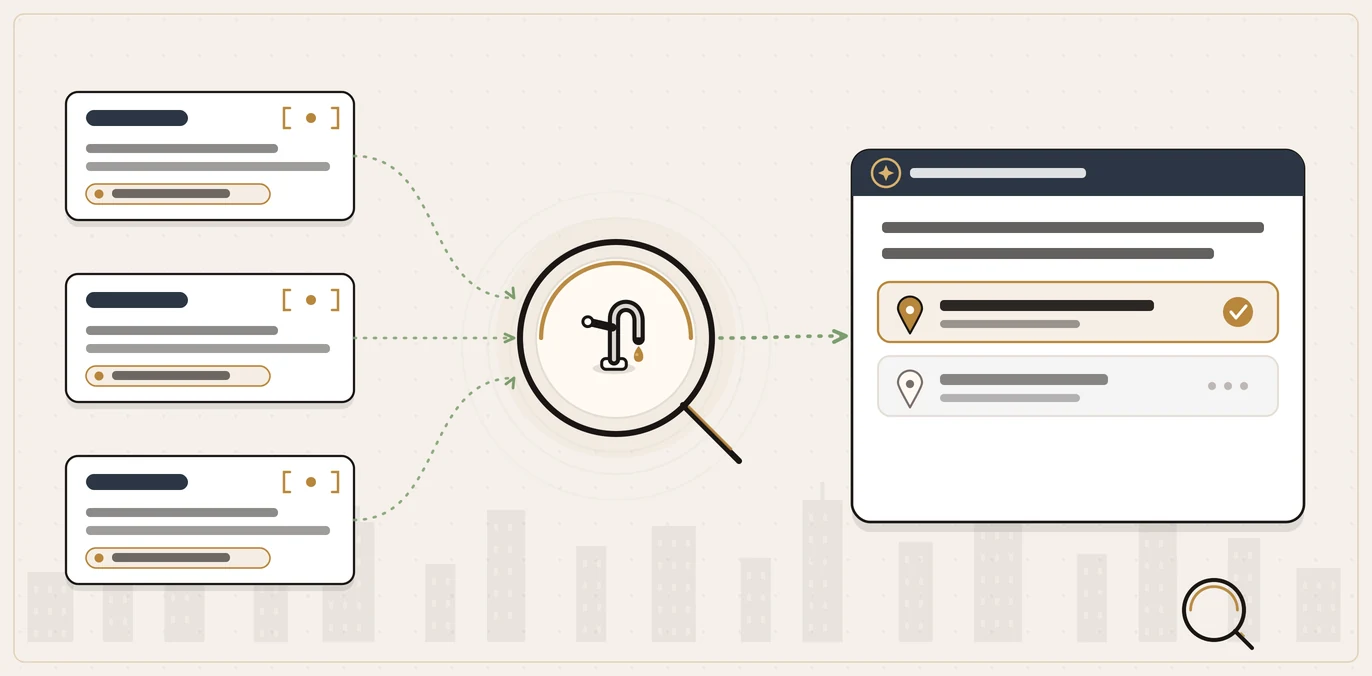
An LA plumber gets named in AI search when Google, Gemini, ChatGPT and Copilot can verify the same business across trusted sources: Google Business Profile, Bing Places, Yelp, Angi, the BBB, reviews, service pages and local mentions. Generative Engine Optimization is not keyword stuffing for phrases like "plumber near me". It is making a licensed plumber in Silver Lake, Burbank or Sherman Oaks easy for an engine to understand, corroborate and cite when a homeowner asks for help. Build the Business Profile first, claim Bing Places, make name-address-phone data match everywhere, add service-specific pages and schema, then earn reviews and third-party mentions that repeat the same facts.
The short version
- AI names the business it can verify. Your own website matters, but Google, Yelp, Angi, Bing Places, the BBB and local mentions are what turn a claim into corroboration.
- GEO is not local SEO with new labels. Traditional SEO chases ranked links; GEO makes your plumbing company understandable enough to be named inside the answer.
- Reviews work as evidence. A review that says "same-day water heater replacement in Burbank" is more useful to AI than a generic five-star compliment.
- NAP conflicts cost citations. Old suite numbers, mixed phone numbers and inconsistent service areas make the engine less confident, even when the company is real.
- Build in the right order. Profile, Bing Places, directory cleanup, answer-first service pages, schema, then earned mentions. Skipping the basics makes later promotion weaker.
AI-driven search is reshaping how customers find plumbers in Los Angeles, and most plumbing businesses have no strategy for it yet. Generative Engine Optimization (GEO) is fundamentally different from traditional SEO, focusing on how AI systems interpret and cite your business rather than just keyword rankings. Your Google Business Profile, online reviews, and schema markup all make your business easier for AI answer engines like Google's AI Overviews and Gemini to read and describe accurately.
Citation authority, how consistently and credibly your business appears across trusted third-party sources, is the deciding factor when AI picks which plumber to name. There is a specific sequence to building this authority, and LA plumbers who act early are locking in a compounding advantage that will be difficult for competitors to close.
Something significant has shifted in how Los Angeles homeowners find a plumber. They are no longer just typing into Google and scrolling through links. They are asking AI tools like ChatGPT, reading Google's AI Overviews, and trusting whatever name comes back. For most plumbing businesses in the city, that name is not theirs. Not because they are bad at the work, but because they have not yet built the kind of digital presence that AI systems recognize and trust.
Most Plumbers Are Invisible to AI Search
The numbers behind this shift are hard to ignore. According to BrightLocal's Local Consumer Review Survey 2026, 45% of consumers now use AI tools like ChatGPT for local recommendations, up from 6% a year ago, which makes AI the third most popular source of business recommendations.[1] Google's AI Overviews now appear on a large share of searches, and they are especially common for service-related queries like "best plumber near me" or "plumber in Los Angeles."
The opportunity
Why LA plumbers are mostly invisible to AI
1.2%
of multi-location brand locations are recommended by ChatGPT (SOCi)
35.9%
appearance rate for the same brands in Google's local 3-Pack
45%
of consumers now use AI for local recommendations, up from 6% a year ago
SOCi Local Visibility Index 2026; BrightLocal, Local Consumer Review Survey 2026
Despite that, most local businesses have not yet adapted to AI search. That is not just a missed opportunity, it is an open door. New research from SOCi's 2026 Local Visibility Index found that ChatGPT recommends just 1.2% of the multi-location brand locations it studied, against a 35.9% appearance rate in Google's local 3-Pack, making AI visibility roughly 30 times more selective than traditional local search.[2] The gap between how customers now search and how prepared most businesses are has rarely been this wide.
For a deeper breakdown of what this means specifically for LA plumbers, QBiz Leads AI's guide to Los Angeles plumber local SEO walks through each layer of the visibility problem, and why the fix is more structured than most businesses expect.
GEO Is Not SEO: Here's the Difference
Traditional SEO is built around keywords: place the right terms on your page, earn backlinks, and climb Google's ranked list of blue links. Generative Engine Optimization (GEO) is built around something different, making your business understandable, credible, and citable by AI systems that do not return a ranked list at all. They return an answer, usually with one or two names in it.
Side by side
GEO is not SEO for an LA plumber
| Traditional local SEO | Generative Engine Optimization | |
|---|---|---|
| What it is built around | Keywords, backlinks and on-page terms | Being understandable, credible and citable to AI |
| What the searcher gets | A ranked list of blue links | An answer, usually naming one or two businesses |
| How you win | Climb the ranked list | Be the plumber the AI can verify and quote |
| Where the work sits | Your own pages and links | Profile, directories, reviews and earned mentions together |
Beyond Keywords: How AI Interprets Local Queries
When someone asks Google or ChatGPT for a plumber in Silver Lake, the AI is not matching keywords to a webpage. It is assembling a response from everything it can verify about businesses in that area: their services, their location signals, their reviews, their mentions across trusted sites. Context and consistency matter far more than keyword density. A plumbing company that clearly describes what it does, where it works, and what customers say about it, across multiple sources that agree with each other, is the one the AI is equipped to name confidently.
Citation Consistency and Quality: Key Authority Metrics for AI
Citation authority measures how reliably and credibly a business appears across the sources AI systems already trust. Having a website that claims you serve the San Fernando Valley is not enough on its own. The AI wants corroboration: does Yelp say the same thing? Does Angi? Does your Google Business Profile match your YellowPages listing? When the details align across sources, the AI has reason to feature you. When they conflict, the safe move for the engine is to name someone whose story holds together everywhere.
Your Google Business Profile Is an AI Feed
Plenty of plumbers still treat their Google Business Profile as nothing more than a Maps pin with a phone number attached. It is now the single richest data feed into local AI answers. The AI Overview Google displays above the map is assembled from the same signals Google uses to rank the map pack, and a fully built-out profile is the fastest way to influence both at once.
The LA sequence
From profile to earned mentions, in order
Build the profile
Complete every Google Business Profile field: exact NAP, hours, each service, neighbourhoods and real photos.
Claim Bing Places
ChatGPT and Copilot ground local answers in Bing, so a Google-only plumber is invisible to both.
Reconcile the details
One agreed name, address and phone number across every LA directory.
Earn mentions
Layer in outside coverage once the free, durable foundations are in place.
What AI Actually Reads From Your Profile
AI systems pull specific, actionable information from a profile. That means spelling out each service on its own, water heater repair, slab leak detection, sewer and drain clearing, repiping, after-hours call-outs, rather than a single "plumbing" category. It means naming the neighborhoods served the way residents actually say them: Pasadena, the Westside, Downtown LA, not just "greater Los Angeles." It means stating that the business is licensed, bonded, and insured in plain readable text, not buried in a logo image no machine can parse. And it means keeping reviews recent, because an engine weighs a current five-star rating very differently from a wall of old ones.
How Gemini and AI Integration Are Reshaping Local Search
In March 2026, Google launched "Ask Maps," a Gemini-powered conversational feature in Google Maps that uses a business's Google Business Profile (categories, attributes, services, hours, photos, and reviews) as its primary input for generating recommendations.[3] In practical terms, the description written for a Business Profile at a 7th-grade reading level, with core services and license status spelled out, is not just profile copy. It is training material for the model that decides which plumber gets named when someone asks Gemini for help.
Reviews Are Evidence, Not Just Reputation
BrightLocal's Local Consumer Review Survey 2026 found that 97% of consumers read reviews for local businesses before choosing one.[1] More notably, AI tools like ChatGPT have risen into the top three sources people use for local recommendations, alongside Google and Facebook, and Google's own share of where people read reviews has slipped from 83% in 2025 to 71% in 2026 as AI tools absorbed more of that influence.[1]
How AI Weighs Star Ratings and Review Content
AI-powered tools, including Google's Local Pack, pull signals from star ratings, the specific language inside reviews, and how businesses respond to them. A review that mentions "same-day water heater replacement in Burbank" is more useful to an AI than a generic five-star comment, because it contains verifiable, service-specific information the engine can cite. Responding to reviews, even short, genuine acknowledgments, signals an active, credible business, which feeds back into how prominently the engine features it. Gathering steady, recent reviews with specific service mentions is one of the most useful moves an LA plumber can make right now.
Schema Markup Gives AI a Direct Briefing
Schema markup is structured code that tells AI systems exactly what a business does, where it operates, and what customers think, without requiring the engine to interpret it from paragraph text. Schema markup makes a business easier for an engine to read and classify. The one controlled test available found that adding it did not lift AI citations,[4] so treat it as machine legibility, not a citation lever.
For a plumbing business, the relevant types are LocalBusiness (or the more specific Plumber type) to establish who and where, Service schema for each individual job offered, and FAQPage schema for any questions answered on the page. The non-negotiable rule: the markup must only reflect what is already visible on the page. Overclaiming in structured data is penalized, and it undercuts the trust the schema was meant to build.
Your Website and Third-Party Mentions Work Together
A business that only vouches for itself on its own website is a weak signal. Getting your business mentioned and described on trusted third-party platforms gives AI systems far more places to find and corroborate you than your own site alone. In AI answers, independent third-party sources tend to count for more than a business's own claims about itself. The implication for an LA plumber is direct: what Yelp, Angi, local press, and industry sites say about your business carries more weight in AI answers than what your own homepage says.
Why Directories and Earned Mentions Reinforce Your Site's Authority
When an AI encounters a plumber named consistently across Google, Yelp, Angi, the BBB, and a handful of credible local sources, it has corroboration from multiple independent directions. That agreement is what tips a close decision. Two plumbers with similar profiles and similar reviews will not both get named, the one with more trusted outside mentions will. Building that kind of outside reputation is exactly the earned-mentions work covered in our guide to citations for AEO.
NAP Consistency Across LA Directories
NAP stands for Name, Address, and Phone number, the three data points every local listing carries. When these details differ across platforms (an old suite number here, a cell number there), the AI has to decide which version of your business is real. The safe default is to feature the competitor whose details line up cleanly everywhere. Auditing and correcting NAP data across Yelp, Angi, YellowPages, the BBB, and any local LA directories is unglamorous work, but it removes a friction point that can quietly cost citations regardless of how good everything else looks.
Build Citation Authority in the Right Order
There is a specific sequence that pays back fastest, front-loading the free, durable work before layering in anything that costs ongoing spend.
Priority order
Build citation authority in the right order
Complete the Google Business Profile.Exact NAP, real hours, every service, named neighbourhoods and genuine crew photos.
Claim Bing Places too.Google-only optimisation leaves you invisible to ChatGPT and Copilot.
Fix NAP consistency everywhere.One agreed name, address and phone number across every LA directory.
Add schema and gather reviews.Give AI a direct briefing and the review evidence it weighs when choosing a name.
Layer in earned mentions last.Outside coverage reinforces a site that already has its foundations right.
From Profile to Earned Mentions: The LA Plumber Sequence
- Build the Google Business Profile out fully first. Complete every field: exact NAP, real hours with an after-hours note, each service listed individually, neighborhoods named, credentials in plain text, genuine crew photos.
- Claim and complete a Bing Places listing. ChatGPT and Microsoft Copilot ground their local answers in Bing's index. A plumber who only optimizes for Google is invisible to both of those tools.
- Audit NAP consistency across every directory. One agreed-upon version of the business name, address, and phone number, everywhere.
- Rewrite key service pages to lead with the answer. A page for water heater repair in Sherman Oaks should open with what happens on the visit and roughly what it costs, not a company history.
- Add schema markup to service and FAQ pages. Give AI systems a direct briefing rather than making them guess.
- Gather fresh reviews and earn outside mentions. Consistent, recent reviews with specific service language, plus credible third-party coverage, are what separate a named plumber from an invisible one in a contested LA market.
Early Movers in LA Capture a Compounding Advantage
Citation authority builds over time as mentions accumulate, reviews stack up, and AI systems encounter a consistent, credible business across more and more trusted sources. The compounding nature of that process is also what makes it defensible. A plumber who starts now, while most competitors have not yet adapted to AI search, will be difficult to dislodge once the authority is established.
Los Angeles is a larger and more competitive market, and results will vary, but the pattern holds. The first plumbers to build genuine citation authority in their LA neighborhoods will not just rank better today; they will be the default recommendation an AI reaches for a year from now, when the market has caught up and the window has closed. The full picture of how we build this for plumbing businesses sits on our AI optimization for plumbers page.
Frequently asked questions
What is GEO for an LA plumbing company?
GEO, or Generative Engine Optimization, means making a plumbing business easy for AI answer engines to understand, verify and cite. For an LA plumber, that means clear service pages, a complete Google Business Profile, a Bing Places listing, consistent directory data, specific reviews and third-party mentions that all describe the same licensed business in the same service area.
How is GEO different from local SEO for plumbers?
Local SEO helps a plumbing company rank in Google's map pack and organic results. GEO helps that same company get named inside an AI answer, where the engine may return only one or two plumbers. The foundation overlaps, but GEO puts more weight on corroboration: whether Yelp, Angi, the BBB, Google, Bing and your own site all agree about who you are, where you work and what you do.
Should an LA plumber target "near me" as a keyword?
No. "Near me" is buyer language, not a service page strategy. Google, ChatGPT and other engines resolve the searcher's location themselves, then match it against real business locations, service areas and local signals. An LA plumber should write around the actual job and actual place, such as "water heater repair in Burbank" or "emergency drain cleaning in Silver Lake", because those facts help the engine match the business to a nearby customer.
Which citations matter most for Los Angeles plumbers?
Start with Google Business Profile and Bing Places, then clean up Yelp, Angi, YellowPages, the BBB and any local or trade-specific listings that already mention the company. The best citation is not just a directory link. It is a consistent record of the same name, address, phone number, services, license language and service area, repeated on sites an answer engine already trusts.
Does Bing Places matter if most customers use Google?
Yes. Google feeds Google AI Overviews and Gemini, but ChatGPT and Microsoft Copilot lean on Bing's index when they search the web. A plumber who only maintains Google has left two major AI surfaces weaker than they need to be. Claiming Bing Places is usually a low-cost fix, and in LA plumbing it is still overlooked enough to create an advantage.
What should a plumber put on a service page for AI search?
Lead with the answer a customer needs: the service, the place, what happens on the visit, a clear price or diagnostic range if you can state one, and the license or insurance signal that proves you are qualified. A page for slab leak detection in Pasadena should not open with company history. It should explain what the plumber checks, how quickly they can attend and why the business is credible.
Do reviews help AI choose which plumber to name?
Yes. Reviews give AI systems current, third-party language about real jobs. A review that mentions "same-day water heater replacement in Burbank" helps more than "great service" because it contains a service, a place and an outcome. Recent reviews with specific job language make it easier for an engine to match the company to a customer's question.
What is NAP consistency and why does it matter?
NAP means name, address and phone number. If one listing uses an old suite number, another uses a mobile number and the website uses a different spelling of the business name, the AI has to decide which record is real. Consistent NAP removes that doubt. It tells the engine that every trusted source is pointing to the same plumbing company.
Can schema markup make an LA plumber appear in AI answers?
Schema helps, but it does not work on its own. Plumber, Service and FAQPage markup give an engine a direct briefing about the business and its pages. The markup must match visible page content, and it works best when the same facts are backed by profiles, reviews and citations. Schema clarifies authority; it does not replace authority.
How long does citation authority take to build?
The basic cleanup can be done quickly: profile fields, Bing Places, directory corrections and service-page rewrites. The stronger authority layer takes longer because it depends on new reviews, local mentions and repeated corroboration across trusted sites. In a competitive LA market, the payoff is cumulative: the plumber that starts early becomes harder for later competitors to overtake.
To see how this strategy is built for local service businesses, QBiz Leads AI helps local businesses build the citation authority and AI visibility needed to get found as customers move to AI search. A free QBiz Leads AI visibility check scans your website in about thirty seconds and returns a clear pass or fail on the signals that decide whether AI tools can find and recommend your business, so you know where you stand before spending anything.
Get your AI visibility check →
Sources
- [1] BrightLocal, "Local Consumer Review Survey 2026": https://www.brightlocal.com/research/local-consumer-review-survey/ (US-relevant consumer survey. "97% of consumers read reviews for local businesses." Also: "Use of ChatGPT and other generative AI tools for local recommendations has grown rapidly, rising from 6% last year to 45% and becoming the third most popular source of business recommendations." And: "Google has always been the standout source for reviews, but this year its share has dipped from 83% in 2025 to 71%.")
- [2] SOCi, "In AI-Driven Discovery, Few Brands Are Chosen, Most Disappear" (2026 Local Visibility Index): https://www.soci.ai/news/in-ai-driven-discovery-few-brands-are-chosen-most-disappear/ (Analysis of more than 350,000 locations across 2,751 multi-location brands. "ChatGPT recommends just 1.2% of brand locations, compared to an average 35.9% appearance rate in Google's local 3-Pack, making AI visibility nearly 30 times more selective than traditional local search." Figure refers to multi-location brand locations studied, not all local businesses.)
- [3] Google, "Ask Maps and immersive navigation," blog.google, 12 March 2026: https://blog.google/products-and-platforms/products/maps/ask-maps-immersive-navigation/ (Google's own blog. "Google Maps is changing with the help of Gemini models, offering a new conversational experience called Ask Maps." "Ask Maps starts rolling out now in the U.S. and India on Android and iOS.")
- [4] Ahrefs, Linehan & Guan, "We Tracked 1,885 Pages Adding Schema. AI Citations Barely Moved." (May 2026, matched difference-in-differences test)
Leave a comment
Thoughts on this post? Leave a comment below. Comments are moderated before they appear, so yours will not show on the page straight away.
Your email is used only to contact you about your comment if needed — it is never published.
Comments
No comments yet. Be the first to leave one above.