Paid Directory Profiles or Organic AI Mentions: Where Should a Dental Practice Spend in 2026?
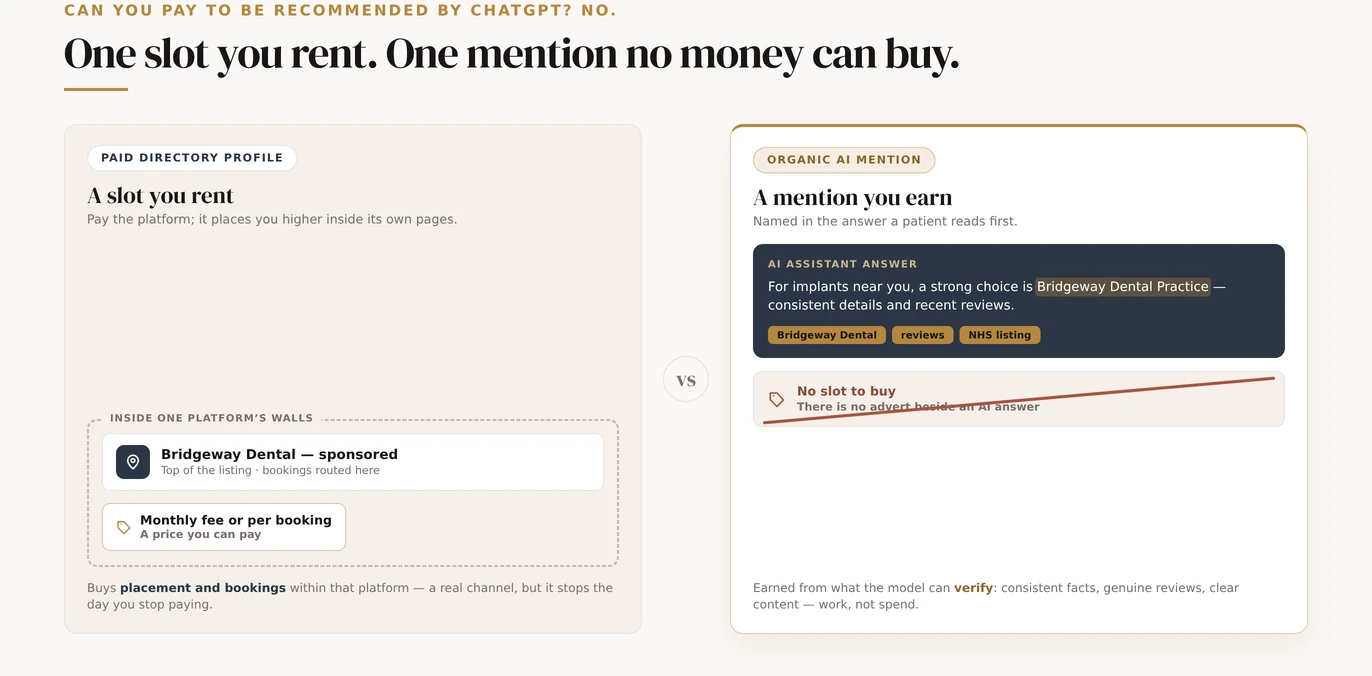
A paid directory profile buys placement and bookings inside that one platform's walls. An organic AI mention is earned and cannot be purchased at any price. The work that actually feeds the AI is the accurate, consistent, free version of your listings plus genuine reviews and clear content, so pay for the badge last, if at all, and build the asset first.
Every month, a practice owner signs off a payment to a listing platform for a profile upgrade and quietly hopes it is pulling its weight. It is a fair hope, and increasingly a misplaced one. The money that used to buy a better slot inside a directory is now being asked to compete with a channel that has no slot to buy at all: the recommendation an AI assistant gives when a patient asks it who to see. This is a piece about where that budget should actually go.
Two routes have opened up, and most practices are paying for the wrong one. You can pay a platform to push your profile up its own rankings and hand you its bookings. Or you can become the practice an assistant names, unprompted, inside the answer a patient reads first. They look like two ways of buying the same visibility. They are not: one is a channel you rent by the month, the other is an asset you build once and cannot buy at any price. This guide answers the budget question a practice owner actually loses sleep over, is written for UK practices, and stays inside General Dental Council rules throughout.
The short version
- Two different things. A paid profile is placement you rent inside one platform; an AI mention is a recommendation you earn and cannot buy.
- The free tier does the AI work. Claiming and aligning your listings feeds the verification an assistant reads; the premium upgrade does not.
- Spend order matters. Consistent listings, then reviews, then answer-first content, and a paid profile last, only where it measurably converts.
- No paid lane into ChatGPT. Nobody can sell you a place in an AI recommendation; substance the model can verify is the only route in.
Paid directory profile or organic AI mention: which one brings a dental practice more patients?
They win at different moments in the patient's decision, so the straight answer is that you need the earned one first and the paid one only once it pays for itself. A paid directory profile captures patients who are already browsing that platform and ready to book. An organic AI mention captures patients at the moment they ask an assistant for a recommendation, before they have opened any directory at all. The second moment is growing fast, and there is no slot to buy inside it.
Those two moments are not evenly matched any more, and the gap is widening in one direction. In BrightLocal's Local Consumer Review Survey 2026, the share of consumers using ChatGPT and similar tools for local recommendations jumped from 6% to 45% in a single year, enough to make it the third most popular source of business recommendations, while 97% still read reviews before they choose[1].
Dental questions sit squarely inside that shift: a KFF tracking poll in 2025 put the share of adults using AI for health information or advice at about a third (32%)[2]. And when the AI answer appears in an ordinary Google search, it tends to take the decision with it, because 58% of users saw at least one such summary in March 2025 and clicked the older links far less often once it did (8% of visits, against 15% when no summary showed)[3].
Put plainly: a meaningful and rising share of patients now decide which dentist to consider inside an AI reply, and you cannot pay to be the practice it names. That single fact reorders where your budget should go.
What exactly is a paid directory profile, and what does it actually get you?
A paid directory profile is the upgraded or sponsored tier inside a listing platform: you pay the platform, and in return it ranks you higher within its own pages, suppresses competitor adverts on your profile, and routes its on-platform traffic and bookings to you. It is a lead-buying arrangement, and it works entirely inside that platform's funnel.
The economics vary by platform and change often, so the clearest way to think about them is by model rather than by a price that will be stale before you read it. Some healthcare listing platforms charge providers per new patient booked, so you are effectively buying confirmed appointments at a set cost each. Others sell an enhanced or sponsored subscription tier, where a monthly fee buys better placement and a richer profile. UK practices will recognise the same two models across the booking platforms and healthcare directories that operate here, several of which carry paid tiers of their own.
None of that is a scam, and it can genuinely work. If a platform has a lot of high-intent traffic in your town and you can measure the cost of each booked patient against the value of the treatments they come in for, a paid profile can be a perfectly sound channel.
An implant or aligner enquiry that converts is worth several thousand pounds (a single implant commonly runs somewhere between £2,000 and £3,000 per tooth, and a course of clear aligners from around £2,500 to £5,000, though these are illustrative ranges to show the stakes rather than researched figures), so even a meaningful per-booking fee can pay back many times over. The catch is what the paid tier does not do, which is the whole point of the next section.
What is an organic AI mention, and how do you earn one?
An organic AI mention is your practice being named, quoted or recommended inside an answer from ChatGPT, Perplexity, Google's AI Overviews or Copilot. It is earned, not bought. No assistant sells a "recommended dentist" placement; the practice that gets surfaced is simply the one the model can verify and is most confident describing.
Why the budget question changed
Patients are already asking the assistants
6% to 45%
rise in people using ChatGPT and other AI tools for local recommendations, now the third most popular source.
32%
of US adults use AI for health information or advice.
58%
of respondents ran at least one Google search in March 2025 that produced an AI summary.
97%
of consumers still lean on reviews to guide their decisions, the signal both funnels share.
BrightLocal Local Consumer Review Survey 2026; KFF Tracking Poll 2025; Pew Research Center, 22 July 2025.
You earn it through three things working together. The first is consistent, accurate entity data: your name, address, phone number, opening hours and services reading identically everywhere a machine looks, so the model can confirm you exist and what you do. The second is a genuine, recent review footprint gathered across the places patients actually leave feedback. The third is content that answers patients' real questions in specific, plain terms a machine can lift.
None of those three has a payment button. They are work, not spend, which is exactly why a well-run single-site practice can out-answer a national group for a "near me" question. You only have to be the best-described dentist in one town, not in fifty. That earning process is a subject in its own right; our guide to AI citations for dentists covers how the mentions are won across the wider web.
This is the channel that the paid badge cannot touch, and the one growing fastest. So the practical question becomes blunt.
The blunt truth: can you pay to be recommended by ChatGPT?
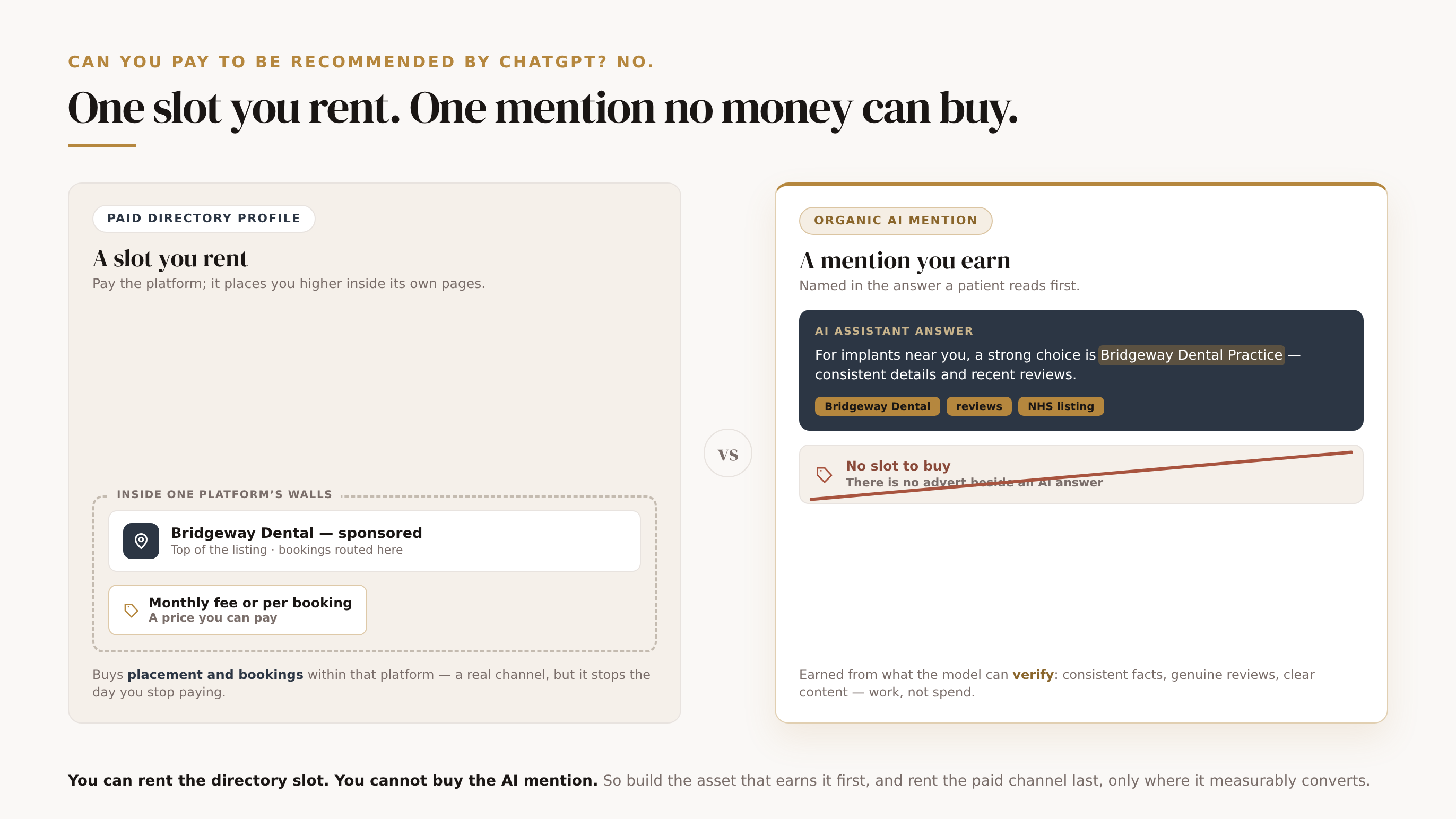
No. There is no paid lane into an AI recommendation, and any service implying otherwise is selling you something it cannot deliver. You can pay a listing platform to promote you on that platform. You cannot pay ChatGPT, Perplexity or Google's AI to name your practice in an answer. The recommendation is assembled from sources the model trusts and can verify, not from an advertising auction.
What earns the citation is substance the model can confirm. Reviews have become, in the words of the company that runs the largest annual study of them, "worthy of prominent visibility and citation within traditional Google search and LLMs like ChatGPT, and AI search"[4]. That evidence is earned across the same directory ecosystem you might be tempted to pay into, but it is the accuracy and the reviews that feed the AI, not the premium upgrade.
The stakes sharpen when you remember how patients now read answers. When an AI summary appears, people rarely click through to the underlying links[3]. In that zero-click moment, being the named practice is the visibility. There is no second prize and no advert slot beside it. A patient asking "who is a good implant dentist near me" either hears your name or does not, and the premium badge you bought on a listing platform did nothing to earn it.
Paid profile versus organic AI mention: the plain side-by-side
The fastest way to see why these are different funnels is to put them next to each other. The table below is the spine of the whole decision.
Side by side
Paid profile versus organic AI mention
| Consideration | Paid directory profile | Organic AI mention |
|---|---|---|
| What it is | Upgraded or sponsored tier on a listing platform. | Your practice named or recommended inside an AI answer. |
| What you pay | Subscription or per-booking fee to the platform. | Nothing to the AI: it cannot be bought. |
| What it gets you | Higher placement and bookings within that platform. | Being the recommended practice in the answer. |
| Where the patient meets you | Browsing that one directory. | Inside a ChatGPT, Perplexity or Google AI answer. |
| What actually moves it | Paying the platform, plus on-platform reviews. | Consistent entity data, reviews and answer-first content. |
| Does the free tier still help AI? | Yes: a claimed, consistent profile feeds verification. | Not applicable, the whole thing is earned. |
| The failure mode | Paying for a badge while your fundamentals are broken. | Thin reviews or content, so the AI cannot verify or quote you. |
| The verdict | A real on-platform channel: buy it last, and only if it converts. | The prize you cannot buy: earn it first. |
Drawn from the article's side-by-side of paid profiles and earned AI mentions.
The pattern in that table is the argument. One column is a channel you rent. The other is an asset you build. Renting can be sensible once the asset is in place, but renting instead of building leaves you paying monthly for a position that disappears the day you stop, while your competitors quietly become the answer the assistant gives for free.
So do directory profiles help AI at all? Yes, but it is the free part
This is the nuance that stops the article being simply anti-directory, and it matters. A claimed, complete and consistent directory profile does help your AI visibility, because it feeds the verification layer that assistants cross-check before they name anyone. The model wants several independent, reputable sources agreeing on who you are, where you are and what you do. Your listings are part of that chorus.
The decisive point is which part of the listing does the work. Google describes its own local results as resting on relevance, distance and prominence, where prominence is built partly from information about your business from across the web[5]. Consistency and completeness feed that picture. Nowhere does paying for an upgrade enter into it. The signal an external AI reads from a directory is whether your details are present, accurate and in agreement, and that is precisely what the free, claimed version of the profile already gives you.
So a dentist paying for a "premium" badge while their phone number differs across three listings has bought the wrong thing. The upgrade improved their ranking inside one platform and did nothing for the AI, while the broken consistency that actually hurts their AI visibility went unfixed. The premium tier adds on-platform conversion. The free, accurate tier adds the verification the AI is looking for.
Where should a dentist actually spend first? The priority order
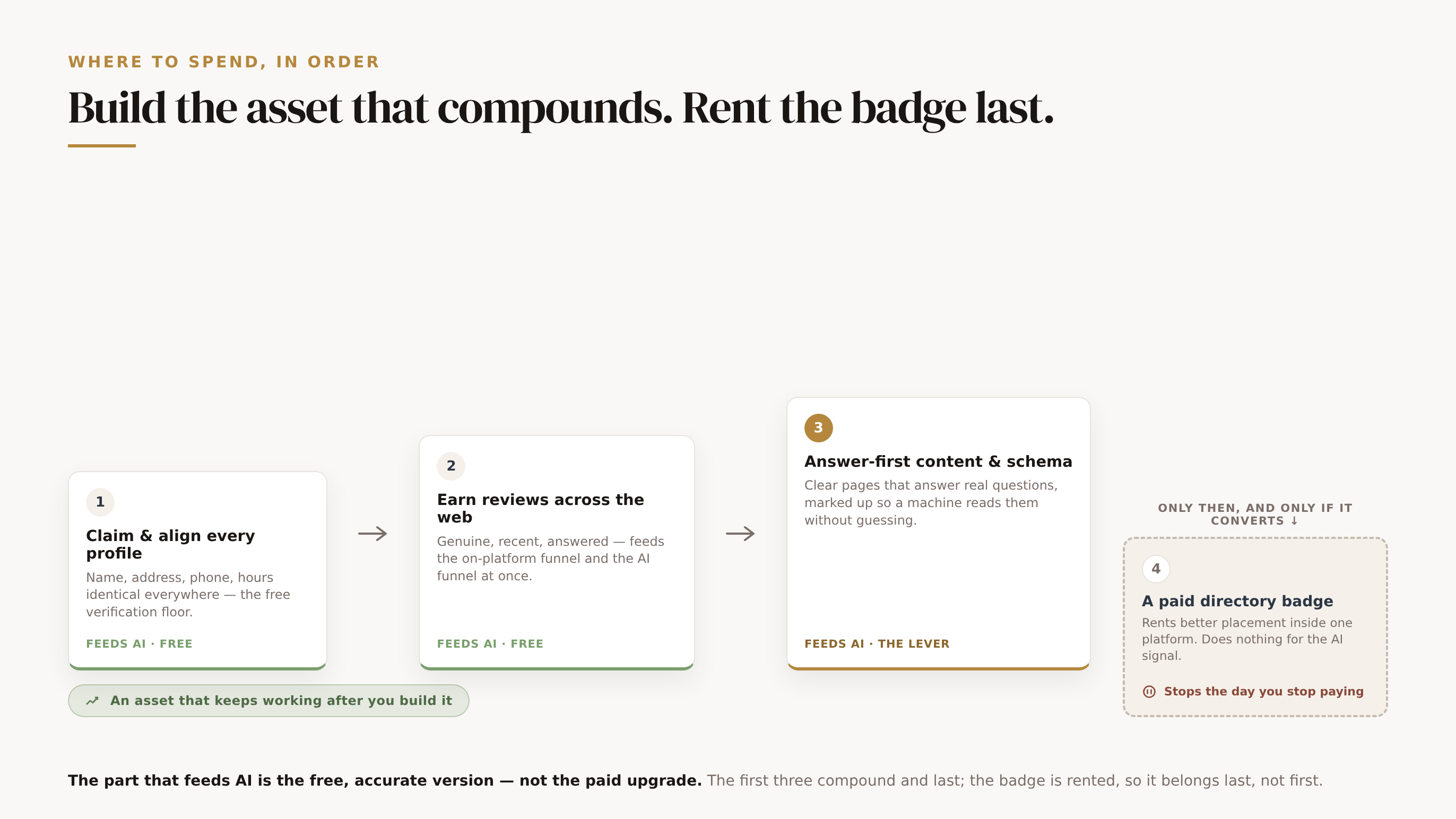
Spend in the order that builds the asset before you rent the channel. The sequence below puts the cheapest, highest-return work first and the paid badge last, which is the opposite of how most practices currently allocate the budget.
The priority order
Where a dentist should spend first
Claim and align every profile
Make name, address, phone, hours and services identical everywhere. The free verification floor, costing time not money.
Earn reviews across the ecosystem
Gather genuine, recent reviews and reply safely. They help the on-platform funnel and the AI funnel at once.
Write answer-first content
Publish clear pages that answer patient questions and add Dentist and FAQPage schema so a machine reads your facts.
Only then, a paid profile
Add it where a booking funnel demonstrably converts and you can measure cost per booked patient. The last pound, not the first.
- Claim and align every profile. Make sure your practice is claimed on the major platforms and that the name, address, phone, hours and services are identical everywhere. This is the free verification floor that helps AI confirm you, and it costs time rather than money.
- Earn reviews across the ecosystem. Steadily gather genuine, recent reviews, and reply to all of them without ever putting a patient's clinical details in a public response. Reviews help the on-platform funnel and the AI funnel at once.
- Write answer-first content and mark it up. Publish clear pages that answer the specific questions patients ask, with clear treatment information, and add
DentistandFAQPagestructured data so a machine can read your facts without ambiguity. - Then, and only then, consider a paid profile. Add it where a platform's booking funnel demonstrably converts for your treatments and your area, and where you can measure the cost per booked patient. The badge is the last pound you spend, not the first.
The reason for the order is financial, not moral. The first three steps compound and keep working after you have done them. The fourth stops the moment you stop paying. Build the part that lasts before you rent the part that does not.
When is a paid directory profile genuinely worth it?
It is worth it when three things are true at once, and a waste when they are not. It earns its place when the platform carries real, high-intent traffic in your specific area, when you can measure the cost per booked patient and it beats your other channels, and when your free fundamentals are already solid so the spend is adding reach rather than papering over gaps.
The worth-it test
When a paid profile earns its place
Real high-intent traffic in your areaThe platform carries genuine local demand for your treatments, not just national noise.
A measurable cost per booked patientYou can track it, and it beats your other channels rather than being assumed to.
Your free fundamentals are already solidThe spend adds reach rather than papering over broken listings, thin reviews or missing content.
The treatment value carries the feeFor implants or aligners worth several thousand pounds, even a significant per-booking fee can return well.
Avoid the mirror-image wastePaying for a premium tier while details are inconsistent and reviews are thin is the most expensive mistake in this area.
For high-value treatments the maths can be comfortable. If a platform reliably delivers implant or aligner enquiries at a known cost each, and those cases are worth several thousand pounds, then even a significant per-booking fee can be one of your better-returning channels. The test is always cost per booked patient set against the lifetime value of that patient, measured rather than assumed.
It is a waste in the mirror-image case. Paying for a premium tier while your details are inconsistent across the web, while you have few recent reviews, and while your site has no clear, answerable content, means you are buying a slightly better position inside one platform's walls and leaving every free signal that drives both funnels broken. You have spent on the badge and skipped the foundations. That is the most common and most expensive mistake in this whole area, because it feels like marketing while quietly leaving the real money on the table.
What does the UK picture look like (GDC, NHS and private, and the directories that matter here)?
The UK has its own listing ecosystem and its own rules, and both change the calculation. The platforms that carry weight here include your Google Business Profile, the NHS "find a dentist" service, Bing Places, and the main UK healthcare-specific directories, alongside local and community listings. Some carry paid tiers and some do not, but the verification value of being present and accurate applies to all of them regardless of whether you pay.
The NHS listing deserves particular attention because both patients and engines treat it as high-trust, and getting your details right there does more for your credibility than most paid upgrades. For practices offering a mix of NHS and private care, keeping the distinction clear and accurate across every listing is part of the consistency the AI is checking for.
The General Dental Council rules then sit over everything you publish. The GDC's Standards for the Dental Team require, at standard 1.3.3, that "you must make sure that any advertising, promotional material or other information that you produce is accurate and not misleading, and complies with the GDC's guidance on ethical advertising"[6]. In practice this means no superlatives you cannot evidence, no guarantees of clinical outcomes, and care with reviews so that nothing in a public reply discloses a patient's treatment. None of this restricts the work that earns AI mentions, because accurate, specific content is exactly what both the GDC and the AI reward. The compliant route and the effective route are the same route here.
How do you check what is actually working for your practice?
You can audit both funnels yourself in an afternoon, for nothing, before you spend another pound. The point of the check is to see which channel is earning its keep and which is quietly costing you.
For the organic AI side, ask the assistants the questions your patients ask. Type "best dentist for implants in [your town]" or "emergency dentist near me [your town]" into ChatGPT, Perplexity and Google's AI, and see whether your practice is named. If it is not, the verification footprint and content work above is where your attention belongs. For the paid side, pull each profile's reported bookings and set them against what you are paying, so you know your real cost per booked patient rather than guessing. Then check your name, address, phone and hours across every listing for the inconsistencies that silently undermine both funnels.
That self-audit tells you, in concrete terms, whether your directory spend is buying patients or just a badge, and whether the AI already mentions you or hands those patients to someone else.
Get your free AI visibility check →
How QBiz helps, and where the work actually happens
This is the work QBiz does, and it deliberately covers both halves of the job rather than just the on-page part. On one side we get your practice into the state an AI assistant can verify and quote: consistent entity data across the listings that matter, the structured information that lets a machine read your facts cleanly, and answer-first content built around the exact questions your patients ask. On the other side we handle distribution, getting that content and those signals out across the wider web where the assistants actually look, because a perfect page no one else references is a page the AI struggles to trust.
The combination is the point. Optimising your own site is necessary but not sufficient, because an AI answer is assembled from agreement across many sources, not from your homepage alone. Building the on-site substance and then distributing it is what turns a practice the assistant cannot find into the one it names. It is also the work that keeps paying after it is done, which is why we treat the paid directory question as a later, measured decision rather than the first thing you reach for.
If you want to see where you stand today, a free QBiz Leads AI visibility check scans your own website in about thirty seconds and returns a plain pass or fail on the signals that decide whether AI tools can find, read and describe you: the crawlability, the schema, the clarity of your service pages and the consistency of your listed details.
It reads your site, not the engines, so it points you at the fixes that put you in the running rather than reporting a single moment-in-time answer. And that check is only half of what we do: alongside the on-site groundwork we run the content distribution that earns the off-site mentions and corroboration these answers are assembled from. You can request it from the QBiz AI visibility check.
Frequently asked questions
Can I pay to get my dental practice recommended by ChatGPT?
No. AI recommendations are earned, not sold. You can pay a listing platform to promote you on that platform, but no assistant offers a paid recommended-dentist slot. The practice an AI names is the one it can verify and is confident describing, which comes from consistent listings, genuine reviews and clear content rather than from any advertising spend.
Is a paid premium directory profile worth it for a dentist?
Only if its booking funnel demonstrably converts for you. A paid profile is a real on-platform channel that can deliver bookings, and for high-value treatments the cost per booked patient can pay back well. It will not, however, improve your visibility inside AI answers directly. Judge it on measured cost per booked patient against the value of those patients, and add it after your free fundamentals are in place.
Do I need to pay for a directory profile to show up in AI search?
No. A free, claimed, consistent profile is what helps an AI verify that your practice exists and what it does. The paid upgrade changes your ranking inside that one platform, not the signals an external assistant reads. For AI visibility, accuracy and consistency across your listings matter, and those come with the free tier.
What actually gets a dentist mentioned by AI?
A combination of three things: consistent, accurate details across the places machines check, a genuine and recent review footprint, and content that answers patients' real questions in specific terms a machine can lift. Those signals let an assistant confirm you and quote you with confidence. None of them is for sale.
Where should I spend my marketing budget first?
In this order: the free fundamentals of claimed and consistent listings, then reviews, then answer-first content and structured data, and only then a paid directory profile where it measurably converts. The first three build an asset that keeps working. The paid profile rents a position that stops the day you stop paying, so it belongs last.
Where to start
The cheapest move is also the most revealing: ask ChatGPT, Perplexity and Google's AI the questions your patients ask, and see whether your practice is named. If it is not, you have found where the patients are going instead, and no paid badge will buy them back. The work that earns those mentions is the free, consistent, well-reviewed, clearly-written version of your practice, distributed across the web where the assistants look.
A free QBiz Leads AI visibility check reads your own website and shows you what to fix first, so the next pound you spend builds the asset rather than renting the badge. If you would rather have that earned-mention work run for you, our AI SEO for dentists service page sets out how we do it for a practice.
Sources
- [1] BrightLocal, Local Consumer Review Survey 2026: https://www.brightlocal.com/research/local-consumer-review-survey/ (US-weighted; independent. "Use of ChatGPT and other generative AI tools for local recommendations has grown rapidly, rising from 6% last year to 45% and becoming the third most popular source of business recommendations." Also: "97% of consumers still lean on reviews to guide their purchase decisions.")
- [2] KFF, Tracking Poll on Health Information and Trust, 2025: https://www.kff.org/public-opinion/kff-tracking-poll-on-health-information-and-trust-use-of-ai-for-health-information-and-advice/ (US; independent. "About a third (32%) of adults are turning to AI for health information and advice", including about three in ten (29%) who have used AI tools in the past year for information or advice about their physical health.)
- [3] Pew Research Center, 22 July 2025: https://www.pewresearch.org/short-reads/2025/07/22/google-users-are-less-likely-to-click-on-links-when-an-ai-summary-appears-in-the-results/ (US; independent. "About six-in-ten respondents (58%) conducted at least one Google search in March 2025 that produced an AI-generated summary." Users who saw an AI summary clicked a traditional result in 8% of visits, against 15% when no summary appeared.)
- [4] BrightLocal, Local Consumer Review Survey 2026 (Myles Anderson, Co-founder and CEO, quoted on page): https://www.brightlocal.com/research/local-consumer-review-survey/ (US-weighted; independent. "They've become an essential piece of evidence that your business is active, reliable. Also that it's worthy of prominent visibility and citation within traditional Google search and LLMs like ChatGPT, and AI search.")
- [5] Google Business Profile Help, "Tips to improve your local ranking on Google": https://support.google.com/business/answer/7091 (Global; vendor primary. Local results are based mainly on relevance, distance and prominence; prominence is "also based on info like how many websites link to your business and how many reviews you have".)
- [6] General Dental Council, Standards for the Dental Team, principle 1: https://standards.gdc-uk.org/pages/principle1/principle1 (UK; regulatory. Standard 1.3.3: "You must make sure that any advertising, promotional material or other information that you produce is accurate and not misleading, and complies with the GDC's guidance on ethical advertising.")
Leave a comment
Thoughts on this post? Leave a comment below. Comments are moderated before they appear, so yours will not show on the page straight away.
Your email is used only to contact you about your comment if needed — it is never published.
Comments
No comments yet. Be the first to leave one above.