Google's 'Query Fan-Out' Explained, and How to Write Pages That Catch Every Version of a Question
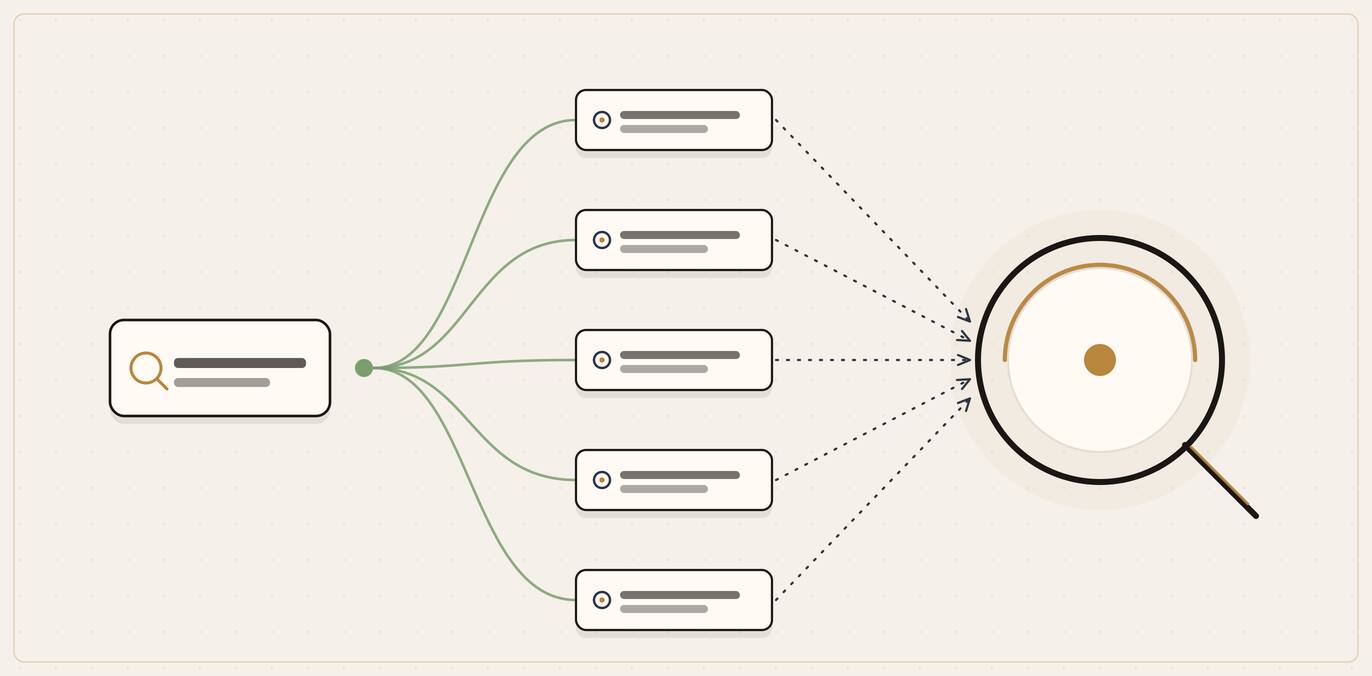
Query fan-out is how an AI search tool answers a question: instead of running the exact phrase you typed, it breaks the question into a dozen smaller searches, runs them all at once, and assembles one reply from the best source for each piece. To become the business it names, your pages have to answer the whole cluster of sub-questions the customer's request contains (cost, time, what is included, qualifications, area, and the things they actually ask on the phone) in plain, quotable sentences, rather than just repeating one headline keyword.
The essentials
- One question becomes many searches. The tool decomposes a query into subtopics and runs them simultaneously, then stitches the strongest sources together into one answer.
- Breadth of specific coverage beats keyword repetition. Answering six of the ten sub-questions clearly is worth far more than ranking first for the single headline phrase.
- Concrete facts win; brochure adjectives lose. Fan-out searches for fees, process, timing and area, so a page of personality and no specifics answers none of the strands.
- Map the cluster before you write. List the headline question plus its practical sub-questions from your own call notes and the "People also ask" boxes, then answer each one on a focused page.
- Split, do not cram. A separate page per service and area catches specific strands cleanly; one catch-all page is quotable for almost nothing.
For twenty years, search optimisation taught a simple habit: pick the phrase your customer types, then build a page around it. One keyword, one page, one target. A plumber wanted "emergency plumber Leeds", so the page said "emergency plumber Leeds" a few times and hoped to rank.
That habit is now quietly out of date, and the reason is query fan-out. When someone asks an AI tool a question, it does not run that one phrase and read the top result. It breaks the question apart into many smaller searches, runs them all, and assembles an answer from the best sources for each piece. Write for the single headline phrase and you catch one of those searches. Write for the whole cluster and you catch a dozen.
If you want the broader picture of how to show up specifically in Google's AI features, our guide to appearing in Google AI Overviews covers that ground and introduces fan-out briefly. This page goes deep on the writing craft fan-out demands, wherever the answer appears.
What query fan-out actually is
Query fan-out is the technique an AI search tool uses to answer a question by running several related searches at once, rather than a single search for the exact words you typed.
The mechanism
What query fan-out actually does
One question
A searcher types a single question in their own words.
Break into subtopics
Google breaks the question down and issues several related searches at once, not one for the exact words.
Answer the cluster
Each sub-search finds the clearest source for its strand of the question.
One reply
The engine composes a single answer from the sources that covered the most strands.
This is not a guess about how the technology works. It is how Google describes its own system. When Google introduced its AI Mode, it explained that the feature "uses a query fan-out technique, breaking down your question into subtopics and issuing a multitude of queries simultaneously on your behalf" (Google, AI in Search, May 2025)[1]. The tool asks the many questions so the person only has to ask one.
A worked example makes it concrete. Suppose someone asks an AI tool:
"Who's a good accountant in Sheffield for a small limited company, and what should I expect to pay?"
Behind the scenes, the tool does not search for that whole sentence. It fans the question out into something like:
- accountants in Sheffield
- accountants who handle limited companies
- typical fees for small-company year-end accounts
- reviews of accountancy firms in Sheffield
- what a small limited company needs from an accountant
- qualifications to look for in an accountant
Then it gathers the strongest sources for each strand and writes a single answer that stitches them together. The business that gets named is the one whose online presence answered the most of those strands clearly. A firm with a page that only says "Sheffield accountants: trusted, professional, reliable" answers almost none of them. A firm with clear, separate material on limited-company accounting, on fees, on what the process involves, and a stack of recent reviews, answers most of them, and walks into the answer.
What this changes about how you write, not just how you optimise
The old keyword model treated a search as a single target you aimed at. Fan-out replaces that target with a scatter of smaller ones. Three practical consequences follow, and all three are about content rather than code.
Side by side
Old keyword model versus writing for fan-out
| Old keyword model | Writing for fan-out | |
|---|---|---|
| The target | One phrase you aim at | A cluster of related questions |
| What wins | Ranking first for the headline term | Answering the most sub-questions clearly |
| What it rewards | Repetition of the keyword | Breadth of genuine, specific coverage |
| What now costs you | Was tolerated | Vague, brochure-style copy answers no sub-question |
You are no longer competing for one phrase. You are competing to be the clearest answer to a cluster of related questions. Ranking first for "Sheffield accountant" is worth far less than being the source that answers six of the ten sub-questions fan-out generates around that topic. Breadth of genuine, specific coverage beats repetition of one keyword.
Vague, brochure-style copy now actively costs you. When a tool fans a question into specifics (fees, process, qualifications, area covered), it needs pages that answer those specifics. A page written in personality and adjectives gives it nothing to lift for any of the strands. The more concrete your writing, the more strands you catch.
Sub-questions you have never explicitly targeted become winnable. Because fan-out searches for things like "what does the process involve" and "how long does it take", a page that plainly answers those everyday questions can be pulled into an answer even though you never thought of them as "keywords". The questions your customers actually ask on the phone are now optimisation targets.
There is reassurance buried in this for a local business. Fan-out tends to preserve the things that matter most to you: when these tools rewrite and split a question, they hold tightly onto geography and "best in [place]" intent while discarding vaguer details. So "best emergency electrician in Bristol" is a question shape fan-out handles cleanly and keeps your town inside, which means the sub-questions you most want to win are the ones the technology is least likely to throw away. We cover the evidence for that in why AI search almost never drops your town. For the wider picture of how to get named in those answers, see our complete guide to AEO for local businesses.
How to find the sub-questions before you write
You cannot answer the cluster of questions if you do not know what is in it. Mapping the cluster is the step most people skip, and it takes an afternoon, not a budget. Here is how to build the list for any service you offer.
1. Write down the headline question first. The plain thing a customer would ask: "who installs heat pumps near me?" That is your starting point, not your destination.
2. Add the five practical strands fan-out almost always generates. For any local service, the tool reliably searches around:
- What it is / what's included: what does the service actually cover?
- Cost: how much does it cost, or what is the range?
- Time: how long does it take, how quickly can you come out?
- Trust: qualifications, accreditations, guarantees, reviews.
- Area: which towns or districts you cover.
Write the customer's version of each. "How much does a heat pump cost to install in [town]?" "How long does heat pump installation take?" "Do I need an MCS-certified installer?" These are your sub-questions.
3. Mine the questions you already get asked. Your inbox, your call notes and your quote conversations are full of the exact sub-questions fan-out is running. Every "but does that include..." and "how soon can you..." is a strand to answer on the page.
4. Read the "People also ask" boxes and AI answers yourself. Search your headline question on Google and in AI Mode, and note every follow-up question and sub-point the answer raises. Those are literally the strands the engine cares about for your topic.
5. Check what a named competitor covers that you don't. If a competitor is named in AI answers and you are not, read their site against your sub-question list. The gaps are usually strands they answer and you don't.
By the end you should have, for each service, a headline question and eight to fifteen specific sub-questions. That list is the brief for the page.
How to write the page so it catches the whole cluster
Now turn the list into a page. The goal is a page that answers the headline question at the top and every sub-question plainly somewhere on it, in language a machine can lift cleanly.
Write the page
How to catch the whole cluster on one page
Lead with a direct, quotable answer.Answer the headline question in one or two plain sentences before any throat-clearing.
Give each sub-question its own answer.Address every strand plainly somewhere on the page, in language a machine can lift.
Use the customer's words.Match how people actually ask, not how your industry phrases it.
Add an FAQ block and keep facts consistent.Catch the tail with a questions block, and keep details agreeing across your web presence.
Lead with a direct, quotable answer
Open the page by answering the headline question in one or two plain sentences, before any throat-clearing. "We install air-source heat pumps across Sheffield and Rotherham, typically in two to three days, from around £8,000 to £13,000 depending on the system." That single sentence answers four strands at once (service, area, time, cost) and is exactly the kind of statement an AI can quote directly. Compare it to "Welcome to our heat pump page, where quality meets passion", which answers nothing.
Give each sub-question its own clear answer
Work down your sub-question list and make sure each one is answered explicitly on the page, ideally with the question as a heading and a direct answer beneath. You do not need a wall of text; you need a clear statement per strand. A reader skims it easily and a machine reads it cleanly. The independent research behind "generative engine optimisation" found that pages improved their visibility in AI answers when they added concrete material like relevant statistics, cited sources and direct quotations, the opposite of vague filler (Aggarwal et al., GEO: Generative Engine Optimization, KDD 2024)[2].
Use the customer's words, not your industry's
Fan-out searches in the language people actually use. If customers say "boiler service" and your page says "annual thermal maintenance", you miss the match. Name services the way customers say them, ask the questions the way customers ask them, and keep the trade jargon for where it genuinely adds precision (like a named certification).
Put a frequently-asked-questions block at the foot
An FAQ section is the most natural home for the smaller strands: the "do you...", "how soon...", "what if..." questions that do not deserve their own page but absolutely get searched. A genuine FAQ block, where each question is one a real customer asks and each answer is direct, maps almost perfectly onto how fan-out decomposes a query. Do not stuff it with questions nobody asks; answer the real ones.
Split, don't cram
Fan-out rewards specificity, which means one giant page trying to cover every service in every town answers each sub-question worse than a focused page would. Give each important service its own page and each area you serve a real page with genuine local detail. A page that tries to be about everything is quotable for nothing.
Keep the facts consistent with the rest of your web presence
The fees, areas and qualifications you state on the page should match what your Google Business Profile, directories and listings say. Fan-out pulls from many sources and cross-checks them; contradictory facts make the engine less confident and less likely to name you. Decide your numbers once and keep them identical everywhere.
A worked before-and-after
To make it concrete, here is the same service page written two ways.
Before (one headline keyword, brochure voice):
Driving Lessons in Norwich
Welcome! We are Norwich's friendly, professional driving school, passionate about getting you on the road. With our experienced instructors and bespoke approach, your success is our priority. Get in touch today!
It targets one phrase, answers no sub-questions, and gives an AI nothing specific to lift. It catches one strand of the fan-out at best.
After (written for the cluster):
Driving Lessons in Norwich
We provide manual and automatic driving lessons across Norwich and the surrounding villages, with DVSA-approved instructors. Lessons are £38 an hour, or £360 for a block of ten. Most learners take 40 to 47 hours of tuition before passing, in line with the national average. We cover NR1 to NR16 and can usually start within a week.How much do driving lessons cost in Norwich? £38 per hour, or £360 for ten hours booked together.
Manual or automatic? Both. Automatic lessons suit learners who want to pass faster on a narrower licence.
How many lessons will I need? Most people need 40 to 47 hours; we will give you a clear estimate after your first assessment lesson.
Are your instructors qualified? Every instructor is DVSA-approved and fully insured.
Which areas do you cover? All of Norwich and the surrounding villages, NR1 to NR16.
The second version answers cost, transmission type, duration, qualifications and area as separate, plain, quotable statements. When fan-out breaks a learner's question into those strands, this page is a clean source for each of them. Same business, same facts, written for how AI search actually reads.
Common mistakes
- Optimising for one phrase and ignoring the cluster. The headline keyword is the start of the work, not the whole of it.
- Brochure language over plain facts. Fan-out searches for specifics; adjectives answer none of them.
- One mega-page for every service and town. Specific pages catch specific strands; a catch-all catches nothing well.
- Using industry jargon instead of customer wording. If the words on your page are not the words customers use, the match never happens.
- Inventing an FAQ nobody asks. The block works only if the questions are real ones your customers actually ask.
- Letting facts drift between your page and your listings. Contradictory numbers across the web make every engine less sure of you.
- Writing for the machine instead of the reader. The same plain, specific writing serves both; do not keyword-stuff in the name of fan-out.
Frequently asked questions
What is query fan-out in simple terms?
It is the way AI search tools answer a question by running many smaller, related searches at once instead of one search for the exact words you typed. Google describes its AI Mode as "breaking down your question into subtopics and issuing a multitude of queries simultaneously on your behalf" (Google, May 2025)[1]. The tool answers a cluster of sub-questions and assembles one reply.
Split or cram
One page for the cluster, or separate pages?
Ask
Are these sub-questions one topic, or genuinely different services?
Keep them together
Answer the whole related cluster on one page so it catches every strand of the fan-out.
Split them out
A single mega-page for every service and town catches nothing well; specific pages catch specific strands.
How is writing for fan-out different from old-style SEO?
Old SEO aimed a page at one keyword. Fan-out means a page is judged on how many of the smaller sub-questions around a topic it answers clearly. The shift is from repeating one phrase to genuinely, specifically answering the whole cluster of related questions a customer's query contains.
Do I need special tools to do this?
No. The method is research and writing: list the sub-questions for each service (using your own customer conversations and the "People also ask" boxes), then answer each one plainly on a focused page. Tools can speed up the research, but the core work is done by hand.
Does fan-out keep my location, or does it get lost?
Location tends to survive. When AI tools rewrite and fan out a query, geography is the detail they hold onto most reliably, while looser filters like adjectives and price limits are often dropped. For a local business that is good news: the strand you most want to win is the one the technology is least likely to drop. We set out the evidence in why AI search almost never drops your town.
How long should a page be to cover the cluster?
Long enough to answer the headline question and each genuine sub-question clearly, and no longer. That is usually a focused page per service or area, not an enormous catch-all. Depth of specific answers matters more than raw word count.
Is this only relevant to Google, or to ChatGPT and Perplexity too?
The principle applies across AI search tools, because they all decompose and rewrite questions to some degree. The writing method (answer the cluster plainly, in the customer's words) helps you wherever the answer is assembled. Our guide to how each AI engine picks its sources covers where the engines differ.
How many sub-questions should one page answer?
For a single service, expect a headline question plus roughly eight to fifteen specific sub-questions once you have mined your call notes and the "People also ask" boxes. Answer all of them plainly on one focused page. If the list grows past that, it is usually a sign two services are fighting for one page and should be split.
Do I answer the sub-questions in an FAQ block or in the body?
Both work, and a page usually uses both. Put the four or five biggest strands (service, cost, time, area) into the opening answer and the body headings, and use an FAQ block at the foot for the smaller "do you...", "how soon...", "what if..." strands that get searched but do not deserve their own section. What matters is that every sub-question is answered somewhere on the page in a direct, liftable sentence, not which container it sits in.
How do I know which sub-questions the engine actually runs for my topic?
Search your headline question in Google's AI Mode and read the answer it assembles: the sub-points it raises, the follow-up questions it lists, and the "People also ask" entries are the strands it cares about for your topic. Add the questions your customers ask you directly on the phone, and you have the real cluster without guessing.
Will fan-out pull in a page I never targeted with a keyword?
Yes, and that is the useful part. Because the tool searches for things like "what does the process involve" and "how long does it take", a page that plainly answers those everyday questions can be lifted into an answer even though you never treated them as keywords. The questions customers actually ask become optimisation targets in their own right.
Where to start
If you take one habit from this guide, make it this: before you write or rewrite any service page, list the sub-questions a customer's request really contains (cost, time, what's included, qualifications, area, plus the things they actually ask you on the phone), and make sure the page answers every one of them in plain, quotable sentences. That single change turns a page built for one keyword into a page built for the whole fan-out.
If you would rather see where you stand first, a free QBiz Leads AI visibility check scans your website in about thirty seconds and returns a clear pass or fail on the key signals that decide whether AI tools can find and recommend your business, and hands you the fixes to make in order. It is the sensible starting point before you rewrite a single page.
Get your AI Visibility audit →
Sources
- [1] Google, "AI in Search: Going beyond information to intelligence," 20 May 2025: https://blog.google/products/search/google-search-ai-mode-update/ (primary; original definition of query fan-out: "breaking down your question into subtopics and issuing a multitude of queries simultaneously on your behalf"; AI Overviews driving over a 10% increase in usage for the query types that show them)
- [2] Aggarwal, Murahari, Rajpurohit, Kalyan, Deshpande, Narasimhan et al., "GEO: Generative Engine Optimization," accepted to KDD 2024, arXiv:2311.09735: https://arxiv.org/abs/2311.09735 (independent academic research; pages improved visibility in generative-engine answers when they added concrete material such as relevant statistics, cited sources and quotations; deliberate optimisation boosted visibility by up to 40%, varying by domain)
Leave a comment
Thoughts on this post? Leave a comment below. Comments are moderated before they appear, so yours will not show on the page straight away.
Your email is used only to contact you about your comment if needed — it is never published.
Comments
No comments yet. Be the first to leave one above.