Structured Data Markup vs. On-Page SEO for Law Firms: What 46 Attorney Sites Actually Show
AI Visibility
One page, read two ways
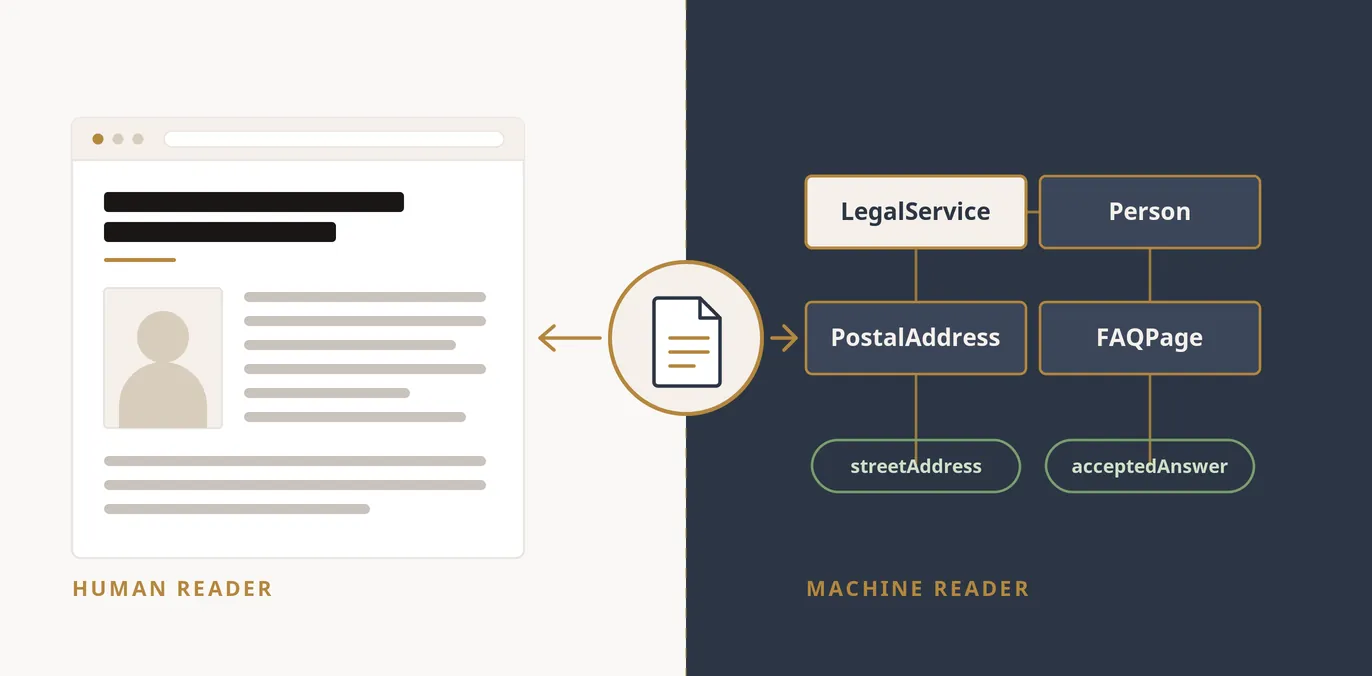
Summary
Structured data markup and on-page SEO are not competing choices for a law firm website. We fetched and parsed 46 US attorney sites across five cities. Schema markup does not replace strong on-page content; it travels with it. Firms with parsed schema were far more likely to also have a visible FAQ section (38.7% vs 6.7%) and a written process explanation (32.3% vs 13.3%). They also scored higher on the composite readiness measure (7.52 vs 5.67 out of 10). Only 13.0% had all three: schema, FAQ and process explanation together. The weakest sites were not strong on one and weak on the other. They were missing both.
Short version
Structured data does not move your ranking. Google says schema is not a general ranking factor, and an independent study of 1,005 law firm websites found essentially no link between how complete a site's schema was and where it ranked, a correlation score of -0.0581, close to zero. What schema does do: it makes a page eligible for certain search features, and it helps search engines and AI systems correctly identify who your firm is and what it does. In AI search, Google's own guidance says the same thing: structured data is not required for AI-generated answers, and there is no special markup built for them. So is it worth doing? Yes, as basic technical upkeep, not as a shortcut. It will not save a page that fails to answer the visitor's question. In our own measurement, the firms with schema are largely the same firms already writing real answers on the page.
Every law firm SEO article says the same thing. We measured a real one.
Search "structured data vs on-page SEO for law firms" and the results read like the same article copied seven times: a definition of schema, a definition of on-page SEO, a comparison table, and a closing line that says "you need both." None of those pages open a single law firm website and check what is actually there.
We did. On August 13, 2026, we fetched 191 local business websites across five US cities, New York, Los Angeles, Chicago, Houston, and Atlanta, spanning four sectors. Forty-nine of those were law firms, and 46 of the fetches succeeded cleanly enough to score. This article is built entirely on what we found in that data, plus what Google and schema.org actually say about how structured data works, not on repeating the "you need both" line without evidence.
What did we actually measure?
We built a fetch instrument that pulls the live HTML of each site, parses it for <script type="application/ld+json"> blocks and inline itemtype schema.org markup, and checks for a defined set of on-page signals:
- Visible FAQ content
- A written explanation of the firm's process
- Service definitions
- Heading structure
- NAP (name, address, phone) consistency
- Mobile rendering
- Crawlability
- Internal linking
- Presence of an
llms.txtfile
A site counts as having "schema present" if we found a parsed JSON-LD or itemtype block. That is a narrower claim than it sounds. It means the markup exists and parses, not that it is complete, valid, or accurate. A firm could have a single LegalService block with a name and nothing else and still count as "schema present" in this data. We are measuring presence, not quality, and every figure below should be read that way.
The sample is a convenience sample of independent local law firms in five US cities, not a random national sample, and it excludes chains and directory listings. This is a snapshot from a single collection date, not a tracked trend. We are not claiming these numbers generalize to every law firm in the country, and we are not claiming any of this measures rankings, AI citations, or traffic. It measures what was on the page the day we looked.
Does schema markup correlate with better on-page content?
Across the 46 attorney sites, 31 had parsed schema of some kind (67.4%), 23 specifically used LegalService (50.0%), and 15 had no parsed schema we could detect (32.6%).
Splitting the sample into "has schema" and "no schema" and comparing their on-page signals produces a consistent pattern: sites with schema score higher on nearly every content signal we measured.
| Signal | Schema present | No schema | Difference |
|---|---|---|---|
| Visible FAQ content | 38.7% | 6.7% | +32.0 pts |
| Process explanation | 32.3% | 13.3% | +18.9 pts |
| Heading structure | 93.5% | 80.0% | +13.5 pts |
| NAP consistency | 96.8% | 86.7% | +10.1 pts |
| llms.txt present | 48.4% | 40.0% | +8.4 pts |
| Mean composite score (of 10) | 7.52 | 5.67 | +1.85 pts |
That is not a small gap. 12 of the 31 schema sites had a visible FAQ section, against 1 of the 15 without. That is roughly six times more likely, on a base of one site.
Read the correlation carefully. This does not mean schema markup causes better content, and it does not mean adding a LegalService block will make your FAQ section appear. The more likely explanation is the reverse: firms that invest in structured, well-organized content are also the firms that invest in structured data, because both come from the same underlying habit of treating the website as a system rather than a brochure. Structured data travels with on-page answer quality. Whether you frame this article as "schema vs. on-page SEO" or not, the sites in this data set never actually chose one over the other.
First-party data, N=46 attorney sites
Five signals up, one down
Where does the correlation break down?
One signal moved the other way, and it is worth reporting plainly rather than leaving it out because it complicates the headline finding. Service definitions, plain-language explanations of what the firm actually does ("we handle uncontested divorces," "we represent tenants in eviction cases") were present on 41.9% of schema sites and 46.7% of no-schema sites, a 4.7-point gap in favor of the sites with no schema.
We do not have a confirmed explanation for this in the data, and we are not going to invent one. A plausible read is that some firms treat adding LegalService schema as a technical checklist item, separate from the plain-English "what we do" copy a visitor actually reads. The schema gets added, and nobody revisits whether the surrounding page still explains the service in words a client would use. That is a hypothesis, not a finding. What the data shows is the number, not the reason. Crawlability and internal linking, by contrast, sat at 100% for both groups: nearly every firm in this sample gets the baseline technical work right, schema or not.
What does published research say about law firm schema?
Our 67.4% schema-adoption figure is not an outlier. An independent preprint analysis of 500 US personal injury law firm websites found 67.6% implementing some form of JSON-LD markup, within 0.2 points of our own number on an entirely separate sample.[7] That is a useful cross-check: two independent measurement efforts, different instruments, different firms, land in the same place on adoption. It is also where published measurement of law firm schema mostly stops. Neither that study nor a related preprint audit of 1,005 page-one-ranking personal injury firm websites measures whether schema correlates with content quality or AI-answer readiness.[8] That relationship is what this article's data adds, not a first or only measurement of it, but the specific relationship between schema and on-page answer quality.
The two published samples diverge from ours on LegalService adoption specifically: 40.0%[7] and 35.3%[8] in the two studies, against 50.0% here. A plausible explanation is sample composition. Both published preprints draw from personal injury firms only, while our sample spans mixed practice areas, and PI-focused firms may prioritize different schema types for their marketing-heavy sites. That is a plausible read, not a confirmed one.
The 1,005-firm preprint also reports something closer to a direct test of our thesis: a Spearman rank correlation between schema completeness and Google search position of -0.0581, essentially no relationship.[8] That reinforces, from an independent sample, what Google states directly about its own systems: structured data controls a page's eligibility for certain visual features, not where it lands in the results.
What is a content-schema mismatch, and how common is it on law firm sites?
The recognized term for this is a content-schema mismatch: the structured data and the visible page describe two different things. The informal shorthand some SEOs use is "orphan schema." Nine of the 46 attorney sites declared FAQPage schema, which runs against a common assumption that law firms mostly dropped FAQPage markup years ago. Of those nine, three had no visible FAQ content in the fetched HTML, meaning the schema described a section that was not there for a visitor to read. That finding is measured against the served page source with no JavaScript execution; a small number of sites may render FAQ content client-side in ways this method cannot detect. Going the other direction, seven sites had a visible, readable FAQ section with no matching FAQPage schema, meaning a machine reader had no structured way to find it.
Both directions are the same underlying problem: the schema and the visible page describe two different sites. Neither failure is rare, and they show up in roughly equal numbers in this sample.
Content-schema mismatch
Two ways a firm's FAQ goes missing
Why is "schema vs. on-page SEO" a false choice?
Google's own documentation backs this up directly, not just in tone but in mechanism. Google's structured data policy page states plainly: "A structured data manual action means that a page loses eligibility for appearance as a rich result; it doesn't affect how the page ranks in Google web search."[4] Structured data controls whether a page is eligible for certain visual features in search results. It is not, on Google's own account, a general ranking factor you can add to move up the page.
That cuts against the pitch some vendors make, that schema markup alone will improve a firm's Google ranking. It also cuts against the opposite mistake, treating schema as decorative and skippable. Being machine-readable is a separate, real requirement for a different reason: an AI system summarizing "who handles divorce cases in Atlanta" has to extract facts about your firm from somewhere. A page with clear structured data plus clear on-page answers gives it more to work with than either one alone. The 46-site data above shows firms are not actually treating these as separate investments.
Schema is not an AI-visibility shortcut. Google's own AI-optimization guidance says so directly: "Structured data isn't required for generative AI search, and there's no special schema.org markup you need to add. However, it's a good idea to continue using it as part of your overall SEO strategy, as it helps with being eligible for rich results on Google Search."[9] That is consistent with everything above: the reason to fix your schema is not that it will make an AI system notice your firm. It is that firms that fix their schema have usually also written the on-page content an AI system needs, and clean structured data makes that content easier to extract accurately.
What schema type should a law firm actually use?
The specific schema.org type is a small, correctable detail law firms frequently get wrong. LegalService is the correct type for a law firm, "a business that provides legally-oriented services, advice and representation."[2] It sits in the type hierarchy under LocalBusiness and Organization, which means it inherits standard local-business properties like address, phone, and opening hours.
A narrower type, Attorney, also exists in schema.org's vocabulary, but it is officially deprecated: "This type is deprecated - LegalService is more inclusive and less ambiguous."[3] If a developer set up your site's schema a few years ago and used Attorney, or if a template default still references it, that is worth fixing, and it is a five-minute change.
Schema.org reference
What a LegalService block actually needs
What must an attorney bio page actually contain?
The identity and credential signals a bio page needs are covered in Signal 2 of 8 Technical Signals AI Parses to Cite Law Firms in Search Results: full name, bar admissions, directory verification. This article's narrower contribution is what that identity data connects to in schema terms, and where the 46-site measurement above actually touches a bio page.
A bio page's identity fields are Person schema data, and that Person needs to be tied to the firm's LegalService entity for either to mean much on its own. Half the sample, 23 of 46 sites, had no LegalService entity at all. On those sites, even a fully built-out bio page has nothing to attach to: the attorney's Person data sits on the page with no structured link to the business it belongs to. That is the gap none of the competitor pages measure. It is not that attorney bio pages lack identity fields. It is that 32.6% of these sites have no parsed schema at all, and half again have no LegalService entity, so a well-built Person block has nowhere to connect.
Google's own structured data documentation gives a bio page a real top-level type for this: ProfilePage, with a required mainEntity pointing to a Person.[10] Google's own content guidelines list "an employee page on a company website" as a valid ProfilePage use case, and an attorney bio page fits that description directly. This is a legitimate, Google-documented use, not a guarantee of any particular search result. It is the correct structural pattern:
- The bio page itself is
ProfilePage. - Its
mainEntityis the attorney'sPersonrecord. - That
Personrecord should reference the firm'sLegalServiceentity by ID.
Beyond the identity fields the sibling article covers, two things matter most for what an AI system can actually cite from a bio page:
- Named practice areas, in plain language, not just a list of legal terms. "We handle uncontested divorces" gives a machine reader a usable fact; "Family Law" alone does not.
- Specific representative experience: case types handled, a jurisdiction, a stage of a matter, not just "years of experience." This is the same distinction the data above measures for practice-area pages: a checkable specific beats a vague adjective.
None of this requires disclosing anything beyond what a bar directory already makes public. It is a matter of putting that public record on the page, connected to the firm's own entity, in text a machine can read.
What does visible evidence of experience look like on a page, in practice?
Two firms can both claim "20 years of experience handling personal injury cases." One states it as an adjective. The other backs it with something concrete: a named case type resolved, a specific court or jurisdiction, a bar admission date that makes the timeline checkable, a link to a published article the attorney wrote on the topic. The second version is not longer for its own sake. Every added detail is a fact an outside source could check.
This applies to the practice-area pages as much as the bio. A page titled "Personal Injury" that explains, in the firm's own words, what a typical case involves, what the process looks like, and what a client should expect at each stage gives both a human reader and a machine reader the same clear answer. A page that only lists the practice area name and a phone number gives neither one much to work with, schema or not.
Does FAQ schema still help law firms in Google Search?
This is worth stating clearly because most competing articles on this topic have not caught up to it: Google removed the FAQ rich result feature from Search. The deprecation notice went up in May 2026, and the documentation was removed entirely in June: "This feature will no longer appear in Google Search starting May 7, 2026,"[1] and by mid-June, "The FAQ rich result feature is no longer shown in Google Search results."[1]
That does not mean FAQPage markup is now pointless. It means the reason to use it has changed. Adding FAQPage schema will not earn a firm an expandable FAQ snippet directly in Google's search results anymore, because that visual feature does not exist. It is still worth doing, for two separate reasons that have nothing to do with that now-retired snippet. First, it gives an AI system a structured, unambiguous list of question-and-answer pairs to cite directly. Second, per the correlation above, firms that carry it also tend to have the broader content discipline that supports every other signal we measured. Write FAQ content because it answers real client questions completely, and mark it up because a machine reader benefits from the structure, not because it will produce a visual result in classic Google Search.
The actionable E-E-A-T plan
Everything above points to the same short list. This is not a checklist to work through once. It runs cheapest and fastest first.
- Fix the schema type. If your site uses
Attorney, change it toLegalService. Confirmnameand a nestedPostalAddressare present and accurate. - Close the content-schema mismatch both ways. If you have FAQPage schema, confirm there is a matching visible FAQ section on the page. If you have a visible FAQ section, add FAQPage schema that mirrors it exactly.
- Build one attorney bio page per lawyer, carrying bar admissions, jurisdictions, a link to the state bar profile, named practice areas, and specific representative experience, as text, not inside an image.
- Write a plain-language service definition for every practice area, in words a client would actually search for, separate from and in addition to the schema.
- Add a process explanation to your main practice-area pages: what happens after someone contacts the firm, and what the typical stages look like. Only 26.1% of the firms in this sample had one.
- Add
llms.txtif you have not already; less than half of the schema-present firms in this sample had one. - Recheck NAP consistency across your site, your Google Business Profile, and any directory listings. The firms with schema in this sample were more consistent here too: 1 of the 31 schema sites still had inconsistent details, and 2 of the 15 without schema did.
Frequently Asked Questions
Do I need structured data markup, on-page SEO, or both for my law firm website?
Both, and they are not competing investments. In our sample of 46 attorney sites, firms with schema markup were also far more likely to have strong on-page content: a visible FAQ section, a written process explanation, and consistent business details. Treating this as an either-or choice does not match how the sites that are doing well actually built their pages.
What is the correct schema.org type for a law firm?
LegalService. The narrower Attorney type exists in schema.org's vocabulary but is officially deprecated, with schema.org's own documentation stating LegalService is "more inclusive and less ambiguous."
Does adding schema markup improve my Google ranking?
Not directly, according to Google's own documentation. Google states that a structured data issue affects a page's eligibility for rich-result features, "it doesn't affect how the page ranks in Google web search." Structured data helps machines, including AI systems, read and cite your page accurately. It is not a ranking lever on its own.
Does FAQPage schema still create a visible FAQ box in Google search results?
No. Google deprecated the FAQ rich result feature in May 2026 and removed its documentation in June 2026, stating the feature "is no longer shown in Google Search results." FAQPage schema is still useful for giving AI systems a structured list of your firm's Q&A content to cite, just not for that retired visual snippet.
What is a content-schema mismatch and does my firm have it?
A content-schema mismatch, sometimes called "orphan schema" informally, is when your structured data and your visible page content do not match, in either direction. In our data, some firms declared FAQPage schema with no visible FAQ section on the page, and others had a real, readable FAQ section with no schema describing it. Check both: does every schema block describe something a visitor can actually see, and does every visible FAQ section have matching schema?
What should an attorney bio page include to be citable by AI search tools?
As crawlable text: the attorney's full name as it appears on their bar record, every jurisdiction and state bar admission with the year admitted, a link to their state bar directory profile, named practice areas in plain language, specific representative experience, and any publications or professional memberships, each linked where possible.
How common is it for law firms to have both good schema and good on-page content?
Uncommon. Only 6 of the 46 sites we measured, 13.0%, had schema markup, a visible FAQ section, and a written process explanation together. Most firms have made progress on one or two of these, not all three.
Is a plain "20 years of experience" claim enough evidence for AI search visibility?
Not by itself. A claim becomes verifiable evidence when it is specific: a named case type, a bar admission date, a linked publication, a specific court or jurisdiction. Those are the details a machine reader can actually check before deciding whether to repeat the claim.
My firm's site has good schema but weaker plain-language service descriptions. Is that unusual?
No, and it was the one place our data ran opposite to the main pattern: sites with schema actually had slightly lower rates of plain-language service definitions than sites without schema (41.9% vs 46.7%). It is worth checking your own practice-area pages specifically for this, since schema alone does not guarantee the surrounding copy explains the service in words a client would use.
Do I need to disclose anything beyond what is already public to build this out?
No. Bar admissions, jurisdictions, and court records are already public information through your state bar's own directory. This plan is about putting that public record on your site as readable, structured text, not about disclosing anything new.
Where should a law firm start if it can only do one thing from this list first?
Fix the schema type if it still says Attorney instead of LegalService, since it is the fastest, lowest-risk correction. After that, close the content-schema mismatch: confirm every FAQPage schema block matches a real visible FAQ section, and every visible FAQ section has schema pointing to it.
Where this fits with our other law firm guidance
This article measures one narrow question: does a law firm's schema markup line up with its on-page content. It does not repeat ground already covered elsewhere on this site. For the fuller set of technical and credibility signals AI systems check before citing a firm, including attorney identity verification and answer-first content structure, see 8 Technical Signals AI Parses to Cite Law Firms in Search Results. For the compliance and reputation side of AI visibility, Google Business Profile completeness, reviews, and transparency requirements, see AEO for Law Firms. For which AI platform is currently sending the most law firm traffic, see ChatGPT vs Google AI Overviews: Which Drives More Law Firm Traffic?.
The practical takeaway
Does structured data move a law firm's organic ranking? No: Google says schema is not a ranking signal, and the 1,005-firm sample above showed almost no statistical relationship between schema completeness and search position. Does it help in AI search specifically? Also no, by Google's own account: its AI-optimization guidance states structured data is not required for generative AI features and there is no dedicated markup for them. What schema actually buys a firm is narrower and duller than either question implies: eligibility for certain search features, and a cleaner signal for engines trying to work out who the firm is and what it does. Treat it as maintenance, not marketing. The concrete starting point is the mismatch itself: nine sites in our sample declared FAQPage schema, three with nothing visible on the page to match it, and seven ran a real FAQ section with no schema pointing to it at all.
Sources
- [1] Google Search Central, "Latest documentation updates" (developers.google.com/search/updates), fetched 2026-08-13: FAQ rich result deprecation, May 8 and June 15, 2026 entries.
- [2] Schema.org, "LegalService" (schema.org/LegalService), fetched 2026-08-13.
- [3] Schema.org, "Attorney" (schema.org/Attorney), fetched 2026-08-13: type deprecation notice.
- [4] Google Search Central, "Structured data general guidelines: policies" (developers.google.com/search/docs/appearance/structured-data/sd-policies), fetched 2026-08-13.
- [5] QBiz Leads AI, first-party fetch and parse of 46 US attorney websites, 5 cities (New York, Los Angeles, Chicago, Houston, Atlanta), single collection date 2026-08-13. Convenience sample of independent local firms; excludes chains and directories. "Schema present" means a parsed JSON-LD or schema.org itemtype block was found, not that the markup is valid, complete, or accurate.
- [6] QBiz Leads AI Research Team, "The AI Visibility Gap: A Technical Readiness Audit of 173 UK Local Service Business Websites" (Figshare, doi.org/10.6084/m9.figshare.33086327), fetched 2026-08-13. Earlier study in the same research program, covering 173 UK local service business websites. Cited here as prior companion research, not as evidence for the findings in this article.
- [7] Behzad Hussain, "Schema Markup Adoption in Personal Injury Law Firm Websites: A Systematic Analysis of Structured Data Implementation Across North American Legal Services" (Figshare preprint, doi.org/10.6084/m9.figshare.33029486.v1), fetched 2026-08-13. Preprint, not peer-reviewed. Independent analysis of 500 US personal injury law firm websites.
- [8] Behzad Hussain, "Schema Markup Adoption in Top-Ranking Personal Injury Law Firm Websites: A Structured Data Audit of 1,005 Google Page-1 Sites Across 50 US States" (Figshare preprint, doi.org/10.6084/m9.figshare.33028652.v1), fetched 2026-08-13. Preprint, not peer-reviewed. A separate, distinct preprint from the same author, examining 1,005 page-one-ranking personal injury law firm websites.
- [9] Google Search Central, AI-optimization guide (developers.google.com/search/docs/fundamentals/ai-optimization-guide), last updated 2026-07-10, fetched 2026-08-13.
- [10] Google Search Central, "ProfilePage" structured data documentation (developers.google.com/search/docs/appearance/structured-data/profile-page), fetched 2026-08-13.
Leave a comment
Thoughts on this post? Leave a comment below. Comments are moderated before they appear, so yours will not show on the page straight away.
Your email is used only to contact you about your comment if needed; it is never published.
Comments
No comments yet. Be the first to leave one above.