Best Dental SEO & AI Marketing Tools For Texas Practices: How to Grow & Scale
AI tools like ChatGPT, Gemini and Perplexity recommend a Texas dental practice using different signals than Google, which is why a top ranking no longer guarantees new patients. To get named, make your site machine-readable (clear provider bios with credentials, precise Dentist schema, and answer-first FAQ content), earn independent corroboration (accurate directory listings, genuine recent reviews, and third-party mentions), and keep your name, address and phone identical everywhere, including in Bing, which ChatGPT leans on. You cannot buy the recommendation; you earn it by being the practice the model can most confidently verify. Most dental sites are still invisible to AI, so the early-mover window is open.
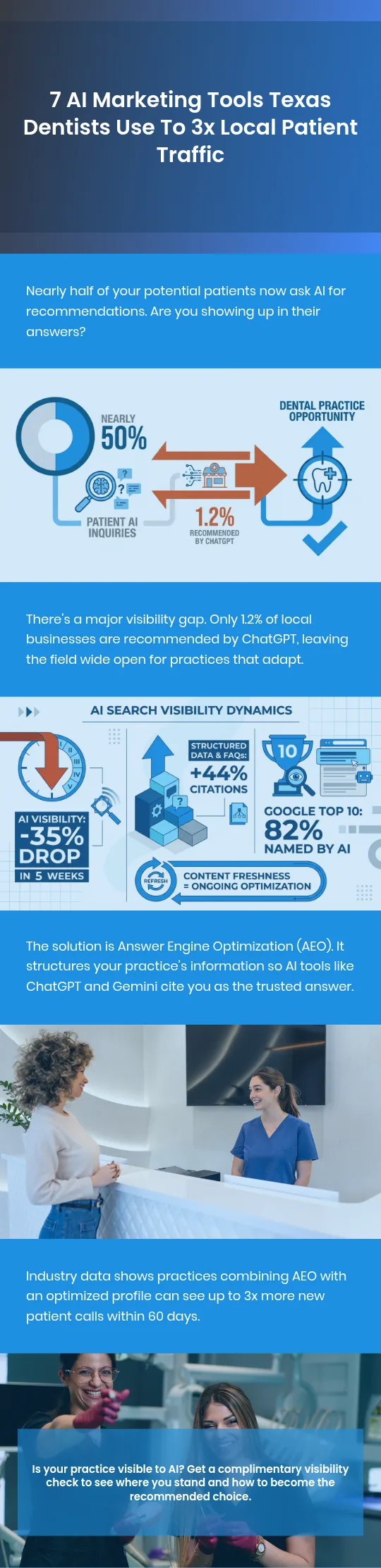
If you're ranking #1 on Google but still not getting new dental patients, here's why: AI tools like ChatGPT are now recommending dentists using completely different signals than traditional search, and most dental practices are still invisible to them.
The short version
- A significant and growing share of patients now use AI tools to guide local service decisions. Some healthcare surveys already show AI recommendations influencing provider choice, and many patients now interact directly with chatbots instead of a normal search-results page.
- Ranking #1 on Google no longer guarantees new patients. Platforms like ChatGPT, Gemini and Perplexity build their own shortlists using signals that overlap with SEO but do not mirror it.
- The factors that correlate with AI citations, including E-E-A-T, structured data, Q&A content, third-party mentions and review quality, are actionable right now regardless of practice size.
- Most dental websites are still invisible to AI in 2026, which means the early-mover window is still open for practices willing to act.
- Strategies like Answer Engine Optimization (AEO) and Generative Engine Optimization (GEO) are designed to close the gap between a Google ranking and an AI recommendation.
The way patients find a dentist has quietly but fundamentally changed. It used to be a simple Google search, a scroll through the map pack, and a phone call. Today, a growing share of patients skip the list entirely and ask an AI tool a direct question, then act on the answer they get. For dental practices, that shift is either a threat or an opportunity, depending on how prepared the website is to be read, trusted and cited by those AI systems.
A Growing Share of Patients Now Use AI to Find Local Services
Patient discovery behaviour is moving faster than most dental marketing strategies have kept up with. In a rater8 survey of more than 1,000 U.S. healthcare patients, 26% listed AI recommendations among their top sources when choosing a provider.[1] That is healthcare-wide rather than dental-specific, but it is enough to show that the behaviour has already entered the mainstream. Platforms like ChatGPT now serve around 900 million weekly active users,[2] with a large share of prompts being recommendation or advice queries. That means millions of people each week are asking an AI chatbot which dentist to visit, not typing a keyword into a search bar.
Patient behaviour
Why AI discovery has entered the mainstream
26%
of patients list AI recommendations among their top sources (rater8, 1,000+ patients)
900 million
weekly active users on ChatGPT, many asking recommendation queries
61%
organic click-through drop reported on some query sets where AI Overviews appear
rater8 survey; platform usage figures, 2026.
The downstream effect on traditional search is significant. On some informational query sets where Google AI Overviews appear, studies have reported organic click-through-rate drops of as much as 61%.[3] When an AI answers a patient's question directly in the search result, or inside a chat interface, many patients never scroll further. They get a name, they trust it, and they book. If a practice is not in that AI-generated answer, it may as well not exist for that patient.
This is not a future trend. Patients are already searching this way, and the practices that appear inside AI answers are collecting patients that others never even compete for. The question is not whether to pay attention to AI visibility. It is whether a practice will act early enough to benefit from it.
AI Recommendations vs. Google Rankings: A Critical Difference
Why ranking #1 on Google no longer guarantees new patients
For years, the goal was straightforward: rank as high as possible on Google, and new patients would follow. That logic still has merit, but it is no longer the complete picture. The overlap between classic Google rankings and AI citations is weaker than many practices assume, especially once you move beyond Google AI Overviews into chatbot-style answers. A practice could hold a first-page Google position and still be completely absent from what ChatGPT or Perplexity tells a prospective patient.
The reason is that AI tools and search engines use meaningfully different signals. Google rewards keyword relevance, backlinks and page authority. AI platforms look for something closer to web-wide consensus: a pattern of consistent, credible mentions across many independent sources. A practice that ranks well but has thin schema, no third-party citations and no structured Q&A content simply does not give AI the data it needs to confidently name it in an answer.
SEO opens the door. AI-specific optimisation is what walks a practice through it.
Side by side
A Google ranking and an AI recommendation reward different things
| Google ranking | AI recommendation | |
|---|---|---|
| The signals it rewards | Keyword relevance, backlinks and page authority | Web-wide consensus: consistent, credible mentions across independent sources Consensus |
| The output | A ranked list of ten links | A synthesised answer that may name one to three practices |
| What wins the patient | A first-page position | Being named inside the answer the patient actually reads |
How AI tools like ChatGPT and Gemini select which dentists to name
Think of AI recommendation as a voting system. When a patient asks ChatGPT who is the best dentist near me for dental implants, the model tallies credible signals from across the open web and names the practices with the most consistent, trustworthy support. A practice's own website claiming to be the best carries almost no weight. What counts is a clear, machine-readable website plus independent, trusted sources that vouch for it.
ChatGPT pulls from a combination of training data, real-time web retrieval and brand consensus. Perplexity is even more citation-driven, aggressively favouring freshness and content updated within the last few days. Google AI Overviews lean more on traditional rankings, with roughly 76% of URLs cited in AI Overviews also ranking in Google's top 10,[4] but even there structured content and trust signals matter. Each platform weights things slightly differently, which is why a complete strategy accounts for all of them.
The practical implication for dental practices is that showing up in AI answers requires being mentioned across many places, in structured ways AI can extract, with consistent and verifiable information. A good website is the starting point. What surrounds it across the web is what tips the recommendation.
What AEO and GEO Actually Mean for Your Practice
Answer Engine Optimization (AEO): being cited, not just found
Answer Engine Optimization is the process of structuring a dental practice's content so AI tools can easily interpret it, are inclined to trust it, and reuse it when responding to patient questions. While traditional SEO focuses on ranking a page in a list of links, AEO focuses on getting the practice cited directly inside the AI-generated answer, which is what the patient actually reads and acts on.
The distinction matters because answer engines do not behave like search engines. When someone asks ChatGPT who is the best cosmetic dentist in Dallas, it does not return ten links. It synthesises an answer and may name one to three practices. If a practice is not in that synthesis, the patient may never know it exists. AEO makes sure the practice's content, schema and authority signals are structured so the practice is eligible for that mention.
Key AEO tactics include leading service pages with direct, concise answers to patient questions; building FAQ sections using real patient phrasing; writing detailed provider bios with credentials and professional affiliations; and keeping all practice information consistent and current across the web. Author schema and regularly updated content make it easier for a model to see who wrote a page and how current it is. Freshness is still worth taking seriously, because recently updated pages are easier for both search engines and AI systems to treat as current and reliable.
Generative Engine Optimization (GEO): earning AI's trust at scale
Generative Engine Optimization takes AEO a step further. Where AEO focuses on on-site structure and content formatting, GEO is about building the kind of web-wide credibility that generative AI platforms treat as consensus. It targets platforms like ChatGPT, Claude, Gemini and Perplexity, and the goal is for the practice to be cited as a trusted source in AI-generated answers, not just indexed as a website.
GEO work includes earning coverage in regional news and dental publications, getting listed accurately on authoritative directories, building a genuine social and video presence, and generating steady new patient reviews. AI tools weigh independent evidence heavily because they are designed to avoid amplifying self-serving claims. The more authoritative outside sources mention a practice, the more confident an AI model becomes in recommending it.
Practices can see how these strategies are applied specifically for dental offices through resources like QBiz Leads AI's guide on AI SEO for dentists, which outlines how on-site readability and off-site recognition work together to convert a website from invisible to cited. The distinction between being readable and being recommended is central to how GEO builds on AEO's foundation.
From readable to recommended
How AEO and GEO turn a site into a named practice
Make the site readable
Answer-first service pages, precise Dentist schema and provider bios with credentials in crawlable text.
Earn outside evidence
Accurate directory listings, genuine recent reviews and third-party mentions the model reads as consensus.
Keep facts consistent
Identical name, address and phone everywhere, including Bing, which ChatGPT leans on for local answers.
Named in the answer
The practice the model can most confidently verify is the one it puts forward to the patient.
The 5 AI Citation Ranking Factors That Matter Most
The five factors
What decides whether AI names a dental practice
E-E-A-T signals in crawlable text.Specific credentials, board certifications and a real photo on dedicated clinician pages, not a homepage slider or PDF.
Precise dental schema, not generic LocalBusiness.Dentist and Physician subtypes, FAQPage and Review schema tell AI exactly what the practice is and who runs it.
Question-answer content in tight blocks.Answer first, then expand; 6 to 10 patient-phrased FAQs per treatment page give AI multiple extraction points.
Third-party mentions on trusted sources.Regional coverage, dental publications and accurate directory listings weigh far more than self-published claims.
Recent, detailed reviews with consistent NAP.Fresh, specific reviews outweigh a stale archive; name, address and phone must be identical everywhere, including Bing.
1. E-E-A-T signals: credentials, bios and clinical authority
E-E-A-T stands for Experience, Expertise, Authoritativeness and Trustworthiness, a framework both Google and AI platforms use to evaluate medical and dental content. Dentistry is classified as a Your Money or Your Life topic, which means AI tools apply a higher trust threshold before citing a dental source. Thin, generic content does not clear that bar.
In practical terms, E-E-A-T shows up in dentist bios that include specific credentials, board certifications, years of experience, professional affiliations like ADA membership, and a clear photo. It shows up in service pages written with clinical accuracy rather than marketing language. It shows up when a practice links to reputable organisations and is cited by them in return. AI tools are designed to recognise expertise signals and to skip sources that do not demonstrate them clearly.
One common mistake is burying provider information in a homepage slider or a downloadable PDF. AI crawlers cannot read those. Credentials and clinical authority need to be in plain, crawlable text on dedicated clinician profile pages, formatted so a model can extract and attribute them when composing an answer.
2. Structured data and schema markup built for dental practices
Structured data is the machine-readable layer underneath a website that tells AI exactly what a practice is, what it offers, and who runs it. For dental practices, this means implementing specific schema types: Dentist schema, Physician schema for individual providers, FAQPage schema for service and treatment pages, and Review schema so patient feedback is presented in a format AI can parse.
Many dental websites still use the generic LocalBusiness schema type instead of the more specific Dentist subtype, a small technical detail that meaningfully weakens how clearly AI can identify the practice. Schema.org defines Dentist as a specific subtype,[6] and Google recommends using the most precise subtype available.[5] Vague schema produces a vaguer machine reading of the practice, which leaves the engine less sure whether to name it.
Structured data and FAQ schema make it easier for AI systems to identify the practice, its clinicians and its treatments without guessing from unformatted prose.
3. Question-answer formatted content in tight answer blocks
AI tools are built to extract concise, direct answers from web content. Pages that bury the answer to a patient question under several paragraphs of background information tend to get skipped in favour of pages that lead with the answer. A practical rule of thumb is to give the direct answer first, then expand with the detail underneath.
This format applies directly to dental service pages. A page about dental implants, for example, should open with a direct definition of what an implant is, followed by a clear answer to who it suits, how the process works, what it costs in general terms, and how to book. Each of those answers should be written in the kind of plain, direct language a patient would use to ask the question in the first place.
FAQ sections on service pages are one of the highest-leverage places to implement this. Building out 6 to 10 patient-phrased questions on each major treatment page, with concise, accurate answers, gives AI multiple extraction opportunities on a single page. The pages that do this well tend to get cited; the ones that do not tend to stay invisible regardless of how polished they look.
4. Third-party mentions on authoritative directories and publications
AI tools are designed to weight independent evidence over self-published claims. A practice's own website saying it is the best cosmetic dentist in the city carries almost no weight in how AI builds its recommendation. What carries weight is a regional newspaper feature, an ADA directory listing, a mention in a respected dental publication like Dental Economics or DentistryIQ, a local podcast appearance, or a community event covered by a local news outlet.
At the directory level, accurate listings on Healthgrades, Vitals, Zocdoc, the ADA Find-a-Dentist tool, and many other healthcare directories give AI a consistent, cross-referenced picture of the practice. Each accurate listing is a data point that reinforces the practice's identity, location and legitimacy. Missing or inconsistent listings create friction that reduces AI confidence.
At the editorial level, even a single article in a local business journal can help establish third-party validation. Awards and best-of recognitions can also carry weight because they imply external evaluation and selection, exactly the kind of consensus AI systems are trying to detect.
5. Review volume, recency and consistent NAP data across platforms
Reviews are a critical AI citation factor, but not in the way many practices assume. It is not simply about having the most reviews. AI tools weigh both the number and freshness of reviews, with recent, detailed reviews often carrying more weight than a large archive of older ones. In practice, a smaller volume of recent, detailed reviews can be more persuasive than a much larger archive of stale ones, especially when the older reviews no longer reflect how the practice operates today.
Review sentiment and specificity also matter. Generic five-star reviews with no text register as weaker signals than detailed reviews that mention specific treatments, staff names, or the overall patient experience. AI tools can detect the difference between authentic engagement and templated replies, and they factor it in accordingly.
Equally foundational is NAP consistency: the practice's name, address and phone number must be identical across every platform where it appears, including Google Business Profile, Yelp, Healthgrades, the practice website, and dozens of smaller directories. Even minor variations like an abbreviated street name or an old phone number on one listing reduce AI confidence in the practice's identity. For ChatGPT in particular, Bing index coverage and Bing Places verification are worth attention because ChatGPT draws heavily on Bing's index for local recommendations, a platform many dental practices have never actively managed. Our guide to how dentists get recommended by ChatGPT walks through that Bing-index step in detail.
What an AI Visibility Check Looks At, Compared with a Standard SEO Audit
A standard SEO audit and an AI visibility check overlap, but they are not the same exercise, and running only the first leaves real gaps an AI system will still trip over.
| Area | What a standard SEO audit reports | What it misses |
|---|---|---|
| Structured data | Marks the schema present and valid | Does not distinguish a generic type from the precise one that gives an AI system entity clarity |
| Credentials | Confirms the clinician page is indexed | Does not check that the registration and qualification detail on that page is readable text rather than sitting in an image or a downloadable file |
| Off-site listings | Flags whether directory links exist | Does not compare the details across those listings for an exact match |
A Texas practice usually carries three specific gaps: schema that is technically valid but not precise, credentials that exist but are not machine-readable, and directory listings that are present but inconsistent. None of those show up in a conventional SEO report, which is why a practice can pass an SEO audit and still be invisible to ChatGPT or Perplexity.
Most Dental Websites Are Invisible to AI Right Now
The early-mover window that still exists in 2025-2026
The vast majority of dental websites were built for a different era, optimised for traditional local SEO, paid search clicks, and brochure-style browsing. They were not designed for AI systems that need explicit treatment definitions, structured clinician entities, machine-readable schema and verified local signals to generate a confident recommendation. That mismatch is widespread, and it creates a genuine opportunity.
AI visibility for dentists is still early. Most practices in any given market have not yet separated AI citation strategy from conventional SEO. The first practices in each treatment category and geography to structure their content properly become the default sources AI returns to, and that default position becomes harder to displace the longer it holds. In 2026 and into 2027, the early-mover window is still open, but it will not stay that way indefinitely as awareness grows and competitors catch up.
AI search visibility is not a one-time optimisation project. Without active maintenance, visibility can erode quickly. This is a continuous signal that needs to be built and maintained, much like any other aspect of a healthy online presence.
Before making any changes, the most useful starting point is understanding what AI can and cannot currently read about the practice. A structured AI readiness audit maps service-page clarity, treatment-page depth, structured data accuracy, FAQ coverage, crawler access, local signals and internal linking, then shows which parts of the practice are legible and which are effectively invisible.
Running a simple self-audit is also possible. Ask ChatGPT, Perplexity and Google AI Overviews a set of standardised prompts: who is the best dentist in your city? Where should someone go for cosmetic dentistry near a specific zip code? Is your practice name a good dentist? Note whether the practice is mentioned, what the AI says about it, and which sources are cited. Track this monthly on a simple spreadsheet. Sentiment scores can vary significantly between platforms for the same brand, so testing multiple tools matters.
That gap between what AI currently says about a practice and what it should say is where the optimisation work begins. For practices that have not yet done this kind of audit, the results are often surprising and clarifying.
Practices That Optimize for AI Citation Win Patients Competitors Miss
The patients AI tools recommend a practice to are not random. They are patients who already know what they want, whether that is an implant, a cosmetic consultation, or an emergency appointment, and they are ready to book. When an AI answers their question with a specific practice name, those patients arrive with higher intent and greater pre-formed trust than almost any other acquisition channel can deliver. That is a meaningful difference at the point of conversion.
For privately owned dental practices, there is a structural advantage worth naming. Corporate DSO-backed competitors can outspend on advertising, but they rarely out-authenticate on the local, community-rooted signals that AI tools weigh most heavily. A practice with deep local roots, genuine patient reviews, real community involvement, and a clinician with clearly demonstrated expertise can outperform a corporate competitor in AI citation far more easily than in a paid media auction. AI rewards substance, and independent practices often have more of it than they have yet made visible.
The shift underway in how patients find dental care is not reversible. AI tools are becoming a primary discovery layer, and the practices that invest in being readable, credible and consistently cited across the web will capture a patient population that competitors still focused only on Google rankings never even see. The five citation factors outlined here are already shaping which dentists get named. QBiz Leads AI works with dental practices to build this kind of AI visibility, from on-site structure to earned authority.
Listen to our podcast on AI marketing tools for Texas dental practices.
City-Level Accuracy Matters as Much as Statewide Presence
A Texas practice competing across Dallas, Austin, San Antonio and the surrounding suburbs is judged on how precisely its content maps to each of those markets, not just the state as a whole. A Texas-specific AI visibility check looks at the same five factors through that market-by-market lens: whether schema and listings are accurate at the city level, whether reviews are recent and specific to that location, and whether the practice is mentioned by name in local coverage rather than only in a statewide directory entry. For more on how location signals are weighed, see how AI ranks dentists near me.
A practice that wants that comparison run for its own city can get it from the AI visibility check, which names the factors it is missing.
Frequently asked questions
What is the difference between AEO and GEO for a dental practice?
AEO (Answer Engine Optimisation) is mostly on-site work: structuring your content, schema and answers so an AI tool can interpret and reuse them when it responds to a patient question. GEO (Generative Engine Optimisation) is the wider job of building web-wide credibility, the earned coverage, accurate directory listings, reviews and third-party mentions that generative platforms treat as consensus. AEO makes you readable and quotable; GEO makes you trusted enough to be the practice the model actually names. You need both, and GEO builds on the AEO foundation rather than replacing it.
Why is dental content held to a higher trust standard by AI?
Because dentistry is a "Your Money or Your Life" topic. Both Google and the AI platforms apply a higher trust threshold before citing medical and dental sources, so thin, generic content simply does not clear the bar. That is why E-E-A-T signals matter so much here: specific clinician credentials, board certifications, professional affiliations, a real photo, and service pages written with clinical accuracy rather than marketing language. Put those in plain, crawlable text on dedicated provider pages, not in a homepage slider or a downloadable PDF an AI crawler cannot read.
Which schema type should a Texas dental website use?
Use the specific Dentist subtype, not the generic LocalBusiness type. Schema.org defines Dentist as a precise subtype, and Google recommends using the most precise subtype available, because vague schema gives a model a vaguer reading of the practice. Add Physician or provider schema for individual clinicians, FAQPage schema on your service and treatment pages, and Review schema so patient feedback is presented in a format AI can parse. Precise structured data lets a model identify your practice, its clinicians and its treatments without guessing from unformatted prose.
How should I format a dental service page so AI will cite it?
Lead with the direct answer, then expand underneath. A dental implants page, for example, should open with a plain definition of what an implant is, then answer who it suits, how the process works, roughly what it costs, and how to book. AI tools extract concise answers, so a page that buries the answer under several paragraphs of background tends to be skipped. Add an FAQ of six to ten patient-phrased questions per major treatment page: each one is another clean extraction opportunity on a single page.
Why does my Google ranking not get me into ChatGPT answers?
Because the two systems weigh different signals, and the overlap is weaker than most practices assume once you move past Google AI Overviews into chatbot answers. Google rewards keyword relevance, backlinks and page authority; AI platforms look for web-wide consensus, a pattern of consistent, credible mentions across many independent sources. A practice can hold a first-page Google position and still be absent from what ChatGPT or Perplexity tells a patient, because it has thin schema, no third-party citations and no structured Q&A content. SEO opens the door; AI-specific optimisation walks you through it.
Can an independent Texas practice really out-rank a DSO-backed competitor in AI answers?
Often, yes, and more easily than in a paid media auction. Corporate DSO-backed competitors can outspend on advertising, but they rarely out-authenticate on the local, community-rooted signals AI tools weigh most heavily. A practice with deep local roots, genuine recent reviews, real community involvement and a clinician with clearly demonstrated expertise gives a model exactly the substance it is trying to detect. AI rewards that substance, and independent practices often have more of it than they have yet made visible.
Do reviews need to be recent, or is a big archive enough?
Recency and detail matter more than raw volume. AI tools weigh both the number and the freshness of reviews, and a smaller set of recent, detailed reviews that mention specific treatments or the patient experience can be more persuasive than a large archive of older, generic five-star ratings that no longer reflect how the practice runs today. Gather genuine reviews steadily, keep them specific, and never buy or template them; a model that later detects the pattern trusts you less.
Why does ChatGPT need me to manage my Bing listing?
Because ChatGPT draws heavily on Bing's index for local recommendations, and many dental practices have never actively managed their Bing presence. Claim and verify Bing Places, submit your site through Bing Webmaster Tools, and confirm your pages are indexed with a site:yourpracticedomain.com search in Bing. Combine that with identical name, address and phone details across Google Business Profile, Yelp, Healthgrades and every other listing, because even a small NAP discrepancy reduces the model's confidence in your identity.
How do I audit whether AI already mentions my Texas practice?
Run a standardised set of prompts across ChatGPT, Perplexity and Google AI Overviews: "who is the best dentist in [your city]?", "where should someone go for cosmetic dentistry near [a specific zip code]?", "is [your practice name] a good dentist?". Note whether you are named, what the AI says about you, and which sources it cites. Run each a few times and track it monthly on a simple spreadsheet, because sentiment can vary significantly between platforms for the same practice. The gap between what AI says now and what it should say is where your work starts.
Can I pay to have my Texas practice recommended by AI?
No. There is no paid placement that buys you into a ChatGPT, Gemini or Perplexity recommendation the way Google Ads buys a slot above the organic results, and anyone promising to "pay your way in" is selling something that does not exist. You earn the recommendation by being the practice the model can most confidently verify: precise schema, answer-first content, real credentials, accurate listings, genuine recent reviews and independent third-party mentions. That path is open to a single-location practice as much as a large group.
Sources
- [1] rater8: survey of 1,000+ U.S. patients on how they choose providers
- [2] TechCrunch reporting OpenAI on ChatGPT reaching 900 million weekly active users
- [3] Seer Interactive on click-through-rate impact when AI Overviews appear
- [4] Ahrefs on Google AI Overview citations and ranking overlap
- [5] Google Search Central: AI features and your website
- [6] Schema.org Dentist subtype
For the wider dental AEO framework, read answer engine optimisation for dentists and clinics. For the citation and recommendation logic behind Google's own AI answers, see how AI Overviews rank dental practices in 2026. For the main service overview, visit AI SEO for dentists.
Leave a comment
Thoughts on this post? Leave a comment below. Comments are moderated before they appear, so yours will not show on the page straight away.