How Do Dentists Get Recommended by ChatGPT? What AI Looks For
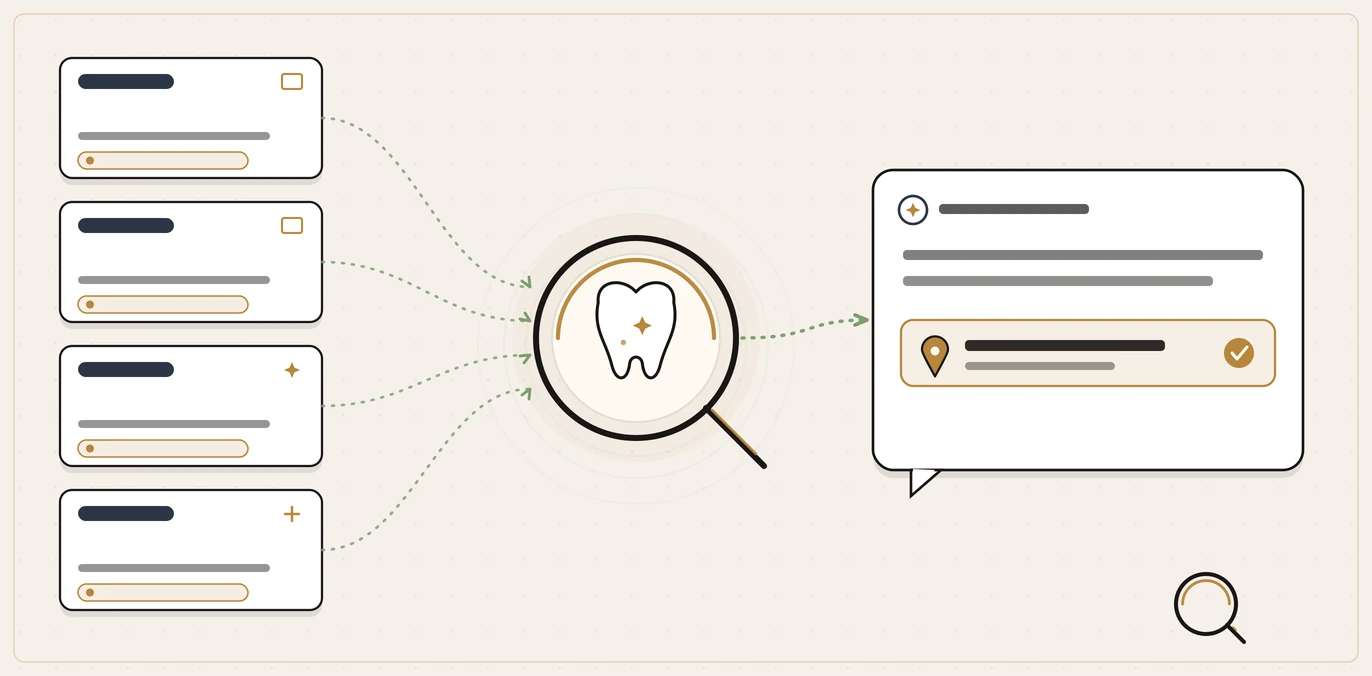
ChatGPT recommends a dentist when it can find your practice in the sources it actually searches (chiefly Microsoft Bing's index, plus directories, review platforms and the NHS listing), when those sources describe what you do in specific, machine-readable terms, and when enough independent places agree that you exist and are good at it. You cannot pay for the slot and your Google ranking does not carry over; you earn it with complete listings, consistent facts and genuine recent reviews. A well-documented single-site practice can be named ahead of a national group.
The short version
- Your Google ranking does not carry over. ChatGPT searches Bing, so claim Bing Places and confirm your pages are indexed there, or the engine that feeds it cannot cite you.
- No single page wins it. Your website is one voice alongside your Google profile, directories, reviews and the NHS listing, and the engine names you only when they agree.
- Be specific and machine-readable. A page per treatment named the way patients name it, plus schema, beats a vague "Treatments" page for every situational query.
- Recent reviews and consistent details decide close calls. Fresh, genuine reviews and identical name, address, phone and hours everywhere tip the engine towards naming you.
- You cannot buy it, and it stays GDC-safe. There is no paid placement; earning the mention with accurate, non-misleading information is exactly what the rules require.
A patient with a throbbing molar at nine on a Sunday night no longer opens a map and scrolls the stars. They open ChatGPT and type "is there an emergency dentist near me taking patients today?" The reply names two or three practices, sometimes one. If yours is named, the phone rings on Monday. If it is not, you never find out the call existed, because as far as your practice is concerned that patient was never looking.
This guide answers the question dental owners keep putting to us directly: how do you get ChatGPT to recommend your practice, and what is the model actually looking for when it decides which dentist to name? Every section below is a real question a practice owner asks, answered immediately and in full, so you can read the one that applies to you and act on it. It is written for UK practices, it stays inside General Dental Council rules at every step, and it asks you to overclaim nothing.
The short version, for anyone who wants the answer before the detail: ChatGPT recommends a dentist when it can find your practice in the sources it actually searches (chiefly Microsoft Bing's index, plus third-party directories, reviews and the NHS listing), when those sources describe what you do in specific, machine-readable terms, and when enough independent places agree that you exist and are good at it. The rest of this article unpacks each part of that sentence and tells you what to do about it. If you want the fuller practical playbook behind it, our guide to answer engine optimisation for dentists and clinics is the companion piece to this one.
Are patients really asking ChatGPT to recommend a dentist?
Yes, and the numbers behind it have crossed from curiosity into routine. ChatGPT reached 900 million weekly active users in February 2026, up from 800 million the previous October (TechCrunch, reporting OpenAI, February 2026)[2]. A tool used by close to a billion people every week is no longer a niche channel; it is one of the main places adults now ask questions, including questions about their health.
Health is one of the things they bring to it most. A KFF Tracking Poll in 2025 found that about a third (32%) of US adults now use AI for health information or advice, with 29% using it for their physical health specifically (KFF, 2025)[3]. KFF is a respected, non-partisan health research body rather than a marketing firm, which is exactly why the figure is worth trusting where vendor surveys are not. "Find me a dentist" sits squarely inside that behaviour: it is a local, practical, health-adjacent question of the kind AI tools are now asked all day.
Patient behaviour
AI is already part of the health search habit
900 million
weekly active users reached by ChatGPT in February 2026.
800 million
weekly active users the previous October.
32%
of US adults use AI for health information or advice.
29%
use AI for their physical health specifically.
TechCrunch, reporting OpenAI, February 2026; KFF Tracking Poll, 2025.
The same shift is visible inside ordinary Google searches. AI-generated summaries now appear on a large share of everyday Google searches. For a "dentist near me" query, that summary typically sits above the map pack a patient used to scroll. The practical lesson is simple: a meaningful and growing share of patients now read an AI answer before they reach anyone's website, and they decide which dentist to consider inside that answer.
That is the stake. The practices being named in these answers are quietly collecting the patients who used to be yours to win on the strength of a good website and a Google ranking. Neither of those, on its own, gets you into the AI reply any more.
Why doesn't my Google ranking get me into ChatGPT?
Because ChatGPT does not read Google. When ChatGPT searches the live web to answer a local question, it leans on Microsoft Bing's search index, not Google's. Your hard-won first-place Google position is invisible to it. A practice can top Google for "dentist in Reading" and go completely unnamed by ChatGPT, because the two systems are looking at different maps of the web.
Side by side
Two AI answers, two source maps
| Signal | ChatGPT recommendations | Google AI Overviews |
|---|---|---|
| Source index | Leans on Microsoft Bing's search index when it searches the live web. | Draws on Google's index. |
| Result format | Names or cites a dentist inside a chat answer. | Shows an AI-generated summary above the map pack. |
| Practice action | Claim Bing Places, submit your sitemap and keep independent listings consistent. | Keep your Google profile, website and corroborating sources clear and current. |
Drawn from the article's explanation of Bing, Google AI Overviews and source agreement.
This catches owners out because they have spent a decade being told that Google ranking is the finish line. It still matters for the patients who use Google directly, and good local SEO genuinely helps your wider visibility. But being named by ChatGPT is a separate job with its own inputs, a gap we set out in full in why a No.1 Google ranking means nothing in ChatGPT. The practical consequence is that you need to be present and well-described in Bing's index as deliberately as you ever were in Google's, and that you cannot assume your existing SEO work has carried you there.
There is a second reason a strong website alone is not enough, and it matters more than the Bing point for many practices. An AI answer about a dentist is not built from your website by itself. It is assembled from your Google Business Profile, review platforms, healthcare and local directories, the NHS "find a dentist" service and local press, then weighed for agreement. Your website is one voice in that chorus. If the other voices are missing or contradict each other, a beautiful website cannot rescue you.
How does ChatGPT actually choose which dentist to name?
It runs a short, hidden sequence: it works out what you really asked, gathers sources it trusts, checks whether they agree, and names the practice it is most confident about. Four questions decide whether that practice is yours.
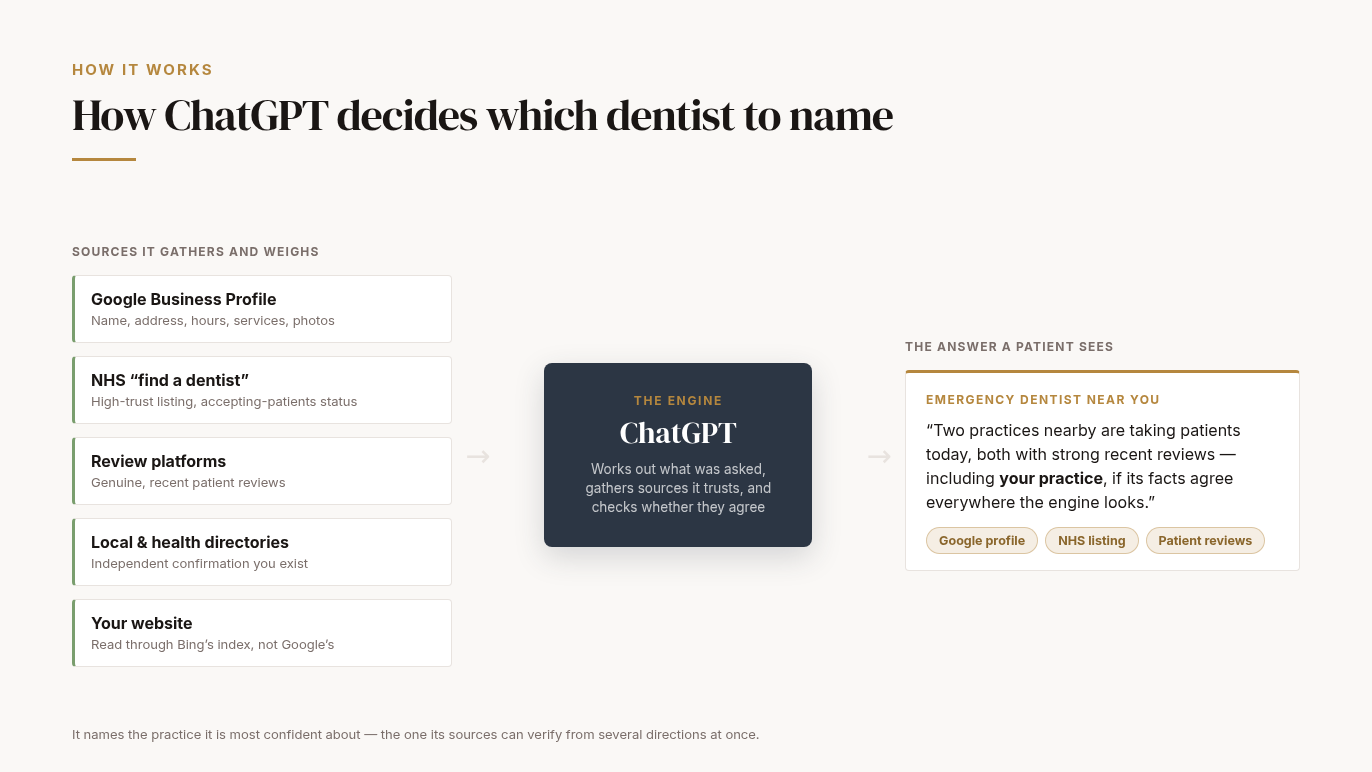
Recommendation path
How a dentist gets named
Understand the question
The engine works out whether the patient needs location, treatment, urgency or reassurance.
Gather sources
It looks across your website, listings, reviews, directories and NHS entry.
Check agreement
Name, address, hours, services and reviews need to tell the same story.
Name the practice
The answer chooses the dentist it can verify and describe most clearly.
Can the AI even find your site? (the Bing-index question)
If your pages are not in Bing's index, ChatGPT cannot cite them, and nothing else you do here matters. Two things commonly keep a practice out. The first is simply never having told Bing you exist: claim Bing Places for Business and submit your sitemap through Bing Webmaster Tools, the same way you once did for Google. The second is more technical and more common than owners expect.
Some practice websites, especially heavily-designed ones and certain page builders, render their text with JavaScript that only runs once a browser opens the page. Several AI crawlers do not run that code, so they arrive at your site and find a near-empty shell. A perfectly written practice page can be invisible to the engines for this single reason, a trap we walk through in our guide to whether AI can read your website.
The check takes two minutes: search site:yourpracticedomain.co.uk in Bing. If few or none of your pages show up, the engine that feeds ChatGPT cannot see you, and that is the first thing to fix before any of the work below pays off.
Does your site say what you do in a way a machine can read? (schema)
ChatGPT names practices it can describe with confidence, and confidence comes from clarity. Structured data (schema markup) is the machine-readable label that tells a search system, in plain terms it cannot misread, that you are a dental practice, where you are, what you offer, your opening hours and how patients rate you. The relevant types for a dentist are Dentist (or LocalBusiness), FAQPage for your common patient questions, and AggregateRating where you display genuine review scores.
Schema does not make a claim for you; it makes your true facts legible. A page that says "we offer emergency appointments, NHS check-ups and Invisalign in Leeds" reads clearly to a person, but schema removes the last scrap of ambiguity for the machine deciding whether to put your name in front of a patient asking for exactly those things.
Do enough independent sources confirm you exist? (citations and directories)
A single website saying good things about itself is the weakest possible signal. AI answers are built on corroboration: the more independent, reputable places that confirm your practice, its location and its services, the more confident the engine is in naming you. This is why the same handful of well-listed practices monopolise the answers in many towns. They are simply the ones the engine can verify from several directions.
For a UK dental practice the sources that carry weight are your Google Business Profile, the NHS "find a dentist" service (which both engines and patients treat as high-trust), reputable healthcare and local directories, any genuine professional or accreditation listings you hold, and local press or community pages. Each one needs to exist, be accurate, and agree with the others. Which leads to the single most boring and most decisive point in this whole guide.
Are your facts identical everywhere, and your reviews recent?
Your practice name, address, phone number, opening hours and service list should read identically across your website, Google profile, NHS listing and every directory. When they conflict, the engine has to guess which version is true, and an engine that is unsure tends to reach for a practice it is sure about instead. Conflicting opening hours or two slightly different phone numbers are enough to tip a close decision against you.
Reviews are the other heavy lever, and recency does more of the work than owners think. A wall of five-star reviews from three years ago reads, to both patients and engines, as a practice that may have gone quiet. Steadily gathering genuine, recent reviews on Google first, then NHS and healthcare-specific platforms, is one of the highest-impact things you can do. Reply to all of them, good and bad, but never put a patient's clinical details in a public reply: thank them, answer the general point, and take specifics offline. That single discipline protects confidentiality and reads well to everyone, human and machine.
What exactly are patients typing into ChatGPT?
They are not typing "best dentist". They are asking specific, situational questions, and they fall into five recognisable groups. Knowing the groups tells you which pages and facts you are missing.
- General "find me a dentist" questions. "NHS dentist near me taking on patients", "good family dentist in Bristol". These reward a complete Google profile and an accurate NHS listing above all.
- Treatment-specific questions. "How much is Invisalign in Leeds?", "teeth whitening dentist in Cardiff", "dental implants near me". These reward a clear, factual page for each treatment, named the way patients name it, with clear price ranges.
- Emergency questions. "Emergency dentist open now near me", "I've knocked out a tooth, where do I go in Manchester?" These are among the highest-intent questions in dentistry, and they reward explicit opening hours and a plainly described out-of-hours route.
- Comparative questions. "NHS versus private dentist", "which dentist in [town] is best for nervous patients?" These reward clear comparison pages and reassurance content, not superlatives.
- Trust and reassurance questions. "Dentist for nervous patients in [town]", "is [practice] any good?", "dentist with wheelchair access near me". These reward genuine reviews, accessibility detail and clearly stated qualifications.
The practical move is to read that list as an audit. For each group, ask whether a patient could get a clear, specific answer about your practice from what is currently published about you. Every group where the answer is "no" is a group of patients the engine cannot route to you.
One point works in your favour underneath all of this. AI tools rewrite the question before they search: Google calls its own method "query fan-out", where it breaks a question into subtopics and issues "a multitude of queries simultaneously on your behalf" (Google, AI in Search, May 2025)[4]. Owners reasonably fear that "in Sheffield" or "near me" gets sanded off in that rewrite, taking their local advantage with it.
In practice, location is the part of the question the engines hold on to most reliably while they thin out the rest. Geography stays the filter, which is precisely why a well-documented single-site practice can out-answer a national group for a "near me" question: you only have to be the best-described dentist in one place, not in fifty. We unpack how that rewrite works in query fan-out explained.
What do I actually do to get recommended? A step-by-step
Here is the practical sequence, in the order that pays off fastest. None of it is glamorous and all of it is verifiable.
- Claim and complete your Google Business Profile. Exact name, address, phone and website; full opening hours and how emergency care works; every service you genuinely offer, in plain words; a current, truthful "accepting new patients" status; real photos; and accessibility details (step-free access, parking, wheelchair access). This is the single biggest lever, and many practices never fully pull it.
- Get into Bing. Claim Bing Places, submit your sitemap through Bing Webmaster Tools, and confirm your pages are indexed with the
site:check above. This is what puts you on the map ChatGPT actually reads. - Add the right schema.
Dentist/LocalBusiness,FAQPageandAggregateRatingwhere genuine. Make your true facts machine-legible. - Build treatment-specific pages with real facts. One clear page per service, named as patients name it, with what the treatment involves, indicative price ranges, typical timescales and named clinicians where appropriate. Replace the single "Treatments" page that answers none of the fanned-out questions with pages that each answer one.
- Fix your NHS listing and key directories. Make the NHS "find a dentist" entry truthful about whether you are accepting patients, and bring your details into exact agreement across every directory you appear in.
- Gather genuine, recent reviews and reply safely. Ask satisfied patients at the right moment (after a completed course of treatment, not mid-appointment), make it a one-tap job, and reply to everything without ever revealing clinical detail.
Work them in that order and you fix the cheapest, highest-impact gaps first. You do not need to complete all six before any of it counts; each one independently improves your odds of being named.
Worklist
The fixes that make a practice recommendable
Complete the Google Business ProfileName, address, phone, website, hours, services, photos and accessibility details.
Get the site into BingClaim Bing Places, submit the sitemap and confirm pages appear with the site check.
Add the right schemaMake your true facts machine-readable with Dentist, LocalBusiness, FAQPage and AggregateRating where genuine.
Build treatment-specific pagesAnswer one patient question per service page in plain, provable detail.
Fix the NHS listing and directoriesBring accepting-patients status and practice details into exact agreement.
Gather recent reviews safelyAsk satisfied patients at the right moment and reply without revealing clinical detail.
How do I check whether ChatGPT already recommends me?
You can test all of this today, free, in about ten minutes. Open ChatGPT, Google's AI Mode and Perplexity, and ask each one the questions a real patient asks: "best dentist in [your town]", "NHS dentist near me taking on patients", "emergency dentist in [your area] today", "dentist for nervous patients in [town]". Watch whether your practice is named, where in the answer it appears, and which sources the reply is leaning on.
Run each prompt a few times, because the answer shifts between attempts, and it is the recurring pattern rather than any single reply that tells you where you stand. Absent from every answer means you have found the leak. Named only alongside a competitor means it is worth studying what they hold that you do not: fresher reviews, a live NHS listing, clearer fee and service pages, details that agree across the web. The gap between their online presence and yours is your worklist. For the fuller method, including when a paid tracking tool earns its keep, see our guide to checking whether AI mentions your business.
Finish the self-test with the index check: search site:yourpracticedomain.co.uk in Bing. No results there explains a lot of absence in ChatGPT, and it is the first thing to fix.
How long does it take, and is it worth it?
There is no fixed schedule, and the straight answer is that it varies. Completing your Google profile and starting to gather recent reviews can move things within a few weeks; building out directory presence, fixing inconsistent facts across the web and earning enough corroboration to be named confidently takes longer, often a few months of steady work. Slow, durable groundwork beats any quick fix, and there is no shortcut that survives contact with how these engines actually verify a practice.
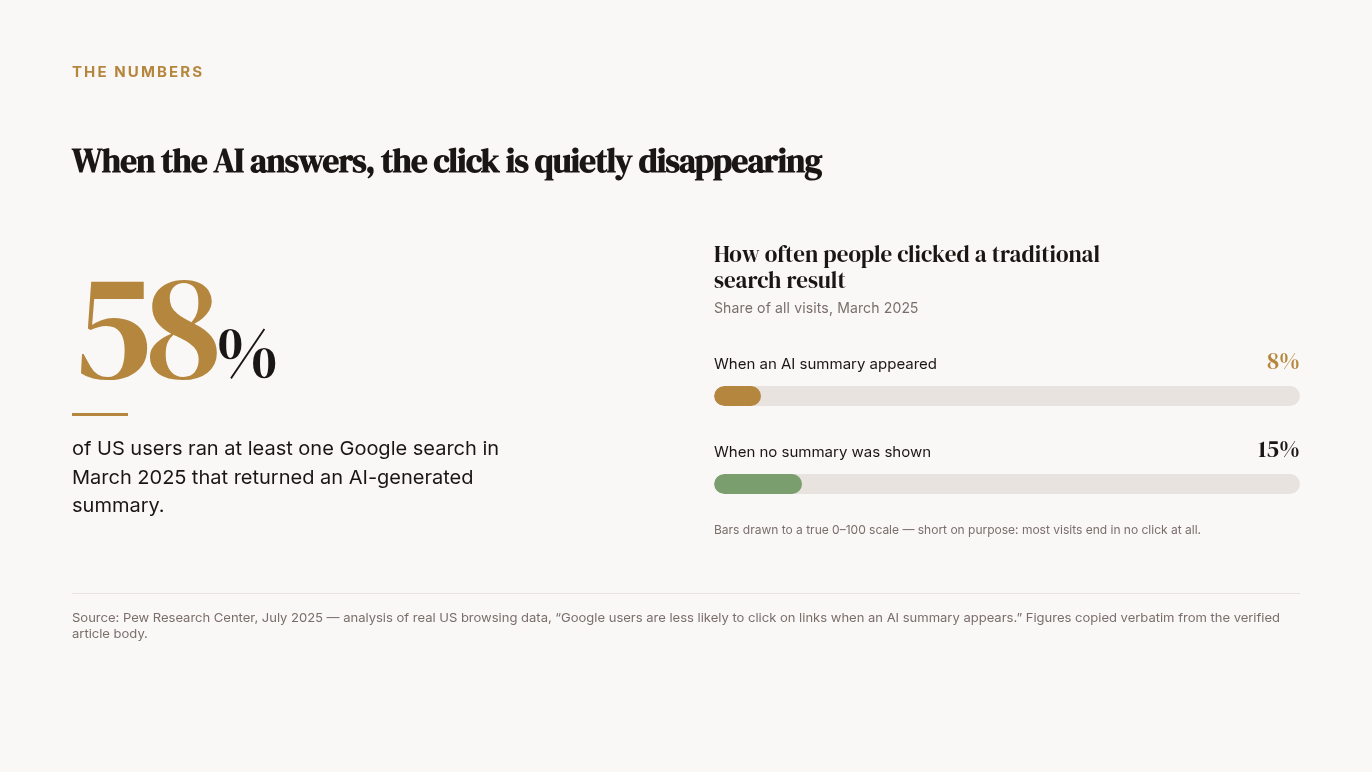
On whether it is worth it, weigh it against the alternative. When an AI summary answers the question at the top of the page, far fewer people scroll down to the old blue links at all. The patient increasingly acts on the answer itself. A practice that is named in that answer is collecting bookings its competitors never see coming; a practice that is absent is losing them with no missed-call log to show for it. The effort is real, but so is the cost of staying out of it.
Can I pay ChatGPT to recommend my practice?
No. There is no paid placement that buys you into a ChatGPT recommendation the way Google Ads buys you a slot above the organic results. Anyone promising to "pay your way" into the AI answer is selling something that does not exist. What you can do is earn the recommendation by being the practice the engine can most confidently verify and describe: complete listings, consistent facts, genuine recent reviews, clear service pages. That route is open to a single-site practice as much as a national group.
Is any of this against GDC rules?
No, done as described here. The General Dental Council asks that anything you publish about your practice is accurate and not misleading (General Dental Council, Standards for the Dental Team)[1]. That covers your website, your Google profile, your social posts and any third-party listing you feed.
The moves that win you an AI recommendation are the same ones that keep you inside that rule. Accurate information, genuine reviews, clear service pages and clear pricing satisfy both at once. The places people get into trouble are the places the rule already forbids: outcome guarantees ("a brighter smile guaranteed", "pain-free dentistry, always"), unverifiable superlatives ("the best dentist in [town]"), and stale claims such as an "accepting NHS patients" line left switched on after the list has closed.
None of those help with AI visibility either; an engine cannot responsibly repeat a guarantee or a superlative, and a stale fact actively damages the consistency the engine rewards. You can be specific, factual and convincing without ranking yourself above a named peer, and an engine will happily recommend you on factual strength alone.
Frequently asked questions
Does ChatGPT use Google or Bing to find dentists?
Chiefly Bing. When ChatGPT searches the live web it leans on Microsoft Bing's index, not Google's, so your Google ranking does not carry over. You need your pages indexed in Bing (claim Bing Places, submit your sitemap through Bing Webmaster Tools) for ChatGPT to be able to cite you.
If I have great Google reviews, why doesn't ChatGPT mention me?
Because reviews are only one signal, and an AI answer is built from several that have to agree. If your Google profile is strong but your NHS listing is out of date, your directory details conflict, or your pages are not in Bing's index, the engine cannot confidently name you. Bring your facts into agreement everywhere and make sure you are indexed, and your good reviews start counting for far more.
Can I say my practice is "the best" if AI seems to reward confident language?
No. "Best dentist in [town]" is an unverifiable superlative, and it gives the engine nothing it can stand behind. Be specific instead (services, qualifications, genuine patient feedback, transparent fees), and an engine can recommend you on that factual strength without you ever ranking yourself above a competitor.
How is this different from SEO?
Traditional SEO is about ranking your own pages in a list of links, mostly on Google. Getting recommended by ChatGPT is about being named or cited inside an AI answer, which leans as much on your reviews, NHS and directory listings and consistent facts as on your website, and which reads Bing rather than Google. The two overlap and good SEO helps, but a first-place Google ranking does not guarantee an AI mention.
How quickly can my practice start showing up?
There is no set timeline. Completing your Google profile and gathering recent reviews can shift things within weeks; building directory presence and earning enough corroboration to be named confidently takes a few months. It is durable, compounding work rather than a switch you flip.
How do I check whether ChatGPT can even read my website?
Search site:yourpracticedomain.co.uk in Bing. If few or none of your pages appear, the index that feeds ChatGPT cannot see you, and that is the first thing to fix. It is also worth checking whether your text shows in the page's view-source, because a site that renders its words only through JavaScript can look complete to you and be a hollow shell to a crawler.
Do reviews on the NHS site and directories count, or only Google?
They all count, and spread across platforms is part of what builds confidence. Google reviews carry weight, but the engine also reads your NHS listing, healthcare directories and local platforms, and it values seeing the same picture in more than one place. Gather genuine reviews Google-first, then add NHS and healthcare-specific sites, and keep them recent.
Should I create a separate page for every treatment?
For the treatments patients actually search by name, yes. A page each for implants, Invisalign, emergency care, whitening and the like, named the way patients name them and stating what the treatment involves, rough prices and typical timescales, lets the engine match you to specific questions. A single catch-all "Treatments" page answers none of them clearly.
Does an FAQ section help my practice get recommended?
Only in the sense that it answers real patient questions clearly. Question-style headings do not lift AI recommendations on their own; the value is coverage and reader clarity, addressing insurance, nervous patients, emergencies and pricing in plain language. Treat FAQs as a way to answer what patients ask, not as a citation trick.
How is being recommended by ChatGPT different from being recommended by Google AI Overviews?
The mechanics are similar (both name practices they can verify and describe clearly) but the source maps differ. Google AI Overviews draw on Google's index; ChatGPT leans on Bing's. So a practice can appear in one and not the other. Getting into both means being well-described and consistently listed across both indexes, not assuming one carries the other.
Where to start
If you do only three things from all of this, take them in this order: claim and complete your Google Business Profile with an accurate, current accepting-patients status; confirm your pages are indexed in Bing and add the right schema so the engine can read you; and rewrite your key service and fee pages so each answers a real patient question plainly and provably. Those three carry most of a patient from "I need a dentist" to "I've booked".
If you would rather have this checked for you first, a free QBiz Leads AI visibility check scans your website in about thirty seconds and returns a clear pass or fail on the key signals that decide whether AI tools can find and recommend your practice, with a prioritised list of what to fix first. It is the no-cost first step before any spend.
One last distinction is worth drawing before you begin, because it sets the ceiling on how far the work above can carry you. Everything on this page is on-page work: what your own pages, profiles and listings say about your practice, which is what makes you eligible to be named.
The other half sits off-page, in the mentions and coverage you do not control, where independent directories, local press and healthcare write-ups describe your practice in their own words. An engine weighs that earned corroboration heavily precisely because you did not write it, and we treat the two halves as one job. If you want to see how the off-page side is built, our guide to citations for AEO explains what actually earns a mention and why it counts.
If your practice is currently absent from these answers, see why your dental practice is not showing up in ChatGPT recommendations. For the full practical playbook, read answer engine optimisation for dentists and clinics. For the ranking mechanics behind these recommendations, see how AI Overviews rank dental practices in 2026. If you are still weighing why this deserves your attention and where to begin, start with AI search visibility for dental practices. For the service-page view of how QBiz applies it, see our AI SEO for dentists page, part of our wider AI optimization services.
Get your AI Visibility audit →
Sources
- [1] General Dental Council, "Standards for the Dental Team" (the requirement that advertising and information about your practice is accurate and not misleading): https://standards.gdc-uk.org/pages/principle1/principle1 (primary, regulatory)
- [2] TechCrunch, "ChatGPT reaches 900M weekly active users," reporting OpenAI, 27 February 2026: https://techcrunch.com/2026/02/27/chatgpt-reaches-900m-weekly-active-users/ (900 million weekly active users in February 2026, up from 800 million the previous October)
- [3] KFF, "KFF Tracking Poll on Health Information and Trust: Use of AI for Health Information and Advice," 2025: https://www.kff.org/public-opinion/kff-tracking-poll-on-health-information-and-trust-use-of-ai-for-health-information-and-advice/ (independent; 32% of US adults use AI for health information or advice, 29% for their physical health specifically)
- [4] Google, "AI in Search: Going beyond information to intelligence," 20 May 2025: https://blog.google/products/search/google-search-ai-mode-update/ (primary; query fan-out definition, issuing "a multitude of queries simultaneously on your behalf")
Leave a comment
Thoughts on this post? Leave a comment below. Comments are moderated before they appear, so yours will not show on the page straight away.
Your email is used only to contact you about your comment if needed — it is never published.
Comments
No comments yet. Be the first to leave one above.