How to Check If AI Recommends Your Business: Free Methods First
Your next customer may not search Google in the old way. They may ask ChatGPT, Perplexity or Google AI Mode a direct question: "Who is the best accountant near me for a limited company?" or "Which roofing company in Bristol has good reviews?"
The answer may name three businesses. If yours is one of them, you have a chance. If it is not, you may never know the customer was looking.
That is why AI visibility tracking matters. Forget chasing a fashionable marketing metric; the point is to answer a practical question: when real buyers ask AI tools for a business like yours, do they mention you, your competitors, or nobody useful at all?
The good news is that you do not need a paid tool to start. You can run a basic check yourself in an hour. This guide shows you how to test your business manually, what to record, which metrics matter, where free testing falls short, and when a paid tool or a QBiz AI Visibility audit becomes worth it.
If you are brand new to the topic, start with our wider guide to Answer Engine Optimisation for local businesses. If you already know you want to check your own visibility, stay here.
What AI visibility tracking actually means
AI visibility tracking is the process of checking whether answer engines mention, cite or recommend your business when people ask questions related to your services.
For a local business, that usually means testing prompts like:
- "best [service] in [town]"
- "who should I call for [problem] in [area]?"
- "recommend a [trade or profession] near me"
- "which [type of business] has good reviews in [town]?"
- "is [your business name] a good choice for [service]?"
The aim is not to prove that one tool gives one fixed answer. AI answers change. The aim is to spot patterns: whether you appear at all, whether competitors appear more often, which sources the AI cites, and whether the answer describes your business accurately. (For the mechanics behind that last point, see how AI engines pick their sources.)
A simple manual test can tell you a lot. It will not replace proper monitoring over time, but it will show whether you have an obvious visibility gap.
The free manual method: how to check AI mentions yourself
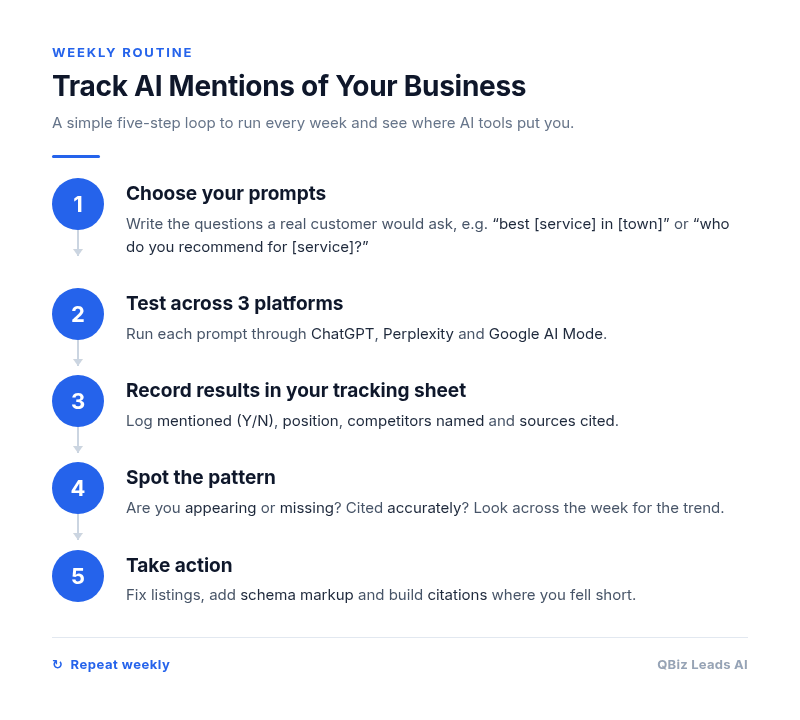
Set aside 45 to 60 minutes. Open a spreadsheet or a simple document. You are going to test the same set of buyer questions across the main tools your customers are most likely to use.
The free method
Check your AI mentions in under an hour
Choose the tools
Start with three: web-enabled ChatGPT, Perplexity and Google AI Mode.
Write buyer prompts
Ten to fifteen prompts mixing service-led, problem-led, location-led and brand-led questions.
Run and record
Note whether you were named, which competitors were, the sources cited and the accuracy.
Repeat for the pattern
Run the same set again a few days later; look for the pattern, not a perfect score from one run.
Step 1: Choose the AI tools to test
Start with three:
ChatGPT: useful because many people ask it broad recommendation questions and follow-up questions. If you have access to web-enabled ChatGPT, use that rather than a model that cannot browse current information.
Perplexity: useful because it behaves more like a search engine and usually shows sources clearly. It is one of the easiest places to see which pages are being cited.
Google AI Mode or Google AI answers: useful because many customers still begin inside Google. If AI Mode is available to you, test there. If not, test ordinary Google searches and note whether AI-generated answers appear.
You can add Microsoft Copilot, Gemini or another tool later. For a first pass, do not overcomplicate it. Three platforms are enough to see whether you are present, absent or misrepresented.
Step 2: Write prompts a real customer would ask
Do not test only your business name. That tells you whether AI can recognise you when prompted directly, not whether it recommends you to a buyer who has never heard of you.
Build a prompt list around customer intent. Use your actual services, towns and buying situations.
For an electrician, useful prompts might be:
- "Who is the best emergency electrician in [town]?"
- "Recommend an electrician near [area] for a fuse board replacement."
- "Which electricians in [town] have strong reviews?"
- "Who should I call if my power keeps tripping in [town]?"
- "Is [business name] a good electrician in [town]?"
For a solicitor, useful prompts might be:
- "Who is a good family solicitor in [town]?"
- "Recommend a solicitor for a house purchase near [area]."
- "Which law firms in [town] handle employment disputes?"
- "Is [firm name] a reputable solicitor?"
Use ten to fifteen prompts. Include a mix of service-led, problem-led, location-led and brand-led questions. If you only test one type, you get a distorted view.
Step 3: Run the prompts in a clean, repeatable way
Run each prompt in each tool. Keep the wording identical where possible. Do not argue with the tool or feed it extra hints after the first answer, because that changes the test.
For each answer, record:
- The date.
- The tool tested.
- The exact prompt.
- Whether your business was mentioned.
- Which competitors were mentioned.
- Whether any sources or citations were shown.
- Whether the answer was accurate.
- Any obvious reason the named businesses won (reviews, directory listings, clearer service pages, local press, stronger Google Business Profile).
If an answer gives no business names and only generic advice, record that too. It still tells you something: the tool may not be confident enough to recommend providers for that question.
Step 4: Repeat the test, but do not obsess over one answer
AI answers vary. A business can appear one day and disappear the next. That is normal, so do not make a big decision from a single answer.
Run the same test again a few days later. If you have time, test from a different device or account as well. You are looking for the pattern across prompts and platforms, not a perfect score from one run.
A useful first test is two runs across three tools: once today, once next week. That is enough to reveal whether you are consistently absent, occasionally named or already visible for some questions.
What to measure: the AI visibility metrics that matter
You do not need a dashboard full of numbers. For a small business, four metrics matter most.
What to measure
The four metrics that matter for a small business
Mention rate.The share of tested answers that name your business; track it over time using the same prompts, as your own sample not a market statistic.
Competitor share.Ask who appeared instead; a repeated competitor exposes the signals you need to match or beat.
Citation sources.Record which pages the answer used; the fastest route in is often improving a profile the AI already trusts.
Accuracy and sentiment.Visibility is not enough if the answer is wrong; fix the sources it reads, not the AI directly.
1. Mention rate
Mention rate is the share of tested answers that name your business.
If you test 30 answers in total (ten prompts across three tools) and your business appears in three, your manual mention rate is 10% for that test set. Do not present this as a market-wide statistic. It is your own sample, based on your own prompts, but it is still useful.
Track it over time using the same prompts. If you go from three mentions to eight mentions after fixing reviews, service pages and directory listings, you have a meaningful signal that the work is helping.
2. Competitor share
Do not only ask "did we appear?" Ask "who appeared instead?"
If the same two competitors appear again and again, study them. Look at their Google Business Profile, review volume, directory coverage, service pages, local press mentions and third-party profiles. AI answers often expose the competitor signals you need to match or beat.
This is one of the best parts of manual testing. It turns a vague complaint ("AI ignores us") into a practical comparison ("three competitors have clearer service pages and stronger directory mentions for this question").
3. Citation sources
Some tools show the pages they used. Perplexity is usually clear about this, and Google often shows sources in or around AI answers. ChatGPT may show links when web search is active.
Record the cited sources. Are they business websites, Google profiles, directories, review sites, local news pages, trade bodies or forums?
Then ask two questions:
- Is your website or profile being cited?
- If not, can you get mentioned on the sources that are being cited?
Sometimes the fastest route into an AI answer is not a new page on your own site. It is improving a profile on the directory, trade-body page or local article that the AI already trusts.
4. Accuracy and sentiment
Visibility is not enough if the answer is wrong.
Record whether the AI describes your business accurately. Does it list the right services? Does it use the right town? Does it mention old opening hours, an old address, a service you no longer offer, or a negative complaint that has since been resolved?
If AI is describing you incorrectly, the fix is usually not to "correct the AI" directly. It is to correct the sources it reads: your website, Google Business Profile, directories, review replies and any pages that mention you. Our guide to fixing what AI says about your business walks through that source-cleaning process in detail.
A simple tracking sheet you can copy
Use these columns:
| Date | Tool | Prompt | Your business mentioned? | Position or prominence | Competitors mentioned | Sources cited | Accuracy notes | Action needed |
|---|---|---|---|---|---|---|---|---|
| 17 June | Perplexity | best [service] in [town] | No | N/A | Competitor A, Competitor B | Directory, local article | Competitor A cited via directory | Improve directory profile |
| 17 June | ChatGPT | is [business name] good for [service]? | Yes | Named directly | None | Website, reviews | Old opening hours shown | Update Google Business Profile and directory listings |
| 17 June | Google AI Mode | who do you recommend for [service] near [town]? | No | N/A | Competitor B, Competitor C | Google Maps, review site | Not mentioned despite ranking p.1 organically | Add FAQPage schema to main service page |
| 24 June | Perplexity | best [service] in [town] | Yes | 2nd of 3 named | Competitor A | Directory, own website | Description accurate | Push for 1st position — get more third-party citations |
| 24 June | ChatGPT | who handles [service type] in [region]? | No | N/A | Competitor A, Competitor D | Industry directory, news article | Neither competitor cited our site | Target industry directory listings; pitch local press |
| 24 June | Google AI Mode | is [business name] reputable? | Yes | Named with summary | None | Google Business Profile, review site | Review summary slightly outdated | Respond to recent reviews; request fresh ones |
Save a copy: recreate these columns in a Google Sheet or spreadsheet of your choice — Date, Tool, Prompt, Mentioned (Y/N), Position, Competitors named, Sources cited, Accuracy notes, Action needed. Run the same core prompts each week so you can track movement over time.
Keep it boring. The value is in consistency. If you change the prompts every week, you cannot see progress. Keep a core set of prompts and add a few new ones only when you want to test a new service or location.
How to interpret the results
Manual testing usually reveals one of five situations.
You are not mentioned anywhere
This is common. It usually means AI tools do not have enough confident, consistent evidence to recommend you for those prompts.
Start with the basics: complete your Google Business Profile, strengthen your key service pages, gather recent reviews, clean up directory information and make sure your name, address and phone number match across the web. This is the same foundation covered in the local AEO guide.
You appear only when your business name is included
This means the tools can identify you, but they are not yet choosing you for category searches. That is a different problem.
You need clearer evidence that you are a good answer for the service and location, not just proof that your business exists. Service pages, reviews, trade directories and third-party mentions matter here.
You appear in one tool but not another
This is normal. ChatGPT, Perplexity and Google do not all choose sources in the same way. A strong Perplexity result does not guarantee a ChatGPT mention, and a good Google presence does not guarantee AI answers will name you.
Use the difference as a clue. If Perplexity cites directories but ChatGPT names a competitor from a local article, you have two different source paths to work on.
Competitors appear repeatedly
This is useful, even if it stings. A repeated competitor mention gives you a target.
Look at what the AI seems to trust about them. Are they named in more local articles? Do they have more recent reviews? Is their site clearer about services and towns? Are they present on a trade-body directory where you are absent?
Do not copy their wording, copy what they do well: clear facts, consistent profiles, credible mentions.
The answer is wrong
If AI lists the wrong phone number, old services or a poor description, treat it as a source-cleaning job. Find where that information exists and correct it. Start with your own website and Google Business Profile, then check directories and old social profiles.
Wrong answers are frustrating, but they are also useful. They show you which facts are messy enough for AI to misunderstand.
Free testing has limits
Manual testing is the right starting point, but it has limits.
Side by side
Where the free manual test stops and a paid tool starts
| Free manual method | Paid tool or audit | |
|---|---|---|
| Coverage | A small sample of prompts across a few tools; reveals a pattern, not every question a customer might ask | Wider prompt sets built to test more of the questions customers actually ask |
| Repeatable at scale | Hard once you serve many towns and services; the prompt list grows quickly | Designed to run large prompt lists across towns, services and branches |
| Tracking volatility | A spreadsheet can miss swings unless you test regularly | Tracks movement over months rather than a single check |
| Source detail | Citations show cleanly on some platforms and not others | Often surfaces citation and source pages, though still vendor information |
It is a small sample. Ten prompts across three tools can reveal a pattern, but it does not cover every question a customer might ask.
It is hard to repeat at scale. If you serve five towns and offer ten services, the prompt list becomes large quickly.
It does not track volatility well. AI answers change over time. A spreadsheet can show some movement, but it is easy to miss swings unless you test regularly.
It can be biased by your own prompt choices. Business owners often test the questions they wish customers asked, not the questions customers actually ask.
It rarely captures source detail cleanly across every platform. Some tools show citations clearly. Others do not. You may see the answer without knowing exactly why it chose those businesses.
These limits do not make free testing useless. They simply define what it is: a first diagnostic, not a full monitoring system.
When paid AI visibility tools are worth it
A paid tool becomes worth considering when the cost of not knowing is higher than the tool or audit cost.
Free or paid
Do you need more than the free manual test?
Ask
Is the cost of not knowing higher than the tool or audit cost?
A paid tool earns its place
Many towns, services or branches, competitors investing, and a need to track movement over months and report to a board.
The free test is enough for now
One location and a first diagnostic; run the manual check and fix the basics before paying for a dashboard.
That usually happens when:
- AI recommendations could influence high-value enquiries.
- You operate across multiple towns, services or branches.
- Several competitors are investing in content, reviews and digital PR.
- You need to track movement over months, not just run one check.
- You need competitor comparisons at scale.
- You need to see which sources are driving mentions.
- You are reporting to partners, a board or a franchise group.
Vendor platforms often measure things such as visibility score, mention rate, sentiment, citation share, cited pages and competitor rank. Treat those dashboards as vendor information, because the companies behind them sell AI visibility software, but the categories themselves are useful: they reflect the kinds of signals any serious tracking process should inspect.
Paid tools are not magic. They still depend on prompt sets, assumptions and platform access. Before buying one, ask:
- Which AI engines does it test?
- How are prompts chosen?
- Can I edit the prompts to match my services and locations?
- Does it show the raw answers, not just a score?
- Does it show citations and source pages?
- Does it separate brand mentions from true recommendations?
- Can it track competitors I actually care about?
- Does it explain what to fix, or only show a dashboard?
If a tool gives you a score but no useful next step, it is reporting, not strategy.
When a QBiz AI Visibility audit is the better first step
A paid software subscription is not always the right first move for a local business. Many owners do not need another dashboard. They need a clear answer to three questions:
- Where do we appear now?
- Which competitors appear instead?
- What should we fix first?
That is where a QBiz AI Visibility audit fits. It is designed as a practical starting point, not a long-term software commitment.
The audit is worth considering if:
- You have run the free test and found little or no visibility.
- You are not sure which prompts customers actually use.
- You appear in one tool but not another and need to know why.
- AI gives wrong or outdated information about your business.
- Competitors are repeatedly recommended and you want to know what they have that you do not.
- You want a prioritised action plan before spending money on content, SEO or paid tracking.
A good audit should not simply tell you that AI is important. You already know that. It should show the actual prompts tested, the answers returned, the competitors named, the sources cited and the practical fixes in order of priority.
For most small businesses, that is more useful than paying for a platform before the basics are in place.
What to do after your first AI visibility check
Once you have the results, do not jump straight into random content. Fix the highest-confidence gaps first.
If your business information is inconsistent
Clean this up before anything else. Your name, address, phone number, opening hours, service list and areas covered should match across your website, Google Business Profile, directories and social profiles.
AI tools are less likely to recommend a business when the web cannot agree on the facts.
If competitors have stronger review signals
Build a review process. Ask satisfied customers at the right moment, make it easy for them, and respond to reviews properly. Do not buy fake reviews or pressure customers. You need genuine, recent proof that people trust you.
If your service pages are vague
Rewrite them around real customer questions. A page titled "Services" that says you offer "tailored solutions" gives AI very little to use. A page that clearly answers "emergency locksmith in Leeds", with services, response times, areas covered, pricing guidance and qualifications, is far easier to understand and cite.
If third-party sources keep getting cited
Work out whether you can earn a place there. That may mean completing a trade directory profile, joining a professional body, improving a local listing, answering a community question genuinely or pitching a useful local story.
Do not spam forums or fake mentions. AI visibility is a trust game. Fake signals tend to create risk faster than they create leads.
If AI describes you incorrectly
Find and correct the source. If the answer says you no longer serve a town, check whether old pages, old profiles or old directory entries say the same. If it says you lack a service you do offer, make that service clearer on your own site and profiles.
Common mistakes when checking AI mentions
Testing only your own business name. That is a brand-recognition test, not a buyer-recommendation test.
Running one prompt once and panicking. AI answers vary. Look for repeated patterns.
Using prompts no customer would ask. If the wording sounds like a marketer, rewrite it like a real customer with a problem.
Ignoring competitors. The names that appear instead of yours are the most useful part of the test.
Counting any mention as a win. A passing mention is not the same as a recommendation. "Other firms include..." carries less value than "I would shortlist..."
Forgetting accuracy. A mention with the wrong service, town or phone number can hurt more than silence.
Buying a tool before fixing the basics. If your Google profile is incomplete and your service pages are thin, tracking the problem more closely will not solve it.
Frequently asked questions
Can I check ChatGPT mentions for free?
Yes. Ask ChatGPT the same questions a buyer would ask, then record whether it names your business, names competitors, shows sources and describes you accurately. Use web-enabled ChatGPT where available, because non-browsing models may not reflect current information.
Which AI tools should I test first?
Start with ChatGPT, Perplexity and Google AI Mode or Google's AI answers. That gives you a mix of conversational AI, citation-heavy AI search and the AI layer inside traditional search.
How often should I check AI visibility?
For a small business doing this manually, monthly is enough once you have a baseline. If you are actively fixing pages, reviews and listings, test before the work starts, then again four to six weeks later using the same prompts.
Why does ChatGPT mention me one day and not the next?
AI answers are not fixed rankings. They can change because the tool rewrites the question differently, retrieves different sources or produces a different summary. That is why you track patterns over time rather than one answer.
Do I need a paid AI visibility tracker?
Not at the start. Run the free test first. A paid tracker makes sense when you need scale, competitor tracking, repeated monitoring, citation analysis or reporting. Many local businesses are better served by an audit and a fix list before they buy software.
What is the difference between AI visibility tracking and AEO?
Tracking measures what is happening: whether AI tools mention, cite or recommend you. AEO is the work you do to improve that result: clearer pages, better reviews, stronger listings, consistent facts and credible off-site mentions.
Start with the free test, then decide
You can learn a lot today without spending anything. Pick ten real customer prompts. Test them in ChatGPT, Perplexity and Google AI Mode. Record who gets mentioned, what gets cited and whether your business is described accurately.
If you are visible, you have a baseline to improve. If you are absent, you have proof that the gap is real. If competitors keep appearing, you have a map of what to investigate next.
If you would rather start with a quick read on where you stand, a free QBiz Leads AI visibility check scans your website in about thirty seconds and returns a clear pass or fail on the key signals that decide whether AI tools can find and recommend your business, with a prioritized plan for what to fix first.
Get your AI Visibility audit →
Sources
- [1] OpenAI, ChatGPT: https://chatgpt.com/ (primary platform interface for manual prompt testing.)
- [2] Perplexity: https://www.perplexity.ai/ (primary platform interface for manual prompt testing and citation review.)
- [3] Google Search, AI Mode: https://www.google.com/ (primary platform interface for testing Google AI answers where available.)
Leave a comment
Thoughts on this post? Leave a comment below. Comments are moderated before they appear, so yours will not show on the page straight away.
Your email is used only to contact you about your comment if needed — it is never published.
Comments
No comments yet. Be the first to leave one above.