Zero-Click Search Is Here: What It Really Means for a Small Business's Leads
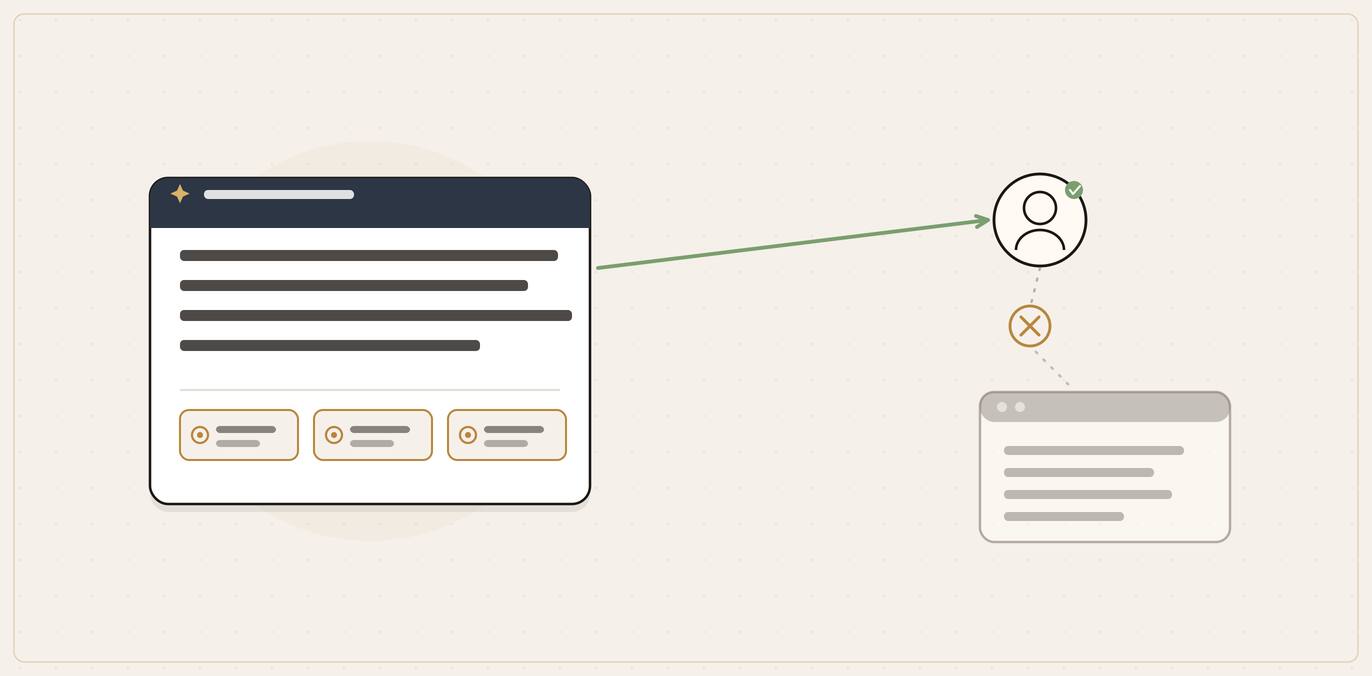
Zero-click search is any search where the person gets their answer on the spot, in an AI summary or a chatbot reply, and never clicks through to a website. It is now common: Semrush found around 16% of Google queries show an AI Overview, and Ahrefs measured a 34.5% lower clickthrough rate for the top page when one appears.
For a small business it does not mean the end of being found; it means the customer's choice of who to contact now happens inside the answer, so your job shifts from ranking a page to being one of the businesses the answer names. You do that by measuring enquiries rather than just clicks, making your key pages plainly quotable, and tending the off-site reviews, listings and mentions the AI reads.
Quick answer
- The click is disappearing, not the customer. People read the answer in place, so a falling traffic graph can sit next to steady or rising enquiries.
- The data is real but not apocalyptic. Roughly one in six Google searches now shows an AI Overview, and clickthrough to the top page drops about a third when it does.
- Being named beats being ranked. The comparison happens inside the answer, so ranking first and going unnamed is now the painful place to be.
- Change the scoreboard. Track enquiries, how people say they found you, and whether the AI names you, not website visits alone.
- Feed the signals the answer uses. Clear quotable pages, recent reviews, consistent listings and genuine mentions are what get a small business into the reply.
If your website traffic has slipped this year while your phone hasn't got any busier, you are not imagining it, and it probably isn't your fault. Something has changed in how search works, and it has a clumsy name: zero-click search.
The phrase sounds like jargon, but the idea is simple. More and more often, a person types a question, reads the answer right there on the results page or inside ChatGPT, and never clicks through to anyone's website. The question is answered. The click never happens. For a business that has spent years earning those clicks, that is a real change worth understanding calmly rather than panicking about.
This guide covers what zero-click search actually is, what the independent data shows (the measured version, not the doom-laden one), what it means for a small business chasing leads, and a practical plan for Monday morning.
What "zero-click" actually means
A zero-click search is any search where the person gets what they needed without clicking through to a website. The answer is delivered on the spot.
This is not entirely new. For years Google has answered some questions directly: the weather, a currency conversion, what time a shop closes, how many millilitres in a pint. Nobody clicked through for those, and nobody minded much.
What has changed is the range of questions now answered on the spot. With AI summaries sitting at the top of Google's results, and with people asking ChatGPT, Perplexity and Copilot directly, the kinds of questions that used to send someone to your website ("how do I stop a tap dripping", "what's involved in remortgaging", "do I need planning permission for a loft conversion") increasingly get answered in a paragraph, with no visit to anyone.
For an information question, that is convenient for the searcher. For a business that used to earn the enquiry off the back of being helpful, it removes the step where they found you.
What the independent data actually shows
Plenty of frightening numbers circulate about zero-click search, often from companies selling the cure. Here is the version backed by independent research, sobering enough without the theatrics.
Two independent search-analytics studies, neither from a company selling AEO software, measure the two halves of the shift: how often AI answers now appear, and what happens to clicks when they do.
AI answers are now common, not rare. Semrush tracked more than 10 million keywords and found that the share of Google queries showing an AI Overview climbed from 6.49% in January 2025 to 24.61% in July, then settled at 15.69% in November, hovering around 16%, roughly one in six searches (Semrush AI Overviews Study, 2025)[1]. And AI answers are most common on longer, question-shaped searches ("which... best... how do I...") which are exactly the ones a prospective customer types when weighing up who to call. For anyone asking those questions, the AI answer is no longer a novelty.
When the AI answers, people click away far less. This is the heart of zero-click. Ahrefs analysed 300,000 keywords using Google Search Console data and found that the presence of an AI Overview correlated with a 34.5% lower average clickthrough rate for the top-ranking page, compared with similar informational queries that had no AI Overview (Ahrefs, 2025)[2]. The summary satisfies the searcher, and the onward click you used to rely on quietly thins out. The answer becomes the destination, with no second stop after it.
The measured shift
How common AI answers are, and what they do to clicks
16%
of Google queries show an AI Overview, roughly one in six (Semrush)
34.5%
lower click-through for the top page when one appears (Ahrefs)
300,000
keywords Ahrefs analysed via Search Console data
Semrush AI Overviews Study, 2025; Ahrefs, 2025.
One fair note for balance: Google disputes this picture. The company says its AI features create "new opportunities for people to connect with websites" and that it has "not observed significant drops in aggregate web traffic" (Ars Technica, July 2025)[3]. Aggregate traffic across the entire web is not the same as the traffic to your site, though, and the direction of travel for click-through on AI-answered queries is hard to wave away.
What this means for a small business's leads
Zero-click changes one specific thing: the moment a customer chooses who to contact has moved earlier, and out of your sight.
It used to run like this. Someone searched, clicked a few websites, compared them, and rang the one that looked best. Your website did the selling, and you could see the visit in your analytics.
Increasingly it runs like this. Someone asks a question, reads an AI answer that already names two or three businesses, and contacts one of them, without visiting a single website first. The comparison still happens. It just happens inside the answer, using whatever the AI already knows about each business from across the web.
Side by side
Where the customer now chooses who to contact
| How it used to run | How it increasingly runs | |
|---|---|---|
| Where the comparison happens | Across a few websites the searcher opened | Inside the answer, before any site is visited Out of sight |
| What does the selling | Your website, once they clicked through | Whatever the AI already knows about you from the wider web |
| Can you see it in analytics? | Yes, the visit showed up as a click | No; the enquiry that starts "ChatGPT said you do this" never was a click |
That has three consequences worth sitting with.
Your website traffic will undersell your visibility. You can be more visible than ever, named in answers all day long, while your visitor numbers fall. Judging your marketing purely on website traffic will increasingly mislead you. The enquiry that starts "ChatGPT said you do bathroom installations" never showed up as a click.
Information-heavy pages lose the most. If a chunk of your traffic came from genuinely useful "how to" and "what is" content that pulled people in, expect that to soften, because that is precisely the kind of question AI now answers itself. A garden-design studio's "how much does landscaping cost" page, a bookkeeper's "what can I claim as expenses" guide: these still matter for credibility, but they will earn fewer direct clicks than they used to.
Being the named business matters more than being the ranked one. When the answer names a few businesses and the searcher contacts one, your job is to be one of the names. That depends less on where your site ranks and more on what the wider web says about you: your reviews, your listings, your mentions, the clarity of your own pages. Ranking first and being unnamed is now a real and painful place to be.
None of this favours big brands over small ones for the kinds of local and specialist questions most small businesses care about. The signals that get you named (clear pages, recent reviews, consistent listings, genuine mentions) are well within a small business's reach.
What to do on Monday: a calm plan
You cannot opt out of zero-click search, and you cannot get the old clicks back by wishing. What you can do is make sure that when the AI answers on your behalf, your business is in the answer, and that you stop judging yourself by a number that no longer tells the whole story. Here is the practical version.
The calm plan
What to do about zero-click on Monday
Change the scoreboard
Track enquiries, how people say they found you, and whether the AI names you, not visits alone.
Test what it says
Ask ChatGPT, Google AI Mode and Perplexity what a prospect would, and note who gets named and cited.
Make pages quotable
Lead with what you do, the price or range, how long it takes, the area and your credentials.
Strengthen off-site signals
Gather recent reviews, keep listings consistent, and earn genuine mentions where customers gather.
1. Change what you measure
Before you change any marketing, change the scoreboard. Website visits alone will increasingly understate your reach. Start tracking the things that still tell the truth:
- Enquiries and calls, and above all how people say they found you (just ask, every time).
- Whether you are named when you ask ChatGPT, Google's AI Mode and Perplexity the questions your customers ask.
- Reviews gained, across each platform that matters in your field.
A drop in clicks alongside steady or rising enquiries is not failure. It is zero-click search working out fine for you.
2. Test what the AI says about you today
Spend twenty minutes being your own customer. Run the check yourself: ask ChatGPT, Google's AI Mode and Perplexity what a real prospect would ask, "best [your service] in [your town]", "who should I use for [the job]", "[your trade] near me". Note who the answer names and what it cites, since that is all the customer will see. Try it across a couple of days, as the replies are not fixed. This is your baseline, and it is free.
3. Make your key pages answer the question directly
Since the AI lifts clean, quotable facts, give it some. On your most important pages, state plainly what you do, what it costs or the range, how long it takes, the area you cover, and your credentials. Lead with the answer, not the brand story. A removals firm's page that says "two-person team, average three-bed move within Bristol, from £450, same-week slots" is far more quotable than one built on "your trusted moving partner."
4. Strengthen the signals AI reads off-site
Because the comparison now happens inside the answer using the wider web, tend that wider web:
- Gather recent reviews, steadily, across more than one platform.
- Keep your name, address and phone identical everywhere you appear.
- Claim and complete every relevant listing and professional directory.
- Earn genuine mentions where your customers gather, helpfully and openly.
5. Keep the useful content, but change why you publish it
Don't delete your helpful guides because they earn fewer clicks. They now do a different job: they are part of the evidence an AI reads to decide whether you know your subject. Write them to be quoted and to build trust, not purely to win a visit. A clear, authoritative answer on your site is exactly the kind of source an answer engine likes to draw on, even when the reader never clicks through to it.
Common mistakes in reacting to zero-click
Avoid these
How the reaction to zero-click goes wrong
Check enquiries before panicking over a traffic dip.The click and the customer are no longer the same event; look at both.
Do not try to "block" AI to protect clicks.Making yourself invisible does not bring clicks back; it removes you from answers your competitors still appear in.
Do not chase clicks with thin content.More mediocre pages will not beat zero-click; fewer, clearer, genuinely useful pages get quoted.
Do not ignore reviews and listings.Those off-site signals now do much of the deciding, even though they are not "your website."
Do not assume this is a passing phase.AI answers are expanding, not retreating; adjusting now is cheaper than catching up later.
- Panicking over a traffic dip without checking enquiries. The click and the customer are no longer the same event. Look at both.
- Trying to "block" AI to protect clicks. Making yourself invisible to AI tools does not bring the clicks back; it just removes you from the answers your competitors still appear in.
- Doubling down on thin content to chase clicks. More mediocre pages won't beat zero-click. Fewer, clearer, genuinely useful pages get quoted.
- Ignoring reviews and listings because they are not "your website." Those off-site signals now do much of the deciding.
- Assuming this is a passing phase. AI answers are expanding, not retreating. Adjusting now is cheaper than catching up later.
Frequently asked questions
Is zero-click search going to kill my website?
No. Your website still matters, both as somewhere to send people and as a source the AI reads to decide whether to recommend you. What changes is that you should expect it to earn fewer raw clicks and judge it more on the enquiries and the AI mentions it helps produce.
Should I stop doing SEO?
No. Solid SEO still helps people and AI tools find and understand you. The shift is that you add AEO (being named inside AI answers) on top, rather than relying on rankings alone. The two work together.
If people aren't clicking, how will they ever find me?
Through the answer itself. When the AI names your business, the customer contacts you directly, often without visiting your site first. That is why being one of the named businesses now matters as much as ranking well.
Does this hurt small businesses more than big ones?
Not for the local and specialist questions most small businesses care about. The signals that get you named, recent reviews, clear pages, consistent listings, genuine mentions, are achievable for a small business and don't require a national brand's budget.
How do I even know if I'm losing clicks to AI answers?
Watch for falling search traffic alongside steady or rising enquiries, and check directly: search your key questions and see whether an AI summary appears above the links. If it does, and your page sat just below, that is where the click went.
Which of my pages will lose the most clicks?
Your informational pages: the "how to", "what is" and "how much does it cost" guides that pulled people in with useful answers. Those are exactly the questions AI now answers itself, so expect their direct clicks to soften. Your contact, service and area pages, which people reach once they have already decided to enquire, are far less exposed.
Can I stop AI tools from using my content to protect my clicks?
You can block the crawlers, but it backfires. Blocking does not bring the old clicks back; it just removes you from the answers your competitors still appear in, so you lose the visit and the mention. The better move is to make your pages easy to read and quote, so when the AI answers on your behalf, it names you.
If nobody clicks, how does zero-click search actually make me money?
Through the enquiry, not the visit. When the answer names your business and states what you do and where, the customer contacts you directly, often without opening your site at all. The revenue arrives as a call or a form fill that never registered as a website click, which is why you have to track how people say they found you.
Is zero-click search only a Google thing, or does ChatGPT count too?
Both, and they compound. Google's AI Overviews answer inside the results page, while ChatGPT, Perplexity and Copilot answer without any results page at all. Every one of them can satisfy a customer's question and name a business without sending a click, so the shift is across the whole way people search, not one product.
Is there any kind of business zero-click search does not really affect?
If almost all your work comes from referrals, repeat customers and word of mouth, you feel it less, because those customers were not searching for you in the first place. But any business whose new customers research online before choosing is affected, because that research increasingly ends in an AI answer. The safer assumption is that it touches you to some degree and to check directly rather than assume you are immune.
Where to start
Zero-click search is not the end of being found online. It is a shift in where being found happens, from a list of links you climb to an answer you need to be named in. The businesses that adjust calmly (measuring enquiries instead of just clicks, making their pages quotable, and tending the reviews and listings AI reads) come out of it fine. Often better, because most of their competitors are still staring at a traffic graph and panicking.
Run a business in one town or region? Dig into the local angle: Answer Engine Optimisation for Local Businesses maps the full local playbook, from Business Profiles and reviews to what a "near me" search really asks of an engine. And if the whole idea is new, Answer Engine Optimisation explained lays out the basics in plain terms.
When you want to see exactly where you stand, which questions name you, which name your competitors, and what is holding you back, that is what a QBiz AI Visibility audit does. We check whether the AI answer names you when the click never happens, and give you a prioritised list of the pages and signals to strengthen. It is the clearest way to turn a vague worry about lost clicks into a concrete plan.
Get your AI Visibility audit →
Sources
- [1] Semrush, "Semrush AI Overviews Study" (10M+ keywords, refreshed 2025): https://www.semrush.com/blog/semrush-ai-overviews-study/ (independent search-analytics study; AI Overviews triggered for 6.49% of queries in January, 24.61% in July and 15.69% in November 2025, settling around 16% of all queries; longer, question-shaped queries most likely to trigger one)
- [2] Ahrefs, "AI Overviews Reduce Clicks by 34.5%," 2025: https://ahrefs.com/blog/ai-overviews-reduce-clicks/ (independent; 300,000 keywords analysed via Google Search Console data; presence of an AI Overview correlated with a 34.5% lower average clickthrough rate for the top-ranking page)
- [3] Ars Technica, "Surprising no one, new research says AI Overviews cause massive drop in search clicks," 23 July 2025: https://arstechnica.com/ai/2025/07/research-shows-google-ai-overviews-reduce-website-clicks-by-almost-half/ (independent press write-up; includes Google's rebuttal disputing the methodology, cited here only for that balancing counter-view)
Leave a comment
Thoughts on this post? Leave a comment below. Comments are moderated before they appear, so yours will not show on the page straight away.
Your email is used only to contact you about your comment if needed — it is never published.
Comments
No comments yet. Be the first to leave one above.