AI-Generated vs. Human-Written Content: Which Ranks Better in Search?
Summary
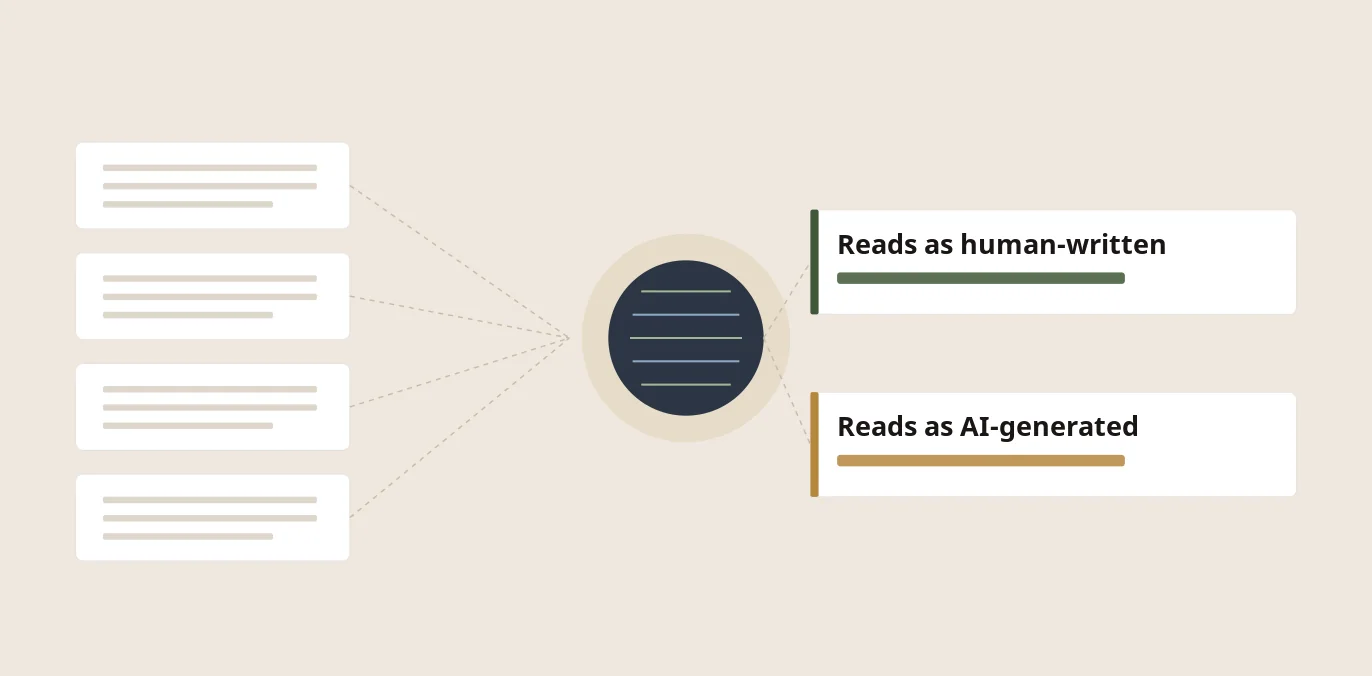
Semrush and Graphite each ran an AI detector across a sample of search-results pages and recorded where the detector's human and AI labels landed among the top rankings. Semrush's detector labeled 80.5% of position-one pages as human and 10% as AI.[1] Graphite's detector labeled 7% of number-one pages as AI.[2] Both companies classified finished text after publication; neither traced a page back to the person or process that wrote it.
Short version
Detector labels produced these percentages, and neither company verified who wrote any page. Judge a specific page on its accuracy and usefulness, whatever process created the draft.
The short answer is: the evidence does not prove that human-written content ranks better because the studies behind that claim did not verify who wrote the pages. They ran pages through AI detectors. Still, both measured the gap at position one. Semrush classified 80.5% of position-one pages as human-written and 10% as AI-generated.[1] Graphite classified 7% of number-one pages as AI-generated.[2]
That distinction changes the practical question to whether the finished page is original, accurate, useful, and clear about what it knows. Google's published guidance says appropriate use of AI is allowed; using automation mainly to manipulate rankings is not.[4]
What do the ranking studies actually show?
The studies show an association between detector classifications and top rankings, not a verdict on real-world authorship. Semrush analyzed 42,000 blog pages from 20,000 keyword results in November 2025 and ran their text through GPTZero. At position one, 80.5% of pages were classified as human-written and 10% as AI-generated.[1]
Semrush's method matters more than the headline. No researcher interviewed the publishers or checked their drafting process. The study classified the final text. Semrush also found that the gap narrowed from position five onward, meaning AI-classified pages still appeared across page one.[1]
Scope and instrument for each study, side by side. Sources: Semrush and Graphite.
Graphite reached a similar pattern with a different dataset and detector. In its June 2025 analysis of results for 31,493 keywords, it used Surfer's AI detector and reported that 7% of number-one pages were classified as AI-generated.[2]
The split each study reported at the top of Google's results. Sources: Semrush and Graphite.
Why the "burstiness" explanation is wrong
"Burstiness" was a detector metric, not a Google ranking signal, and GPTZero retired it in autumn 2023. GPTZero described burstiness as variation in perplexity across a document, then said it moved away from both perplexity and burstiness when it adopted a deep-learning architecture.[7]
Semrush used GPTZero to classify the pages in its study.[1] Treating GPTZero's old detection metric as the reason Google ranks a page confuses a third-party classifier with a search engine. Google has not named burstiness as a ranking signal.
A detector-based study cannot establish who wrote the text, reveal why Google ranked it, or turn an old detector feature into an SEO rule.
The order these two events happened in. Sources: GPTZero Support and Semrush.
Does the volume of AI content change the picture?
AI-generated articles are no longer merely catching up with human-written articles by volume. They have been near an even split for more than a year. Graphite's May 2026 update reported that 50% of articles in its sample were primarily AI-generated and 50% were human-written. It said the AI-generated share had plateaued at roughly 50% since Q1 2025.[3]
That volume finding does not tell us what will rank. It does show why a simple "AI content is rare" explanation no longer fits the data. Graphite's researchers hypothesized that the plateau may reflect practitioners finding that primarily AI-generated articles do not perform well in search.[3]
What does Google say about AI-written content?
Google's February 2023 guidance does not ban AI content. It objects to automation used primarily to manipulate rankings. Google says its focus is the quality of content rather than how it was produced, and that its ranking systems aim to reward content showing experience, expertise, authoritativeness, and trustworthiness.[4]
That policy does not make any particular workflow a ranking advantage. It sets a standard for the finished page. A page can be written with AI assistance and still need original information and careful sourcing. A page produced at scale to manipulate results falls on the wrong side of the policy regardless of the tool used.[4]
Do readers prefer human-written text?
In a short-fiction study reported by BBC News, readers gave their highest ratings to AI-written stories they had been told were human-written.[6] The finding points to a premium for the human label in that experiment, not a demonstrated preference for human-written prose itself.[6]
The experiment warns against treating apparent authorship as a reliable measure of writing quality. It is not evidence about web pages, Google rankings, traffic, or citations. A short-fiction rating experiment and a search-ranking study answer different questions, so neither result settles the other.[6]
Does freshness decide whether AI systems cite a page?
No evidence supports a rule that content must be less than 30 days old, or that Perplexity mainly cites pages under 13 weeks old. The available large-scale citation study points in the opposite direction. Ahrefs analyzed 17 million citations and found that AI assistants cited URLs averaging 1,064 days old, or about 2.9 years.[5]
Ahrefs found that cited URLs were 25.7% fresher on average than URLs in organic results, but Google's AI Overviews were the exception: they cited content that was 16 days older than organic results on average.[5] Updating a weak page every day does not create a reliable visibility advantage; relevance and quality remain necessary.[5]
One axis, so the measured figure and the two refresh rules can be read against each other. Source: Ahrefs.
What should a business do with this evidence?
Read the studies as a warning against overclaiming. The evidence does not test the common "AI drafts, human edits" workflow. Graphite explicitly said its study did not evaluate AI-assisted content with heavy human editing.[2]
QBiz's view is that AI can help with research, outlines, and first-pass drafting. The final process still needs fact-checking and source review. It also needs a distinct point of view and editorial judgment someone is accountable for. That is a reasoned production approach, not a measured claim that a hybrid workflow performs best.
Three checks matter more for the page than any detector score:
Add original information. Bring firsthand experience, a documented process, or a clearly sourced finding to the reader's question.
Verify every material claim. AI output can present incorrect or outdated information confidently, so review facts before publication.
Make each section self-contained. Lead with the answer, then give the evidence and limits needed to understand it.
The bottom line
Both detector-based studies place human-classified pages ahead at the very top of Google results, but neither proves that human authorship caused the outcome. Semrush put AI-classified pages at 10% of position one and Graphite put them at 7%, using different datasets and different detectors.[1][2]
Build pages that give readers an accurate, useful answer. Distinguish evidence from opinion, and make the source material easy for a reader to check. That approach aligns with Google's stated emphasis on helpful, high-quality content while avoiding claims the available studies never tested.[4]
Summary
Nothing in this evidence set names a human or an AI as the cause of a ranking result. What it shows is a correlation: at position one, pages an AI detector labeled human outnumbered pages the same kind of tool labeled AI-generated in both studies.[1][2] Use that correlation as a caution against overclaiming either way, and put your effort into original reporting, verified facts, and a clear answer to the reader's actual question.
Frequently asked questions
Does Google penalize AI-generated content?
Google's February 2023 guidance says appropriate use of AI or automation is not against its guidelines. It says automation used primarily to manipulate search rankings violates its spam policies.[4]
Does human-written content rank better than AI content?
The available studies do not verify authorship. They find that pages classified as human-written by AI detectors held more top positions than pages classified as AI-generated, especially at position one.[1][2]
Is "burstiness" an SEO ranking factor?
No. Burstiness was a GPTZero detection metric, not a stated Google ranking signal. GPTZero said it stopped using burstiness and perplexity in autumn 2023.[7]
Should I update every article every 30 days for AI search?
No evidence in this source set supports a 30-day rule. Ahrefs' analysis of 17 million AI-assistant citations found that the average cited URL was 1,064 days old, while Google AI Overviews cited pages that were 16 days older than organic results on average.[5]
Sources
[1] Semrush, ["Does AI content rank well in search? [Survey + Data study]"](https://www.semrush.com/blog/does-ai-content-rank-in-search-data-study/). Method: 42,000 blog pages classified with GPTZero in November 2025.
Leave a comment
Thoughts on this post? Leave a comment below. Comments are moderated before they appear, so yours will not show on the page straight away.
Your email is used only to contact you about your comment if needed — it is never published.
Comments
No comments yet. Be the first to leave one above.