Google AI Overviews vs Bing Copilot: Which One Sends a Dentist More Patients?
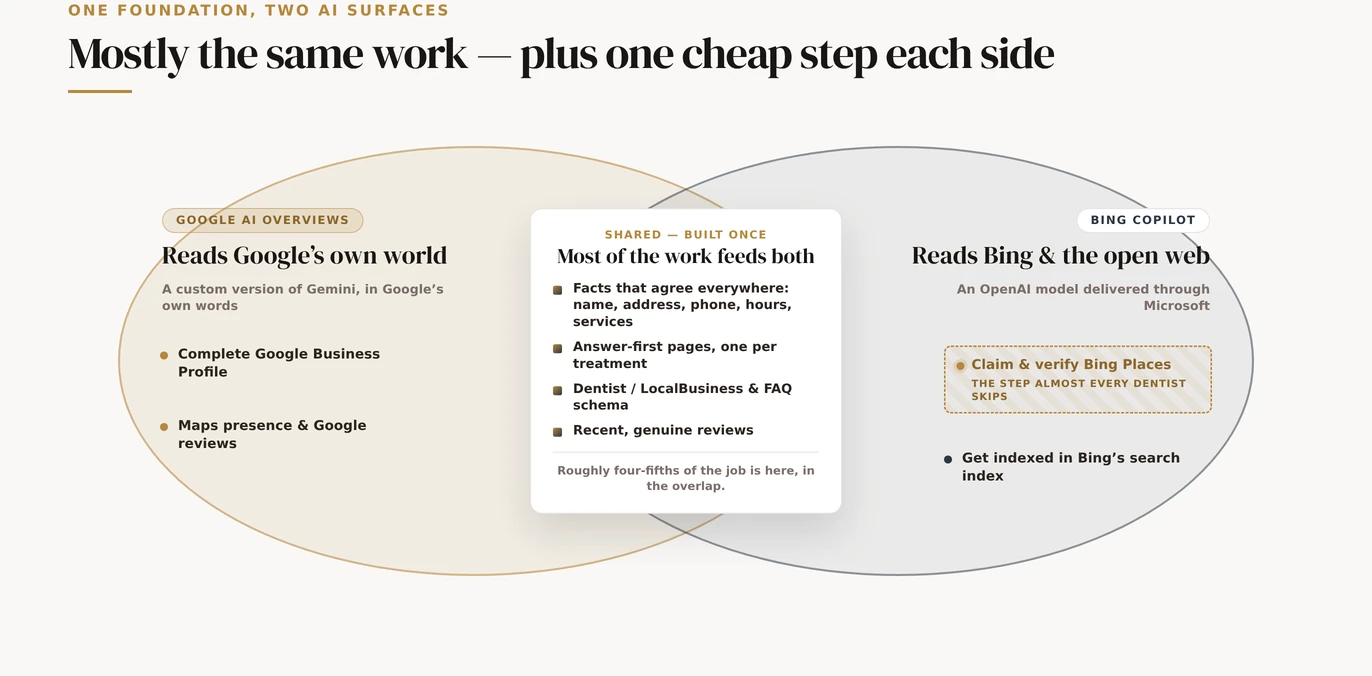
There is no single winner, because the two boxes are fed by two different webs. A Google AI Overview is assembled from Google's own index, your Business Profile, Maps and your Google reviews. Bing Copilot is assembled from Microsoft's Bing index, your Bing Places listing and the directories and review sites Bing crawls, and it reaches patients through Edge, Windows and the Copilot app rather than through a search box alone.
Most of the groundwork, roughly four-fifths of it, feeds both at once, so a single foundation does the heavy lifting. What feeds Copilot alone is narrow and cheap: a claimed Bing Places listing whose details line up across the sites Bing reads. Almost every practice has walked past it, which is exactly where the easy gains are sitting.
Two of the boxes a patient now reads before they ring anyone are answer summaries rather than lists of links, and they belong to two different companies. Google drops its AI Overview at the top of a search. Microsoft puts Copilot across Bing, Edge, Windows and its own app. A dentist can be the practice named in one of those boxes and left out of the other completely, and the box a practice has most likely never influenced is the one it has never caught its own name inside.
What turns that into a commercial problem rather than a vanity one is the size of a dental booking. In the UK a single implant tends to land between £2,000 and £3,000 for one tooth, a full course of clear aligners between about £2,500 and £5,000, and a veneer case can run well into five figures (illustrative ranges to show what is at stake, not researched figures, and every real case varies by clinician and complexity).
Larger than any one of those, though, is the long tail behind it: register a family and keep them for a decade of check-ups, hygiene appointments and the odd bigger case and you are looking at many thousands in steady, repeatable revenue. So when an assistant fields "who is a good dentist near me?" and returns two names, whether yours is one of the pair is the whole ballgame, the difference between the booking landing on your list and landing on a rival's.
The condensed version, for anyone who wants the shape before the detail: this is not a choice between Google AI Overviews and Bing Copilot, it is a matter of supplying both. An Overview is built from Google's own index, your Google Business Profile, Maps and your Google reviews. Copilot is built from Microsoft's Bing index, your Bing Places listing and the third-party web that surrounds it, from review platforms through to social profiles.
Roughly four-fifths of the preparation is identical for the two. The remaining fifth, on Copilot's side, is one inexpensive listing step that almost every practice has walked straight past. Written for UK practices, it holds to General Dental Council rules at every step and asks you to claim nothing you could not stand behind in front of a regulator.
The short version
- Two answer boxes, two owners. Google runs AI Overviews; Microsoft runs Copilot across Bing, Edge, Windows and its own app. They draw on different halves of the web and can name different practices.
- The bulk of the effort overlaps. Matching details across the web, dental schema, pages that answer plainly, a current review stream and a site a crawler can read all serve both boxes together.
- Bing Places is the missing piece. Scarcely any practice has claimed it, and that neglect is exactly what makes it the fastest gain on the Microsoft side.
- There is no cheque that buys entry. Neither box sells a slot; the mention is earned by being the practice each engine can pin down most cleanly.
Have patients genuinely started letting AI choose their dentist?
They are, and what makes it worth taking seriously is that this is not one platform's fad but a change in how people locate any local service. The plainest measure comes from BrightLocal's Local Consumer Review Survey 2026, which recorded use of ChatGPT and similar generative AI tools for local recommendations climbing from 6% to 45% inside twelve months, enough to rank it the third most-used source of the lot[1]. When close to half of consumers lean on a channel that a year earlier barely registered, the behaviour is no longer emerging; it has arrived.
Dentistry sits inside an unusually AI-heavy corner of that behaviour, because health is one of the subjects people put to these assistants most. A KFF tracking poll in 2025 put roughly a third (32%) of US adults using AI for health information or advice, and 29% specifically for a physical-health question[2]. The anxious late-evening "does this tooth pain need seeing this week, and who near me can do it?" belongs squarely in that group: half medical worry, half local search.
Nor is this confined to people who deliberately open a chatbot. Pew Research Center, working from real browsing records, found 58% of US users had run at least one Google search in March 2025 that surfaced an AI-generated summary[3], and those summaries dampened click-through to the links beneath them: 8% of visits ended in a click when a summary showed, against 15% when none did. The assistant side is on a similar trajectory of scale, with ChatGPT reaching 900 million weekly active users in February 2026, up from 800 million the previous October[4], and it is worth remembering that an OpenAI model of the same lineage underpins much of what Copilot returns.
Patient behaviour
The AI shortlist is settling before the patient calls
45%
use ChatGPT and other generative AI for local recommendations, up from 6% a year earlier and now the third most-used source.
32%
of US adults use AI for health information or advice, and 29% for a physical-health question.
58%
of US users ran at least one Google search in March 2025 that surfaced an AI summary.
900 million
weekly active users reached by ChatGPT in February 2026, up from 800 million the previous October.
BrightLocal Local Consumer Review Survey 2026; KFF Tracking Poll 2025; Pew Research Center 2025; TechCrunch, reporting OpenAI, February 2026.
Line those figures up and the conclusion is hard to dodge. Before a patient ever loads a practice website, a growing majority have already read an AI answer, and the shortlist they end up ringing is largely settled inside it. The winners on that shortlist are collecting enquiries that a slick site and a good Google ranking, by themselves, used to guarantee and no longer do.
What does being missing from Copilot actually cost a practice?
Put a rough figure on the thing you cannot see. Say your town throws off only a modest handful of "implant dentist near me" or "Invisalign near me" questions through these AI surfaces each week. If even one a month turns into a booked case at the values above, the recommendation you are not getting is worth more in that single month than many practices spend on marketing all year. It never surfaces in your missed-call log, because as far as your systems are concerned the enquiry was never made.
The Copilot gap is a particular kind of quiet loss, because it is so one-sided. A practice can be doing everything right on Google, ranking well and gathering reviews, and still be a blank to every patient who asks Microsoft's assistant, purely because a free listing was never claimed. Every month that stays true is a month a competitor banks the higher-value enquiries and, more quietly, the routine families who register and stay.
The reassuring half of the picture is how winnable it is: being named is not bought and does not favour the biggest chain. It rewards the practice each engine can verify most cleanly across the sources it trusts, which a well-run single site can absolutely be in its own town.
Why do AI Overviews and Copilot name different dentists?
The gap that decides whether your name comes up is a gap of provenance: each box trusts a different source of truth. A Google AI Overview reasons over Google's index and the ecosystem hanging off it. Bing Copilot reasons over Bing's index and the directories, review platforms and open pages Bing has crawled. Two indexes, two versions of who exists in your town, and therefore two answers that can name two different practices to the same patient. Optimise only for Google and you have decorated one of the two rooms a patient might step into, leaving the other bare.
The Google side does not need to be guessed at, because Google has spelled out how the surface works. Its AI features run on a custom version of Gemini and apply what Google calls query fan-out, "breaking down your question into subtopics and issuing a multitude of queries simultaneously on your behalf", and Google states that AI Overviews are "driving over 10% increase in usage" for the query types that show them[5]. Pointed at a dental question, that fan-out draws on the Google assets a practice tends to maintain anyway: the Business Profile, the Maps pin, the flow of reviews and whatever pages a crawler can actually reach.
Copilot fills its plate from Microsoft's larder instead. It pieces a local answer together from Bing Places records, the third-party platforms Bing indexes and the open web around them, then serves it wherever a Microsoft surface reaches the patient, which increasingly means Edge's sidebar, a Windows taskbar prompt or the standalone Copilot app as much as a Bing search.
The awkward result, and the one hardly any practice has moved on, is that a Google-only practice can be all but unreachable here, because the record Copilot depends on, Bing Places, was never opened. The comparison that follows ranges the two engines against each other for a dental practice. The Copilot rows describe how the engine is consistently characterised in the field rather than a figure Microsoft confirmed for this article; the Google rows quote Google's own published words.
Side by side
Two answer boxes, two source maps
| Factor | Google AI Overviews | Bing Copilot |
|---|---|---|
| Underlying model | A custom version of Gemini, in Google's own words | An OpenAI GPT model delivered through Microsoft, as the field describes it |
| Where the answer comes from | Google's Search index plus Google Business Profile, Maps and Google reviews | Bing's index plus Bing Places, with Yelp, Facebook, directories and the open web |
| How it builds the answer | Query fan-out: one question split into many simultaneous sub-queries | Conversational retrieval across Bing's index |
| The highest-value asset for a dentist | A complete, active Google Business Profile and recent reviews | A claimed and verified Bing Places listing plus a crawlable site |
| Where dentists under-invest | Usually already worked through local SEO | Almost universally skipped: this is the opening |
| What both reward | Answer-first content under question headings, dental schema, consistent details everywhere | The same: clean crawlable pages, clear answers, matching listings |
Google rows quote Google's published description; Copilot rows reflect how the field consistently characterises the engine.
What the table really shows is that one is not a mirror of the other. They are two independently sourced verdicts, and a practice can be the confident pick on one while never surfacing on the other. Closing that distance is the whole job, and it does not mean abandoning the Google work that still carries the bulk of local demand: it means adding the Microsoft half a practice has never built. If you would rather see the Google surface weighed against a pure chatbot, our companion guide on Google SGE versus ChatGPT for a local dentist covers that matchup, and how AI ranks dentists near me breaks down the local signals both engines depend on.
What tips a Google AI Overview towards one practice?
It leans overwhelmingly on Google's own ecosystem and then rewards whichever practice presents the most complete, consistent and current set of facts. Since the engine splits one question into a spray of smaller ones, the practice it likes is the one holding a crisp, checkable answer for each of those fragments, not a single fog-bound "Treatments" page that resolves none of them.
The Google Business Profile does most of the talking
Nothing else on the Google side counts for as much, and a surprising number of practices leave the profile half-built. What it asks for is the precise name, address and phone number; opening hours for the full week with a line on how after-hours emergencies are dealt with; every treatment named in patients' own words; a truthful statement of whether the books are open to new patients; real photographs; and the access details that actually matter, step-free entry and parking among them. Because a Google AI answer about a dentist is stitched largely from this one record, a sparse or stale profile drops the practice from the running before the patient has even finished typing.
Reviews, and how fresh they are
Reviews carry a lot of weight on this surface, and their age matters more than owners tend to think. A shelf of glowing ratings whose most recent entry is three summers old signals, to human reader and engine alike, a practice that has since fallen silent. A thinner but unbroken stream of real reviews arriving month on month, on Google first and the health-specific platforms next, gives the engine present-tense proof it can restate without pausing to doubt it.
Answer every one, warmly and briefly, but keep clinical detail out of any public reply: thank the person, speak to the general point, and move anything specific to a private channel. That single habit guards confidentiality and looks right to every reader, flesh-and-blood or machine.
Pages a crawler can read, marked up as dental content
An Overview can only cite what it can actually parse, and two obstacles routinely stop it. One is content that only materialises after JavaScript runs, which some crawlers never execute, so they arrive at what looks like a blank page. The other is service copy dressed in marketing haze rather than the direct question-and-answer shape the engine can quote straight off. Fitting the machine-readable labels for a dental practice, the Dentist or LocalBusiness type, a FAQPage for the recurring questions, and a genuine AggregateRating wherever you really display scores, removes the last trace of doubt about who you are, where you sit and what you treat.
What makes Bing Copilot pick one practice over another?
Its answer is built on Bing's index and the third-party web feeding it, so the factor that most often decides your fate is a listing you never got around to creating. Everything that makes a practice legible to Google helps on this surface as well, yet one groundwork step belongs to Copilot alone, and skipping it is the reason so many capable practices never appear in its answers.
Copilot's recommendation path
How Copilot reaches a named dentist
Read the question
It works out what the patient needs, from a ready-to-book local query to a research question.
Pull from Bing
It draws on your Bing Places listing and the pages Bing has actually indexed.
Cross-check the web
It corroborates against review platforms, social profiles and directories before committing your name.
Name the practice
The answer, served across Bing, Edge, Windows and the app, favours the practice it can verify most cleanly.
Claim and verify Bing Places, and sign in with a Microsoft account
Bing Places plays the part for Copilot that a Google Business Profile plays for an Overview, and the great majority of dental practices have never even opened one. You claim it through a free Microsoft account, verify that you run the practice, then fill the listing with details identical to the ones on Google.
Do that and you have spent what is comfortably the best-value hour available on this whole subject: it is the single move that flips a practice from unreachable to nameable across every Microsoft surface at once, from Bing to Edge to the Copilot app. Since so few local practices have bothered, the door is standing open. Of everything in this guide, this is the one action to take first.
Get indexed through Bing Webmaster Tools, and keep it current with IndexNow
Claiming the listing is only worth so much if Bing cannot read your actual pages, which is where indexing comes in. Bing Webmaster Tools, a separate console from anything on the Google side, lets you submit your sitemap and confirm the engine has your pages on file. IndexNow, which Microsoft backs, pings the engine the instant something changes, a revised set of opening hours or a freshly published treatment page, so Copilot quotes today's facts instead of last quarter's. One quick test shows where you stand: run site:yourpracticedomain.co.uk in Bing, and if barely anything comes back, the index behind Copilot has not found you yet.
The wider Microsoft-adjacent web Copilot corroborates against
Copilot does not stop at its own listing; it cross-checks against the surrounding web before it commits your name to an answer, pulling on review platforms, social profiles, directories and any open page that mentions the practice. The principle mirrors the Google side but the source list differs: the name, address, phone number, hours and services need to read the same everywhere Bing might encounter them.
Where those details contradict each other, the engine is forced to pick a winner, and a hesitant engine simply names a rival it feels sure of. Getting the facts to agree across that third-party spread is quiet, unglamorous work that is doing more to earn the recommendation than anything on the practice's own domain.
Which AI wins which patient question?
There is no clean winner; each engine tends to own a different moment in one patient's decision, which is exactly why a practice wants a footing on both. Break the questions down by type and the division of labour becomes obvious.
The ready-to-book local questions ("emergency dentist open now near me", "dentist taking new NHS patients in [town]", "implant dentist near me") ride on the listing and review signals each engine holds dear: the Business Profile and Maps for an Overview, Bing Places and the third-party platforms for Copilot. These enquiries carry the highest value to a practice, and what settles them is chiefly how fully the listing is completed and how fresh the reviews are.
The research-stage questions ("does a root canal hurt?", "Invisalign versus fixed braces", "how much do veneers cost in the UK?") are resolved less from a map pin than from well-built pages a crawler can read. Both engines favour a page that takes one question and answers it cleanly, with plain indicative pricing and none of the superlative puffery.
The patient who gets a calm, useful answer drawn from your site at this early point is very often the same person who returns weeks later with the ready-to-book question, so the two moments feed each other. Holding a place on both surfaces across both kinds of question is how a practice stays in the conversation the whole way, from "is this treatment worth it?" to "who near me actually does it?".
Do I have to choose between them?
No, and once you see how the work is built you understand why the choice is a false one. About four-fifths of what the two engines consume is common ground: one agreed set of facts about the practice wherever it appears, dental schema on the site, service pages written to answer rather than sell, a dependable trickle of recent genuine reviews, and a site tidy enough to crawl.
Get that base right one time and each surface pulls from it. The leftover fifth is the per-engine listing work, and on Copilot's side that comes down mostly to the one Bing Places step scarcely anyone local has taken. Build the common base, add the cheap Microsoft-side hour your competitors have ignored, and you have covered both boxes for barely more effort than covering one.
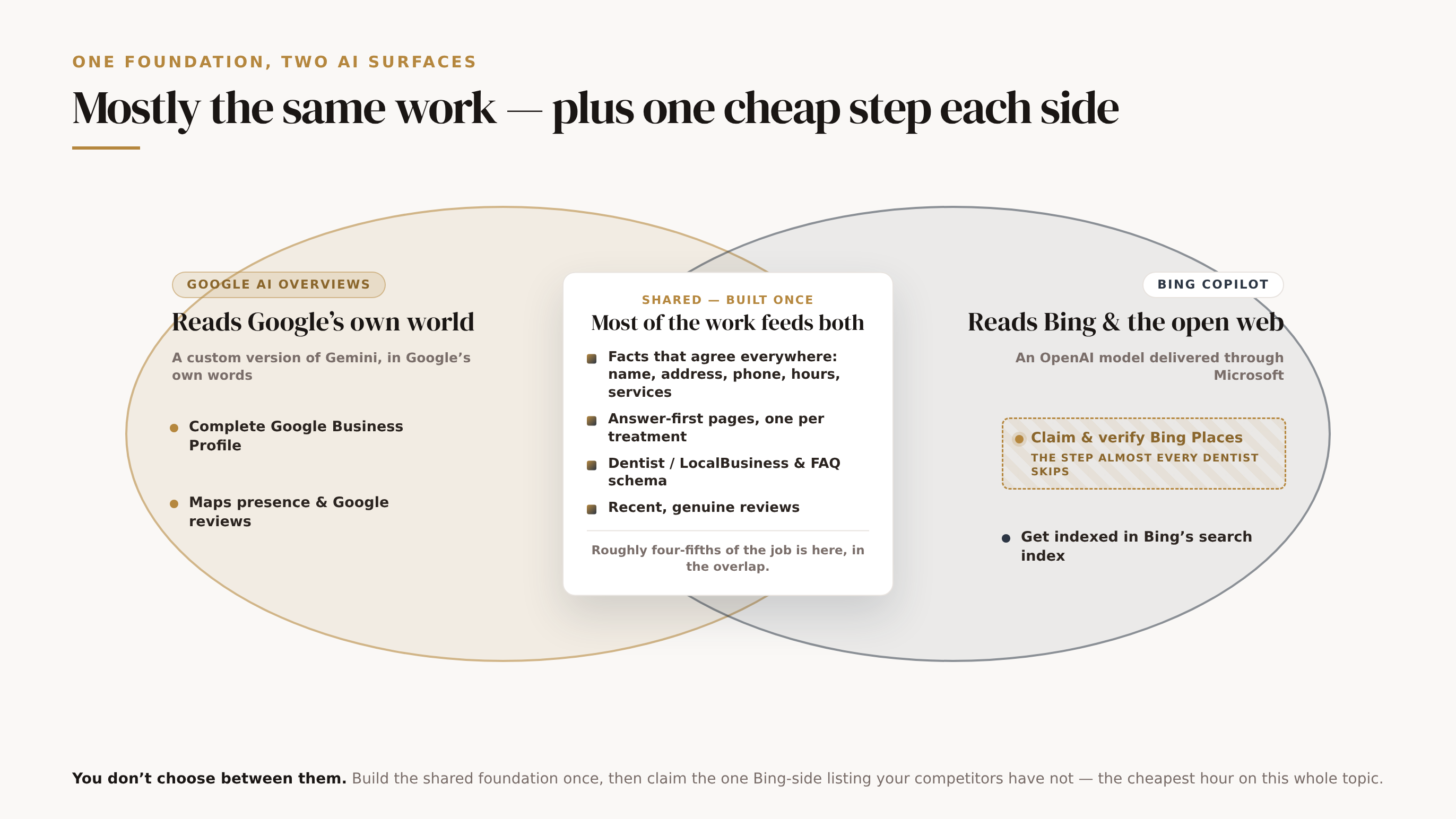
The action list, sorted by which engine it serves
Here is the checklist, split three ways so it is clear what earns you the Google box, what earns you Copilot, and what pays off on both. None of it is dramatic; all of it can be worked through methodically.
Worklist
The action list, sorted by which box each task serves
For a Google AI Overview: finish the Business ProfileExact details, a full week of hours, a truthful accepting-patients line, real photos, plus a steady flow of recent Google reviews.
For Bing Copilot: claim and verify Bing PlacesComplete it with details identical to Google's, submit your sitemap through Bing Webmaster Tools, wire up IndexNow, and match the practice across Yelp, Facebook and directories.
For both: keep facts identical everywhereOne set of name, address, phone, hours and services in every place they appear.
For both: fit dental schemaDentist or LocalBusiness, FAQPage and a genuine AggregateRating where you display real scores.
For both: one clear page per treatmentTitled the way patients say it, with indicative price ranges and realistic timescales, and reviews handled without clinical detail.
For a Google AI Overview. Claim the Google Business Profile and finish it properly: exact details, a full week of hours, a truthful line on whether new patients are being taken, real photographs and the accessibility notes. Keep genuine, recent Google reviews arriving at a steady pace and respond to each without touching clinical detail. Confirm the core service pages are crawlable and framed answer-first.
For Bing Copilot. Claim and verify Bing Places through a Microsoft account, then populate it with details identical to Google's. Push your sitemap through Bing Webmaster Tools and run the site: test to prove you are indexed. Wire up IndexNow so changes land with the engine fast. Then check the practice reads the same across Yelp, Facebook and whatever directories Bing might crawl.
For both at once. Hold the name, address, phone, hours and services identical in every place they appear. Fit Dentist or LocalBusiness, FAQPage and a genuine AggregateRating in schema. Give each treatment its own clear page, titled the way patients say it, with indicative price ranges and realistic timescales. Bring in reviews steadily and handle every reply without clinical detail. That common block accounts for most of what you are after; the two engine-specific lists above deal with the rest.
How can I see whether AI Overviews or Copilot name me yet?
None of this needs a budget or an agency; a spare ten minutes today will do, and the exercise writes your to-do list as it goes. Start in Google with the questions a real patient types ("best dentist in [your town]", "emergency dentist near me today", "Invisalign in [your area]") and note whether an AI Overview shows and whether your practice is in it. Then move to Copilot, in the app, in Edge's sidebar or as Bing's chat answer, and put the same questions to it. Mark down, per engine, whether it names you, names a competitor, or skips you altogether.
Ask each one a handful of times over, since the wording of these answers drifts from attempt to attempt, and it is the pattern that repeats, not any lone reply, that reveals your real standing. Close out with two listing checks and one index check: make sure the Google Business Profile and the Bing Places listing both exist and carry matching details, then run site:yourpracticedomain.co.uk in Bing to see whether you are indexed at all.
The finding that comes up more than any other is a practice that is fine on Google, invisible on Copilot, and has no Bing Places listing behind it, which also happens to be the fastest thing on the whole list to put right.
Get your free AI visibility check →
Is any of this against GDC rules?
No, not when it is done the way this guide sets out, and that alignment is not an accident. The General Dental Council's Standards for the Dental Team require at standard 1.3.3 that "you must make sure that any advertising, promotional material or other information that you produce is accurate and not misleading, and complies with the GDC's guidance on ethical advertising"[6]. That obligation reaches your website, each of the two AI-facing listings, and any third-party page you hand your details to.
What is striking is that the tactics which earn an AI recommendation are the very ones that keep a practice on the right side of that standard. Accurate facts, real reviews, factual service pages and plainly stated indicative prices satisfy the engine and the regulator in the same stroke. The trouble spots are precisely what the rule already bars: guaranteed outcomes ("a perfect smile, guaranteed"), unprovable superlatives ("the best dentist in [town]"), and out-of-date claims like an "accepting NHS patients" banner still lit long after the list closed.
None of that earns AI visibility in any case, since a careful engine declines to echo a guarantee or a superlative, while an out-of-date fact erodes the very consistency both surfaces are looking for. Persuasion built on verifiable specifics is entirely allowed, and it is also what gets your name spoken.
Where this leaves your practice
Two AI surfaces now stand between a patient and the phone call, each drinking from a different half of the web, and most practices have plumbed in only one of them. The Google half has probably had years of local-SEO attention already. The Microsoft half, Bing and the Copilot experiences it powers, usually reduces to one unclaimed listing and a site Bing has never indexed, which is at once the whole gap and the quickest win on offer. Pour the shared foundation once, open the listing your competitors have left shut, hold your facts identical and your reviews current, and both engines are handed a practice they can name without a flicker of doubt.
If you would rather know where you stand before starting, a free QBiz Leads AI visibility check looks at your own website, not the engines, and grades in under a minute whether AI tools can find, read and make sense of you: how crawlable the pages are, whether the dental schema is in place, how plainly each service page answers its question, and whether your listed details line up. Because it scans your site rather than querying Copilot or AI Overviews on your behalf, it hands you the specific fixes that put you in the running instead of a single snapshot of one day's answer.
The website scan is one side of the QBiz coin. The other is distribution: we place the content that earns the off-site mentions and cross-web corroboration these AI answers are actually built from, so the picture of your practice stays consistent across the third-party sources each engine trusts, rather than living only on your own domain. You can request it from the QBiz AI visibility check. If you would rather have that groundwork and distribution run for you, our AI SEO for dentists service page sets out how we do it for a practice.
Frequently asked questions
Is Google AI Overviews or Bing Copilot better for getting dental patients?
Neither is better on its own, because they reach different patients from different sources. Google AI Overviews carry more total volume today and tend to win the high-intent local questions, while Bing Copilot is the surface most practices are entirely absent from, which makes it the larger untapped opportunity. The practical answer is to cover both: the shared foundation serves each, and the one extra step, claiming Bing Places, is cheap.
Does Bing Copilot use my Google Business Profile?
No. Copilot draws on Bing Places, third-party sites and the open web rather than your Google Business Profile. This is the single most common reason a practice is well represented on Google and missing from Copilot. You need a separate, claimed Bing Places listing and consistent third-party details for Copilot to describe you with confidence.
Do I need to do anything different for Bing Copilot?
Yes, one main thing: claim and verify Bing Places, then submit your sitemap through Bing Webmaster Tools so your pages are indexed. Everything else, consistent details, dental schema, recent reviews and clear pages, overlaps with the Google work. The Bing Places step is the part almost every dentist has skipped.
If I rank well on Google, will I automatically show up in Bing Copilot?
No. A first-place Google ranking is invisible to Copilot, which reads Bing's index rather than Google's. Strong Google performance helps the patients who use Google, but Copilot visibility is a separate job built on Bing Places and Bing's index.
Can I pay to appear in AI Overviews or Copilot?
No. There is no paid placement that buys you into either AI answer the way an advert buys a slot above the organic results. Anyone who offers to sell you a shortcut into the AI answer is selling something that does not exist. You earn the recommendation by being the practice each engine can most confidently verify and describe.
How long until my practice shows up in AI answers?
No fixed timeline exists, and anyone who names one is guessing. Claiming both listings and building up recent reviews can move things within a few weeks; earning the steady, cross-web corroboration needed to be named with confidence usually takes a few months of consistent work. It is compounding groundwork, not a switch you flip.
Sources
- [1] BrightLocal, Local Consumer Review Survey 2026: https://www.brightlocal.com/research/local-consumer-review-survey/ (US-weighted; independent. "Use of ChatGPT and other generative AI tools for local recommendations has grown rapidly, rising from 6% last year to 45% and becoming the third most popular source of business recommendations.")
- [2] KFF, Tracking Poll on Health Information and Trust, 2025: https://www.kff.org/public-opinion/kff-tracking-poll-on-health-information-and-trust-use-of-ai-for-health-information-and-advice/ (US; independent. "About a third (32%) of adults are turning to AI for health information and advice", including about three in ten (29%) who have used AI tools in the past year for information or advice about their physical health.)
- [3] Pew Research Center, 22 July 2025: https://www.pewresearch.org/short-reads/2025/07/22/google-users-are-less-likely-to-click-on-links-when-an-ai-summary-appears-in-the-results/ (US; independent. "About six-in-ten respondents (58%) conducted at least one Google search in March 2025 that produced an AI-generated summary." Users who saw an AI summary clicked a traditional result in 8% of visits, against 15% when no summary appeared.)
- [4] TechCrunch, reporting OpenAI, 27 February 2026: https://techcrunch.com/2026/02/27/chatgpt-reaches-900m-weekly-active-users/ (Global; reporting OpenAI. "ChatGPT has reached 900 million weekly active users"; "a jump of 100 million users from the 800 million that OpenAI reported in October 2025.")
- [5] Google (The Keyword), "AI in Search: going beyond information to intelligence", 20 May 2025: https://blog.google/products/search/google-search-ai-mode-update/ (Global; vendor primary. "AI Mode uses our query fan-out technique, breaking down your question into subtopics and issuing a multitude of queries simultaneously on your behalf"; a custom version of Gemini 2.5 is brought "into Search for both AI Mode and AI Overviews"; AI Overviews is "driving over 10% increase in usage" for the query types that show them.)
- [6] General Dental Council, Standards for the Dental Team, principle 1: https://standards.gdc-uk.org/pages/principle1/principle1 (UK; regulatory. Standard 1.3.3: "You must make sure that any advertising, promotional material or other information that you produce is accurate and not misleading, and complies with the GDC's guidance on ethical advertising.")
Leave a comment
Thoughts on this post? Leave a comment below. Comments are moderated before they appear, so yours will not show on the page straight away.
Your email is used only to contact you about your comment if needed — it is never published.
Comments
No comments yet. Be the first to leave one above.