Google SGE vs ChatGPT for Finding a Local Dentist in the UK: Which One Actually Sends You Patients?
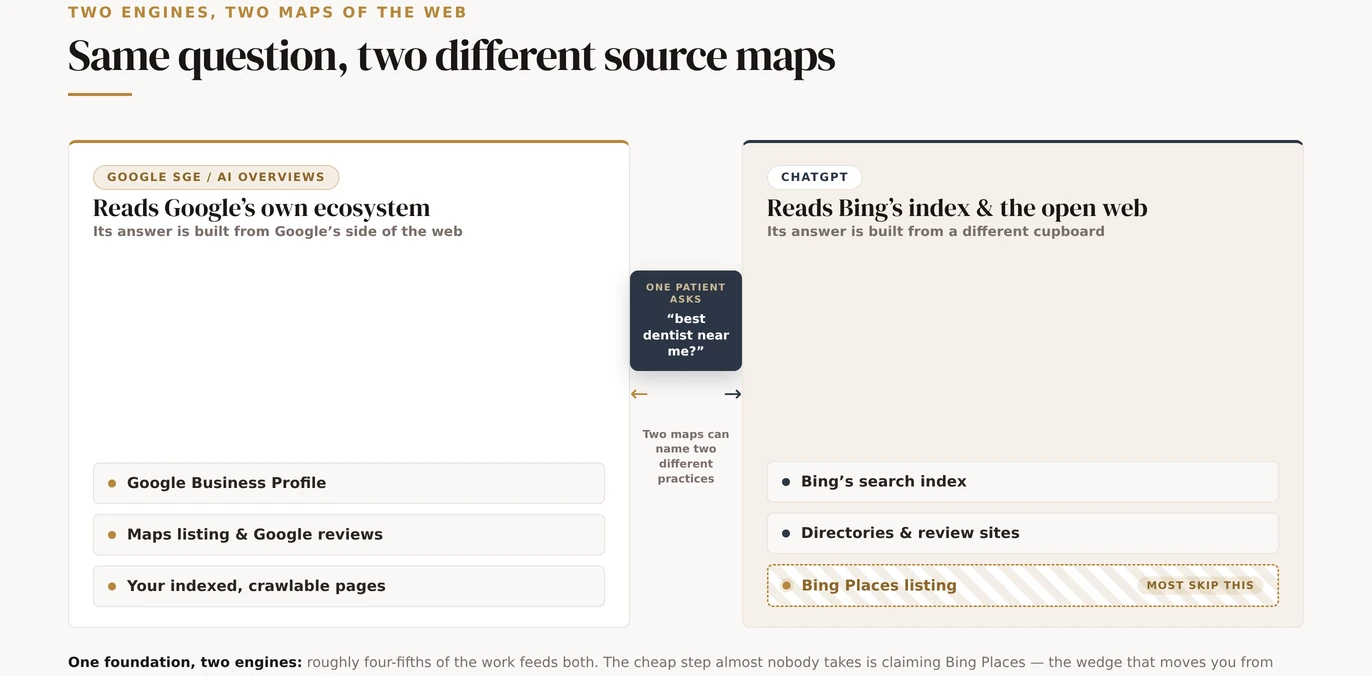
Neither engine wins outright, and they do not read the same web. Google's AI Overviews build their answer from Google's own index, your Business Profile, Maps and Google reviews; ChatGPT leans on Microsoft's Bing index plus third-party directories and review sites. Most of the groundwork feeds both, so one shared foundation covers each engine. The piece that feeds only ChatGPT, a claimed Bing Places listing and consistent directory details, is the cheap step nearly every practice has skipped.
Ask two patients in the same town how they found their last dentist and you may now get two completely different answers. One typed a quick question into Google and read the AI summary that appeared above the usual links. The other had a back-and-forth conversation with ChatGPT about a painful molar and, somewhere in that chat, asked it to suggest a practice nearby. Both were handed a short, confident reply with a practice named in it. The catch is that the two replies were not built from the same information, and a practice can be the one named in the first while being completely missing from the second.
That matters in money, not just visibility. Implants, clear aligners and veneer work are the cases a practice plans its year around, and a single one of them can be worth more than a month of routine appointments. Underneath those headline treatments is the quieter prize: a family that registers and stays for ten years of check-ups, hygiene visits and the occasional larger case is worth many thousands in steady revenue. When an assistant names two practices in response to "who is a good dentist near me?", being one of those two is the difference between that booking landing on your diary or someone else's.
This guide answers three questions for a UK practice: where each of these answer engines looks, which patient questions each tends to win, and what you have to do differently to be named in both.
The short version
- SGE is just AI Overviews. It is not a separate Google product to prepare for; the name changed when the feature left Labs.
- Two engines, two maps. Google's AI answer draws on Google's ecosystem; ChatGPT draws on Bing plus the third-party web, so they can name different practices for the same question.
- One foundation serves both. Consistent facts, dental schema, answer-ready pages, recent reviews and a crawlable site make you legible to both surfaces at once.
- The Bing Places listing is the gap. Almost every practice has skipped it, which is exactly why it is the quickest win on the ChatGPT side.
Wait, is "SGE" still a thing? What "Google SGE" means now
SGE stood for Search Generative Experience, and that was the name Google used while the feature lived in its experimental Labs phase. It is not a separate live product any more. Google graduated it and shipped it under a new name: AI Overviews, the summary box you now see at the top of many results, with AI Mode as the fuller, end-to-end conversational version. So when a practice owner asks "should I optimise for SGE?", the accurate response is that SGE is simply what today's AI Overviews used to be called. You are not chasing two different Google products. You are working on one: the AI answer Google now places above the links.
A fair amount of advice still circulating treats SGE as a distinct thing to prepare for separately. It is not. Throughout this guide, when you read "Google's AI surface" or "AI Overviews", that is the same surface a patient's "SGE" question is really about. With the naming settled, the real comparison can begin: Google's AI answer on one side, ChatGPT on the other.
Are patients really using AI to choose a dentist now?
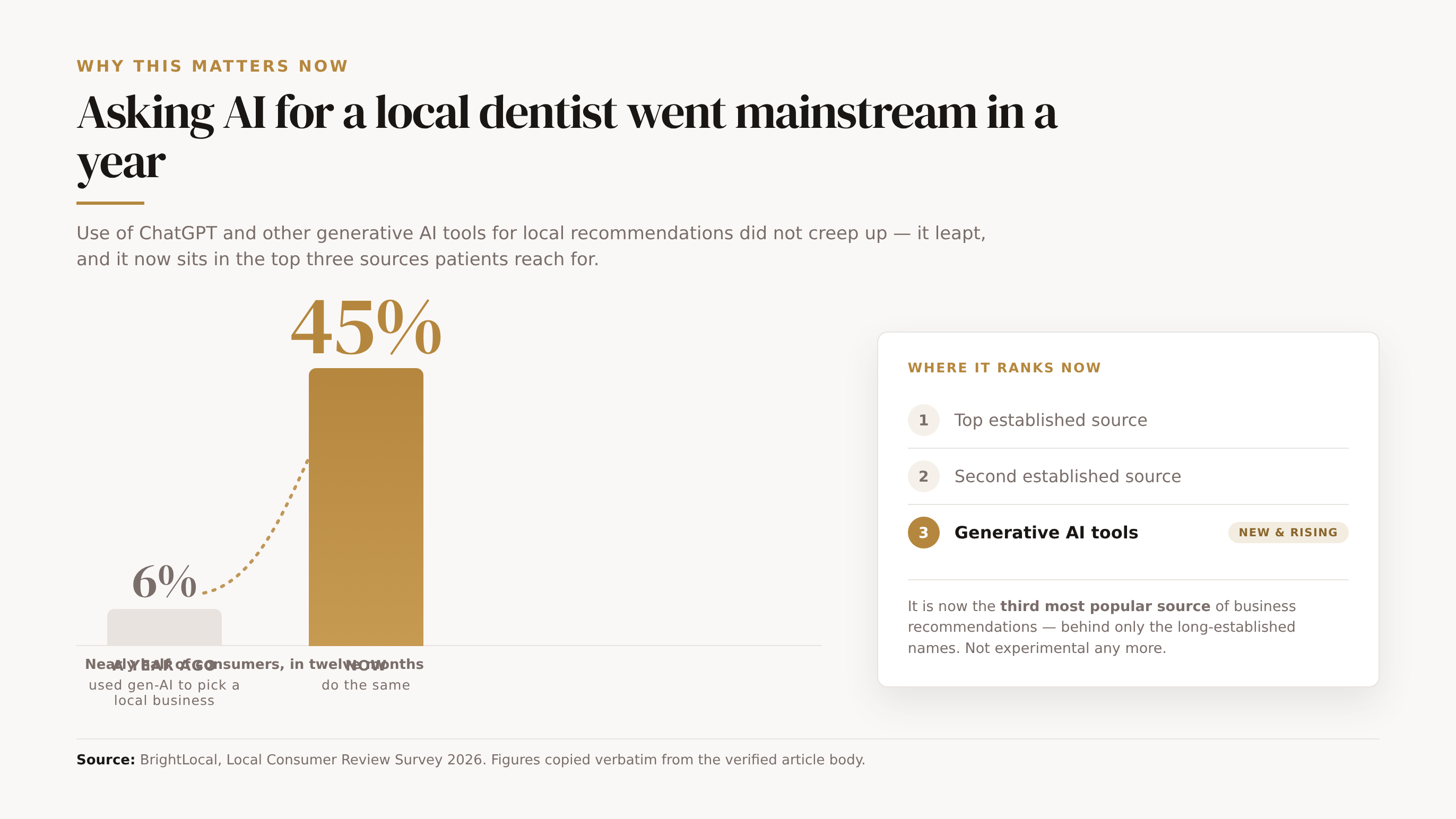
Yes, and it has crossed from curiosity into ordinary habit faster than most owners noticed. The clearest evidence is in how people now pick any local business at all. BrightLocal's Local Consumer Review Survey 2026 found that the use of ChatGPT and other generative AI tools for local recommendations climbed from 6% to 45% in a single year, making it the third most popular source of business recommendations[1]. A channel that nearly half of consumers now reach for, sitting third behind only the long-established names, is not something a practice can keep filing under "experimental".
Health is one of the topics these tools get asked about most. A KFF tracking poll in 2025 found that about a third (32%) of US adults now turn to AI for health information or advice[2]. "Is this tooth pain something I need seen this week, and who near me can do it?" sits right inside that behaviour: local, practical and health-adjacent all at once, exactly the sort of question an assistant fields all day.
The shift shows up inside plain Google searches too, not only in standalone chatbots. A Pew Research Center analysis of real browsing data found that 58% of US users ran at least one Google search in March 2025 that returned an AI-generated summary[3].
For a "dentist near me" query, that summary now occupies the spot where the map pack and the blue links used to do the persuading, and Pew's data shows people click the underlying links far less often when it appears (8% of visits, against 15% when no summary shows). On the assistant side, the scale is hard to ignore: ChatGPT reached 900 million weekly active users in February 2026, up from 800 million the previous October[4].
Patient behaviour
Patients are already choosing local businesses through AI
45%
use ChatGPT and other generative AI for local recommendations, up from 6% a year earlier and now the third most popular source.
32%
of US adults turn to AI for health information or advice.
58%
of US users ran at least one Google search in March 2025 that returned an AI summary.
900 million
weekly active users reached by ChatGPT in February 2026, up from 800 million the previous October.
BrightLocal Local Consumer Review Survey 2026; KFF Tracking Poll 2025; Pew Research Center 2025; TechCrunch, reporting OpenAI, February 2026.
Put it together and the picture is plain. A large and growing share of patients now read an AI answer before they ever reach a practice website, and a good deal of the decision about who to consider happens inside that answer. The practices being named are quietly collecting enquiries that a tidy website and a solid Google ranking, by themselves, no longer guarantee.
What is the difference between Google's AI Overviews and ChatGPT?
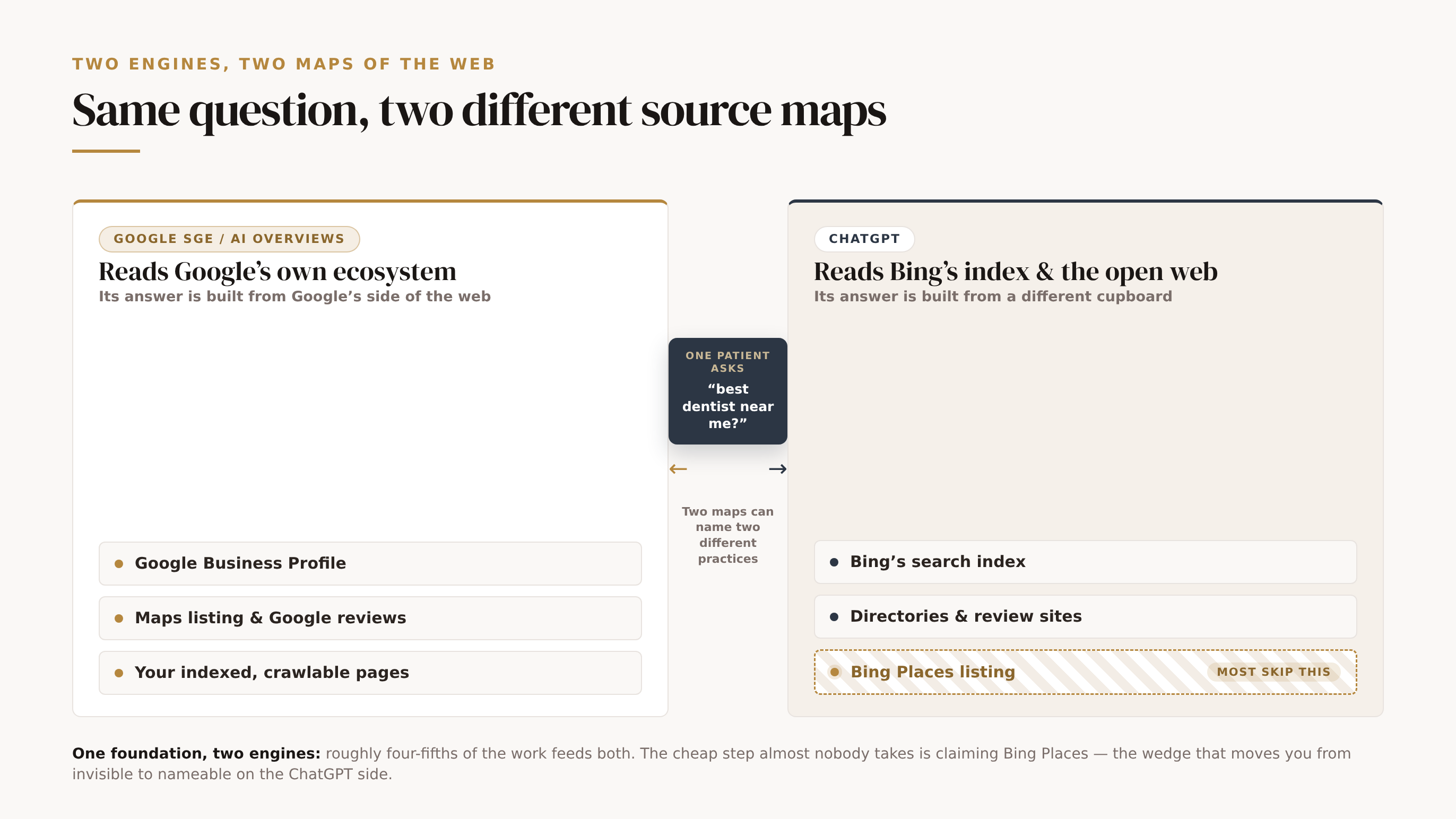
They differ in the way that matters most for whether you get named: they read different parts of the web. Google's AI answer is anchored in Google's own ecosystem. ChatGPT is anchored, when it looks something up, in Bing's index and the wider open web. Those are two different maps, so they can recommend two different practices for the identical question. A dentist who has only ever worked on their Google presence has, in effect, prepared one of the two rooms a patient might walk into.
Google has described its own machinery in clear terms. Its AI features run on a custom version of Gemini 2.5 and use what Google calls query fan-out, "breaking down your question into subtopics and issuing a multitude of queries simultaneously on your behalf", and Google reports that AI Overviews are "driving over 10% increase in usage" for the query types that show them[5]. For a dental query, that fan-out leans on the Google assets a practice already tends: the Google Business Profile, the Maps listing, the reviews and the crawlable pages on the site.
ChatGPT draws from a different cupboard. When it answers a local question by searching, it works largely over Bing's index plus the open web, behaving like a selective researcher that scans the strongest Bing results and picks the sources that look credible, specific and easy to verify. The practical upshot for a dentist is the one almost nobody has acted on: a practice that has only optimised for Google can be close to invisible to ChatGPT, because the listing and directory presence ChatGPT leans on were never set up. Claiming Bing Places and being present and consistent across third-party directories is the most-skipped step on this whole topic.
The table below sets the two side by side for a dental practice.
Side by side
Two engines, two source maps
| Factor | Google SGE / AI Overviews | ChatGPT |
|---|---|---|
| What it actually is now | AI Overviews plus AI Mode (SGE was the old Labs name), in Google's own words | An OpenAI GPT model with a browse and search layer over the web |
| Underlying model | A custom version of Gemini, per Google | An OpenAI GPT model |
| Where the answer comes from | Google's index plus Google Business Profile, Maps and Google reviews | Bing's index plus third-party directories, review sites and the open web |
| How it builds the answer | Query fan-out: one question split into many simultaneous sub-queries | Conversational retrieval, described as a selective researcher over the strongest Bing results |
| Patient questions it tends to win | Local and transactional ("dentist near me", "emergency dentist open now") | Conversational and comparison ("root canal or implant?", "is this tooth pain serious?") |
| The highest-value dental asset | A complete, active Google Business Profile with recent reviews | A claimed Bing Places listing plus consistent directory presence and a crawlable site |
| Where dentists under-invest | Usually already worked through local SEO | Almost universally skipped, which is exactly the opening |
| What both can read | Answer-first pages under question headings, dental schema, identical details everywhere | The same: clean crawlable HTML, clear answers, matching details on other sites |
Google rows quote Google's published description; ChatGPT rows reflect how the field consistently characterises the engine.
These are not the same answer shown in two windows. They are two answers drawn from two different slices of the web, and a practice can sit comfortably in one while being absent from the other. The job is to close that gap without walking away from the Google work that already carries most of the local load. For the Google side on its own, our companion guide covers Google AI Overviews and SGE for dentists.
Which AI tends to win which patient question?
Neither wins outright. They tend to win different moments in the same patient's journey, which is the real reason to cover both rather than bet on one. Sorting the questions by type makes the split obvious.
High-intent local questions are Google's home ground. "Emergency dentist open now near me", "dentist taking new NHS patients in [town]", "implant dentist near me" lean heavily on the local listing and review signals Google's AI surface trusts: the Google Business Profile, Maps and recent Google reviews. These are also the enquiries worth most to a practice, and they are decided largely by how complete the profile is and how current the reviews are. If a patient is at the point of booking, there is a good chance a Google AI Overview is shaping who they ring.
Conversational, advice and comparison questions are where ChatGPT earns its keep. "Should I get a root canal or an implant?", "is my tooth pain an emergency?", "what are my options for a missing tooth?", "is Invisalign worth it for mild crowding?" are the questions a patient asks earlier, when they are still working out what they need rather than who to call.
ChatGPT answers these from crawlable, well-structured content and the agreement it finds between sources across the web, and the practice whose site explains these things plainly, in the patient's own words, is the one it can quote. The patient who reads a clear, reassuring answer that draws on your content at this stage is frequently the same patient who later asks the high-intent local question. Cover both surfaces across both question types and you stay in the conversation from "what should I do about this?" through to "who near me does it?".
How does Google's AI Overview decide which dentist to show?
It pulls almost entirely from Google's own ecosystem, then favours the practice whose facts are complete, consistent and current. Because the engine fans a single question out into many smaller ones, it rewards the practice that has a clear, verifiable answer ready for each of those sub-questions rather than one vague "Treatments" page that answers none of them precisely.
Google's recommendation path
How AI Overviews reach a named dentist
Fan out the question
Query fan-out splits one question into many simultaneous sub-queries about location, treatment and urgency.
Gather Google assets
It draws on the Business Profile, the Maps listing, Google reviews and the crawlable pages on your site.
Check the facts agree
Name, address, hours, services and reviews need to tell the same story across those assets.
Name the practice
The Overview favours the practice whose details are most complete, consistent and current.
Your Google Business Profile and Maps presence
This is the single biggest lever on the Google side, and plenty of practices never pull it fully. The profile wants seven things:
- Your exact name, address and phone number.
- Complete opening hours, including how out-of-hours emergencies are handled.
- Every treatment you genuinely offer, named the way patients name it.
- An accurate "accepting new patients" status.
- Real photographs of the practice and the team.
- Access details such as step-free entry and parking.
- Recent reviews, replied to.
A Google AI answer about a local dentist is assembled in large part from this record, so a thin or out-of-date profile quietly drops you out of contention before the question has even finished forming.
Your reviews, recent and specific
Reviews do heavy lifting here, and recency counts for more than owners expect. A wall of five-star reviews from three years ago reads, to a patient and to the engine alike, as a practice that may have gone quiet. A steady trickle of genuine, recent reviews, on Google first and then on health-specific platforms, gives the engine current evidence it can repeat with confidence. Reply to all of them, briefly and warmly, but never put a patient's clinical detail in a public reply: thank them, address the general point and take anything specific offline. That one discipline protects confidentiality and reads well to every reader, whether human or machine.
Crawlable, answer-first content with dental schema
The Overview can only quote pages it can actually read. Two things commonly block it. The first is content that only appears once JavaScript has run, which some crawlers never execute, leaving them looking at a near-empty page. The second is a site that wraps its services in vague marketing language instead of the plain question-and-answer form the engine can lift directly. Adding the machine-readable labels for a dental practice (the Dentist or LocalBusiness type, FAQPage for your common questions, and a genuine AggregateRating where you actually display real scores) clears away any last doubt about who you are, where you are and what you treat.
How does ChatGPT decide which dentist to recommend?
It works from Bing's index and the third-party web around it, which means the deciding factor is often a listing the practice simply never created. Everything that makes you legible to Google helps here too, but one step is unique to this surface, and skipping it is the reason so many well-run practices never surface in a ChatGPT answer.
The step almost every dentist skips: claim Bing Places
Bing Places is, roughly, to ChatGPT's local answers what Google Business Profile is to Google's, and the overwhelming majority of dental practices have never claimed it. Claiming and verifying the listing, then filling it out with the same exact details you hold on Google, is the highest-return hour of work on this entire subject. It is the wedge that moves a practice from invisible to nameable on the Bing-fed side.
Be consistent across third-party directories and review sites
ChatGPT reaches well beyond any single listing, checking your details against directories, review platforms, social profiles and the open pages that mention your practice. The rule that governs this is the same one that governs the Google side, applied to a wider spread of sources: your name, address, phone number, hours and services should read identically wherever they appear. When a practice's details contradict each other across the web, the engine has no reliable version to quote, and the name that ends up in the answer belongs to whoever it could pin down. Consistent details across the third-party web are what get you recommended.
Write citable, answer-first content a selective researcher will quote
Because ChatGPT behaves like a researcher picking the clearest sources, the pages that win are the ones that answer a single question plainly and stand on their own. One page per treatment, headed with the question a patient actually asks, opening with a direct answer in the first couple of sentences, then expanding into plain detail with indicative pricing and typical timescales. No superlatives, no brochure language, nothing that needs the rest of the site to make sense. A page like that is easy to lift a sentence from, and a sentence lifted into an answer with your name attached is exactly the outcome you are working towards.
Do I have to choose between them?
No, because the two lists overlap almost entirely. Most of what makes you legible to the two engines is shared: a consistent set of facts about your practice everywhere it appears, dental schema on your site, answer-ready service pages, a steady flow of genuine recent reviews, and a site clean enough to be crawled. Do that foundation once and both surfaces benefit from it. The engine-specific listing work is the small remainder, and on the ChatGPT side that is mostly the single Bing Places step almost nobody has taken. One foundation, two engines: build the shared base, then spend the cheap incremental hour on the Bing-fed side that your competitors have left untouched.
What is the practical split: do this for Google AI, do this for ChatGPT?
Do this for each surface, and this for both. Every item is checkable in an afternoon.
Worklist
The practical split, sorted by which engine each task serves
For Google AI: complete the Google Business ProfileExact details, full hours, accurate accepting-patients status, real photos, plus a steady stream of recent Google reviews.
For ChatGPT: claim Bing PlacesVerify it, complete it with the same exact details, and match your name, address, phone, hours and services across directories and review sites.
For both: keep facts identical everywhereOne consistent set of name, address, phone, hours and services wherever your practice appears.
For both: add dental schemaDentist or LocalBusiness, FAQPage and genuine AggregateRating so the engines can read your true facts.
For both: one answer-first page per treatmentPatients search a treatment by name, so a single combined services page answers none of those questions.
Do this for Google AI Overviews. Claim and fully complete your Google Business Profile with exact details, complete hours, an accurate accepting-patients status, real photos and access information. Build a steady stream of recent, genuine Google reviews and reply to every one without clinical detail. Make sure your key service pages are crawlable and written answer-first, so the fan-out has a clean answer to lift for each sub-question.
Do this for ChatGPT. Claim and verify Bing Places, then complete it with the same exact details you hold on Google. Check that your name, address, phone, hours and services match across the directories and review sites ChatGPT might read, such as the main listings platforms and your social profiles. Make sure each treatment page opens with a direct, quotable answer a selective researcher can pick up and attribute to you.
Do this for both. Keep your name, address, phone, hours and services identical everywhere. Add Dentist or LocalBusiness, FAQPage and genuine AggregateRating schema. Write one clear page per treatment, named as patients name it, with indicative price ranges and typical timescales. Keep reviews recent and reply to them safely. This shared block delivers most of the result; the two engine-specific lists above close the rest.
How do I check whether SGE or ChatGPT already mentions me?
You can test all of this today, for nothing, in about ten minutes, and the test doubles as your worklist. Open Google and run the questions a real patient asks ("best dentist in [your town]", "emergency dentist near me today", "Invisalign in [your area]"), and watch whether an AI Overview appears and whether it names your practice. Then open ChatGPT and ask the same kinds of question, including the more conversational ones a patient would actually phrase, such as "I have got a missing tooth, what are my options and who near me does implants?". Note which surface names you, which names a competitor, and which leaves you out completely.
Run each prompt a few times. Answers shift between attempts, so treat one reply as an anecdote and the pattern across several as your reading. Finish with two listing checks and one index check: confirm your Google Business Profile and your Bing Places listing both exist and carry identical details, then search site:yourpracticedomain.co.uk in Bing to confirm your pages are indexed at all. The most common single finding is "well represented on Google, absent from ChatGPT, no Bing Places listing", and it is also the quickest thing on the list to fix.
Get your free AI visibility check →
Is any of this against GDC rules?
No. The General Dental Council's Standards for the Dental Team require at standard 1.3.3 that "you must make sure that any advertising, promotional material or other information that you produce is accurate and not misleading, and complies with the GDC's guidance on ethical advertising"[6]. That duty covers your website, both of your AI-facing listings and any third-party page you feed with your details.
The moves that win an AI recommendation are the same ones that keep you safely inside the rule. Accurate details, genuine reviews, clear factual service pages and plain indicative pricing satisfy both at once. The places practices come unstuck are the places the rule already forbids: outcome guarantees ("a perfect smile, guaranteed"), unverifiable superlatives ("the best dentist in [town]"), and stale claims such as an "accepting NHS patients" line left switched on after the list has closed.
None of those help your AI visibility either, because a responsible engine will not repeat a guarantee or a superlative, and a stale fact damages the very consistency both surfaces reward. You can be specific and persuasive on factual strength alone, and that is precisely what gets you named.
Where this leaves your practice
The two AI answers a patient is most likely to read before they ring anyone are fed from two different halves of the web, and most practices have only ever set up one half. The Google half you have probably worked on through years of local SEO, and it still does most of the heavy lifting on the high-intent local questions.
The ChatGPT half usually comes down to a single unclaimed Bing Places listing and a scatter of inconsistent third-party details, which is both the gap and the quickest win available to you. Settle the SGE confusion (it is just AI Overviews), build the shared foundation once, claim the listing your competitors have not, and keep your facts identical and your reviews recent, and you give both engines a practice they can name without hesitation.
If you would rather see where you stand first, a free QBiz Leads AI visibility check scans your website in about thirty seconds. It returns a plain pass or fail on four things: crawlability, schema, the clarity of your service pages and the consistency of your listed details. It reads your site rather than the engines, so it points at fixes instead of reporting one moment-in-time answer. The check is only half of what QBiz does.
Alongside the on-site groundwork we run the content distribution that earns the off-site mentions these answers are assembled from, so your practice reads the same way across the third-party web. You can request it from the QBiz AI visibility check. To hand the on-site and off-site side to a team, our AI SEO for dentists service page sets out how we run it for a practice.
If the ChatGPT side is where you suspect the gap is, see why dental practices do not show up in ChatGPT.
Frequently asked questions
Is Google SGE the same as AI Overviews?
Yes. Google retired the SGE name when the feature left Labs, and it now ships as AI Overviews, with AI Mode as the fuller conversational version. There is no separate SGE product to optimise for, so any advice still written around the old label is out of date.
Is Google AI or ChatGPT better for getting dental patients?
Neither is better in isolation, because they reach different patients from different sources. Google's AI surface tends to carry more total volume today and owns the high-intent local questions, while ChatGPT is the surface most practices are entirely missing from, which makes it the larger untapped opportunity. The practical answer is to cover both: the shared foundation serves each, and the one extra step, claiming Bing Places, is cheap.
Does ChatGPT use my Google Business Profile?
Not directly. When ChatGPT looks up a local answer it leans on Bing's index, third-party directories and review sites rather than your Google Business Profile. This is the single most common misunderstanding behind a practice being well represented on Google and absent from ChatGPT. You need a claimed Bing Places listing and consistent third-party details for ChatGPT to describe you confidently.
If I rank well on Google, will ChatGPT automatically recommend me?
No. A strong Google ranking helps the patients who use Google, but it does not carry across to ChatGPT, which reads Bing's index and the open web rather than Google's. ChatGPT visibility is a separate job built on Bing Places, consistent directory presence and clearly quotable content.
Can I pay to appear in SGE or ChatGPT?
No. There is no paid placement that buys you into either AI answer the way an advert buys a slot above the organic results. Anyone promising to pay your way in is selling something that does not exist. You earn the recommendation by being the practice each engine can most confidently verify and describe.
How long until my practice shows up in AI answers?
There is no fixed timeline, and nobody can credibly promise one. Completing both listings and gathering recent reviews can shift things within a few weeks; earning enough matching detail across the web to be named with confidence usually takes a few months of steady work. It is durable, compounding groundwork rather than a switch you flip.
Do reviews on sites other than Google count?
For ChatGPT, yes, and more than most practices assume. Google reviews are the strongest signal on the Google side, but ChatGPT reads review platforms and directories across the open web rather than Google's, so a practice with a strong Google profile and nothing anywhere else looks thin from the Bing-fed side. Reviews on health-specific and general listing platforms give the second engine something to read.
What happens if my NHS status changes?
Update every listing the same week it changes. An "accepting NHS patients" line left on after the list has closed is the most common stale fact on a dental listing. It also puts your listings out of step with each other, which is the inconsistency both engines penalise. Change it on your Google Business Profile, your Bing Places listing, your website and any directory that carries it.
Do I need a separate page for every treatment?
For the treatments patients search for by name, yes. A single "Treatments" page that lists implants, clear aligners, veneers and whitening in a paragraph each gives an engine nothing precise to quote for any one of them. One page per treatment, headed with the question a patient actually asks and opening with a direct answer, gives both engines a self-contained passage to lift. Routine items such as check-ups and hygiene visits can sit together on one page.
Does my practice need to be on Bing's index as well as Bing Places?
Yes, and they are two different things. Bing Places is your business listing; Bing's index is the record of your website pages. ChatGPT's search layer draws on both, so a claimed listing does not help if your treatment pages were never indexed. Search site:yourpracticedomain.co.uk in Bing to confirm your pages are there at all, and fix crawlability first if they are not.
Sources
- [1] BrightLocal, Local Consumer Review Survey 2026: https://www.brightlocal.com/research/local-consumer-review-survey/ (US-weighted; independent. "Use of ChatGPT and other generative AI tools for local recommendations has grown rapidly, rising from 6% last year to 45% and becoming the third most popular source of business recommendations.")
- [2] KFF, Tracking Poll on Health Information and Trust, 2025: https://www.kff.org/public-opinion/kff-tracking-poll-on-health-information-and-trust-use-of-ai-for-health-information-and-advice/ (US; independent. "About a third (32%) of adults are turning to AI for health information and advice", including about three in ten (29%) who have used AI tools in the past year for information or advice about their physical health.)
- [3] Pew Research Center, 22 July 2025: https://www.pewresearch.org/short-reads/2025/07/22/google-users-are-less-likely-to-click-on-links-when-an-ai-summary-appears-in-the-results/ (US; independent. "About six-in-ten respondents (58%) conducted at least one Google search in March 2025 that produced an AI-generated summary." Users who saw an AI summary clicked a traditional result in 8% of visits, against 15% when no summary appeared.)
- [4] TechCrunch, reporting OpenAI, 27 February 2026: https://techcrunch.com/2026/02/27/chatgpt-reaches-900m-weekly-active-users/ (Global; reporting OpenAI. "ChatGPT has reached 900 million weekly active users"; "a jump of 100 million users from the 800 million that OpenAI reported in October 2025.")
- [5] Google (The Keyword), "AI in Search: going beyond information to intelligence", 20 May 2025: https://blog.google/products/search/google-search-ai-mode-update/ (Global; vendor primary. "AI Mode uses our query fan-out technique, breaking down your question into subtopics and issuing a multitude of queries simultaneously on your behalf"; a custom version of Gemini 2.5 is brought "into Search for both AI Mode and AI Overviews"; AI Overviews is "driving over 10% increase in usage" for the query types that show them.)
- [6] General Dental Council, Standards for the Dental Team, principle 1: https://standards.gdc-uk.org/pages/principle1/principle1 (UK; regulatory. Standard 1.3.3: "You must make sure that any advertising, promotional material or other information that you produce is accurate and not misleading, and complies with the GDC's guidance on ethical advertising.")
Leave a comment
Thoughts on this post? Leave a comment below. Comments are moderated before they appear, so yours will not show on the page straight away.
Your email is used only to contact you about your comment if needed — it is never published.
Comments
No comments yet. Be the first to leave one above.