How to Become an Entity AI Recognises
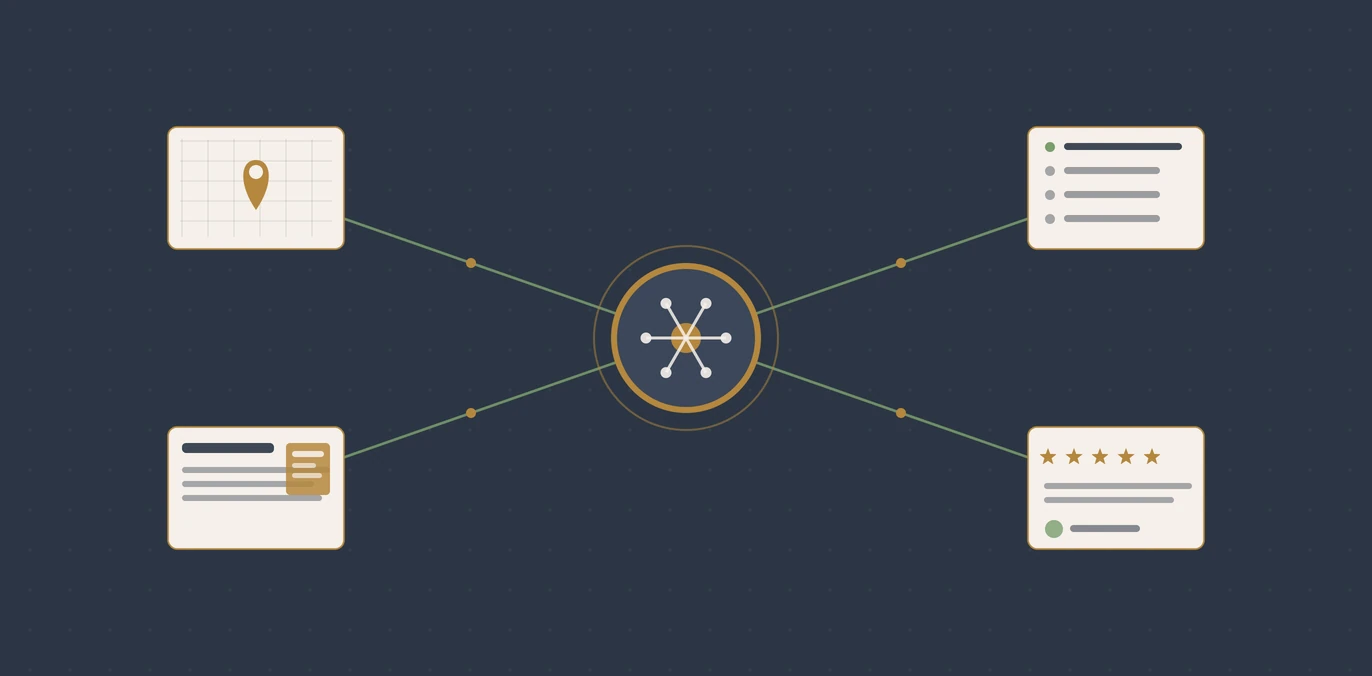
AI tools recommend entities, not web pages. Google defines an entity as “a thing or concept that is singular, unique, well-defined and distinguishable”: something a machine is sure is one specific, real thing rather than a vague topic. For a local business that means a named practice, at a fixed address, offering defined services: “Bridge Road Dental, 14 Bridge Road, Leeds”, not just the idea of “a dentist”. You become one by making the same facts about you appear, identically, in the places machines read for identity:
- Your own site's Organization markup.
- Your business listings and profiles.
- The open knowledge bases.
- Independent mentions that point back to you.
Do that and an AI has a stable, cross-checked record to draw on. Skip it and you are just a page it is not sure about.
A homeowner in Leeds asks an AI assistant for an emergency plumber. Two firms nearby do that work, and both have perfectly good websites. The assistant names one of them and never mentions the other.
The one it named could be checked from somewhere other than its own website. It also said where it works in terms an assistant can verify: Headingley, Horsforth and Chapel Allerton, rather than a blanket claim to cover all of Leeds.
That is the difference between a page and an entity. A page is a document about a plumber. An entity is the plumber itself, established firmly enough that a machine can attach facts to it and answer with it. Your website feeds that record. On its own, it is one source among several.
A page about you, versus a thing AI knows
As a page
A document it crawled
- One website among many on the same topic
- Read, but not confirmed as a real business
- The engine is unsure it can recommend you
As an entity
A record it trusts
- A named business at a fixed location and category
- Confirmed across the places machines read
- A confirmed record it can reach for and name
What an entity actually is
Google is explicit about the vocabulary. Its Knowledge Panel help documentation describes panels as boxes that appear "when you search for entities (people, places, organizations, things) that are in the Knowledge Graph."[2] The Knowledge Graph is the store of those entities and the relationships between them, and it sits underneath a great deal of what search and AI answers show.
An entity, then, is a real-world thing the system has decided to model as a distinct item: your business, its location, its category, the people behind it. Once you are in that graph, you are no longer a loose set of pages. You are an identity with attributes attached.
The rest of this piece is about giving the machines enough consistent, agreeing evidence to create that identity and keep it accurate.
Start with one non-negotiable: consistent NAP
NAP is name, address, phone. It sounds trivial. It is where entity records most often come apart, because nothing else consolidates until it is right.
Say your website footer reads "St Mary's Auto Ltd, 14 Bridge Road" while your directory listing reads "St Marys Auto" and an old profile still carries a former mobile number. A machine then has three weak candidates instead of one strong one. It cannot be certain they are the same business, so it hedges, and a hedged entity is a weak entity.
Why consistent NAP decides everything
Inconsistent name, address and phone
Three weak candidates a machine cannot be sure are one business, so it hedges. A hedged entity is a weak entity.
One exact form, written identically everywhere
Separate mentions collapse into a single, confident record the engine can attach facts to.
Pick one exact form of your name, address and phone number. Write it identically everywhere: your site, your Google Business Profile, every directory, every social profile, every citation. No abbreviations in one place and full words in another. Consistency is what lets separate mentions collapse into a single, confident record.
Tell machines who you are: Organization schema and sameAs
Your website can state its identity in a format built for machines. That is what Organization structured data is for. Schema.org defines the Organization type plainly as "An organization such as a school, NGO, corporation, club, etc."[4] You add a small JSON-LD block to your home page declaring:
- Your name and URL
- Your logo
- Your address and contact details
Google's own Organization documentation explains why this matters for identity specifically: "Adding organization structured data to your home page can help Google better understand your organization's administrative details and disambiguate your organization in search results. Some properties are used behind the scenes to disambiguate your organization from other organizations."[1] That is the point of the exercise: you are helping the machine tell you apart from every similarly named business.
Note Google's guidance that "There are no required properties; instead, we recommend adding as many properties that are relevant to your organization."[1] More accurate detail gives the model more to anchor on.
The property that does the heavy lifting for entity identity is sameAs. Schema.org defines it as "URL of a reference Web page that unambiguously indicates the item's identity. E.g. the URL of the item's Wikipedia page, Wikidata entry, or official website."[3] In practice you list the URLs of your verified profiles: your Business Profile, your main social accounts, your industry directory pages, your Wikidata entry if you have one. Each sameAs link is you telling the machine, in its own language, that these scattered profiles are all the same business.
Organization markup plus sameAs, in plain terms
sameAs links point to
Structured data is not decoration. As Google's introduction to structured data puts it, the search engine "uses structured data that it finds on the web to understand the content of the page, as well as to gather information about the web and the world in general, such as information about the people, books, or companies that are included in the markup."[6] Your markup is a direct input to how the world is modelled.
Claim the panel you may already have
For many established local businesses, Google has already begun forming an entity. Its Knowledge Panel help notes that panels "are automatically generated, and information that appears in a knowledge panel comes from various sources across the web."[2] You do not create a panel by asking. It emerges once there is enough agreeing evidence.
What you can do is take ownership of it. Google's documentation states: "If you are the subject of or official representative of an entity depicted in a knowledge panel, you can claim this panel and suggest changes."[2] A claimed, corrected panel is a cleaner entity record, and one you have some influence over.
For local service businesses, the front door is the Business Profile. Google's help is clear that Business Profiles "look similar to knowledge panels, but are specific to businesses that serve customers at a particular location or within a designated service area", claimed or created through Google Business Profile.[2] A complete, verified profile is an entity signal a local business controls directly, and it feeds Google's local answers.
Wikidata: the open knowledge base, and a realistic view of the bar
Wikidata is a free, structured knowledge base that many systems read from, and a natural sameAs target. There is a lot of wishful advice about "just add yourself to Wikidata".
Wikidata publishes its own notability policy. An item is acceptable only if it meets at least one of three criteria. The first is that it "contains at least one valid sitelink to a page on Wikipedia, Wikivoyage, Wikisource" and similar Wikimedia projects.[5] The second, and the one most relevant to a business, is that it "refers to an instance of a clearly identifiable conceptual or material entity that can be described using serious and publicly available references."[5]
Read that second criterion carefully. The lever is not a Wikipedia article, which few small businesses will ever merit. It is the references: credible, independent, verifiable sources that describe your business. Genuine press coverage, an entry in a recognised trade register, established directory records, reputable local journalism. If those exist, a Wikidata item describing you can be justified. If they do not, no amount of self-editing will make one stick.
So do not chase a Wikidata entry as a trick. You build the underlying references that make you a describable, verifiable entity, and the knowledge-base presence follows from that.
Entity-linked mentions: agreement across the open web
Machines trust an entity in proportion to how many independent, agreeing sources point at the same facts. Consistent NAP, sameAs, a claimed profile and verifiable references matter because they reinforce each other.
So the last mechanism is breadth of consistent mention. Being named, accurately and identically, in the places relevant to your field: reputable industry directories, local business listings, professional bodies, coverage of work you have actually done. Every accurate mention that repeats your exact name, location and category is another vote that you are a real, single, findable thing. Every inconsistent one is noise that weakens the record.
The proof ladder to a recognised entity
Consistent NAPOne exact name, address and phone, everywhere.
Organization markup and sameAsYour identity stated in machine-readable form, linking your verified profiles.
Claimed Business ProfileThe address, hours and category stated by you, in the record Google shows locally.
Independent referencesCredible third-party sources that describe and back up who you are.
A recognised entityEnough agreeing evidence for a settled record, and a panel you can claim.
This is where entity building meets everything else on this site. How different engines weigh those sources is covered in how AI engines pick sources, and the wider discipline of being the cited answer is answer engine optimisation.
Page signals versus entity signals
Traditional page-level work and entity work are not rivals; they answer different questions for the machine.
| Question the machine is asking | Page-level signal | Entity signal |
|---|---|---|
| Is this document relevant to the query? | Content, headings, on-page answers | Not the point of this layer |
| Who or what is this, exactly? | Weak on its own | Organization markup, consistent NAP |
| Is it the same business I saw elsewhere? | Cannot tell from one page | sameAs links across verified profiles |
| Can I trust that it is real? | A single site is thin evidence | Independent, agreeing references and mentions |
| Do I have a settled record to recommend? | No, just a page | Yes, a recognised entity |
Good pages make you readable; entity signals make you recommendable. You need both, but if AI keeps overlooking you despite a decent site, the missing layer is almost always the entity one.
Where entity records break in practice
The sequence above assumes a clean start. These are the situations that quietly split one business into two records, and none of them are fixed by doing the steps again.
- A rebrand that only half migrated. The new name sits on your site and your Business Profile while the old one still sits on a dozen directories and a trade register. A machine reads two businesses at one address and divides the evidence between them, so neither record is strong enough to recommend. Chase the old name down listing by listing until it is gone or redirected.
- Two locations sharing one phone line. Give each site its own number and its own profile. Where a single number covers both, the machine cannot tell which facts belong to which address, and it will either fuse the two into one muddled record or keep both as weak ones.
- A sameAs link to a profile you have lost access to. An abandoned social account carrying a former address contradicts your own markup, and you are the one pointing the machine at it. Reclaim it if the platform allows, otherwise drop it from the list rather than linking to a record you cannot correct.
- An address written two ways. A unit number, a floor, a shortened street type: if these appear on some listings and not others, those listings do not merge. This is the version of inconsistency that survives a NAP tidy-up, because the name and the phone number already match.
A simple sequence to build your entity
You do not do this all at once. In rough priority order:
- Lock your NAP. Decide the one exact form of name, address and phone. Write it down.
- Fix it everywhere. Update your site, Business Profile and every listing to that exact form. Retire or correct old profiles.
- Add Organization structured data to your home page with your real detail, including a sameAs list of your verified profiles.
- Claim and complete your Business Profile, and claim any auto-generated panel you already have.
- Build the references. Earn accurate, independent mentions in the directories, bodies and coverage that fit your field, so the supporting evidence is genuinely there.
- Only then consider a Wikidata item, if and when the independent references Wikidata requires actually exist to justify it.
For local businesses specifically, the same principles applied to a service area are covered in AEO for local businesses, and there is a worked, trade-specific version in the plumbing AI Overviews guide.
Where to start
Before you can be a recognised entity, your own website has to state your identity in a form machines can read. That means complete Organization markup, a consistent name, address and phone, and a clean set of sameAs links. That is exactly what a free QBiz Leads AI visibility check looks at.
It scans your own website and returns a pass or fail on the machine-readable identity signals: whether your structured data is present and complete, whether your business details are consistent, whether the technical groundwork for entity recognition is in place. It reads your site, not the engines, so it will not tell you what any assistant currently says about you. It tells you whether your own foundations are ready for one to build an entity on.
Get your AI Visibility audit →
Frequently asked questions
What does it mean to be an "entity" in AI search?
An entity is a specific real-world thing a system models as a distinct item: your business, its location and its category, stored in a knowledge graph with facts attached. Google describes knowledge panels as appearing when you search for "entities (people, places, organizations, things) that are in the Knowledge Graph." Being an entity means the machine is confident you exist and knows what you are, rather than just having crawled a page about you.
Why do AI tools recommend entities instead of pages?
Because a recommendation needs certainty. A page is a document that might be about anyone; an entity is a verified identity the model can trust and attach facts to. When an assistant names a business, it is drawing on established knowledge, not deciding which document to quote.
What should I fix first?
Consistent NAP: one exact form of your name, address and phone number, written identically everywhere. Inconsistent details stop separate mentions from consolidating into one confident entity, so nothing built on top of them holds.
What does sameAs do?
Schema.org defines sameAs as a "URL of a reference Web page that unambiguously indicates the item's identity", such as a Wikipedia page, Wikidata entry or official website. Listing your verified profiles as sameAs links tells machines that your scattered listings are all the same entity, which helps them merge you into one record.
Can my small business get on Wikidata?
Only if you meet its notability policy. The criterion most relevant to a business is that the item "refers to an instance of a clearly identifiable conceptual or material entity that can be described using serious and publicly available references." If credible, independent references about you exist, an item can be justified. If they do not, it will not qualify, so you build those references first.
Does adding Organization schema guarantee a knowledge panel?
No. Google states that knowledge panels "are automatically generated" from "various sources across the web", so no single action forces one to appear. Organization markup, a complete Business Profile and consistent details all improve the odds, but the panel emerges from agreeing evidence over time, not from one tag.
How long does it take for these changes to show up?
There is no switch to flip. Each machine picks up a change when it next reads the source carrying it, so markup on your own site can be seen quickly while a directory record may sit unchanged far longer. The record settles once enough of those sources agree, which is why correcting the details everywhere matters more than correcting them quickly.
A knowledge panel already shows something wrong about me. How do I get it corrected?
Claiming the panel lets you suggest a change, but Google generates panels from sources across the web, so a suggestion holds when the web agrees with it. Correct the underlying sources first: your own markup, your Business Profile, and whichever directory record carries the wrong detail. A suggestion that contradicts every other source the machine can see gives it no reason to prefer your version.
I work from home and do not publish my address. Can I still be an entity?
Yes. A Business Profile can cover a service area instead of a walk-in address, so hiding the address and defining the areas you travel to is a supported setup rather than a compromise. Your record is then anchored on the name, the phone number, the category and that service area. The consistency rule does not relax: those remaining details still have to match everywhere they appear.
What is my "category", and where does a machine read it from?
Your category is the plain description of what you do, such as an emergency plumber or an orthodontic practice. Machines read it from your Business Profile category, the type declared in your structured data, the trade headings directories file you under, and the wording on your own pages. Pick the one that describes your actual main work and use it consistently, because a business filed under different trades in different places is harder to place in an answer.
Sources
- [1] Google Search Central, "Organization (Organization) structured data" (primary documentation): "Adding organization structured data to your home page can help Google better understand your organization's administrative details and disambiguate your organization in search results. Some properties are used behind the scenes to disambiguate your organization from other organizations." Also: "There are no required properties; instead, we recommend adding as many properties that are relevant to your organization." https://developers.google.com/search/docs/appearance/structured-data/organization
- [2] Google Knowledge Panel Help, "About knowledge panels" (primary documentation): "Knowledge panels are information boxes that appear on Google when you search for entities (people, places, organizations, things) that are in the Knowledge Graph"; "Knowledge panels are automatically generated, and information that appears in a knowledge panel comes from various sources across the web"; "If you are the subject of or official representative of an entity depicted in a knowledge panel, you can claim this panel and suggest changes"; Business Profiles "look similar to knowledge panels, but are specific to businesses that serve customers at a particular location or within a designated service area." https://support.google.com/knowledgepanel/answer/9163198
- [3] Schema.org, "sameAs" (primary vocabulary): "URL of a reference Web page that unambiguously indicates the item's identity. E.g. the URL of the item's Wikipedia page, Wikidata entry, or official website." https://schema.org/sameAs
- [4] Schema.org, "Organization" (primary vocabulary): "An organization such as a school, NGO, corporation, club, etc." https://schema.org/Organization
- [5] Wikidata, "Wikidata:Notability" (primary policy): an item is acceptable if it meets at least one of three criteria, including that it "contains at least one valid sitelink to a page on Wikipedia, Wikivoyage, Wikisource" (and similar Wikimedia projects) and that it "refers to an instance of a clearly identifiable conceptual or material entity that can be described using serious and publicly available references." https://www.wikidata.org/wiki/Wikidata:Notability
- [6] Google Search Central, "Intro to how structured data markup works" (primary documentation): "Google uses structured data that it finds on the web to understand the content of the page, as well as to gather information about the web and the world in general, such as information about the people, books, or companies that are included in the markup." https://developers.google.com/search/docs/appearance/structured-data/intro-structured-data
Leave a comment
Thoughts on this post? Leave a comment below. Comments are moderated before they appear, so yours will not show on the page straight away.
Your email is used only to contact you about your comment if needed — it is never published.
Comments
No comments yet. Be the first to leave one above.