Why Your Dental Practice Is Not Showing Up in ChatGPT Recommendations
ChatGPT does not rank dentists; it assembles a shortlist from the sources it can actually search (chiefly Microsoft Bing's index, plus directories, review platforms and the NHS listing) and names only the practices it can verify and describe with confidence. Absence means it has not yet found enough consistent, readable evidence to name you, not that it has ruled you out. The most common single cause is simply not being in the index it reads; close behind are business details that disagree across the web and pages too vague for an engine to quote. Give it clear, agreeing evidence and the shortlist starts to include you.
If you typed a question into ChatGPT, watched it name three or four local dentists, and your own practice was nowhere in the list, the cause is almost always one of a few specific, fixable things: your website is not in the search index the tool reads from, your business details disagree with each other across the web, or your pages do not describe your services in the plain, factual detail an engine can quote. None of those is a verdict on the quality of your dentistry. They are gaps in how findable and how legible your practice is to a machine, and every one of them can be closed.
This guide walks through why it happens and what to do about it, in the order that actually matters. The fixes that win an AI recommendation are the same ones a dental practice should be doing anyway: accurate information, real reviews, clear pages, clear pricing. If you want the companion piece on earning the recommendation from a standing start, our guide to how dentists get recommended by ChatGPT is the place to go next.
The short version
- Absence is a gap, not a penalty. The engine has not blacklisted you; it has not yet found enough consistent reason to name you.
- Indexing and rendering come first. If your pages are not in the search index, or your text loads only through JavaScript, no other fix matters yet.
- Contradictory details cost you. When your name, address, phone and hours disagree across the web, an unsure engine picks a practice it is sure about.
- Thin pages are invisible pages. Engines quote pages that answer a specific question; a single catch-all "Treatments" page answers none of them.
- Stale reviews read as a quiet practice. A stack of old five-star ratings on one platform, with nothing recent, signals a practice that may have gone dark.
Why the miss matters
The patient journey has moved into AI answers
900 million
weekly active ChatGPT users in February 2026.
800 million
weekly active users the previous October.
32%
of US adults have used AI for health information or advice.
over 10%
increase in usage for query types that trigger Google AI features.
Sources: TechCrunch reporting OpenAI, February 2026; KFF, 2025; Google, May 2025.
You asked ChatGPT and your practice was not there: what does that actually mean?
It means the tool either did not find your practice among the sources it trusts, or found it but judged a competitor to be the clearer, better-evidenced answer. It is not a penalty, and there is no blacklist. ChatGPT is choosing a small set of names from a much larger field, and your practice has not yet given it enough reason to be one of them.
That moment matters more than it used to, because of how many people now reach a dentist this way. ChatGPT passed 900 million weekly active users in February 2026, up from 800 million the previous October (TechCrunch, February 2026)[1]. A meaningful share of those people are asking about health: KFF's 2025 tracking poll found that about a third (32%) of US adults have turned to AI for health information or advice, including 29% who used it for physical health questions (KFF, 2025)[2]. "Is there a good dentist near me taking on patients?" sits squarely in that territory.
So the practices being named are quietly collecting the patients who ask, and the ones that are absent never see the enquiry at all. The miss does not show up in your diary or your analytics, because as far as you are concerned the patient was never looking. The rest of this guide is about turning that invisibility into a worklist.
Why your Google ranking has nothing to do with whether ChatGPT names you
A first-place Google ranking does not carry over to ChatGPT. They are separate systems, judged on different evidence, and topping one tells you almost nothing about the other. A practice that has paid for years of search engine optimisation can still be invisible in an AI answer, and a smaller practice with tidy, consistent information can be named ahead of it.
Four assumptions quietly trip people up here:
- A high Google rank does not transfer. Being position one for "dentist in Leeds" does not put you in ChatGPT's reply. The engine builds its own shortlist from its own sources.
- Your Google star rating does not feed the AI directly. Reviews matter, but a strong Google profile is one input among many, not a passport.
- There is no "submit your business" button. You cannot register your practice with ChatGPT the way you claim a Google Business Profile. Visibility is earned through the wider web, not through a form.
- Search optimisation and answer optimisation are now two jobs. They overlap, but being found by a person scrolling results and being named inside an AI answer are different outcomes that need different work.
If this is the first time the distinction has landed, our AEO guide for dentists and clinics sets out the full picture of how answer engines treat a practice differently from a search engine.
How does ChatGPT actually decide which dentists to name?
For a local question like finding a dentist, modern ChatGPT does not rely only on what it memorised during training. It searches the live web, reads what it finds, and synthesises an answer from the most consistent, trustworthy sources, then names the practices those sources agree on. This is the single most misunderstood point in most advice on the subject, and getting it right changes what you should do.
A lot of older guidance still describes AI recommendations as coming purely from "frozen" training data, a fixed snapshot that you cannot influence without waiting for the next model. That was a fair description of an early chatbot answering a general question. It is not how a current tool handles a local, time-sensitive query. When you ask about a dentist near you, ChatGPT runs live searches, in much the same way a person would, and assembles the reply from current pages. Which is good news: a live system can find you this month if you give it something to find.
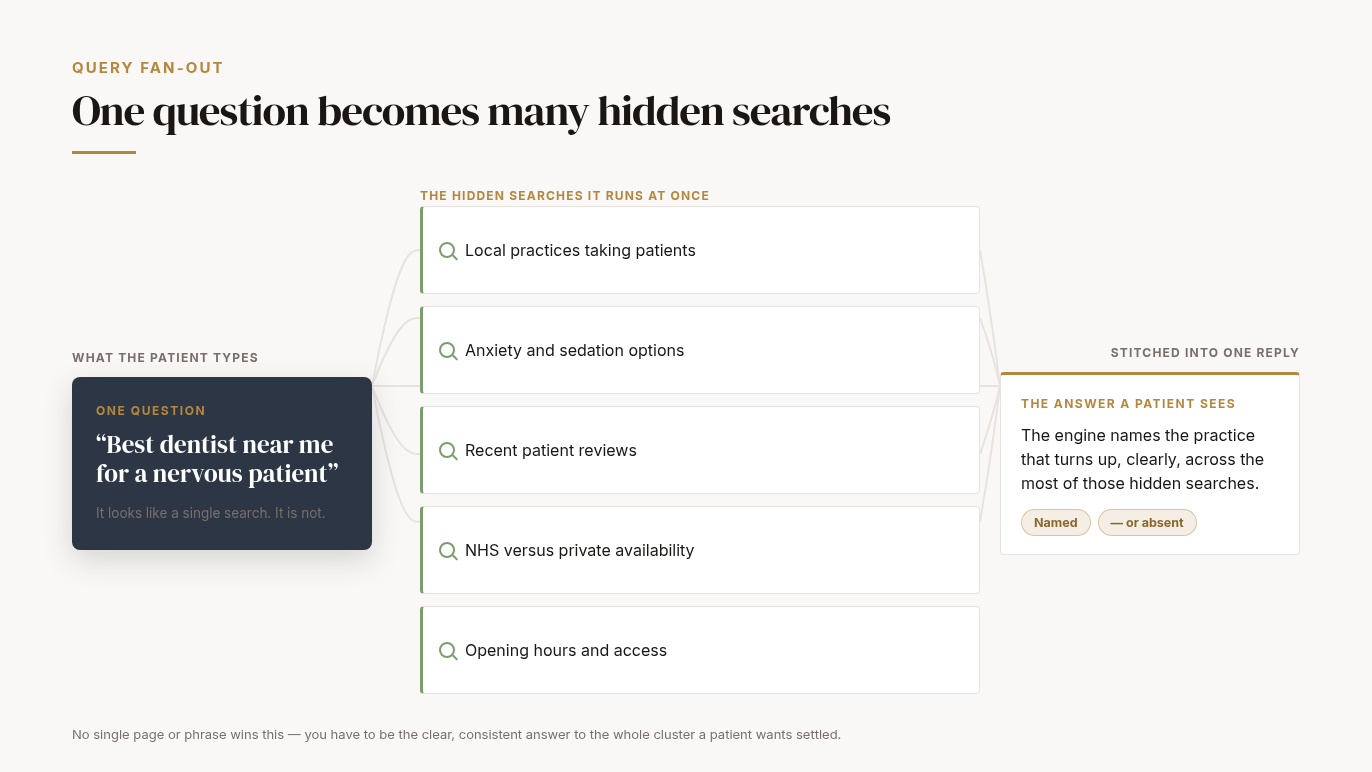
It helps to picture what one question becomes. Google describes its own AI Mode as using a "query fan-out technique, breaking down your question into subtopics and issuing a multitude of queries simultaneously on your behalf" (Google, May 2025)[3]. A single "best dentist near me for a nervous patient" is not one search. Behind it sit separate hidden searches for local practices, anxiety and sedation options, recent reviews, NHS versus private availability, opening hours. The engine stitches the answers back together. Google has said these AI features are popular enough to drive "over 10% increase in usage" for the kinds of queries that trigger them (Google, May 2025)[3], so the behaviour is growing, not fading.
The practical lesson is that no single page or phrase wins this. You are trying to be the clear, consistent answer to the whole cluster of things a patient wants settled about dental care in your area. The more of those an engine can find answered plainly across your presence, the more of the fanned-out searches you turn up in, and the more often your name survives into the final reply.
From prompt to shortlist
How one dental question becomes many checks
Patient prompt
The patient asks for a dentist with a specific need and place.
Hidden searches
The engine looks for location, services, reviews, hours and availability.
Source checks
Website, Google profile, NHS listing, directories and reviews must agree.
Named answer
Only practices with clear, current evidence survive into the reply.
So why is my practice invisible? The fixable reasons
Most invisibility traces back to one of five concrete gaps. Read them as a diagnosis: find the one (or two) that describe you, and you have found your leak.
Diagnosis map
Five leaks that keep a practice out of the answer
| Reason | What the engine sees | First check |
|---|---|---|
| Indexing or rendering gap | A site that is missing from the index, or text that only appears after browser code runs. | Search site:yourpractice.co.uk and confirm key pages appear. |
| Business facts disagree | Name, address, phone, hours or services conflict across website, Google profile, NHS listing and directories. | Compare the same facts everywhere and fix the outlier version. |
| Thin service pages | Generic treatment copy that does not answer the patient's specific question. | Map one clear page to each real service and fee question. |
| Stale review signal | Old or single-platform reviews make the practice look quiet or hard to verify. | Check recency, spread and safe review replies. |
| Recent change | A new name, address or opening has not yet lined up across the web. | Update every listing on the same day and wait for reindexing. |
Is your website even in the search index ChatGPT reads?
If search engines cannot find or read your website, the AI that searches through them cannot quote you, and you will be absent no matter how good your dentistry is. This is the most common single cause, and the easiest to overlook because your site looks perfectly fine to you in a browser.
Two things break it. The first is indexing: if your pages are not in the search index, they do not exist as far as a retrieval-based tool is concerned. You can sanity-check this in seconds by searching site:yourpractice.co.uk in a normal search engine. If few or none of your pages come back, that is your headline problem.
The second is rendering: on some sites, particularly heavily-designed ones and a few page builders, the words only appear after JavaScript runs in an open browser. Several AI crawlers do not run that code, so they arrive, find almost nothing, and move on. A site can look rich to a visitor and read as a near-blank page to a machine.
Is your business information the same everywhere AI looks?
When your practice name, address, phone number, opening hours and services do not match across the web, the engine cannot tell which version is true, and an unsure engine reaches for a practice it is sure about instead. Consistency is dull admin that quietly decides a great deal.
When an AI tool answers a dental question, your own website is only part of what it reads. Alongside your own pages it weighs your Google Business Profile, the reviews you have gathered, the healthcare and local directories you appear in, your NHS "find a dentist" entry and any local press, and it looks for them to line up. If your old phone number lingers on one directory, your former opening hours sit on another, and a previous practice name survives somewhere else, you are handing the engine reasons to doubt you. One version of your facts, everywhere, removes that doubt.
Do your pages describe your services in plain, specific detail?
Engines quote pages that answer a specific question and ignore "welcome to our practice" copy that answers none. If your services live behind vague headings or a single catch-all "Treatments" page, you are invisible for the precise things patients ask.
A patient does not ask "tell me about your practice". They ask "how much is a private check-up in [town]?" or "can I see an emergency dentist today near me?" Each of those deserves a clear, factual page, named the way patients name it, describing what the treatment involves and what it costs in clear ranges. Machine-readable structure helps too: schema markup that labels you as a dentist, with your location, services and hours, makes the facts easy to lift. Keep it accurate throughout: state qualifications and GDC registration, describe treatments accurately, keep fees current, and avoid outcome guarantees and superlatives like "the best dentist in town", which an engine cannot repeat anyway.
Are your reviews recent, and on more than just Google?
Reviews are among the strongest trust signals an engine has for a local practice, and recency and spread matter as much as the total. A wall of five-star reviews that stops eighteen months ago, all on a single platform, reads as a practice that may have gone quiet.
Gather genuine reviews steadily rather than in one burst, ask satisfied patients at the right moment (after a completed course of treatment, not mid-appointment), and make leaving one a single tap. Spread them across the places an engine and a patient both check: Google first, then NHS profiles and healthcare-specific platforms. Respond to every review, positive or critical, but keep a patient's clinical details out of any public reply: acknowledge the person, address the general point, and move anything specific to a private channel. The line you must not cross is buying, incentivising or editing reviews to mislead, which is both a fitness-to-practise problem and unlawful in the UK.
Did you recently rebrand, move, or open?
This is the one genuine case where the AI simply does not know about you yet. If you have changed your practice name, moved premises, or only recently opened, the web is still full of your old details or empty of your new ones, and the engine is working from what it can find.
The fix is to flood the gap with consistent, current information: update your Google Business Profile and every directory the same day a detail changes, make sure your new name and address agree everywhere, and give the new pages time to be indexed. This is the only reason on the list where patience is part of the answer, but it is patience plus action, not patience alone.
How can I check exactly where I stand right now?
You can diagnose your own visibility today, for nothing, by asking the engines the questions a real patient asks and watching what comes back. You do not need a paid tool to find the leak; you need fifteen minutes and a little candour about the results.
Work through this:
- Run the real questions. Open ChatGPT, Google's AI Mode and Perplexity. Put a patient's own wording to each one: "dentist for nervous patients in [town]", "emergency dentist in [your area] today", "NHS dentist near me taking on patients", "best dentist in [your town]".
- Watch where you enter, if you do. Are you named at all? Named only sometimes? Named only when you ask very specifically? Note which practices appear instead of you, and which sources the answer leans on.
- Do the index check. Search
site:yourpractice.co.uk. If your key service pages are missing, indexing or rendering is your first job. - Run each prompt a few times. The reply shifts between attempts, so it is the recurring pattern, not a single answer, that tells you where you genuinely stand.
Absent from every answer means the problem is foundational: indexing, consistency or thin content. Named only by a competitor means it is worth studying what they hold that you do not, because the gap between their presence and yours is your worklist.
What should I fix first?
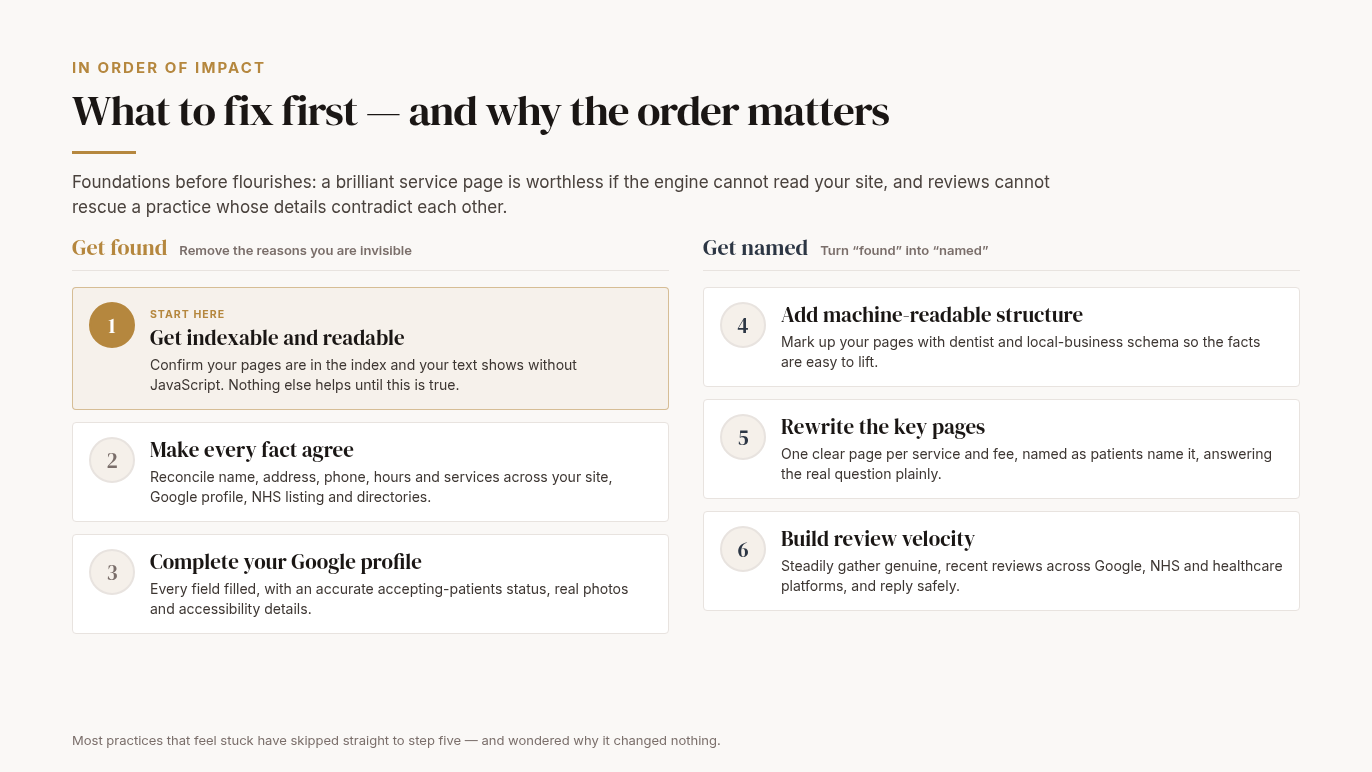
Fix in order of impact, not in the order the problems happen to occur to you. Foundations first, because a brilliant service page is worthless if the engine cannot read your site, and reviews cannot rescue a practice whose details contradict each other.
A sensible sequence runs like this:
- Get indexable and readable. Confirm your pages are in the index and that your text is visible without JavaScript. Nothing else helps until this is true.
- Make every fact agree. Reconcile your name, address, phone, hours and services across your website, Google profile, NHS listing and directories. Fix the contradictions.
- Complete your Google Business Profile. Fill in every field, with an accurate, current accepting-patients status, real photos, services in plain words, and accessibility details.
- Add machine-readable structure. Mark up your pages with dentist and local-business schema so the facts are easy to lift.
- Rewrite the key service and fee pages. One clear page per service, named as patients name it, answering the real question plainly and directly.
- Build review velocity. Steadily gather genuine, recent reviews across Google, NHS and healthcare platforms, and reply to them safely.
Fix order
The repair sequence that stops wasted work
Get indexable and readableConfirm the engine can find the site and read the text.
Make every fact agreeName, address, phone, hours and services need one version.
Complete the Google profileUse current fields, plain services, real photos and availability details.
Add structureDentist, local-business, service, location and opening-hour facts should be easy to lift.
Rewrite the service and fee pagesAnswer each patient question on its own page in clear language.
Build review velocityGather recent reviews steadily and reply without sharing clinical detail.
The first three remove the reasons you are invisible. The last three are what turn "found" into "named". Most practices that feel stuck have skipped straight to step five and wondered why it changed nothing.
How long until my practice starts showing up?
There is no fixed schedule, and AI answers are volatile by nature: they shift from one week to the next even for practices doing everything right. What you can rely on is the direction, not a date. Fixing indexing and consistency can move things within a few weeks; building directory presence and a steady stream of recent reviews takes longer and compounds over time.
It helps to separate the levers you control from the noise you do not. You control whether your site is readable, whether your facts agree, whether your pages answer real questions, and whether your reviews are genuine and recent. You do not control the exact wording of any given answer on any given day. Treat the durable groundwork as the goal and the daily fluctuation as weather. Slow, consistent work beats chasing a single good answer that may not survive to next week.
This volatility also explains why being invisible matters on two fronts at once. People are not only relying on AI answers, they are clicking through to the open web less: when a search returns an AI-generated summary, the reader often takes the answer at face value and never clicks a traditional result at all. If you are absent from the answer and the click is vanishing too, the patient reads a reply that never mentions you and stops there.
Frequently asked questions
Do I have to pay to show up in ChatGPT?
No. There is no fee, no advertising slot and no paid placement for appearing in a ChatGPT recommendation. Visibility is earned through accurate, consistent, well-reviewed information that the tool can find and trust across the web. A paid audit or service can speed up the work and tell you precisely where you are losing the patient, but the recommendation itself cannot be bought.
I have hundreds of Google reviews, so why am I still invisible?
Because reviews are one signal among several, and they do not work alone. If your website is not indexed or readable, or your details contradict each other across directories, a strong review profile cannot rescue you: the engine may not be reading your site at all, or may distrust the conflicting facts. Reviews also lose weight as they age, so a large but stale collection counts for less than a steady stream of recent ones. Check the foundations first.
Does ChatGPT use Google or Bing?
For current and local questions, ChatGPT searches the live web rather than relying only on its training data, and that retrieval has long run primarily through Microsoft's Bing search index. The practical takeaway is more useful than the brand name: make sure your site is indexed and readable by mainstream search engines, because that index is what the AI reads from. A quick site:yourpractice.co.uk check in Bing as well as Google is worth two minutes.
Can I submit my practice to ChatGPT?
No, there is no submission form or business registration for ChatGPT. You influence it indirectly, by being present and consistent across the sources it reads: a complete Google Business Profile, accurate directory and NHS listings, clear service pages, and genuine recent reviews. Think of it as making yourself easy to find and quote, rather than signing up to a directory.
Will my practice show up eventually if I just wait?
Not necessarily. Waiting only helps in the single case where you have recently rebranded, moved or opened and the web simply has not caught up yet. In every other case, invisibility is caused by something specific (an unreadable site, contradictory details, thin pages, or ageing reviews) and those problems do not resolve themselves. They need the fixes above. Time helps once the groundwork is done, not instead of it.
How do I know which of the five reasons is affecting my practice?
Begin with an index test: run site:yourpractice.co.uk through Bing and Google. If your pages are missing, indexing or rendering is your reason. If they show up but you are still absent from AI answers, compare your name, address, phone and hours across your Google profile, NHS listing and directories for contradictions, then read your service pages and ask whether each answers a specific patient question. The first gap you find is usually the one holding you back.
Does having an FAQ section fix my visibility?
Not by itself. Question-style headings do not lift AI recommendations on their own, and the evidence does not support treating an FAQ as a ranking lever. What helps is answering the questions patients actually ask (pricing, emergencies, nervous patients, NHS versus private) in clear language, wherever they naturally belong on your site. Clarity and coverage are the point, not the FAQ format.
My competitor is smaller than me but keeps getting named. Why?
Almost always because their information is cleaner, not because they are bigger. A smaller practice whose details agree everywhere, whose pages answer specific questions, and whose reviews are recent is easier for the engine to describe with confidence. Study what they hold that you do not (a live NHS listing, fresher reviews, clearer fee pages) and close that gap; size is not the deciding factor.
Is this the same problem as not showing up in Google AI Overviews?
The causes overlap but the source maps differ. Google AI Overviews draw on Google's index, while ChatGPT leans on Bing's, so a practice can be absent from one and present in the other. The underlying fixes are the same (be indexed, be consistent, be specific, be well-reviewed), but you need to be readable and correctly listed in both indexes rather than assuming one covers the other.
If I fix all of this, am I guaranteed to be named?
No, and any guide that promises it is overselling. Fixing the foundations makes you eligible and consistently readable, which is what puts you in the running, but the engine still picks a small set from everyone it can verify, and answers shift from week to week. What that effort buys you is a durable, genuine chance rather than a certainty: the practices that are indexed, consistent, well-described and freshly reviewed are the ones these tools can name at all, while the ones that are not never get considered.
Where to start
If you do only three things, take them in order: confirm your site is indexed and readable, reconcile your business details so they agree everywhere, and rewrite your key service and fee pages to answer real patient questions plainly. Those three remove the most common reasons a practice is invisible.
If you would rather have this checked for you first, a free QBiz Leads AI visibility check scans your website in about thirty seconds and returns a clear pass or fail on the key signals that decide whether AI tools can find and recommend your practice, with a prioritised list of what to fix first.
It is the no-cost first step before any spend.
There is also a reason those foundations, once fixed, still leave some practices short of the answer, and it is worth naming here. Tidying your own site, profiles and listings settles the on-page side, the part you own outright. What decides many close calls is off-page: whether independent voices such as local directories, community pages and healthcare write-ups mention your practice at all, and whether they agree with each other.
That earned coverage is harder to build than a schema tag, but an engine leans on it because no one can simply publish it about themselves, and we handle both halves together rather than stopping at the site. Our guide to citations for AEO sets out how those off-page mentions are earned and why they carry a close decision when your own pages alone do not.
For the companion playbook on earning the recommendation, read how dentists get recommended by ChatGPT, and the fuller method in answer engine optimisation for dentists and clinics. For the local-business view of the same problem, see AEO for local businesses. For why AI visibility matters now and the first moves to make, see AI search visibility for dental practices. To see the same thinking delivered as a service, our AI SEO for dentists page is the place to go, and it sits within our broader AI optimization services.
Get your AI Visibility audit →
Sources
- [1] TechCrunch, "ChatGPT reaches 900M weekly active users," reporting OpenAI, 27 February 2026: https://techcrunch.com/2026/02/27/chatgpt-reaches-900m-weekly-active-users/ (900 million weekly active users in February 2026, up from 800 million the previous October)
- [2] KFF, "KFF Tracking Poll on Health Information and Trust: Use of AI for Health Information and Advice," 2025: https://www.kff.org/public-opinion/kff-tracking-poll-on-health-information-and-trust-use-of-ai-for-health-information-and-advice/ (independent; 32% of US adults have used AI for health information or advice, 29% for their physical health specifically)
- [3] Google, "AI in Search: Going beyond information to intelligence," 20 May 2025: https://blog.google/products/search/google-search-ai-mode-update/ (primary; query fan-out definition, "a multitude of queries simultaneously on your behalf," and "over 10% increase in usage" for query types that trigger AI features)
Leave a comment
Thoughts on this post? Leave a comment below. Comments are moderated before they appear, so yours will not show on the page straight away.
Your email is used only to contact you about your comment if needed — it is never published.
Comments
No comments yet. Be the first to leave one above.