How to Get Cited in Google AI Overviews: The Citation Mechanics Explained
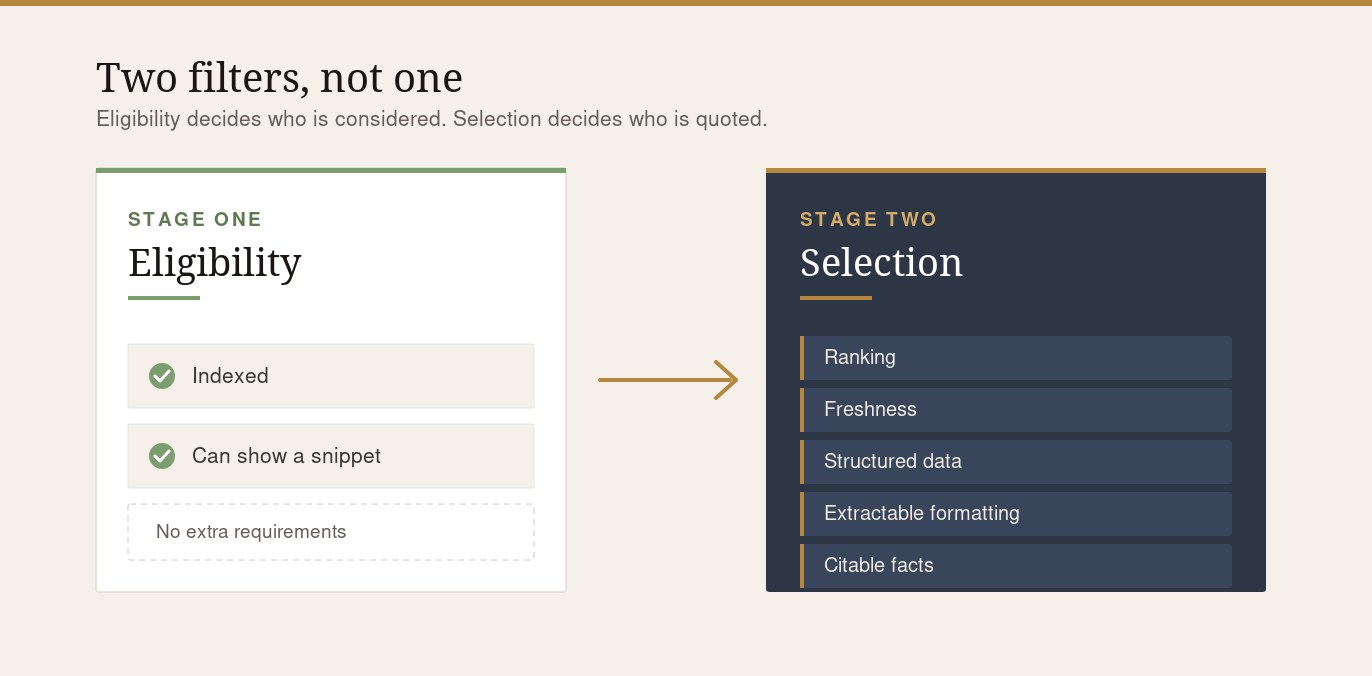
Short version: Getting cited in a Google AI Overview is a two-stage filter, not one. Stage one is eligibility: your page must already be indexed and able to show a normal snippet, and Google states plainly there are no extra technical requirements beyond that. Stage two is selection: once a page clears that bar, Google's system weighs several measurable signals against every other eligible page, among them whether it already ranks well, how recently it was genuinely updated, whether its facts are unambiguous, and whether its answer can be lifted cleanly without rewriting. None of these signals works alone. Rank first with the answer buried in a long paragraph, and the citation can still go to the page sitting at position five that states it in one liftable sentence.
What actually decides which page gets cited
Once a page is eligible, Google is not choosing a single winner the way classic search picks a position one result. It is assembling an answer from several sources at once, typically five, and deciding for each sentence of that answer which source states the point most cleanly. Being eligible gets you considered. Ranking, freshness, clarity of facts and extractable writing decide whether you are the one it actually quotes.
Google's own documentation is unusually direct about where the line sits. On its eligibility page for AI features, it states: "To be eligible to be shown as a supporting link in AI Overviews or AI Mode, a page must be indexed and eligible to be shown in Google Search with a snippet, fulfilling the Search technical requirements. There are no additional technical requirements."[1] That sentence closes off an entire category of advice selling a separate AI-only technical checklist. There is not one.
What Google adds immediately after is the part most guides skip: ordinary SEO fundamentals "continue to be worthwhile", and the list it gives includes keeping structured data matched to visible text and making important content available as text.[1] Those are the levers that move you from merely eligible to actually chosen, and the rest of this piece works through the evidence behind each one.
The mechanism
Eligibility gets you considered; selection decides who is quoted
Stage one
Eligibility
A pass or fail bar that Google states in its own documentation.
- Indexed
- Eligible to show with a snippet
- No additional technical requirements
Stage two
Selection
A comparison against every other eligible page, not a second bar to clear.
- Does it already rank?
- Was it genuinely updated?
- Are its facts unambiguous?
- Can the answer be lifted as written?
- Is there something worth quoting?
Stage-one wording from Google's own eligibility documentation.[1]
Ranking still predicts citation, but the link has weakened sharply
Whether a page already ranks well in ordinary search remains a measurable predictor of whether it gets cited in an AI Overview, but how strong that link is has shifted substantially inside a single year. The data is worth reading as a moving picture, not a fixed finding.
Ahrefs' original study, published in July 2025, analysed 1.9 million citations drawn from 1 million AI Overviews and found that 76.10% of cited pages ranked in the organic top 10. An update Ahrefs published in March 2026 covers 863,000 keyword SERPs and 4 million AI Overview URLs, more than double the first study's 1.9 million citations. Measured on the same organic-position basis, the top-10 share has fallen to 37.10%: a further 26.20% of cited pages ranked between position 11 and 100, and 36.70% did not rank in the top 100 at all.[2] A second test in the same update, counting every block an AI Overview can draw from (ads, featured snippets, People Also Ask and video packs, not just ordinary blue links), found a similar pattern: 37.9% of citations fell within the first 10 blocks, 31.2% at positions 11 to 100, and 31.0% beyond the top 100.[2]
Ranking overlap
Most cited pages are not in the top 10
Top 10
37.10% of cited pages
Positions 11 to 100
26.20% of cited pages
Outside top 100
36.70% of cited pages
Ahrefs, March 2026 update.[2]
Ahrefs frames the change plainly: "it indicates that Google is selecting far fewer pages straight from the original SERP (~76% in July 2025 vs. ~38% today)."[2] Its explanation is that AI Overviews now draw less on the direct search results for a query and more on the wider set of pages surfaced through query fan-out, a shift it links to Gemini 3 powering AI Overviews since January 2026.
A separate study by Surfer, covering 405,576 AI Overviews, found 52% of cited sources also ranked in the organic top 10 for that query.[3] On the current data that figure is now the higher of the two, where Ahrefs' original study was once higher. Two things sit behind the reversal. Surfer's study predates the March 2026 shift Ahrefs measured, so it describes the earlier behaviour. And Ahrefs widened what it counts: it improved its parsing for the update so that it could, in its own words, "see even more of the citations that appear in AI Overviews". Reading further down a citation list reaches pages that are less likely to rank, which is why the newer figure sits below both its own predecessor and Surfer's.
That gap matters practically, more now than it did a year ago. On Ahrefs' current figures, 62.90% of citations (26.20% ranking positions 11 to 100, plus 36.70% not ranking in the top 100 at all) go to a page that is not in the top 10, and well over a third go to a page that does not rank at all in the conventional sense. A page with no ranking history can still be selected if it answers the specific sub-question more clearly than anything that does rank, and on the newer data that happens far more often than the original study suggested. Chasing position one is not wasted effort, but treating it as the only lever now leaves even more on the table than it did a year ago, which is exactly why the other four signals in this list matter more than ever.
Freshness is earned by updating, not by publishing new
Recency is one of the clearest, most measurable citation signals across generative engines, and the mechanism behind it is not what most people assume.
A 2026 study by Seer Interactive tracked every page cited in non-branded answers from ChatGPT, Gemini and Perplexity across four brands over a four-month window, March to June 2026, dating 7,683 of those pages from structured signals such as schema and sitemaps. It found 75% of cited pages had been updated within the previous year.[4] This study covers citations across ChatGPT, Gemini and Perplexity rather than Google AI Overviews specifically, so treat it as evidence about how generative retrieval behaves broadly, not a Google-only figure. The detail that matters is what happens when you split that figure by update date against publish date: "by last update, 72% look fresh. But if that page was published in the last year, that citation rate drop to 42%."[4] In other words, the freshness these engines reward is overwhelmingly manufactured by editing an existing page, not by publishing a new one. Pages first written two or more years earlier made up more than a quarter of the "fresh" set the study measured.[4]
Two meanings of fresh
Updating an old page beats publishing a new one
Fresh by last update
72%
Cited pages counted as fresh when the measure is the date of the last edit.
Fresh by publish date
42%
The rate once the measure becomes the original publication date instead.
Seer Interactive, 2026 recency study.[4]
Google's own AI features sit on the same core Search index and the same query fan-out retrieval behaviour that decides which sources get pulled into an answer at all (see our guide to query fan-out), which is why a recency signal this consistent across three unrelated engines is worth acting on regardless of which one you are optimising for.
The practical read: a dateModified field that only ever matches datePublished is a tell that nothing has actually changed. Revisit a page's facts, figures and examples on a real cadence, update the visible content and the schema date together, and treat an old page with current facts as more valuable than a new page with none.
Structured data clarifies facts; it does not buy a citation
Structured data earns a place on this list because of what it rules out, not because it is a separate ranking lever. Google's AI features documentation lists "making sure your structured data matches the visible text on the page" alongside its other SEO fundamentals, in the same breath as internal linking and crawlability.[1] It sits in the list of things worth doing, not in a separate list of AI-only requirements, because there is no such list.
What it actually does is remove ambiguity. A page that states a fact in prose asks the model to parse sentence structure and infer what the fact refers to. The same fact marked up as structured data states it as data: this is the business name, this is the opening time, this is the answer to this specific question. That makes the fact safer for a system that has to decide, in a fraction of a second, whether to quote it confidently. It does not make a weak or vague page stronger. For the full implementation detail, including which schema types apply to which page type, see our JSON-LD schema guide.
Extractable formatting decides whether a page can be lifted at all
Ranking, recency and clean structured data all describe the page. None of them describes whether its answer exists as a passage a model can lift without rewriting it first.
The evidence that formatting choices matter comes from the shape of the answers themselves. Surfer's analysis of over 400,000 AI Overviews found that 78% contained either an ordered or unordered list, and that AI overviews reached for unordered lists even on "top X" queries drawing from sources that used numbered lists themselves.[3] That is a system reaching for whatever structure it can lift cleanly, converting it to the shape its answer needs. A page that states a comparison in one long sentence, or buries its answer in the third paragraph of a section, gives the model nothing to extract without editing it first, and editing it first is exactly the step a competitor's cleaner passage lets the model skip.
This piece will not re-teach the mechanics of writing extractable sections. Our companion guide on content structure for AI visibility covers the answer-first opening, the one-question-per-heading rule and when a table beats prose, in depth. The point to take from here is narrower: formatting is not a cosmetic preference. It is the difference between a fact existing on your page and a fact being available to be cited from it.
AI Overviews cite several sources, rarely the same one twice
A citation is not winner-take-all the way a position-one ranking is, and that changes how you should think about competing for one.
Surfer's dataset put the average AI Overview citation count at 5 sources, with 90% of overviews listing 8 or fewer.[3] The same analysis found that 99% of sources were referenced only once per answer, meaning Google is almost never pulling two different sentences from the same page within a single response.[3] The practical implication is that you are not trying to be the single source for an entire topic. You are trying to be the clearest answer to one specific slice of it, something a different source cannot state more plainly, strongly enough that it earns one of the five or so slots in the finished answer.
Citation slots
You are competing for one slot, not the whole answer
5
sources in the average AI Overview
90%
of overviews list 8 or fewer sources
99%
of sources are referenced only once per answer
Surfer, 405,576-overview study.[3]
Citations, quotes and figures measurably change selection odds
If extractable formatting decides whether a passage can be lifted, the content of that passage decides whether it is worth lifting over a competitor's.
Researchers including Princeton University's Vishvak Murahari, Karthik Narasimhan and Ameet Deshpande, publishing at KDD 2024, built a benchmark of 10,000 queries across multiple domains and tested nine ways of rewriting the same source content for generative engines. They found that "including citations, quotations from relevant sources, and statistics can significantly boost source visibility, with an increase of over 40% across various queries," and separately demonstrated the same effect, up to 37%, on Perplexity.ai as a live, real-world system rather than a benchmark simulation.[5] The effect size varied by topic domain, meaning this is not a single trick to apply uniformly, but the direction was consistent: a page that cites its own sources, quotes a relevant figure and states a real number is more often the one selected to speak for a given fact than a page that asserts the same point with no backing.
That gives the structured-data and formatting sections above a reason beyond clarity. A statistic with its own source link, sitting inside a self-contained, answer-first sentence, is the single most citation-dense unit you can put on a page.
Putting the mechanics together
None of these five signals operates alone, and none of them substitutes for another. The table below orders them by where the evidence is strongest and what each one actually buys you.
| Signal | What the evidence shows | What it earns you |
|---|---|---|
| Organic ranking | 37.10% of AI Overview citations rank in the top 10; 36.70% rank outside the top 100 entirely[2] | A real signal, but no longer dominant |
| Freshness via updates | 75% of pages cited across ChatGPT, Gemini and Perplexity were updated in the past year (not a Google-specific measurement); citation rate drops from 72% to 42% when "fresh" means newly published rather than updated[4] | A recency signal you control without a rewrite |
| Structured data | Listed as an ordinary SEO fundamental for AI features, matched to visible text[1] | Removes ambiguity; does not add weight on its own |
| Extractable formatting | 78% of AI Overviews contain a list; the model reshapes whatever it can lift cleanly[3] | Decides whether a strong fact is usable at all |
| Citable facts and figures | Over 40% visibility increase from adding citations, quotations and statistics[5] | Gives the model something worth selecting over a rival |
The table is ordered by strength of evidence, not by effort: start at the top. Skip any one row and the others do less than they should, because each one only decides whether the next is worth anything, not whether a citation happens on its own.
Frequently Asked Questions
Does ranking first in Google guarantee a citation in the AI Overview?
No. Ranking well remains a measurable predictor, but on Ahrefs' most recent data only 37.10% of cited pages also rank in the organic top 10, down from 76.10% in its 2025 study. A majority of citations now go to pages that rank lower or do not rank in the top 100 at all.[2]
Do I need schema markup to appear in AI Overviews?
Google does not list structured data as a separate requirement for AI features. It is one of the ordinary SEO fundamentals that still apply, and its role is to remove ambiguity from facts you have already stated in visible text, not to act as an AI-only switch.[1]
How often does a page need to be updated to stay eligible for citation?
There is no fixed interval in the evidence. Across ChatGPT, Gemini and Perplexity, Seer Interactive found recently updated pages are cited far more often than recently published ones; Google's AI features run on the same underlying signals, so the same logic applies, but the study itself does not measure Google AI Overviews directly.[4]
Can a page with no organic ranking still get cited?
Yes, and increasingly often. Ahrefs' most recent data puts this at 62.90% of AI Overview citations going to pages ranking below position 10, including 36.70% that do not rank in the top 100 at all, when the page answers a specific sub-question more clearly than anything that ranks.[2]
Does adding sources and statistics to my own page help it get cited?
The evidence points that way. Controlled testing found that adding citations, quotations and statistics to source content increased its visibility in generative engine answers by more than 40% on average.[5]
Knowing the five signals is the easy part. Checking where your own pages actually stand against them, ranking, freshness, structured data, extractable formatting and citable facts, takes a second pair of eyes. Get an AI visibility check from QBiz and see which of the five is costing you the citation.
Get your AI Visibility audit →
Sources
- [1] Google Search Central, AI Features and Your Website
- [2] Ahrefs, Update: 38% of AI Overview Citations Pull From The Top 10
- [3] Surfer, Google AI Overviews Study: 25+ Statistics from 405,576 Searches
- [4] Seer Interactive, Study: Content Recency's Impact on AI Visibility in 2026
- [5] Aggarwal, Murahari, Rajpurohit, Kalyan, Narasimhan, Deshpande, GEO: Generative Engine Optimization (KDD 2024)
Leave a comment
Thoughts on this post? Leave a comment below. Comments are moderated before they appear, so yours will not show on the page straight away.
Your email is used only to contact you about your comment if needed — it is never published.
Comments
No comments yet. Be the first to leave one above.