Online Reviews vs AI Citations for Dentists: Why You Need Both, and in Which Order
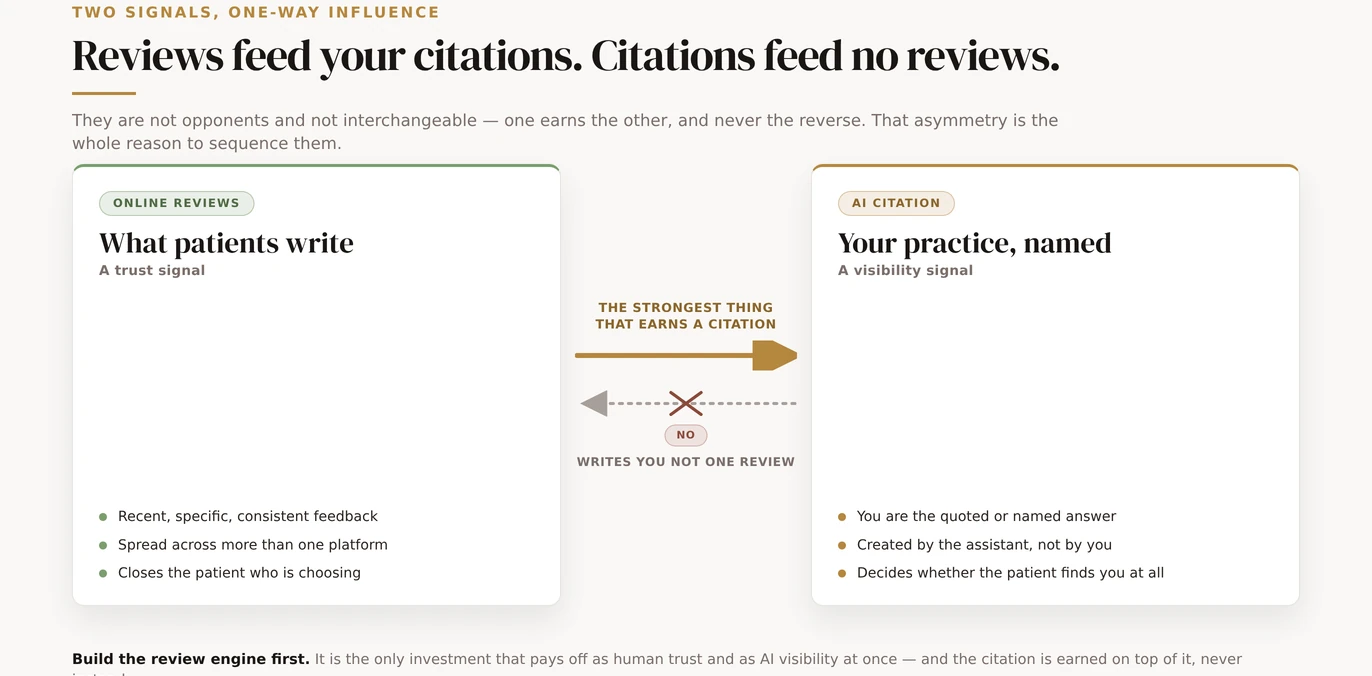
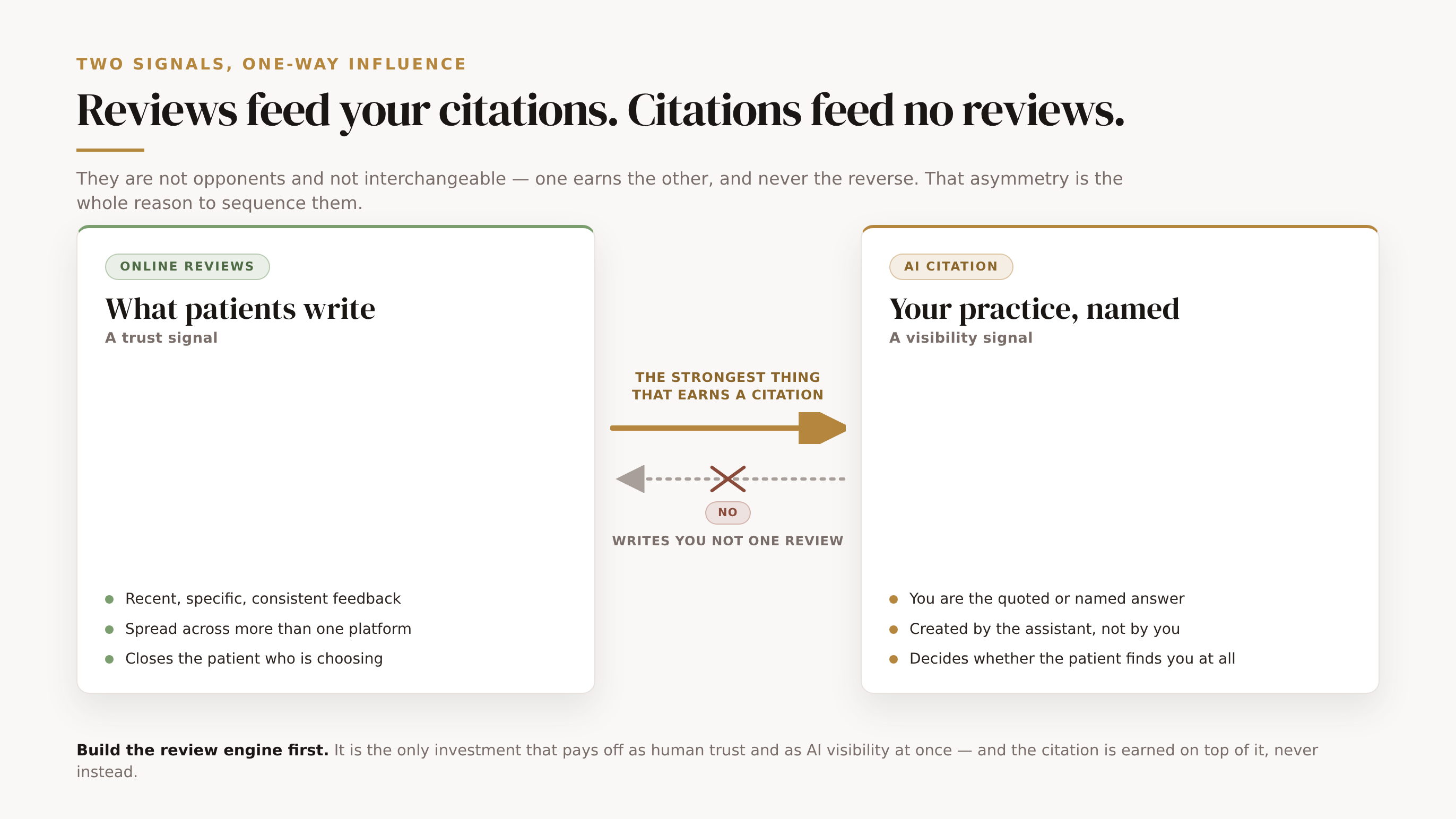
Reviews and AI citations are not rivals. They are two different signals doing two different jobs: a review is patient-written proof that people can trust you, while a citation is your practice being named inside an assistant's answer so patients discover you at all. The link between them runs one way, though. Strong, specific reviews are one of the things that earn a citation, but no amount of AI visibility writes you a single review. So the efficient move is not to pick one. It is to build the review engine first, lock down consistent practice details so an assistant can verify you, then earn the citations on top.
A patient who has spent years quietly unhappy with their crooked teeth finally decides to act. They do not open a directory or scroll a map. They open ChatGPT and ask which practice near them is good for Invisalign. The reply names two or three. One of those names lands an enquiry worth, on a typical clear-aligner case, somewhere around £2,500 to £4,500. If your practice is not in that reply, you do not lose a click. You lose the case, and you never find out it existed.
That unseen enquiry is the money at the centre of this piece, so let us be plain about the numbers before anything else. A single implant placement commonly sits around £2,000 to £2,500 per tooth in the UK, a veneer smile makeover runs to several thousand, and a patient who simply joins your list for routine care is worth years of check-ups, hygiene visits and the occasional larger treatment: comfortably a four-figure relationship across a decade, often more (these are illustrative ranges to show what is at stake, not researched price figures, and every real case varies by clinician and complexity).
The enquiries that ride on all this, the elective and high-value ones, are exactly the ones patients now research through an assistant or a review site long before they pick up the phone. So the question underneath the title is a commercial one: where does a busy owner put limited time and budget, into reviews or into AI visibility, to stop handing those cases to the practice two streets over?
The answer is that this is not a contest between two rivals. Online reviews and AI citations are two different signals doing two different jobs, and the practices winning the high-value enquiries are building both, in the right order. This guide is written for UK practices, stays inside General Dental Council rules throughout, and every section answers a real question an owner has put to us, so you can jump to the one that fits your situation and act on it.
The short version
- Two signals, two jobs. Reviews decide whether a patient who found you will trust you; citations decide whether they find you at all when an assistant is doing the choosing.
- The influence runs one way. Reviews help earn citations. Citations do nothing to earn you reviews. That asymmetry is the whole reason for the order below.
- Specificity is the multiplier. A review that names the treatment and describes the experience is a citation waiting to happen; a generic five-star rave gives a model nothing to quote.
- Build in sequence. Review engine first, then consistent practice details, then citable answer-first pages. Reverse it and you build a citable shell with nothing worth citing inside.
Reviews or AI citations: which actually matters more for a dental practice?
Both matter, and they are not interchangeable, so treating it as an either/or is the mistake that quietly costs you cases. Reviews are patient-written proof that people can trust you, gathered on Google and on the health and local platforms alongside it. They close the decision at the moment a patient is choosing, and they feed the local systems that rank you.
An AI citation is something else entirely: it is your practice being named or linked inside an answer from ChatGPT, Perplexity, Google's AI Overviews or Microsoft Copilot. Reviews decide whether a patient who has found you will trust you. Citations decide whether the patient finds you in the first place, when an assistant rather than a page of blue links is doing the choosing.
The reason you cannot ignore either is that both channels are mainstream at the same time. Reviews remain close to universal: 97% of consumers read reviews for local businesses, and the share who say they "always" read them has jumped to 41%, up from 29% a year earlier[1]. In the same survey, the use of ChatGPT and similar tools for local recommendations climbed from 6% to 45% in a single year, making AI the third most popular source people reach for when finding a local business[1].
Patients bring health questions to these tools in particular: about a third (32%) of US adults now use AI for health information or advice[2]. Reviews are how patients still decide; AI answers are an increasingly common way they work out who to decide between. A practice strong on one and absent on the other is leaving money on the table at whichever end it is weak.
Both channels are mainstream
Reviews and AI answers are live at the same time
97%
of consumers read reviews for local businesses.
41%
now "always" read reviews when browsing, up from 29% a year earlier.
45%
use ChatGPT and other generative AI for local recommendations, up from 6% and now the third most popular source.
32%
of US adults use AI for health information or advice.
BrightLocal Local Consumer Review Survey 2026; KFF Tracking Poll 2025.
What is an online review actually doing for your practice?
A review is doing three jobs at once: it is social proof that turns a hesitant enquirer into a booking, it is an input the local-ranking systems read, and it is a public record of how your practice treats people. At the point a patient is weighing a £3,000 course of treatment against the practice across town, recent and specific reviews are often the thing that tips them to pick up the phone. That is real revenue, and it turns on details most owners underestimate.
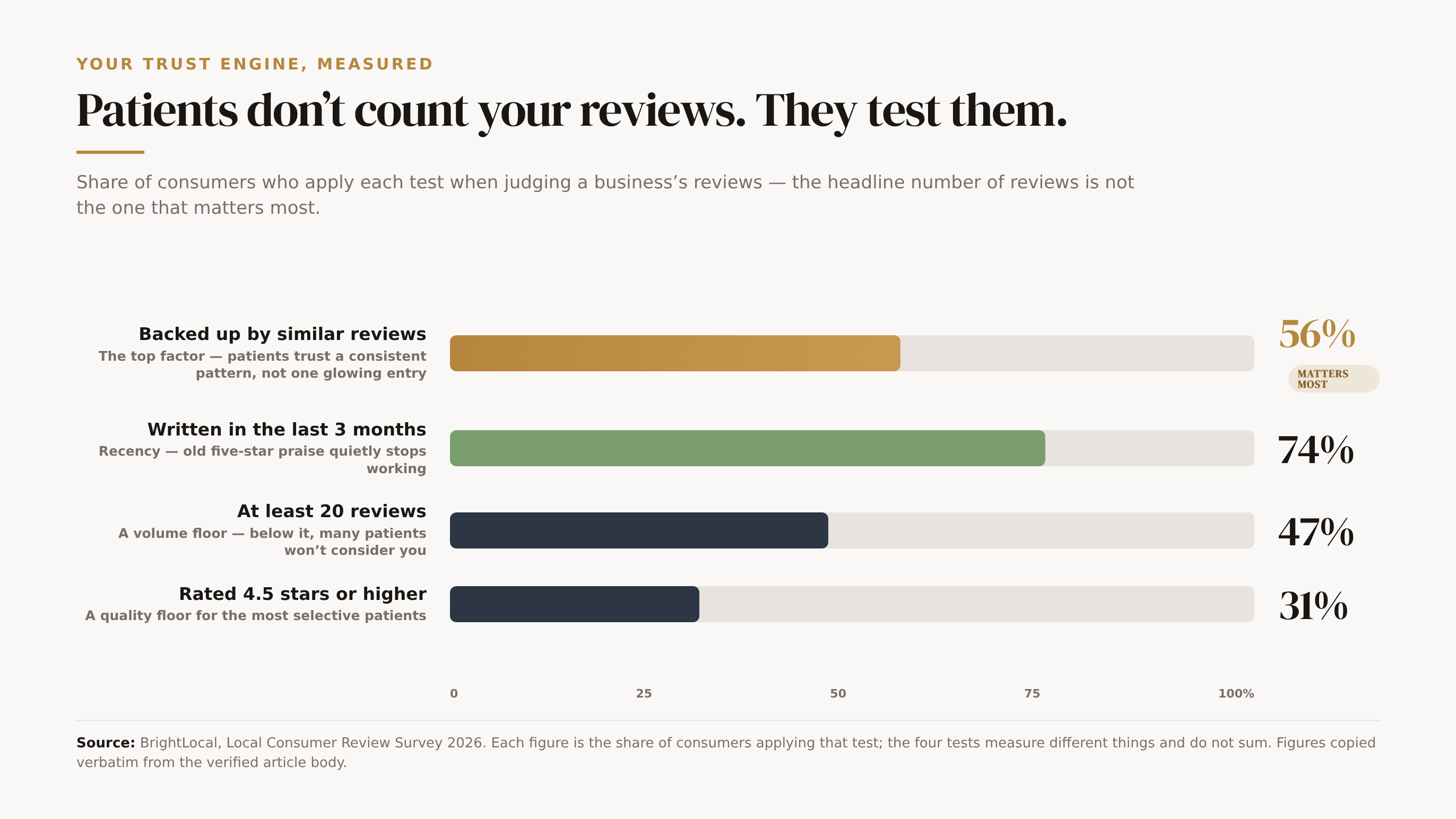
The detail that matters most is not the headline number of reviews. It is consistency of sentiment. When BrightLocal asked which factor mattered most in judging reviews, the top answer, chosen by 56%, was that the review is backed up by other reviews with similar sentiment: patients trust a pattern, not a single glowing entry[1]. Recency runs close behind, with 74% caring only about reviews from the last three months, so a wall of five-star praise from a couple of years ago quietly stops working.
Volume still sets a floor, with 47% saying they will not use a business that has fewer than 20 reviews, and quality has a threshold too, with 31% only using a business rated 4.5 stars or higher[1]. Every one of those is a human-trust lever, and together they explain why a steady drip of fresh, genuine reviews beats an occasional burst.
There is one more fact worth building a strategy around: the average consumer now consults six different review sites when choosing a business[1]. For a dental practice that means Google alone is not the finish line. Your presence on health-relevant platforms and the wider local directories is part of how a careful patient cross-checks you before committing to expensive, elective work. Reviews, in short, are your trust engine. What they do not do, on their own, is make an assistant name you.
What is an AI citation, and how is it genuinely different?
An AI citation is your practice being surfaced inside an assistant's answer: named in the text, linked as a source, or both. Where a review measures whether people trust you, a citation measures something the patient never sees: whether the model is confident enough about your practice to put it forward as the answer. It is a visibility signal, not a trust signal, and it is earned through a completely different mechanism.
A citation forms when an assistant can verify you from several independent directions. It reads the machine-readable facts on your site (your name, location, services, hours and genuine ratings, marked up so a system cannot misread them), it cross-checks those against your Google Business Profile, the NHS "find a dentist" service, health and local directories and any genuine accreditation listings, and it weighs whether those sources agree. When they line up, the model can name you with confidence.
When your phone number differs between two directories, or your opening hours conflict, or your services page is written for people but not legible to a machine, the model hedges and reaches instead for a practice it can verify cleanly. That is the failure mode: not a bad review, but ambiguity the assistant cannot resolve. We cover how to earn them in depth in our guide to AI citations for dentists.
The crucial difference for budgeting is this. You cannot directly write your own AI citation the way you write a website page, and you certainly cannot buy one. It is the by-product of a clean, corroborated presence across the web, and reviews turn out to be one of the strongest ingredients that earn it. Which brings us to the part of this debate almost nobody states plainly.
Reviews vs AI citations: the two signals, side by side
Here is the contrast drawn cleanly, because it is the fastest way to see why you need both. The two signals differ in what they are, what they measure, where they live, who creates them and what counts as winning.
Side by side
Two signals, two jobs
| Online reviews | AI citations | |
|---|---|---|
| What it is | Patient-written social proof | Your practice named or linked inside an AI answer |
| What it measures | Human trust, plus local-ranking input | Whether an assistant can confidently surface you |
| Where it lives | Google and the health and local review platforms (around six sites) | ChatGPT, Perplexity, Google AI Overviews, Copilot |
| Who creates it | Your patients | The assistant, drawing on sources it trusts |
| What moves it | Recency, consistency, specificity, volume, replies | Consistent practice details, off-site mentions, and your reviews |
| What winning looks like | 4.5+ stars, fresh, specific, spread across sites, answered | Being the named or quoted practice in the answer |
| The failure mode | Few, old or generic reviews, so patients hesitate | Conflicting practice details, so the assistant cannot verify you |
Drawn from the article's account of the two signals and how they relate.
Read down the two columns and the relationship jumps out. They share a row: reviews appear under "what moves it" for AI citations, but citations never appear under reviews. The influence runs one way. Your review footprint is partly responsible for whether you get cited, while no amount of AI visibility writes you a single patient review. That asymmetry is the whole basis for the sequence recommended below. First, though, the mechanism that connects them.
The part most practices miss: reviews feed your AI citations
The one-way link
How a review becomes a citation
A specific review lands
A patient names the treatment and describes the experience, not just "5 stars, lovely practice".
It corroborates you
Spread across the platforms patients check, it agrees with your listed details and services.
The assistant verifies
With sources in agreement, the model is confident it has the right, active practice.
It quotes you
The specific review becomes the evidence the answer surfaces for exactly that treatment.
Reviews and citations are not opponents. Reviews are one of the strongest things that earn a citation, and the clearest statement of that comes from the review industry itself. Describing what reviews have become, BrightLocal's chief executive says they are now "an essential piece of evidence that your business is active, reliable" and "worthy of prominent visibility and citation within traditional Google search and LLMs like ChatGPT, and AI search"[1]. Note the word in that quote: citation. The people who measure reviews for a living are telling you that a strong review presence is now part of how the assistants decide whom to name.
The mechanism is more specific than "good reviews help", and it changes how you should ask for reviews. An assistant answering "which dentist near me is good with nervous patients for implants?" is looking for evidence it can point to. A specific review that says the team talked an anxious patient through a sedation implant case and explained the costs upfront gives the model something concrete to surface. A "5 stars, lovely practice" gives it nothing quotable.
The same logic applies to treatment-led queries: reviews that name Invisalign, veneers, same-day crowns or emergency care, in patients' own words, become the raw material an assistant can lift into an answer about exactly those high-value treatments. So the goal is not only more reviews and fresher reviews. It is reviews specific enough to be quoted, because a quotable review is a citation waiting to happen.
This is why the false versus is so expensive. A practice that pours effort into review volume but lets its details drift across directories has built trust the assistants cannot connect to a verifiable entity. A practice that tidies its listings but neglects reviews has a verifiable shell with no compelling evidence inside it. The cases go to the practice that does both, because that practice gives the assistant a clean entity to name and a rich, specific reason to name it.
So where should a dentist spend effort first?
Spend first on the work that does double duty, then on the work that only does one job. Because reviews feed citations but not the other way round, the efficient order starts with your review engine, moves to the consistency that lets a citation form, and finishes with the content that makes you the obvious answer.
Start with the review engine, because it is the only investment that pays off in human trust and AI visibility at the same time. Get a steady, genuine flow of recent reviews, encourage patients to be specific about the treatment they had, and make sure you are present on more than just Google, given that patients cross-check around six sites. Next, lock down the consistency of your practice details everywhere they appear: name, address, phone, opening hours and service list reading identically across your website, Google profile, NHS listing and every directory.
This is the unglamorous step that lets an assistant verify you and stops a close decision tipping to a rival it trusts more. Only then invest in the citable content: clear, answer-first pages for each high-value treatment, written the way patients ask about them, with clear indicative price ranges and the facts marked up so a machine reads them without ambiguity.
Run in that order and the spend compounds. The reviews you gather in stage one become quotable evidence once stages two and three make you verifiable. Reverse the order and you build a citable structure with nothing worth citing inside it. The sequence is the strategy.
Do reviews still matter once AI is answering for patients?
They matter more, not less, for two reasons that pull in the same direction. The first is that reviews are now doing both jobs: they are still the trust closer at the decision moment, and they are also fuel for the citations that get you discovered. A signal that works at both ends of the patient journey is not one you scale back as AI grows. You lean into it.
The second reason is the zero-click reality. Pew Research Center's analysis of real browsing data found that 58% of US users ran at least one Google search in March 2025 that returned an AI-generated summary, and that when a summary appeared, users clicked a traditional result in only 8% of visits, against 15% when there was no summary[3]. Fewer patients are scrolling to the old list of links and arriving on your website to read your reviews there.
Increasingly the answer itself is the moment of visibility, which means being the cited, well-reviewed practice inside that answer is the prize. Reviews used to win the click; now they help win the citation that replaces the click, and they still close the patient who does arrive. There is no version of the near future in which a thin, stale review profile is an asset.
How do you build both signals? The dental playbook
This is the practical part, broken into the moves that build trust and visibility together. None of it needs a big budget, and all of it is checkable by you.
Worklist
The dental playbook for both signals
Run a steady review drip, not a one-time blitz74% of patients only value reviews from the last three months, so ask after completed treatment and make it a single tap.
Spread beyond GoogleThe average consumer checks six review sites, so a presence on reputable health and local platforms both reassures patients and corroborates you.
Make reviews specific enough to be quotedInvite patients to mention what they came in for and how it went, without scripting or incentives.
Lock your practice details so an assistant can verify youBring name, address, phone, hours and services into exact agreement everywhere, and make them machine-legible on your site.
Respond to every reviewReply to positive and negative alike, and never put a patient's clinical details in a public reply.
Run a steady review drip, not a one-time blitz
Because 74% of patients only value reviews from the last three months, a one-off campaign decays fast. Build a simple, repeatable habit instead: ask satisfied patients at the right moment, which is after a completed course of treatment rather than mid-appointment, and make leaving a review a single tap from a text or email. A consistent trickle of fresh reviews reads as a busy, current practice to patients and to the assistants reading the same signal.
Spread beyond Google, because patients check around six sites
Google is necessary but not sufficient. With the average consumer consulting six different review sites, your presence on health-relevant and reputable local platforms is part of how a careful patient validates a costly treatment decision, and part of the corroboration an assistant uses to verify you. Claim and complete the listings that matter for a UK dental practice, and keep them accurate.
Make reviews specific enough to be quoted
A review that names the treatment and the experience is worth more than a generic rave, because it gives an assistant something to lift into an answer. Without ever scripting a patient or offering an incentive, you can prompt specificity simply by how you ask: invite patients to mention what they came in for and how it went. "They explained every cost before my implant and the whole thing was painless" is the kind of sentence that can become the content of a citation about implant care.
Lock your practice details so an assistant can verify you
Inconsistent information is the most common reason a practice that deserves to be named is not. Audit your name, address, phone, hours and services across the web and bring every version into exact agreement. Then make those facts machine-legible on your own site, so the systems feeding ChatGPT and Google's AI answers can read them cleanly rather than guessing. This is the step that converts a strong reputation into something an assistant can actually cite.
Respond to reviews, because silence now reads as a red flag
Reply to reviews, positive and negative, as a matter of routine. It signals an attentive practice to patients and to the systems weighing your reputation. One hard rule for dentistry: never put a patient's clinical details in a public reply. Thank them, address the general point, and take any specifics offline. Keep to that and you protect confidentiality while still showing every reader, patient or model, an engaged practice.
Is any of this against GDC rules?
No, not when it is done as described here, and that is deliberate. Standard 1.3.3 of the General Dental Council's Standards for the Dental Team is the one that governs all of this: "you must make sure that any advertising, promotional material or other information that you produce is accurate and not misleading, and complies with the GDC's guidance on ethical advertising"[4]. It reaches your website, your Google profile, your directory listings and the way you handle reviews alike.
In practice the compliant path and the effective path are the same path. You must not gate reviews so only happy patients can leave them, and you must not offer incentives for reviews: genuine, unfiltered feedback is both the ethical standard and the kind an assistant can trust.
Keep your claims specific and provable rather than superlative, because "the best implant dentist in town" is exactly the unverifiable claim the rule is built to catch, and it gives an assistant nothing it can responsibly repeat. State clear price ranges and real qualifications, keep your "accepting new patients" status current, and you satisfy the GDC and the assistants at once. The trust bar is high for health topics precisely because the decisions matter, and meeting it is what makes you both recommendable and citable.
How do you check where you stand on both signals?
You can run a useful self-audit today, free, in about fifteen minutes, and it tells you which signal is your weak point. Start with reviews: count how many you have, check how recent the most recent ones are, and see how many platforms you appear on, then do the same for two or three local competitors. If your reviews are fewer, older or confined to Google while a rival is fresh and spread across several sites, you have found a trust gap that is costing you decision-moment conversions.
Then test your AI visibility directly. Open ChatGPT, Perplexity and Google's AI Mode and ask the questions a real patient asks about your most valuable treatments: "best dentist for Invisalign in [your town]", "dental implants near me", "emergency dentist in [your area] today", "dentist for nervous patients in [town]". Note whether your practice is named, whether it is linked, and which practices appear when you are absent.
Ask each question two or three times over, since the wording of the reply moves between attempts and it is the pattern that repeats, not any single answer, that tells you where you stand. Finish by checking your own details for drift: do your name, phone and hours match across your website, Google profile and NHS listing? Absence from the AI answers plus inconsistent details is a visibility gap; strong reviews that the assistants are not citing usually points straight at that consistency problem.
Get your free AI visibility check →
How QBiz helps you win both, end to end
Most providers in this space sell you one half of the answer. QBiz is built around the fact that you need both signals and that they reinforce each other, so the work spans two connected fronts. On the first, we tune your own presence for AI: we make your practice details consistent and machine-readable everywhere they appear, build answer-first pages for your high-value treatments, and structure your reviews and ratings so the assistants can verify and quote you.
On the second, we do the distribution work that earns the off-site mentions and corroboration a citation depends on, getting your practice referenced across the platforms and sources the models actually read, rather than leaving you to hope they find you. Optimising your site is the necessary groundwork; getting your practice out into the wider web is what turns that groundwork into citations and enquiries.
The starting point is a free QBiz Leads AI visibility check. It looks at your own website, not at the engines, and works through the machine-side signals that decide whether an assistant can find, read and describe you: whether your pages are crawlable, whether your dental schema is in place, whether each treatment page answers plainly, and whether your listed details agree with one another. Because it inspects your site rather than firing a one-off query at ChatGPT, what you get back is a durable worklist of fixes, not a single answer that changes on the next attempt.
From there we can weigh your review depth, recency and spread against local rivals and layer on the off-site distribution, tackling the highest-value cases first. Request it from the QBiz AI visibility check. If you would rather have that work run for you, our AI SEO for dentists service page sets out how we approach it for a practice. If reviews are the weaker of your two signals, our companion guide on how many reviews a dentist needs for AI results is the natural next read.
Frequently asked questions
Are online reviews or AI citations more important for dentists?
Neither replaces the other, because they do different jobs. Reviews build human trust and help close a patient who is choosing between practices, and they feed the local-ranking systems. AI citations get you discovered when a patient asks an assistant rather than searching a list. Reviews also help earn citations, so the practical answer is to build a strong, specific review presence first and use it as part of your foundation for AI visibility.
Do my Google reviews help me get cited by ChatGPT?
Yes, and increasingly directly. The review industry now describes reviews as evidence worthy of citation within tools like ChatGPT, and a specific review that names a treatment and describes the experience gives an assistant something concrete to surface. Generic five-star reviews help your human trust but give a model little to quote, so encourage patients to mention what they came in for.
Can I pay for AI citations?
No. There is no paid placement that buys you into an AI answer the way an advert buys a slot. A citation is earned by being the practice an assistant can verify from several independent sources and describe with confidence. Anyone selling guaranteed AI citations is selling something that does not exist.
How many reviews do I need before AI recommends me?
There is no review threshold that switches AI recommendations on. Volume matters for human trust, since many patients want to see at least 20 reviews, but for AI visibility the consistency, recency and specificity of your reviews and the agreement of your practice details across the web do more work than any single count. We cover this directly in our guide on how many reviews a dentist needs for AI results.
Do reviews on sites other than Google count?
They count, and spreading beyond Google is wise. The average consumer consults around six different review sites when choosing a business, so a presence on reputable healthcare and local platforms both reassures careful patients and gives the assistants more independent sources to corroborate you. Google is the start, not the whole job.
Will responding to reviews help my AI visibility?
It helps both your trust and your visibility. Replying signals an active, attentive practice to patients and to the systems weighing your reputation, and routine responses keep your review presence looking current. Keep every public reply free of clinical detail: thank the patient, answer the general point, and take specifics to a private channel.
Sources
- [1] BrightLocal, Local Consumer Review Survey 2026: https://www.brightlocal.com/research/local-consumer-review-survey/ (US-weighted; independent. "97% of consumers read reviews for local businesses"; "In 2026, 41% of consumers 'always' read reviews when browsing for businesses, a huge jump from last year (29%)"; use of generative AI tools for local recommendations rose "from 6% last year to 45% and becoming the third most popular source of business recommendations"; top review factor is "the review is backed up by other reviews with similar sentiment" at 56%; "47% of consumers won't use a business that has fewer than 20 reviews"; "74% only care about reviews written in the last three months"; "31% of consumers will only use a business that has 4.5+ stars"; "The average consumer uses six different review sites when choosing businesses"; CEO Myles Anderson: reviews are "worthy of prominent visibility and citation within traditional Google search and LLMs like ChatGPT, and AI search.")
- [2] KFF, Tracking Poll on Health Information and Trust, 2025: https://www.kff.org/public-opinion/kff-tracking-poll-on-health-information-and-trust-use-of-ai-for-health-information-and-advice/ (US; independent. "About a third (32%) of adults are turning to AI for health information and advice", including about three in ten (29%) who have used AI tools in the past year for information or advice about their physical health.)
- [3] Pew Research Center, 22 July 2025: https://www.pewresearch.org/short-reads/2025/07/22/google-users-are-less-likely-to-click-on-links-when-an-ai-summary-appears-in-the-results/ (US; independent, corroborative. "About six-in-ten respondents (58%) conducted at least one Google search in March 2025 that produced an AI-generated summary." Users who saw an AI summary clicked a traditional result in 8% of visits, against 15% when no summary appeared.)
- [4] General Dental Council, Standards for the Dental Team, principle 1: https://standards.gdc-uk.org/pages/principle1/principle1 (UK; regulatory. Standard 1.3.3: "You must make sure that any advertising, promotional material or other information that you produce is accurate and not misleading, and complies with the GDC's guidance on ethical advertising.")
Leave a comment
Thoughts on this post? Leave a comment below. Comments are moderated before they appear, so yours will not show on the page straight away.
Your email is used only to contact you about your comment if needed — it is never published.
Comments
No comments yet. Be the first to leave one above.