Voice Search or AI Chatbots: How Patients Actually Find a Dentist Now
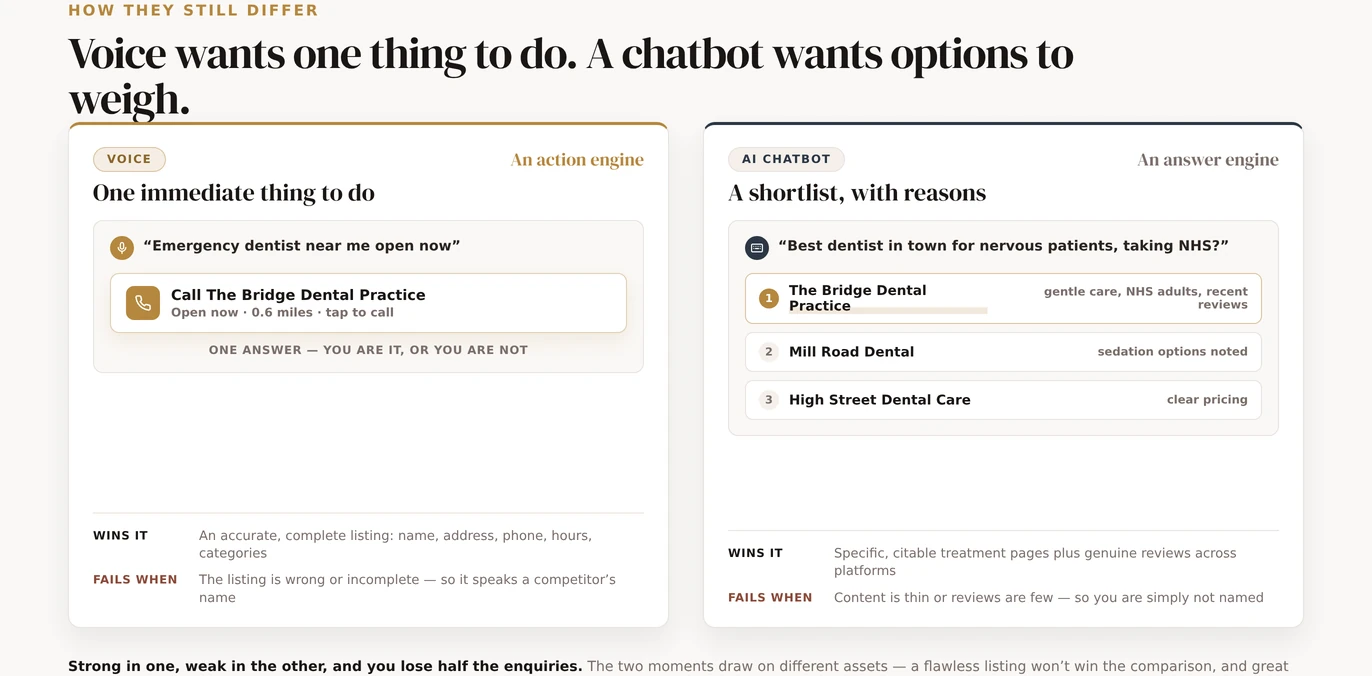
Do not choose. Voice assistants and AI chatbots are converging onto the same generative-AI engine: Alexa+ is a generative-AI assistant, and Siri can hand a hard question to ChatGPT. Voice tends to behave like an action engine (call, navigate, opening time); a chatbot tends to behave like an answer engine (compare, explain, shortlist). One body of work, accurate listings, specific answer-first pages and consistent details, wins both at once. The trap is treating them as rivals and splitting your effort.
A nervous patient who has spent two years putting off a mouthful of work finally decides to do something about it on a Tuesday evening. They do not reach for a phone book or scroll a map. They say, out loud to the speaker on the kitchen counter, "find me a good dentist near here that's taking new patients," and a moment later they are reading a couple of options on their phone, asking a follow-up. That enquiry, if it lands with you, is rarely a single check-up.
It is often the start of an implant case that commonly sits somewhere in the region of £2,000 to £2,500 per tooth, an Invisalign relationship that typically runs to £2,500 to £4,500, or simply a patient who joins your list and is worth a steady four-figure sum over a decade of routine care (these are illustrative ranges to show the stakes, not researched figures, and any real case varies by clinician). If the assistant names the practice down the road instead of yours, you do not see a lost click in your analytics. You never learn the patient existed.
That is the commercial question hiding underneath a technical-sounding title. Practice owners keep asking us a version of it: should I be optimising for voice search, the Siri and Alexa world, or for AI chatbots like ChatGPT, and where do I put my limited time and money so I stop handing those cases to a competitor? This guide answers that directly, in plain language, for UK practices, and it stays inside General Dental Council rules throughout. Every section below is a real question an owner has put to us, answered immediately and in full, so you can read the one that fits your situation and act on it.
The short answer, before the detail: do not choose. Voice search and AI chatbots are not two separate worlds you have to back one of. They are converging onto the same engine, fast, and the work that wins you one increasingly wins you the other. The trap is treating them as rivals and splitting your effort. The rest of this article shows why they are merging, where they still genuinely differ, and the single practical to-do list that serves both.
The short version
- Do not pick a side. Voice and chatbots are merging onto the same generative-AI engine, so betting on one leaves the other unattended.
- The microphone now sits on a chatbot. Alexa+ is generative AI on hundreds of millions of devices, and Siri can route a harder question straight to ChatGPT.
- Two moments, not two worlds. Voice is usually an action ("call, navigate, opening time"); a chatbot is usually an answer ("compare, explain, which is right for me").
- One list wins both. Accurate listings, specific answer-first pages, recent reviews and consistent details feed the spoken answer and the typed one alike.
Voice search or AI chatbot: how do patients actually look for a dentist now?
Through both, and the line between them is dissolving as you read this. A decade ago "voice search" meant speaking a short command to Siri, Alexa or Google Assistant and getting one spoken answer or a handful of map results. "Asking a chatbot" did not really exist for the public. In 2026 the two have collapsed into roughly the same experience: a patient talks or types a question in ordinary language and gets a synthesised answer that names a few practices and reasons about them.
The stakes have climbed with the change. By February 2026, ChatGPT was fielding questions from 900 million people every week, a rise of 100 million in four months on the 800 million OpenAI had reported the previous October[1]. Close to a billion people a week now put questions to an AI assistant, a great many of them local and health-related.
The same shift has pushed into ordinary search, too: when Pew Research Center studied the real browsing records of US adults, 58% of them had run at least one Google search in March 2025 that came back with an AI-generated summary[4]. Whether the patient speaks the question to a device or types it into a chat box, an AI is more and more the thing that answers first and decides which dentist gets a mention.
The scale of the shift
One AI answers first, spoken or typed
900 million
weekly ChatGPT users by February 2026, up from 800 million the previous October.
600 million
Alexa devices now out in the world, rebuilt as the generative-AI assistant Alexa+.
58%
of US Google users ran at least one search in March 2025 that returned an AI summary.
10%+
increase in Google usage for the query types that show AI Overviews.
TechCrunch, reporting OpenAI, February 2026; Amazon Alexa+ announcement; Pew Research Center, 22 July 2025; Google, The Keyword, 20 May 2025.
So the real framing is not "voice versus chatbots." It is this: when an assistant answers a patient's question about a dentist, however it was asked, are you the practice it names? That is what this guide is really about.
What do we actually mean by "voice search" for a dental practice?
Voice search is when a patient speaks a question instead of typing it, usually to a phone assistant or a smart speaker, and usually because their hands are busy or they want a fast, local answer. Think of someone driving with toothache asking "where's the nearest emergency dentist open now," a parent in the kitchen saying "call my dentist," or somebody in bed asking their phone "what time does the dental practice on the high street open tomorrow."
The defining traits are immediacy and locality. Voice queries tend to be spoken in full, natural sentences ("is there a dentist near me that can see my son today?") rather than the clipped keywords people once typed. They are very often "near me" or "open now" questions, and they usually want one answer the patient can act on straight away: a number to call, directions to follow, an opening time.
Historically the assistant pulled that answer from Google or Apple Maps and the business listings behind them, plus a featured-snippet-style "one best result." The practical point for a dentist is that voice has always rewarded accurate, complete listing data above almost anything else, because that is what gets read aloud.
And what do we mean by "AI chatbots" for finding a dentist?
An AI chatbot is an assistant like ChatGPT, Google's Gemini, Perplexity or Microsoft Copilot that takes a question, typed or increasingly spoken, and replies with a written, conversational answer that can name practices, compare them and explain its reasoning. Rather than handing back a list of links for the patient to sift, it does the sifting and presents a shortlist with reasons attached.
This is a different kind of moment from the quick voice command. A patient using a chatbot is often researching rather than acting on impulse: "which dentist in Leeds is best for nervous patients and is taking on NHS adults?", "compare Invisalign and fixed braces and tell me who near me does both," "is the practice on Mill Road any good for kids?" The assistant builds its reply by reading and summarising web content, reviews and third-party mentions, then names the practices it is most confident about.
Where the answer comes from matters: a chatbot leans on what is actually written across your site and the wider web, not only on your map listing. If you want the deeper detail on how two of the big assistants differ here, our companion piece on ChatGPT versus Gemini for dentist recommendations goes further; for now, hold the contrast in mind: voice tends to want one thing to do, a chatbot tends to want a few options to weigh.
Aren't these turning into the same thing? Yes, and here is the convergence
This is the part most articles on the subject miss, and it is the heart of the matter. The voice assistants patients already own are being rebuilt as generative-AI chatbots. The two channels are not drifting apart into specialisms; they are merging onto the same underlying technology.
The convergence
Why voice is now a chatbot you talk to
The patient asks aloud
A spoken question goes to Alexa+, Siri or Google's assistant on the device in their hand or kitchen.
Same engine takes over
Alexa+ is generative AI; Siri can hand a harder question straight to ChatGPT; Gemini answers on Google devices.
It reads your signals
The model weighs your listings, treatment pages, reviews and third-party mentions, the same signals a typed answer uses.
A practice is named
The assistant reads back or displays the practice it is most confident about, spoken or written.
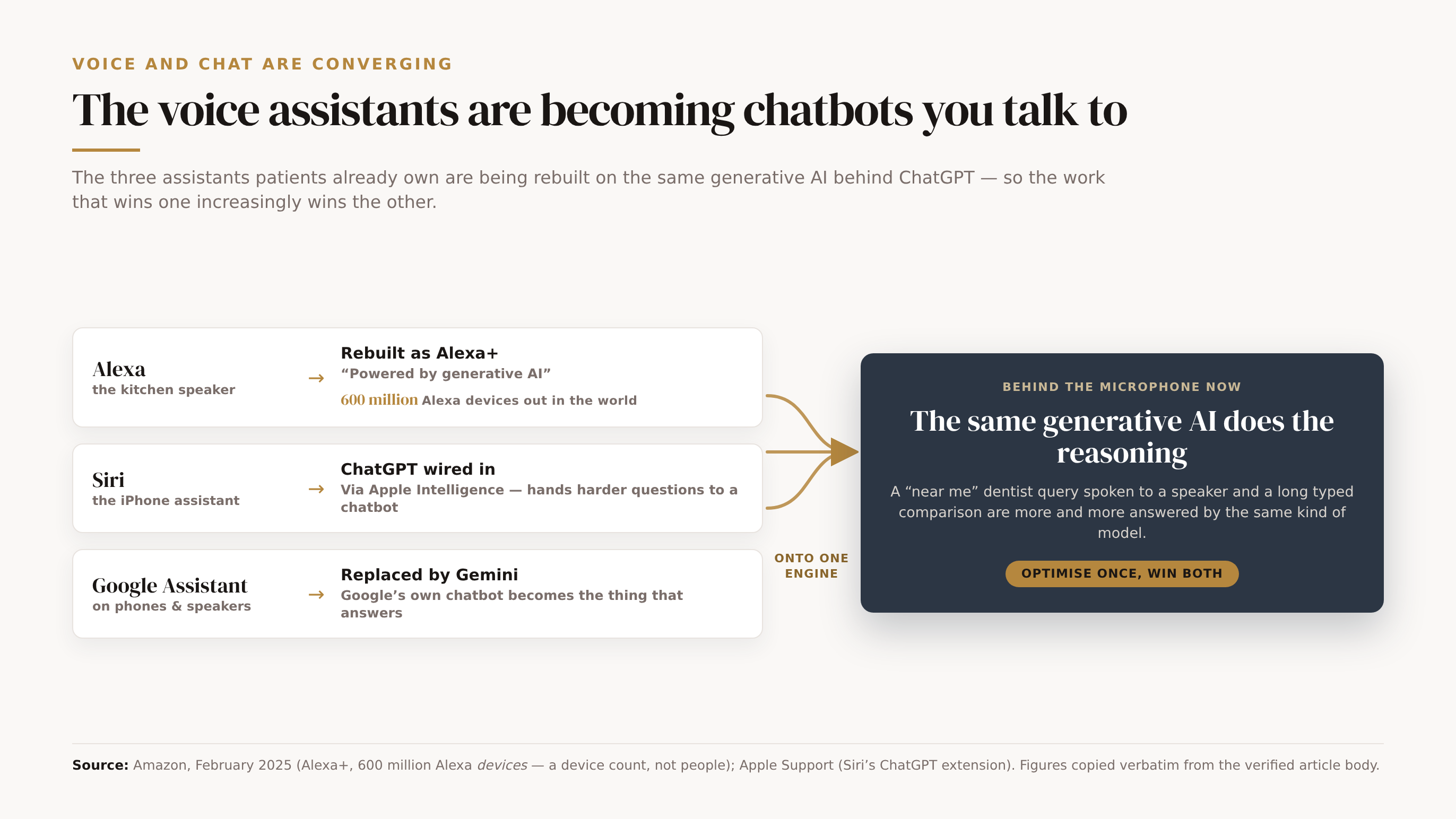
Look at what has actually happened to the big three voice assistants. Amazon rebuilt Alexa as Alexa+, describing it in its own announcement as "your new personal AI assistant" that is "powered by generative AI," and noting that there are "600 million Alexa devices now out in the world"[2]. The most common voice assistant in British kitchens and living rooms is now a generative-AI system, the same class of technology as ChatGPT, on hundreds of millions of devices.
Apple, meanwhile, wired ChatGPT directly into Siri through Apple Intelligence, so the phone's own voice assistant can hand a harder question straight to a chatbot: Apple's support page explains that once you enable the ChatGPT extension, you can get more in-depth answers from Siri[3]. Google is replacing Assistant with Gemini, its chatbot, as the thing that answers on its phones and speakers.
Put those together and the supposed rivalry falls apart. When a patient asks Siri a complicated question about a dentist, their iPhone may quietly route it to ChatGPT and read back the result. When they speak to Alexa+, they are talking to a generative-AI assistant, not the keyword-matcher of five years ago. So "voice search" in 2026 is, more and more, simply a chatbot you talk to out loud. The same signals that make a practice citable in a typed ChatGPT answer increasingly drive what a smart speaker says aloud, because behind the microphone there is now the same kind of model doing the reasoning.
The takeaway for a practice is liberating rather than alarming: you are not facing two separate optimisation jobs pulling in different directions. You are facing one shift, with two front doors.
If they're converging, how do they still differ? Answer engine versus action engine
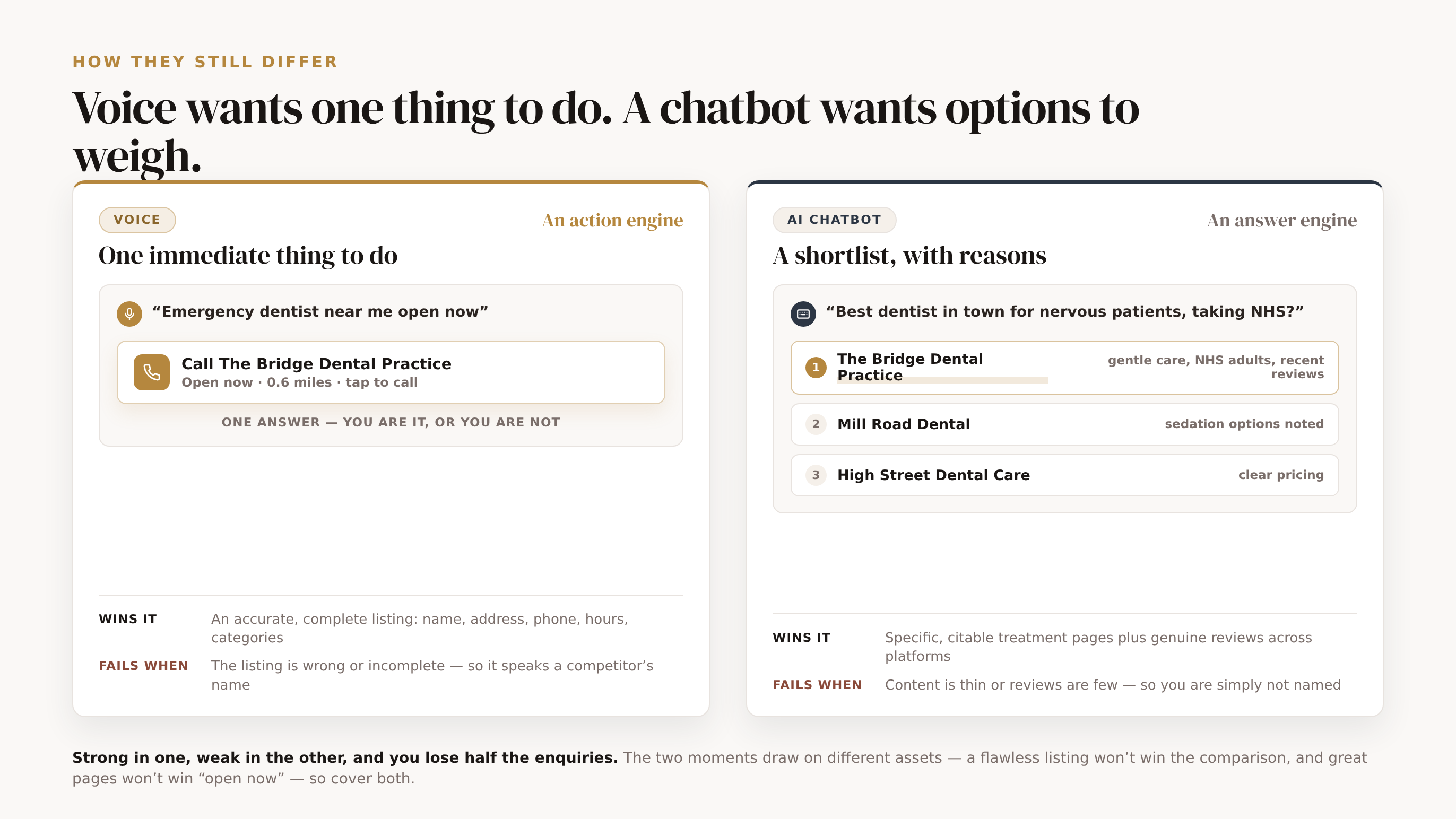
They are merging on technology, but they still differ in what the patient wants in the moment, and that difference is worth understanding because it tells you which part of your presence does the work in each case. A useful way to hold it: voice often behaves like an action engine, and a chatbot often behaves like an answer engine.
A spoken query is usually about doing one thing now. "Call the nearest emergency dentist," "take me to the dental practice on Queen Street," "what time do they open." The patient wants a single result they can immediately act on, and the assistant reaches for the data that supports action: your Google or Apple Maps listing, your phone number, your opening hours, your location. There is rarely a shortlist. There is one answer, and you are either it or you are not.
A chatbot query is more often about working something out before acting. "Which practice near me is best for implants and roughly what does it cost," "find me a dentist that's good with anxious patients and explain why." Here the patient wants comparison and reasoning, so the assistant pulls from the wider material it can read and weigh: your treatment pages, your reviews across different platforms, the places other sources mention you. It returns a few named options with justifications.
The reason this matters commercially is that the two moments are won by different parts of your presence, and a practice that is strong in one and weak in the other quietly loses half the enquiries. A flawless map listing wins the voice, action moment but does nothing for the patient comparing implant providers in a chatbot. Beautifully written, specific treatment pages win the chatbot, research moment but will not put you top of "dentist near me open now" if your opening hours are wrong on your listing. You need both, which is the whole argument of this guide.
Voice search versus AI chatbots: the full side-by-side
No dental site sets this out cleanly, so here is the full contrast in one place. Read down the two columns and the practical instruction writes itself: cover both, because they draw on different things you control.
The full side-by-side
Two front doors, different signals
| Factor | Voice search (Siri, Alexa, Google Assistant) | AI chatbots (ChatGPT, Gemini, Perplexity, Copilot) |
|---|---|---|
| A typical query | "Emergency dentist near me open now" | "Best dentist in Leeds for nervous patients, taking NHS?" |
| What the patient wants | One immediate answer or action: call, navigate, opening time | A comparative shortlist with reasons |
| Where the answer mostly comes from | Google and Apple Maps plus your business listing | Web content, reviews, third-party mentions and citations |
| Underlying intent | Action and immediacy | Comparison and research |
| What the dentist must get right | An accurate, complete listing: name, address, phone, hours, categories | Specific, citable pages plus genuine reviews across platforms |
| The failure mode | Wrong or incomplete listing, so the assistant speaks a competitor's name | No specific content or thin reviews, so you are simply not named |
| The convergence | Now generative-AI powered (Alexa+, Siri routing to ChatGPT) | Increasingly voice-capable too |
Drawn from the article's comparison of voice search and AI chatbots.
The bottom two rows are the ones to sit with. The failure modes are different because the two moments draw on different things, which is exactly why you cannot trade one off against the other and hope the stronger side carries you. And the final row is the reason none of this is a passing fad: both columns are being absorbed into the same generative-AI layer, so the work compounds rather than splitting.
What kinds of dental questions go to voice, and which go to chatbots?
Mapping real patient questions to each channel turns the theory into a worklist, because each kind of question rewards a specific thing you can go and fix.
The questions that lean to voice are short, urgent and local. "Dentist open now near me." "Call the closest emergency dentist." "What time does the practice on the high street open." "Nearest dentist that takes card." Every one of these is answered from listing data, so they reward an accurate, complete and consistent business profile above all else. If your opening hours are wrong, your emergency arrangement is unstated, or your address differs between your website and your listing, you lose these the instant they are asked, and these are some of the highest-intent moments in dentistry. A patient in pain at the weekend is ready to book in the next ten minutes.
The questions that lean to chatbots are longer, comparative and research-shaped. "Which dentist in [town] is best for nervous patients and is taking new NHS patients." "Compare Invisalign with fixed braces and tell me who near me offers both, and roughly what it costs." "I want a smile makeover, who near me is good and what does it involve."
These reward specific, clear, answer-first content: a clear page per treatment that states what is involved, an indicative price range labelled as typical, the timescale and who carries it out, plus genuine reviews the assistant can read across more than one platform. A vague single "Treatments" page answers none of these, so the assistant has nothing about you to quote and names someone else.
Read the two lists as an audit. For every voice-type question, ask whether your listing would give a correct, complete answer this minute. For every chatbot-type question, ask whether the real answer is actually written, in plain sentences, somewhere a machine can read it. Each "no" is a group of patients an assistant cannot currently route to you, and given the treatment values involved, each gap has a number attached.
What do I actually do to get found by both? One checklist, two wins
Here is the practical core. The good news from the convergence is that this is one list, not two, and it pays off across both channels at once. Work it roughly in this order, because the early steps are the cheapest and move the most.
One checklist, two wins
What serves both channels at once
Get your business listing flawless.Exact name, address, phone, full opening hours, emergency arrangement, categories, photos and access details win the spoken, local moment.
Publish specific, citable content.Give each high-value treatment its own page that answers the real question, with a labelled typical price range and timescale, plus genuine reviews.
Write answer-first questions and answers.A heading phrased as a patient asks it, answered underneath in a self-contained block, reads aloud, lifts into a comparison and extracts into a summary.
Be consistent everywhere.The same details across your site, Google and Apple listings, the NHS service and every directory; disagreement tips a close call against you.
Win the voice and action moment: get your business listing flawless
Your Google Business Profile, and your Apple equivalent, is the single highest-value asset for spoken, local, immediate queries, and many practices never fully complete it. Make the name, address and phone number exact. State your full opening hours, including how emergency and out-of-hours care actually works, because "emergency dentist open now" is one of the most valuable questions you can be the answer to.
Set your categories properly, keep your "accepting new patients" status truthful and current, add real photographs, and fill in accessibility details such as step-free access, parking and wheelchair access. This is the data an assistant reads aloud when someone asks their phone for a dentist, and it is almost entirely within your control.
Win the chatbot and research moment: specific, citable content
For the comparative, research questions, you need pages that actually answer them. Give each high-value treatment, implants, Invisalign and clear aligners, veneers, emergency care, its own page that opens by answering the real question: what the treatment involves, a clear price range plainly labelled as typical, how long it takes, and who carries it out.
This is the material a chatbot quotes when a patient is weighing options, and it is also where the larger cases live, so it is worth the effort. Pair it with genuine reviews gathered steadily across more than one platform, and with consistent mentions of your practice on the third-party sources assistants read. Our guide to AI citations for dentists covers that off-site corroboration in depth.
Serve both at once: answer-first questions and answers, in natural language
The format that travels furthest across voice and chat is the plain question-and-answer block: a heading phrased exactly as a patient would ask it, answered immediately underneath in a self-contained way, in the natural language people actually speak. A spoken assistant can read that answer aloud; a chatbot can lift it into a comparison; an AI summary can extract it.
Writing your common patient questions out this way, "do you offer emergency appointments on Saturdays?", "how much does Invisalign cost at your practice?", and answering each one cleanly, does double duty in a single piece of work. A note on the technical side: the question-and-answer format is what helps here, not a promise of decorated search results, since Google retired its FAQ rich result, so write for the patient and the assistant, not for a rich-result badge.
Be consistent everywhere
The quiet, decisive one. Your name, address, phone, opening hours and service list should read identically across your website, your Google and Apple listings, the NHS "find a dentist" service and every directory you appear in. Voice assistants and chatbots both lose confidence when sources disagree, and an unsure assistant reaches for a practice whose details are clean instead. Two slightly different phone numbers or a stale set of hours is enough to tip a close call against you, in either channel.
Notice that not one of these four steps is "for voice" or "for chatbots" alone. Each strengthens your standing across both, which is exactly what you would expect once you accept that the two are running on the same kind of engine.
How do I check whether voice and AI chatbots already recommend me?
You can test all of this today, for free, in about fifteen minutes, and it tells you precisely where you are leaking patients. Do it in two halves, matching the two moments.
For the voice and action side, speak the local, urgent queries to the assistants a patient uses: ask Siri, Google Assistant and Alexa "find me a dentist near me," "emergency dentist open now near me," and "what time does [your practice] open." Listen to whether you are named, whether the details read back are correct, and whether the assistant offers to call or navigate to you or to someone else.
For the chatbot and research side, ask ChatGPT, Gemini and Perplexity the comparative questions a patient researching treatment would ask: "best dentist for implants in [your town]," "which dentist near [your area] is good for nervous patients and taking NHS adults," "compare Invisalign providers near me." Note whether your practice is named, where it appears, and which practices show up when you are absent.
Ask each assistant more than once, since the replies vary from one attempt to the next, and read the pattern that keeps recurring rather than any lucky or unlucky single answer. Absence from the voice answers usually points at a listing problem: incomplete hours, wrong category, an inconsistent address. Absence from the chatbot answers, especially when a competitor is named, usually points at thin treatment content, too few recent reviews, or details that disagree across the web. The gap between what is published about the practice that does get named and what is published about you is your worklist, and now you know which half to look at.
Get your free AI visibility check →
Is voice search dead now that everyone uses chatbots? No, and here's why
It is a fair question, because the headlines make it sound as if chatbots have swept everything else away. They have not. Voice search is not dying; it is being absorbed. The hands-free, in-the-car, across-the-kitchen, "I can't be bothered to type" moments are as common as ever, arguably more so, and they are now powered by the same generative AI that sits behind the chatbots. Alexa+ is generative AI on 600 million devices[2]; Siri can route to ChatGPT[3]. The microphone has not gone anywhere. What has changed is the intelligence behind it.
So the wrong response to "chatbots are rising" is to abandon the listing basics that win the spoken, local moment and pour everything into chasing chat. That would lose you the very enquiries, "emergency dentist near me open now," that are the most ready to book. The right response is to recognise that one body of work, accurate listings, specific content, answer-first questions, consistent details, now feeds both the spoken answer and the typed one, because they increasingly run on the same machinery.
There is a deeper reason the basics still matter, too. The mechanics underneath are converging as well. Google describes its AI Mode using a "query fan-out technique, breaking down your question into subtopics and issuing a multitude of queries simultaneously on your behalf," and reports that "AI Overviews is driving over 10% increase in usage of Google for the types of queries that show AI Overviews"[5]. That same Gemini layer increasingly powers Google's spoken answers. A "near me" dentist query whispered to a phone and a long typed comparison are more and more answered by the same underlying system, which is the clearest possible signal that you should optimise once and aim to win both.
What does this cost a practice that ignores it?
It is worth being blunt about the money, because the cost of sitting still is invisible in exactly the way that makes it dangerous. When an AI answers, the patient frequently does not click through to anyone's website at all: in the Pew browsing data, people who saw an AI summary went on to click a traditional result in only 8% of visits, against 15% when no summary was present[4]. The patient acts on the answer itself. If you are named in it, you collect bookings your competitors never see coming. If you are absent, you lose them with no missed-call log, no failed form submission, nothing in your analytics to mourn.
Now attach the treatment values, presented as the typical, illustrative UK ranges they are rather than researched figures. A single implant commonly sits in the region of £2,000 to £2,500 per tooth, and a full-arch restoration runs well into five figures. An Invisalign case is typically a £2,500 to £4,500 relationship. A veneer smile makeover reaches several thousand pounds.
A patient who simply joins your list for routine care is worth years of check-ups, hygiene visits and the occasional larger treatment, easily a four-figure relationship over a decade. These are precisely the enquiries patients now research through an assistant, by voice or by chat, before they ever pick up the phone. A practice that is not in those answers is not losing clicks. It is quietly losing cases, one unseen patient at a time, to whichever practice did the work to be named.
How QBiz gets your practice into the answer, on both fronts
Most providers sell you half of this. One firm tidies your map listing; another writes you a few pages; nobody owns whether you actually get named when a patient asks, by voice or by chatbot. QBiz is built around the single shift this whole article describes, so the work runs across two connected fronts rather than one.
On the first front, we get your own presence ready for the assistants. We complete and tighten the listing data that wins the spoken, local moment, and we write answer-first pages for your high-value treatments in the language patients actually use, structured so each question is answered in a self-contained block an assistant can read aloud or lift into a comparison, then marked up cleanly so the engines read your true facts without guessing. That is the side that turns "emergency dentist near me" and "best implant dentist in town" into answers with your name in them.
On the second front, we do the distribution work that on-site optimisation alone cannot reach. A clean, well-written site is necessary but not sufficient, because an assistant's confidence comes partly from your practice being referenced consistently across the wider web it reads. So we also get you mentioned and consistent across the platforms, directories and sources the models actually draw on, turning the groundwork on your own pages into the off-site agreement that earns a citation. Getting your own house in order is the foundation; getting your practice out into the wider web is what converts that foundation into spoken and written answers that name you.
It starts with a free QBiz Leads AI visibility check. It scans your own website in about thirty seconds and returns a plain pass or fail on the signals that decide whether an assistant can find, read and describe you: whether your pages are crawlable, whether your treatment content answers the comparative questions in a self-contained way, whether the machine-readable markup is in place, and whether your listed details are consistent enough to trust.
It reads your site, not the engines, so instead of a single moment-in-time answer it points you at the concrete fixes that put you in the running, on both the spoken and the typed side. From there you get a prioritised, GDC-safe plan covering the on-site groundwork and the distribution work, highest-value cases first.
Frequently asked questions
Should my dental practice optimise for voice search or AI chatbots?
Both, because they are converging and the work overlaps almost entirely. The voice assistants patients use, Alexa+ and Siri, now run on the same generative AI as chatbots like ChatGPT, so a single body of work, accurate listings, specific answer-first content and consistent details, feeds both the spoken answer and the typed one. The practical answer is to stop choosing and do the shared work once.
Is voice search still relevant for dentists in 2026?
Yes. Voice is not obsolete; it has been rebuilt on generative AI. Hands-free, local, immediate queries such as "emergency dentist near me open now" are as common as ever and are some of the most ready-to-book moments in dentistry. The difference is that the assistant answering them is now an AI system, so the listing accuracy that wins voice is more valuable than ever, not less.
Does optimising for ChatGPT also help me show up on Siri or Alexa?
Increasingly, yes, because they share the underlying technology. Siri can route harder questions to ChatGPT through Apple Intelligence, and Alexa+ is itself a generative-AI assistant. The specific, citable content and consistent details that get you named in a chatbot reply feed the same kind of model that now answers by voice, so the two reinforce each other rather than competing for your attention.
What is the single most important thing for voice search for a dentist?
An accurate, complete business listing. Spoken "near me" and "open now" queries are answered from your Google and Apple listings, so the name, address, phone, full opening hours, emergency arrangement and categories must be exact and current. If a patient asks their phone for an emergency dentist and your hours are wrong or missing, the assistant simply speaks a competitor's name instead.
How do I get named when someone asks ChatGPT for the best dentist near them?
Give the assistant something specific and trustworthy to quote, and make sure other sources agree. Write a clear, specific page for each high-value treatment with what it involves, a typical price range and timescale, gather genuine reviews steadily across more than one platform, and keep your details consistent everywhere. Our guide to AI citations for dentists covers the off-site corroboration that makes a chatbot confident enough to name you.
Where to start
If you do only three things from all of this, take them in order. First, complete and correct your Google and Apple business listings so the spoken, local moment, "emergency dentist near me open now", reads your true, current details aloud.
Second, write an answer-first page for each of your most valuable treatments, with a clear price range plainly labelled as typical and a timescale, so a chatbot has something specific about you to quote when a patient is comparing options. Third, make your name, address, hours and services identical everywhere they appear, so neither a voice assistant nor a chatbot has cause to doubt you. Each step sits comfortably inside GDC rules, and each pays off across both channels at once.
If you would rather see exactly where your practice drops out of the answer, whether it is the voice moment leaking on a listing gap or the chatbot moment leaking on thin content, that is the job of a QBiz Leads AI visibility check.
It scans your own website for the signals that decide whether an assistant can find, read and describe you, and returns a prioritised, GDC-safe list of what to fix, on your own site and across the wider web. It reads your site rather than querying the engines, so it is the practical first step before any spend. When you want that work handled for you, our AI SEO for dentists service page sets out how we run it for a practice.
Get your AI visibility check →
Sources
- [1] TechCrunch, reporting OpenAI, 27 February 2026: https://techcrunch.com/2026/02/27/chatgpt-reaches-900m-weekly-active-users/ (Global; reporting OpenAI. "ChatGPT has reached 900 million weekly active users"; "a jump of 100 million users from the 800 million that OpenAI reported in October 2025.")
- [2] Amazon (Panos Panay, SVP Devices & Services), "Introducing Alexa+, the next generation of Alexa", 26 February 2025: https://www.aboutamazon.com/news/devices/new-alexa-generative-artificial-intelligence (Global; vendor primary. "Powered by generative AI, Alexa+ is your new personal AI assistant"; "With 600 million Alexa devices now out in the world". 600 million is a count of devices, not people.)
- [3] Apple Support, "Use ChatGPT with Apple Intelligence on iPhone": https://support.apple.com/guide/iphone/use-chatgpt-with-apple-intelligence-iph00fd3c8c2/ios (Global; vendor primary. Documents that enabling the ChatGPT extension lets users get more in-depth answers from Siri. Stated in this article as a paraphrase, not a direct quotation.)
- [4] Pew Research Center, 22 July 2025: https://www.pewresearch.org/short-reads/2025/07/22/google-users-are-less-likely-to-click-on-links-when-an-ai-summary-appears-in-the-results/ (US; independent. "About six-in-ten respondents (58%) conducted at least one Google search in March 2025 that produced an AI-generated summary." Users who saw an AI summary clicked a traditional result in 8% of visits, against 15% when no summary appeared.)
- [5] Google (The Keyword), "AI in Search: going beyond information to intelligence", 20 May 2025: https://blog.google/products/search/google-search-ai-mode-update/ (Global; vendor primary. "AI Mode uses our query fan-out technique, breaking down your question into subtopics and issuing a multitude of queries simultaneously on your behalf"; "AI Overviews is driving over 10% increase in usage of Google for the types of queries that show AI Overviews.")
Leave a comment
Thoughts on this post? Leave a comment below. Comments are moderated before they appear, so yours will not show on the page straight away.
Your email is used only to contact you about your comment if needed — it is never published.
Comments
No comments yet. Be the first to leave one above.