AI Agents Will Soon Book Appointments For Your Customers: Is Your Business Ready?
A customer needs a boiler looked at today. She does not open a browser, scroll a map, or read a single review. She tells an assistant on her phone, "find someone local who can come out this afternoon and book it." A few minutes later she has a confirmed slot, a name, and a price. She never visited a website. Something did, on her behalf, and it chose a business that made itself easy to deal with.
That is not science fiction any more. The pieces are already shipping. The question for a booking-driven local business is no longer whether AI will sit between you and your customers, but whether your business is set up so an assistant acting for that customer can actually reach you, understand what you offer, and complete the booking.
AI agents are moving from recommending a business to doing the booking. Google already documents an automated call that can book an appointment on a customer's behalf, and OpenAI's agent can work a booking form the way a person would. To be chosen by these systems, your availability, services, and prices need to be machine-readable, and your booking step needs to be a path an agent can traverse without a human in the loop. This is a page-and-structure job, not an advertising spend.
What "agentic" actually means for a booking business
An AI agent is a system that does not just answer a question but carries out a task. Instead of returning a list of plumbers, it contacts one, confirms a time, and reports back that the job is booked. The distinction matters for local service owners because the agent is the customer's stand-in. If your business is hard for it to parse, or your booking step needs a human on the other end at the exact moment the agent is working, you are quietly filtered out before a person ever sees your name.
For years the goal of getting found online was to rank, to be listed, to be recommended. Agentic tools add a new layer on top: being actionable. It is one thing to be the answer to "who is a good local electrician." It is another to be the business an agent can go on and book.
The shift: from recommending to doing
The old model ended at the recommendation. A search engine or a review site pointed a person at you, and the person did the rest: they clicked through, read your hours, rang you, and arranged a time. Every one of those steps was a chance for a human to fill a gap your website left open.
The agentic model removes the human from the middle steps. When an assistant is booking for someone, there is no one to squint at a PDF price list, guess your opening hours from a photo, or ring a mobile that goes to voicemail. The agent works with what it can read and act on directly. Anything it cannot read, it treats as if it were not there.
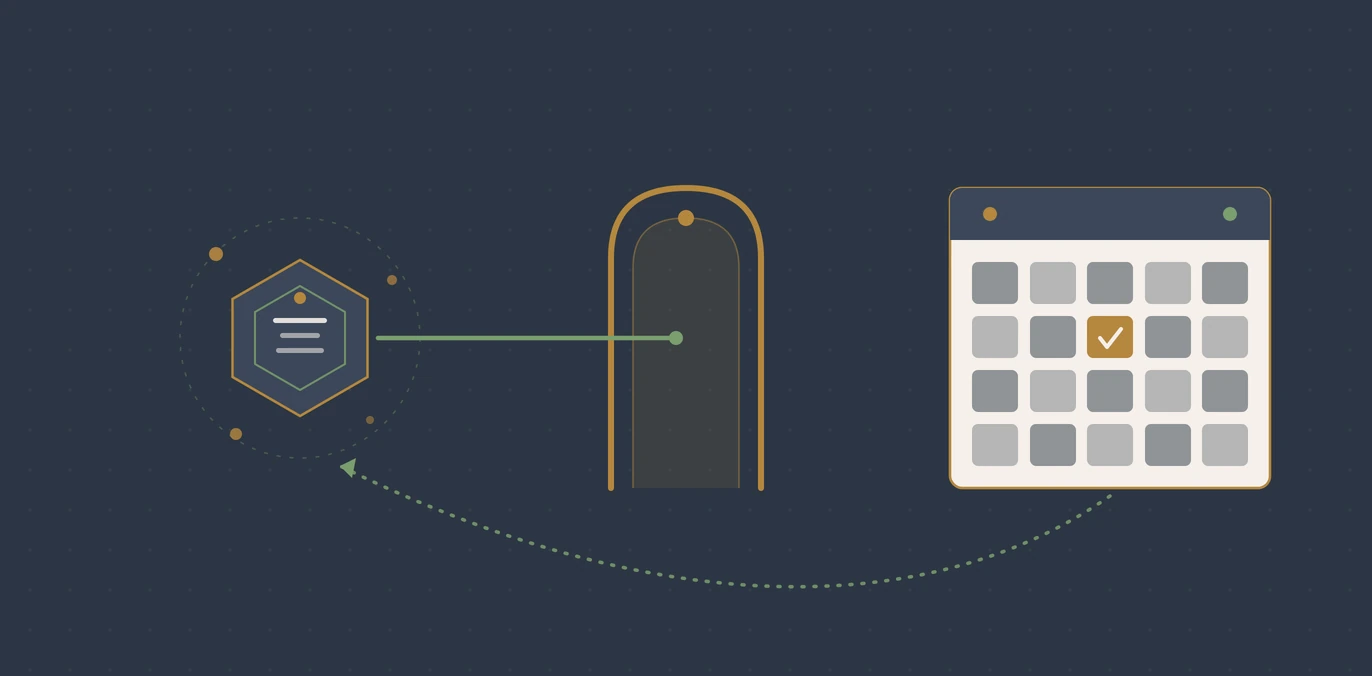
From suggesting to completing
Recommend
The old model: an assistant names your business and stops there
Book
The agent works your availability, service and booking step for the customer
Done
A confirmed slot, a name and a price, with no human in the middle
What the platforms have already shipped
This is the part worth grounding carefully, because the space attracts a lot of speculation. Set the marketing claims aside and look only at what the platforms document themselves. The scale is not niche either: more than 800 million people now use ChatGPT every week,[1] so the surface where an assistant might act for a customer is already vast, whatever share of it ends in a booking today.
Google can already phone your business to book
Google's own Business Profile help documentation describes automated calls made to a business on a customer's behalf. It lists booking an appointment as a supported action: "Customers can ask Google to book appointments with specific details like preferred time, service type, and party size. After Google confirms the details, it calls your business to book the appointment."[2] The same documentation notes Google can book "through an online booking partner or by calling your business directly with an automated call," and lists checking restaurant wait times and confirming price and availability as further actions.[2]
There is a related consumer-facing feature in Google Search called "Let Google call." Google's Shopping help page explains that for certain "near me" product searches, "Google calls multiple stores to confirm product availability, prices, and any deals," and returns a summary to the customer.[3] Read the small print, though, and the scope is narrower than the headlines suggest.
OpenAI's agent can work the web like a customer
OpenAI describes its agent as "an agent that can go to the web to perform tasks for you." Using its own browser, "it can look at a webpage and interact with it by typing, clicking, and scrolling," and it can handle "filling out forms" and "ordering" among other repetitive browser tasks.[4] That capability was later folded into ChatGPT as agent mode, described as letting ChatGPT "do work for you using its own computer, handling complex tasks from start to finish."[5] In practice, that means an agent can land on your booking page and try to use it exactly as a person would, clicking through the same buttons and filling the same fields.
Where "Let Google call" stops today
Precision matters here, so this piece will not overstate it. Google's Shopping documentation is explicit that the "Let Google call" product feature "focuses on product availability confirmation and questions about that product type," and that customers "can't add custom questions at this time."[3] It also excludes most apparel and grocery categories, and is limited to signed-in customers on English queries in the US, with several states carved out.[3]
The appointment-booking action lives in the separate Business Profile documentation, and Google notes it may route through a booking partner or a direct automated call.[2] The point is not that a fully autonomous agent books every appointment today. The point is that the mechanism is documented, live in parts, and expanding, and the businesses that are easy to deal with by machine are the ones it will reach first.
What an agent needs to complete a booking
Strip the topic back to what an agent physically has to do, and the requirements are concrete. It has to work out whether you are open and free at the requested time. It has to understand what service the customer wants and whether you provide it. It has to know, or be able to find, the price or at least a starting price. And it has to have a booking step it can complete, whether that is a structured action, a bookable slot, or a clearly identified phone line an automated call can use.
Miss any one of those and the booking stalls. An agent that cannot confirm availability moves on. An agent that cannot tell whether you do the service moves on. An agent that hits a booking form it cannot parse moves on. There is no benefit of the doubt in an automated flow.
The human path and the agent path
It helps to see the two journeys side by side, because the same booking looks very different depending on who is doing the work. A person forgives a messy website; an agent does not. On the human path, a customer searches, skims a few options, opens your site, reads your hours off a banner image, works out that you cover their area, rings the number, waits, and arranges a time by voice.
Ambiguity is fine, because a human bridges every gap with a phone call and a bit of patience. On the agent path, the assistant needs each of those same facts in a form it can read without guessing, and where the human path tolerates ambiguity, the agent path punishes it.
| Human path | Agent path |
|---|---|
| Reads your opening hours off a banner image | Needs hours as structured data it can read directly |
| Works out your service area from context | Needs the service and area as matchable text |
| Rings the number and waits on hold | Needs a price or starting price it can quote |
| Arranges a time by voice, forgiving any gaps | Needs a booking action it can trigger, or a line an automated call can dial |
| Tolerates ambiguity | Punishes ambiguity: any gap and it moves on to a clearer competitor |
Same booking, two very different journeys
Human path
Ambiguity is fine; a person bridges every gap
- Reads hours off a banner image
- Guesses the service area
- Rings the number and waits
- Arranges a time by voice
Agent path
Every fact must be readable without guessing
- Structured opening hours
- Services as matchable text
- A price or price range to quote
- A booking action it can trigger
Both lanes arrive at the same confirmed booking
Machine-readable availability
The single most important thing an agent needs is to know when you are open and free. Human visitors can read "open till late Thursdays" off a hero image. An agent cannot. Opening hours belong in structured data, using schema.org's OpeningHoursSpecification, which schema.org defines as "a structured value providing information about the opening hours of a place or a certain service inside a place," with opens, closes, and dayOfWeek properties.[6] Availability expressed this way can be read directly, rather than inferred from a graphic or a paragraph.
Structured booking actions
Beyond hours, there is a vocabulary specifically for reservations and the act of reserving. Schema.org publishes Reservation (the record of a booking, with properties such as reservationFor, startTime, and provider)[7] and ReserveAction (the action of reserving, which takes an object, a startTime, and a provider).[8] There is also Offer for describing what is on sale and at what price.
These are not a magic switch that makes an agent book you, but they are the shared vocabulary that lets a machine understand "this is a bookable service, at this time, from this provider" without reverse-engineering your layout. A page that speaks that vocabulary is far easier for any agent to act on than one that hides the same facts in prose and images.
ReservationThe record of a booking, with properties like reservationFor, startTime and provider.
ReserveActionThe act of reserving, taking an object, a startTime and a provider.
OpeningHoursSpecificationStructured opening hours, expressed with opens, closes and dayOfWeek.
Transparent service and pricing information
Agents match a request against what you publish. If the customer asks to book a "45-minute deep tissue massage" and your site only says "treatments available, call for details," there is nothing for the agent to match. Services should be listed as plain, specific text, each with a clear name, and ideally a price or a starting price. This is not about publishing your entire rate card to the world; it is about giving a machine enough to confirm that you do the thing being asked for, at roughly the expected cost, so it can proceed with confidence rather than dropping you for a competitor who was clearer.
A bookable path an agent can traverse
Finally, the booking step itself has to be completable. A booking widget buried three clicks deep, loaded by a script an agent cannot execute, or gated behind a login it cannot pass, is a dead end. The most agent-friendly setups offer a clear, structured booking action, or a bookable-slot integration through a provider, or at minimum a plainly identified phone number that an automated call can reach. If you use a third-party booking provider, Google's documentation notes you can "find providers available in your country through Reserve with Google,"[9] which is one reason a well-integrated booking tool is worth more than a contact form that lands in an inbox nobody checks at 4pm.
An agent-ready booking checklist
Pulling it together, "agent-ready for booking" comes down to four things a machine can act on: machine-readable opening hours and availability; specific, named services with clear or starting prices; structured booking actions using the reservation vocabulary; and a booking path an agent can actually complete, whether a structured action, a provider integration, or a clearly identified phone line. None of these is an advertising campaign. All of them are properties of your website and your listings, and all of them are things you either have or you do not.
Agent-ready for booking: four things a machine can act on
Machine-readable hours
Opening hours and availability as structured data, not baked into an image.
Named services and prices
Specific service names, each with a clear or starting price an agent can quote.
Structured booking actions
The reservation vocabulary, so a machine reads the bookable action directly.
A completable booking path
A structured action, a provider integration, or a clearly identified phone line.
What this does not mean
It is worth being clear about the limits, because the hype outruns the reality. This does not mean every customer will book through an agent tomorrow, that phones stop ringing, or that you should tear up how you take bookings today. Autonomous end-to-end booking is early, uneven, and in Google's own case still often routed through a human-answered call or a booking partner rather than pure machine-to-machine.
There are no reliable adoption or return-on-investment figures for agentic booking yet, and any number you see quoted for it should be treated with suspicion until it names a primary source. What is real is the direction of travel and the fact that the groundwork is a website that machines can read, which is worth doing regardless of how fast agents arrive.
How to tell if your site is agent-ready today
You can sanity-check the basics yourself. Are your opening hours in structured data, or only in an image? Is each service named in plain text with a price or starting price? Can a visitor reach a working booking step in one obvious click? Does your booking tool work without a human on the other end at the moment of booking? If your site leans heavily on scripts to show its content, an agent may not see any of it, which is worth understanding in its own right.
For the underlying mechanics of how agents read a site, and why some pages are invisible to them, our guides on the agent experience layer, whether AI can read a JavaScript-heavy website, and what llms.txt is go deeper. For the local-service angle specifically, answer engine optimisation for local businesses covers the groundwork this booking layer sits on.
Where QBiz Leads AI fits
Being agent-ready starts with a website a machine can actually read. A free QBiz Leads AI visibility check scans your own website in about thirty seconds and returns a clear pass or fail on the signals that decide whether AI tools can find, understand, and act on your business: structured data, machine-readable hours and services, clarity, and general machine-legibility.
It does not query ChatGPT, Gemini, or Google's AI features on your behalf, and it does not claim to detect whether you are named by them. It checks the one thing you fully control, which is whether your own site is built so an agent can use it. That is the foundation every booking action described here sits on.
Get your AI Visibility audit →
Frequently asked questions
Can an AI agent really book an appointment with my business right now?
In parts, yes. Google's Business Profile documentation describes an automated call that books an appointment on a customer's behalf, which may route through a booking partner or a direct call to your business. Fully autonomous, machine-to-machine booking is still early and uneven, but the mechanism is documented and live in pieces, so the businesses that are easy to deal with by machine are the ones it reaches first.
What does "agent-ready for booking" actually require?
Four things a machine can act on: machine-readable opening hours and availability, specific named services with clear or starting prices, structured booking actions using schema.org's reservation vocabulary, and a booking path an agent can complete, whether a structured action, a provider integration, or a clearly identified phone line.
Do I need to publish all my prices for this to work?
No. You need enough for a machine to confirm you provide the requested service at roughly the expected cost. A clear service name with a price or a starting price is usually enough. The goal is to give an agent something concrete to match a customer's request against, rather than "call for details," which an agent cannot act on.
Is this just advertising by another name?
No. Everything described here is a property of your website and your business listings, not an ad spend. It is about making your hours, services, prices, and booking step readable and completable by a machine. Those are structural things you either have in place or you do not.
Should I change how I take bookings today because of this?
Not urgently, and not by tearing anything up. Phones still ring and customers still book the usual ways. The sensible move is to make your site machine-readable now, because that groundwork helps human customers and agents alike, and it is worth doing regardless of how quickly agentic booking spreads.
Sources
- [1] TechCrunch, "Sam Altman says ChatGPT has hit 800M weekly active users" (reporting Sam Altman at OpenAI Dev Day, 6 Oct 2025). Claim: ChatGPT has more than 800 million weekly active users, used only as platform-scale context. URL: https://techcrunch.com/2025/10/06/sam-altman-says-chatgpt-has-hit-800m-weekly-active-users/. Exact quote: "More than 800 million people use ChatGPT every week, and we process over 6 billion tokens per minute on the API."
- [2] Google Business Profile Help, "Get bookings and appointments from Google" (automated call, book-appointment action). URL: https://support.google.com/business/answer/16190256. Exact quotes: "Customers can ask Google to book appointments with specific details like preferred time, service type, and party size. After Google confirms the details, it calls your business to book the appointment"; booking occurs "through an online booking partner or by calling your business directly with an automated call".
- [3] Google Shopping Help, "Let Google call to check product availability" (scope and limits). URL: https://support.google.com/googleshopping/answer/16742225. Exact quotes: "Google calls multiple stores to confirm product availability, prices, and any deals"; the feature "focuses on product availability confirmation and questions about that product type"; customers "can't add custom questions at this time"; it "supports English queries from signed-in customers on Search in the US" with several states excluded. Used to scope the claim, not overstate it.
- [4] OpenAI, "Introducing Operator". URL: https://openai.com/index/introducing-operator/. Exact quotes: "an agent that can go to the web to perform tasks for you. Using its own browser, it can look at a webpage and interact with it by typing, clicking, and scrolling"; it handles "filling out forms" and "ordering groceries".
- [5] OpenAI, "Introducing ChatGPT agent" (Operator folded into ChatGPT as agent mode). URL: https://openai.com/index/introducing-chatgpt-agent/. Exact quote: "ChatGPT can now do work for you using its own computer, handling complex tasks from start to finish."
- [6] Schema.org, "OpeningHoursSpecification". URL: https://schema.org/OpeningHoursSpecification. Exact quote: "A structured value providing information about the opening hours of a place or a certain service inside a place." Properties include opens, closes and dayOfWeek.
- [7] Schema.org, "Reservation". URL: https://schema.org/Reservation. Documented properties include reservationFor ("The thing -- flight, event, restaurant, etc. being reserved"), provider, and (via subtypes) startTime.
- [8] Schema.org, "ReserveAction". URL: https://schema.org/ReserveAction. An Action with an object, a startTime ("the time that it is expected to start"), and a provider ("The service provider, service operator, or service performer").
- [9] Google Business Profile Help, "Get bookings through Reserve with Google". URL: https://support.google.com/business/answer/7475773. Exact quote: "If you don't work with a provider to manage your bookings, you can find providers available in your country through Reserve with Google."
Leave a comment
Thoughts on this post? Leave a comment below. Comments are moderated before they appear, so yours will not show on the page straight away.
Your email is used only to contact you about your comment if needed — it is never published.
Comments
No comments yet. Be the first to leave one above.