Directory Listings or AI Search: Where Do New Patients Find a Dentist Now?
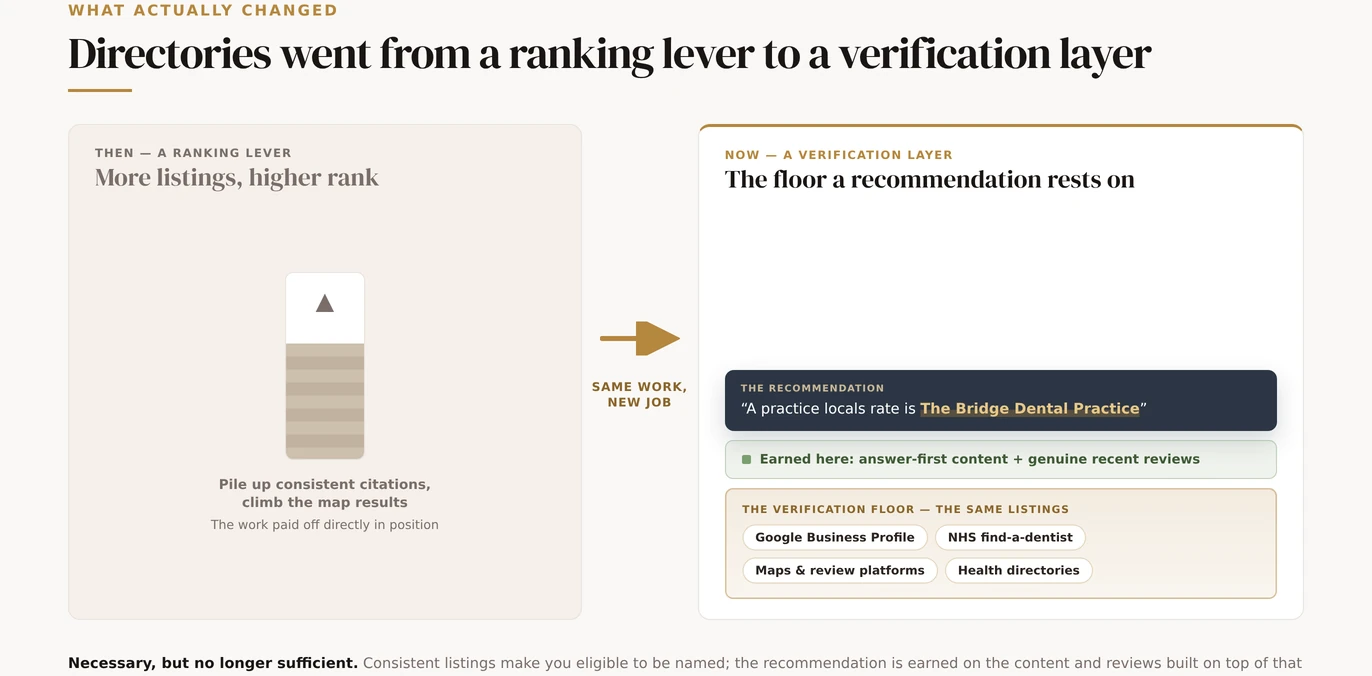
Directory listings and AI search optimisation are not rival channels you choose between. Your listings are now the verification floor that lets an engine confirm your practice is real; the optimisation built on top is what earns you the recommendation. You need both, and in that order. Treating them as competitors, spending on one while neglecting the other, is the mistake that quietly drains a dental marketing budget. The cheapest, most-skipped work sits at the bottom: get every listing to agree, then build the recommendation on the floor that creates.
Think about the single most valuable enquiry your practice can take this month. A patient who has put up with a failing tooth for years finally decides to deal with it, and a single implant in the UK commonly sits somewhere in the region of £2,000 to £2,500 per tooth, with a full-arch case running well into five figures. Or it is an adult who has wanted straighter teeth since their twenties and books a course of clear aligners, typically a £2,500 to £4,500 commitment (these are typical, illustrative UK ranges to make the stakes tangible, not researched figures).
Or it is a family that joins your list for routine care and stays a decade, worth a four-figure relationship before you count a single larger treatment. Every one of those patients now starts the same way: they ask. Sometimes they ask a search box, increasingly they ask an assistant, and the practice that gets named is the one that takes the case.
For fifteen years the standard advice for winning that patient was the same: get your practice listed everywhere. Claim your profiles, keep your name, address and phone identical across the web, pile up citations across every directory you can find, and watch your position in the local map results climb. That advice was not wrong. The trouble is that it has quietly gone out of date in one specific way, and most dental marketing has not noticed. The listings still matter enormously. What they are for has changed.
This article answers the question a practice owner is actually weighing up when they ask whether to invest in directory listings or in AI search optimisation: where does the limited budget go to stop handing high-value cases to the practice down the road? The straight answer is not a choice between two rival channels. It is an understanding of how one now feeds the other. Each section below takes a real question, answers it in full straight away, and is written for UK practices inside General Dental Council rules throughout, so you can read the part that fits your situation and act on it.
The short version
- Listings changed job, not importance. They went from a ranking lever that lifted your position to a verification layer an engine checks before it will name you.
- AI search optimisation is built on the listings. Consistent details, plus recent reviews, plus answer-first content, together earn the recommendation.
- Sequence is where the money is saved. Lock the listing footprint and reviews first, because they are the cheapest and most foundational, then earn the content-led recommendation on top.
- A listing alone rarely grows a practice now. The decision increasingly happens one layer up, inside the AI answer, so being verified is necessary but no longer sufficient.
Directory listings or AI search optimisation: which one wins a dental practice new patients?
Neither replaces the other, because they are no longer two separate channels competing for the same budget. A consistent directory footprint is now the groundwork that AI search optimisation is built on, so the realistic answer is that you need the listings done properly and the optimisation on top, in that order, and treating them as rivals is the mistake that wastes money.
Here is why the question feels like a contest when it is not. A directory listing used to win patients directly: a person browsed a listing platform, found you, and rang. That still happens occasionally. But a growing share of patients no longer browse a directory at all before they decide who to consider. They put the question to an assistant and read the answer it gives.
The evidence that this has crossed from novelty into routine is firm: generative AI tools such as ChatGPT have become the third most popular source of local-business recommendations, climbing from 6% to 45% of consumers in a single year, while 97% of people still read reviews before they choose[1]. Patients bring health decisions to these tools specifically: about a third (32%) of adults now use AI for health information or advice[2].
So the patient's first impression of who to see is increasingly formed inside an answer, not inside a directory. The directory work has not become pointless because of that. It has become the foundation the answer stands on, which is a different and more important job than the one it used to do. The rest of this guide explains exactly how that shift works and what it means for where you spend.
Where patients decide now
The decision is moving into the answer
6% to 45%
rise in consumers using generative AI for local-business recommendations in a single year, now the third most popular source.
97%
of people still read reviews before they choose a local business.
32%
of adults now use AI for health information or advice.
58%
of US Google users saw at least one AI summary in March 2025; clicks to a traditional result fell to 8% from 15%.
BrightLocal Local Consumer Review Survey; KFF Tracking Poll, 2025; Pew Research Center, 22 July 2025.
What is a directory listing actually doing for your practice in 2026?
A directory listing is your practice recorded, with consistent details, on the platforms that catalogue local businesses and dental providers: your own Google Business Profile, the NHS find-a-dentist service, the major map and review platforms, the health-specific provider directories, your dental association register, and the general business listings. At its simplest, a listing proves you exist and states your facts: who you are, where you are, your phone number, your opening hours and what you offer.
For years the value of that footprint was direct and mechanical. The more places your practice appeared, with matching details, the more the old local-search machinery trusted that you were a real, established business, and the higher you climbed in the map results. Listings were a ranking lever you could pull. Build more consistent citations, rank a little higher, catch a few more of the patients scrolling the map. That logic is the reason "get listed in fifty directories" became a product you could buy.
That direct lever has weakened, and a quieter, more important role has taken its place. What your listings now do, more than anything, is let a machine verify you. When a search system or an assistant is deciding whether it can confidently put your practice in front of a patient, it cross-checks your details across all those independent sources.
If they agree, you are a known quantity it can surface without risk. If they disagree, you are a doubt it would rather skip. The listing stopped being mainly a vote that lifts your rank and became mainly a fact-check that earns the engine's confidence. Getting it right still matters as much as it ever did. It just matters for a new reason.
What is AI search optimisation, and how is it different from getting listed?
AI search optimisation, often shortened to AEO, is the work of becoming the practice that gets named, quoted or recommended inside an answer from an assistant such as ChatGPT, Perplexity, Google's AI Overviews or Copilot. Where a directory listing records that you exist, AI search optimisation earns you the recommendation itself. It is the difference between being in the phone book and being the name a trusted friend gives when asked.
It is worth being precise about how the two differ, because the difference is the whole point. A listing is a static record of your details. You fill it in, keep it accurate, and it sits there as a reference. AI search optimisation is not a record you complete; it is an outcome you earn, and it draws on three things working together.
The first is exactly that consistent listing footprint, because the assistant has to be able to verify you before it will name you. The second is a genuine, recent review presence across the places patients leave feedback, because that is the evidence the assistant reads as proof you are active and trusted. The third is content on your own site that answers, in plain and specific language, the real questions patients ask, because that is the material an assistant actually quotes when it builds its reply.
Notice what that list does to the supposed rivalry. The first ingredient of AI search optimisation is your directory work. You cannot do the optimisation properly while neglecting the listings, because the listings are one of its raw materials. The accurate framing is not "listings versus AI search". It is "listings, plus reviews, plus answerable content, equals AI search". (For the detail on earning those mentions, our guide to AI citations for dentists is the companion piece; for how the assistants weigh a practice for a "near me" question, see how AI ranks dentists near me.)
Directory listings versus AI search optimisation: the plain side-by-side
No dental page draws this contrast cleanly, which is odd given how much money rides on it, so here it is in full. Read down the two columns and the dependency between them becomes obvious.
The plain side-by-side
The floor and the building on top of it
| What you are comparing | Directory listings | AI search optimisation (AEO) |
|---|---|---|
| What it is | Your practice recorded with consistent details across the web | Your practice named or recommended inside an AI answer |
| What it gets you | Verification, plus the occasional direct click | Being the practice the assistant actually recommends |
| Where the patient meets you | Browsing a listing or map platform | Inside a ChatGPT, Perplexity or Google AI answer |
| Who or what reads it | Patients, and engines checking whether you are real | The assistant, choosing which practice to name |
| What moves it | Consistent details, the right platforms, regular audits | The verified listings, plus reviews, plus answer-first content |
| What winning looks like | Identical, complete records everywhere | Your practice is the named recommendation |
| The failure mode | Inconsistent details, so an engine cannot verify you | Verified but with no content or reviews, so never chosen |
| Its role now | The necessary foundation: a verification layer | What actually earns the patient the recommendation |
Drawn from the article's comparison of directory listings and AI search optimisation.
The bottom two rows carry the argument. A directory listing can fail on its own terms, when your details disagree across platforms and an engine cannot confirm who you are. AI search optimisation can fail on its own terms too, when your listings are immaculate but you have given the assistant nothing to quote and no reviews to trust, so it verifies you and then recommends somebody else. They fail in different ways because they do different jobs, and that is precisely why you cannot trade one off against the other. The listing is the floor. The optimisation is the building. A floor with no building on it wins very few patients, and a building with no floor falls over.
Here is what actually changed: directories went from a ranking lever to a verification layer
If you take one idea from this article, take this one, because it reorders where the budget should go. The role of your directory footprint has shifted from a thing that lifted your rank to a thing that earns an engine's trust, and that shift is sourced, not speculative.
Start with how local visibility is decided. Google describes its own local results as resting on three factors, relevance, distance and prominence, where prominence is built partly from the information it has about your business from across the web[3]. Your spread of consistent listings feeds that prominence and confirms the entity. So far, so familiar. The change is what now sits on top of that same footprint.
The assistants answering patients cross-check the very same web-wide details before they will name anyone, for exactly the reason a careful person checks a fact in more than one place before repeating it. The footprint you built for local ranking is now doing double duty as the evidence base an AI uses to decide whether it can vouch for you.
That is the move from lever to layer. As a lever, more citations meant a higher position, and the work paid off directly in rank. As a layer, your listings are the verification floor beneath everything else: get them consistent and you are eligible to be surfaced and recommended, but the listings alone no longer push you to the top of anything, because the assistant chooses what to recommend on the strength of the content and reviews sitting above that floor. The blunt way to say it is that directory consistency has become necessary but no longer sufficient. You still have to do it. You can no longer stop there.
This is also why the two most common pieces of dental marketing advice are both half-wrong. One camp still sells "get listed in fifty directories" as though it were 2018 and citations were a ranking lever, ignoring that the listing now earns verification rather than rank. The other camp sells "AI optimisation" as though you could earn a recommendation while your details contradict each other across the web, ignoring that the assistant cannot name a practice it cannot verify. The accurate position runs straight down the middle: the listings are the groundwork, and the optimisation is what you build on it.
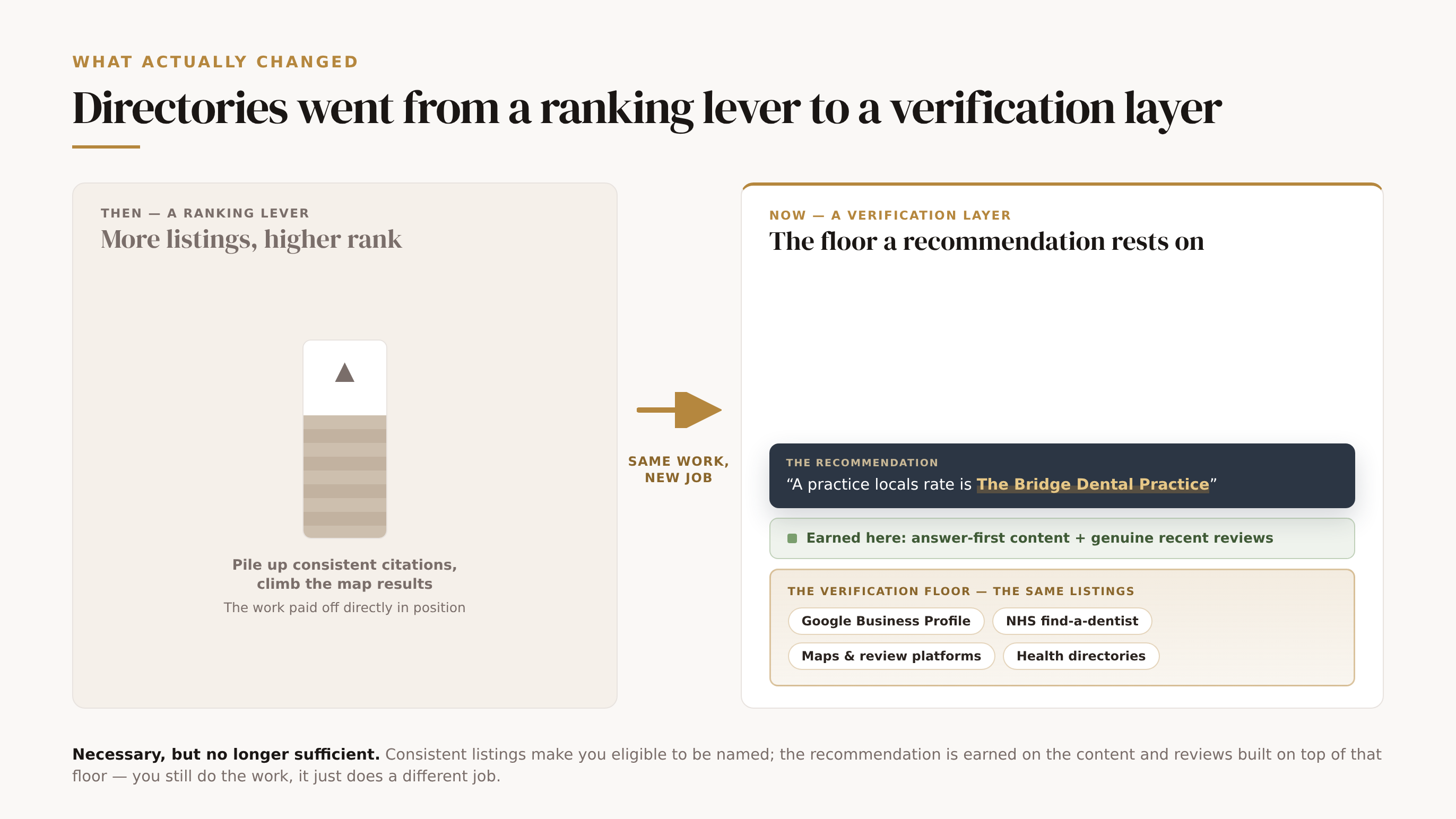
The thread that ties them together: your reviews live in the listings
There is one more reason these two cannot be separated, and it is the part most owners underestimate. The reviews that increasingly decide whether an assistant recommends you are gathered across the same directory ecosystem you maintain. Your listings are not just a record of your address; they are where your review evidence accumulates, and that evidence is read directly by the AI.
The thread that ties them
How a listing becomes an AI citation
Claim and align
Your details read identically across every platform, so an engine can confirm the practice is real.
Gather the evidence
Genuine, recent reviews accumulate on those same listings, the proof you are active and trusted.
Corroborate across the web
The same facts and feedback line up across independent sources, so nothing contradicts you.
Get recommended
The assistant reads that review evidence directly and names the practice it can vouch for.
The company that runs the largest annual study of local reviews now puts it in plain terms. In its words, reviews have become "worthy of prominent visibility and citation within traditional Google search and LLMs like ChatGPT, and AI search"[4]. Read that against the earlier point that 97% of consumers still read reviews before choosing, and the picture is complete: the review footprint you build across your listings is simultaneously what persuades a human patient and what an assistant cites when it recommends a practice. The listing platform is the shared home of both.
So the supposed wall between "directory work" and "AI work" turns out to run right through the middle of the same activity. Keeping your listings claimed, consistent and steadily gathering genuine reviews is directory work and AI search work at once. You are not choosing between maintaining your listings and earning AI mentions. The first is a large part of how you do the second. (For the specific question of how reviews translate into citations, see online reviews versus AI citations for dentists.)
So where should a dentist actually spend effort first? The sequence that pays
Spend in the order that builds the verification floor before you try to win the recommendation, because each step makes the next one worth more. The sequence below is deliberately the reverse of how many practices currently allocate their attention, which is why so much marketing money underperforms.
- Lock the listing footprint first. Claim your practice on the platforms that matter, and make the name, address, phone, hours and services read identically on every one of them. This is the verification floor. It costs time rather than money, and until it is solid, nothing built on top of it is reliable, because an engine that cannot confirm your details will not stake a recommendation on them.
- Earn reviews across the ecosystem. Gather genuine, recent feedback steadily, and reply to all of it without ever putting a patient's clinical details in a public response. Reviews feed the human decision and the AI's confidence in the same motion.
- Write answer-first content for real patient questions. Give your most valuable treatments, implants, aligners, veneers, emergency care, their own pages that open by answering the actual question a patient has, a realistic price range labelled as typical, the timescale, who carries it out, before anything else. This is the substance an assistant can lift and quote.
- Mark it up so a machine reads it cleanly. Add the
DentistandFAQPagelabels so the engines can read your genuine content without guessing and credit it to your practice. Done after the content exists, this confirms something real. (Our dental practice schema markup guide has the detail.)
The sequence that pays
Where a dentist should spend first
Lock the listing footprint first.Make the name, address, phone, hours and services read identically on every platform. This is the verification floor.
Earn reviews across the ecosystem.Gather genuine, recent feedback steadily and reply without putting a patient's clinical details in a public response.
Write answer-first content for real patient questions.Give each valuable treatment a page that opens by answering the question, with a realistic labelled price range and timescale.
Mark it up so a machine reads it cleanly.Add Dentist and FAQPage labels after the content exists, so engines read your genuine facts and credit them to you.
The reason for the order is financial rather than tidy. The listing footprint and the reviews are the cheapest work and the foundation everything else depends on, yet they are the steps owners most often skip in favour of something that feels more like marketing. Build the floor first. The recommendation is earned on top of it, never instead of it.
Do directory listings still get a dentist new patients on their own?
Occasionally, yes, but rarely enough that you should not plan your growth around it. A listing can still win you a direct enquiry when a patient browses a map or a review platform, lands on your profile and rings you. That patient exists and that click is real. What has shrunk is how large a share of your prospective patients ever reach that browsing step before they have already formed a shortlist somewhere else.
The reason is the way answers now sit above everything. Pew Research Center, analysing real browsing data, found that 58% of US users ran at least one Google search in March 2025 that returned an AI-generated summary, and that when a summary appeared they clicked through to a traditional result far less often, in 8% of visits against 15% when no summary was shown[5].
In that increasingly common moment, the patient reads the answer and stops. There is no directory browse to win, because the directory was never opened. Being the practice the answer names is the entire visibility on offer, and a listing alone, with no answerable content and no review evidence above it, gets you verified but not chosen.
So the plain verdict on the standalone listing is this: it is a necessary record that occasionally produces a direct patient, and it is the foundation that makes the recommendation possible, but it is no longer a reliable growth channel by itself. The patients are increasingly decided one layer up, and the listing's main job today is to make sure you are eligible to be the practice decided upon.
What does the UK directory picture look like (GDC, NHS and private)?
The UK has its own listing ecosystem and its own rules, and both shape the work. The platforms that carry weight here include your Google Business Profile, the NHS find-a-dentist service, the major map and review platforms, and the UK healthcare-specific directories, alongside local and community listings. The verification value of being present and accurate applies to all of them, whether or not any individual platform charges for an enhanced profile.
The NHS listing deserves particular care, because both patients and engines treat it as a high-trust source, and getting your details exactly right there does more for your credibility than a great deal of other activity. For practices running a mix of NHS and private care, keeping that distinction clear and accurate across every listing is part of the consistency an assistant is checking for; a patient told one thing by a listing and another by your website is a contradiction an engine notices.
The General Dental Council rules then sit over everything you publish. Standard 1.3.3 requires that any advertising, promotional material or other information you produce is accurate and not misleading. In practice that means no superlatives you cannot evidence, no promises about clinical outcomes, and real care with reviews so that nothing in a public reply discloses a patient's treatment. None of this gets in the way of the work that earns AI mentions, because accurate, specific, plain information is exactly what both the GDC and the assistants reward. The compliant route and the effective route are, conveniently, the same route.
How do I check where my practice stands on both?
You can audit both layers yourself in an afternoon, for nothing, and the check tells you which one is your weak point before you spend a penny. The aim is to separate a verification problem from a recommendation problem, because the fixes are different.
Start with the verification floor. Look up your practice's name, address, phone number and opening hours on every listing you can find, and note any that disagree. A different phone number on an old profile, a former address, opening hours that were never updated: each of these is a contradiction that quietly undermines an engine's confidence in you. Drift like this is common and almost always invisible until you go looking.
Then test the recommendation itself. Open ChatGPT, Perplexity and Google's AI Mode and ask the questions a real patient asks about your most valuable treatments: "best dentist for implants in [your town]", "Invisalign near me", "emergency dentist in [your area] today". Note whether your practice is named, and which practices appear when you are absent. Run each prompt a few times, because the answers move, and it is the recurring pattern that tells you the truth. If your listings are consistent but you are never named, the gap is in your content and reviews. If your listings themselves are a mess, start there, because no amount of good content will earn a recommendation an engine cannot verify.
Get your free AI visibility check →
How QBiz handles both layers, from the groundwork up
Most providers in this space sell you one half of this and leave you to guess about the other. Someone tidies your listings, or someone writes you a few pages, and nobody owns whether the verification floor and the recommendation actually connect well enough to win enquiries. QBiz is built around the dependency this whole article describes, so the work runs across two joined-up fronts.
On the first, we get your own foundations right for AI. We claim and align your listings so your details read identically everywhere an engine checks, because that is the verification floor the recommendation rests on. We help you build a genuine, recent review footprint across the platforms that feed both a patient's decision and an assistant's confidence. And we write your high-value treatment pages so each one answers the real question a patient asks, in language an assistant can lift, then label them cleanly so the engines read your true facts and credit them to you.
On the second, we do the distribution work that on-site tidying alone cannot reach. A clean, consistent practice on its own listings is necessary but not sufficient, because an assistant assembles its answer from agreement across many sources rather than from your homepage in isolation. So we also get your practice referenced and consistent across the wider web the models actually read, turning the groundwork on your own profiles into the off-site agreement that earns a citation. Fixing your foundations is the floor; getting your practice out across the web is what turns that floor into answers that name you.
It begins with a free QBiz Leads AI visibility check. It reads your own website, not the engines, and in about half a minute tells you where you pass or fall short on the things that decide whether an assistant can locate, read and describe your practice: whether your pages can be crawled, whether your details are marked up so a machine reads them cleanly, whether each service page answers a real question plainly, and whether the facts about you line up.
You get back a prioritised, GDC-safe plan that covers both the verification gaps and the recommendation gaps, highest-value cases first. It is the no-cost first step, and it shows you precisely which layer is leaking the patients you should be winning.
Where to start
If you do only three things from all of this, take them in order. First, make your practice details identical on every listing you can find, because that is the verification floor and the cheapest high-value fix you have. Second, build genuine recent reviews across those same platforms, since they persuade patients and assistants at once. Third, write your key treatment pages so each one answers, in plain sentences, the real question a patient is asking, with a realistic price range and timescale, because that is the substance an assistant quotes when it recommends a practice. Each step sits comfortably inside GDC rules, and each makes the next one count for more.
If you would rather see exactly where your practice drops out, whether the gap is listings that disagree or content an assistant has nothing to quote from, that is the job of a free QBiz Leads AI visibility check. It looks over your own site, not the assistants, and flags where the signals that make you findable and quotable are missing: crawlability, the mark-up on your details, how directly your treatment pages answer, and whether your listed facts agree.
It hands back a prioritised, GDC-safe list of what to fix, on your own profiles and across the wider web, and it costs nothing to run before any spend. You can request it from the QBiz AI visibility check. If you would rather have the listings and content work handled for you, our AI SEO for dentists service page sets out how we do it for a practice.
Frequently asked questions
Are directory listings or AI search optimisation better for getting new patients?
They are not alternatives, so the question of which is better is the wrong one. A consistent directory footprint is the verification layer that AI search optimisation depends on, so you need both, in that order. The listings let an engine confirm your practice is real and accurate; the optimisation, built on top, earns you the recommendation. Skipping the listings undermines the optimisation, and stopping at the listings leaves you verified but rarely chosen.
Do directory listings still matter for AI search?
Yes, very much, but for a different reason than they used to. Listings no longer act mainly as a ranking lever that pushes you up the results. They act as a verification layer: assistants cross-check your details across your listings before they will name you, so inconsistent or incomplete profiles quietly stop you being recommended. Keeping your details identical everywhere is now foundational to AI visibility rather than a separate, old-fashioned task.
Which directories should a UK dental practice be listed in?
Prioritise the platforms that carry the most trust and the widest reach: your Google Business Profile, the NHS find-a-dentist service, the major map and review platforms, and the established UK healthcare directories, plus relevant local listings. The specific platform matters less than the consistency across all of them. An engine is looking for your name, address, phone and hours to agree everywhere it checks, so completeness and accuracy beat sheer quantity.
Can I get my practice into ChatGPT just by being in lots of directories?
No. Being listed widely helps an assistant verify that you exist, but verification is not the same as being chosen. The recommendation goes to the practice whose content answers the patient's question and whose reviews give the assistant confidence, on top of a consistent listing footprint. Listings make you eligible to be named; they do not, on their own, earn the name. You need the answerable content and the reviews above the verification floor.
Will fixing my name, address and phone across directories help my AI visibility?
Yes, and it is often the highest-return fix available, because it is both cheap and foundational. When your details contradict each other across the web, an engine cannot confidently confirm who you are, and a practice it cannot verify is one it is reluctant to recommend. Making every listing agree removes that doubt and strengthens the verification layer everything else is built on. It is usually the first thing worth doing.
How many directory listings does a dentist actually need?
Fewer than the old list everywhere advice implied, but each one accurate. Consistency matters far more than quantity now: a handful of complete, agreeing, well-reviewed profiles on trusted platforms does more for your verification than dozens of half-filled listings that contradict each other. Aim for the platforms patients and engines actually trust, keep every detail identical, and direct the saved effort into reviews and content instead.
Sources
- [1] BrightLocal, Local Consumer Review Survey 2026: https://www.brightlocal.com/research/local-consumer-review-survey/ (US-weighted; independent. "Use of ChatGPT and other generative AI tools for local recommendations has grown rapidly, rising from 6% last year to 45% and becoming the third most popular source of business recommendations." And: "97% of consumers still lean on reviews to guide their purchase decisions.")
- [2] KFF, Tracking Poll on Health Information and Trust, 2025: https://www.kff.org/public-opinion/kff-tracking-poll-on-health-information-and-trust-use-of-ai-for-health-information-and-advice/ (US; independent. "About a third (32%) of adults are turning to AI for health information and advice", including about three in ten (29%) who have used AI tools in the past year for information or advice about their physical health.)
- [3] Google Business Profile Help, "Tips to improve your local ranking on Google": https://support.google.com/business/answer/7091 (Global; vendor primary. Local results are based on relevance, distance and prominence; prominence is "based on info like how many websites link to your business and how many reviews you have." No numeric weighting is stated by Google or inferred here.)
- [4] BrightLocal, Local Consumer Review Survey 2026 (Myles Anderson, Co-founder and CEO, quoted on page): https://www.brightlocal.com/research/local-consumer-review-survey/ (US-weighted; independent. "They've become an essential piece of evidence that your business is active, reliable. Also that it's worthy of prominent visibility and citation within traditional Google search and LLMs like ChatGPT, and AI search.")
- [5] Pew Research Center, 22 July 2025: https://www.pewresearch.org/short-reads/2025/07/22/google-users-are-less-likely-to-click-on-links-when-an-ai-summary-appears-in-the-results/ (US; independent. "About six-in-ten respondents (58%) conducted at least one Google search in March 2025 that produced an AI-generated summary." Users who saw an AI summary clicked a traditional result in 8% of visits, against 15% when no summary appeared.)
Leave a comment
Thoughts on this post? Leave a comment below. Comments are moderated before they appear, so yours will not show on the page straight away.
Your email is used only to contact you about your comment if needed — it is never published.
Comments
No comments yet. Be the first to leave one above.