How to Get Listed in Google AI Overviews: The Eligibility Gate Before Citation
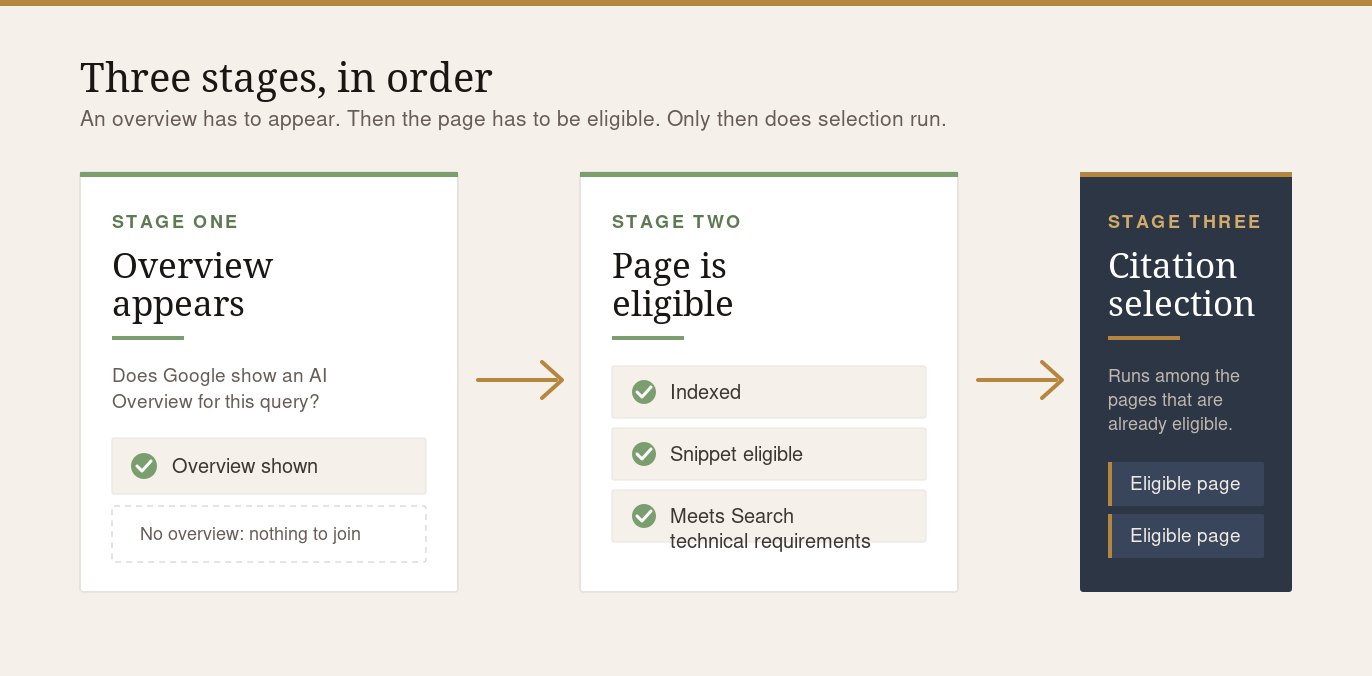
Short version: Getting listed in a Google AI Overview starts before citation selection. Google says a page must be indexed and eligible to appear in Google Search with a snippet before it can be eligible as a supporting link. Even then, Google may not show an AI Overview for the query at all. Check whether the query produces an overview first. Then check whether Google can crawl, render and index the page. Citation selection is the next stage, not the first.
Eligibility and citation selection are separate stages
An AI Overview has two prior questions. Does Google show an overview for this search? And, if it does, is your page technically eligible to appear as a supporting link? Only after those questions does Google select among eligible sources.
That distinction matters because a page cannot be selected for an overview that never appears, and an unindexed page is not eligible to support one. QBiz's guide to how Google chooses citations in AI Overviews covers the later selection stage. It explains how Google chooses between pages that have already cleared this one. This guide stays with the earlier gate: overview presence and technical eligibility.
Google's own rule is narrow: to be eligible as a supporting link in AI Overviews or AI Mode, a page must be indexed, eligible to show a Google Search snippet and meet Search technical requirements. Google also says there are no additional AI-only technical requirements.[1]
The gate
The eligibility gate before citation selection
Stage 1
Query receives an AI Overview?
No overview for the query: there is no supporting-link selection for that query.
Stage 1 continued
Page indexed, snippet-eligible and meets Search technical requirements?
Page not eligible: selection proceeds among other eligible pages and this page is outside the pool.
Stage 2
Supporting-link selection
See QBiz's citation-selection guide.
What technical eligibility actually means
The useful starting point is not a separate AI checklist. It is whether Googlebot can reach a working page and find content it can index. Google's minimum technical requirements say a page is eligible to be indexed when Googlebot is not blocked, the page returns HTTP 200 and it contains indexable content. Meeting those requirements makes indexing possible. It does not guarantee Google will index the page, show a snippet or use it as a supporting link.[2]
Make the page reachable to Googlebot
A public page that blocks Googlebot, sits behind a login, or returns an error cannot progress through the indexing route described by Google.[2]
Put indexable text where Google can discover it
Google says that indexable content must be in a supported file type and comply with its spam policies. In practical terms, the page needs a substantive textual answer that Google can find, not only an interface that needs an interaction before the answer appears. A page can be reachable and still fail to offer enough usable content for the query it is meant to answer.[2]
Treat JavaScript as a rendering risk, not an automatic ban
JavaScript does not automatically make a page ineligible. Googlebot can render JavaScript, but Google explains that it queues crawling and rendering separately. On app-shell sites, the initial HTML may not contain the content, so Google needs to execute JavaScript before it can see the generated page text. That creates a content-discovery risk when the important answer is absent, delayed or fails to render.[4]
The requirements
Google's three minimum technical requirements
Not blocked to Googlebot
Fails whenblocked by robots.txt or login
Returns HTTP 200
Fails whenserver error or redirect loop
Contains indexable content
Fails whenscript-only content Google cannot find
Source: Google Search Technical Requirements[2]
Why an AI Overview may not appear for the query
Technical eligibility only describes a page's place in the pool. It does not make Google generate an AI Overview. Google says AI Overviews appear only when its systems determine they add to classic Search, and therefore they often do not trigger. Google's public help gives the example of a search where someone wants to quickly understand information from a range of sources. Google's published documentation on AI features and Search technical requirements does not give a trigger rate by query type.[1][3]
That leaves a hard boundary for planning. You can remove a crawl block, improve indexable content and make a page eligible. You cannot force an overview onto a query where Google's systems decide a conventional result is sufficient.
What recent data says about variation by intent and industry
The public evidence does show that AI Overview appearance changes across categories, but the scope matters. Semrush examined more than 600,000 keywords from its U.S. desktop database across 10 industries between November 2025 and April 2026. In that dataset, AI Overview appearance for commercial-intent queries grew 71%, while appearance for transactional-intent queries fell 5%. Those are changes within Semrush's study period and dataset, not universal rates for all countries, devices or searches.[5]
The same study found uneven movement by industry. It reported 231.25% growth in commercial-intent AI Overview appearance for Finance over six months. In Food & Drink, it recorded AI Overviews on 16% of transactional SERPs and 14% of commercial SERPs.[5]
Use these figures to decide which queries are worth testing in your own market.
Intent movement
Commercial up, transactional down
Semrush, over 600,000 U.S. desktop keywords, 10 industries, November 2025 to April 2026.
Source: Semrush[5]
QBiz mini-test: what appeared in one UK desktop capture
QBiz ran a small directional observation on 3 October 2026 to make the prior gate visible. The purpose was to record whether a typed AI Overview element appeared for a defined query set.
Results at a glance
- 16 queries were attempted.
- 15 queries were captured.
- 1 query remained unverified after two upstream
40101errors and was not treated as an absence. - 13 of the 15 captured queries returned an AI Overview.
- 2 of the 15 captured queries did not return an AI Overview. Both returned a local pack.
- All 4 captured YMYL-adjacent queries returned an overview.
Methodology note
Method: QBiz queried the DataForSEO Google Organic Live Advanced endpoint between 16:18:25 and 16:22:03 UTC on 3 October 2026. The parameters were United Kingdom location code 2826, English, desktop, Windows, depth 20 and load_async_ai_overview: true. An overview counted as present only where the API returned an element with type: "ai_overview". featured_snippet and people_also_ask are separate element types, so they were not treated as evidence of an overview. Google returns some overviews after the initial response; the API reports these as asynchronous, and three of the captured overviews arrived that way.
Limit: This was a single-location, single-language, single-device, single-point-in-time observation through a third-party SERP API. It cannot establish causality, a stable rate, or what another user would see. One pension query was not captured after two upstream errors. The study records it as unverified.
The mini-test
QBiz mini-test capture by query
Capture setting: UK, English, desktop, 3 October 2026
- how does a heat pump workoverview present
- what is seooverview present
- how often should a boiler be serviced ukoverview present
- why is my boiler losing pressure overnightoverview present
- best crm for small businessoverview present
- best accounting software for sole traders ukoverview present
- car insuranceoverview present
- emergency plumber manchesteroverview absent, local pack
- dentist near me open saturdayoverview present
- wedding photographer leeds pricesoverview present
- symptoms of vitamin d deficiencyoverview present
- how much notice must a landlord give to end a tenancy ukoverview present
- how much can i pay into a pension tax free uknot captured
- hmrc loginoverview present
- facebookoverview present
- screwfix opening timesoverview absent, local pack
| Query | Query class | Captured result |
|---|---|---|
| how does a heat pump work | informational | AI Overview present |
| what is seo | informational | AI Overview present |
| how often should a boiler be serviced uk | informational | AI Overview present |
| why is my boiler losing pressure overnight | informational | AI Overview present |
| best crm for small business | commercial | AI Overview present |
| best accounting software for sole traders uk | commercial | AI Overview present |
| car insurance | commercial, YMYL-adjacent | AI Overview present |
| emergency plumber manchester | local | AI Overview absent, local pack returned |
| dentist near me open saturday | local, YMYL-adjacent | AI Overview present, asynchronous |
| wedding photographer leeds prices | local | AI Overview present, asynchronous |
| symptoms of vitamin d deficiency | informational, YMYL-adjacent | AI Overview present |
| how much notice must a landlord give to end a tenancy uk | informational, YMYL-adjacent | AI Overview present, asynchronous |
| how much can i pay into a pension tax free uk | informational, YMYL-adjacent | not captured after two upstream errors |
| hmrc login | navigational | AI Overview present |
| navigational | AI Overview present | |
| screwfix opening times | navigational | AI Overview absent, local pack returned |
The test included three navigational queries as a negative control. The prediction did not hold: hmrc login and facebook returned overviews, while screwfix opening times did not. This sample therefore does not support a claim that navigational queries suppress AI Overviews.
The four captured YMYL-adjacent queries bear on the claim that Google withholds overviews on sensitive topics. All four returned an overview. The unverified pension query cannot be counted either way. This is evidence that the feature was not withheld in these four captured cases, not evidence about YMYL queries generally.
A practical eligibility check before you pursue citation selection
Start with a defined query and a defined URL. Then work through the inclusion gate in this order:
- Check the query itself. Search the priority query in the target market and device, preferably on more than one occasion. If Google does not show an overview, no supporting-link work can produce one for that query.
- Confirm crawl access. Check that Googlebot is not blocked and that the page is publicly accessible.
- Confirm page health. Ensure the URL returns HTTP 200 and is the page you intend Google to index.
- Confirm indexable content. Put the central answer in supported, readable text rather than making it dependent on a fragile rendering path or hidden interaction.
- Inspect indexing in Search Console. Check the reported indexing status of the exact URL you want to be eligible.
- Check rendering where JavaScript carries the answer. Make sure the critical text is available after Googlebot's rendering process, not merely visible in a browser session that has already run the page's scripts.
These steps remove the blocks that prevent a page from being technically eligible for a supporting link.
If your priority query has no overview
Do not turn a non-triggering result into a content-quality verdict.
Keep the page technically sound and useful for ordinary Google Search. Then build a query set around the problem your audience is trying to solve and observe which questions receive overviews in the relevant market. A single absence is an observation, not a permanent classification of the query.
Once a page clears this gate, citation selection begins
Technical eligibility and query-level overview presence put a page in contention. They do not answer which eligible source Google will use. For that next question, read QBiz's guide to how to get cited in Google AI Overviews. It covers the citation-selection stage that begins only after an overview appears and your page is eligible to support it.
Frequently Asked Questions
Is an indexed page guaranteed to become a supporting link in an AI Overview?
No. Google says an indexed, snippet-eligible page that meets Search technical requirements is eligible to be shown as a supporting link. Eligibility does not guarantee an overview for the query or selection as a supporting link. https://developers.google.com/search/docs/appearance/ai-features
Do Google's technical requirements guarantee that my page will be indexed?
No. Google says meeting the minimum requirements makes a page eligible to be indexed. Indexing remains Google's decision, and AI Overview eligibility is a later, separate condition. https://developers.google.com/search/docs/essentials/technical
Does JavaScript make a page ineligible for Google AI Overviews?
No. Google can render JavaScript. The risk is that the important content is absent from the initial HTML or is not available when Googlebot renders the page, which can limit content discovery and indexing. https://developers.google.com/search/docs/crawling-indexing/javascript/javascript-seo-basics
Do all Google searches show an AI Overview?
No. Google says AI Overviews are shown only when its systems determine they are additive to classic Search, and that they often do not trigger. Google's published documentation on AI features and Search technical requirements does not give a trigger rate by query type. https://developers.google.com/search/docs/appearance/ai-features
Why can a page rank in Google Search without appearing in an AI Overview?
A ranking result does not create an AI Overview for a query. Google may decide not to show one. Where an overview does appear, technical eligibility only puts a page in the pool for a supporting link; citation selection is a separate stage. https://developers.google.com/search/docs/appearance/ai-features
Get your AI Visibility audit →
Sources
- [1] Google Search Central, AI Features and Your Website
- [2] Google Search Central, Google Search Technical Requirements
- [3] Google Search Help, Find information in faster & easier ways with AI Overviews in Google Search
- [4] Google Search Central, Understand JavaScript SEO Basics
- [5] Semrush, AI Overviews are expanding across commercial intent search [Study]
Leave a comment
Thoughts on this post? Leave a comment below. Comments are moderated before they appear, so yours will not show on the page straight away.
Your email is used only to contact you about your comment if needed: it is never published.
Comments
No comments yet. Be the first to leave one above.