Directory Dominance in Law Firm AI Citations: How Market Size and Platform Change the Answer
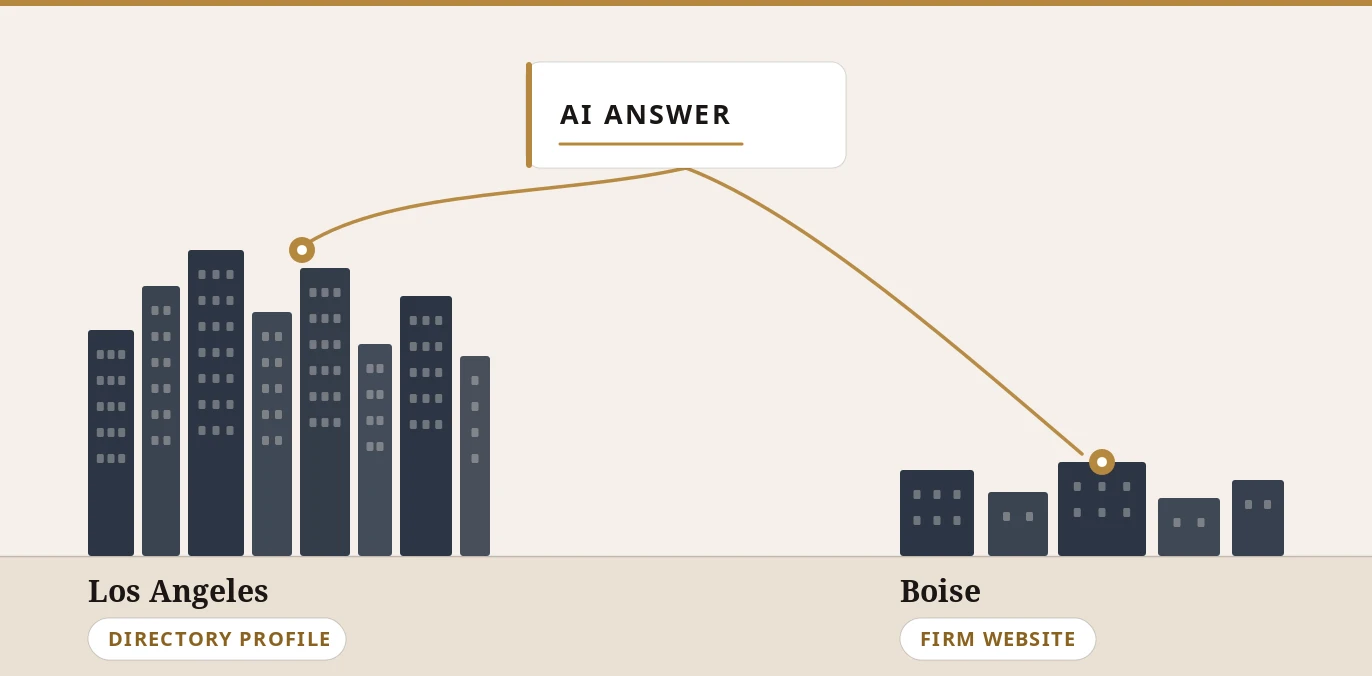
A law firm in Los Angeles and a law firm in Boise may appear in different citation-source mixes. In the cited report, the Los Angeles sample included national directory profiles, while the Boise sample included firm websites as primary citations. The report groups cities by market tier, and its observed citation sources differ across those tiers.
Summary
An agency-published report found different citation-source mixes across its US legal-market samples. In its large-market sample, New York, Chicago, and Los Angeles featured national directories such as Chambers, Best Law Firms, and Super Lawyers, while firm websites rarely appeared as direct sources. In its small-market sample, Boise, Providence, and Tucson included firm websites as primary citations. A separate 3,200-prompt dataset spanning 100 US cities and 32 practice areas found different directory citation shares by platform. Among the directory and resource sites each platform cited, Avvo accounted for 87.1% of Claude's and 5.4% of Google AI Mode's, while Super Lawyers accounted for 62.8% of Google AI Mode's and 0.0% of Claude's. These are historical citation shares in their cited datasets, not demonstrated weighting factors inside AI systems.
Short version
An agency-published report found directories in its large-market sample and firm websites as primary citations in its small-market sample. In a cited 3,200-prompt dataset across 100 US cities and 32 practice areas, Avvo, Super Lawyers, and Martindale held different shares of directory citations by platform. On Perplexity, Chambers Band 1 rankings tracked the first-named answer for estate planning in 8 of 9 markets tested, with Tucson outside the comparison because no private-wealth ranking exists there.
How did the report's citation-source mix vary by market tier?
A marketing agency's original research into AI-generated legal recommendations grouped its sampled markets into three tiers. The report recorded a different citation-source mix in each tier.
In New York, Chicago, and Los Angeles, the report found the market "dominated by a small number of highly selective national credentialing systems," including Chambers, Best Law Firms, Best Lawyers, Super Lawyers, and Legal 500. Firm websites, the report states, are "essentially invisible as direct citation sources" in these markets, with rare exceptions regardless of how well optimized they are. [2]
Philadelphia, Atlanta, and Denver have a different mix in the report. National directories still appear there, alongside local editorial publications. [2]
Boise, Providence, and Tucson show a different source mix. National directory coverage there is thin, and the report found firm websites appearing as primary citations across multiple practice areas. [2]
This finding comes from Splat, an AI-visibility marketing agency, in a report titled "Law Firm Visibility in AI Search," published on the agency's own site. [2] It is agency-published research, not an independent or peer-reviewed study.
How does the report separate market size from firm size?
The report's tiers are city-market groupings. Firm size is a separate variable.
The QBiz article on whether AI favors big brands over small ones addresses firm scale and AI visibility separately. The cited report does not test whether firm size determines a citation outcome. [2]
Which directory each AI platform actually cites
In a company employee's Reddit post disclosing data from 3,200 prompts across 100 US cities and 32 practice areas, Avvo, Super Lawyers, and Martindale had different shares of each platform's directory citations. [1]
The prompts were run through three platforms, producing 9,600 queries and a cleaned dataset of 107,716 citations, according to the Reddit post disclosing the data. [1] Among the directory and resource sites each platform cited, the shares split like this:
| Directory | Share of Claude's directory citations | Share of Google AI Mode's directory citations |
|---|---|---|
| Avvo | 87.1% | 5.4% |
| Super Lawyers | 0.0% | 62.8% |
| Martindale | 55.5% | 0.1% |
Among the directory and resource sites Claude cited, Avvo accounted for 87.1%, while among the same category on Google AI Mode, Avvo accounted for just 5.4%. Super Lawyers ran the other way: 62.8% of Google AI Mode's directory citations against 0.0% in Claude's sample. Martindale split closer to Avvo's pattern, at 55.5% of Claude's directory citations and 0.1% of Google AI Mode's. [1]
These figures are historical citation shares in one disclosed dataset, not demonstrated weighting factors inside AI systems, a distinction QBiz's guide for Florida attorneys on ChatGPT recommendations also makes.
This data comes from Custom Legal Marketing (CLM Sequoia)'s published research report; a company employee also disclosed the same figures in a Reddit post. [1] The methodology quoted above is disclosed in that report.
This measurement is specific to law firm citations in this dataset. A QBiz article on Claude's citation sources across a much broader, non-legal dataset reports OtterlyAI's finding that company and product domains, not directories, took the largest share of Claude's citations there. The two findings describe different verticals and different denominators, and neither one contradicts the other.
The QBiz article on why a directory profile often outranks a firm's own website in AI answers covers the mechanics: fixed fields, a declared category, a visible review history, and agreement across multiple sources make a directory listing easier for a model to verify than a claim on a firm's own site. What this dataset adds is that the effect isn't uniform. It depends on which platform is doing the citing and, as the section above shows, on the size of the market.
Why does Tucson sit outside the Chambers comparison?
On Perplexity, a Chambers Band 1 ranking tracked the first-named firm for estate planning searches in 8 of 9 markets tested. Tucson sits outside this comparison because Chambers publishes no private-wealth ranking there.
Across the 9 markets tested for estate planning on Perplexity, the firm named first was either ranked Band 1 in the Chambers High Net Worth Guide for private wealth, or tied to a firm that was, in 8 of them. [2] In the ninth, Chambers publishes no private-wealth ranking, so the report has no Band 1 firm to compare there. [2]
What did one practitioner observe about franchise and employer-side employment law?
A commenter on the original research contrasted personal injury and family law with franchise law and employer-side employment law.
Personal injury and family law, the commenter wrote, "have a decade of content fighting for the same ai answers," while "nobody is doing this seriously for stuff like franchise law or employer side employment work." [3] This is one AI-visibility practitioner's observation in a comment on the original research thread, not a measured count of published content.
How can a firm investigate citation visibility without overreading the data?
Compare the citation sources visible in the firm's market and on the platform being assessed. The cited reports show different source mixes by market tier and platform; they do not measure the effect of changing a directory listing or website. [1]
Get your AI Visibility audit →
Frequently Asked Questions
Do all AI platforms cite the same legal directories?
No. Among the directory and resource sites each platform cited in one 3,200-prompt dataset, Avvo accounted for 87.1% of Claude's and 5.4% of Google AI Mode's. Super Lawyers accounted for 62.8% of Google AI Mode's and 0.0% of Claude's. These historical shares show that the sampled directory citation mix differed by platform. They do not establish which directory strategy will produce citations for a firm.
Does market size matter more than firm size for AI citations?
They measure different things. In the report, market size is a city-tier grouping, and the large- and small-market samples had different citation-source mixes. Firm size describes the scale of the practice itself. The report does not test whether firms of different sizes face the same citation outcome within one market tier.
Should a firm in a small market still list on national legal directories?
The report observed firm websites as primary citations in its small-market sample, alongside directory listings. It did not find the same source mix in the largest markets tested. The report does not measure the weight a directory listing carries or the effect of a listing.
What does a Chambers Band 1 ranking actually predict?
On Perplexity, a Chambers Band 1 ranking for private-wealth law tracked the first-named firm for estate planning searches in 8 of the 9 markets tested. The one exception, Tucson, has no published Chambers ranking for that practice area, so there was no Band 1 firm to track. The finding is specific to Perplexity and to estate planning, and it should not be read as true of every practice area or every platform.
What did one practitioner observe about franchise and employer-side employment law?
One AI-visibility practitioner, commenting on the original research behind this article, said personal injury and family law have "a decade of content fighting for the same ai answers," while franchise law and employer-side employment work received less attention in that person's observation. It is a single comment, not a measured count of published content or citation competition. Treat it as a lead for further investigation.
Do these percentages mean I should pick one directory and ignore the others?
No. The percentages describe a historical share of citations in one dataset, not a ranking a firm can buy its way into or a demonstrated weighting factor inside an AI system. The dataset does not show which directory choice will produce citations. A firm assessing more than one platform can compare the cited source mix for each platform before deciding what to investigate.
Sources
- [1] Custom Legal Marketing, "ChatGPT, Claude, and Google AI Mode Rarely Recommend the Same Law Firms," custom.legal, fetched 23 Sep 2026. Custom Legal Marketing (CLM Sequoia) is a legal-marketing agency; this is the agency's own published research report, also disclosed by a company employee in a Reddit post (u/jbclm, r/legaltech, 31 Jul 2026), not an independent or peer-reviewed study.
- [2] Splat, "Law Firm Visibility in AI Search," splatworld.tv, Apr 2026, fetched 23 Sep 2026. Splat is an AI-visibility marketing agency; this is the agency's own published research report, not an independent or peer-reviewed study.
- [3] u/kris_2111, comment on "Original Research: How Law Firms Show Up in AI Search," r/SEO_for_AI, posted 15 Jul 2026, fetched 23 Sep 2026. A single Reddit comment, an individual practitioner's observation, not measured research.
Leave a comment
Thoughts on this post? Leave a comment below. Comments are moderated before they appear, so yours will not show on the page straight away.
Your email is used only to contact you about your comment if needed; it is never published.
Comments
No comments yet. Be the first to leave one above.