Why Is a Directory Ranking Above Your Own Website in AI Answers?
When a directory outranks your own website in an AI answer, the cause is structure. A directory publishes your business name, address and phone number in a fixed format, groups you under a defined category, and carries a visible, running history of reviews. That combination is easy for an AI model to extract and cross-check against other sources. A business website that lacks consistent contact details, clear service pages, or any visible review signal gives the model less to work with, so the model reaches for the source that's easier to verify. The fix isn't to compete with the directory; it's to match its consistency and add what a directory can't: direct, specific answers to the questions your actual buyers ask.
Short version
- Directories win AI citations by being structured and consistent, not by being more relevant than your website.
- NAP mismatches (name, address, phone) between your site, your Google Business Profile and the directories that list you make the directory the safer citation.
- A directory's visible review history gives an AI model a trust signal your website may not carry at all.
- A thin or generic service page loses to a directory listing that states the same facts more clearly.
- Closing the gap means matching directory-level consistency.
Why does AI cite a directory instead of your own website?
An AI model choosing what to cite is solving a narrower problem than it looks like from the outside: which available source can it verify fastest, and trust to still be accurate. A directory listing is built for exactly that. Your business name, address and phone number sit in a fixed field, your category is declared rather than implied, and a review history sits alongside the listing showing that the business is real and active. Your own website may say all the same things, but if it says them inconsistently, buries them in a footer, or leaves them out of a page the model actually reads, the directory becomes the source that's easier to confirm. The model isn't rejecting your website in favour of a stranger; it's picking the record that took the least work to trust.
Business directories make up almost a third of local-intent organic search results overall (31%).[1] Directories start any local search with that scale already behind them, independent of anything an AI engine goes on to do with it.
What makes a directory a trusted source in the first place?
Consumers already treat directories as a default reference for finding a business. 94% of consumers used an online directory to find information about a new or previously used business in the last 12 months.[2]
Three things, and none of them are unique to any one directory:
Structure. Name, address, phone, category and hours sit in predictable, labelled fields rather than prose. A model doesn't have to infer what your business does or where it operates; the directory states it.
Cross-source consistency. A directory's details are also carried, matching, on other directories and on your Google Business Profile. When several independent-looking sources agree, that agreement itself becomes a trust signal, one that a single website page can't produce on its own. How to Become an Entity AI Recognises covers this consistency requirement in full; the point that matters here is narrower: a directory is one of the sources feeding that cross-check, so it benefits directly from the agreement it helps create.
A visible review and activity history. Reviews, ratings and recency (how current the listing looks) are all present on a directory page in a form a model can read directly. A business website without a reviews section, or with reviews that are hard to find or old, offers none of that on its own pages.
Scroll to see the full figure
We checked this ourselves, asking for local recommendations in two separate searches. Both answers backed their picks with directory and roundup pages, not only the recommended businesses' own websites.
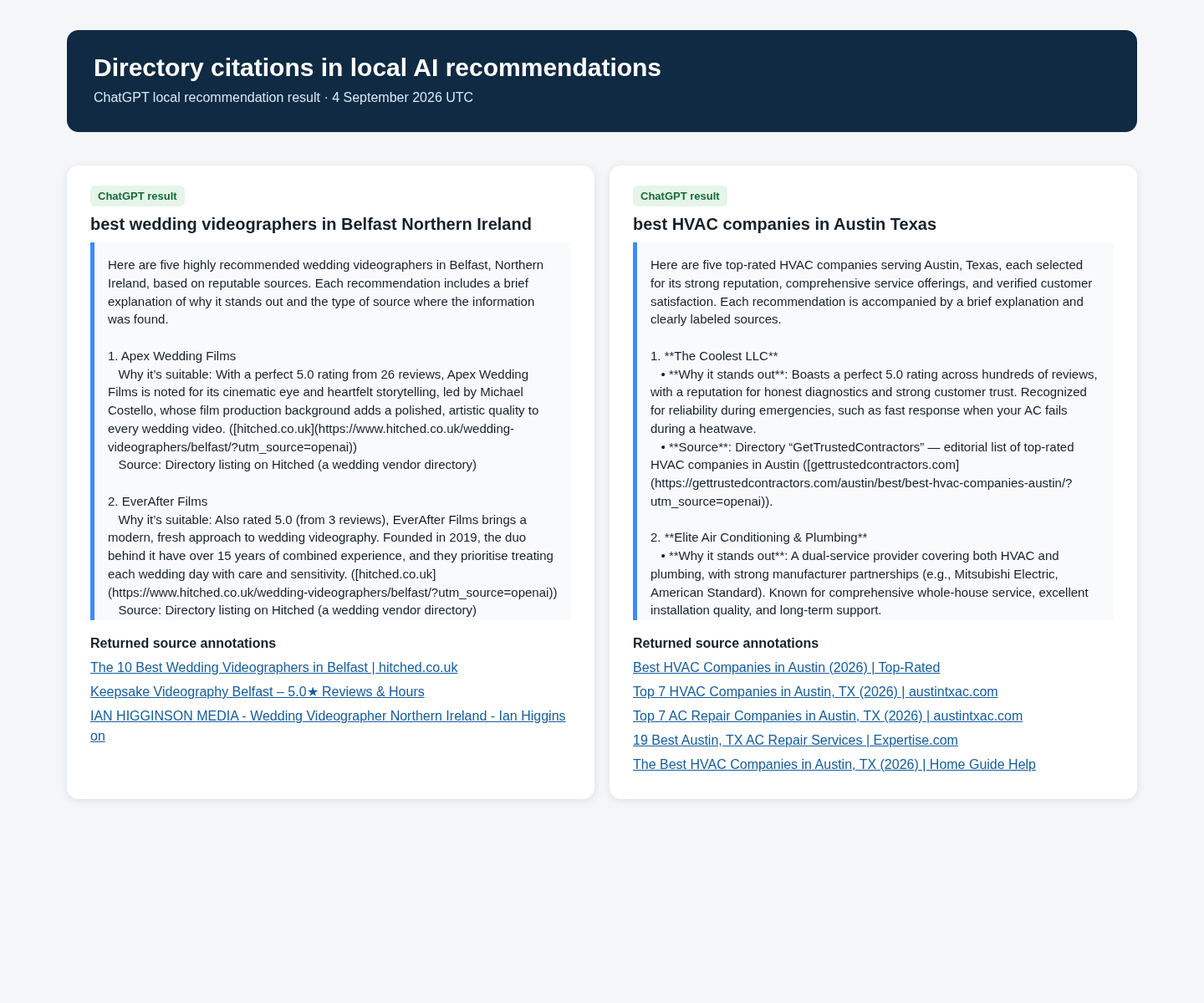
In the Austin search, the recommendations leaned on directory-style lists and review pages rather than any single business's own site.
In the Belfast search, the wedding directory Hitched appeared repeatedly among the stated sources, cited behind more than one of the recommended businesses. Both results point to the same requirement: a business needs consistent, complete information wherever buyers and the model answering them might look, not only on its own domain.
Why your own website loses when it's thin, disconnected or unverified
A directory doesn't have to be better than your website to win the citation; it only has to be more confidently verifiable. Three specific failure patterns hand it that advantage:
Thin pages. A service page that names what you do in one sentence and stops gives a model very little to extract. A directory entry that states the same service with a category tag and a location field, however brief, is still more structured than an under-written page.
Disconnected details. If your phone number on your website doesn't match the one on your Google Business Profile or on the directories that list you, that mismatch doesn't just confuse a human reader. It removes the cross-source agreement a model relies on to treat any one of those numbers as current. A business trading as Smith Plumbing on its own site, Smith Plumbing Ltd on its Google Business Profile and J. Smith Plumbing & Heating across two directories reads as three or four candidate records, not one business with three listings. The consequence goes beyond a lost citation. Finding incorrect information on a business listing would stop 63% of consumers from using that business.[2]
No verification signal. A directory listing shows when it was last updated, how many reviews it has, and whether the business is still marked active. A website with no comparable signal, no recent content, no visible reviews, gives a model no equivalent reason to treat it as current.
Directory ranking vs Google ranking: are these the same problem?
Related, but not the same mechanism. Ranking on Google and being cited by an AI model use different underlying signals, so a page can hold a strong Google position while still losing the AI citation to a directory, for the structural reasons above rather than for anything to do with search ranking. Ranking No.1 on Google Won't Get You Into ChatGPT covers that broader gap between the two systems in full; this page stays on the narrower directory-specific question of why a third-party listing, not a competitor's website, takes the citation.
How to close the gap between your site and the directory
Match your NAP details exactly, everywhere. Your website, your Google Business Profile and every directory that lists you should show the identical name, address and phone number, down to formatting.
Write service and location pages that answer a real question directly, not pages that only describe what you do in general terms. A page titled around a specific buyer question, answered in the first sentence, gives a model something a generic directory category can't match. AEO for Local Businesses covers how that page structure works for a business serving a defined area.
Make your reviews visible on your own site, not only on the platforms that host them. A directory's review count is one of its strongest trust signals; a website that never surfaces its own reviews is giving up a signal it's entitled to.
Get listed properly. QBiz's brand distribution network covers building the wider footprint of consistent, cross-checkable listings this fix depends on.
Check where you currently stand before assuming which fix matters most. A site with a NAP mismatch needs a different fix to a site with no reviews section, and a technical AI-visibility check tells you which of the two you're dealing with.
FAQ
Why does a directory outrank my own website in AI answers?
A directory listing is a structured, aggregated record with consistent business details, a defined category and a running history of reviews. That combination is straightforward for an AI model to read and check against other sources. A thin, inconsistent or unverified business website loses to a listing that is easier to read and cross-check, even when the website itself belongs to the actual business.
What makes a directory listing trustworthy to an AI engine?
Directories hold the same contact details in labelled fields rather than prose, sort each listing under a declared category and service area, and keep a visible review and rating history beside it. An AI model can lift those details and check them against other listings without interpreting anything, so the listing is cheap to trust.
Does NAP consistency affect whether AI cites a directory over my site?
Yes. If your business name, address or phone number differs even slightly across your website, your Google Business Profile and any directory carrying you, an AI model has no easy way to confirm which version is current. A directory that agrees with the other listed sources becomes the safer citation, regardless of which record is actually correct.
Can I get AI to cite my own website instead of a directory?
You can close the gap rather than eliminate the directory. Make your own contact details identical on every source that carries them, answer a real buyer question in the opening line of each service and location page, and surface your reviews on your own site. The aim is for your own page to become the better-documented of the two records.
Is this the same problem as ranking below a directory on Google?
Related but not identical. Google ranking and AI citation run on different signals. Your site can sit at the top of the search results and still lose the citation to a directory, because the listing is quicker for a model to confirm.
Short version, restated
Start with the NAP match. Until your name, address and phone number are identical on your site, your Google Business Profile and every directory carrying you, better service pages and more visible reviews are working against a record the model cannot confirm. Both compound once that agreement is in place.
Not sure whether a NAP mismatch, thin pages or a missing review signal is costing you the citation?
Check whether AI platforms can find and cite your business →
Sources
- [1] BrightLocal, Business Listings Visibility Study.
- [2] BrightLocal, Business Listings Trust Report.
Leave a comment
Thoughts on this post? Leave a comment below. Comments are moderated before they appear, so yours will not show on the page straight away.
Your email is used only to contact you about your comment if needed — it is never published.
Comments
No comments yet. Be the first to leave one above.