Reciprocal Rank Fusion: How ChatGPT Scores Your Content Across a Query Fan-Out
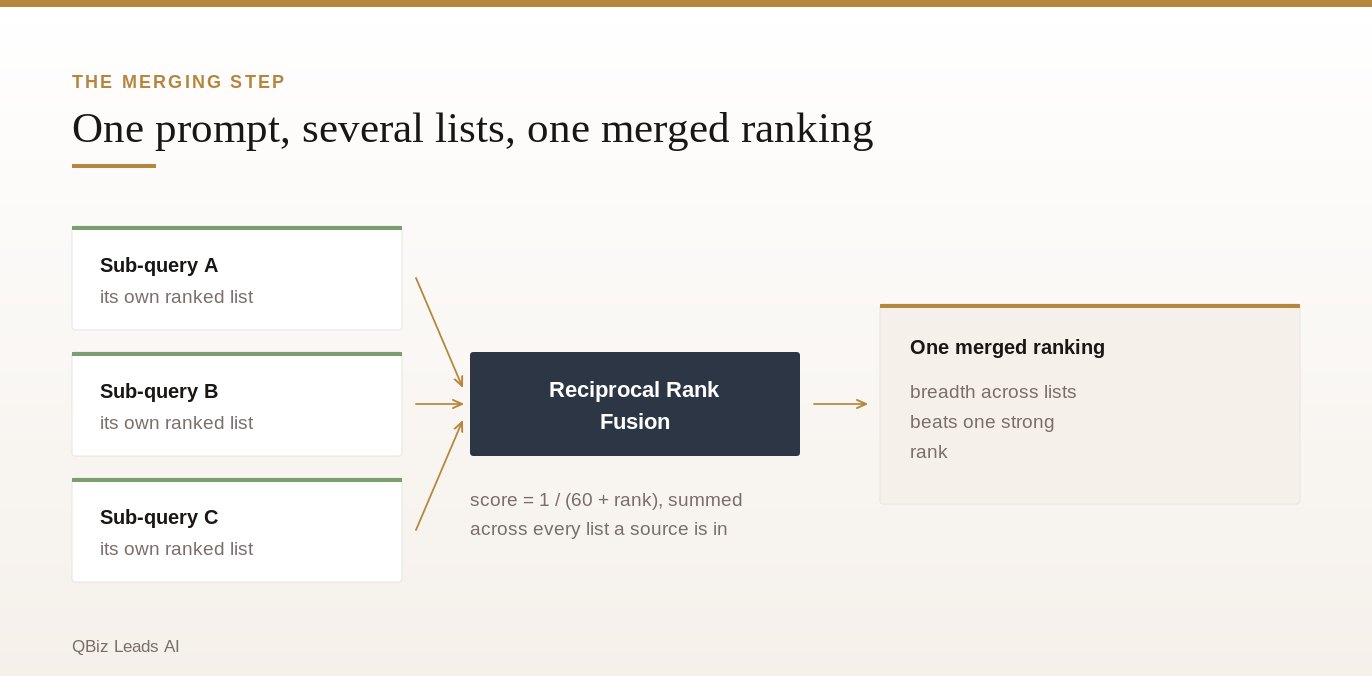
Ask ChatGPT a single question and it rarely runs one search. Behind the scenes it breaks your prompt into several related searches, a query fan-out, then has to decide which sources from all of those results earn a place in the answer it gives you. The merging step has a name: Reciprocal Rank Fusion (RRF), a scoring method that rewards a source for showing up across several of those sub-queries rather than dominating just one.
Short version: ChatGPT does not search once behind your prompt. It fans out into several related sub-queries, then merges every result list with Reciprocal Rank Fusion (RRF), an algorithm that adds a source's rank across every sub-query it appears in. A page that only answers one angle of a topic earns a lower combined score than a page that answers several, so covering the cluster of angles a fan-out is likely to run compounds your odds of being pulled into the final answer.
One scope note. RRF itself is a well-established information-retrieval method from 2009, not a ChatGPT invention. That ChatGPT specifically uses it comes from one AI-visibility vendor's client-side code inspection, not an OpenAI-published specification, so treat the mechanism as the best current read rather than a permanent rule. Google's own fan-out technique, used in AI Mode, is confirmed by Google directly, but Google has not confirmed it merges results with RRF.
What Is Reciprocal Rank Fusion?
Reciprocal Rank Fusion is a method for combining several ranked lists of results into one merged ranking. It was published in 2009 by Gordon Cormack, Charles Clarke and Stefan Büttcher at the ACM SIGIR conference, in a paper simply titled "Reciprocal Rank Fusion Outperforms Condorcet and Individual Rank Learning Methods."[1] The formula gives every item a score equal to 1 divided by a constant (commonly 60) plus its rank position, then sums that score across every list the item appears in.[1]
The point of the method is simple: an item that ranks respectably in three separate lists beats an item that ranks first in only one. It was built for combining the outputs of different search systems, not for AI chat answers, and it predates ChatGPT by more than a decade.
Does ChatGPT Actually Use RRF to Merge Fan-Out Results?
The evidence says yes, with one caveat worth holding onto. AI-visibility researcher Metehan Yesilyurt, who works for the AI-visibility vendor Peec AI, inspected ChatGPT's client-side search code and found the parameters rrf_alpha: 1, rrf_input_threshold: 0 and ranking_model: null, which he reads as confirmation that ChatGPT combines its fan-out search results using standard RRF.[4]
That is a code-inspection finding, not an OpenAI-published specification, and Yesilyurt says so himself: "I'm not saying that I found the exact dominating formula; this can be changed."[4] Because Yesilyurt is affiliated with Peec AI rather than an independent researcher, this is best read as one vendor's own analysis, backed up by that same vendor's affiliated researcher's code inspection, rather than as agreement from two separate parties. Peec AI's own published research states the mechanism the same way: "ChatGPT uses Reciprocal Rank Fusion algorithm, meaning that content that appears across multiple fanout searches scores higher than content that only surfaces for one."[2]
Google has confirmed it runs a fan-out technique in AI Mode, splitting a question into subtopics and running many searches at once.[5] Google has not confirmed that it merges those results with RRF specifically. The RRF attribution in this article is about ChatGPT's implementation, not Google's.
How Many Sub-Queries Does a Fan-Out Actually Run?
It depends on the engine, and the gap is wide. Peec AI analysed 5 million query fanouts collected between 1 and 21 April 2026 across ChatGPT, Perplexity and Grok, and measured how many sub-queries each engine typically runs behind one prompt.[2]
| Engine | Average fan-out sub-queries per prompt |
|---|---|
| Perplexity | 1.4 |
| ChatGPT | 2.1 |
| Grok | 6.8 |
*Vendor-reported by Peec AI, April 2026.[2]*
Grok runs more than three times as many sub-queries per prompt as ChatGPT. That table measures fan-out volume only: the RRF merging evidence in this article is specific to ChatGPT, and this piece does not claim Perplexity or Grok merge their results the same way.
Which Words Does ChatGPT Inject Into a Fan-Out Query?
The same Peec AI dataset shows a recurring pattern: ChatGPT adds certain words to its sub-queries that your original prompt never used. Trade-press outlet ppc.land reported the exact percentages from Peec AI's analysis, ranked by how often each word appears in an affected ChatGPT response.[3]
| Injected word | Share of affected ChatGPT responses |
|---|---|
| best | 15.33% |
| what | 8.72% |
| review(s) | 6.84% |
| current year (e.g. "2026") | 5.44% |
| top | 5.24% |
| comparison | 4.48% |
| vs | 4.27% |
| company / companies | 4.02% |
| service(s) | 3.99% |
| software | 3.47% |
*Vendor-reported by Peec AI, reported with exact percentages by ppc.land.[2] [3]*
Injected terms
The angles ChatGPT adds that you never typed
"Best" leads that table, and it climbs higher on advice-style prompts: Peec AI's own page puts it in 24.3% of the fan-outs behind questions such as "Should I use X?" or "Do you recommend Y?"[2] ChatGPT also injects the current year into fan-out queries in 5.44% of prompts.[2] [3]
Read the denominator
A fan-out is not a response
Fan-out
The set of sub-queries run behind one prompt. Peec AI measured 5 million of them.
Counted per fan-out: 24.3% for the advice-style share of "best".
Response
The single answer assembled from those sub-queries and shown to the person who asked.
Counted per response: 15.33% for the overall share of "best".
Read plainly: if your page never mentions being the "best" option, never carries a review or comparison angle, and never states the current year, it is a poor match for a meaningful share of the sub-queries a fan-out is likely to run, regardless of how well it answers the literal question typed into the box.
The merge step
Why breadth beats one strong rank
Page A
In 1 of 3 sub-query result lists
Answers one angle of the topic, so a single list contributes a reciprocal-rank score.One score is added into its combined total.
Page B
In 3 of 3 sub-query result lists
Answers the injected angles too, so every list contributes a score of its own.Three scores are added into its combined total.
What Does RRF Mean for How You Structure Your Content?
The mechanism has a direct, practical consequence: a page that appears in more of a fan-out's sub-query result lists is better positioned under RRF than a page that only wins one. The instinct that follows, build a separate page for every sub-query angle, runs straight into Google's own published guidance against it. Google's generative-AI optimisation guide warns against creating separate content for every variation of how people might search, including fan-out queries, calling that approach "an ineffective long-term strategy" whatever the intent behind it. Where the aim is to manipulate rankings or generative AI responses, Google also treats it as scaled content abuse.[6]
RRF rewards a page that deliberately covers that cluster of injected angles, which is exactly the writing approach Google's Query Fan-Out Explained, and How to Write Pages That Catch Every Version of a Question walks through in full. This article is about the scoring mechanism behind that advice, not a restatement of it.
Cross-query coverage
Which lists your page can even appear in
A "best" framing
Says plainly what you are the better choice for, and for whom.
A comparison
Sets your option against the alternative a reader is weighing.
A review angle
Carries the verdict language a review-shaped sub-query looks for.
The current year, absent
Without it, the year-stamped sub-query has nothing of yours to rank.
How Does RRF Connect to AI Co-Citation Clusters?
RRF decides which sources make it into a fan-out's merged result set in the first place. What happens after that, why AI answers tend to name a small group of businesses together, is a separate pattern we cover in AI Recommends Businesses in Clusters: How to Get Into Yours. Read together, they describe two stages: RRF governs which sources survive the merge, and co-citation governs who else tends to get named alongside you once you do.
Frequently Asked Questions
What is Reciprocal Rank Fusion (RRF)?
Reciprocal Rank Fusion is a 2009 information-retrieval method, published by Gordon Cormack, Charles Clarke and Stefan Büttcher, that merges several ranked result lists into one combined ranking by adding up a reciprocal-rank score for each item across every list it appears in.
Does ChatGPT actually use RRF?
The evidence points to yes. AI-visibility researcher Metehan Yesilyurt, who is affiliated with the vendor Peec AI, found RRF-specific parameters in ChatGPT's client-side search code. No OpenAI specification confirms it; the evidence comes from inspecting client-side code, and its author calls the finding provisional.
How many sub-queries does a typical ChatGPT fan-out run?
Peec AI's analysis of 5 million query fanouts found ChatGPT runs an average of 2.1 sub-queries per prompt, against 1.4 for Perplexity and 6.8 for Grok.
Which words does ChatGPT add to fan-out queries most often?
"Best" is the most common, appearing in 15.33% of affected ChatGPT responses and in 24.3% of the fan-outs behind advice-style prompts. Other frequently injected words include what, review(s), the current year, top, comparison, vs, company/companies, service(s) and software.
Does Google use RRF too?
Yes to the fan-out half: Google says AI Mode splits a prompt into subtopics and runs many searches at once. On the merging step it has said nothing either way, so the RRF evidence here concerns ChatGPT alone.
Should I build one page or several pages to cover a fan-out cluster?
RRF rewards a page that covers more of a fan-out's injected angles, not one that only answers a single angle. Whether that calls for one page or several is a content-structure decision, not a scoring one, and this article's linked guide to writing for a query fan-out covers it in full.
Is the code-inspection discovery of RRF officially confirmed by OpenAI?
No. It comes from a third party inspecting ChatGPT's client-side code, not from an OpenAI-published specification, and the researcher who found it says the finding could change as ChatGPT's implementation evolves.
How is this different from AI co-citation clusters?
RRF decides which sources survive a fan-out's merge step. Co-citation is what happens next: why AI answers tend to group a small set of businesses together in one response. The two are separate mechanisms that both affect whether your business gets mentioned.
Get your AI Visibility audit →
Sources
- [1] Gordon V. Cormack, Charles L. A. Clarke, Stefan Büttcher, "Reciprocal Rank Fusion Outperforms Condorcet and Individual Rank Learning Methods," SIGIR 2009. Quotes used: the RRF formula (score = sum of 1/(k + rank) across every list an item appears in, k commonly implemented as 60). DOI: https://dl.acm.org/doi/10.1145/1571941.1572114 (read via the publicly mirrored PDF at https://lintool.github.io/robust04-analysis-papers/p758-cormack.pdf where the DOI page is unreachable).
- [2] Peec AI (Tomek Rudzki, GEO Expert), "Patterns we see in ChatGPT query fanouts," 5 May 2026. Quotes used: the RRF mechanism ("ChatGPT uses Reciprocal Rank Fusion algorithm, meaning that content that appears across multiple fanout searches scores higher than content that only surfaces for one"), fan-out volume by engine, the "best" injection rate for advice-style prompts (24.3%), year-injection rate (5.44%), and the 5-million-fanout methodology (1-21 April 2026, ChatGPT/Perplexity/Grok). URL: https://peec.ai/blog/patterns-we-see-in-chatgpt-query-fanouts. Cited by its byline date; the page's front-matter republish date (18 September 2026) is not the original publication date.
- [3] ppc.land, "What ChatGPT actually searches for: 5 million fanout queries analyzed." Quotes used: the exact top-10 injected-word percentages reporting Peec AI's data. URL: https://ppc.land/what-chatgpt-actually-searches-for-5-million-fanout-queries-analyzed/.
- [4] Metehan Yesilyurt, "Is RRF the Secret to Dominating AI Citations? I Decoded ChatGPT's Ranking Formula," metehan.ai, published 22 July 2025 and last modified 4 July 2026. Quotes used: the code snippet (
rrf_alpha: 1, rrf_input_threshold: 0, ranking_model: null) and the caveat ("I'm not saying that I found the exact dominating formula; this can be changed"). Yesilyurt is affiliated with Peec AI, per ppc.land's reporting; treated as the same vendor chain as [2], not an independent source. URL: https://metehan.ai/blog/chatgpt-is-using-reciprocal-rank-fusion-rrf/. - [5] Google, "AI in Search: Going beyond information to intelligence," 20 May 2025. Quote used: "Under the hood, AI Mode uses our query fan-out technique, breaking down your question into subtopics and issuing a multitude of queries simultaneously." URL: https://blog.google/products/search/google-search-ai-mode-update/.
- [6] Google, generative-AI optimisation guide, Google Search Central. Quote used: the guidance against building separate content for every fan-out query variation, calling it "an ineffective long-term strategy" on quantity grounds alone, with the spam-policy breach reserved for content built primarily to manipulate rankings. URL: https://developers.google.com/search/docs/fundamentals/ai-optimization-guide.
Leave a comment
Thoughts on this post? Leave a comment below. Comments are moderated before they appear, so yours will not show on the page straight away.
Your email is used only to contact you about your comment if needed — it is never published.
Comments
No comments yet. Be the first to leave one above.