Why Accountancy Websites Stall Just Short of AI-Ready (46-Site First-Party Breakdown)
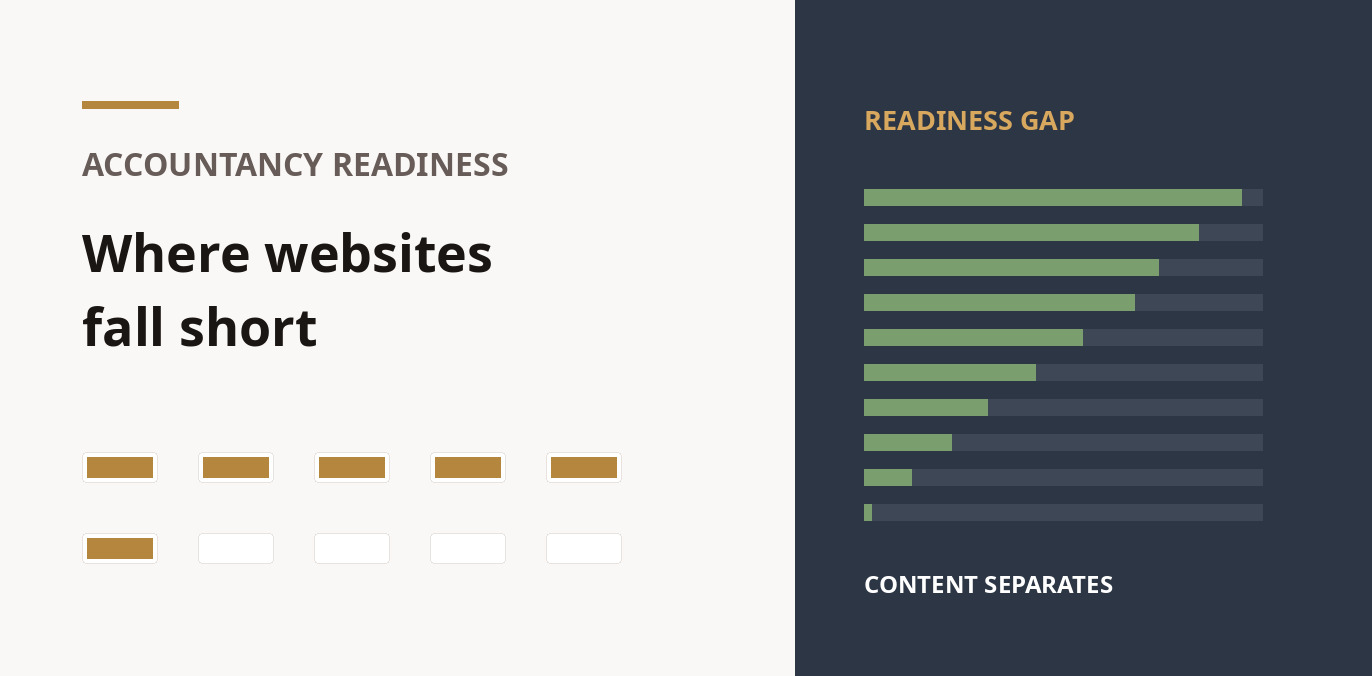
In our audit of 46 UK accountancy websites (all-row basis, n=46, one fetch-error site scored 0), almost none of the 17 Partially Ready firms were failing the technical basics: every one of them passed crawlability. What separated them from the 27 Ready sites was explanatory content, not infrastructure: 16 of the 17 had no FAQ content and 15 had no process explanation (all-row basis, n=46).
Short version
- All 17 Partially Ready accountancy sites in this audit passed crawlability (all-row basis, n=46). Crawlability separates nothing between the two groups.
- The signal with the widest gap between Ready and Partially Ready accountancy sites is heading structure, at 49.2 percentage points (all-row basis, n=46).
- 16 of the 17 Partially Ready sites had no llms.txt file (all-row basis, n=46).
- Only 6 of the 46 accountancy sites audited had both FAQ content and a process explanation; 21 of the 46 had neither.
- This is a descriptive audit of on-site structure. It does not test whether any site was cited, ranked or recommended by an AI system.
Why do accountancy websites stall just short of AI-ready?
Almost none of them are stalling on infrastructure. In our audit of 46 UK accountancy websites (all-row basis, n=46, one fetch-error site scored 0), every one of the 17 sites that scored Partially Ready passed crawlability, and 16 of those 17 had no FAQ content at all. The firms that fell short of Ready status did not fail because a search engine or an AI crawler could not reach their pages. They fell short because the pages that were reachable did not explain anything.
That is a specific, fixable gap, and it is also a different diagnosis from the one most AI-visibility advice reaches for. Much of the advice aimed at this gap assumes a technical problem: fix your schema, fix your crawl errors, fix your mobile rendering. For this group of 46 accountancy sites, that advice is mostly solved already. What is missing sits further up the page, in the content a prospective client actually reads.
How the 46 accountancy sites were audited
This accountancy subset is drawn from a larger first-party study: QBiz Leads AI audited 173 UK local service websites across four sectors and five cities against ten binary technical and content readiness signals (see the full AI Visibility Gap Report for the whole-study method and the sector league table). Each site scored 0 or 1 on each of the ten signals, summed to a total out of 10, then banded into three tiers: Not Ready (0 to 3), Partially Ready (4 to 6) and Ready (7 to 10).
The accountancy subset analysed here is 46 of those 173 sites: London 10, Manchester 10, Birmingham 10, Edinburgh 9 and Bristol 7. On the all-row basis, with the single fetch-error site scored 0, the tiers split 27 Ready, 17 Partially Ready, 1 Not Ready and 1 fetch error. That all-row basis reproduces the sector mean the wider report already publishes (6.85) exactly, which is the check that the accountancy filter and the scoring basis are both correct.

What this audit cannot tell you, and the reason it is worth stating plainly before the figures: this is a descriptive audit of on-site structure. It does not test whether any of the 46 sites was actually cited, ranked or recommended by ChatGPT, Google's AI Overviews, Perplexity or any other AI system. The separation between the Ready and Partially Ready sites below is a difference in what those sites publish, not proof that publishing it earns a recommendation.
Which signals the stalled practices actually failed
Of the 17 accountancy sites that scored Partially Ready (all-row basis, n=46 overall), the failures cluster hard at the content end of the scorecard and almost not at all at the technical end.
| Signal | Failed (of 17) | Share |
|---|---|---|
| llms.txt file | 16 | 94.1% |
| FAQ content | 16 | 94.1% |
| Process explanation | 15 | 88.2% |
| Heading structure | 9 | 52.9% |
| Service definitions | 7 | 41.2% |
| Schema markup | 7 | 41.2% |
| Internal linking | 3 | 17.6% |
| Mobile rendering | 2 | 11.8% |
| Entity consistency | 1 | 5.9% |
| Crawlability | 0 | 0.0% |
Failures among the 17 Partially Ready accountancy sites, all-row basis, n=46 overall.

Whether or not a practice has an llms.txt file is the single most common gap in this group, tied with FAQ content: both failed on 16 of the 17 stalled sites (94.1%). Crawlability, by contrast, failed on none of them.
What separates a Ready accountancy site from a stalled one
Heading structure separates Ready accountancy sites from Partially Ready ones more than any other signal: a 49.2 percentage-point gap between the two groups, 96.3% against 47.1% (all-row basis, n=46). Raw failure rate alone doesn't show this as clearly, because a signal nearly everyone fails tells you less than one that cleanly divides the two groups. The more useful cut is the gap between the pass rate among the 27 Ready sites and the pass rate among the 17 Partially Ready sites, for each of the ten signals. This separation table is this audit's own contribution: the wider Gap Report publishes the sector-level mean, but it has never broken the accountancy cohort down by signal before.
| Signal | Ready (n=27) | Partially Ready (n=17) | Gap |
|---|---|---|---|
| Heading structure | 96.3% | 47.1% | +49.2 pts |
| Process explanation | 55.6% | 11.8% | +43.8 pts |
| FAQ content | 44.4% | 5.9% | +38.6 pts |
| Service definitions | 96.3% | 58.8% | +37.5 pts |
| Schema markup | 88.9% | 58.8% | +30.1 pts |
| llms.txt file | 29.6% | 5.9% | +23.7 pts |
| Internal linking | 96.3% | 82.4% | +13.9 pts |
| Mobile rendering | 100.0% | 88.2% | +11.8 pts |
| Entity consistency | 100.0% | 94.1% | +5.9 pts |
| Crawlability | 100.0% | 100.0% | +0.0 pts |
Pass-rate gap between Ready and Partially Ready accountancy sites, all-row basis, n=46 (27 Ready, 17 Partially Ready).


Process explanation and FAQ content follow closest behind, at 43.8 and 38.6 percentage points (all-row basis, n=46). Crawlability sits at the opposite end: identical in both groups, so it discriminates nothing at all between a Ready accountancy site and a stalled one.
Why "we pass the technical checks" is the trap
Crawlability passed on every single one of the 17 Partially Ready accountancy sites (all-row basis, n=46), exactly as it passed on all 27 Ready sites. A practice can tick every technical box on a readiness checklist and still land in the stalled group, because the checklist that actually separates Ready from Partially Ready in this cohort is a content checklist, not a technical one.
This matches what Google itself says about the technical bar for appearing in its own AI features. Google's own documentation states plainly: "To be eligible to be shown as a supporting link in AI Overviews or AI Mode, a page must be indexed and eligible to be shown in Google Search with a snippet, fulfilling the Search technical requirements. There are no additional technical requirements." There is no extra technical hurdle specific to AI features beyond ordinary indexability, which is consistent with what this audit found: the technical floor was not where these 46 accountancy sites struggled (see how to make a site readable by answer engines for that floor).
The explanation gap: FAQ and process content
FAQ content and a process explanation appeared together on just 6 of the 46 accountancy sites audited (13.0%, all-row basis, n=46), and 21 (45.7%) carried neither.

That pairing is not a coincidence of scoring. A page that never answers a direct question in its own words, and never explains what the firm does once engaged, is a page built to be skimmed by a person already convinced, not one that answers the question a prospective client brings to it. The 21 sites with neither signal are failing in one place: nowhere on the site does a prospective client get a direct, plain-English answer to the question they came with.
What to fix first, in order
Ranked by the size of the gap between Ready and Partially Ready accountancy sites (all-row basis, n=46), not by how often each signal happens to be the one cause, the order that this data supports is:
- Heading structure (+49.2 points). One question per heading, answered in the first sentence beneath it.
- Process explanation (+43.8 points). A plain account of what happens after a client engages the practice, not just a list of services offered.
- FAQ content (+38.6 points). Real questions a prospective client would actually type, answered directly.
- Service definitions (+37.5 points). Each service named and explained in its own right, not folded into a single paragraph of offerings.
- Schema markup (+30.1 points). Structured data identifying the practice, its services and its location. For context on where this sits: schema.org's own usage figures put the
AccountingServicetype at 10,000 to 100,000 domains, the same band asLegalService,DentistandPlumber, and one band below the genericProfessionalServicetype at 100,000 to 1,000,000 domains (Google, August 2026). - llms.txt file (+23.7 points). The lowest-cost item on this list, and the most contested: see llms.txt explained for the evidence on either side.
- Internal linking (+13.9 points), mobile rendering (+11.8 points) and entity consistency (+5.9 points) all show a real but much smaller gap, and are worth a routine check rather than a priority project.
- Crawlability shows no gap at all (+0.0 points) in this cohort. If a site already passes it, as almost all 46 do, there is no separation left to close there.
This is a priority order drawn from where Ready and stalled accountancy sites actually diverge, not a claim about what any AI system is looking for. For the practical workflow covering credentials, software-partner directories and buyer-facing service pages once these signals are in place, see the companion guide to AEO for accountants and bookkeepers.
How a practice checks its own ten signals
Each of the ten signals behind this audit can be checked by a practice itself, without specialist tools, by looking at the site the way a reader (or a crawler) actually encounters it.
- Crawlability. View the page's source (not just the rendered page) and confirm the main content is present in the raw HTML, not injected afterwards.
- Entity consistency. Compare the firm's name, address and any stated credentials across the website, Google Business Profile and any professional register. They should read identically everywhere, not just similarly.
- Mobile rendering. Open the site on a phone and check nothing is cut off, overlapping or missing compared with the desktop version.
- Internal linking. Check that service pages, the credentials page and any guides actually link to one another, rather than sitting as isolated pages reachable only from the main menu.
- Service definitions. Confirm each service the practice offers has its own clearly labelled section or page, not a single paragraph listing everything together.
- Schema markup. View the page source and search for structured data identifying the business type, services and location.
- Heading structure. Read down the page using only the headings. Each one should pose a real question and the text immediately beneath it should answer that question directly.
- Process explanation. Check whether the site explains, in plain terms, what actually happens once a client engages the practice.
- FAQ content. Check whether real, specific questions are answered directly on the site, rather than only generic ones.
- llms.txt file. Check whether
/llms.txtexists at the site's root.
Membership of a chartered body is one of the strongest facts a practice can state here, because it is independently checkable rather than self-asserted; see the guide to AI visibility for ICAEW registered accountants for exactly how that credential should be worded and linked. For a practice that wants this audited and fixed rather than self-checked, that is the specific service QBiz offers for AI visibility for accountants.
Across these 46 accountancy sites, the checks covering whether a page can be fetched, rendered and resolved to a consistent business identity came back almost full. The shortfall sat in what the pages explained: FAQ content, process explanation, and the heading structure that frames both. That is where the Ready sites in this audit differed from the stalled ones, and the order set out above follows the size of that difference.
FAQ
What counts as "Partially Ready" in this audit of accountancy websites?
A total score of 4 to 6 out of 10, against Not Ready at 0 to 3 and Ready at 7 to 10. Of the 46 accountancy sites audited, 17 landed in that band.
Does having schema markup guarantee an accountancy site is AI-ready?
No. Among the 17 Partially Ready accountancy sites in this audit (all-row basis, n=46 overall), 10 already had schema markup in place (58.8%), which left 7 (41.2%) without it. Having it did not move these sites into the Ready tier on its own.
Is an llms.txt file necessary for an accountancy practice to be AI-ready?
Not clearly. Only 9 of the 46 accountancy sites audited (19.6%, all-row basis) had an llms.txt file at all: 29.6% of Ready sites did, against 5.9% of Partially Ready sites. Whether the file itself changes anything is contested; see the llms.txt explainer on this site for the independent research on that question.
Which cities were included in the audit, and how many accountancy sites per city?
London (10), Manchester (10), Birmingham (10), Edinburgh (9) and Bristol (7), for 46 accountancy sites in total.
Is this the same data as QBiz's wider AI Visibility Gap Report?
Yes. The 46 accountancy sites here are the accountancy subset of the 173-site study published in QBiz's AI Visibility Gap Report. The all-row accountancy mean in this subset (6.85) is identical to the sector figure that report already publishes.
Where can I see the full methodology and raw data behind this audit?
The full method, the whole 173-site sample and the sector-by-sector results are in QBiz's AI Visibility Gap Report. The underlying data is published on Zenodo under DOI 10.5281/zenodo.21182318.
Sources
- Eastwood, E., AI Visibility Gap Report 2026, QBiz Leads AI, Zenodo, 14 June 2026, Version 2.0. DOI: 10.5281/zenodo.21182318. Accountancy subset (n=46) computed from the published supplementary data, all-row basis.
- Schema.org,
AccountingServicetype usage data, attributed to Google, August 2026. - Google Search Central, AI features on Search: appearance requirements.