AI Search Visibility for Dental Practices: Why It Matters and How to Start
AI search visibility is whether your practice is named when a patient asks ChatGPT, Gemini, Perplexity or Google's AI Overviews for a dentist. It matters now because a large share of patients form their shortlist inside an AI answer that names only one or two practices, and neither a strong Google ranking nor a wall of reviews puts you there on its own. To start, do three things: claim and complete your Google Business Profile, confirm your site is indexed and readable in Bing as well as Google, and make your name, address, phone and hours agree everywhere the web mentions you. Those foundations decide most of it.
AI search visibility is whether your dental practice gets named in the answers ChatGPT, Google's Gemini, Perplexity and Google's AI Overviews produce when someone asks for a dentist. It matters because most people now reach for an AI tool to find things out, and an AI answer names only one or two practices rather than a page of ten. If you are one of the names, the enquiry is yours. If you are not, you never learn the enquiry happened, because the patient acted on a reply that did not mention you.
This guide is written for the practice owner who has heard the phrase and wants two things settled: why this is worth your attention now rather than later, and what to actually do first. Every section below is a question owners put to us, answered in full and on its own, so you can read the one that fits your week and act on it. It is written for UK practices, and it stays inside General Dental Council rules throughout.
If you want our two companion pieces, how dentists get recommended by ChatGPT covers earning the recommendation from a standing start, and why your practice is not showing up in ChatGPT diagnoses the most common reasons for absence. This article is the one to start with: it explains the stakes and the first moves.
The short version
- Named, not ranked. An AI answer names one or two dentists and explains why; the goal is being in that answer, not somewhere on a list a patient could scroll to.
- The behaviour has already moved. Around 60% of US adults use AI to find information, and about a third of patients now trust AI results as much as Google, so a growing share of shortlists form inside an AI reply.
- Google rank and reviews are not enough alone. ChatGPT reads Bing's index, not Google's rankings, and reviews only count once the engine can read your site and trust your facts.
- Five inputs decide it. Whether the engine can find and read your site, whether your services are legible, whether your details agree everywhere, whether your reviews are recent and spread, and whether independent sources corroborate you.
- Being early is the edge. While your town's answers are still being decided, the practice that fixes the foundations first collects the bookings a competitor never sees coming.
What is AI search visibility, and why should a dental practice care about it now?
AI search visibility means appearing inside the answer an AI tool gives, not merely ranking somewhere a person could scroll to find you. A traditional search returns a list, and the patient does the choosing by scanning it. An AI search returns a decision already mostly made: a short, written answer that names a few practices and explains why. Visibility in the old sense was about being on the list. Visibility in this sense is about being in the answer.
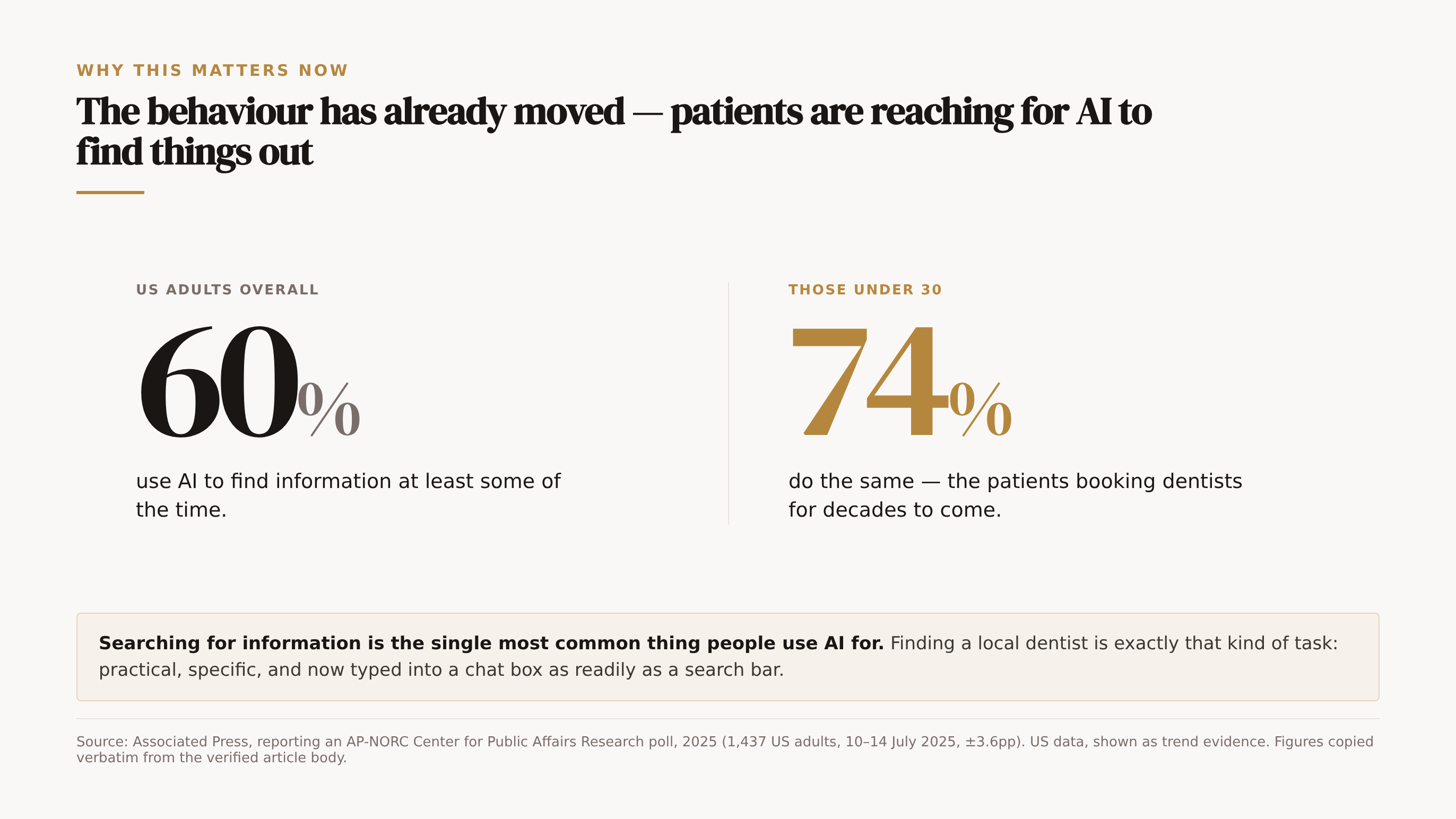
The reason to care now, rather than treating it as next year's problem, is that the behaviour has already moved. An Associated Press report on an AP-NORC poll in 2025 found that 60% of US adults, and 74% of those under 30, use AI to find information at least some of the time, and that searching for information is the single most common thing people use AI for (Associated Press, reporting AP-NORC, 2025)[1]. Finding a local dentist is exactly that kind of task: practical, specific, and the sort of question people now type into a chat box as readily as into a search bar.
The shift is visible inside ordinary Google searches too, not only in dedicated AI tools. For a large slice of routine Google searches, the page now opens with an AI-written summary at the very top. When a patient searches "dentist near me", that summary has climbed into the slot the map pack used to hold. So the question is no longer whether patients meet an AI answer on the way to choosing a dentist. They do. The question is whether your practice is named when they get there.
That is why "later" is the expensive option. The practices being named today are quietly collecting the patients who would once have found you through a tidy website and a decent Google position. Neither of those, on its own, puts you in the AI answer any more, and the longer a competitor is the established name in your town's answers, the harder the ground is to take back.
Are patients really choosing a dentist this way, or is this overblown?
It is a fair challenge, because plenty of "the future is here" marketing is overblown. The straight answer is that the trend is real and measurable, and that healthcare is one of the areas it has reached fastest, but that it has not replaced every other route to a dentist and nobody should claim it has.
Start with trust, because using a tool and trusting it for a health decision are different things. A 2025 report from rater8, a healthcare reputation firm, found that about one-third of patients now trust AI-generated search results as much as they trust Google, nearly one in five trust AI results more than Google, and only 11% are outright sceptical of them; the same report found that 25% of patients began using voice assistants to research providers in 2025 (rater8, 2025)[2].
Read those together and the picture is not a fringe of early adopters. It is a large share of ordinary patients treating an AI answer about a provider as at least as credible as the search results they have relied on for years.
Broader health data points the same way. A KFF Tracking Poll in 2025 found that about a third (32%) of US adults have turned to AI for health information or advice, including 29% who used it for their physical health specifically (KFF, 2025)[3]. KFF is a non-partisan health research body rather than a firm selling visibility services, which is precisely why the figure carries weight where a vendor survey would not.
Patient behaviour
The search habit has already shifted
60%
of US adults use AI to find information at least some of the time.
32%
of US adults have turned to AI for health information or advice.
11%
of patients in the rater8 report are outright sceptical of AI results.
Associated Press/AP-NORC, 2025; KFF, 2025; rater8, 2025.
Two important caveats keep this in proportion. First, the headline figures above are US data; UK adoption is following the same direction, but a careful owner should treat the exact percentages as the trend rather than as a local measurement. Second, none of this means the phone-book habits are gone. Plenty of patients still ask a friend, scroll Google, or walk past your sign.
The point is not that AI has won. It is that a real and growing share of patients now form their shortlist inside an AI answer, and a practice that is invisible there is invisible to all of them. For more on what those patients are actually typing and how a model turns it into a shortlist, our recommended-by-ChatGPT guide goes deeper.
Why doesn't my Google ranking, or my 400 reviews, get me into AI answers?
Because an AI answer is not built the way a Google results page is, and the things that win the old game are only part of the new one. Two assumptions trip owners up here, and both feel reasonable until you see how these tools work.
The first is that a strong Google ranking carries over. It largely does not. When a tool like ChatGPT searches the live web to answer a local question, it does not read Google's rankings; its retrieval has long run primarily through Microsoft's Bing index. You might rank number one on Google for "dentist in Reading" and yet be entirely missing from ChatGPT's answer, simply because each system reads its own separate map of the web. Your Google work still matters for the patients who use Google directly, and good local SEO genuinely helps your overall presence, but it does not quietly deliver you into the AI reply.
The second assumption is that a wall of good reviews is enough on its own. Reviews are one of the strongest signals an engine has, but they are a signal, not a passport. An AI answer about a dentist is assembled from several sources that the engine then weighs for agreement: your Google Business Profile, review platforms, healthcare and local directories, the NHS "find a dentist" service, and local press.
Four hundred five-star reviews on Google cannot rescue a practice whose website is not in the index the AI reads, or whose phone number and opening hours disagree across three directories. The engine reaches for the practice it can verify cleanly from several directions, and an unsure engine reaches elsewhere.
The useful way to hold this is that search optimisation and answer optimisation have become two related jobs rather than one. Being found by a person scanning a list and being named inside an AI answer are different outcomes with overlapping but distinct inputs. If that framing is new, our AEO guide for dentists and clinics lays out the full difference; the short version is that you now have to earn a place in the answer, not just a place on the page.
Side by side
Ranking in a list is not the same as being named in an answer
| Traditional search visibility | AI search visibility | |
|---|---|---|
| What the patient sees | A list of links, maps, profiles and pages to scan. | A short answer that names a few practices and explains why. |
| What wins the click | Position, title, reviews and whether the patient keeps scrolling. | Whether the engine can verify the practice from several trusted sources. |
| What can break visibility | A weak page, poor local SEO or an incomplete profile. | Missing indexation, unreadable pages, stale reviews or facts that disagree. |
How do AI engines decide which dental practice to name?
Behind every reply is the same unseen routine: it interprets what the patient really meant, assembles the sources it trusts, checks them for agreement, and puts forward whichever practice it is most sure of. You cannot see the sequence, but you can influence every input to it. The practice it settles on is decided by five questions, and whether it is yours depends on your answers to them.
How the answer forms
The hidden sequence behind a named recommendation
Interpret intent
The engine turns a patient's phrase into the real need behind it.
Gather sources
It reads the site, profiles, listings, directories, reviews and local proof.
Check agreement
It looks for the same name, address, hours and service claims in each place.
Name the safest practice
The practice it can verify most cleanly is the one it is most likely to recommend.
Can the AI find and read your website at all?
If your pages are not in the search index the AI reads from, or the AI's crawler cannot read your text once it arrives, nothing else on this list matters, because you are not in the running. More practices are missing for this reason than any other, and it slips past owners precisely because the site looks perfectly ordinary when they open it themselves.
Two faults cause most of it. The first fault is indexing: pages missing from the index cannot be quoted by a retrieval-based tool. You can check this in under a minute by searching site:yourpractice.co.uk in Bing as well as Google; if few or none of your pages come back, that is your headline problem.
Rendering is the second fault: on certain practice sites, especially design-heavy builds and a few page builders, none of the text appears until JavaScript executes in an open browser. Because several AI crawlers skip that code, they reach the page, meet a near-empty shell, and leave. A page that reads beautifully to a visitor can read as blank to a machine.
Does your site say what you do in terms a machine can read?
Practices earn the engine's confidence through clarity, and it names the ones it can describe with confidence. Think of structured data (schema markup) as a machine-readable label that spells out, in terms no system can misread, that you run a dental practice, where it is, what it offers, when it opens and how patients rate it. For a dental practice the schema types that matter are Dentist (or LocalBusiness), FAQPage covering the questions patients ask most, and AggregateRating wherever you show real review scores.
Rather than asserting anything itself, schema just puts your real facts into a form a machine can read. "We offer emergency appointments, NHS check-ups and Invisalign in Leeds" already reads plainly to a person, and adding schema clears away any remaining doubt for the engine weighing whether to surface you to a patient after exactly those things.
Is your information identical everywhere the engine looks?
When your practice name, address, phone number, opening hours and service list disagree across the web, the engine cannot tell which version is true, and it tends to settle on a practice whose facts it trusts instead. That reconciliation is dull admin, and it quietly settles a surprising amount. A stray old phone number on one directory, hours from last year on the next, a name you used to trade under still live on a third: every one of them gives the engine grounds to doubt you. One fact, written the same way in every place, takes that doubt away.
Are your reviews recent, specific, and spread across more than one platform?
Reviews pull hard, and their recency and spread do more of the work than owners tend to realise. Where the newest five-star review is eighteen months old and every one sits on a single platform, patients and engines both read a practice that may have gone quiet. Building up genuine, recent reviews at a steady pace, Google first and then NHS and healthcare-specific platforms, and replying to every one, is one of the highest-impact moves open to you.
Write back to everyone who leaves a review, positive or negative, while keeping any patient's clinical details well away from a public reply: acknowledge them, speak to the general point, and settle specifics off the platform. Keeping to that one rule guards confidentiality and reads well to people and machines both.
Do independent, trusted sources confirm you exist?
A single website praising itself is the weakest possible signal. Corroboration is what AI answers run on: the more separate, trustworthy places back up your practice, its whereabouts and its services, the surer the engine feels about naming you. Weight, for a UK practice, sits with your Google Business Profile, the NHS "find a dentist" service that engines and patients alike treat as high-trust, solid healthcare and local directories, any real professional or accreditation listings you hold, and coverage in local press or community pages.
Each one has to be present, correct, and consistent with the rest. This is why the same few well-listed practices monopolise the answers in many towns: they are simply the ones the engine can verify from several directions at once.
How do I start? A realistic first-week plan
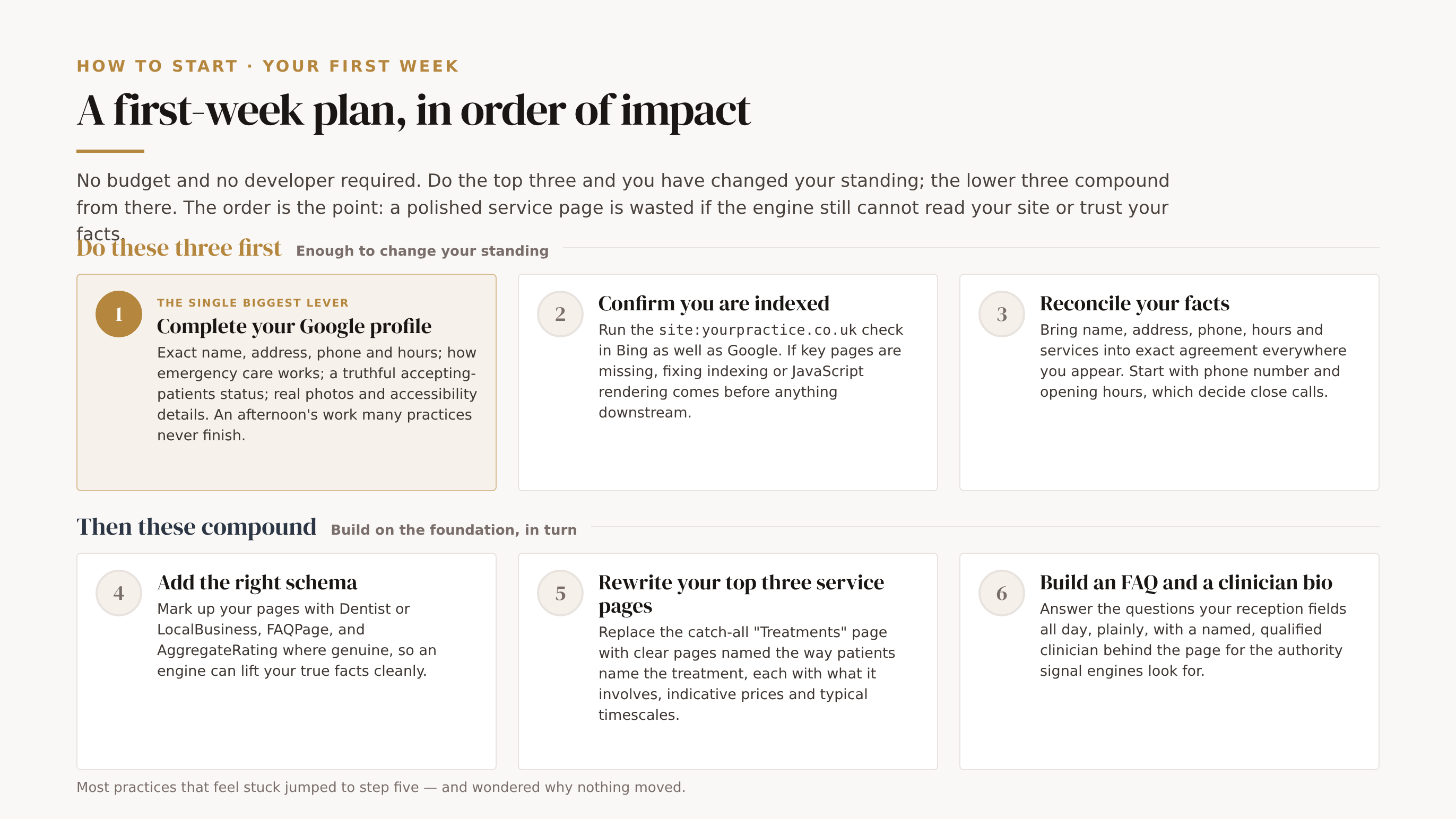
You do not need a budget or a developer to begin, and you should not try to do everything at once. The sequence below is ordered so that the cheapest, highest-impact work comes first and each step stands on its own. Doing the first three is enough to change your standing; the rest compound from there.
First week
Fix the foundations before polishing the pages
-
Complete the Google Business ProfileExact name, address, phone, hours, services, photos and accepting-patients status.
-
Check indexation in Bing and GoogleIf key pages are missing, fix that before spending time on finer work.
-
Make the facts agree everywherePhone number and opening hours decide close calls.
-
Add schema for real factsDentist, LocalBusiness, FAQPage and AggregateRating only where they match the page.
-
Turn service pages into patient questionsClear treatment pages and front-desk FAQs give the answer engine something to quote.
- Claim your Google Business Profile and fill in every field. List the exact name, address, phone and website; full opening hours and how emergency care runs; every service you genuinely provide, in plain words; a truthful, up-to-date "accepting new patients" status; real photos; and access details such as step-free entry and parking. Nothing else on this list does as much for your standing, and it is exactly the step a surprising number of practices leave sitting half-finished. It is an afternoon's work that pays off across both ordinary search and AI answers.
- Confirm you are indexed and readable. Run the
site:yourpractice.co.ukcheck in Bing and Google. If your key service pages are missing, fixing indexing or JavaScript rendering is your first technical job, because nothing downstream helps until the engine can read you. - Reconcile your facts across the web. List everywhere your practice appears (your site, Google profile, NHS listing, directories) and bring the name, address, phone, hours and services into exact agreement. Correct the contradictions, starting with phone number and opening hours, which decide close calls.
- Add the right schema. Mark up your pages with
Dentist/LocalBusiness,FAQPageandAggregateRatingwhere genuine, so your true facts are easy for an engine to lift. - Rewrite your top three service pages as patient questions. Replace the single catch-all "Treatments" page with clear pages named the way patients name the treatment, each describing what it involves, indicative price ranges and typical timescales, and naming clinicians where appropriate.
- Build an FAQ from real front-desk questions, and add a credentialed clinician bio. The questions your reception is asked all day are the questions patients type into AI tools; answering them plainly, with a named, qualified clinician behind the page, gives the engine both the answer and the authority signal it looks for.
- Build genuine brand mentions through relationships with other site owners. Engines grow more confident about a practice the more independent, reputable websites talk about it, so treat this as relationship work rather than link buying. Reach out to local news editors, community and charity sites you already support, dental suppliers, referral partners and health bloggers in your area, and earn a real mention or a guest piece that names your practice and where you are. A handful of trusted sites referring to you by name does more for how an engine describes you than any amount of self-promotion on your own pages.
Work them in that order and you fix the foundations before the finishing. Most practices that feel stuck have jumped to step five, polished a service page, and wondered why nothing moved, because the engine still could not read the site or trust the facts around it. If you want the same list framed as a triage of what is going wrong, our not-showing-up guide sets it out as a diagnosis.
How do I check whether AI already mentions my practice?
You can run this self-test today, for nothing, in about fifteen minutes, and it is the sensible starting point before any spend. Run the searches your patients run, one engine at a time across ChatGPT, Google's AI Mode and Perplexity, trying phrases like a nervous patient's "dentist for nervous patients in [town]", an urgent "emergency dentist in [your area] today", "NHS dentist near me taking on patients" and the broad "best dentist in [your town]". Look at three things in each reply: whether your practice is named at all, whereabouts in the answer it lands, and which sources the reply draws on.
The reply changes from one attempt to the next, so repeat each prompt several times and let the recurring pattern, not any single answer, tell you where you genuinely stand. A practice missing from every answer has a foundational problem underneath: indexing, consistency, or content too thin to quote. Named only alongside a particular competitor is a prompt to study what they hold that you do not, because the distance between their online presence and yours is your worklist: fresher reviews, a live NHS listing, clearer fee and service pages, facts that agree across the web.
Finish with the index check (site:yourpractice.co.uk in Bing), because no results there explains a great deal of absence in ChatGPT and is the first thing to put right. That self-test is deliberately the same first step a paid audit takes; doing it yourself first means you start any further work already knowing where you leak.
How long does it take to see results, and is it worth it?
No timetable is fixed, and any straight reckoning has to grant that AI replies are volatile by nature, moving from one week to the next even for practices that do everything right. What holds steady is the direction of travel, not a calendar date. Completing your Google profile and starting to gather recent reviews can move things within a few weeks. Building out directory presence, reconciling facts across the web, and earning enough corroboration to be named with confidence takes longer, often a few months of steady work. There is no shortcut that survives contact with how these engines verify a practice, and anyone selling one is selling the fluctuation, not the fix.
Sort what you can change from what you cannot, and work on the first list. The readability of your site, the agreement of your facts, the usefulness of your pages, and the genuineness and freshness of your reviews are all yours to set. The precise words of any one reply on any one day are outside your control. Keep your eye on the lasting groundwork and treat the day-to-day swing as weather.
As for whether the effort pays, set it against what absence costs you. When an AI summary sits at the top of the results, far fewer people scroll to the old links at all; the patient increasingly acts on the answer itself. A practice named in that answer is collecting bookings its competitors never see coming. A practice that is absent loses them with no missed-call log to show for it. The effort is real, but so is the cost of staying out of it, and being early is itself an advantage while your town's answers are still being decided.
Frequently asked questions
What does AI search visibility mean for a dentist?
It means being named inside the written answer an AI tool gives when a patient asks for a dentist, rather than just ranking somewhere in a list of links. When someone asks ChatGPT, Gemini, Perplexity or Google's AI Overviews for a dentist in your area, the reply names a few practices and explains why. AI search visibility is whether yours is one of them. It depends on the engine being able to find your site, read your services, verify your facts across the web, and trust your reviews.
Is AI search visibility the same as SEO?
No, though they overlap and good SEO helps. Conventional SEO is the game of getting your own pages to rank in a list of links, chiefly on Google. AI search visibility is about being named or cited inside an AI answer, which draws on your reviews, your NHS and directory listings and your consistent facts as much as on your website, and which often reads Microsoft's Bing index rather than Google's. A first-place Google ranking does not guarantee an AI mention, so the two are now best treated as related but separate jobs.
Do good Google reviews make me visible in ChatGPT?
They help, but they do not do it alone. Reviews are one of several signals an AI answer is built from, and they only count once the engine can actually read your site and trust the facts around it. If your pages are not indexed, or your details contradict each other across directories, even hundreds of strong reviews may not get you named. Reviews also lose weight as they age, so a steady stream of recent ones counts for more than a large but stale collection. Fix the foundations first, and your reviews start working far harder.
Which AI platforms should a UK dental practice care about?
The ones patients actually use to find a dentist: ChatGPT, Google's AI Overviews and AI Mode, Perplexity, and Gemini. You do not optimise for each separately. The same underlying work (a readable, indexed site, consistent facts, clear service pages, genuine recent reviews and trusted directory and NHS listings) is what makes you nameable across all of them, because they draw on overlapping sources. Start by checking how you appear in ChatGPT, Google's AI Mode and Perplexity, since those are the easiest to test yourself.
How do I check whether AI already recommends my practice?
Ask the engines the questions your patients ask. Open ChatGPT, Google's AI Mode and Perplexity and try "best dentist in [your town]", "NHS dentist near me taking on patients" and "emergency dentist in [your area] today". Note whether you are named, where you appear, and which sources the answer leans on, and run each prompt a few times because the replies vary. Then search site:yourpractice.co.uk in Bing to confirm you are indexed. Fifteen minutes of this tells you where you stand before you spend anything.
Why should I act on this now rather than wait?
Because the practices being named today are quietly collecting the patients who would once have found you, and the longer a competitor is the established name in your town's answers, the harder that ground is to take back. An AI reply names only a couple of practices, so there is far less room than on a page of ten links. Fixing your foundations while your area's answers are still unsettled is cheaper and faster than trying to displace an entrenched name later.
Do I need a developer or a big budget to start?
No. The highest-impact first moves cost nothing but time: claiming and completing your Google Business Profile, checking your pages are indexed in Bing as well as Google, and reconciling your name, address, phone number and hours so they agree everywhere. A developer only becomes useful later, if an indexing or JavaScript-rendering fault is stopping crawlers reading your site. Most practices that feel stuck have skipped the free foundations and jumped straight to polishing a page.
What is the single most important first step?
Claiming and fully completing your Google Business Profile, with an accurate, current accepting-patients status. It is the biggest single lever, it feeds both ordinary search and AI answers, and many practices never fully pull it. It is roughly an afternoon's work and it costs nothing, which is why it belongs at the top of the list.
Is this a US trend, or is it happening in the UK too?
The headline figures (around 60% of US adults using AI to find information, and about a third of patients trusting AI results as much as Google) are US data, so a careful owner should read them as the direction of travel rather than a UK measurement. UK adoption is following the same path. The mechanics that decide visibility (a readable, indexed site, consistent facts, genuine reviews, and trusted NHS and directory listings) are identical either side of the Atlantic.
If AI answers keep changing, is it worth optimising for?
Yes, provided you hold the lasting groundwork as the goal and read the daily wording as weather. Answers are volatile and shift from week to week even for practices doing everything right, so no single reply is the scoreboard. What you control (a readable site, facts that agree, pages that answer real questions, and recent genuine reviews) steadily raises how often and how confidently you are named. FAQ pages and question-style headings are worth adding for the reader, but they are not a citation lever in their own right; the foundations are.
Where to start
If you do only three things from all of this, take them in this order: claim and complete your Google Business Profile with an accurate, current accepting-patients status; confirm your pages are indexed and readable in Bing as well as Google; and reconcile your business details so they agree everywhere a patient or an engine might look. Clear those three and you have removed the usual reasons a practice never appears in AI answers.
If you would rather have this checked for you first, a free QBiz Leads AI visibility check scans your website in about thirty seconds and returns a clear pass or fail on the key signals that decide whether AI tools can find and recommend your practice, with a prioritised list of what to fix first. It is the no-cost first step before any spend.
To earn the recommendation from a standing start, read how dentists get recommended by ChatGPT, and for a diagnosis of why a practice stays absent, see why your dental practice is not showing up in ChatGPT. QBiz turns this into a done-for-you service on our AI SEO for dentists page, one part of the broader AI optimization services we run.
Get your AI Visibility audit →
Sources
- [1] Associated Press, "How US adults are using AI, according to AP-NORC polling," 2025: https://www.ap.org/news-highlights/spotlights/2025/how-us-adults-are-using-ai-according-to-ap-norc-polling/ (independent; 60% of US adults and 74% of under-30s use AI to find information at least some of the time, and searching for information is the single most common use of AI)
- [2] rater8, "The Next Evolution of Patient Choice: 2025 Report," 2025: https://rater8.com/the-next-evolution-of-patient-choice-2025-report/ (about one-third of patients trust AI search results as much as Google, nearly one in five trust AI results more, only 11% are sceptical, and 25% began using voice assistants to research providers in 2025)
- [3] KFF, "KFF Tracking Poll on Health Information and Trust: Use of AI for Health Information and Advice," 2025: https://www.kff.org/public-opinion/kff-tracking-poll-on-health-information-and-trust-use-of-ai-for-health-information-and-advice/ (independent; 32% of US adults have turned to AI for health information or advice, 29% for their physical health specifically)
Leave a comment
Thoughts on this post? Leave a comment below. Comments are moderated before they appear, so yours will not show on the page straight away.
Your email is used only to contact you about your comment if needed — it is never published.
Comments
No comments yet. Be the first to leave one above.