Perplexity vs Google for Brand Citation & Referral Traffic
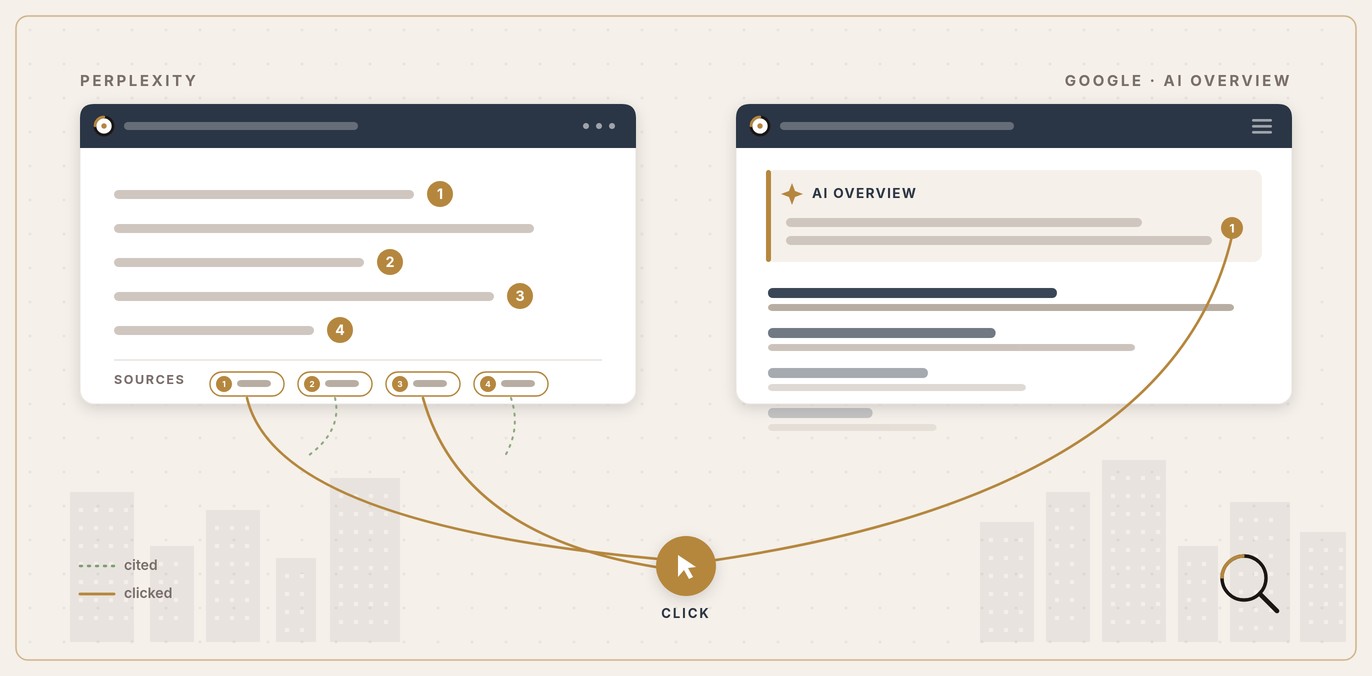
For brand visibility, Perplexity and Google reward different things, and a citation is not the same as a referral or a sale. Perplexity names sources inline and links them, so a clear, crawlable page can be cited within days and the click, when it happens, is high intent. Google increasingly answers above the links with an AI Overview that cites a few sources and keeps most of the click on its own page. The number everyone repeats, that AI traffic converts about five times better, comes from a single 312-brand IT study, and in that same study Perplexity on its own converted lowest of the AI engines at 10.5%.
Treat citation, referral traffic and conversion as three separate scores, and check which one an engine is actually giving you.
Three things get folded into one sentence whenever someone compares Perplexity and Google: a brand citation, a referral click, and a conversion. They are not the same event, they do not move together, and the space between them is where most of the confusion on this topic lives. A page can be cited constantly and send almost no traffic. Traffic can arrive and convert at a rate that either flatters or misleads, depending on whose sample you are reading.
Perplexity handled about 780 million queries in May 2025 and was growing around 20% month over month, per its CEO at Bloomberg Tech[5], so it is worth understanding on its own terms rather than as a smaller Google. This guide separates the three scores, then traces the numbers that get repeated about them back to where they actually came from. Where a figure holds up, it is quoted with its source and its limits. Where it has been misread on the way across a dozen blogs, that is spelled out plainly.
Citation, referral traffic and conversion are three different things
A brand citation is your business being named as a source in an answer. Referral traffic is a person clicking that citation through to your site. Conversion is that person becoming a customer. Each step loses volume, and each engine leaks at a different point, so a strong score on one tells you little about the next.
Where each engine leaks: Perplexity links most citations, so more of them can become clicks. ChatGPT often names a business with no link at all, so a citation there is brand recall with no referral. Google cites a few sources inside an AI Overview but keeps most of the click on its own results page.
This matters because the two engines break the chain in opposite places. Perplexity is built around the citation: it lists numbered sources for almost every answer and links each one, so a citation there stands a real chance of becoming a click. Google's AI Overview cites sources too, but it sits at the top of a results page whose job is to keep you on Google, so many of its citations are read without a click. The same word, citation, describes two very different odds of a visit.
In brief
- Citation, referral and conversion are separate scores. A business can be cited often and clicked rarely. Judge each engine on the score you actually need, not on citation volume alone.
- The famous 5x is one study. Opollo tracked 312 IT brands and found AI traffic converted at 14.2% blended against 2.8% for Google organic.[1] It is one IT portfolio with a self-selection caveat, not a universal law.
- 14.2% is not Perplexity's rate. In that same study Perplexity alone converted at 10.5%, the lowest of the three AI engines, below Claude and ChatGPT.[1]
- More citations did not mean more traffic. For one client, Perplexity produced more citations than ChatGPT (8,047 vs 5,195) yet sent only 17% of the client's AI referral traffic against ChatGPT's 73%.[2]
- Cited is not the same as correct. A Columbia Journalism Review test found Perplexity misidentified the source article in 37% of 1,600 news-citation queries.[3]
- Google's AI Overviews cost clicks. Organic click-through on informational queries fell 61% where an AI Overview appeared, though being cited in it earns 35% more clicks.[4]
Perplexity vs Google at a glance
Before the numbers, here is how the two engines differ on the mechanics that decide whether you are cited, clicked, and measured. The rows are the four things that most change your result.
At a glance
Perplexity versus Google with AI Overviews
| Perplexity | Google (with AI Overviews) | |
|---|---|---|
| Citation mechanics | Names numbered sources inline for almost every answer and links each one; citation is central to the product | Cites a handful of sources inside the AI Overview above the blue links; the overview also keeps much of the click |
| Traffic quality | Fewer visits, but higher intent, since the reader has seen you named against alternatives before clicking | Far larger reach, but the click a top ranking earns is being absorbed by the overview above it |
| Freshness | Retrieves the live web at query time, so a clear new page can be cited within days | Depends on indexing and ranking; the overview draws on pages already ranking well |
| What it rewards | Crawlable, plainly worded pages that match the customer's question literally | Established SEO strength, schema, and being one of the sources the overview trusts to answer |
The split behind the table is simple: Perplexity is a search engine with a language model on top, so it stays close to your words and to the live web. Google is a link index that has bolted an answer layer over the top, so it can quote you and still keep the reader. For the deeper mechanics of how each engine discovers a page in the first place, our guide on how ChatGPT and Perplexity find your content covers the crawler side.
Where the 5x, 14.2% and 2.8% numbers really come from
Nearly every commercial page on this topic repeats some version of "AI traffic converts about 5x better than Google", usually as 14.2% against 2.8%. All of it traces to one place: a single study by the agency Opollo. The number is real, and it is worth knowing exactly what it measured, because the way it gets repeated is wrong in two specific ways.
The real numbers
Where the conversion figures actually come from
14.2%
is the blended AI-referred conversion average, not Perplexity alone
10.5%
Perplexity's own rate, the lowest of the AI engines in the same study
2.8%
Google organic conversion, across 312 IT and technology brands
Opollo, ai-search-traffic-converts study, Q3 2024 to Q1 2025
Opollo tracked UTM-attributed conversions across 312 IT and technology brands in its client portfolio, from Q3 2024 to Q1 2025. It found AI-referred traffic converted at 14.2% on average against 2.8% for Google organic, which is the roughly five-times gap that gets quoted.[1] So far the number holds up. The trouble starts when "14.2%" gets pinned to Perplexity specifically.
Both corrections come straight from Opollo's own write-up. Broken out by engine, Claude led at 16.8%, ChatGPT followed at 15.9%, and Perplexity came in at 10.5%.[1] The blended 14.2% sits above Perplexity because two higher engines pull the average up. A page that hands you "Perplexity: 14.2%" has quietly swapped a three-engine average for a single-engine claim.
None of this means AI traffic is not valuable. A separate Semrush study across more than 500 marketing topics found the average AI-search visitor worth 4.4x a traditional organic visitor by conversion value[6], which is a different method reaching a similar direction. But it too is an AI-blended figure, not a Perplexity one. The safe reading across both studies: AI referrals tend to convert well because they arrive later in the buying journey, and the exact multiple depends heavily on whose sample you read.
More citations did not mean more traffic
The single most useful counter-fact on this topic comes from an agency that tracked citations and clicks side by side. Flow Agency reported that for one client, over the same prompts and time frame, Perplexity shared 8,047 sources while ChatGPT shared 5,195. Perplexity cited more. Yet when they looked at the referral traffic those citations actually produced, 73% of the client's AI traffic came from ChatGPT and only 17% from Perplexity.[2] They describe seeing a similar 70 to 75% ChatGPT versus 12 to 17% Perplexity split across many clients.
Cited more, clicked less: one client's inverted result
Flow Agency, a single client, same prompts and time frame. The two measures cross over.
One agency, one client. Perplexity cited more sources (8,047 vs 5,195) yet drove only 17% of this client's AI referral traffic, against ChatGPT's 73%. Flow Agency reports a similar 70 to 75% ChatGPT versus 12 to 17% Perplexity split across many of its clients, but this is agency client data, not a universal law: it shows that on one account the citation count and the click share pointed in opposite directions.
It is one agency's client data, so it is a strong signal rather than a population law. But it lands the point the whole article turns on: being cited more did not mean being clicked more. Perplexity's citations are numbered and visible, which makes them feel like traffic, while many are read inside an answer that fully satisfies the question, so the reader never clicks. Counting citations as if they were visits is how a business ends up sure Perplexity is driving results it cannot find in its analytics.
If your goal is to be named and remembered, citation volume is a fair measure. If your goal is visits and enquiries, you have to look past the citation count to what actually clicked through. Our guide to getting cited by Perplexity covers the earning side; this piece is about reading the result clearly once you are cited.
A citation is not a fact-check
There is a second reason to be careful with Perplexity citations: being cited does not mean the answer around your name is correct. A visible source makes an answer look verified, which is precisely why the gap is worth stating.
The Columbia Journalism Review's Tow Center ran 1,600 news-citation queries across eight AI search tools, checking whether each retrieved the correct article, publisher and URL. Perplexity misidentified the source article 37% of the time.[3] That is a news-citation retrieval test, not a claim that a third of everything Perplexity says is wrong, but it is a clear measure that a confident citation can point at the wrong place. For a business, the risk is that your name gets attached to a claim you never made, or a rival gets credited with your work, inside an answer that reads as authoritative because it is cited.
The practical takeaway is not to distrust AI search, but to treat a citation as a trust cue rather than proof. It is a reason to keep your own pages unambiguous, so that when an engine does reach for you, there is little room to misread what you do and where.
What Google's AI Overviews do to your clicks
On the Google side, the citation question is really a click question. Google now answers many searches with an AI Overview at the top of the page, and that box changes the value of a ranking without changing the ranking itself.
Seer Interactive analysed 3,119 informational queries across 42 organisations and found organic click-through rate fell 61% between mid-2024 and September 2025 on the queries where an AI Overview appeared.[4] Your page can hold position one and still lose most of the click, because the answer sits above it. The same study found the other side of the trade: being cited inside the AI Overview earns 35% more organic clicks than not being cited at all.[4] So the overview both takes clicks from the results and rewards the few sources it names, which makes being one of those cited sources the whole game on informational queries.
Organic click-through erodes where an AI Overview appears
Seer Interactive, organic CTR on AIO-present informational queries, 3,119 queries across 42 organisations
The other side of the trade. In the same Seer study, being cited inside the AI Overview earns 35% more organic clicks than not being cited at all. The overview takes clicks from the page and hands a share back to the few sources it names.
That reframes "Google traffic" as a shrinking baseline rather than a fixed one. When you weigh Perplexity against Google, you are comparing against a Google number that is quietly eroding on exactly the informational queries where AI answers are strongest. Our companion piece on why ranking No.1 on Google will not get you into ChatGPT looks at how a top ranking and an AI recommendation come apart.
What to expect from each engine
Put the pieces together and each engine has a clear profile. None of this favours the biggest budget; it favours being easy to find, read and trust.
Perplexity
Expect: quick citations, fewer but higher-intent clicks. A clear new page can be cited within days because it retrieves live.
Win it by: being crawlable and plainly worded, naming your service and area the way customers say them.
Google AI Overviews
Expect: the largest audience, but many answers resolved on the page. Being cited earns clicks; being ranked but uncited loses them.
Win it by: strong conventional SEO and schema, so you are one of the sources the overview trusts.
ChatGPT (for context)
Expect: your name in answers, often with no link, plus the largest share of measured AI referral traffic in the data above.
Win it by: broad, consistent off-site presence the model can recall, not a single page.
The pattern across all three is that citation, click and recall pull in different directions. Perplexity gives you the fastest, most measurable citation but the smallest click share; Google gives you reach at a click cost that depends on whether the overview names you; ChatGPT gives you recall and, in the data here, the most referral traffic despite fewer citations. A business chasing enquiries and a business chasing brand presence should read these three columns differently.
The measurement trap that hides your Perplexity traffic
One practical catch sits underneath all of this: the traffic Perplexity does send is easy to miss in a standard analytics report, which makes it simple to conclude it is doing nothing.
Measure it right
Read the two engines without fooling yourself
Check for the hidden Direct traffic.When the referrer is stripped, Perplexity visits land in Direct and look like nothing.
Do not read "5x" as a Perplexity rate.It is a blended AI average; Perplexity alone converted lower than Claude and ChatGPT.
Do not assume citations equal traffic.More Perplexity citations did not mean more Perplexity clicks in first-party data.
Watch clicks on ranked Google pages.An AI Overview can hold your ranking while absorbing most of the click above it.
Perplexity keeps its citation links clean and does not auto-append tracking parameters, so when the referrer survives you see a genuine perplexity.ai referral in your reports. But when the referrer is stripped, the visit lands in the Direct bucket with no label, the same place a person typing your address by hand goes. Combined with a small overall volume, that means Perplexity's contribution often sits split between a tiny referral line and an unmarked slice of Direct, and gets dismissed.
The fix is the same instrument you would build for any AI channel: a custom analytics group that matches AI referrers, plus a watch on branded search, since a lot of AI influence resurfaces as people looking your name up on Google. The full GA4 method, which applies to Perplexity too, is in our guide on why your ChatGPT traffic hides in Direct.
Because a single Perplexity answer is consistent from run to run, checking it is straightforward: ask the questions your customers ask and note whether you appear. Google's AI answers vary more, so they need checking a few times. Reading those results over weeks, rather than trusting one reply, is the reliable way to know which engine is naming you; our guide on tracking AI mentions of your business sets out a repeatable routine.
Where to start
Start by separating the three questions this article separated: is an engine citing you, is that citation sending clicks, and are those clicks converting. Most businesses cannot answer the first, so they argue about the third. Put your best customer's actual questions to both Perplexity and Google, and record whether each one names you. Then check your analytics for a Perplexity referral line and an unexplained rise in deep-landing Direct traffic. That gives you the citation and referral picture in an afternoon.
Three questions
Separate citation, clicks and conversion
Cited?
Ask both engines your best customer's real questions and record whether each names you.
Clicked?
Check whether that citation actually sends referral traffic, not just a mention.
Converted?
Only then ask whether those clicks turn into enquiries and customers.
Clear picture
Answering them in order gives the real citation and referral picture in an afternoon.
The harder question is why an engine does or does not name you, and that comes down to signals a traffic report never shows: whether AI crawlers can read your site, whether your pages are specific enough to quote, whether your business details and reviews line up across the web.
A free QBiz Leads AI visibility check settles that quickly. It scans your website in about thirty seconds and returns a clear pass or fail on the signals that decide whether AI tools can find and recommend you, so instead of guessing which engine is ignoring you and why, you get a prioritised list of what to fix first.
Get your AI Visibility audit →
Frequently asked questions
What is the difference between a brand citation and referral traffic?
A brand citation is your business being named as a source inside an AI answer. Referral traffic is a person clicking that citation through to your site. They are separate events: an engine can name you often and send almost no clicks, because many people read the answer and never click a source. Conversion is a third step again, the visitor becoming a customer. Each stage loses volume, so a strong citation count tells you little about the traffic or the sales beneath it.
Does Perplexity really convert 5x better than Google?
The 5x figure comes from one study, not a universal law. Opollo tracked 312 IT and technology brands over Q3 2024 to Q1 2025 and found AI-referred traffic converted at 14.2% on average against 2.8% for Google organic, which is roughly five times higher. But that 14.2% is a blended average across ChatGPT, Claude and Perplexity, it is one agency's IT portfolio, and Opollo flags a self-selection effect because early AI users tend to be higher-intent. Treat it as one credible data point about a narrow sample, not proof that Perplexity converts 5x better for your business.
Is 14.2% Perplexity's conversion rate?
No. In the Opollo study that produced the 14.2% figure, that number is a blended average across three AI engines. Broken out, Claude converted highest at 16.8%, ChatGPT at 15.9%, and Perplexity at 10.5%, the lowest of the three. Perplexity still beat Google organic at 2.8%, but any page that presents 14.2% as Perplexity's own rate has misread a blended average. The Perplexity-specific figure in that same dataset is 10.5%.
Does Perplexity send more referral traffic than ChatGPT?
Not in the data that exists, even though Perplexity often produces more citations. Flow Agency reported that for one client, Perplexity shared 8,047 sources against ChatGPT's 5,195, yet only 17% of that client's AI referral traffic came from Perplexity versus 73% from ChatGPT. They describe a similar 70 to 75% ChatGPT versus 12 to 17% Perplexity split across many clients. It is one agency's client data, but it shows that more citations did not mean more clicks.
Is being cited by Perplexity a guarantee the answer is correct?
No. A citation is a signal that a source was used, not that the answer is right. In a Columbia Journalism Review test of 1,600 news-citation queries, Perplexity misidentified the source article 37% of the time. The visible citation makes an answer look verified, which is exactly why the gap matters: readers trust cited answers more, so an incorrect one can carry your name into a claim you never made. Cited and correct are two different things.
How much does an AI Overview cut Google click-through rates?
By a large amount on the queries most exposed to it. Seer Interactive analysed 3,119 informational queries across 42 organisations and found organic click-through rate fell 61% between mid-2024 and September 2025 when an AI Overview was present. The same study found that being cited inside the AI Overview earns 35% more organic clicks than not being cited at all. So the overview both takes clicks from the page and rewards the few sources it names.
Why is my Perplexity referral traffic missing from my analytics?
Partly because the volume is small and partly because some visits arrive with no referrer and get filed as Direct. Perplexity keeps its citation links clean and does not auto-append tracking tags, so when the referrer survives you see a genuine perplexity.ai referral, but when it is stripped the visit lands in Direct with no label. Combined with a small overall count, that makes Perplexity easy to overlook in a standard report even when it is naming your business.
Should I choose Perplexity or Google for my business?
You do not have to choose, and the groundwork overlaps. A crawlable, clearly worded site that names your services and area is what Perplexity matches against and what Google needs to rank and to cite you in an AI Overview. Google still sends far more measured traffic, so treat it as the base; Perplexity tends to show results sooner and more visibly, since a clear page there can be picked up within days. Build the shared foundation first, then judge each engine on whether it actually names you.
How fast can Perplexity cite a new page?
Quickly, because Perplexity retrieves live web content at the moment of a question rather than answering from a fixed memory. A clear new page that its crawler can reach can enter the pool of sources within days, which is far faster than a brand-new page influences an engine that answers from trained memory. There is no measured public figure for exact citation speed, so treat within days as a reasonable expectation from the retrieval mechanism, not a promised number.
How do I measure whether Perplexity or Google is naming my business?
Put the questions a real customer would type into each engine, phrased their way, and record whether your business is named. Because Perplexity returns the same answer run to run, one check reads reliably; Google's AI answers shift, so repeat those a few times before trusting them. On the traffic side, set up a custom analytics channel that matches AI referrers and keep an eye on branded search, since much AI influence surfaces later as people Googling your name. A picture built over several weeks beats any single reply.
Is AI referral traffic worth more than Google organic traffic?
Often it is, per visit: someone who arrives from an AI answer has usually read the summary first and clicked through for detail, which places them at a later, higher-intent point in the buying decision. Semrush found the average AI-search visitor worth 4.4x a traditional organic visitor by conversion value, though that is an AI-blended figure across marketing topics, not a Perplexity number. The consistent pattern is that AI channels send far less volume than Google but at higher intent, which is why volume and value need judging separately.
Does Perplexity or Google send more brand citations?
They cite differently, so a straight count is misleading. Perplexity names sources inline for almost every answer and links each one, so citation is central to how it works. Google shows an AI Overview on many searches that cites a handful of sources while keeping most of the click on its own page. Perplexity will tend to name more distinct sources per answer, but Google reaches a far larger audience, so the same citation is seen by very different numbers of people on each.
Can I pay to be cited by Perplexity or in a Google AI Overview?
Neither engine sells a citation; there is no ad unit that puts you inside the answer. Both assemble their answers from sources they retrieve and judge, so the way in is to be the source they can most readily find, read and trust: a crawlable site, plain wording that names your service and area, and consistent, well-reviewed presence across the web. Google runs ads around its results, but those are separate from the sources an AI Overview cites. The citation itself is earned, not purchased.
Sources and verification
Every figure in this article is traced to a primary source below, with the exact scope it was measured in. Where a number is commonly misread, the correction is shown alongside it.
| Claim as usually repeated | What the primary source actually says | Source |
|---|---|---|
| AI traffic converts ~5x better than Google (14.2% vs 2.8%) | "AI-referred traffic converts at 14.2% on average. Google organic converts at 2.8%," across "312 IT and technology brands," Q3 2024 to Q1 2025. Opollo also notes AI is "2 to 8% of total inbound traffic" for these brands and a "self-selection effect." |
Opolloopollo.com/blog/ai-search-traffic-converts-4-5x-better-than-google/ |
| Perplexity converts at 14.2% | Corrected: in the same study, "Claude-referred traffic converted at the highest rate of 16.8%, followed by ChatGPT at 15.9%, and Perplexity at 10.5%." The 14.2% is a blended average; Perplexity alone was the lowest AI engine. |
Opolloopollo.com/blog/ai-search-traffic-converts-4-5x-better-than-google/ |
| More Perplexity citations means more Perplexity traffic | Corrected by first-party data: for one client, "Perplexity shared 8,047 sources, while ChatGPT only shared 5,195," yet "73% of this client's AI traffic comes from ChatGPT, whereas only 17% comes from Perplexity." |
Flow Agency (one client)flow-agency.com/blog/seo-for-perplexity/ |
| Perplexity citations are reliable | "Perplexity answering 37 percent of the queries incorrectly," across 1,600 news-citation queries checking the correct article, publisher and URL. A retrieval-accuracy test, not a blanket error rate. |
Columbia Journalism Review / Tow Centercjr.org/tow_center/we-compared-eight-ai-search-engines-theyre-all-bad-at-citing-news.php |
| AI Overviews cut Google clicks | Organic CTR for AIO queries fell from 1.76% (June 2024) to 0.61% (Sept 2025), an "overall decline: 61%," across 3,119 informational queries. Separately, being "cited in an AIO, you get 35% more organic clicks." |
Seer Interactiveseerinteractive.com/insights/aio-impact-on-google-ctr-september-2025-update |
| Perplexity is huge and growing 239% | Corrected: the CEO said "In May, we did about 780 million queries. That's growing 20% month over month." The "239%" comparison does not appear in the primary; the verified growth figure is ~20% month over month. |
Search Engine Land (CEO at Bloomberg Tech)searchengineland.com/perplexity-780-million-monthly-queries-month-456725 |
Sources
- [1] Opollo, "AI Search Traffic Converts 4-5x Better Than Google" (312 IT and technology brands, Q3 2024 to Q1 2025: AI-referred traffic 14.2% blended vs Google organic 2.8%; by engine, Claude 16.8%, ChatGPT 15.9%, Perplexity 10.5%; AI is 2 to 8% of these brands' traffic, with a stated self-selection effect): https://opollo.com/blog/ai-search-traffic-converts-4-5x-better-than-google/
- [2] Flow Agency, "SEO for Perplexity" (first-party client data via Peec.ai: Perplexity shared 8,047 sources vs ChatGPT 5,195 for one client, yet 73% of that client's AI referral traffic came from ChatGPT and 17% from Perplexity; a 70 to 75% vs 12 to 17% pattern reported across many clients; Perplexity keeps clean, non-UTM citation links): https://www.flow-agency.com/blog/seo-for-perplexity/
- [3] Columbia Journalism Review / Tow Center, "We Compared Eight AI Search Engines. They're All Bad at Citing News" (1,600 queries checking correct article, publisher and URL: Perplexity answered 37% of queries incorrectly), March 2025: https://www.cjr.org/tow_center/we-compared-eight-ai-search-engines-theyre-all-bad-at-citing-news.php
- [4] Seer Interactive, "AIO Impact on Google CTR, September 2025 Update" (3,119 informational queries, 42 organisations: organic CTR fell 61% between June 2024 and September 2025 where an AI Overview appeared; being cited in an AI Overview earns 35% more organic clicks): https://www.seerinteractive.com/insights/aio-impact-on-google-ctr-september-2025-update
- [5] Search Engine Land, "Perplexity: 780 million queries a month" (CEO Aravind Srinivas at Bloomberg Tech: about 780 million queries in May 2025, growing 20% month over month): https://searchengineland.com/perplexity-780-million-monthly-queries-month-456725
- [6] Semrush, "AI Search SEO Traffic Study" (500+ marketing and SEO topics: the average AI-search visitor is worth 4.4x a traditional organic search visitor by conversion value; an AI-blended figure, not Perplexity-specific): https://www.semrush.com/blog/ai-search-seo-traffic-study/
Leave a comment
Thoughts on this post? Leave a comment below. Comments are moderated before they appear, so yours will not show on the page straight away.
Your email is used only to contact you about your comment if needed — it is never published.
Comments
No comments yet. Be the first to leave one above.