Video or Written Content for Dental AI Visibility: Which One Gets You Named by AI?
Both, for different jobs, and they are not competing for the same slot in an answer. Written content is what an assistant lifts directly into its reply. Video is what earns the human trust patients and search engines reward. The catch almost everyone misses: an assistant reads your video through its words, not its pictures. So make videos, but treat every one as a piece of text as much as a piece of film, because an untranscribed video is close to invisible to the tools you are trying to reach.
A patient who has been quietly unhappy with their smile for a decade decides, this week, to finally do something about it. They do not open a directory or scroll a page of blue links. They ask an assistant. They type something into ChatGPT, or Google's AI Mode, or Perplexity: which practice near them is good for veneers, or whether clear aligners are worth it for someone in their forties.
The assistant answers in a few sentences, names a practice or two, and explains why. A veneer case that commonly runs to several thousand pounds, or a full course of Invisalign that typically sits somewhere in the region of £2,500 to £4,500, has just been pointed at a specific practice. If that practice is not yours, nothing shows up in your analytics. There is no missed click to count. You simply never find out the enquiry existed.
That is the money sitting underneath a question practice owners put to us more and more often: should we be filming videos or writing content to get found by AI? It sounds like a question about marketing channels. It is really a question about where to spend a finite budget. Filming costs time and money. Writing costs time and money.
Weigh that against what is at stake: one implant case sits in the region of £2,000 to £2,500 per tooth, a full-arch restoration runs comfortably into five figures, and a single patient who signs up for routine care returns years of check-ups, hygiene visits and the occasional larger treatment (these are illustrative ranges to show the stakes, not researched figures, and any real case varies by clinician and complexity). Those high-value enquiries are precisely the ones patients now put to an assistant before they ever telephone you. Put your effort in the wrong format, or assume the two formats are rivals fighting for the same slot, and you quietly hand those cases to the practice down the road.
The real answer is that the question hides a false choice, and there is one mechanical fact about how AI reads video that most dental marketing gets backwards. Written content and video do two different jobs, a practice benefits from both, and the single thing that decides whether your video helps you at all is something most guides never mention. This guide is written for UK practices, stays inside General Dental Council rules throughout, and each section answers a real question an owner has asked us, so you can jump to the one that fits where you are now and act on it.
The short version
- Not rivals, two jobs. Written content is the text an assistant lifts into its answer; video is the on-camera proof that earns a nervous patient's trust.
- An AI does not watch your video. It reads the title, description and, above all, the transcript. The footage itself is not what gets quoted.
- The transcript is the whole game. A beautifully shot video with no transcript is close to invisible to an answer engine; a well-transcribed one becomes a citable source.
- Written first, then film. The written layer is the cheaper, faster extraction floor; the video sits on top of it, fully transcribed, not instead of it.
Which one actually gets my practice found by AI?
Both, for different jobs, and they are not competing for the same place in an answer. Written content is what an assistant lifts directly into its reply. Video is what earns the human trust patients and search engines reward, and, crucially, an assistant reads your video through its words, not its pictures. So make videos, but treat every one as a piece of text as well as a piece of film.
Here is the shape of it before the detail. A blog post, a service page or an FAQ section is text an assistant can read straight off the page and drop into an answer. It is the most directly liftable thing you own. A video shows a real clinician, a real surgery, a real procedure, the kind of proof a patient feels rather than reads, and the kind of first-hand experience Google's quality systems credit.
The mistake nearly everyone makes is to imagine an assistant watches the film. It does not. It reads the title, the description and the transcript. A beautifully shot video with no transcript, a vague title and a thin description is close to invisible to an answer engine, however good the footage is.
The stakes for getting this right are not abstract. Asking an assistant for a local recommendation has gone from a fringe habit to a mainstream one in a single year: BrightLocal's 2026 survey found use of ChatGPT and similar tools for local business recommendations jumped from 6% to 45%, making it the third most popular source people turn to[1]. And it matters specifically in dentistry, because patients are taking health decisions to these tools: KFF's 2025 polling found about a third of US adults, 32%, now use AI for health information or advice[2].
And often the patient never leaves that answer to check the sources: a Pew Research Center analysis of real browsing data found that 58% of US users ran at least one Google search in March 2025 that returned an AI-generated summary, and that when one appeared they clicked through to a traditional result in just 8% of visits, against 15% when no summary was shown[3]. Whether the assistant ends up quoting your blog, your FAQ or your video transcript, being the practice named in that answer is increasingly the whole game.
What does written content actually do for AI visibility?
Written content is the extraction workhorse. It is text an assistant reads natively and can lift, more or less whole, into the answer a patient reads. Nothing else you publish is as easy for a model to use.
Why the format question matters
Patients are asking the assistants now
6% to 45%
rise in people using ChatGPT and other AI tools for local recommendations, now the third most popular source.
32%
of US adults use AI for health information or advice.
58%
of respondents ran at least one Google search in March 2025 that produced an AI summary.
100M+
AI citations Semrush analysed; YouTube grew the most on Google AI Mode, used directionally.
BrightLocal Local Consumer Review Survey 2026; KFF Tracking Poll 2025; Pew Research Center, 22 July 2025; Semrush, The Most-Cited Domains in AI.
The reason is mechanical rather than mysterious. An AI summary or a chatbot reply is built to give a short, direct response to a specific question, and well-written text already is one. A service page that opens by answering what an implant involves, a clear price range and how long the treatment takes, or an FAQ entry that answers "does a root canal hurt" in two clean sentences, gives the assistant something it can quote with almost no work. There is nothing to transcribe, nothing to interpret from images, nothing to guess at. The words are right there, on the page, in the order a model can use them.
That is why the written layer is the floor you build everything else on. If a patient asks an assistant a sharp, specific question about a treatment you offer, the thing most likely to get lifted into the reply is a clear, self-contained sentence from your site.
We go deeper on how those answers get chosen and quoted in our guide to how dental practices earn AI citations, and on the blog-versus-FAQ split within written content in our piece on blog posts and FAQ pages. For this article, the point to hold is simpler: text is the format an answer engine can read with zero friction, so a practice with no clear written answers has given the assistants nothing to extract, no matter what else it publishes.
What does video do that written content cannot?
Video shows what text can only describe. It is proof of experience: a real clinician, speaking in their own voice, in their own surgery, doing the thing a nervous patient is anxious about. That is a trust signal written words struggle to match, and it is exactly the kind of first-hand, been-there evidence Google's quality guidance rewards.
Think about what actually reassures a patient weighing up an implant or a course of cosmetic work. A page can tell them the procedure is straightforward and comfortable. A two-minute video of the dentist calmly walking through what happens, what they will feel, and how aftercare works, lets the patient see a steady, human professional before they ever book. That is persuasion of a different order, and it does work text cannot. It is also why video sits so well alongside the credibility signals we cover in our guide to E-E-A-T for dentists: the "experience" half of that is the part you can literally show on camera.
There is a second reason video earns its place. YouTube is the second-largest search engine in the world and a heavily referenced source in AI answers. A study by Semrush that analysed more than 100 million AI citations across ChatGPT, Google AI Mode and Perplexity over three months found that user-generated platforms, YouTube among them, were among the domains that grew the most in AI Mode citations[4].
In other words, video is a genuine and rising source that assistants draw on, and we look at which domains AI leans on most in our piece on the domains AI search cites most. But that growth comes with the catch the next section is about, and it is the catch that decides whether any of this helps you.
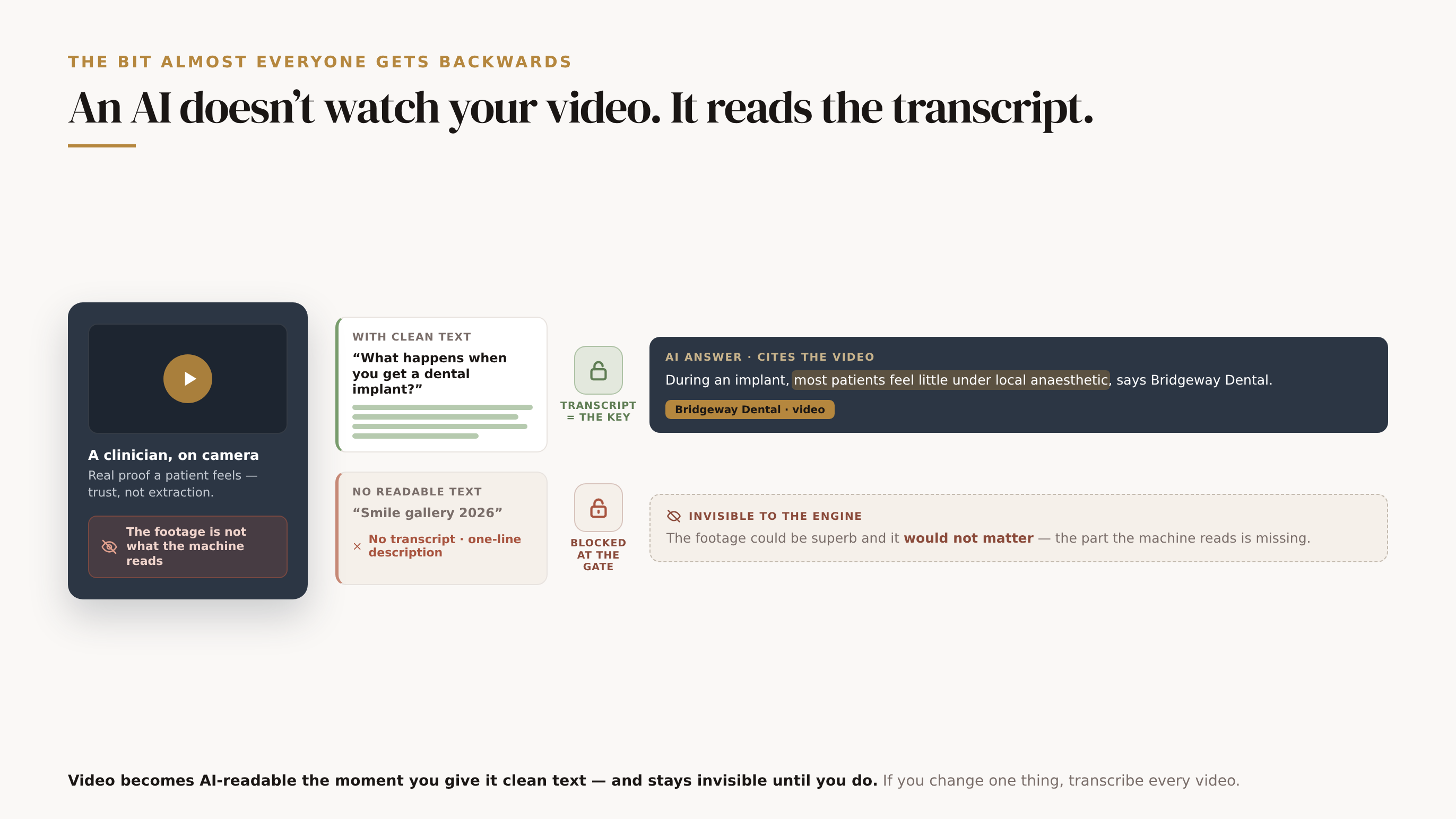
The bit almost everyone gets backwards: an AI does not watch your video, it reads the transcript
This is the section that matters most, and it is the one piece of mechanics that separates a video doing real work from a video doing none. An answer engine does not watch your film. It reads the words attached to it: the title, the description and, above all, the transcript or captions. The footage itself is not what gets understood and quoted. The text of it is.
Google is explicit that the readable layer of a video is its metadata. Its own guidance asks site owners to help engines find and understand videos by providing that information: "To make it easier for Google to find your videos, we recommend providing metadata about the video. We support structured data, video sitemaps, and the Open Graph protocol (OGP)"[5]. Captions and transcripts sit at the centre of that readable layer, which is how an assistant works out what a video is actually about. Perplexity openly cites passages from YouTube transcripts in its answers, and AI summaries draw on the same underlying index that includes those captions.
Follow that through and the practical rule writes itself. A video with a full, accurate transcript, a clear title that matches a real patient question, and a proper description is a rich source of readable text an assistant can quote. A video with no transcript, a title like "Smile gallery 2026" and a one-line description is, to an answer engine, almost nothing. The footage could be superb and it would not matter, because the part the machine reads is missing.
This is where the two common myths both fall down. One says video is the future, so drop the blog: false, because text is what gets lifted, and an untranscribed video is invisible to the very tools you are chasing. The other says AI cannot use video at all: also false, because it uses the transcript happily when one exists. The truth sits between them. Video becomes AI-readable the moment you give it clean text, and stays invisible until you do.
One caveat, because the field is full of overclaims. A transcript helping an assistant understand and cite your video is not the same as your video "training" the model. Influencing what an engine retrieves and quotes today is the realistic, evidenced benefit. Anything grander than that is marketing, not mechanics.
So does video genuinely get cited by AI, or is that wishful thinking?
It genuinely does, and there is primary data behind that rather than the inflated numbers doing the rounds. The fair framing is that video, through its transcript, is a real and growing citation source, not that it wins some fixed share of answers.
The strongest evidence comes from the Semrush study mentioned above. Across more than 100 million AI citations sampled over a three-month window, the platforms that gained the most ground in Google's AI Mode were user-generated ones, with YouTube named among the fastest risers[4]. That is a directional finding measured at real scale: video is a rising channel that answer engines lean on more, not less, as time goes on. Treat it as exactly that. It tells you the trend is real and worth acting on. It does not licence a precise percentage.
It is worth saying plainly what we are not telling you, because the gap between solid data and viral data is wide here. You may have seen claims that "YouTube is cited 200 times more than any other video platform", or that video makes up "29.5% of AI Overview citations".
We have not used either, because neither traces back to a primary source we could stand behind, and a confident-sounding number with no origin is worse than no number at all. The defensible claim, and the one this guide makes, is the measured one: video is a real and growing source answer engines cite, provided the transcript is there for them to read. That is enough to act on, and it has the merit of being true.
Video versus written content: the full side-by-side
No dental page sets these two formats next to each other cleanly, so here is the contrast in full. Read down the columns and the relationship stops looking like a contest and starts looking like a division of labour.
Side by side
Video versus written content
| Consideration | Written content (blog, service page, FAQ) | Video content (YouTube, Shorts, explainers) |
|---|---|---|
| The job it does | Direct, extractable answers. | Proof of experience and human trust. |
| What an assistant does with it | Reads it natively and lifts it into answers. | Reads its transcript and captions, then cites the text. |
| What the patient gets | A quick, quotable answer. | Sees the real clinician and the real procedure. |
| The trust signal | Authority and depth. | Experience: the part you can actually see. |
| How the AI reads it | The words on the page. | The title, description and transcript, never the footage. |
| The schema it uses | Article or BlogPosting, FAQPage. | VideoObject. |
| How it fails | Thin answers, so nothing clean to extract. | No transcript or thin metadata, so invisible to AI. |
| Where it stands in 2026 | The extraction workhorse. | A rising citation source, but only once transcribed. |
Drawn from the article's side-by-side of written and video content for AI visibility.
The two rows in the middle are the ones to sit with: how the AI reads each, and how each fails. They explain why you cannot trade one against the other. Written content fails when the answers are too thin to lift. Video fails when it has no readable text wrapped around it. Neither covers the other's weakness, which is precisely why the practices that win use both, and tie them together.
How do I make a dental video an AI can actually read?
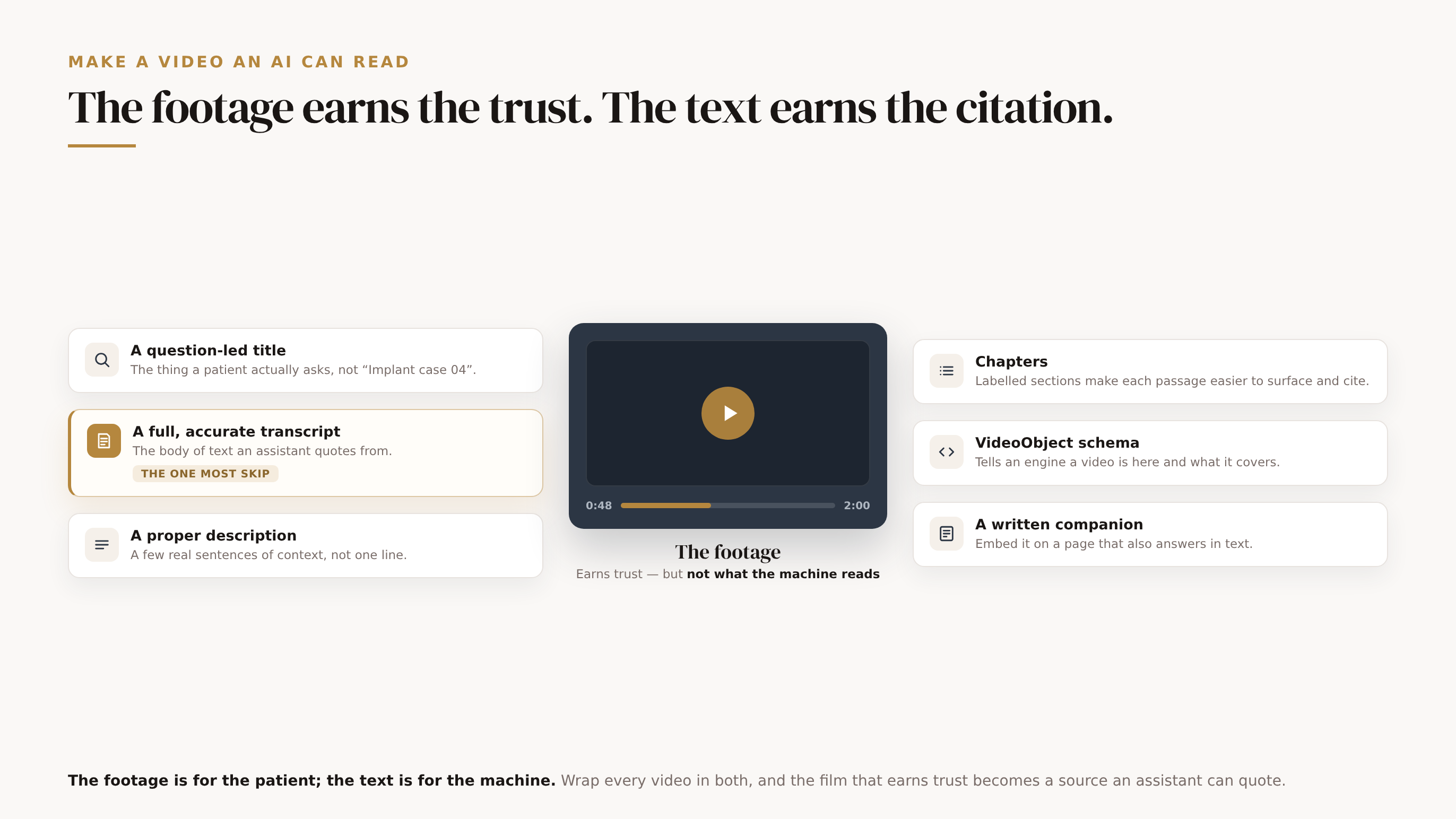
Give every video the text an answer engine needs, because the text is the part it reads. A video without these is film a patient might enjoy but an assistant cannot use. Run down this list for each one and you turn footage into a citable source.
Make a video an AI can read
How footage becomes a citable source
Title it as a real question
Not "Implant case study 04" but "What happens when you get a dental implant?". The title is the first text an engine reads.
Add a full, accurate transcript
The single most important item, and the one most practices skip. It is the readable text an assistant quotes from.
Mark it up with VideoObject
Tell an engine, in machine-readable terms, that a video is here and what it is about, in line with Google's video-metadata guidance.
Pair it with a written companion
Embed the video on a page that also answers the question in text. The text earns the extraction, the video earns the trust.
- A title that matches a real patient question. Not "Implant case study 04", but the thing a patient would actually ask: "What happens when you get a dental implant?" The title is the first piece of text an engine reads, so make it the question, not a label.
- A full, accurate transcript. This is the single most important item and the one most practices skip. The transcript is the body of readable text an assistant quotes from, so it has to be complete and correct, not auto-generated and left full of errors. If you do one thing differently after reading this, transcribe every video.
- A proper description. A few sentences that genuinely summarise what the video covers, in plain language, give the engine context and the patient a reason to watch. A one-line description wastes the slot.
- Chapters for anything longer than a couple of minutes. Breaking a video into labelled sections helps both the viewer and the engine find the part that answers a specific question, which makes individual passages easier to surface and cite.
VideoObjectstructured data on the page that hosts the video. This is how you tell an engine, in machine-readable terms, that a video is here and what it is about, in line with Google's guidance on providing video metadata[5].- A written companion on the same topic. Embed the video on a page that also answers the question in text. The text earns the direct extraction, the video earns the trust, and the two reinforce each other on one indexed page.
Which should a dental practice make first, video or written content?
Build in a deliberate order rather than trying to do everything at once, because each step makes the next one worth more. The sequence below puts the cheapest, highest-certainty work first and the more expensive work where it pays off.
Start with the written answers. Get your key treatment pages and a focused FAQ section genuinely answering the real questions patients ask, in plain sentences, with plain, clearly labelled price ranges and timescales. This is the extraction floor, the content an assistant can lift today, and it is faster and cheaper to produce than film. Until it exists, a practice has nothing for the engines to quote on its own site.
Then film the topics where seeing the clinician genuinely changes how a patient feels. These are the high-trust, high-value treatments: implants, nervous-patient care, cosmetic work like veneers and aligners. A patient deciding on a several-thousand-pound treatment is reassured far more by watching a calm, competent dentist than by reading that they are one. Transcribe every video you make, without exception, because an untranscribed video is effort an answer engine cannot read.
Next, pair each video with its written companion and interlink them, so the video sits on a page that also answers the question in text, and your deeper written content links out to the video for the patient who wants to see as well as read. Finally, mark the pages up: VideoObject for the videos, and the appropriate Article, FAQPage and Dentist types for the written content, so the engines read your genuine content without guessing.
A smaller practice can work through this one treatment at a time. The order is the same for everyone; where you start depends on what you already have. If your site is thin on written answers, begin there. If you have solid pages but no video, the trust layer is your gap.
A worked dental example: the same topic as a blog post and as a video
Take one treatment, dental implants, and watch how the two formats carry it differently, and how an assistant uses each. The underlying knowledge is the same. The job each format does is not.
As written content, the topic becomes a clear, answer-first page and a set of short FAQ entries. The page explains what an implant involves from assessment to final crown, the healing timeline, who makes a good candidate, and a clear cost range clearly labelled as typical, say in the region of £2,000 to £2,500 per tooth (again illustrative, not a researched figure).
The FAQ entries break that into liftable answers: "Do dental implants hurt? Most patients feel little during the procedure, which is done under local anaesthetic, with some mild soreness for a few days afterwards." Asked a sharp question like "do implants hurt", an assistant lifts that answer almost word for word. This is the extraction layer doing its job.
As video, the same topic becomes a two-minute piece of the dentist explaining, on camera, what an implant actually involves: showing the calm reality of the appointment, the care taken, the aftercare. A nervous patient watching it sees a real, steady professional and feels reassured in a way no paragraph achieves. That is the trust layer. And because the video carries a full transcript, a clear title ("What happens when you get a dental implant?") and a proper description, it becomes a second readable source. An assistant can read that transcript and cite a passage from it, exactly as it would cite the written page.
Now see how an assistant draws on each. For a broad, exploratory question ("tell me about getting implants near me"), it leans on the authority of the written explainer and may surface the video as the human-trust source. For a specific question ("does an implant hurt"), it lifts the matching FAQ answer. The written content earns the quote; the video earns the trust and, once transcribed, becomes quotable too.
Publish only the written content and you have liftable answers but none of the on-camera reassurance that converts a nervous patient. Publish only the video and, if it has no transcript, you have footage the engines cannot read and nothing clean to extract. Publish both, derived from the same genuine knowledge, with the video fully transcribed, and you cover the whole range of how a patient asks and decides.
What are the mistakes that waste both formats?
A short list of avoidable errors accounts for most of the wasted effort and budget we see. Work through them before you commit money to either format, because each one quietly cancels out work you have already paid for.
Avoid these
The mistakes that waste both formats
Video with no transcript or a thin descriptionAn answer engine reads the text of your video, so however good the film, it is invisible without one.
Chasing YouTube while your site has no answer-first textThe written floor comes first; video sits on top of it, not instead of it.
Thin written content with no real depthLength is not depth: a page has to genuinely answer the questions a curious patient asks next.
Duplicating content with no clear homeLet the written page hold the extractable answer and the video hold the trust, and link between them.
Ignoring VideoObject and the internal linksMark it up and tie it to its written companion, so a patient and an engine can move between watching and reading.
- Publishing video with no transcript or a thin description. This is the big one. An answer engine reads the text of your video, so a video without a transcript is invisible to it, however good the film. The footage is for the patient; the transcript is for the machine, and you need both.
- Chasing YouTube while your website has no answer-first text. A practice that pours effort into video while its own pages say nothing clear has given the engines no on-site content to extract. The written floor comes first; video sits on top of it, not instead of it.
- Thin written content with no real depth. A generic page that skims a treatment gives a model no reason to trust or quote it. Length is not depth. The page has to genuinely answer the questions a curious patient asks next, which is the authority side we cover in our E-E-A-T guide.
- Duplicating the same content across video and page with no clear home. Repeating an identical answer in several places, with no canonical version, muddies which source an engine should quote. Let the written page hold the extractable answer and the video hold the trust, and link between them rather than copying wholesale.
- Ignoring
VideoObjectand the internal links. A video with no structured data and no links to the relevant page is a disconnected asset. Mark it up and tie it to its written companion, so a patient and an engine can move between watching and reading.
What does the UK angle add: GDC, patient trust and what to film?
UK practices have a particular set of rules and patient expectations that shape what you should film and how you should write it, and no US guide will tell you this part. Getting it right keeps you safe and makes the content more trustworthy, not less.
Start with the General Dental Council. Its guidance on ethical advertising requires that anything you publish, on camera or in text, is clear, accurate and not misleading, and it places real limits on how you present testimonials and claims about outcomes. So a patient video should not promise a result every patient will get, a cosmetic video should not imply a guaranteed transformation, and any before-and-after material has to be handled within the rules, with proper consent.
The careful framing this whole guide argues for is not just better marketing, it is what keeps your content compliant. Film the dentist explaining a procedure and reassuring a nervous patient, rather than making claims about results, and you are on solid ground.
Then there is the practical UK detail. Write transcripts and descriptions in British English, because that is how your patients ask and search, and an answer engine reading your transcript should hear the same language a local patient uses. Be clear about NHS versus private care where it is relevant, because that distinction matters enormously to UK patients deciding whether a treatment is for them.
And choose to film the topics where UK patients feel the most uncertainty and the most cost pressure: implants, clear aligners, veneers, and care for anxious patients. Those are the high-value treatments where seeing a calm, real clinician does the most to turn a hesitant enquiry into a booking, and where the commercial upside of being the named, trusted practice is largest.
How can I check whether AI is drawing from my content at all?
You can run a useful self-audit today, free, in about fifteen minutes, and it tells you whether your written content, your video, or neither, is pulling its weight. It is the sensible first step before you spend on either format.
Put the assistants to the test with a patient's own wording. In ChatGPT, Perplexity and Google's AI Mode, type the queries a real patient would: "best dentist for implants in [your town]", "does getting veneers hurt", "is Invisalign worth it for adults". Watch whether your practice surfaces at all, and when your material is quoted, clock whether the assistant is drawing on one of your written pages or reaching for a video. Repeat each query on separate occasions, since the replies drift, and it is the pattern that recurs which tells you where you stand.
Then check your videos for the one thing that decides whether they help: do they have full, accurate transcripts and clear titles and descriptions? Open a few and look. If the transcript is missing, or auto-generated and full of errors, or the title is a label rather than a question, that video is invisible to the engines, and that is a fixable problem. Finally, read one of your written answers aloud.
If it sounds like a complete, natural reply to the question when spoken, an assistant can lift it; if it trails off or depends on the sentence before it, it will not extract cleanly. That spoken test, which we cover in our piece on voice search and AI chatbots, is the quickest way to tell whether your written content is genuinely liftable. Where the assistants are quoting other practices and not you, this audit shows you which layer is letting you down.
Where QBiz makes video and writing pull together
Most providers in this space sell you a slice and leave the rest. One firm shoots you some videos and never mentions transcripts. Another writes a few blog posts. A third tidies your markup. Nobody owns the question that actually matters, which is whether your content, written and filmed, is being drawn into the answers patients read, and whether your videos even carry the text an engine needs to read them. QBiz starts from the point this article has been making, that the two formats do separate jobs, and the work then runs along two connected tracks.
On your own site, we make both formats earn their keep and in the right order. We write the answer-first service pages and FAQ sections that carry the commercial substance and give the assistants clean, liftable text, and we produce the deeper written content that builds the authority a model returns to.
For video, we do the part most people skip: every video gets a real patient-question title, a full and accurate transcript, a proper description, chapters where they help, and VideoObject markup, so the footage that earns a patient's trust also becomes text an answer engine can read and cite. Then we tie the video to its written companion so the two reinforce each other on one indexed page, all of it kept inside GDC rules.
The second front is the one on-site work alone cannot reach: getting that content out across the web where the engines actually look. A clean site with well-transcribed video is necessary but not sufficient, because an assistant's confidence in naming you comes partly from seeing your practice and your content referenced consistently across the platforms and sources the models read, and video in particular lives on channels beyond your own pages.
So we also do the distribution: publishing and circulating your videos and your written content where they will be found, and making sure your practice details agree with each other wherever they appear. Optimising and transcribing your content on your own site is the foundation. Distributing it across the channels the engines draw on is what turns that foundation into answers that name you. Doing one without the other leaves results on the table.
It begins with a QBiz AI Visibility audit. Our free check scans your own website in about thirty seconds and returns a plain pass or fail on the signals that decide whether AI tools can find, read and describe your content: the crawlability, the schema, the clarity of your written answers, and whether your videos even carry the transcripts and metadata the engines need.
Because it reads your own pages rather than interrogating the engines, it hands you the fixes that get you into contention rather than reporting a single moment-in-time answer. What comes back is a GDC-safe action list, ranked so the highest-value cases are tackled first, spanning both the on-page work and the off-site distribution. It costs nothing to run, and it shows you precisely where the patients you ought to be winning are leaking away.
Frequently asked questions
Should a dentist make videos or write content for AI search?
Both, because they do different jobs. Written content (service pages, blog posts and FAQs) is text an assistant reads natively and lifts straight into an answer, so it is the extraction workhorse. Video shows a real clinician and a real procedure, which earns the human trust patients and search engines reward, and once it carries a transcript it becomes readable to an assistant too. The winning approach is both, with the written content as the floor and every video fully transcribed so the engines can read it.
Does video content get cited by ChatGPT and Google AI?
Yes, but through its transcript rather than its footage. An answer engine reads the title, description and captions of a video, not the moving image, so a transcribed video is a readable source it can quote, while an untranscribed one is effectively invisible. A large study of AI citations found YouTube among the fastest-growing sources in Google's AI Mode, so video is a real and rising citation channel, provided the readable text is there.
Do I really need a transcript on my dental videos?
Yes, and it is the single most important thing. The transcript is the part of a video an answer engine reads and quotes from. Without it, the title and description are all the machine has, which is rarely enough, and the footage itself cannot be read. A full, accurate transcript turns a video from something only a human can use into a source an assistant can cite.
Is YouTube worth it for a dental practice in 2026?
Yes, for two reasons, as long as you transcribe. YouTube is the second-largest search engine and a rising source in AI answers, and video is uniquely good at building the on-camera trust that converts nervous, high-value patients. But it works as a complement to your written content, not a replacement for it, and only when each video carries a clear title, a proper description and a full transcript so the engines can read it.
What kind of dental videos work best for AI visibility?
The high-trust topics where seeing the clinician genuinely changes how a patient feels: implants, care for nervous patients, and cosmetic work like veneers and clear aligners. These are the higher-value treatments where a calm, real explanation on camera does the most to turn a hesitant enquiry into a booking. Keep the claims careful and GDC-compliant, and give every video a question-led title and a full transcript so it earns trust and becomes citable.
Where should my practice start, video or written content?
Start with the written answers, because they are the extraction floor an assistant can lift today and they are cheaper to produce. Get your key treatment pages and an FAQ section genuinely answering patient questions in plain language. Then film the high-trust treatments where seeing the clinician matters, transcribe every video, pair each with its written companion, and mark everything up. Working in that order means each step makes the next one count for more, and a smaller practice can do it one treatment at a time.
Where to start
If you take three things from all of this, take them in order. First, get your key treatment pages and FAQs answering, in plain sentences a patient would recognise, the real questions they are asking, with plain, clearly labelled price ranges, because that written content is the floor an assistant can extract today.
Second, film the high-trust treatments where seeing a calm, real clinician earns a nervous patient's confidence, and transcribe every single video, because the transcript is the part an answer engine reads. Third, tie the two together, embed each video on a page that also answers the question in text, mark it up with VideoObject, and link the layers so trust and quotability reinforce each other. None of it strays outside GDC rules, and each move makes the one after it land harder.
If you would rather see exactly where your practice drops out of the AI answer, whether the gap is written content too thin to lift or videos with no transcript for the engines to read, that is the job of a QBiz AI Visibility audit. The free check reads your own website in about thirty seconds, flags the crawlability, schema, written-answer clarity and video-transcript gaps that keep AI tools from describing you, and returns a prioritised, GDC-safe list of what to fix, on your own site and across the wider web.
It reads your site, not the engines, and it is the no-cost first step before any spend. When you would rather hand the build to a team, our AI SEO for dentists service page sets out how we join the written and video layers for a practice.
Get your AI Visibility audit →
Sources
- [1] BrightLocal, Local Consumer Review Survey 2026: https://www.brightlocal.com/research/local-consumer-review-survey/ (US-weighted; independent. "Use of ChatGPT and other generative AI tools for local recommendations has grown rapidly, rising from 6% last year to 45% and becoming the third most popular source of business recommendations.")
- [2] KFF, Tracking Poll on Health Information and Trust, 2025: https://www.kff.org/public-opinion/kff-tracking-poll-on-health-information-and-trust-use-of-ai-for-health-information-and-advice/ (US; independent. "About a third (32%) of adults are turning to AI for health information and advice", including about three in ten (29%) who used AI tools in the past year for information about their physical health.)
- [3] Pew Research Center, 22 July 2025: https://www.pewresearch.org/short-reads/2025/07/22/google-users-are-less-likely-to-click-on-links-when-an-ai-summary-appears-in-the-results/ (US; independent. "About six-in-ten respondents (58%) conducted at least one Google search in March 2025 that produced an AI-generated summary." Users who saw an AI summary clicked a traditional result in 8% of visits, against 15% when no summary appeared.)
- [4] Semrush, "The Most-Cited Domains in AI: A 3-Month Study": https://www.semrush.com/blog/most-cited-domains-ai/ (Independent. "We analyzed over 100M total AI citations" across ChatGPT search, Google AI Mode and Perplexity between 14 July and 12 October 2025; "The most movement on AI Mode came from user-generated content (UGC) domains. YouTube, Reddit, and Facebook grew the most." Used directionally, not as a fixed share.)
- [5] Google Search Central, "Video SEO best practices": https://developers.google.com/search/docs/appearance/video (Vendor primary. "To make it easier for Google to find your videos, we recommend providing metadata about the video. We support structured data, video sitemaps, and the Open Graph protocol (OGP).")
Leave a comment
Thoughts on this post? Leave a comment below. Comments are moderated before they appear, so yours will not show on the page straight away.
Your email is used only to contact you about your comment if needed — it is never published.
Comments
No comments yet. Be the first to leave one above.