Best AI Visibility Tools and Trackers for Small and Local Businesses
An AI visibility tracker records what answer engines say about a business for a defined set of buyer prompts. It can show mentions, cited pages, competitors and other evidence, but it does not repair the gaps it finds. Compare the record a product exposes, the prompts it can track and the review workflow before choosing one.
Short version
- A tracker preserves evidence from configured buyer prompts, rather than only a headline score.
- Compare access to answers and citations, prompt and location control, and the reporting workflow.
- Choose the record the people making decisions can review, share and export.
Use this guide to compare the evidence and workflow that monitoring products expose. For the wider context, see AI search volatility and how AI engines pick sources.
Trakkr describes the job this way: it measures the answers AI gives to the questions buyers ask. The vendor says each response can be checked for brand mentions, position, cited URLs, competitors, sentiment and framing, while answers, citations, visible referral visits and crawler requests remain separate evidence.[2]
Before paying for software, read the manual guide to checking AI mentions and establish a baseline with real customer questions. This article compares the claims seven tracking vendors make, and sets out the questions a small or local business can use to assess a shortlist.
What a tracker can tell you
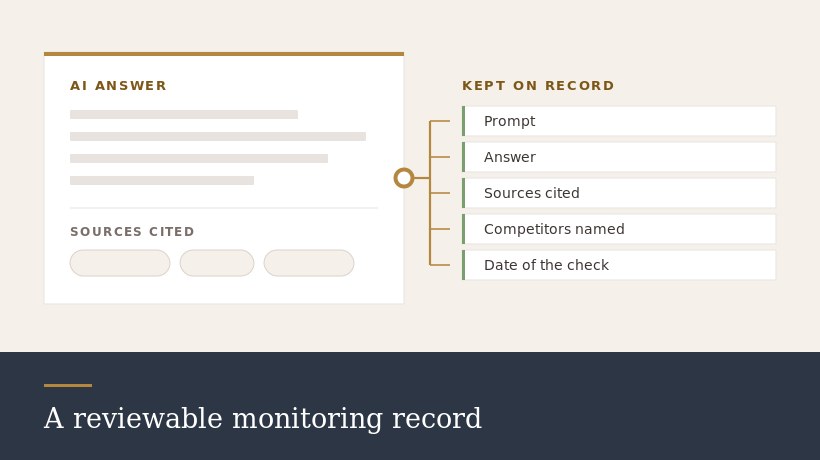
A tracker can create a repeatable record of how a brand appears across selected AI experiences. The reviewable record includes the prompt, the answer, the sources cited, the competitors named and the date of the check. Those are the items a person can review when a result changes.
The data is not the same as attribution. If you need to understand visits and conversions after a mention, see how to measure AI-search ROI. That guide covers GA4 and referral attribution. A tracker helps you observe the answer surface; analytics helps you examine what happens after a visitor arrives.
A single check, preserved
The evidence a single check leaves behind
Seven AI visibility trackers to evaluate
The products below are listed alphabetically. This is not a ranking, a hands-on review or a recommendation. Each row uses only the vendor's published description. Product fit depends on the prompts, places, evidence and workflow a buyer needs to inspect.
Vendor descriptions and plan details in this comparison were checked on 30 September 2026 and can change without notice.
| Product | What the vendor says it tracks or analyses | What a buyer should check |
|---|---|---|
| Ahrefs Brand Radar | Ahrefs says Brand Radar tracks and grows brand visibility across AI answers, YouTube and Reddit. It also says defined prompts can be tracked daily, weekly or monthly.[1] | Ask which AI experiences are included for your prompts, how location changes a prompt check, and whether the output shows the answer and cited pages behind a visibility measure. |
| OtterlyAI | OtterlyAI says it analyses brand mentions and citations across ChatGPT, Google AI Overviews, Claude, Perplexity, Google AI Mode, Gemini and Copilot.[3] | Check which of those experiences matter to your buyers, how you define local prompts, and whether the citation view makes it practical to inspect the pages being used. |
| Peec AI | Peec says it tracks visibility, position, sentiment and share of voice daily against competitors.[4] | Ask how competitors are selected, what sits behind each measure, and whether you can read the answer record before acting on a movement in a summary metric. |
| Profound | Profound says it helps users examine AI-driven traffic and understand how bots view, cite and refer to pages.[5] | Ask which parts of the product are available in the plan under review, how page-level evidence is presented, and how its traffic view relates to your own analytics. |
| Scrunch | Scrunch says its monitoring product tracks how a brand appears in AI answers and shows what gets cited.[6] | Ask for the exact monitoring workflow, the prompts and engines covered, the evidence available to reviewers and the commercial scope offered to your business. |
| SE Ranking | SE Ranking says it provides visibility analysis across five major AI engines and names ChatGPT, Gemini, Perplexity, AI Overviews and AI Mode among the experiences it monitors.[7] | Check the exact five experiences in the current product, the prompt and location configuration, and whether results can be reviewed at answer level rather than only as a roll-up. |
| Trakkr | Trakkr says it measures AI answers to buyer questions. Its plan comparison, as listed by the vendor on 30 September 2026, shows one-brand and 10-brand tiers, 50 prompts per brand, daily refresh and a white-label portal.[8] | Ask how those published limits map to your own services and locations. Confirm prompt allocation, user access, evidence retention and the current plan terms before purchase. |
Six questions, one shortlist
The surface a shortlist is actually compared on
How to assess a tracker without choosing from a headline
Start with the questions your customers actually ask. A local business may need service, problem, location and brand prompts. A multi-location business may need an agreed way to separate areas and services. The product name does not answer those design questions.
Check the AI experiences before the dashboard
List the answer engines you need to observe, then ask each vendor to identify the experiences its current product checks. AI engines can source answers differently, so do not assume that a product which names one engine covers every answer surface your customers use. See how AI engines source answers differently for that distinction.
Order of operations
Getting to a result a person can check
Ask to see the evidence behind a score
A score can make a reporting screen easier to scan, but it is only checkable when the underlying record is reachable. Ask the vendor to open a single result and show the evidence behind the number, then confirm who is allowed to export it.
Define competitors and locations before comparing results
A competitor field is only useful when the names are relevant to the buyer question. The same applies to place names. Agree the services, areas and competitor set first, then check whether the product lets you retain that definition across repeated checks.
Two jobs, one handover
Where monitoring stops and repair begins
Separate monitoring from corrective work
A tracker can reveal that a page is not cited, that a competitor is named more often or that a business is described inaccurately. It cannot by itself correct thin service information, inconsistent business facts or missing third-party evidence. Treat monitoring and corrective work as separate jobs with a clear handover between them.
Frequently asked questions
What does an AI visibility tracker measure?
An AI visibility tracker records how a brand appears in AI answers for a defined set of prompts. Depending on the product, the evidence can include brand mentions, position, cited URLs, competitors, sentiment or the framing of the answer. It is a monitoring record, not proof that a business will be recommended or receive a particular result.
Do local businesses need a paid AI visibility tracker?
Start with the manual guide to checking AI mentions. It explains the baseline; this article compares the monitoring record a product makes available.
What should I compare before choosing a tracker?
Check the AI experiences covered, the way prompts and locations are defined, the refresh schedule, whether raw answers and cited URLs are available, how competitors are represented, and who can review or export the record. Ask the vendor to show those parts of the workflow rather than relying on a score alone.
Is QBiz Leads AI an AI visibility tracker?
No. QBiz Leads AI does not sell an ongoing monitoring dashboard. Its work focuses on AI readiness and citation distribution: improving the information and evidence a tracker can reveal as missing or unclear. The free AI visibility check is a starting check, not a tracking subscription.
What QBiz does after a tracker finds a gap
When a tracking record reveals unclear service information or thin citation evidence, QBiz provides AI readiness and citation-distribution work to address the gap. See AI Visibility Services for the scope; if you are choosing a service provider rather than monitoring software, see how to choose an AI visibility provider.
Keep the evidence visible through monitoring, then assign readiness and citation gaps to corrective work.
Check your site’s readiness before paying for monitoring →
Leave a comment
Thoughts on this post? Leave a comment below. Comments are moderated before they appear, so yours will not show on the page straight away.
Your email is used only to contact you about your comment if needed — it is never published.
Comments
No comments yet. Be the first to leave one above.