Google SGE vs. ChatGPT Search: Website Visibility Compared
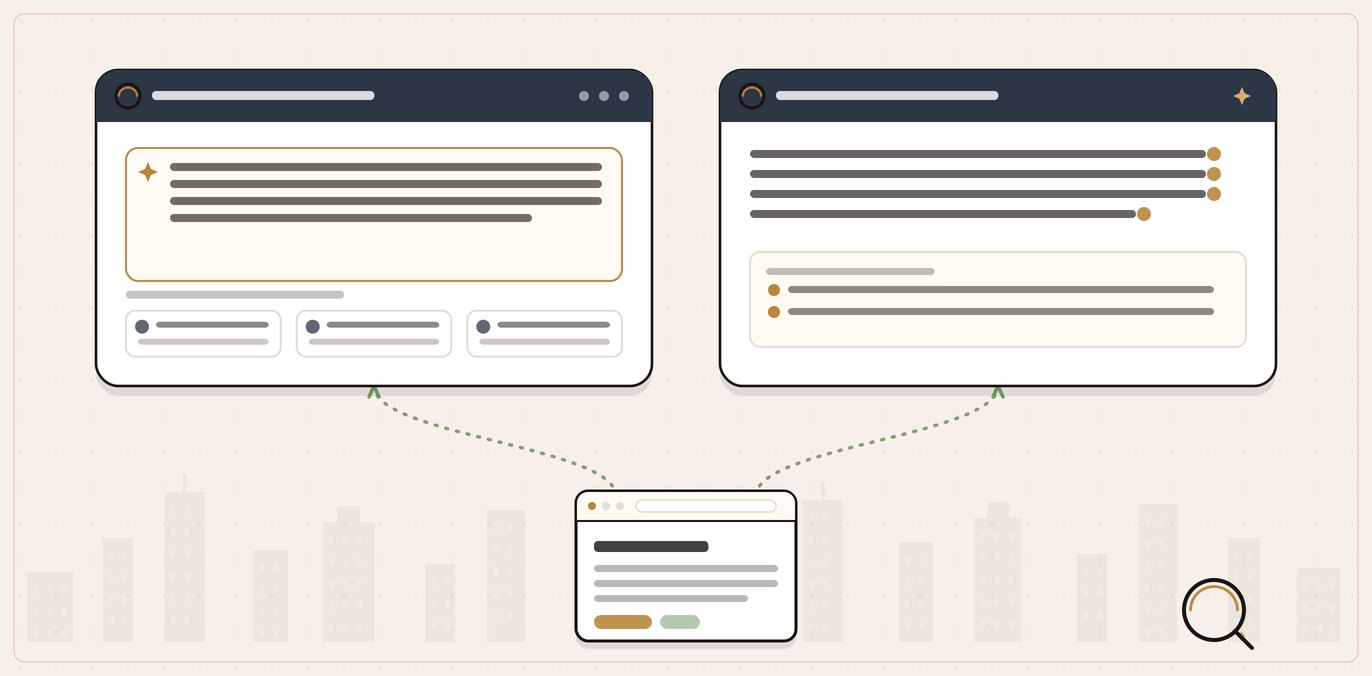
Google's AI search and ChatGPT Search both decide which websites to show, and they do it in different ways. Appearing in one does not mean appearing in the other. In the largest public look at the question, Ahrefs studied 15,000 prompts and found that, on average, only about 12% of the links cited by ChatGPT, Gemini and Copilot also ranked in Google's top 10 for the same query.[1] That single number reframes the comparison: website visibility is now two jobs, not one.
Most "SGE versus ChatGPT" pieces argue about which engine is bigger or smarter. The more useful question for a business is narrower: what makes your pages show up in each one, how much of the work overlaps, and where the reliable data actually ends. This is that comparison, built on primary sources and clear about the gaps nobody has measured yet.
Google's AI Overviews and AI Mode (the products that grew out of the experiment Google called SGE) are built on the same search index and SEO fundamentals as regular Google results. ChatGPT Search runs on its own retrieval layer and needs OpenAI's crawler, OAI-SearchBot, to reach your pages. Ranking well on Google helps, but it does not carry over automatically. To be visible in both, you make pages that are crawlable, specific, well structured and easy to cite.
What is Google SGE, and what is ChatGPT Search?
Google introduced generative AI into Search in 2023 under the label Search Generative Experience, or SGE. That experiment has since shipped as two consumer features: AI Overviews, the synthesized answer that can appear at the top of a results page, and AI Mode, a fuller conversational search surface. Google's own documentation is direct about the foundations. To be eligible as a supporting link, a page needs to be indexed and eligible to appear in Google Search with a snippet, and there are no additional technical requirements; the same SEO fundamentals apply.[2] Both features may also use a query fan-out technique, issuing several related searches across subtopics to build a response.[2]
ChatGPT Search is the mode inside ChatGPT that looks up the live web and answers with cited links. Getting included works differently. OpenAI's help documentation states that ranking in ChatGPT Search is based on a number of factors designed to surface reliable, relevant information, that there is no way to guarantee top placement, and that to be included it is important to allow OAI-SearchBot to crawl your site.[3] So the first gate for ChatGPT visibility is not a ranking signal at all: it is crawl access.
Does ranking on Google make you visible in ChatGPT?
Not reliably, and the best available data says so plainly. Ahrefs analyzed 15,000 prompts across ChatGPT, Gemini, Copilot and Perplexity and compared their citations against Google and Bing's top 10. On average, only about 12% of the links these AI tools cited also ranked in Google's top 10 for the same prompt, and roughly 80% of those citations did not rank anywhere in Google for the original query. Perplexity was the outlier, with nearly one in three of its citations pointing to pages that ranked in the top 10.[1] This is a citation-URL overlap measure rather than a brand-mention measure, but the direction is unambiguous: a strong Google position is a weak predictor of AI citation.
The overlap
A Google ranking weakly predicts AI citation
12%
of links cited by ChatGPT, Gemini and Copilot also ranked in Google's top 10
80%
of those AI citations did not rank anywhere in Google for the original query
68.01%
of Google searches ended without a click in early 2026, up from 60.45% in 2024
Ahrefs, 15,000-prompt study; SparkToro, 2026
Different studies measure this overlap differently and land in very different places. Alongside the Ahrefs figure, one small study of 15 brands across five categories, run by Chatoptic and reported by Search Engine Land, found that brands ranking on Google's first page were mentioned by ChatGPT about 62% of the time.[6] The two numbers are not in conflict; they measure different things (link overlap versus brand mention) at very different scales. That spread is the real lesson: no single overlap percentage is settled, so treat any headline figure with care and plan for the two engines separately.
Side by side: SGE / AI Overviews vs. ChatGPT Search
Side by side
SGE / AI Overviews versus ChatGPT Search
| Dimension | Google SGE / AI Overviews | ChatGPT Search |
|---|---|---|
| What it is | Generative answers inside Google Search, launched as SGE and now shipping as AI Overviews and AI Mode. | A live web-search mode inside ChatGPT that answers with cited links. |
| What it draws on | Google's existing search index and SEO fundamentals; may use query fan-out.[2] | OpenAI's own retrieval layer; requires OAI-SearchBot crawl access.[3] |
| How to be eligible | Be indexed and eligible for a snippet in Google Search; no extra technical requirements.[2] | Allow OAI-SearchBot to crawl the site; be relevant and reliable.[3] |
| How sources appear | Supporting links surfaced alongside the overview, with more to learn more.[5] | Inline citations you can hover and click, plus a Sources panel.[3] |
| Placement guarantee | None; citation depends on Google's systems. | None; OpenAI says there is no way to guarantee top placement.[3] |
How each engine shows its sources
The two engines both surface sources, just in different shapes, and that shape changes what optimization is trying to earn.
ChatGPT Search places its references close to the text. OpenAI's documentation describes inline citations that you can hover over to learn more and click to open the source, plus a Sources panel beneath the response when inline citations are not shown.[3] For a website, that means a citation is a direct, clickable path back to your page.
Google AI Overviews present a synthesized answer with supporting links to learn more. It is easy to assume the summary suppresses clicks, but Google's stated position is the opposite: it reports that the links in AI Overviews get more clicks than if the page had appeared as a traditional web listing for that query,[5] and that when people do click from a results page with an AI Overview, those clicks are higher quality, meaning users are more likely to spend time on the site.[2] Neither engine is hiding your sources; they are competing on how prominently and how clickably they show them.
What about zero-click search?
Zero-click behavior is where laundered statistics multiply, so it is worth separating what is measured from what is guessed. On the Google side, the numbers are solid. SparkToro, using Similarweb and Datos panel data, reported that 68.01% of Google searches ended without a click in the first four months of 2026, up from 60.45% in 2024.[4] That is a real, rising figure, and it is the reason being cited inside the answer now matters as much as ranking beneath it. Our deeper write-up on the zero-click search era covers what that shift means for a website's traffic.
Read the data carefully
What is measured, and what is guessed
Trust the Google zero-click figure.It is measured from panel data and it is rising, so being cited in the answer matters more each year.
Treat any ChatGPT zero-click rate with caution.There is no credible published figure, so distrust a specific percentage.
Do not rely on a single overlap percentage.Different studies measure different things at different scales, so no headline figure is settled.
Plan for the two engines separately.A strong Google position is a weak predictor of an AI citation, so build for both.
On the ChatGPT side, the accurate position is that no credible published zero-click rate exists. A chat answer keeps the user inside the conversation, and there is no comparable results page to click away from in the same sense, so any specific ChatGPT zero-click percentage circulating online should be treated with suspicion until a real methodology is attached to it. Naming that gap is more useful than borrowing a number that was never measured.
What actually makes a website visible in both
Because Google's AI features ride on its existing index and ChatGPT Search needs crawl access and clear, citable pages, the work that serves one largely serves the other. The overlap is the good news. A page built to be understood and quoted tends to earn eligibility in both engines at once. That is the core of answer engine optimisation, and it sits next to, not instead of, traditional SEO. If the distinction between the disciplines is fuzzy, our guide to AEO, GEO and SEO lays out where each one applies.
Visible in both
The work that serves both engines at once
Let both engines in
Stay indexed in Google and allow OAI-SearchBot to crawl the site.
Write citable pages
Clear, quotable answers a model can lift, built on the same SEO fundamentals Google already uses.
Mark up the facts
Structured data helps each engine read what your page is and what it claims.
Be eligible in both
A page built to be understood and quoted tends to earn eligibility in both engines at once.
- Stay crawlable. Confirm Googlebot can index the page and OAI-SearchBot is not blocked in robots. Crawl access is the first gate for ChatGPT visibility, and blocking it removes you from the running entirely.
- Answer first. Lead each section with a direct answer, then support it. Both engines lift clean, self-contained statements more readily than answers buried three paragraphs down.
- Name entities clearly. State who you are, where you operate and what you do, in words rather than pronouns, so a model can attach the facts to the right business.
- Show evidence. First-hand detail, specific numbers with sources, and real examples give an answer engine a reason to cite you over a generic page.
- Earn off-site citations. Consistent listings, reviews and references across the web build the authority signals both engines weigh when they decide who to name.
Where structured data fits
Structured data is the part of this that businesses most often skip, and it earns its place for a specific reason: it removes ambiguity. Marking up your pages with schema (Organization and LocalBusiness for the entity, Article or BlogPosting for content, FAQPage for question-and-answer blocks, and BreadcrumbList for site structure) gives Google an explicit, machine-readable statement of what a page is and who published it. That supports the same E-E-A-T signals Google's AI features rely on, and it keeps the entity behind your site consistent, which is exactly the clarity ChatGPT's retrieval layer needs to attribute facts to you rather than to a competitor.
For answer engines, clean HTML structure and extractable facts matter as much as the schema itself: question-shaped headings, short definitions, tables where comparisons help, and source-numbered claims. Structured data does not guarantee a citation, but it lowers the odds that either engine misreads or overlooks your page.
So which should you optimize for first?
Start with the foundations that serve both, because they are the same foundations: a crawlable, well-structured, evidence-backed site. Then weight the effort toward where your buyers actually are. For most local and lead-driven businesses, Google's AI features carry the larger query volume today, so the AI Overview side usually earns first attention, and the work compounds because it also improves traditional rankings. ChatGPT Search is the faster-growing surface and sends fewer but more engaged visitors, which makes it a strong second focus rather than an afterthought.
If you want to see how this plays out in a specific market, our comparison of ChatGPT and Google AI Overviews for law firm traffic walks through the sequencing decision with real referral patterns, and the guide to how Florida attorneys get recommended by ChatGPT shows the off-site authority work up close. If your interest is the content-production side, Claude vs. ChatGPT for SEO content covers which tool helps at which stage. The common thread across all of them is simple: whichever engine you start with, the pages that win are the ones a person could not have written without knowing the business, the market and the customer.
A QBiz Leads AI visibility check is a practical place to begin. It looks at one page at a time and reports where it stands on crawl access, structure, entity clarity and evidence, the specific things that keep Google's AI features and ChatGPT Search from citing a site that otherwise deserves it.
Get your AI Visibility audit →
Frequently asked questions
Is Google SGE the same as AI Overviews?
Google SGE was the name of Google's 2023 experiment with generative AI in Search. That work now ships as AI Overviews and AI Mode. Google's documentation says these features are built on the same index and SEO fundamentals as regular Google results, so there are no separate technical requirements to be eligible.
Does ranking on Google get you cited by ChatGPT?
Not reliably. In an Ahrefs study of 15,000 prompts, only about 12% of the links cited by ChatGPT, Gemini and Copilot also ranked in Google's top 10 for the same query, and around 80% ranked nowhere in Google for it. Google rank and AI citation are related but far from the same thing.
How do I make my website visible in ChatGPT Search?
Let OpenAI's crawler, OAI-SearchBot, reach your pages, then make those pages specific and easy to cite: clear answers near the top, question-shaped headings, named entities, and facts an answer engine can lift. OpenAI states there is no way to guarantee top placement, so the goal is eligibility and clarity, not a ranking trick.
What is the zero-click rate for ChatGPT?
There is no credible published zero-click rate for ChatGPT. A chat answer keeps the user in the conversation, and there is no comparable results page to click from, so any specific percentage should be treated with caution. For context, SparkToro found 68.01% of Google searches ended without a click in early 2026.
Do I need different content for Google AI and ChatGPT Search?
Mostly no. The same foundations serve both: crawlable pages, answer-first structure, clear entities, evidence and structured data. You weight the effort toward where your buyers are, but you do not build two separate websites.
Sources
- [1] Claim: only about 12% of links cited by AI tools also rank in Google's top 10, and about 80% rank nowhere. URL: https://ahrefs.com/blog/ai-search-overlap/. Exact quote: "In a dataset of 15,000 prompts, we found that, on average, only 12% of links cited by ChatGPT, Gemini, and Copilot appear in Google's top 10 results for the same prompt. Perplexity is the outlier: nearly 1 in 3 of its citations point to pages that rank in the top 10 for the target query." Also: "80% of those citations don't rank anywhere in Google for the original query."
- [2] Claim: Google AI Overviews and AI Mode use the same index and SEO fundamentals, may use query fan-out, and produce higher-quality clicks. URL: https://developers.google.com/search/docs/appearance/ai-features. Exact quote: "To be eligible to be shown as a supporting link in AI Overviews or AI Mode, a page must be indexed and eligible to be shown in Google Search with a snippet... There are no additional technical requirements." Also: "Both AI Overviews and AI Mode may use a 'query fan-out' technique." Also: "When people click from search results pages with AI Overviews, these clicks are higher quality (meaning, users are more likely to spend more time on the site)."
- [3] Claim: ChatGPT Search shows inline citations plus a Sources panel, has no guaranteed placement, and needs OAI-SearchBot crawl access. URL: https://help.openai.com/en/articles/9237897-chatgpt-search. Exact quote: "ChatGPT responses that use search may include inline citations. When inline citations appear, you can hover over a citation to learn more and click it to see the source... If inline citations are not shown, click Sources beneath the response... to open a panel with cited sources and other relevant links." Also: "Ranking in ChatGPT Search is based on a number of factors... There is no way to guarantee top placement. However, to be included it is important to allow OAI-Searchbot to crawl your site."
- [4] Claim: 68.01% of Google searches ended without a click in early 2026, up from 60.45% in 2024. URL: https://sparktoro.com/blog/in-2026-less-than-one-third-of-google-searches-still-send-a-click/. Exact quote: "In the first four months of 2026, a whopping 68.01% of Google searches ended without a click." Also: "In 2024, US zero click searches on Google stood at 60.45%."
- [5] Claim: AI Overview links get more clicks than a traditional web listing. URL: https://blog.google/products/search/generative-ai-google-search-may-2024/. Exact quote: "They like that they can get both a quick overview of a topic and links to learn more... the links included in AI Overviews get more clicks than if the page had appeared as a traditional web listing for that query."
- [6] Attributed aside only, not treated as a bare fact: a small study of 15 brands across five categories, run by Chatoptic and reported by Search Engine Land, on the overlap between Google first-page ranking and ChatGPT mention. URL: https://searchengineland.com/seo-vs-geo-study-461891. Exact quote: "A new study conducted by Chatoptic of 15 brands across five categories found almost no correlation between SEO strength and visibility in AI answers... Brands ranking on Google's first page were mentioned in ChatGPT just 62% of the time."
Leave a comment
Thoughts on this post? Leave a comment below. Comments are moderated before they appear, so yours will not show on the page straight away.
Your email is used only to contact you about your comment if needed. It is never published.
Comments
No comments yet. Be the first to leave one above.