How to Monitor Your Dental Practice's AI Search Presence: A Free Monthly Method (Plus the Tools)
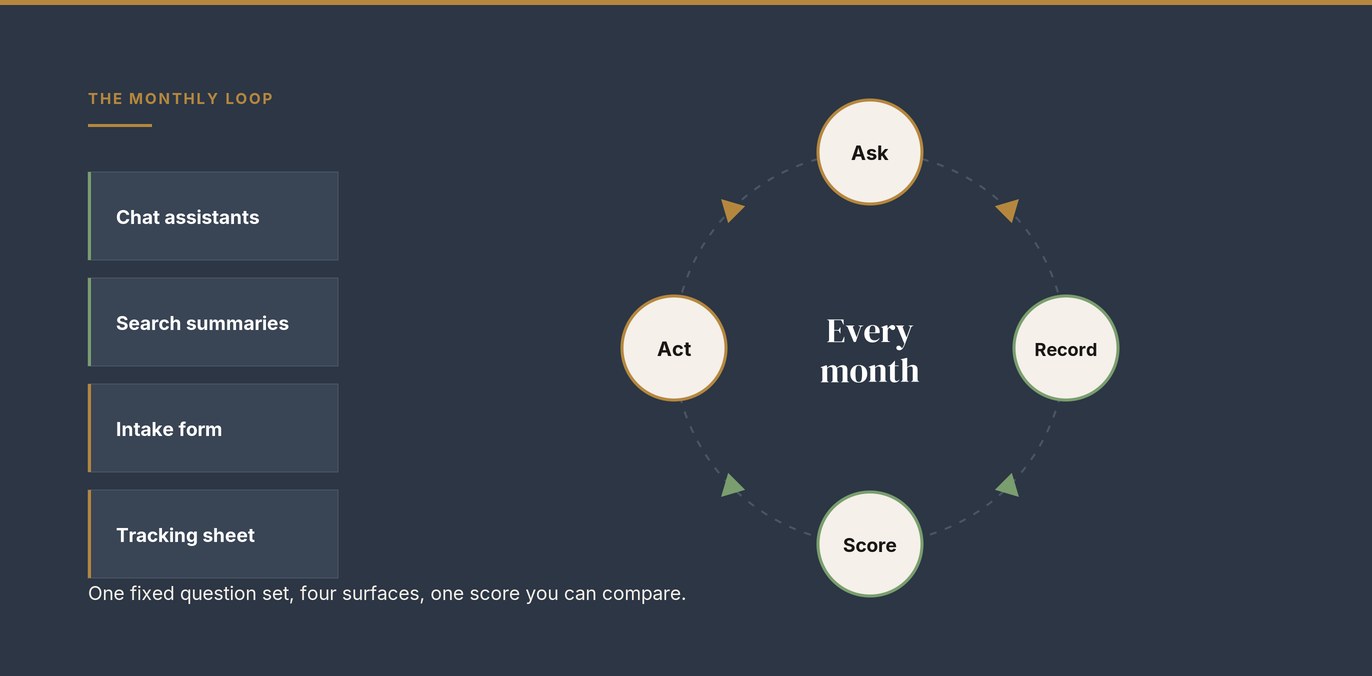
A monthly check of what the AI assistants say about your practice returns two things: an AI Visibility Score (the percentage of your test questions where the assistants named you) and a line on the intake form that records the patients your analytics never attributes. Both matter because an AI summary usually ends the click: Pew Research Center found 58% of US users ran at least one Google search returning an AI-generated summary in March 2025, and people very rarely clicked through when one appeared (Pew Research Center, July 2025).
Short version
- Ask ChatGPT, Perplexity, the Google Gemini app and Google's AI Overview the same questions your patients ask, every month, and note whether you're named and whether the details are correct.
- Turn the result into an AI Visibility Score: the percentage of your test questions where the assistants named you.
- Add "AI assistant" as an option on your new-patient intake form, because most patients an AI answer sends you never click through to your website and so never show up in your analytics.
- An AI summary usually ends the click: Pew Research Center found 58% of US users ran at least one Google search returning an AI-generated summary in March 2025, and people very rarely clicked through when one appeared (Pew Research Center, July 2025).
- Fill in the free AI Search Presence audit worksheet below to run this yourself this month.
To monitor your practice's AI presence, ask ChatGPT, Perplexity and Google's AI Overview the same questions your patients ask, each month, and write down whether you are named and what is said about you. Score the share of questions you appear in so you can see the trend.
Then add "AI assistant" to your new-patient intake form, because many patients who find you through an AI answer never click your website and so never show up in your analytics. That is the whole method, and the rest of this guide turns it into something you can run this afternoon.
There is money sitting behind this, which is the straightforward reason to bother. The treatments patients research before they pick a practice are the expensive ones: a single implant can net you around £2-3K per tooth, a course of clear aligners commonly lands between £2,500 and £4,500 for your practice, and a patient who stays with you for routine care is worth years of check-ups, hygiene visits and the occasional larger case.
When an assistant answers "who does implants near me" with two names and yours is not one of them, nothing appears in any report you keep. The enquiry simply goes to a practice the model trusted more. You cannot fix a leak you cannot see, and AI presence is now a leak worth watching.
This guide is written for UK practices and every section answers a real question an owner has put to us. If you have already done the work to get recommended and want to know whether it is paying off, this is the feedback loop.
Read it in order, or jump to the section that fits where you are stuck.
Why bother monitoring whether AI mentions your practice at all?
Because AI has quietly become a real way patients choose a dentist, and a channel that influences decisions deserves to be measured like any other. This is no longer a novelty you can ignore until it matures. It is already shaping who walks through the door.
The clearest evidence is healthcare-specific. A 2025 study by patient-experience firm rater8 found that by mid-2025, 26% of patients said AI tools, including AI-generated review summaries and assistants such as ChatGPT, had directly influenced their choice of healthcare provider, putting AI roughly level with primary-care referrals (28%) and review sites (29%) as a factor in that decision (rater8, 2025).
That is US data and should be read as directional for the UK rather than a local figure, but the direction is unmistakable: one patient in four now says an AI answer played a part in who they picked. A dentist is squarely the kind of provider that question covers.
The weight patients give those answers is rising too. The same rater8 research found that one-third of patients now trust AI-generated search results as much as traditional search engines such as Google, nearly one in five trust AI even more, and only 11% are outright sceptical.
When most people treat the assistant's answer as at least as credible as a Google results page, what the assistant says about your practice carries genuine commercial weight. Monitoring it is not vanity tracking; it is checking on a source patients actively believe.
This sits inside a broader shift in how people find local services. BrightLocal's Local Consumer Review Survey 2026 reports that AI tools such as ChatGPT have surged into third place as a source of local-business recommendations, rising from 6% the previous year to 45% (BrightLocal, 2026).
And the appetite for asking AI about health is already there: a KFF tracking poll in 2026 found that about a third (32%) of US adults now use AI for health information or advice (KFF, 2026).
Put those together and the case for monitoring is simple. Patients are asking, they believe the answers, and AI now ranks among the top handful of ways they find a local practice. The only question left is whether you know what it is telling them about you.
What is the catch that makes this harder than checking Google Analytics?
The catch is that the patients AI sends you are largely invisible to your website analytics, so the tool you would normally reach for cannot see this channel at all. If you wait for Google Analytics to show an "AI referral" line, you will wait a long time and conclude, wrongly, that nothing is happening.
Here is why. When a patient asks an assistant "best dentist in Leeds for a broken tooth" and reads the reply, they often act on it directly: they phone you, or they search your name and walk in, without ever clicking a link from the AI answer.
The behaviour is well documented. A Pew Research Center analysis of real browsing data found that 58% of US users ran at least one Google search in March 2025 that returned an AI-generated summary, and that when a summary appeared, people very rarely clicked the sources cited beneath it (Pew Research Center, July 2025). No click means no referrer, and no referrer means your analytics never records where that patient came from.

The consequence shapes the whole method below. Monitoring your AI presence cannot be a single screen you glance at. It needs two halves that meet in the middle: an online check, where you ask the assistants directly what they say about you, and an offline catch, where you record the patients who arrive because of an answer they never clicked.
Get only the first and you know what the AI says but not whether it is converting. Get only the second and you see AI-influenced patients arriving but cannot tell which answer sent them or how to improve it. The practices with a real feedback loop run both, and that is the gap most of the field leaves wide open.
How do you audit your AI presence yourself, for free, in under two hours a month?
You run a short, repeatable process: build a list of the questions your patients ask, put each one to every major AI surface, write down what comes back, and turn the results into a single score you can track month to month. It takes most single-site owners under two hours the first time and less once it is a habit. No paid tool is required to start, and the manual method tells you almost everything a dashboard would.
Be straightforward with yourself about one thing before you begin. There is no tidy, automated report that already exists for this the way there is for your website traffic, so the work is hands-on. That is not a flaw in the method; it is the current state of the field, and the practices doing it by hand each month already know more about their AI presence than competitors waiting for a tool to do it for them.
Step 1: build the list of questions your patients actually ask
Start by writing down 15 to 25 questions a real patient would type or speak into an assistant, grouped by what they are trying to do. The grouping matters because you can be named for one kind of question and absent from another, and a single overall score would hide that.
Sort your questions into intent buckets. Service questions name a treatment and a place ("clear aligners in Bristol", "implant dentist near Didsbury"). Emergency questions are urgent and local ("emergency dentist open now near Leeds", "knocked-out tooth what to do Coventry"). Trust questions probe a specific practice ("is [practice name] in Nottingham any good", "reviews for [practice name]"). Comparison questions weigh you against a rival ("[practice A] or [practice B] for Invisalign"). Access questions reflect the very British reality of NHS waiting lists ("private dentist near me taking new patients", "NHS dentist accepting patients in Sheffield").
Write a handful in each bucket using the exact, plain wording a worried person would use at eleven at night, not the clinical terms. This list becomes your fixed test set, so keep it and reuse it every month; changing the questions each time would make the trend meaningless. The downloadable worksheet below gives you a ready-made starting set across real towns and real treatments if you would rather adapt one than write from scratch.

Get the full AI Search Presence Worksheet: every intent bucket, a scoring section and a monthly intake-log table, ready to print and fill in. Download the free PDF worksheet →
Step 2: put every question to each AI surface, not just one
Run your whole list through several assistants, because they read from different places and a result on one tells you little about the others. Checking only ChatGPT is like checking only one directory and assuming the rest agree.
At a minimum, test four surfaces. ChatGPT, Perplexity and the Google Gemini app are the conversational assistants patients open directly. The fourth is the Google AI Overview, which appears inside an ordinary Google search rather than in a chat window, and it is the one most likely to show a citable source link you can actually trace back. The conversational assistants and the AI Overview behave differently and reward slightly different work, which is why both belong on the list (we go deeper into how the Google surface decides who appears in how AI ranks dentists near me).
Two practical notes that change your results: answers vary by location and by whether you are signed in, so search logged out with your location set to your actual area, and the reply shifts between attempts, so run each question two or three times and record the pattern rather than a single lucky or unlucky answer.
Step 3: log what you find in a simple tracking sheet
Record each result in a spreadsheet as you go, because memory will not hold 25 questions across four surfaces run three times, and the value is entirely in being able to compare this month with last. The sheet is the spine of the whole exercise.
Give it one row per question-and-surface combination, with columns for: the question, its intent bucket, the surface (ChatGPT, Perplexity, Gemini, AI Overview), whether you were named (yes or no), roughly where you appeared in the answer (first, in a list, an afterthought), whether the details given about you were accurate, which competitors were named, and any source links the answer cited.
A column for the date ties it to the month. That last detail about accuracy earns its keep more than any other, as the next section explains. Keep the sheet simple enough that filling it in does not become the reason you skip next month. If you would rather not build the sheet from a blank page, the free tracking worksheet below is pre-formatted with these columns.
Step 4: turn it into an AI Visibility Score you can track
Convert the sheet into one straightforward number so you can see movement over time: the percentage of your test questions where the assistants named you. If you appeared in 9 of 30 question-and-surface checks, that is a 30% visibility score for the month. The exact figure matters far less than the direction it moves across months.
Then segment it, because a single number flattens the detail you most need. Score each intent bucket separately, so you can see that you might win on "emergency dentist near me" while losing every "clear aligners" question, or that you are strong on ChatGPT and invisible in the Google AI Overview.
Those segments are your worklist: they tell you exactly which kind of patient question is sending people elsewhere, which is far more useful than knowing your overall number ticked up or down. Track the segmented scores month on month and you have a genuine feedback loop, the thing almost no competitor actually hands a practice owner.
How do you catch the AI-referred patients your website never sees?
You catch them at the front desk, by asking and by noticing, because the offline signal is the half of monitoring that fills the gap your analytics leaves. This is the part nearly every guide forgets, and it is what turns "I think the AI mentions us" into "I can see AI-influenced patients arriving".
Add an AI option to your new-patient intake
Add a referral-source question to your intake form with a specific option for AI, worded plainly: "AI assistant (ChatGPT, Gemini, Perplexity)". Most practices already ask "how did you hear about us", and most patients default to "online" or "Google" because they do not think of an assistant as a distinct source. A named option prompts the straightforward answer.
Brief your reception team to follow up gently when someone says they found you online, with a light question such as "was that a Google search, or did you ask one of the AI assistants". You are gathering a signal, not interrogating anyone, so keep it natural and stop the moment it feels like a survey.
Notice the patterns that mark an AI-referred patient
Train yourself and your team to spot the tell-tale signs, because AI-referred patients often arrive looking subtly different from search-referred ones. Watch for a rise in direct phone calls that bypass your website entirely, for unusually specific procedure enquiries from people who have clearly already been told what they need, and for patients who quote details about your practice they could not have read on your homepage because the assistant assembled them from several sources.
None of these is proof on its own, but together, and rising over time, they are a strong indication that assistants are describing you to patients before those patients ever reach you.
Reconcile the two halves
Read the online score and the offline signal together, because each one checks the other. If your visibility score climbs and your intake AI-mentions climb with it, the work is converting and you can see it.
If your score rises but the front desk hears nothing, the likely culprit is that the assistants are naming you but getting something wrong, an out-of-date phone number, a service you no longer list, hours that send people to a closed door, so the patient cannot act on the mention. That reconciliation is the insight the two halves produce together that neither could alone.
What exactly should you be checking for, beyond just being named?
Check three things in order: whether you are named, where you appear, and whether what the assistant says about you is correct. Most owners stop at the first and miss the most fixable, highest-value problem of all.
Being named is the headline, but accuracy is where the quiet damage lives. An assistant that confidently gives a patient your old opening hours, a phone number you changed last year, a branch you have closed, or a treatment you no longer offer is actively sending business away while appearing to help you.
Worse still is conflation, where the model blends you with a similarly named practice in the next town and attributes their details, or their reviews, to you. These errors are common, they are invisible until you look, and they are usually the easiest thing on your whole list to fix, because they trace back to a source you control: an old directory entry, an unclaimed listing, inconsistent details across the web.
Getting your name, address, phone and hours to agree everywhere is the single most reliable way to stop an assistant repeating something wrong about you, and we cover that groundwork in name, address and phone consistency for dentists. When you log your audit, treat an inaccurate mention as a more urgent finding than a missing one, because a wrong answer costs you a patient who was otherwise ready to choose you.
When is a manual check enough, and when do you need a paid tool?
For most single-site practices the free monthly method is genuinely enough, and a paid tool earns its place only when manual checking stops scaling: multiple locations, a need for daily rather than monthly tracking, or a group that wants automated reporting it does not have to run by hand. Be sceptical of any sales pitch that tells a single practice it cannot manage without a subscription, because for one location the manual audit covers the ground.
That said, the tool category is now real and worth knowing, so here is a straightforward, vendor-neutral map rather than a recommendation. A genuinely useful free first step is a one-off AI visibility check such as the free checker Ahrefs offers, which gives you a snapshot without a commitment.
For ongoing tracking, several general-purpose monitors watch your brand across ChatGPT, Perplexity and the Google AI surfaces and score your visibility over time; names that come up in this space include Otterly, Rankscale, Promptwatch and similar prompt-tracking tools, and the larger SEO suites have added their own AI-visibility modules. A small number of tools are built specifically for dentistry, offering a dental-framed scan and weekly monitoring, and there are dental-specific diagnostic assessments marketed alongside them.
Treat all of them as conveniences that automate the manual method, not as magic the manual method cannot reach, and ignore the headline statistics on their marketing pages unless they cite a traceable source, because many do not. The straightforward rule of thumb: start manual, prove the loop is useful, and only pay for a tool when the time it saves a multi-site operation clearly outweighs the cost.
What should you do when the audit shows you are missing?
Act on the finding by its type, because "we are not showing up" has several different causes and each has a different fix. The audit is only worth running if it tells you what to do next, so triage your results.
If you are not named anywhere, the problem is foundational: the assistants either cannot find and read you, or they have no reason to be confident enough to name you. That is the trust-and-signals work, building the clear entity, consistent details and confirming evidence that make a model sure of you, which we set out in the top signals that get a dental practice recommended by AI.
If you are named but thinly, and rivals with stronger review profiles outrank you, reviews are the likely gap; the realistic target there is not a magic number but recency, specificity and spread, covered in how many reviews a dentist needs for AI results.
If you are named inaccurately, fix the underlying source: claim and correct your listings and bring every detail into agreement. And if you lose consistently on one intent bucket while winning others, the fix is targeted: a clearer page and genuine reviews for that specific treatment or need. Match the remedy to the finding and the audit becomes a plan rather than a worry.
How do you stay inside GDC rules while you monitor?
Monitor plainly and handle the data carefully. The same standard that governs your advertising governs how you gather and use this information.
First, never fabricate or solicit fake "I found you through AI" feedback to flatter your own tracking, and never incentivise patients to leave reviews mentioning an assistant; both mislead, and the General Dental Council's standard 1.3.3 requires that "any advertising, promotional material or other information that you produce is accurate and not misleading" (General Dental Council, Standards for the Dental Team).
Second, the referral-source data you collect at intake is patient data, so handle it under UK GDPR like any other record: collect only what you need, store it securely, and use it for understanding your channels rather than anything a patient has not agreed to.
Third, if you screenshot an AI answer as evidence for your log, never capture or publish anything that identifies a patient.
Sequence the work rather than trying it all at once. Build your fixed list of patient questions and run it through ChatGPT, Perplexity, Gemini and the Google AI Overview this week, logging who gets named and whether the details about you are right. Add an "AI assistant" option to your new-patient intake form so the front desk starts catching the patients your analytics cannot. Then turn the results into one simple score, segmented by question type, and check it again next month so you can see the trend rather than guess at it.
A QBiz AI Visibility audit runs the whole method for a practice that would rather not build it by hand. We put the questions your prospective patients actually ask to every major AI surface, record where you are named and where a rival is named instead, and flag every place an assistant is getting your details wrong, then hand back a single scored picture with a prioritised list of what to fix.
From there QBiz works on both fronts that decide the answer: tightening the signals on your own site so the assistants can read and trust you, and getting your practice accurately described and circulated across the listings, profiles and third-party sources the models actually draw on. Building that base costs nothing to start, and it shows exactly where the patients you should be winning are slipping to someone else.
Get your AI Visibility audit →
Get your AI Visibility check →
Frequently asked questions
How do I check if ChatGPT recommends my dental practice?
Ask it the questions your patients ask and read the answers plainly. Open ChatGPT and put in real queries for your area and treatments ("best dentist in [your town]", "emergency dentist near me today", "Invisalign dentist in [area]"), note whether your practice is named, where, and whether the details are accurate, and run each question a few times because the reply shifts between attempts. Do the same in Perplexity, the Gemini app and Google's AI Overview, since they read from different sources. That free check, repeated monthly, is the core of monitoring your AI presence.
Why doesn't Google Analytics show my AI referrals?
Because patients who find you through an AI answer usually do not click a link to get to you. They read the assistant's reply, then phone you or search your name directly, so there is no referring link for your analytics to record. Pew's research found people very rarely click the sources cited beneath an AI summary. That is exactly why monitoring needs an offline half: add "AI assistant" to your new-patient intake form so you can capture the patients your website statistics never see.
How often should I check my AI search presence?
Run the full audit monthly and a quick spot-check weekly. A monthly run through your whole question list across every surface gives you a reliable score and trend, while a 15-minute weekly look at your top few questions catches any sudden change, such as a new inaccuracy or a competitor appearing where you used to. Monthly is frequent enough to see movement without becoming a burden, and consistency month to month is what makes the trend meaningful.
Do I need a paid tool to monitor my AI visibility?
Not for a single practice. The free manual method, asking the assistants your patients' questions and logging the results, covers what one location needs, and a free one-off checker can give you a quick snapshot. Paid tools earn their keep for multi-site groups, or when you want automated daily tracking rather than a monthly manual run. Start manual, confirm the feedback loop is useful, and only pay for a tool when the time it saves clearly outweighs the cost.
What should I do if the AI says something wrong about my practice?
Fix the source the assistant is reading from, not the answer itself. Inaccurate hours, an old phone number or a service you no longer offer almost always trace back to a stale listing or details that disagree across the web. Claim and correct your Google Business Profile, your NHS listing and the main directories so every detail matches, and the assistants will gradually stop repeating the error. An inaccurate mention is more urgent than a missing one, because it sends a ready patient to the wrong place.
Which AI tools should I test, and is checking one enough?
Test at least four and do not rely on one. ChatGPT, Perplexity and the Google Gemini app are the conversational assistants patients open directly, and the Google AI Overview appears inside an ordinary search and is the surface most likely to cite a traceable source. They read from different indexes, so a result on one says little about the others. Checking only a single tool gives you a false sense of where you stand.