The Top Signals That Get a Dental Practice Recommended by AI (and the Evidence Behind Each One)
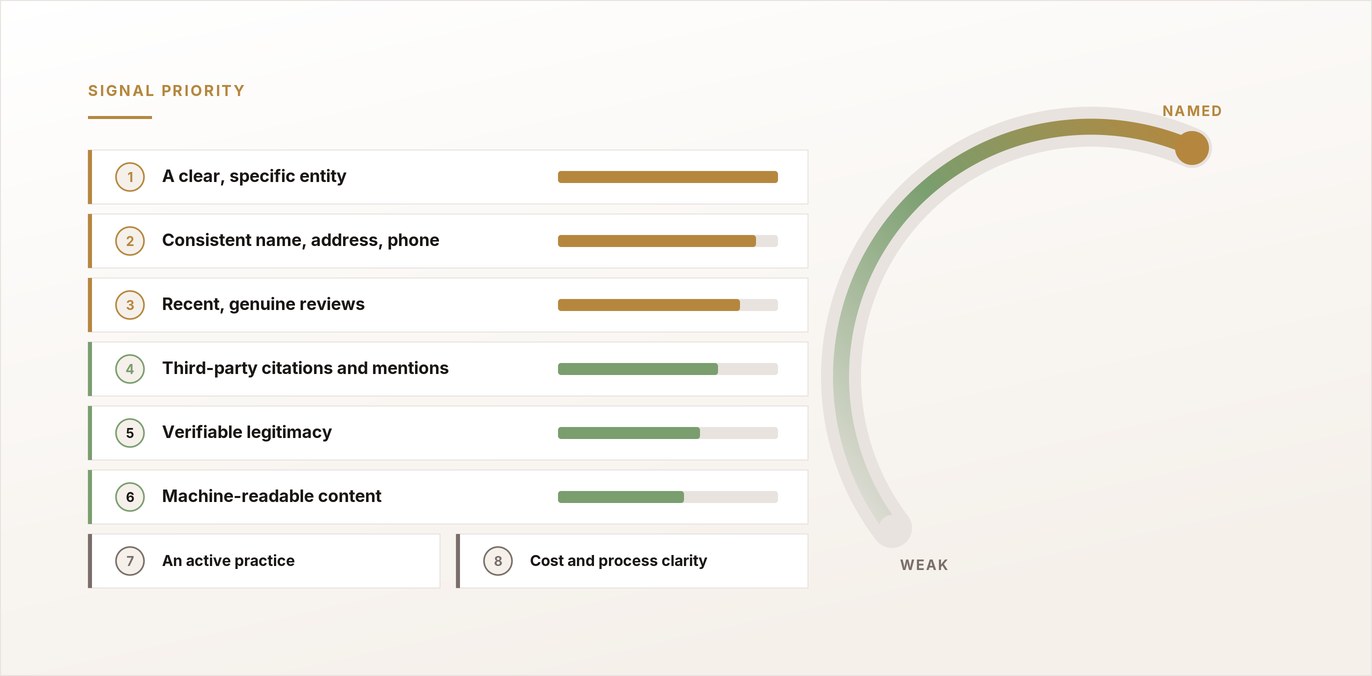
Eight signals decide whether an AI assistant names a dental practice, and three carry most of the weight: how clearly the practice is identified, whether its contact details match everywhere, and how recent its reviews are. That order follows Google's published local-ranking documentation. A KFF Tracking Poll published 25 March 2026 found that about a third (32%) of US adults now use AI for health information or advice (KFF, 2026). Practices that meet those fundamentals give a model enough confidence to put their name in an answer.
Ask ten agencies which signals get a dental practice recommended by AI and you will get ten confident lists: five signals here, seven trust signals there, ten review signals somewhere else. Almost none of them tell you where the list came from.
This article does the opposite. It names the top signals in priority order and ties each one to a published source you can read for yourself, so you are acting on evidence rather than on someone's house style.
The short answer, for anyone who wants it before the detail: the top signals are a clearly described entity (who you are, where you are, what you treat), consistent name, address and phone everywhere you appear, recent and genuine reviews with owner responses, third-party citations and mentions, verifiable legitimacy such as GDC registration, machine-readable content a search system can lift, an obviously active practice, and straightforward transparency about cost and process.
An AI tool recommends the practices it is most confident about, and those signals are what build the confidence. The rest of this guide takes each one in turn.
There is one truth underneath the whole list that no competing article states plainly, so here it is first: these signals are not secret AI magic. They are the same evidence-of-trust signals Google has published for local search for years, now feeding a second layer of visibility in AI answers. Get them right and you are not gaming a model, you are giving it every reason to name you.
What actually makes an AI recommend a dental practice?
An AI tool does not rank dentists one to ten the way the old map pack did. It recommends a short, confidence-weighted set, usually two or three names, sometimes one. So the real question is not "how do I rank first" but "what makes an assistant confident enough to put my name in the answer". The signals below are the inputs to that confidence.
This matters commercially in a way that is easy to underrate. A single implant typically runs in the region of £2,000 to £3,000 per tooth, a course of clear aligners commonly sits around £2,500 to £4,500, and a steady private patient on routine care can be worth several thousand pounds across the years they stay with you (these are illustrative, typical UK ranges, not researched figures).
When an assistant names two practices for "implant dentist near me" and yours is not one of them, you do not see a missed enquiry in any log. The patient simply books with a name the model trusted more. Sitting still while that happens is the quiet cost most owners never measure.
The demand is already here. A KFF Tracking Poll in 2026 found that about a third (32%) of US adults now use AI for health information or advice (KFF, 2026), and "find me a dentist" sits squarely inside that behaviour. Inside ordinary search, a Pew Research Center analysis of real browsing data found that 58% of US users ran at least one Google search in March 2025 that returned an AI-generated summary, and that when a summary appeared people very rarely clicked the sources beneath it (Pew Research Center, July 2025). When the answer names a short set and the patient acts on it without scrolling further, being in that set is the entire contest.
Where do these signals actually come from, and why trust this list?
Most "signals AI uses" articles assert a list from agency experience and leave it there. This list has a published spine, which is what makes it worth following.
The spine is Google's own local ranking framework. Google states that local results are based primarily on three things: relevance, distance and prominence, and that prominence is "based on info like how many websites link to your business and how many reviews you have" (Google Business Profile Help). That is the only published, first-party framework for how a local business earns visibility, and it maps cleanly onto what makes an assistant confident: relevance (a clear description of what you do and where), prominence (links, citations and reviews that prove you are well known and well regarded) and distance (location signals the model holds on to). To be precise about it, Google published this for its local search ranking, not as an "AI signals" list; it is used here as the verifiable analogue, because the evidence-of-trust an assistant looks for is the same evidence Google has always rewarded.
The second source is consumer review data. BrightLocal's Local Consumer Review Survey 2026 reports that AI tools such as ChatGPT have surged into third place as a source of local-business recommendations, and that reviews have become "worthy of prominent visibility and citation within traditional Google search and LLMs like ChatGPT, and AI search" (BrightLocal, 2026). That single source links reviews directly to AI recommendation in the publisher's own words, and it confirms why the work is urgent rather than optional.
So the test for everything that follows is simple. If a signal traces back to Google's published framework or to genuine consumer evidence, it earns its place. If it is only a number someone invented to sound authoritative, it does not appear here at all.
What are the top signals, in priority order?
Each signal below is a tight, sourced summary plus a pointer to the deeper article in this series. The aim is to give you the full map first, then let you dig where you have a gap.
Signal 1: a clear, specific entity, so the AI knows exactly what you do and where
This is relevance in Google's framework, and it comes first because nothing else lands without it. An assistant has to understand, without guessing, that you are a dental practice in a named place that offers named treatments. Vague "we care for your smile" copy gives a model nothing to match against a patient asking for "Invisalign in Reading" or "emergency dentist in Leeds". Specific, plainly written service and location detail is the foundation every other signal attaches to.
Get this right and the model can attribute your reviews, your citations and your listings to the correct practice rather than blurring you with a similarly named one two towns over. For the deeper treatment of describing distinct services so a model can tell them apart, see the article on specialist versus general service pages, and for marking the facts up in machine-readable form, the dental schema markup guide.
Signal 2: consistent name, address and phone everywhere you appear
This is the most boring signal and one of the most decisive. Your practice name, address, phone number and opening hours should read identically across your website, Google Business Profile, NHS listing and every directory. When they conflict, the model has to guess which version is true, and an assistant that is unsure tends to reach for a practice it is sure about instead. Two slightly different phone numbers or a stale set of opening hours is enough to tip a close call against you.
This sits under prominence and consistency in Google's framework, because the model is cross-checking sources for agreement before it trusts you. The full method for auditing and fixing it lives in the article on name, address and phone consistency, and it pairs closely with building the citations in Signal 4.
Signal 3: recent, genuine reviews, judged on rating, recency and responses
Reviews are a heavy lever, but the signal is not raw volume. BrightLocal's 2026 survey reports that 97% of consumers read reviews for local businesses and that 41% now "always" read them, a sharp jump from 29% the year before, with a marked move towards only using businesses rated 4.5 stars or higher (BrightLocal, 2026). The same research flags that star ratings and recency matter more than ever, and that slow or generic responses to reviews are ...are increasingly read as a red flag.

The practical reading is that a wall of five-star reviews from three years ago looks, to both patients and models, like a practice that may have gone quiet. Steady, recent reviews with thoughtful owner replies do more than a larger but older pile. Reply to everything, good and bad, but never put a patient's clinical detail in a public response: thank them, address the general point, and take specifics offline. For the volume-and-recency question in depth, see how many reviews you need for AI results, and for how reviews compare with other trust signals, reviews versus AI mentions.
Signal 4: third-party citations and mentions beyond your own site
A single website praising itself is the weakest possible signal. Confidence comes from being checked against other sources: the more independent, reputable places that confirm your practice exists, where it is and what it does, the more readily a model will name you. Google names this directly in its prominence factor, citing "how many websites link to your business", and BrightLocal's own language about reviews earning "citation within LLMs" points the same way (Google Business Profile Help; BrightLocal, 2026).
For a UK practice the citations that carry weight are your Google Business Profile, the NHS "find a dentist" service, reputable healthcare and local directories, genuine professional or accreditation listings, and local press. Each needs to exist, be accurate and agree with the rest. The full method for earning these is the article on building AI citations for dentists.
Signal 5: verifiable legitimacy and credentials
Trust models reward businesses that can be checked. For a UK dental practice the strongest legitimacy signal is GDC registration, alongside any genuine qualifications, memberships and accreditations you hold. Stating clearly that your clinicians are GDC-registered, and naming the qualifications behind a treatment, gives a model something solid to stand behind when it decides whether to recommend you for a procedure that carries real clinical weight.
This is the signal the generic "trust signals" lists call verifiable legitimacy, made specifically dental. It is also a compliance point, not only a visibility one, which is why it appears again in the section on staying inside GDC rules. For how credentials feed wider trust, see the article on experience, expertise, authority and trust for dentists.
Signal 6: machine-readable, answer-first content with schema
Relevance is only useful if a machine can read it. Content that answers a real patient question directly, in plain language, near the top of the page, is far easier for an assistant to lift than the same information buried three paragraphs into marketing copy. Schema markup is the label that removes the last scrap of ambiguity, telling a search system in terms it cannot misread that you are a dentist, where you are, what you offer and how patients rate you.
A note worth carrying: FAQ markup no longer earns a rich result in Google (the badge was retired in May 2026), so add it for clarity and for AI extraction rather than for a SERP feature. The depth is in the dental schema markup guide and the article on FAQ pages that get cited.
Signal 7: an obviously active practice
Models favour businesses that are demonstrably still operating and engaged. Fresh reviews arriving steadily, current opening hours, recent posts and an up-to-date "accepting new patients" status all read as signs of life. A profile that has not changed in a year reads as one that might have closed, and an assistant has little reason to risk recommending a practice it cannot confirm is still trading.
This is recency as a freshness signal rather than as a one-off task. It overlaps with Signal 3, because a stream of recent reviews is one of the clearest activity signals you can send, and it connects to how location and currency feed ranking, covered in how AI ranks dentists near me.
Signal 8: transparency on cost, process and what to expect
Publishing straightforward, specific information about treatment cost, process and what a patient should expect does double duty. It answers the exact questions patients put to assistants ("how much is Invisalign", "what happens at an implant consultation"), and it reads as the kind of straightforward, non-evasive content that builds trust. Indicative price ranges, a plain description of each step, and clear aftercare detail all give a model concrete, useful facts to repeat.
This is a relevance win and a trust win at once, and it is squarely GDC-safe provided the information is accurate and free of superlatives. It rounds out the list because it is the signal most practices have the easiest time improving immediately.
The signals at a glance
| # | Signal | What it is | Anchored to | Go deeper |
|---|---|---|---|---|
| 1 | Clear, specific entity | Who you are, where, what you treat | Google relevance | Specialist vs general; schema |
| 2 | Consistent name, address, phone | The same details everywhere | Google prominence and consistency | NAP consistency |
| 3 | Recent, genuine reviews | Rating, recency and responses, not just volume | BrightLocal 2026 | Reviews vs AI mentions; how many reviews |
| 4 | Third-party citations and mentions | Links and listings beyond your site | Google prominence; BrightLocal | AI citations for dentists |
| 5 | Verifiable legitimacy | GDC registration, genuine credentials | Trust and legitimacy | E-E-A-T for dentists |
| 6 | Machine-readable content and schema | Answer-first pages a machine can read | Google relevance and clarity | Schema guide; FAQ pages |
| 7 | An obviously active practice | Fresh reviews, posts and current details | Recency and activity | How AI ranks dentists near me |
| 8 | Transparency on cost and process | Published prices, process and expectations | Relevance and trust | This article |
Which signals matter most, and which do owners over-invest in?
Not all eight carry equal weight, and the straightforward hierarchy follows Google's framework rather than any vendor's preferences. Entity clarity (Signal 1), consistency (Signal 2) and recent reviews (Signal 3) are the foundation.
Get those wrong and nothing above them rescues you, because the model cannot confidently work out who you are, cannot reconcile your conflicting details, and reads stale reviews as a quiet practice.
Citations and schema (Signals 4 and 6) are amplifiers. They are powerful once the foundation is solid, and close to wasted before it is. This is where owners most often misallocate effort: pouring money into directory listings while their NAP details still conflict, or adding elaborate schema to pages that say nothing specific. The structured markup faithfully describes vague content as vague. Fix the foundation first, then amplify.
The two signals owners most often neglect are legitimacy (Signal 5) and transparency (Signal 8), both of which are cheap to improve and disproportionately trusted. Stating GDC registration and publishing straightforward treatment information costs almost nothing and gives a model real, checkable facts. Chasing review volume alone, by contrast, is the classic over-investment: a thousand reviews mean little if they are old, unanswered, or attached to an entity the model cannot pin down.
How do the signals work together as one system?
The signals are not a checklist of independent boxes; they reinforce each other, which is why partial work underperforms. A consistent entity (Signals 1 and 2) is what lets a model attribute your reviews and citations to the right practice in the first place. Those reviews and citations (Signals 3 and 4) then build the prominence Google names as a ranking factor. Schema and answer-first content (Signal 6) make all of it legible, so the model does not have to infer what it can simply read. Legitimacy and transparency (Signals 5 and 8) give the whole picture credibility, and visible activity (Signal 7) confirms it is current.
The practical consequence is that the practice with a solid foundation across every signal beats the one that has done a single thing brilliantly. An assistant assembles its recommendation from agreement across sources, so the win goes to the practice whose signals all point the same way, not to the loudest single channel.
How do you stay inside GDC rules while doing this?
Everything above is compatible with regulation when done plainly, and the moves that win an AI recommendation are largely the same ones the General Dental Council already requires. The relevant rule is standard 1.3.3, which states that "you must make sure that any advertising, promotional material or other information that you produce is accurate and not misleading, and complies with the GDC's guidance on ethical advertising" (General Dental Council, Standards for the Dental Team). That governs your website, your Google profile, your listings and the reviews you solicit.
Three points keep you safe. First, GDC registration is your legitimacy signal, so state it plainly rather than dressing it up. Second, reviews must be genuine and never incentivised, gated or fabricated, and your public replies must never disclose clinical detail. Third, transparency content stays factual: publish straightforward price ranges and process descriptions, and avoid superlatives such as "best", "painless" or "cheapest", which are both unverifiable claims the GDC's rule is built to catch and claims a model cannot responsibly repeat. The reassuring part is that accurate, specific, non-boastful content is exactly what an assistant prefers anyway.
How do you check which signals your practice is sending?
You can audit all eight today, free, in about fifteen minutes. Work down the list:
- Entity and recommendation. Ask ChatGPT, Perplexity and Google's AI Mode the questions a patient asks ("best dentist in [your town] for implants", "emergency dentist near me today") and note whether you are named, where, and which sources the reply leans on.
- Consistency. Check that your name, address, phone and hours match exactly across your website, Google profile, NHS listing and the main directories you appear in.
- Reviews. Read your own recent reviews for recency, specificity and whether you have replied; look for the 4.5-star threshold consumers increasingly apply.
- Legitimacy and transparency. Confirm GDC registration is stated, and that each main treatment has a straightforward cost and process description.
- Machine-readability. Confirm your key pages carry the right schema and answer their headline question near the top.
Every gap you find is a signal you are not currently sending, and therefore a reason a model is naming someone else for your town's dental queries.
Priority matters more than completeness here, so tackle these in sequence rather than all at once. Get your entity unmistakable first: state clearly who you are, where you are and what you treat, and mark it up so a machine can read it. Next, bring your name, address, phone and hours into exact agreement everywhere you appear. Only once those two hold does a steady habit of recent, genuine reviews with thoughtful, confidentiality-safe replies start paying off. Handled in that order, the three cover most of the distance from "the model has never heard of you" to "the model names you with confidence", and none of them strays outside GDC rules.
A QBiz AI Visibility audit exists for practices that want to see exactly which of these signals they already send, and which gaps are keeping them out of the AI answer for their town. We check each signal against the questions new patients actually ask the assistants, show where you are named and where a competitor is named instead, and hand back a prioritised, GDC-safe list of what to fix. From there QBiz works both sides: tightening entity, schema, answer-first content and transparency on your own site, and getting your practice consistently described and cited across the listings, profiles and third-party sources the models lean on. None of that groundwork requires any spend to begin.
Get your AI Visibility check →
Frequently asked questions
What is the single most important signal for getting recommended by AI?
There is no single one. Entity clarity, consistent details and recent genuine reviews are the foundation that everything else builds on, and they map directly to Google's published relevance and prominence factors. A practice that nails those three before adding citations and schema will out-perform one that has done a single thing brilliantly while neglecting the basics.
Can I pay to get my dental practice recommended by ChatGPT?
No. AI recommendation has no purchase path: nothing you pay buys a name in the answer, unlike a search ad that buys a slot above the results. A claim to the contrary is false on its face. What earns the recommendation is being the practice the model can verify and describe with the least guesswork.
Do reviews really affect whether AI recommends my practice?
Yes. BrightLocal's 2026 research describes reviews as "worthy of prominent visibility and citation within traditional Google search and LLMs like ChatGPT, and AI search", and places AI third among sources people use for local recommendations. Recency, rating and your responses matter more than raw volume.
Does schema markup help AI recommend a dentist?
It helps a model read you clearly, which is a relevance and clarity signal rather than a direct ranking lever. Schema makes your true facts machine-legible. Note that FAQ markup no longer earns a Google rich result, so add it for clarity and AI extraction, not for a SERP badge.
How long until these signals get my practice recommended by AI?
There is no fixed timeline. Completing your profile and gathering recent reviews can shift things within weeks; building citations and earning enough confirming detail to be named confidently usually takes a few months. The work compounds, so consistency over time beats any single push.
Is GDC registration a ranking signal for AI?
It functions as a verifiable-legitimacy signal: stating GDC registration gives a model a checkable fact that supports trust. It is also a compliance requirement rather than an optional extra, so it is worth making explicit on your site regardless.